
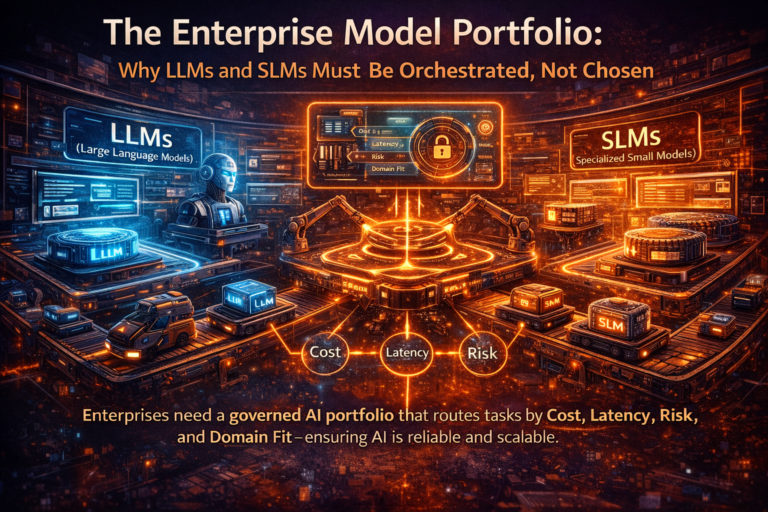
The Enterprise Model Portfolio
“Enterprises don’t fail at AI because models aren’t smart enough—they fail because intelligence isn’t operated like a portfolio.”
Enterprise AI leaders are being asked a deceptively simple question:
“Which model are we using?”
It sounds like a procurement decision: choose a frontier LLM, standardize, negotiate pricing, and ship.
But in 2026, that mindset quietly breaks—because the real enterprise problem is no longer access to intelligence. It’s operating intelligence: reliably, securely, and economically, across dozens of workflows, regions, risk profiles, and user populations.
That’s why the next enterprise AI capability isn’t “model selection.” It’s model orchestration.
Enterprises will run a portfolio of models—frontier LLMs plus specialized smaller models—and route work between them like a managed supply chain. This isn’t just a conceptual shift; Gartner has predicted that by 2027, organizations will use small, task-specific AI models at least three times more than general-purpose LLMs (by volume). (Gartner)
So the question that matters is not “LLM or SLM?”
It’s:
How do we build an enterprise model portfolio that routes tasks to the right model—with governance, cost control, and reliability?
This article is a practical, vendor-neutral guide to that answer, written for CIOs, CTOs, enterprise architects, and AI engineering leaders.
“Enterprises don’t fail at AI because models aren’t smart enough—they fail because intelligence isn’t operated like a portfolio.”
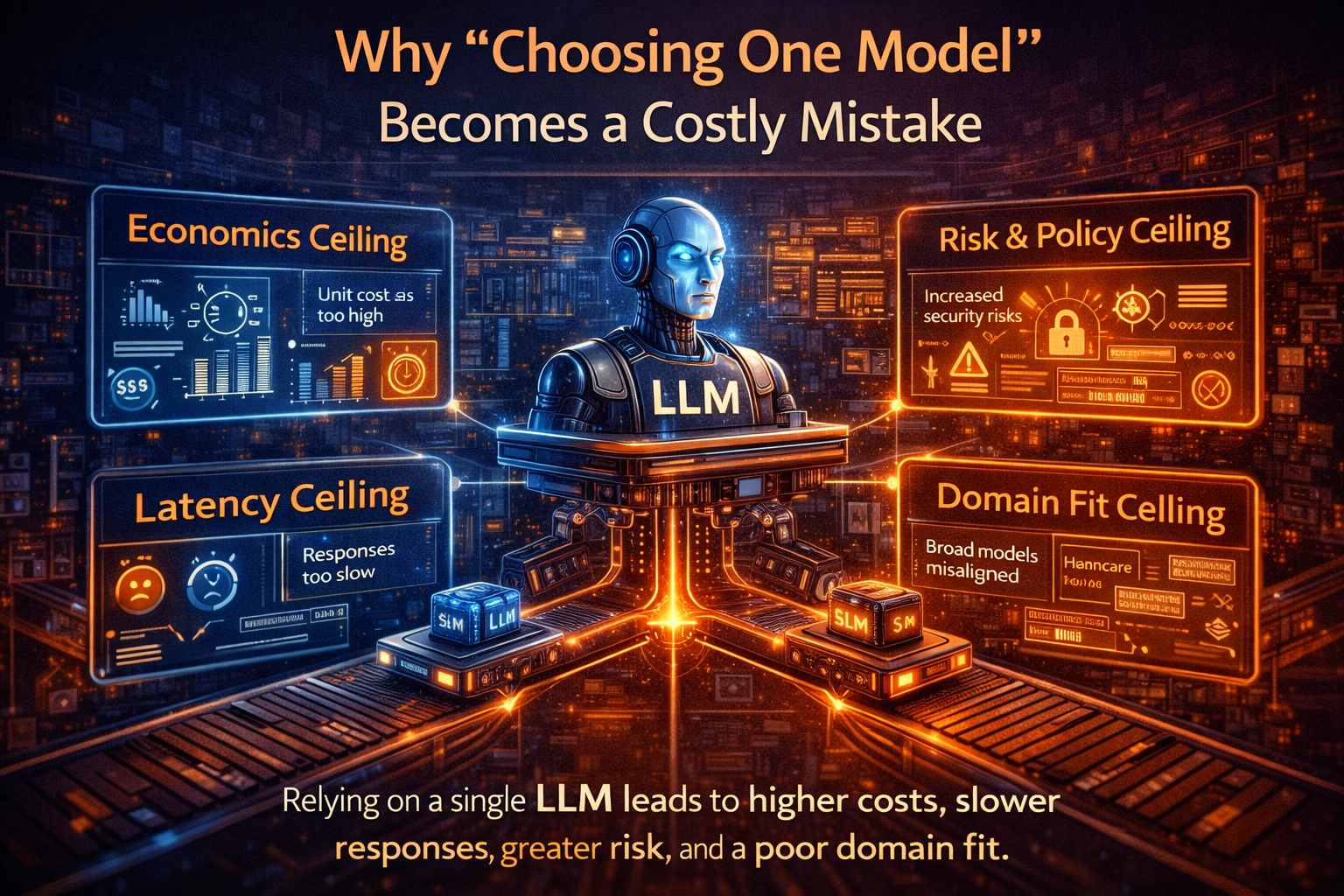
Why “Choosing One Model” Becomes a Costly Mistake
If you standardize on a single frontier LLM, you will eventually hit four predictable ceilings.
1) The economics ceiling
Frontier LLMs are powerful—but they’re not the cheapest way to solve the majority of enterprise tasks.
Many enterprise interactions are routine:
- classification (what is this request?)
- extraction (what fields are missing?)
- routing (which queue/team should handle it?)
- summarizing short text (what happened?)
- templated drafting (produce a compliant reply)
- policy lookup and response scaffolding (what does the policy say?)
Using a frontier model for all of this is like using a heavy industrial machine for every small job. It works—but unit economics get crushed.
2) The latency ceiling
Enterprise AI is increasingly embedded in operational workflows—customer support, internal ticketing, procurement approvals, IT incident triage. These workflows have human attention windows: if the system is slow, people stop trusting it and revert to old behavior.
Smaller language models are often positioned as a way to reduce latency and improve responsiveness for specific tasks; IBM, for example, highlights lower latency as a practical advantage of SLMs due to fewer parameters. (IBM)
3) The risk and policy ceiling
As AI becomes more agentic—able to trigger actions and influence decisions—governance and security requirements intensify.
LLMs can introduce security risks through issues like prompt injection and data leakage pathways when not controlled. (Wall Street Journal)
The risk is amplified when one model becomes the “default brain” across every workflow: one set of failure modes gets replicated everywhere.
4) The domain-fit ceiling
General-purpose LLMs are broad. Enterprises are narrow—industry terms, internal policy language, proprietary processes, regulated constraints.
Task-specific models can be more controllable and better aligned to a domain, which is part of the shift Gartner describes toward small, task-specific models. (Gartner)
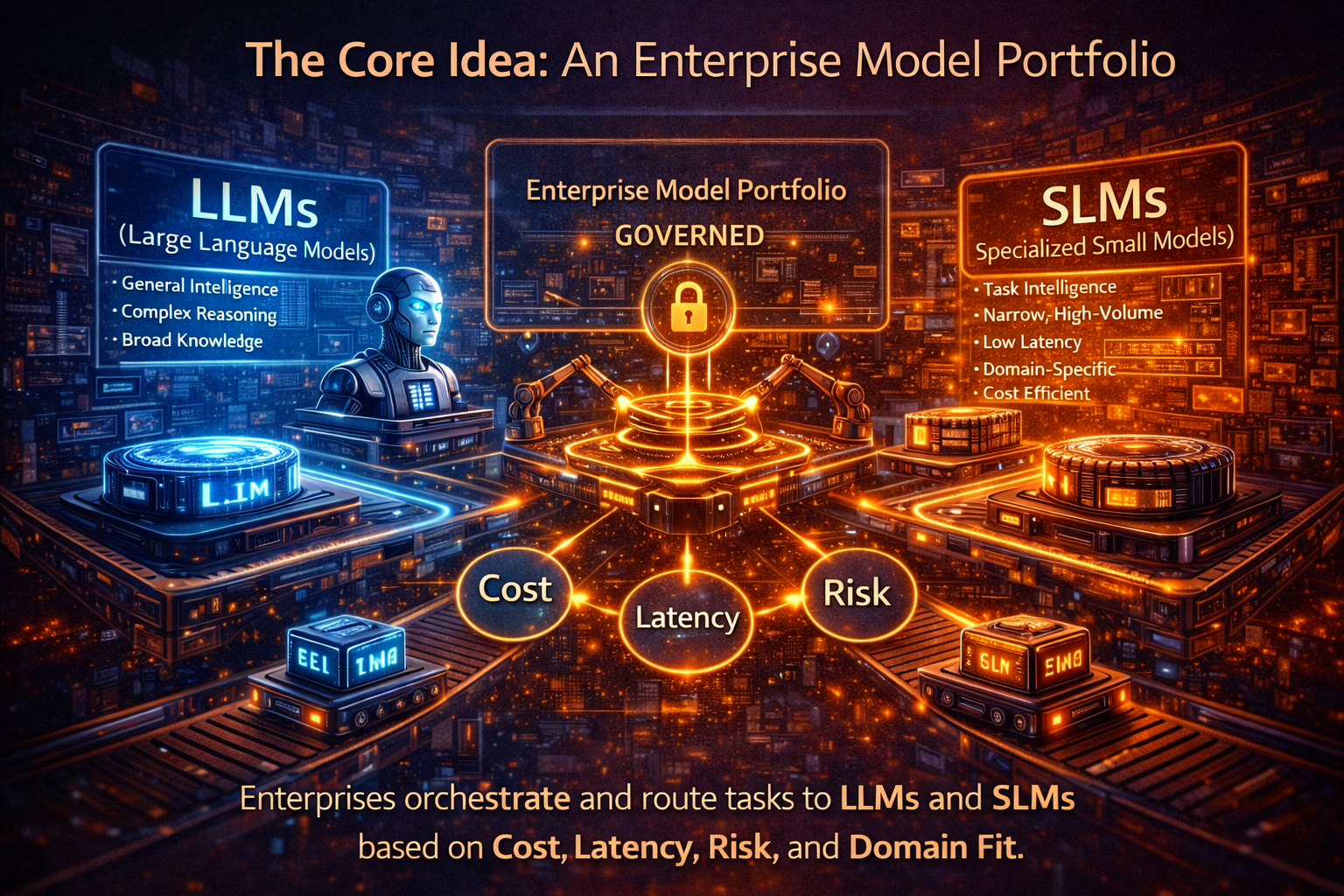
The Core Idea: An Enterprise Model Portfolio
Think of enterprise AI like an airline or logistics network.
You don’t run every route with the same aircraft.
You match the vehicle to the job.
Similarly, an enterprise model portfolio typically includes:
-
A) Frontier LLMs (general intelligence)
Best for:
- complex reasoning across messy inputs
- multi-step planning and synthesis
- ambiguous requests requiring broad knowledge
- high-variance tasks (new problems)
-
B) Specialized SLMs (task intelligence)
Best for:
- narrow, high-volume workflows
- low-latency experiences
- controlled outputs (consistent format, bounded behavior)
- domain-specific language and internal terminology
- certain privacy-sensitive or constrained deployments (depending on hosting and architecture)
The strategic implication is simple:
Your enterprise AI stack should treat models as a portfolio, not a single decision.
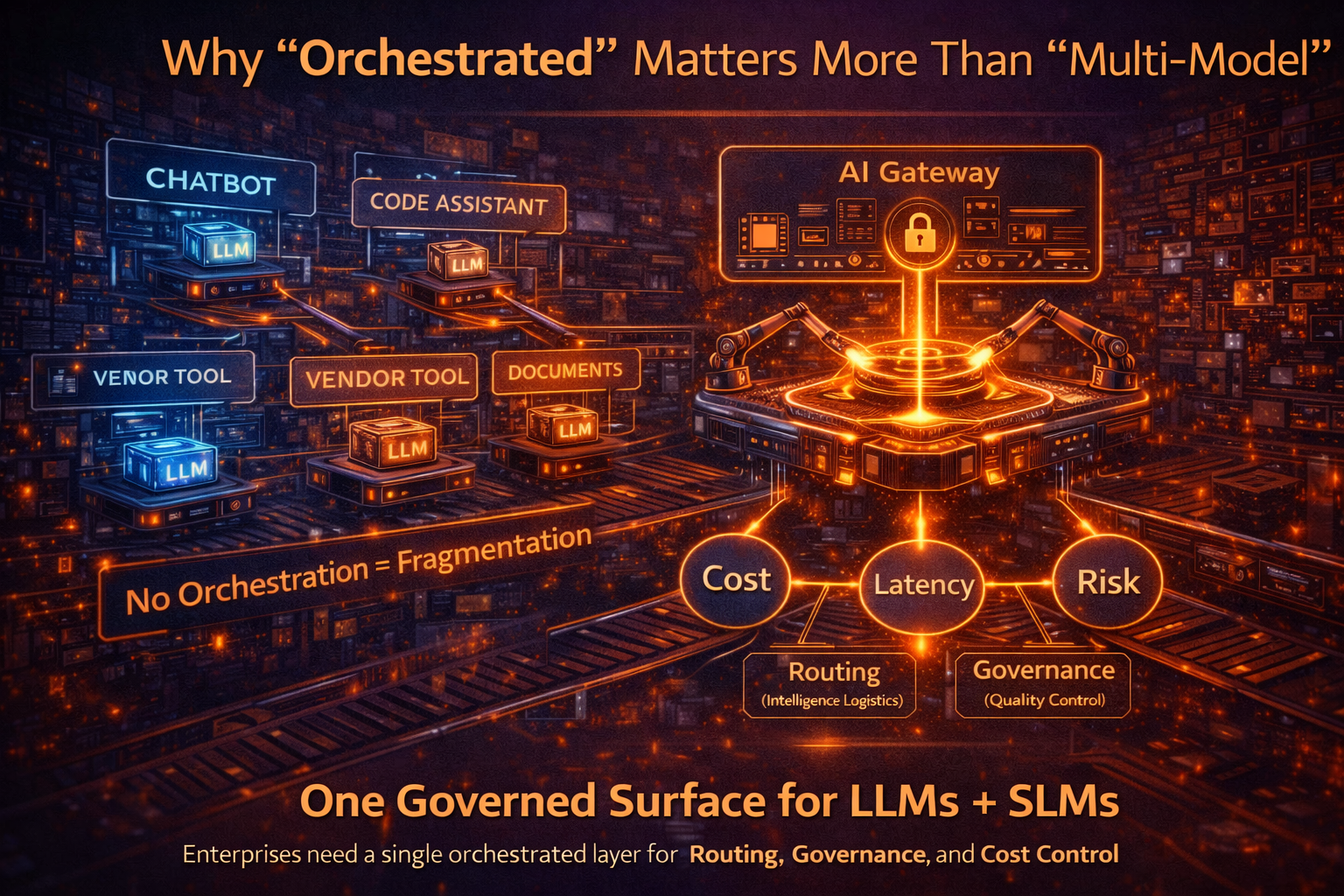
Why “Orchestrated” Matters More Than “Multi-Model”
Many enterprises already use multiple models—often accidentally:
- one model in the chatbot
- another in the coding assistant
- another in a vendor tool
- another in a document workflow
But that’s not a portfolio. That’s fragmentation.
A portfolio becomes real only when you orchestrate it with three disciplines.
1) Routing: the intelligence logistics layer
You need a mechanism that decides, per request:
- which model to use
- what context to include
- what tools are allowed
- what risk level applies
- what fallback should happen if the model fails
This is why “AI gateways” / “LLM gateways” are emerging: a thin layer that proxies requests to multiple model providers, centralizes authentication/RBAC, applies rate limits and guardrails, supports load balancing/failover, and captures observability and cost data. (TrueFoundry)
2) Governance: the quality control layer
Enterprises need consistent enforcement across models:
- safety policies
- data handling rules
- audit trails
- redaction and PII controls
- permissioning and action constraints
Without governance, a multi-model strategy becomes a multi-risk strategy.
3) Economics: the unit cost layer
A portfolio is not just about capability—it’s about predictable unit economics.
That means:
- monitoring token usage and latency
- enforcing budgets per workflow
- caching repeated context where appropriate
- routing simpler tasks to cheaper, faster models
Prompt caching is one concrete production technique. Amazon Bedrock documents prompt caching as a feature to reduce inference latency and input token costs by avoiding recomputation for repeated prompt portions. (AWS Documentation)
Google also documents caching approaches for repeated content in Vertex AI / Gemini contexts to reduce cost and latency. (Google Cloud Documentation)
“The smartest enterprise AI strategy isn’t picking the best model—it’s routing work to the right one.”
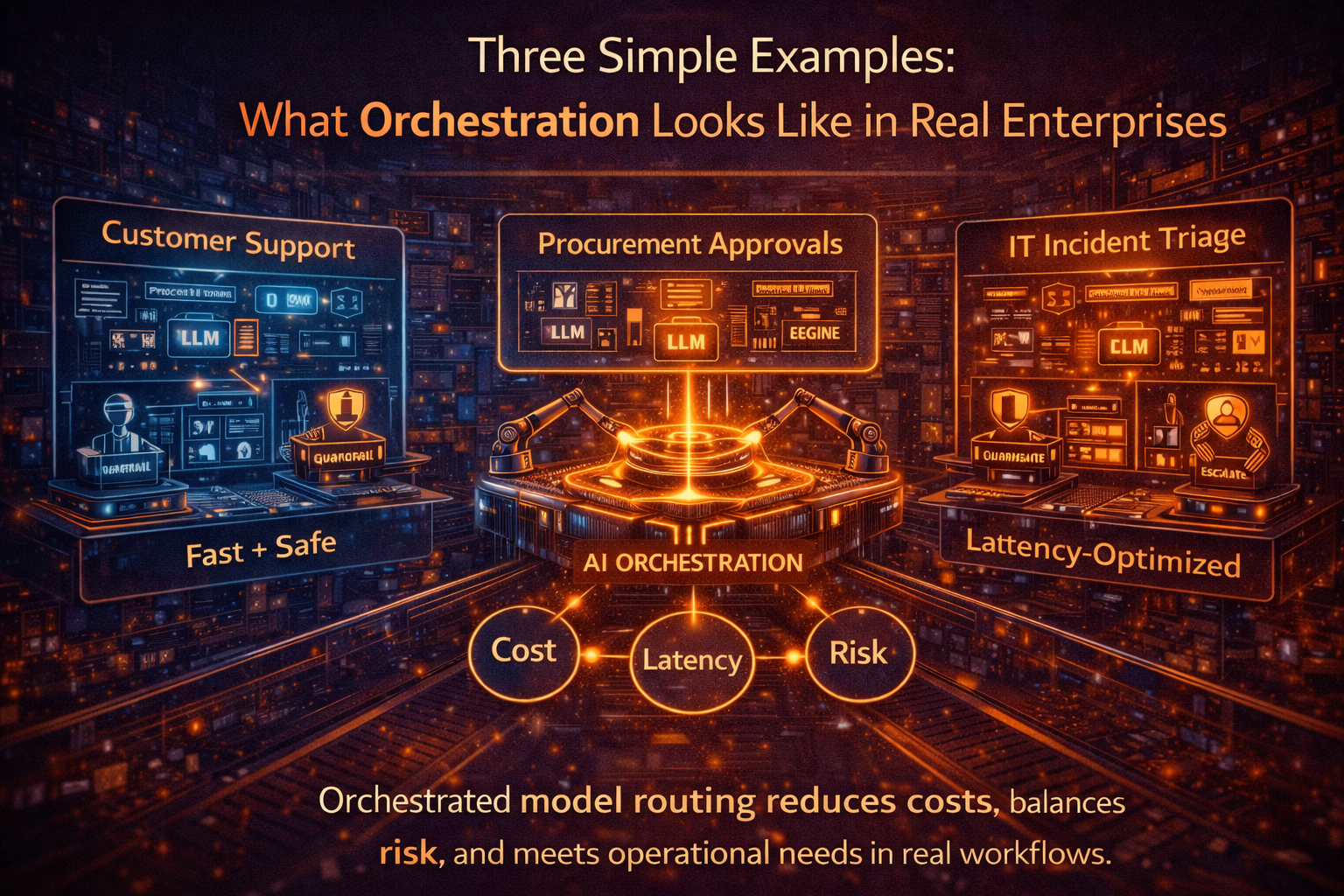
Three Simple Examples: What Orchestration Looks Like in Real Enterprises
Example 1: Customer Support — speed + tone + policy
A customer support workflow might route like this:
- An SLM classifies intent (“billing issue,” “account access,” “product question”) fast
- An SLM extracts key fields (customer ID, product, date, issue type)
- A frontier LLM drafts a high-quality response grounded in customer history and approved knowledge
- A guardrail layer checks policy constraints (no over-promising, no sensitive data)
- Fallback: if confidence is low, escalate to a human agent
Outcome: fast handling where it’s safe, and deeper reasoning where it’s necessary.
Example 2: Procurement approvals — risk-based routing
For purchase approvals:
- An SLM checks whether the request fits approved category + threshold
- An SLM validates required fields are present
- A frontier LLM is invoked only when the request is ambiguous (“justify exception,” “compare alternatives”)
- A policy engine enforces approval routing and logs evidence
Outcome: the expensive model is used for the minority of cases where ambiguity is real.
Example 3: IT incident triage — latency matters under pressure
During incident response:
- An SLM summarizes logs and classifies incident type quickly
- A frontier LLM synthesizes across multiple signals when the case is complex
- Tool permissions limit what any model can do automatically
- Escalation rules trigger human approval for risky changes
This “engineered for control” mindset is increasingly important as agentic AI expands; Gartner has predicted that over 40% of agentic AI projects may be canceled by 2027 due to escalating costs, unclear business value, or inadequate risk controls. (Gartner)
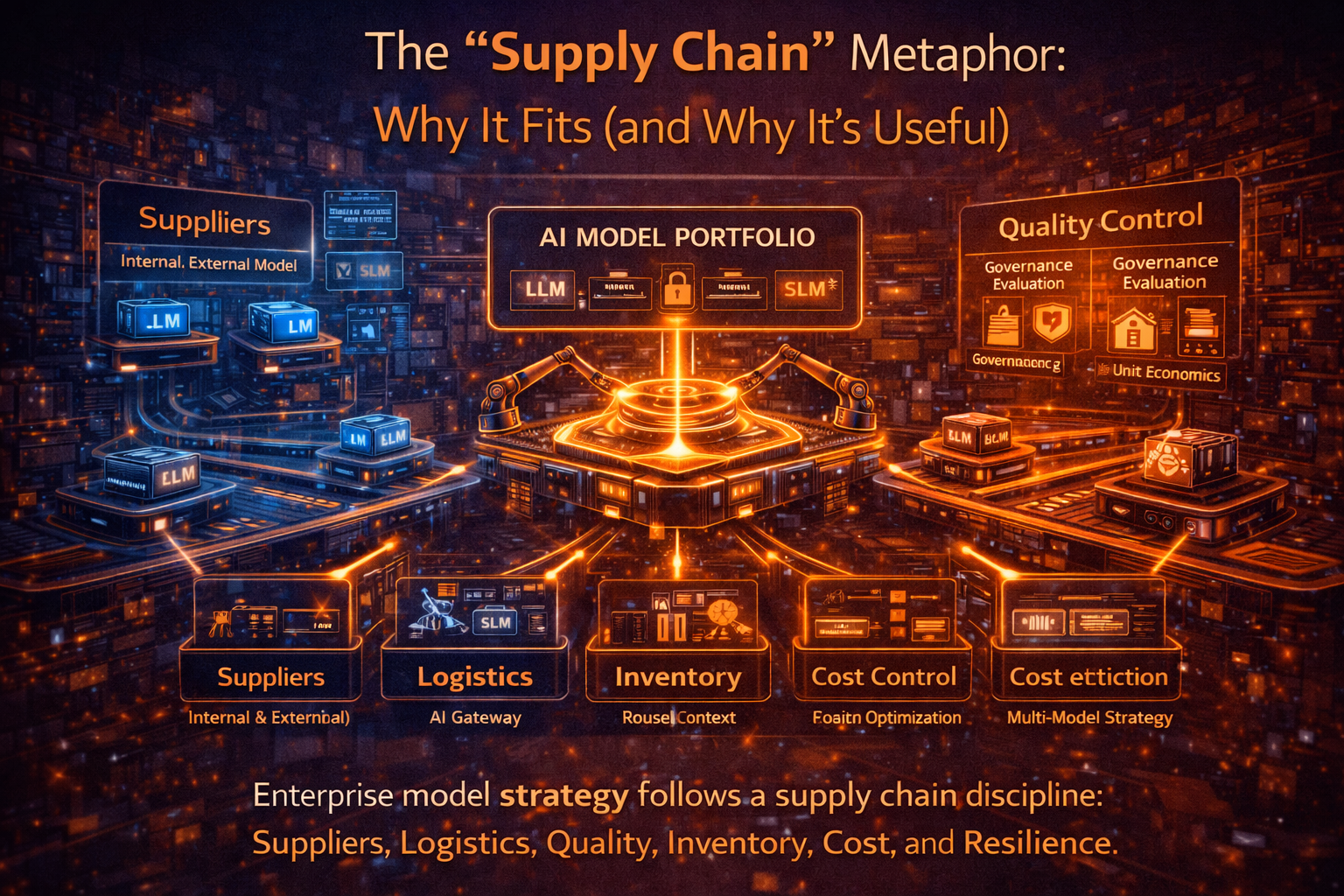
The “Supply Chain” Metaphor: Why It Fits (and Why It’s Useful)
Calling this a “supply chain” isn’t gimmick language. It’s operationally useful.
A supply chain has:
- suppliers
- routing and distribution
- quality checks
- inventory and caching
- cost controls
- resilience planning
- observability and incident response
Your enterprise model portfolio needs the same.
Suppliers = model providers (and internal models)
You may use:
- external frontier LLMs
- internal fine-tuned SLMs
- domain models from vendors
- specialized models for safety tasks (classification, redaction)
Logistics = routing layer
An AI gateway becomes your logistics system: selecting and dispatching the right model per request, with consistent policy and telemetry. (TrueFoundry)
Quality control = governance and evaluation
You need consistent checks:
- safety and policy adherence
- hallucination risk management
- output format validation
- audit traces
Inventory = caching and reusable context
In high-volume enterprise workflows, repeated context is common (policies, manuals, templates). Prompt/context caching is increasingly formalized in major platforms to reduce latency and cost. (AWS Documentation)
Resilience = fallbacks and multi-provider strategy
If one model is unavailable or slow, the router can:
- route to a backup model
- degrade gracefully (summarize instead of synthesize)
- ask a clarifying question rather than hallucinate
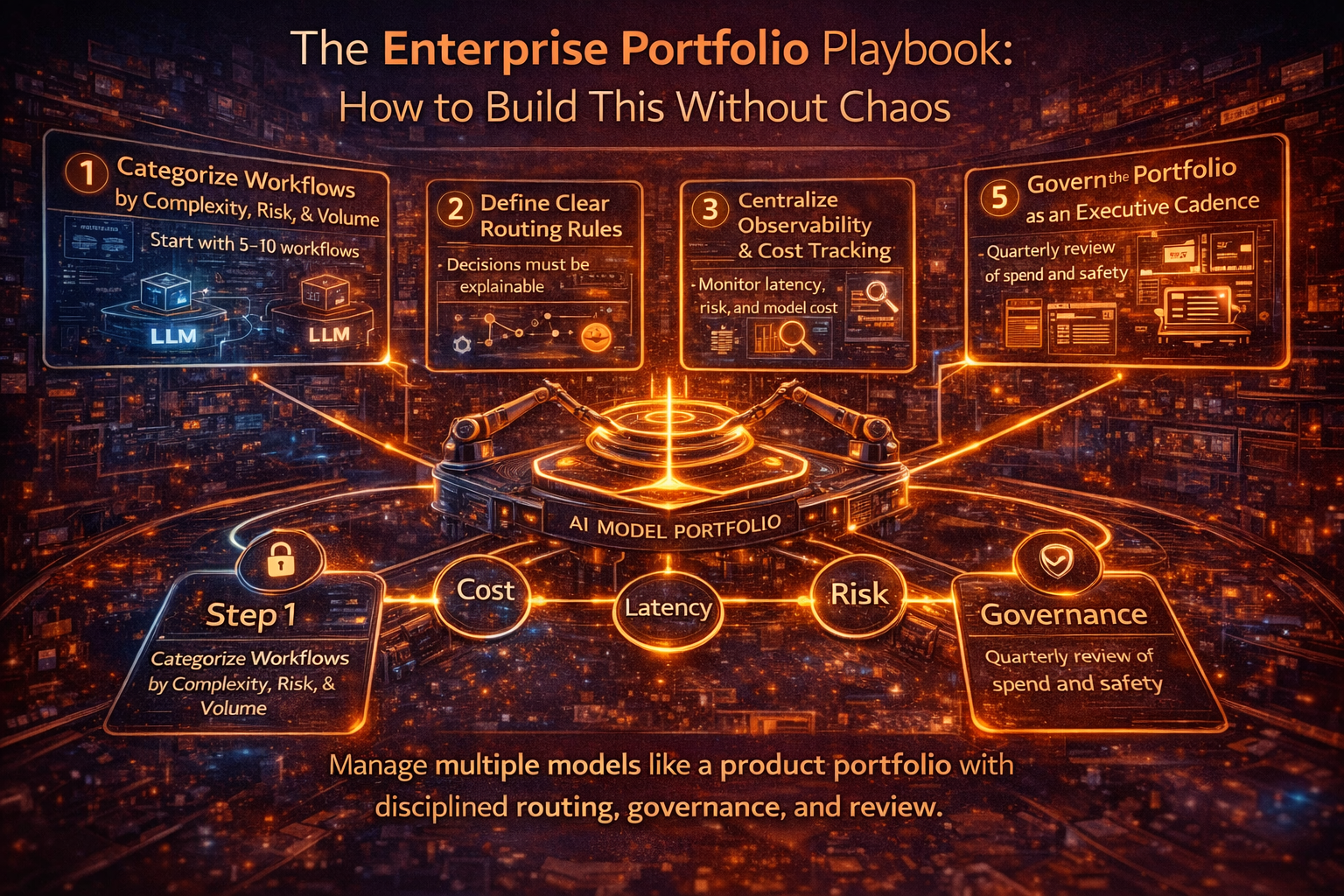
The Enterprise Portfolio Playbook: How to Build This Without Chaos
The Enterprise Portfolio Playbook: How to Build This Without Chaos
Step 1: Categorize workflows by complexity, risk, and volume
Start with 5–10 workflows, not 50.
Ask:
- Is this high volume?
- Does latency matter?
- Is the task narrow or broad?
- What is the blast radius of mistakes?
High-volume + narrow tasks are SLM-friendly.
High-ambiguity tasks often need frontier LLM capacity.
Step 2: Define routing rules that are easy to explain
Your routing strategy must be explainable to executives and auditors.
Simple explanations scale:
- “We use small models for classification and extraction.”
- “We use frontier models only for complex synthesis.”
- “We block actions unless confidence and permissions are sufficient.”
Step 3: Centralize observability and cost accounting
If you can’t see latency, token usage, error rates, safety incidents, and routing outcomes, you don’t have a portfolio—you have guesses.
This is a core rationale behind AI gateways: centralizing observability and policy enforcement across providers and models. (TrueFoundry)
Step 4: Build a model lifecycle, not just deployments
Models change frequently: versions, behavior shifts, new releases.
So you need:
- versioning policies
- regression evaluation
- rollback capability
- change approvals for critical workflows
Step 5: Establish portfolio governance as an executive cadence
Treat the model portfolio like a product portfolio:
- quarterly review of performance and spend
- model changes and deprecations
- safety incidents and learnings
- new workflow onboarding priorities
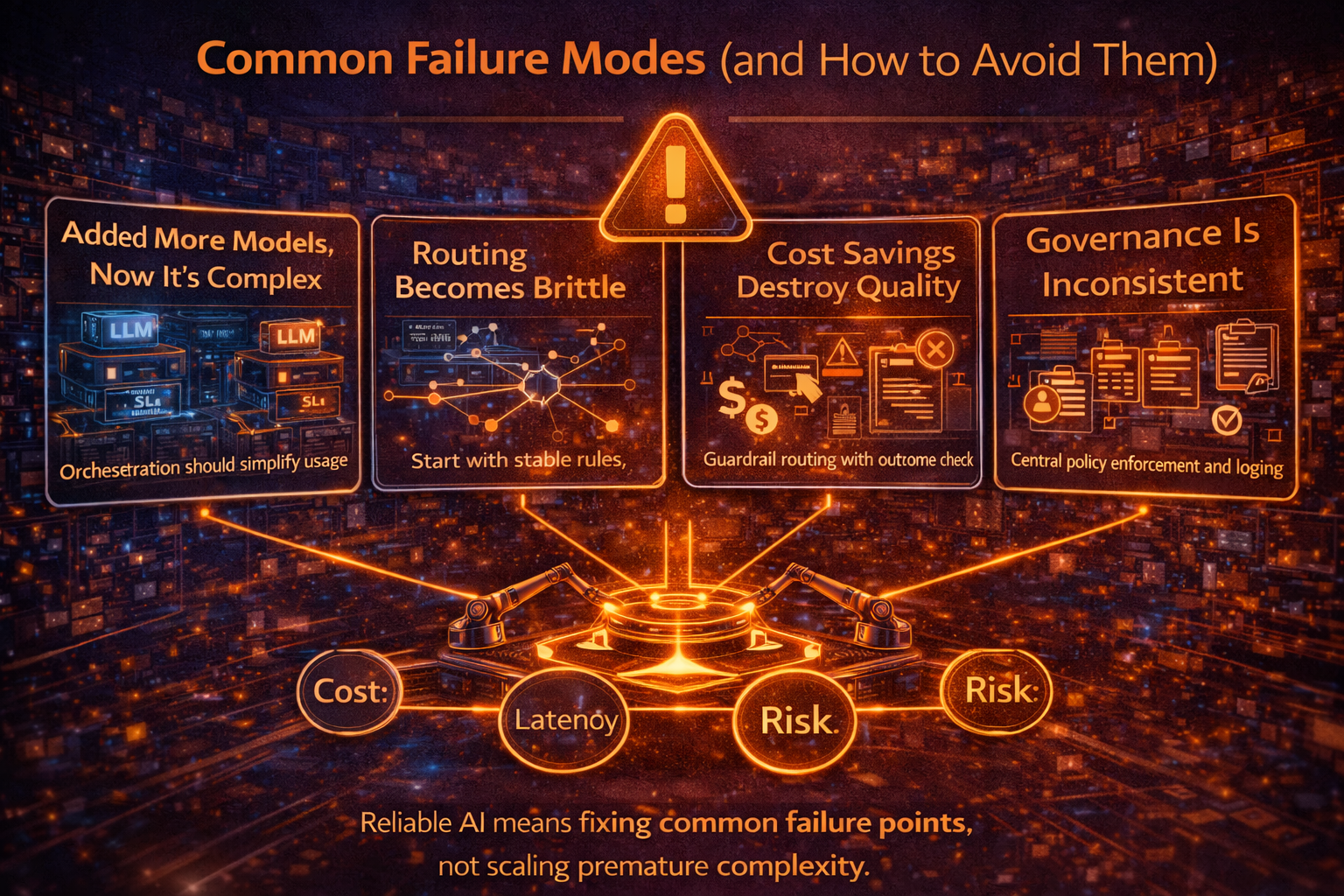
Common Failure Modes (and How to Avoid Them)
Failure mode 1: “We added more models—now it’s more complex”
Fix: orchestration must simplify usage for app teams. One interface. One policy layer. One observability surface.
Failure mode 2: Routing becomes brittle
Fix: start with stable rules, expand gradually, and design fallbacks.
Failure mode 3: Cost savings destroy quality
Fix: don’t route only by price—route by risk and complexity, and monitor outcomes.
Failure mode 4: Governance becomes inconsistent across models
Fix: centralize policy enforcement and logging. Treat governance as the portfolio backbone.
Stop choosing models. Start orchestrating a portfolio.
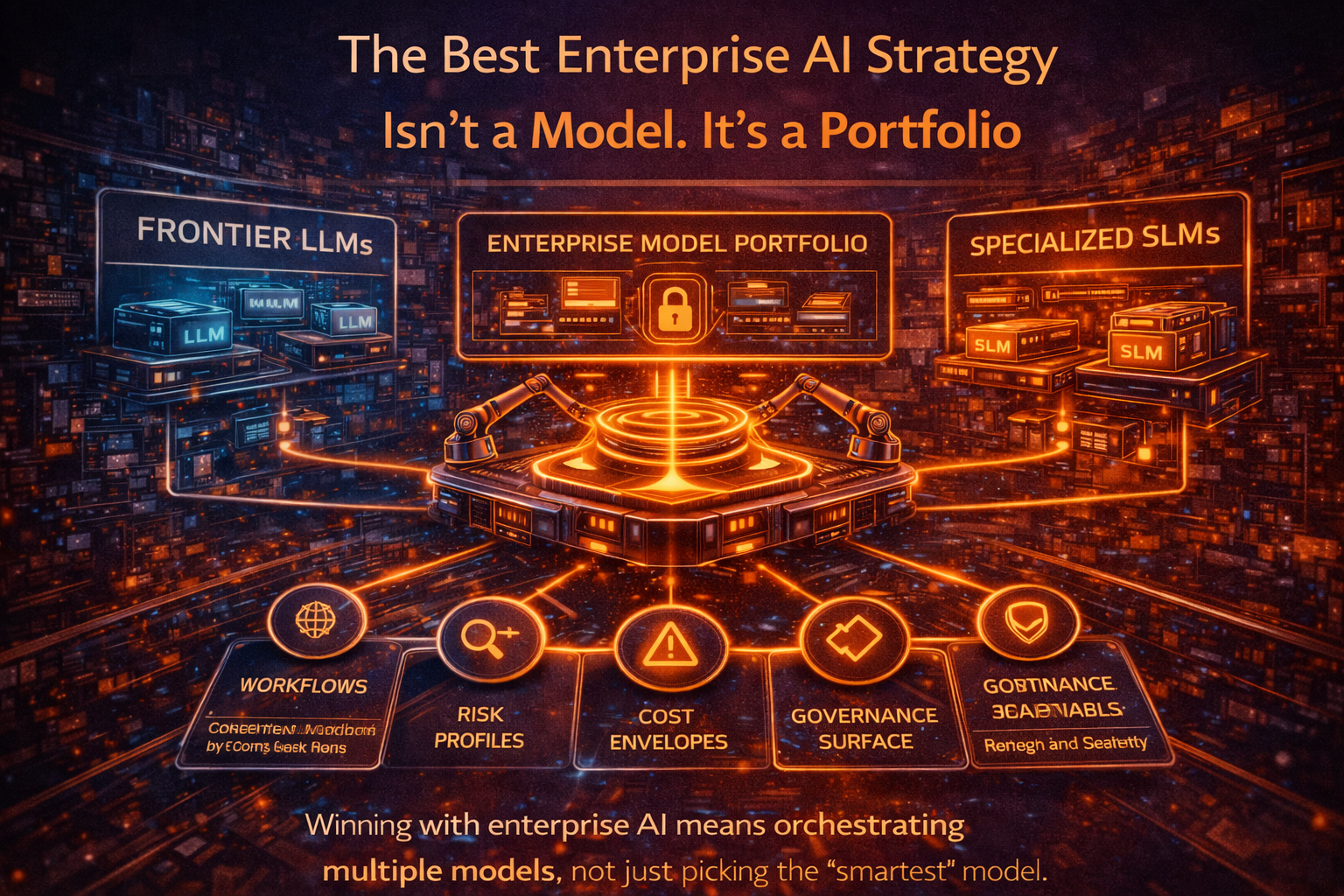
Conclusion: The Best Enterprise AI Strategy Isn’t a Model. It’s a Portfolio.
In the early phase of enterprise AI, success looked like picking a model and launching a chatbot.
In the next phase, success looks different:
- multiple workflows
- multiple risk profiles
- multiple cost envelopes
- multiple models
- one governance surface
- one routing layer
- predictable unit economics
- reliable operational performance
The enterprises that win won’t be the ones that chose the “smartest” model.
They’ll be the ones that built the best enterprise model portfolio—where frontier LLMs and specialized SLMs are orchestrated, governed, and routed like a well-run supply chain.
That is how AI becomes not just impressive—but indispensable.
Glossary
Enterprise Model Portfolio: A managed set of AI models (LLMs + SLMs + specialized models) used across workflows with routing, governance, and cost controls.
LLM (Large Language Model): A general-purpose model with broad capabilities, often used for complex synthesis and reasoning tasks.
SLM (Small Language Model): A smaller, task-focused model often used for faster, cheaper, and more controlled workflows; often associated with lower latency due to fewer parameters. (IBM)
Model Orchestration: The system-level approach of routing tasks to models, enforcing policies, managing context, and handling fallbacks.
Model Routing: Selecting the best model per request based on complexity, risk, latency, and cost.
AI Gateway / LLM Gateway: A centralized layer that proxies requests to multiple model providers or self-hosted models, centralizes auth/RBAC, applies guardrails/rate limits, supports failover, and captures observability and cost data. (TrueFoundry)
Prompt Injection: A security attack technique that attempts to manipulate a model into following malicious instructions or revealing sensitive data. (TechRadar)
Prompt/Context Caching: A technique to reuse repeated content across requests, reducing latency and cost by avoiding recomputation. (AWS Documentation)
Fallback Strategy: A controlled downgrade path when a model fails, is slow, or returns low-confidence/unsafe outputs.
FAQ
1) Why can’t enterprises just standardize on one LLM?
Because cost, latency, risk, and domain fit vary widely by workflow. A single-model strategy creates economic waste and concentrates governance risk.
2) Are SLMs replacing LLMs?
No—most enterprises will use both. Gartner predicts increased usage of small, task-specific models (by volume), not the disappearance of LLMs. (Gartner)
3) What’s the simplest way to start a model portfolio?
Start with routing: use an SLM for classification/extraction and a frontier LLM for complex synthesis—then expand.
4) What is an AI gateway and why do enterprises use it?
To centralize routing, observability, security controls, and policy enforcement across multiple models and providers. (TrueFoundry)
5) How do we control cost without degrading quality?
Route by risk and complexity, not just price. Add validation, fallbacks, and monitor business outcomes—not only token spend.
6) How does caching help in enterprise AI?
In workflows with repeated content (policies, templates, manuals), caching can reduce recomputation and lower latency/cost. (AWS Documentation)
This article is part of a broader architectural framework defined in the Enterprise AI Operating Model, which explains how organizations design, govern, and scale intelligence safely once AI systems begin to act inside real enterprise workflows.
👉 Read the full operating model here:
https://www.raktimsingh.com/enterprise-ai-operating-model/
References and Further Reading
- Gartner prediction on small, task-specific models used more than general-purpose LLMs (by volume) (Gartner)
- IBM explainer on small language models and latency benefits (IBM)
- Prompt injection risk discussion (UK NCSC warning) (TechRadar)
- WSJ on growing security risks of LLM usage, including prompt injection and data leakage concerns (Wall Street Journal)
- Gartner / Reuters coverage on agentic AI project cancellations tied to cost/value/risk controls (Reuters)
- Amazon Bedrock prompt caching docs (AWS Documentation)
- Google Vertex AI / Gemini caching docs (Google Cloud Documentation)
- TrueFoundry explainer on AI gateways as “ingress + policy + telemetry” for GenAI (TrueFoundry)
- Why Enterprises Are Quietly Replacing AI Platforms with an Intelligence Supply Chain – Raktim Singh
- The New Enterprise Advantage Is Experience, Not Novelty: Why AI Adoption Fails Without an Experience Layer – Raktim Singh
- The Enterprise AI Control Tower: Why Services-as-Software Is the Only Way to Run Autonomous AI at Scale – Raktim Singh
- The One Enterprise AI Stack CIOs Are Converging On: Why Operability, Not Intelligence, Is the New Advantage – Raktim Singh



Raktim Singh is an AI and deep-tech strategist, TEDx speaker, and author focused on helping enterprises navigate the next era of intelligent systems. With experience spanning AI, fintech, quantum computing, and digital transformation, he simplifies complex technology for leaders and builds frameworks that drive responsible, scalable adoption.