
Forward-Deployed AI Engineering
Forward-Deployed AI Engineering is emerging as the missing link between enterprise AI ambition and enterprise AI reality. Across industries, organizations are discovering that the hardest part of AI is no longer model capability or platform choice—it is execution inside real workflows.
Forward-Deployed AI Engineering refers to embedding AI engineers directly within business domains to design, deploy, and continuously adapt AI systems in real operational environments—rather than delivering intelligence solely through centralized platforms.
AI pilots shine in controlled demos, yet stall in production when they encounter legacy systems, policy constraints, risk thresholds, and everyday operational complexity.
As enterprises move from AI that advises to AI that acts—triggering workflows, updating records, and influencing decisions—the question shifts from “Can the model do this?” to “Can we run this safely, repeatedly, and at scale?” Forward-deployed AI engineering answers that question by embedding builders directly into the business context, where real work happens, turning AI from an impressive experiment into a reliable, governed part of enterprise execution.
Forward-Deployed AI Engineering: Why Platforms Alone Can’t Deliver Enterprise AI Outcomes
Enterprise AI is having a strange moment.
The technology is clearly powerful. Models can draft, summarize, reason, translate, generate code, and plan multi-step actions. Cloud platforms are mature. Data stacks are modern. Tooling for agents, retrieval, observability, and governance is everywhere.
And yet, inside real enterprises, a familiar pattern keeps repeating:
- A pilot looks great in week two.
- A prototype wins internal demos in week six.
- Then it reaches production—and slows down.
- Adoption becomes uneven.
- Risk reviews multiply.
- Integration takes longer than expected.
- The “AI team” becomes a bottleneck.
- Business teams quietly revert to old workflows.
This isn’t because “the platform isn’t good.”
It’s because enterprise AI is not a platform-only problem.
It’s a last-mile engineering problem—where messy workflows, legacy systems, policy constraints, risk thresholds, and organizational habits collide.
That’s why a delivery motion is spreading fast across the globe: forward-deployed AI engineering—also described as embedded builders, deployment engineers, or AI application engineers embedded with business teams. The role itself has become widely recognized in modern software delivery models, popularized by companies that embed engineers with customers and operational teams to ship outcomes and feed learnings back into product and platform patterns. (Pragmatic Engineer Newsletter)
The idea is simple:
Put strong builders inside the business context—close to operations—so AI becomes real work, not a lab demo.
This article explains what forward-deployed AI engineering is, why it’s becoming essential in 2026, and how enterprises can build it in a vendor-neutral way—using practical examples, clear language, and an execution-first playbook.
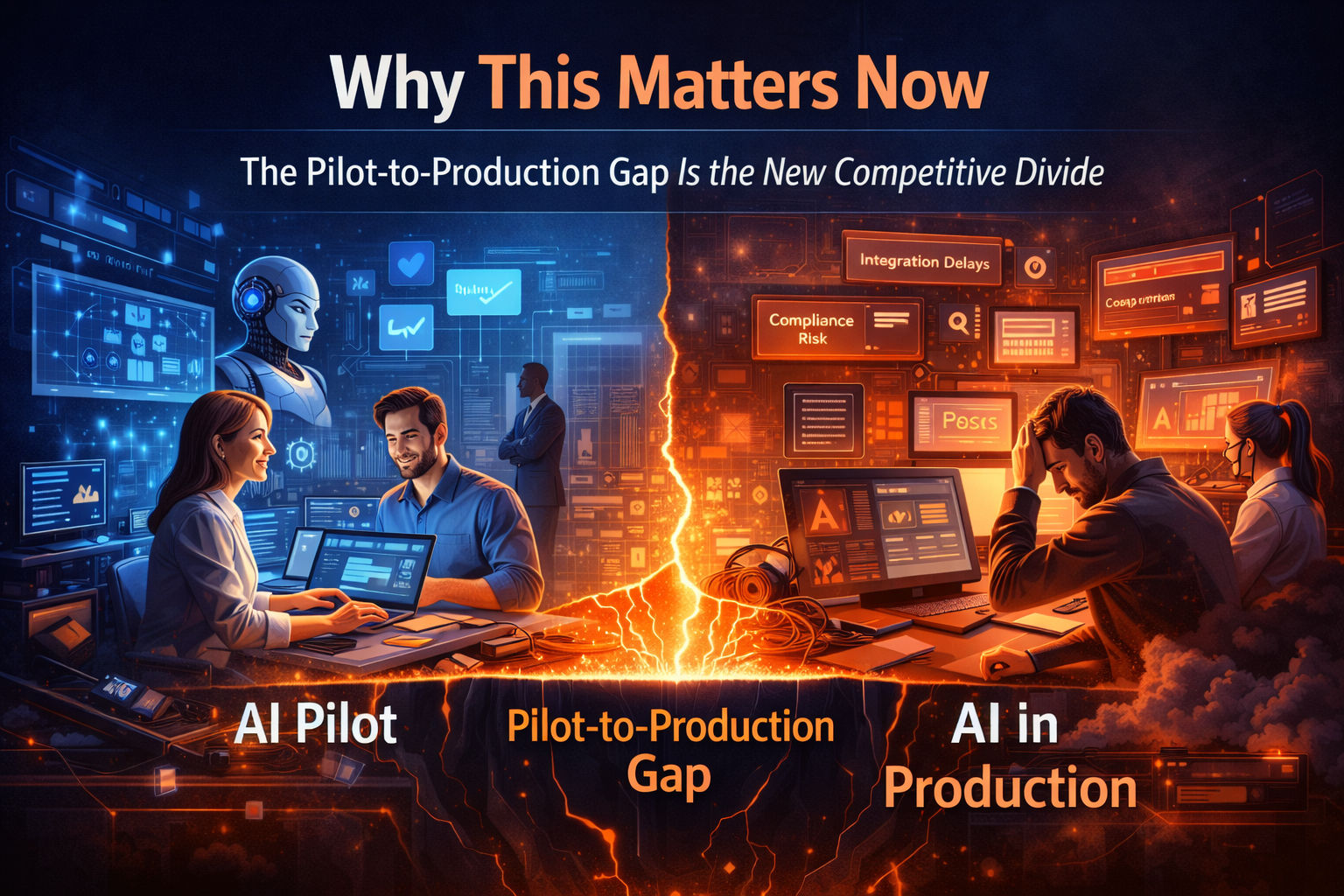
Why This Matters Now: The Pilot-to-Production Gap Is the New Competitive Divide
Across industries and geographies, the hardest part of enterprise AI is not “access to models.” It’s scaling value—turning experiments into production systems people actually trust and use.
Multiple research and industry analyses highlight that many organizations struggle to move from AI ambition to scaled impact. (BCG Global) And as enterprises push from copilots (assistive AI) to agentic systems (AI that can take actions), the risk and complexity increase—making last-mile execution even more decisive. (Reuters)
In other words: the game has changed.
When AI is just “advice,” you can tolerate mistakes.
When AI is “execution,” mistakes become incidents.
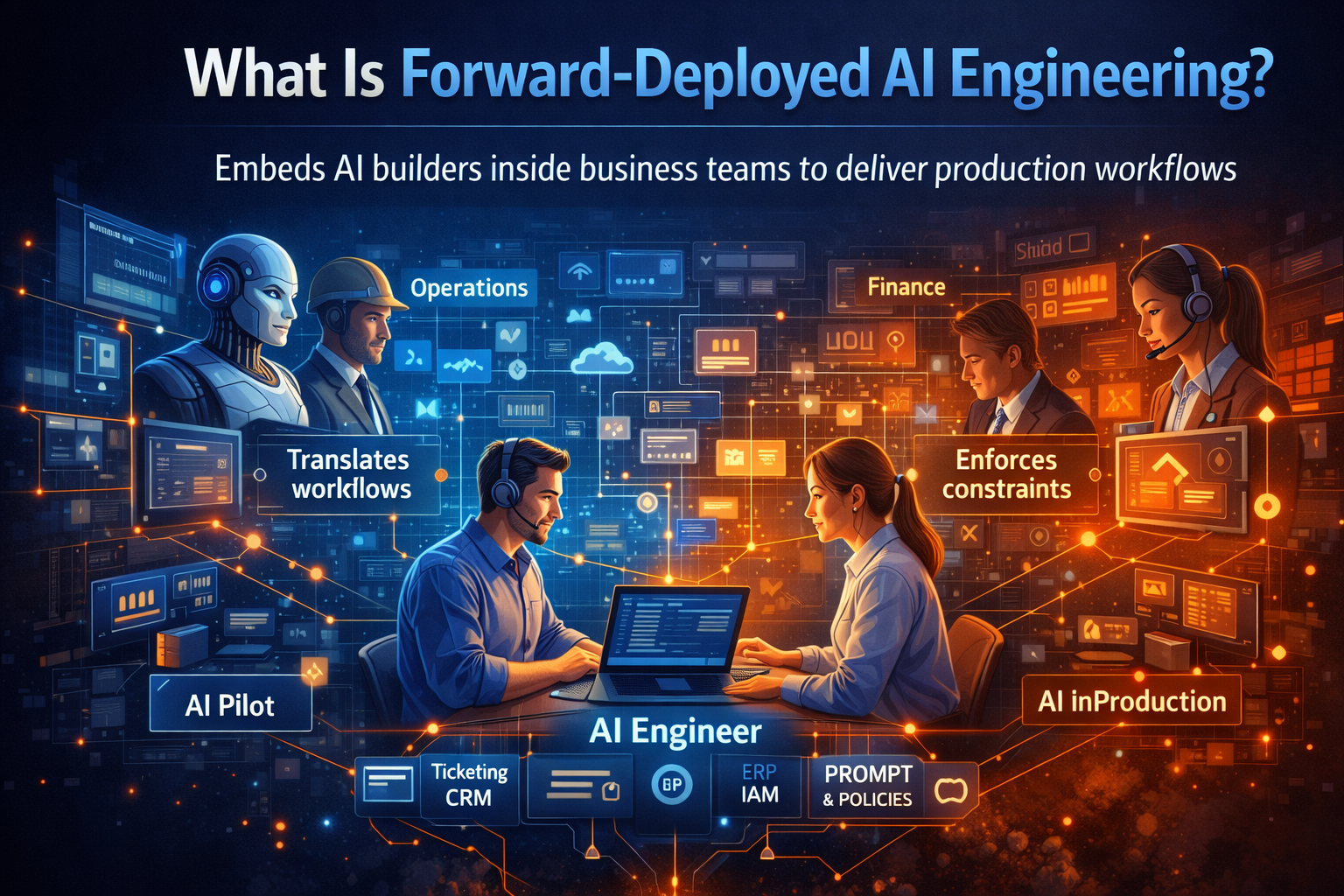
What Is Forward-Deployed AI Engineering?
What Is Forward-Deployed AI Engineering?
Forward-deployed AI engineering is a way of building and delivering enterprise AI.
Instead of a centralized AI team “throwing” a model or chatbot over the wall, you embed builders directly inside the teams where work happens—operations, finance, procurement, customer support, HR, cybersecurity, engineering, and more.
A forward-deployed AI engineer is not support. Not a demo specialist. Not someone who only writes prompts.
They are a full-stack builder who can:
- understand a workflow end-to-end (including exceptions)
- translate it into a reliable AI-enabled flow
- integrate it into real systems (ticketing, ERP, CRM, IAM, email, knowledge bases)
- enforce constraints on actions and permissions
- instrument the system for logging, auditability, monitoring, and recovery
- ship it as a reusable capability—not a one-off prototype
Think of them as:
Embedded product engineers for enterprise AI.
A useful mental model:
Platforms provide ingredients. Forward-deployed engineers cook the meal—inside your kitchen—using your constraints.
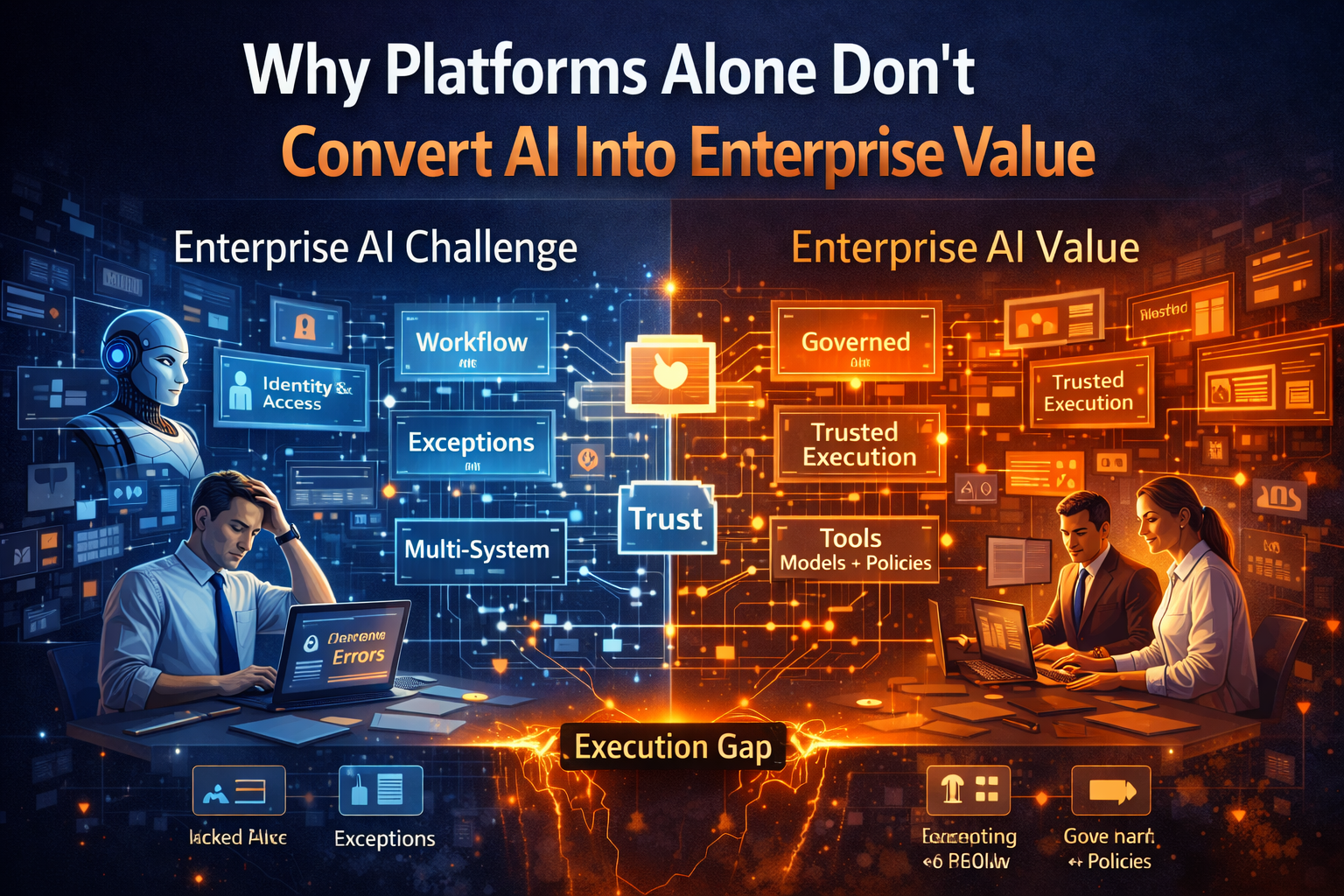
Why Platforms Alone Don’t Convert AI Into Enterprise Value
Platforms matter. But most enterprises discover a hard truth:
The platform is only part of the problem. The rest is workflow reality.
Here’s where enterprise AI usually breaks.
1) In enterprises, the workflow is the product
In consumer AI, “a great answer” might be the product.
In enterprise AI, the product is almost always:
a completed workflow.
A helpful assistant that gives guidance is nice. But value is created when the system:
- gathers missing information
- validates constraints
- checks policies
- triggers the right steps
- escalates exceptions
- records evidence
- updates systems of record
If you don’t engineer the workflow, you get an “AI overlay” that people admire… and then ignore when the stakes rise.
2) Exceptions are not edge cases—they are daily reality
Enterprise work is full of exceptions:
- incomplete documents
- missing fields
- special approvals
- regional rules
- policy conflicts
- outages in upstream systems
- ambiguous human requests
- last-minute changes
Most AI prototypes are designed for the happy path. Production lives in the messy path.
Embedded builders win because they sit with the teams who handle exceptions every day—and design for them upfront.
3) Enterprise AI is multi-system by default
The best enterprise use cases touch many systems:
- identity & access management
- workflow engines and ticketing
- data sources and knowledge bases
- communication channels (email, chat, portals)
- monitoring and security systems
- audit and compliance repositories
This is why “it worked in the demo” fails in production: it wasn’t wired into the real landscape, with real constraints and failure modes.
4) Trust isn’t a policy document; trust is runtime behavior
In enterprises, trust is earned when the system can answer:
- Who took the action?
- What exactly happened (step-by-step)?
- Why did it happen (policy + evidence)?
- Was it allowed under current rules?
- Can we stop it if something looks wrong?
- Can we undo it or compensate safely?
Platforms can provide tools. But embedded builders are the ones who turn “governance intent” into “governance reality.”
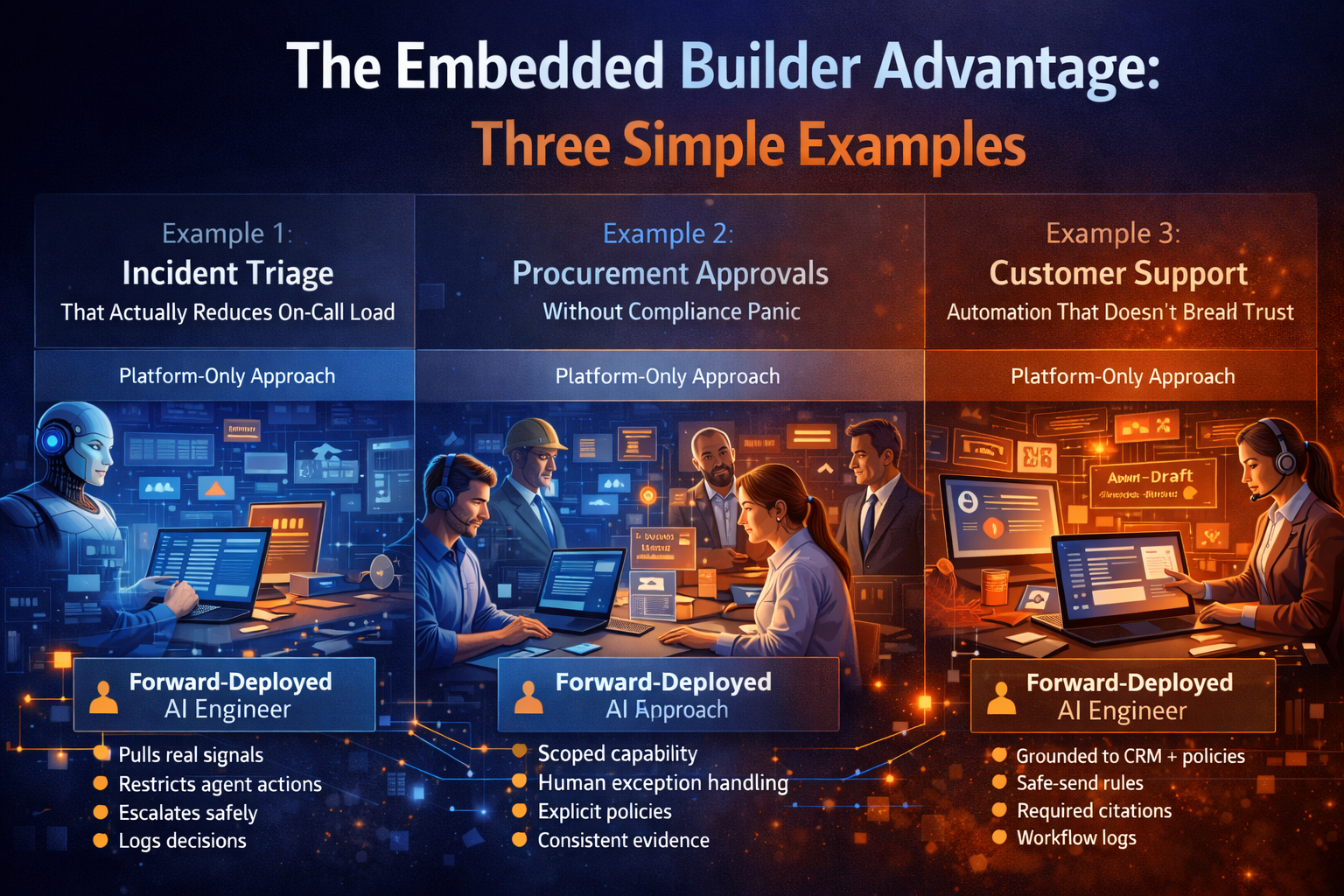
The Embedded Builder Advantage: Three Simple Examples
Example 1: Incident triage that actually reduces on-call load
Platform-only approach:
Deploy an assistant that summarizes incidents and suggests remediation.
Reality in production:
Engineers don’t trust suggestions during high-severity incidents. The assistant isn’t grounded in the exact telemetry they rely on, can’t follow runbooks safely, and doesn’t fit escalation patterns.
Forward-deployed approach:
An embedded builder sits with the on-call team and ships a controlled flow that:
- pulls signals from the same monitoring sources engineers already use
- correlates recent changes and deployments
- proposes actions, but only executes “safe steps” automatically
- escalates high-risk changes to humans
- logs tool calls and evidence for post-incident learning
Now the AI isn’t just advice. It becomes operational leverage.
Example 2: Procurement approvals without compliance panic
Platform-only approach:
“Let’s add an agent that approves low-value purchases.”
Reality:
Procurement asks: “What about supplier exceptions?”
Finance asks: “What about budget envelopes?”
Compliance asks: “Where’s the evidence trail?”
Forward-deployed approach:
Embedded builders define a narrow, governed capability:
- approvals only for specific categories
- thresholds that route exceptions to humans
- policy checks that are consistent across channels
- evidence recorded in the same place auditors already use
Outcome: faster approvals without creating compliance fear or shadow processes.
Example 3: Customer support automation that doesn’t break brand trust
Platform-only approach:
Auto-generate replies and let agents copy-paste.
Reality:
Drafts are good, but agents don’t send them directly. Why?
Tone risk, incorrect promises, missing context, and inconsistent CRM logging.
Forward-deployed approach:
Embedded builders implement:
- reply generation grounded in CRM history and policy constraints
- “safe-send rules” (send only under clear conditions; otherwise escalate)
- mandatory inclusion of approved knowledge references
- logging that fits the support workflow
Now the system fits reality—and adoption happens naturally.
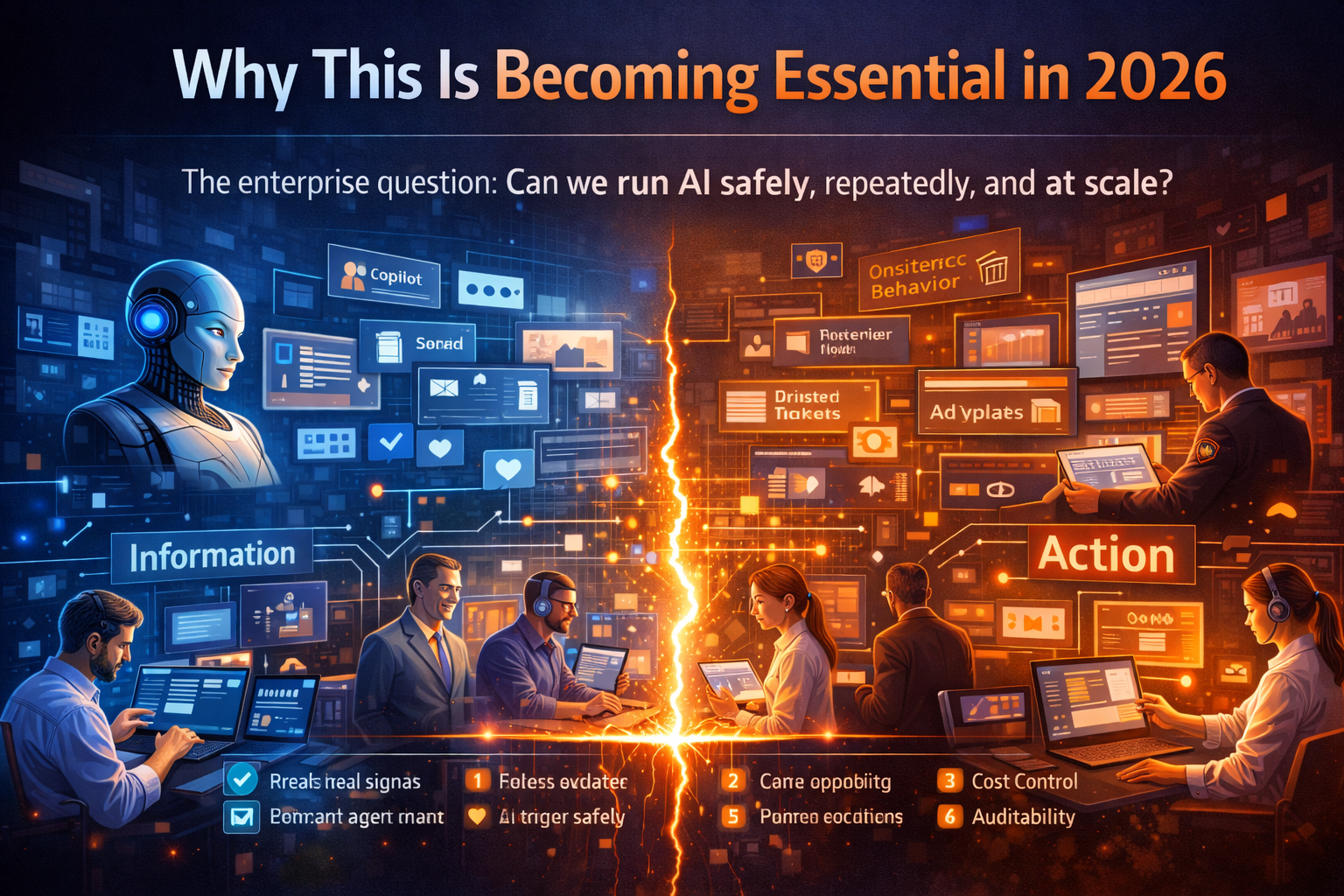
Why This Is Becoming Essential in 2026
As AI shifts from “answering” to “acting,” enterprises are crossing a threshold:
AI is moving from information to execution.
When AI can update records, trigger workflows, create tickets, grant access, or send messages, the risk profile changes. The central enterprise question becomes:
Can we run this safely, repeatedly, and at scale—across teams and regions?
This question can’t be solved by buying a platform alone.
It requires a delivery capability: embedded builders who convert workflows into governed, operable, reusable services.
This urgency is amplified by the agentic AI wave—where hype is high, but many initiatives risk being scrapped due to cost and unclear outcomes if they don’t become operationally real. (Reuters)
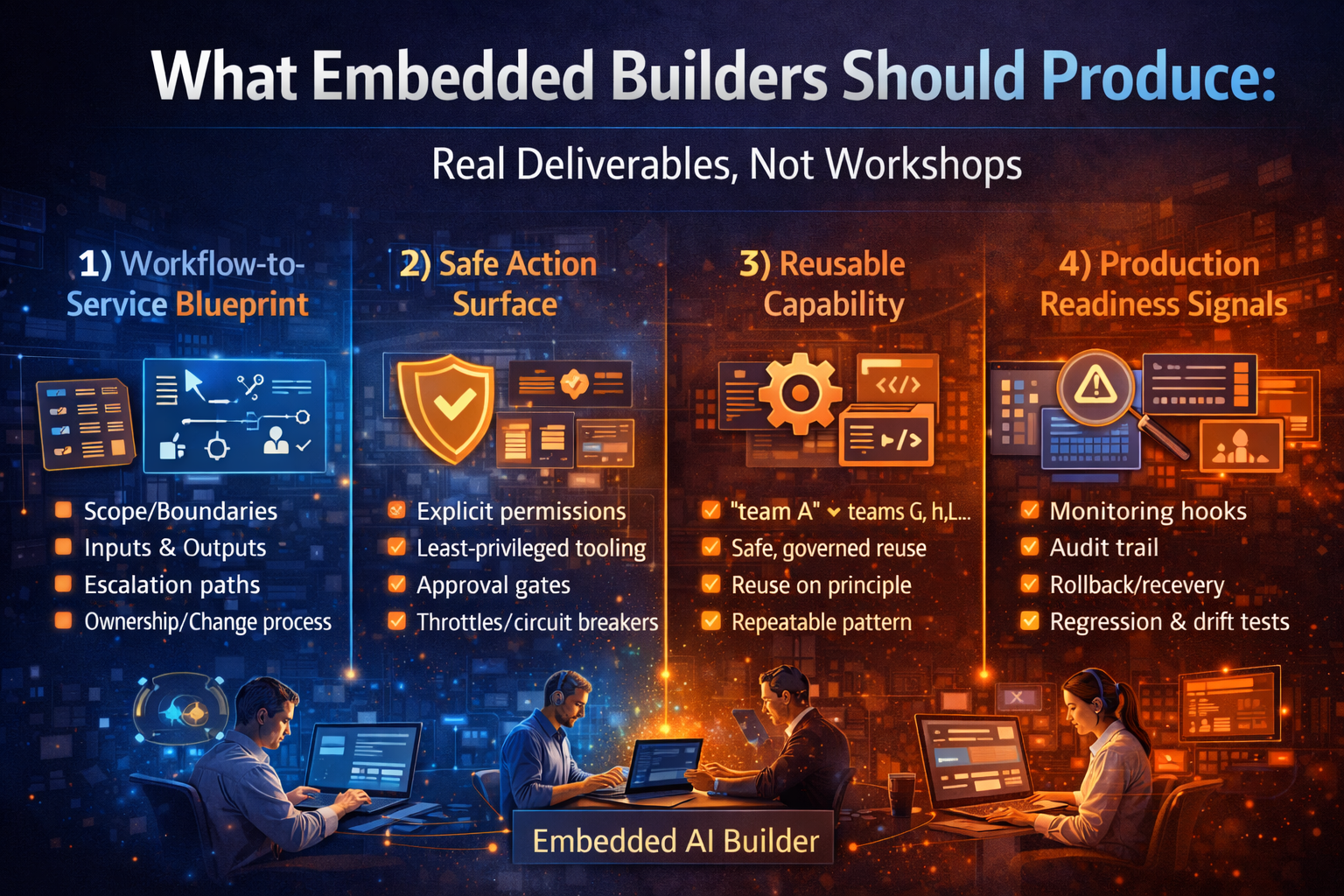
What Embedded Builders Should Produce: Real Deliverables, Not Workshops
If you want forward-deployed AI engineering to be real (and not theater), measure it by production artifacts.
1) A workflow-to-service blueprint
- scope and boundaries
- inputs and outputs
- exception paths
- escalation triggers
- ownership and change process
2) A safe action surface
- explicit allowed actions
- least-privilege tool access
- throttles and circuit breakers
- human approvals for irreversible steps
3) A reusable capability, not a one-off prototype
The rule that drives scale:
Stop building “an agent for Team A.” Build a capability that multiple teams can reuse safely.
4) Production readiness signals
- monitoring hooks
- audit traces
- rollback / safe-mode procedures
- behavior regression tests (so updates don’t break trust)
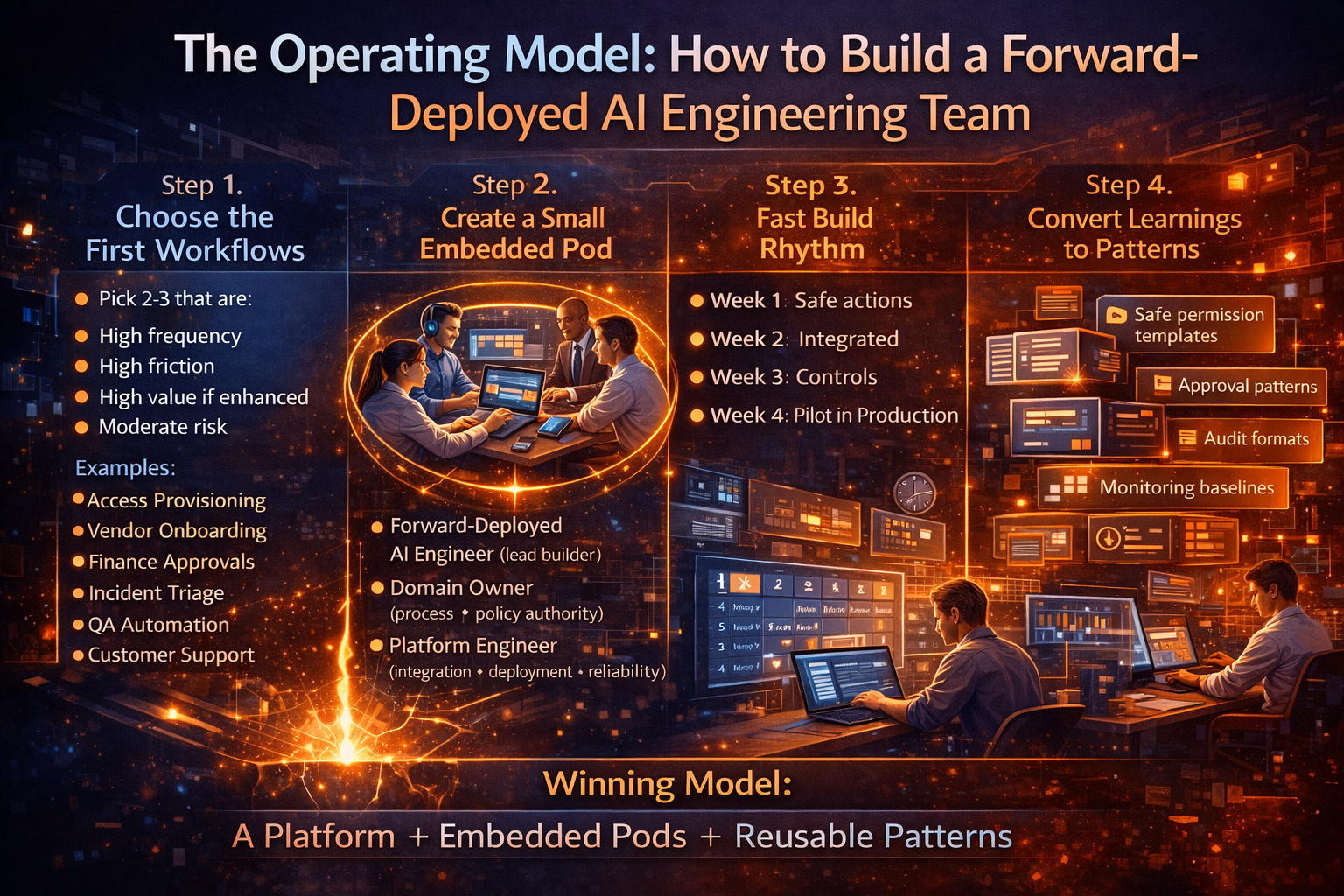
The Operating Model: How to Build a Forward-Deployed AI Engineering Team
This is where most enterprises make mistakes.
They either:
- keep everything centralized (slow, bottlenecked), or
- let every team build their own agents (fast chaos).
The winning model is a hybrid:
A stable platform foundation + forward-deployed delivery pods + reusable service patterns.
Step 1: Choose the right first workflows
Pick 2–3 workflows that are:
- high frequency
- high friction
- high value if improved
- low-to-moderate risk to start
Examples: access provisioning, vendor onboarding, finance approvals, incident triage, QA automation, customer support workflows.
Step 2: Create a small embedded pod
A practical pod looks like:
- forward-deployed AI engineer (lead builder)
- domain owner (process + policy authority)
- platform engineer (integration + deployment + reliability)
- risk/compliance partner (fast feedback, not late veto)
Step 3: Use a short build rhythm (4 weeks is a good default)
- Week 1: map workflow + exceptions; define safe actions
- Week 2: integrate into real systems; build “working end-to-end”
- Week 3: add controls: audit, approvals, rollback, cost limits
- Week 4: pilot in production with monitoring and feedback loops
Step 4: Convert learnings into reusable patterns
This is the real multiplier.
Embedded builders should continuously produce reusable assets:
- safe tool permission templates
- approval and escalation patterns
- evidence capture formats
- prompt/policy versioning rules
- monitoring baselines and incident playbooks
That’s how you scale without building an “agent zoo.”
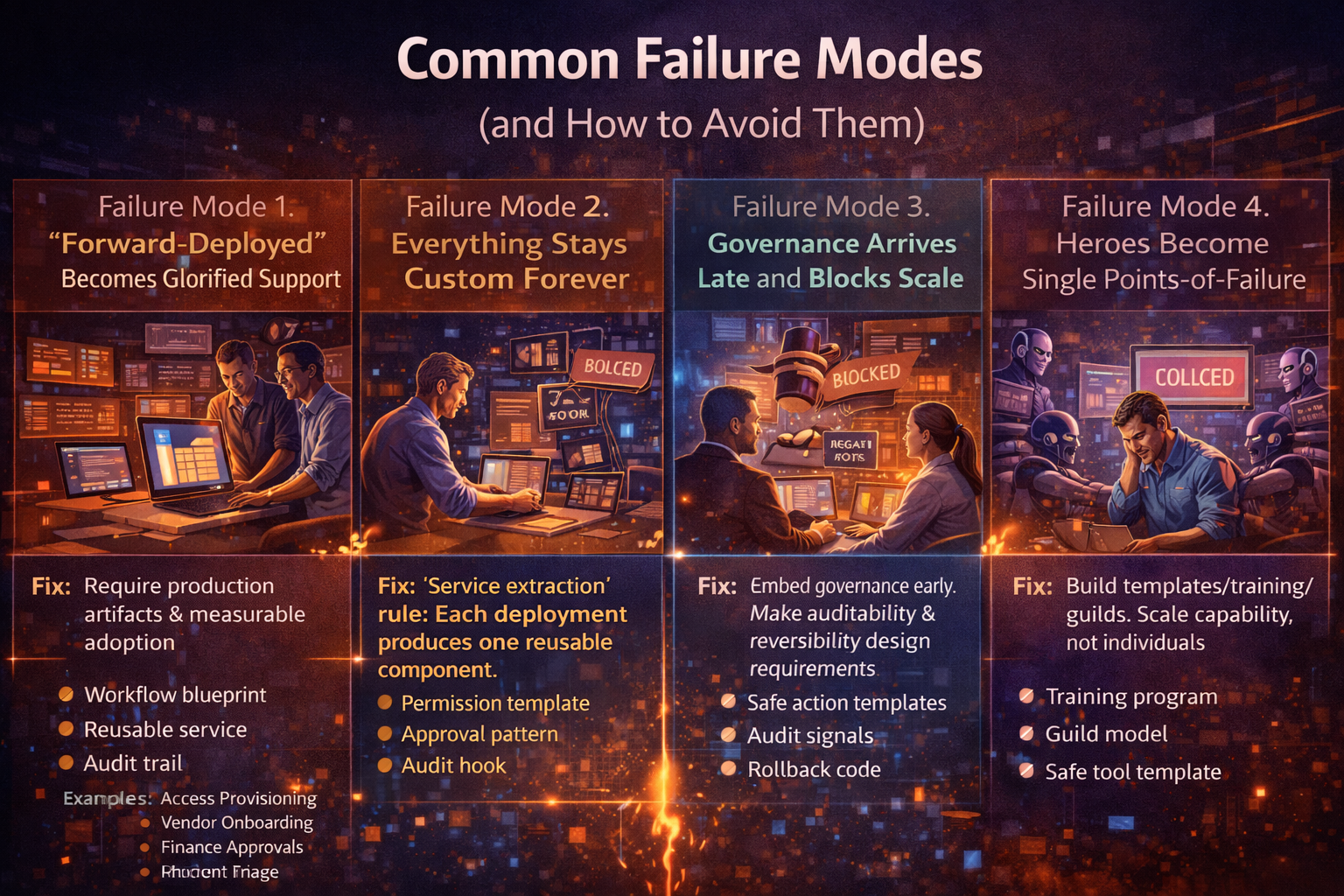
Common Failure Modes (and How to Avoid Them)
Failure mode 1: “Forward-deployed” becomes glorified support
Fix: Require production artifacts and measurable adoption.
Failure mode 2: Everything stays custom forever
Fix: Use a “service extraction” rule: each deployment must produce at least one reusable component.
Failure mode 3: Governance arrives late and blocks scale
Fix: Embed governance early. Treat auditability and reversibility as design requirements, not compliance add-ons.
Failure mode 4: A few heroes become single points of failure
Fix: Build templates, internal training, and a guild model. Scale capability, not individuals.
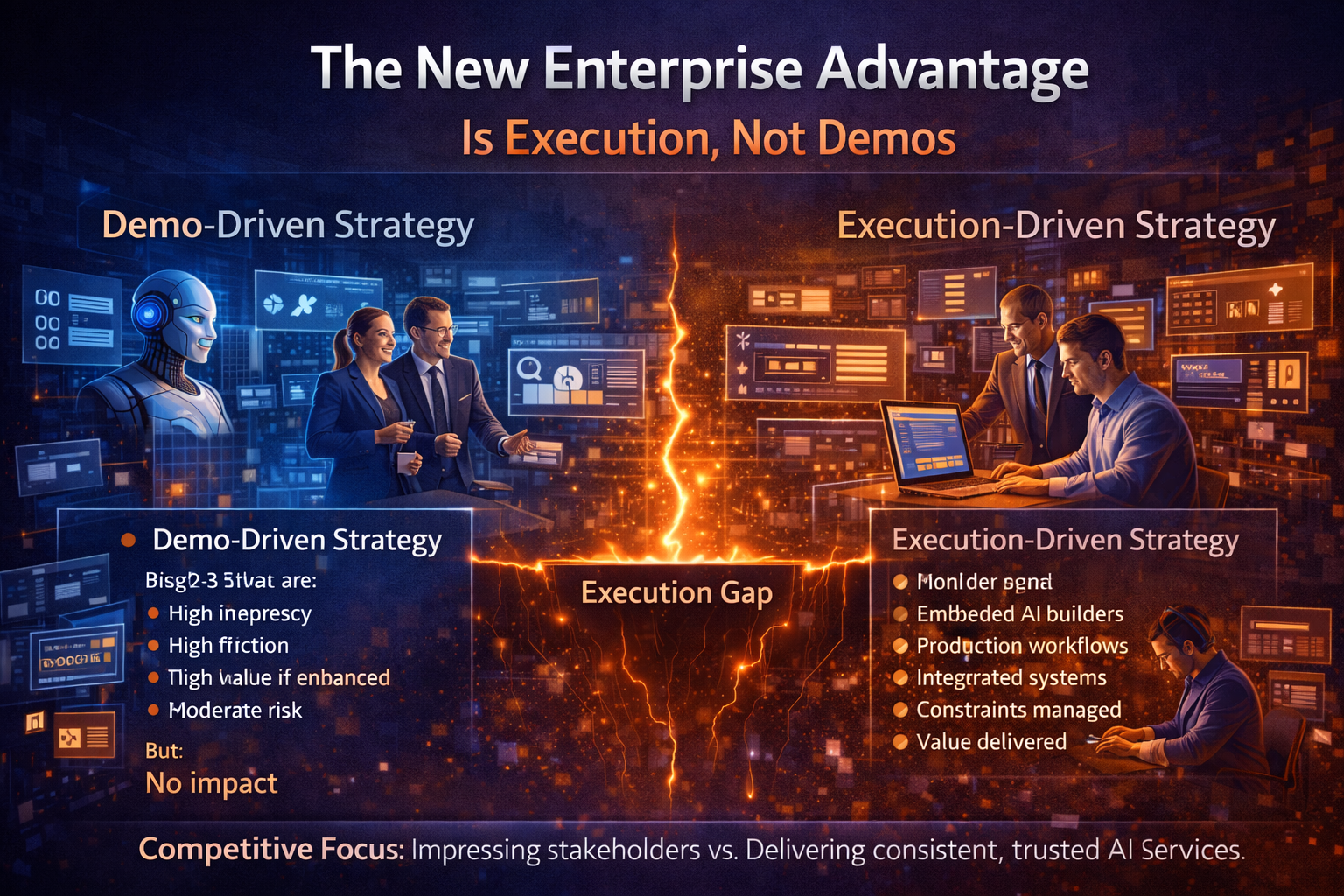
Conclusion: The New Enterprise Advantage Is Execution, Not Demos
In 2026, winners won’t simply have “more AI.”
They’ll have the capability to deploy, operate, and continuously improve AI inside real work—fast, safely, and repeatedly.
Forward-deployed AI engineering is how enterprises build that capability.
Not by adding more tools.
Not by centralizing everything.
But by putting builders where reality lives—and turning workflows into reusable, governed systems that teams trust.
That is what moves AI from impressive to indispensable.
Glossary
Forward-Deployed AI Engineering (FDAIE): A delivery model where AI builders embed with operational teams to ship production AI workflows and reusable components.
Embedded Builders: Engineers who work inside business teams to translate real workflows (including exceptions) into production-ready AI systems.
Last-Mile AI: The final step of translating a working prototype into a reliable, governed production workflow integrated with enterprise systems.
Agentic AI: AI systems that can plan and take actions (e.g., creating tickets, updating records), not just generate text.
Workflow-to-Service: Converting a business workflow into a reusable, governed service that multiple teams can call.
Safe Action Surface: The explicit set of actions an AI system is allowed to take, under least privilege and controls.
Human-in-the-Loop: A design where humans approve or intervene for high-risk steps; not a blanket “everything must be reviewed.”
Evidence Trail: The log of what happened, why it happened, and what data/policy supported it—used for audit and incident review.
Rollback / Safe Mode: Mechanisms to stop or reverse actions when an AI workflow behaves unexpectedly.
Reusable Service Patterns: Standard templates for permissions, approvals, escalation, auditing, monitoring, and deployment used across many AI workflows.
FAQ
1) What is forward-deployed AI engineering in simple terms?
It’s embedding AI builders inside business teams so they can turn real workflows into production AI systems—integrated, governed, and reusable.
2) Why do enterprise AI pilots fail to scale?
Because real workflows include exceptions, multiple systems, policy constraints, and trust requirements. Platforms help, but execution in context is the hard part. (BCG Global)
3) Is forward-deployed engineering only for large enterprises?
No. Any organization with cross-team workflows and compliance needs benefits. Smaller firms can start with a single embedded pod.
4) How is this different from consultants?
The output is different: production artifacts, reusable service patterns, and operational ownership—not slide decks.
5) What should embedded builders deliver in the first 30 days?
One end-to-end workflow in production with: safe action surface, basic monitoring, audit logging, and a reusable pattern that can be applied to the next workflow.
6) Does this replace an AI platform team?
No. It complements it. The platform team standardizes primitives; forward-deployed pods apply them inside real workflows and convert learning into reusable patterns.
7) What makes this approach critical for agentic AI?
Agentic systems increase risk because they can take actions. Without embedded execution discipline, many projects become expensive experiments. (Reuters)
References and Further Reading
- “What are Forward Deployed Engineers, and why are they…?” (The Pragmatic Engineer) (Pragmatic Engineer Newsletter)
- “Forward Deployed Engineers” (SVPG) (Silicon Valley Product Group)
- Palantir: “A Day in the Life of a Forward Deployed Software Engineer” (Palantir Blog)
- Gartner via Reuters on agentic AI project risk and hype cycles (Reuters)
- BCG research on scaling AI value (BCG Global)
- The Human–Agent Ratio: The New Productivity Metric CIOs Will Manage—and the Enterprise Stack Required to Make It Safe – Raktim Singh
- The Synergetic Workforce: How Enterprises Scale AI Autonomy Without Slowing the Business – Raktim Singh
- The Agentic Identity Moment: Why Enterprise AI Agents Must Become Governed Machine Identities – Raktim Singh
- Enterprise AI Operating Model 2.0: Control Planes, Service Catalogs, and the Rise of Managed Autonomy – Raktim Singh



Raktim Singh is an AI and deep-tech strategist, TEDx speaker, and author focused on helping enterprises navigate the next era of intelligent systems. With experience spanning AI, fintech, quantum computing, and digital transformation, he simplifies complex technology for leaders and builds frameworks that drive responsible, scalable adoption.