
Why “Aboutness” Is the Hardest Governance Problem in Enterprise AI
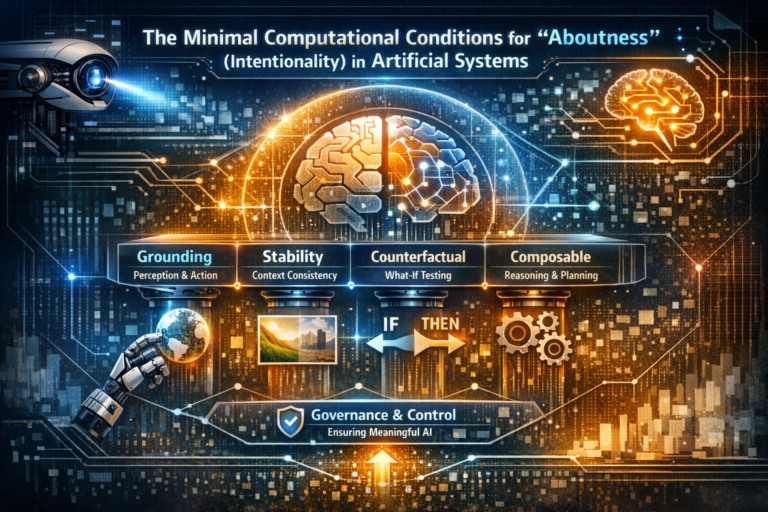
Most Enterprise AI failures don’t begin with incorrect predictions—they begin with misaligned meaning. As AI systems move from decision support to autonomous action, the question is no longer “Is the model accurate?” but “What is the model actually about?”
This article explains why aboutness—how AI concepts are grounded, interpreted, and tested under counterfactual change—has become a first-order governance problem in Enterprise AI, and why organizations that ignore it are not deploying intelligence, but fragile correlations at scale.
Aboutness becomes an Enterprise AI governance problem when models act on concepts that are statistically learned but not causally grounded, making their decisions brittle under change, scale, or real-world intervention.
When do internal states become about something—instead of merely co-occurring with it?
A model can be accurate without meaning anything.
That sentence sounds like a provocation. It is also a practical diagnosis. Many AI systems look “green” on dashboards—strong accuracy, fast latency, high confidence—yet fail in ways that feel inexplicable to the people responsible for outcomes. Not because the system is defective, but because it never acquired the kind of aboutness humans silently assume it has.
Philosophers call this property intentionality: the directedness of a mental state toward something—an object, a situation, a risk, a promise, a plan. (Stanford Encyclopedia of Philosophy) In AI, we casually borrow this vocabulary: “this neuron is about X,” “this embedding means Y,” “the agent believes Z.” But most of the time, those statements describe our interpretation—not the system’s intrinsic semantics.
That gap is the classic symbol grounding problem in modern clothing: how can a token, vector, or internal state have meaning for the system itself rather than meaning that is “parasitic” on human interpretation? (ScienceDirect)
This article answers a hard question in an operational way:
What are the minimal computational conditions that upgrade an internal state from “correlated with something” to “about something”?
There is no single globally accepted definition of aboutness. But there is a practical, defensible set of conditions—strict enough to filter out “fake meaning,” and usable enough to guide how we build and govern Enterprise AI systems.
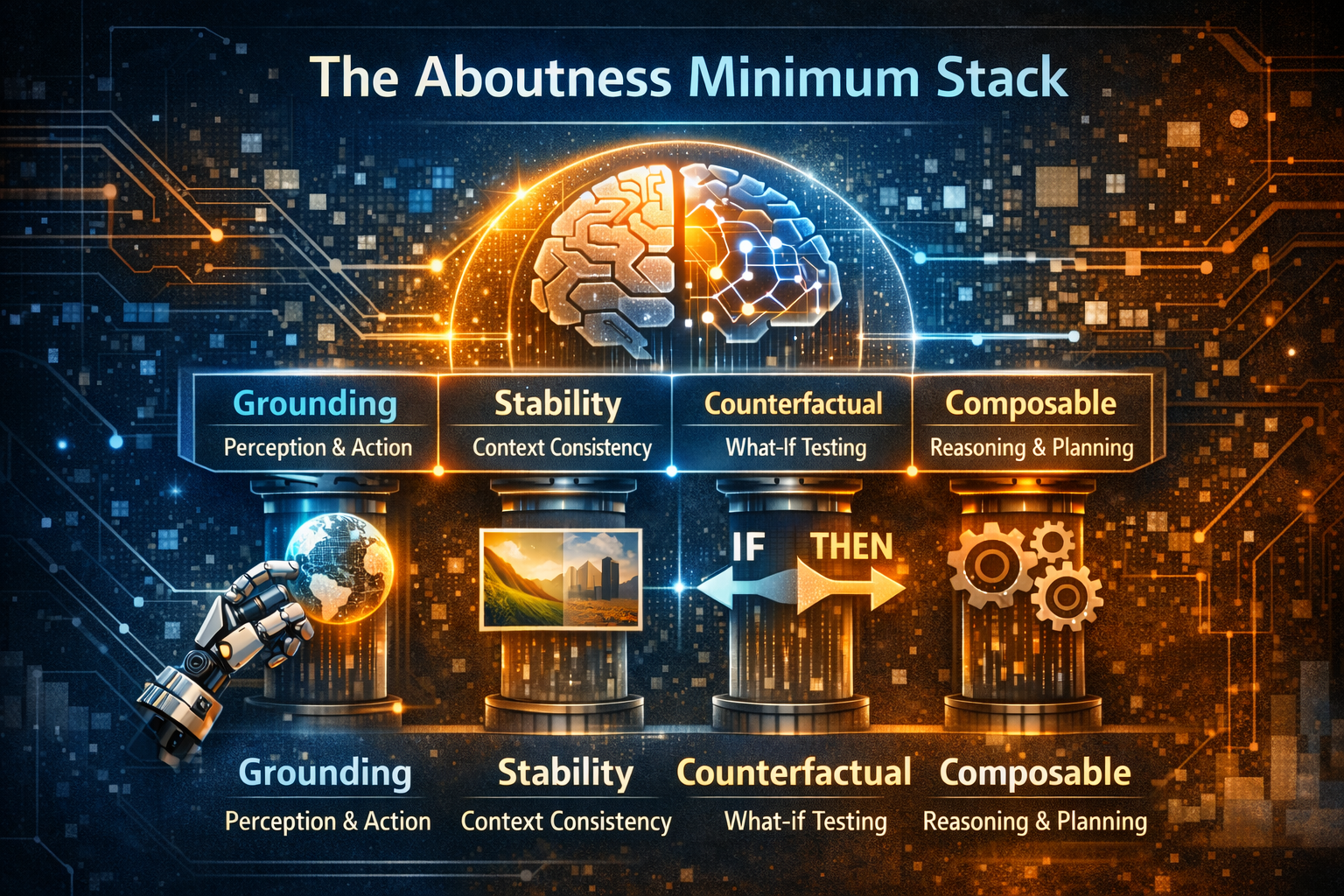
I’ll present a minimal stack: four conditions that create credible aboutness—plus a fifth condition that turns it into enterprise reality: governance.
The intuition: correlation is not aboutness
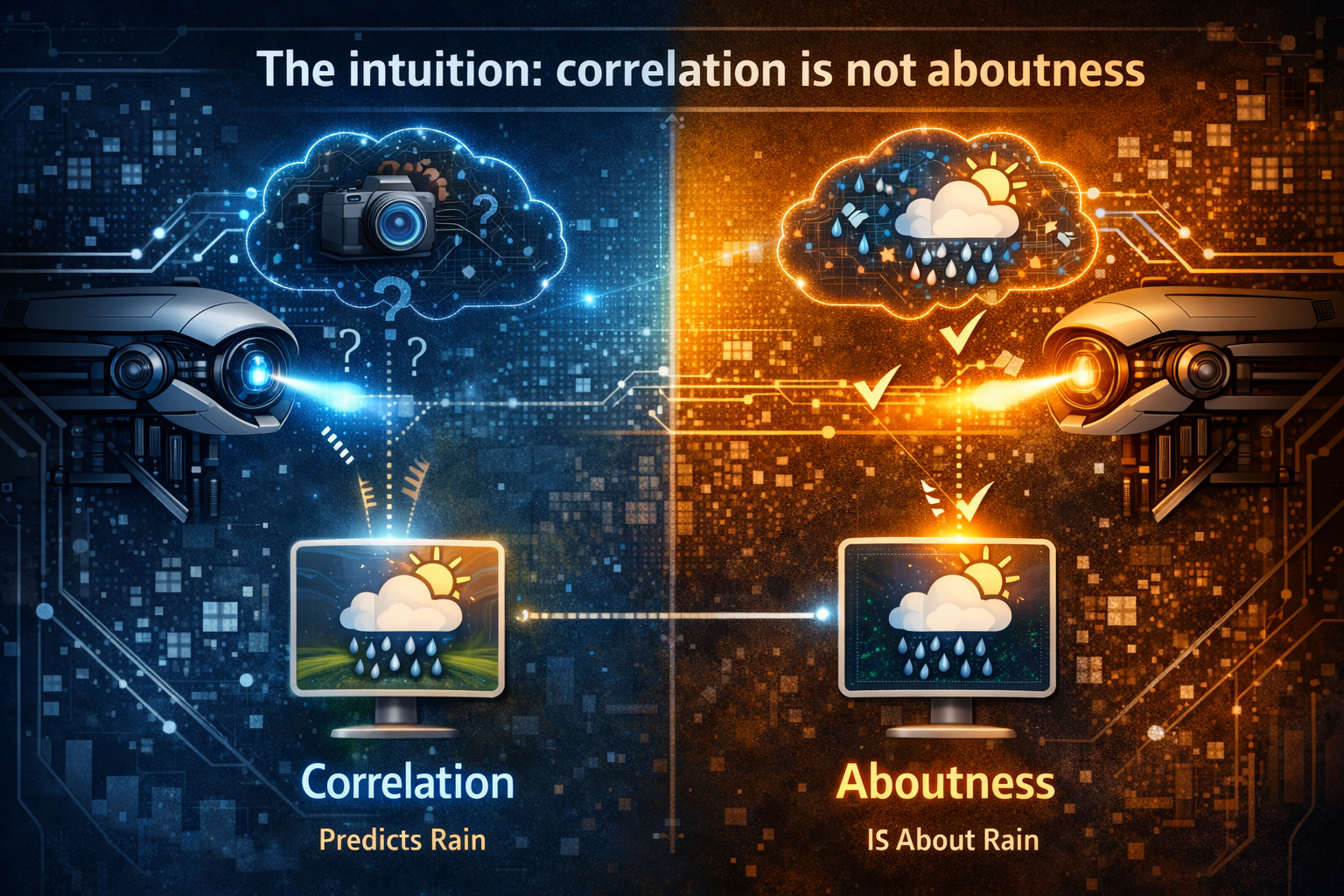
The intuition: correlation is not aboutness
Let’s begin with a tiny story that captures the entire problem.
Example 1: The “rain neuron” that isn’t about rain
Imagine a model that predicts whether it will rain tomorrow from images of the sky. It learns a hidden feature that activates whenever the sky looks gray. The feature becomes a great predictor.
Is the feature about rain?
Not necessarily. It might be about camera exposure, time of day, seasonal lighting, or a lens artifact common in the training set. It co-occurs with rain in the dataset, but it may not refer to rain in any robust sense.
Aboutness requires more than “fires when X happens.”
This matters because modern neural systems can store multiple “reasons” in the same internal space—distributed, overlapping, and non-unique.
Mechanistic interpretability The Completeness Problem in Mechanistic Interpretability : Why Some Frontier AI Behaviors May Be Fundamentally Unexplainable – Raktim Singh researchers warn that internal variables are not automatically “human-meaningful units,” and that the choice of basis (how you carve the space into “variables”) can change what looks meaningful. (transformer-circuits.pub)
So: if correlation isn’t meaning, what is the minimum upgrade path?
The Aboutness Minimum Stack
Condition 1: Grounding
A state must connect to the world through perception and/or action.
A state becomes meaning-like when it participates in a reliable loop between the system and the world—not only text labels, not only training correlations.
This is the heart of grounding: symbols cannot get meaning purely from other symbols; there must be contact with the world that makes some interpretations work and others fail. (ScienceDirect)
Example 2: A thermostat vs. a cleaning robot
- A thermostat has a “temperature state.” It changes with sensor readings and triggers an action (turn heat on/off).
- A cleaning robot has a “dirt map state.” It updates as it moves, revises when it finds new debris, and changes its route accordingly.
Both are grounded, but the robot is grounded in a richer way: it tracks something across time and uses that tracking to control behavior.
Minimal grounding test (meeting-friendly):
If you changed the internal state, would the system’s actions change in the real world in a way that keeps it aligned with the same external referent?
If not, you likely have a pattern—not aboutness.
Condition 2: Stability under variation
The state must keep referring across contexts, not just inside one dataset.
Humans recognize “the same thing” across changes in lighting, phrasing, format, and environment. An AI system’s aboutness needs a shadow of that property.
Example 3: “Fraud” that collapses under minor change
A model flags fraud correctly—until a merchant changes the formatting of transaction metadata. Suddenly the model’s “fraud feature” stops working.
That feature was not about fraud. It was about a brittle proxy.
Stability requirement:
A state counts as “about X” only if it remains effective for the right reasons across plausible context shifts—not merely inside the training distribution.
This is why enterprises repeatedly experience a painful truth: high offline performance can coexist with fragile, non-semantic internal structure.
Condition 3: Counterfactual sensitivity
The state must support “what-if” distinctions—tracking causes, not just cues.
Here is the leap from weak meaning to stronger meaning:
A state is about something when it changes appropriately under interventions, not merely observations.
- Observation: “When X happens, state S is high.”
- Counterfactual: “If X were different—while superficial cues stayed the same—S would change correspondingly.”
This is where causal thinking becomes unavoidable. Mechanistic interpretability increasingly treats understanding as an intervention problem: edit or ablate activations and see what changes downstream. (transformer-circuits.pub)
Example 4: The “urgent email” feature that fails the what-if test
Suppose a model routes emails and learns “urgent” from ALL-CAPS subject lines.
Ask a counterfactual:
- If the message were not urgent but still ALL-CAPS, would the state still fire?
If yes, it’s not about urgency. It’s about typography.
Minimal counterfactual test:
Can you change the world-relevant factor while holding superficial cues constant—and does the state track the world factor?
Without this, “meaning” is convenient storytelling.
Condition 4: Composable use in reasoning or control
The state must be usable as a building block—not a one-off shortcut.
Even if a state is grounded, stable, and counterfactually sensitive, it may still be “thin.” Aboutness becomes stronger when the system can reuse the state compositionally—combine it with other states to plan, constrain, retrieve, explain, or decide.
Example 5: A map vs. a snapshot
A photo is grounded and stable, but it doesn’t support: “Take route A, avoid obstacle B, arrive before time C.”
A map-like internal representation does.
Minimal composability test:
Can the system reuse this state across multiple downstream tasks (planning, retrieval, constraint checking), without learning a brand-new proxy each time?
In enterprise terms: can the representation participate in decision integrity, rather than functioning as a one-off correlation hack?
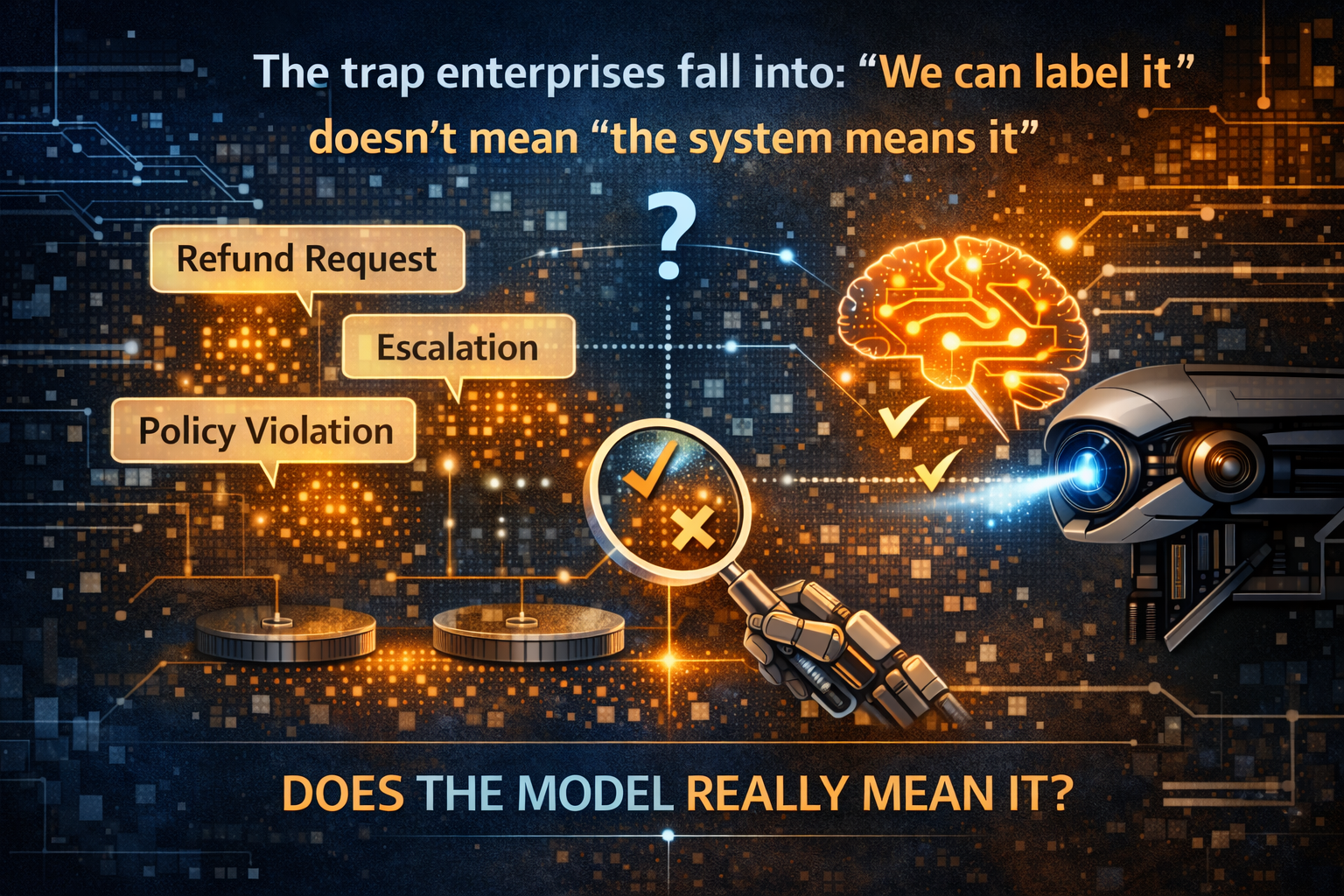
The trap enterprises fall into: “We can label it” doesn’t mean “the system means it”
Humans are expert narrators. We see a cluster in embedding space and name it: “refund request,” “policy violation,” “escalation.”
But internal states in neural systems are often:
- distributed rather than localized,
- polysemantic (one feature contributes to multiple behaviors),
- non-unique (different internal coordinate systems can yield the same outputs).
So naming is not proof of aboutness. It is a hypothesis.
This is why interpretability needs a mature promise: deciding what counts as a real variable—and validating meaning through interventions, not vibes. (transformer-circuits.pub)
A practical definition you can govern
Put the four conditions together:
An internal state S is minimally about X if:
- Grounded: S is linked to X through reliable perception/action loops. (ScienceDirect)
- Stable: S continues to track X across reasonable contextual changes.
- Counterfactual: If X changed (not just correlated cues), S would change correspondingly. (Neel Nanda)
- Composable: S can be reused as a building block in multiple decisions and tasks.
This won’t satisfy every school of philosophy of mind. But it is strong enough to guide real systems—and strict enough to disqualify most fake meaning.
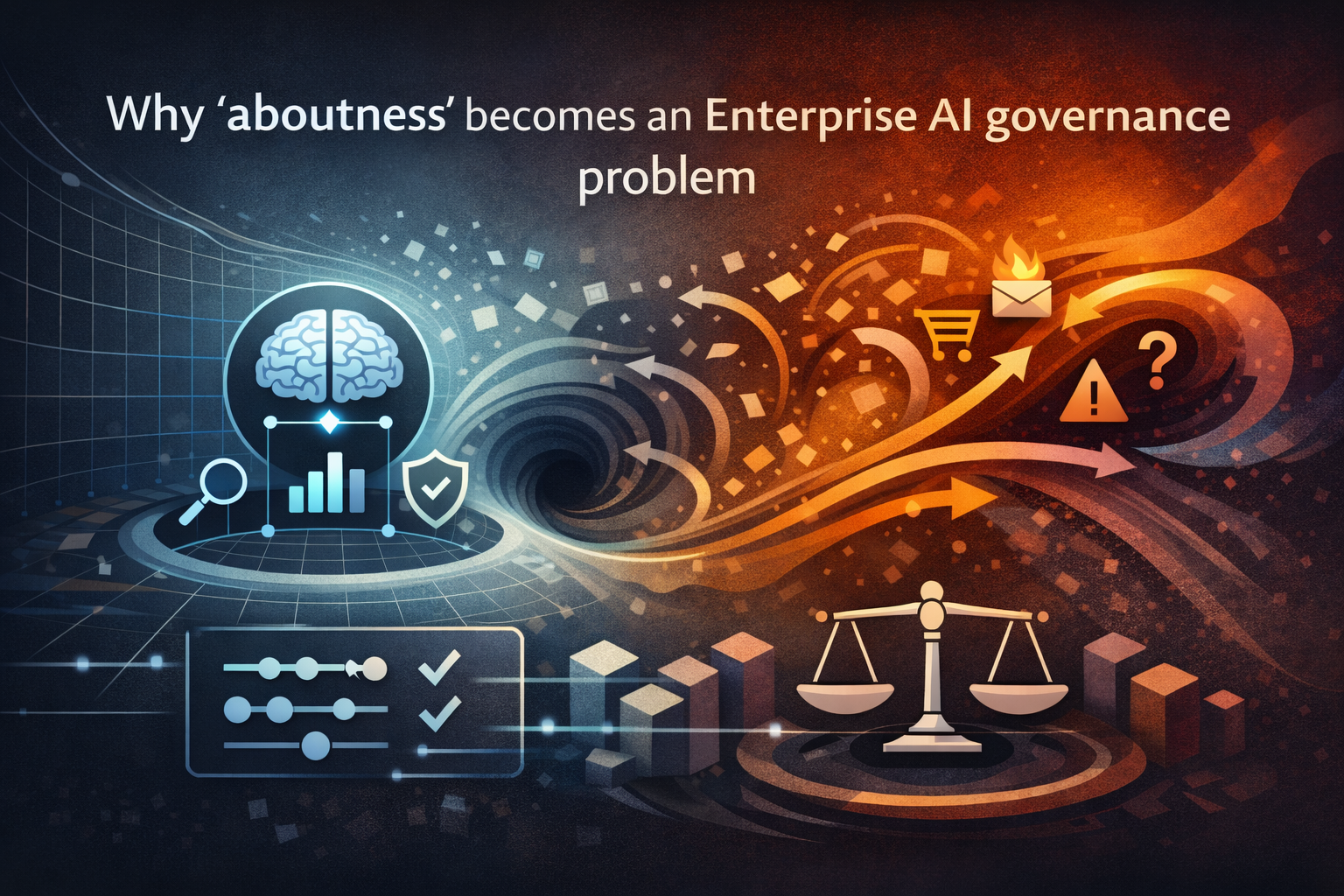
Why “aboutness” becomes an Enterprise AI governance problem
Once you care about aboutness, you discover a dangerous truth:
Meaning is not just learned. Meaning is allowed.
Enterprises operate with definitions, policies, obligations, and accountability. If a model internalizes a proxy and the organization treats it as the real concept, the result is institutional failure—quietly, confidently, at scale.
This is precisely why concept formation is not merely an optimization problem; it is a governance problem.
In an Enterprise AI operating model, this fits naturally into a Control Plane mindset:
- define what the system is permitted to treat as a concept,
- define evidence thresholds for “aboutness,”
- monitor semantic drift,
- enforce decision boundaries when semantics are uncertain.
If you’re building agentic systems, this is not optional. Acting systems turn internal states into decision primitives—and decision primitives need semantic governance.
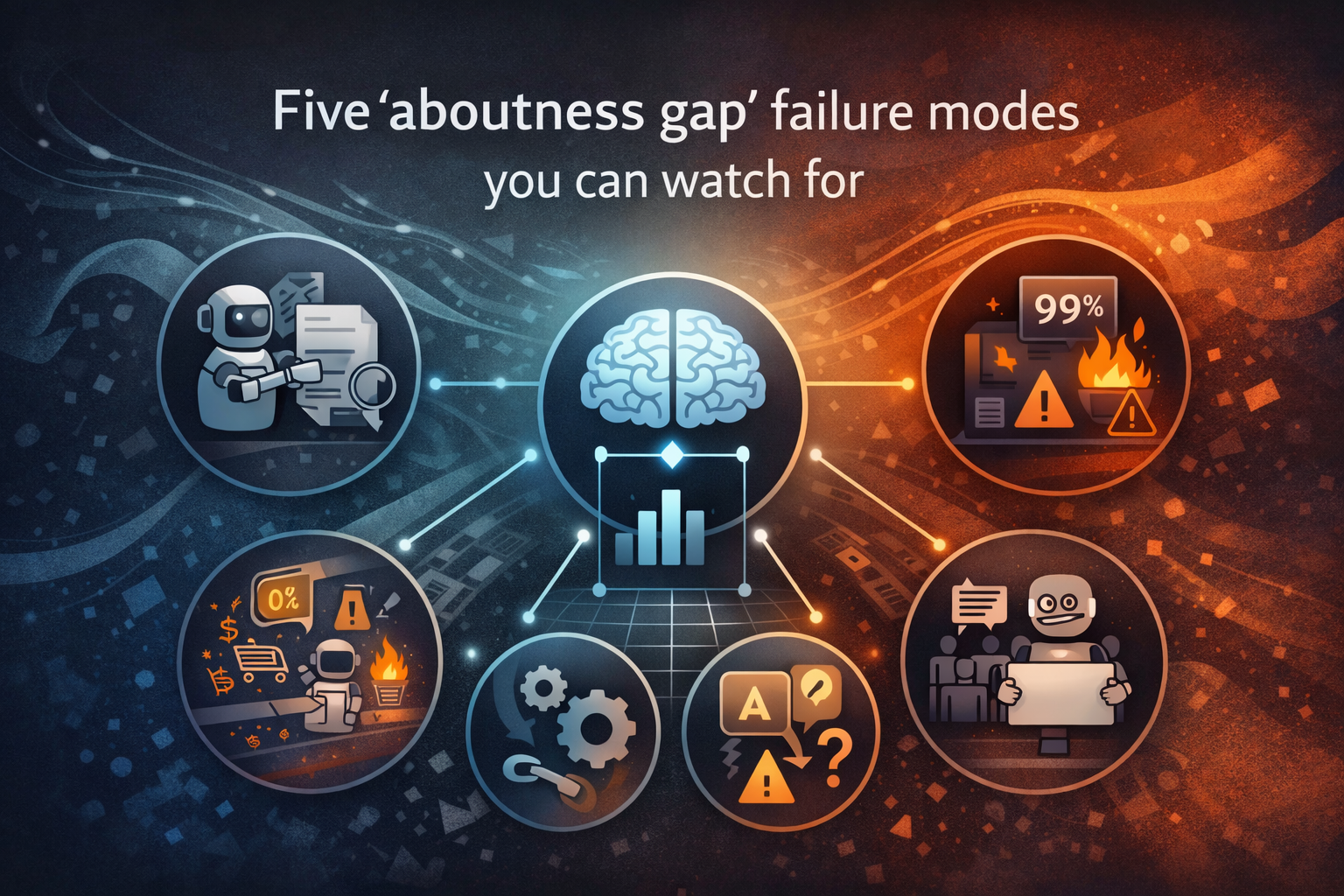
Five “aboutness gap” failure modes you can watch for
- Proxy lock-in
The system finds a shortcut and never has to mean what you care about. - Meaning drift (semantic drift)
Retraining, new data, tool changes, or retrieval updates shift what internal states latch onto—without an immediate drop in metrics. - Confident misrouting
The model is highly confident about the proxy, not the concept. - Non-portability
The “meaning” works in one workflow and collapses in another. - Governance illusions
Dashboards track accuracy and latency while the organization assumes semantic integrity is guaranteed.
Operationalizing the stack: what to build (without turning this into math)
If you’re building modern AI—especially decision-influencing or agentic systems—here’s what minimal aboutness translates to:
Grounding mechanisms
- multimodal coupling (text + signals + outcomes),
- tool feedback (actions change the world; the world responds),
- closed-loop evaluation (not just static benchmarks).
Stability mechanisms
- stress tests under context shifts,
- monitoring for semantic drift signals (not only performance drift).
Counterfactual mechanisms
- intervention-style evaluation (change the suspected cause, hold superficial cues fixed),
- controlled “what-if” environments for agentic behaviors.
Composability mechanisms
- reuse representations across tasks,
- consistent concept interfaces (the same concept constrains multiple decisions).
Governance mechanisms (the missing fifth condition)
- define “concepts that matter” as governed objects,
- require evidence that the model is tracking them (not proxies),
- enforce change control when semantics might have shifted.
This is how aboutness becomes operational—not philosophical.
Conclusion:
Here is the uncomfortable executive truth: most AI systems do not possess meaning—only performance.
They can be accurate and still be semantically hollow: high confidence, wrong concept. That is not a rare bug; it is the default outcome when correlation is mistaken for aboutness.
If you remember one idea, remember this:
Aboutness is earned.
It is earned through grounding, stability, counterfactual sensitivity, and composable use—and it is preserved through governance.
Enterprises that treat meaning as “emergent” will keep suffering silent failures: the system performs, the dashboards glow, and the organization slowly delegates decisions to proxies it never intended.
The enterprise move is different: govern what AI is allowed to mean, because meaning is the substrate of accountable autonomy.
“If we can’t explain what the model’s concepts are grounded in—and how they survive a ‘what-if’ test—we’re not deploying intelligence. We’re deploying correlations.”
FAQ
1) What is “aboutness” (intentionality) in AI?
Aboutness is the property of a state being directed toward or about something—an object, condition, or situation—rather than merely correlating with it. (Stanford Encyclopedia of Philosophy)
2) Is symbol grounding the same as aboutness?
Grounding is a core ingredient: it explains how internal tokens or states can have meaning intrinsic to the system rather than borrowed from human interpretation. (ScienceDirect)
3) Can a highly accurate model still lack meaning?
Yes. It may rely on proxies that work in training data but do not track the underlying concept under shifts or interventions.
4) Do language models have aboutness?
They can show partial, task-like aboutness, but much of what looks like meaning can be pattern completion without grounded reference—especially without robust counterfactual testing.
5) How do I test whether a feature is truly “about” a concept?
Use interventions: change the concept while holding superficial cues constant, and check whether the internal state tracks the concept. Mechanistic interpretability frames this through activation interventions. (Neel Nanda)
What does “aboutness” mean in Enterprise AI?
Aboutness refers to what an AI model’s internal representations actually correspond to in the real world—not just patterns, but meaningful concepts tied to outcomes.
Why is aboutness a governance issue?
Because models can perform well while being about the wrong thing, leading to silent failures when environments change.
How is aboutness different from explainability?
Explainability describes how a model made a decision; aboutness governs what the decision is grounded in.
Can accuracy metrics detect aboutness failures?
No. High accuracy can coexist with concept drift, spurious correlations, and semantic misalignment.
How do enterprises govern aboutness?
Through concept audits, counterfactual testing, semantic invariants, and decision-level accountability—not just model monitoring.
Enterprise AI Operating Model
Enterprise AI scale requires four interlocking planes:
Read about Enterprise AI Operating Model The Enterprise AI Operating Model: How organizations design, govern, and scale intelligence safely — Raktim Singh
- Read about Enterprise Control Tower The Enterprise AI Control Tower: Why Services-as-Software Is the Only Way to Run Autonomous AI at Scale — Raktim Singh
- Read about Decision Clarity The Shortest Path to Scalable Enterprise AI Autonomy Is Decision Clarity — Raktim Singh
- Read about The Enterprise AI Runbook Crisis The Enterprise AI Runbook Crisis: Why Model Churn Is Breaking Production AI — and What CIOs Must Fix in the Next 12 Months — Raktim Singh
- Read about Enterprise AI Economics Enterprise AI Economics & Cost Governance: Why Every AI Estate Needs an Economic Control Plane — Raktim Singh
Read about Who Owns Enterprise AI Who Owns Enterprise AI? Roles, Accountability, and Decision Rights in 2026 — Raktim Singh
Read about The Intelligence Reuse Index The Intelligence Reuse Index: Why Enterprise AI Advantage Has Shifted from Models to Reuse — Raktim Singh
Read about Enterprise AI Agent Registry Enterprise AI Agent Registry: The Missing System of Record for Autonomous AI — Raktim Singh
Glossary
- Aboutness / Intentionality: The property of a mental or computational state being directed toward an object, property, or state of affairs. (Stanford Encyclopedia of Philosophy)
- Symbol Grounding Problem: How internal symbols/states get intrinsic meaning rather than meaning borrowed from human interpreters. (ScienceDirect)
- Proxy Feature: A correlated shortcut that is not the intended concept.
- Counterfactual Test: A “what-if” test that changes a hypothesized cause while holding superficial cues constant.
- Composability: The ability to reuse a representation as a building block across tasks and decisions.
- Semantic Drift / Meaning Drift: When what internal states track changes over time without obvious metric collapse.
- Mechanistic Interpretability: Reverse-engineering what neural networks compute by identifying internal variables/circuits and validating them through interventions. (transformer-circuits.pub)
References and further reading
- Stevan Harnad, “The Symbol Grounding Problem” (core framing of intrinsic meaning vs. symbol soup). (ScienceDirect)
- Stanford Encyclopedia of Philosophy: “Intentionality” (authoritative definition of aboutness and representational content). (Stanford Encyclopedia of Philosophy)
- Stanford Encyclopedia of Philosophy: “Consciousness and Intentionality” (useful distinctions around aboutness and directedness). (Stanford Encyclopedia of Philosophy)
- Chris Olah (Transformer Circuits): “Mechanistic Interpretability, Variables, and the Importance of Interpretable Bases” (why “variables” aren’t automatic). (transformer-circuits.pub)
- Neel Nanda’s mechanistic interpretability glossary (clear practical notion of “intervening on activations”). (Neel Nanda)



Raktim Singh is an AI and deep-tech strategist, TEDx speaker, and author focused on helping enterprises navigate the next era of intelligent systems. With experience spanning AI, fintech, quantum computing, and digital transformation, he simplifies complex technology for leaders and builds frameworks that drive responsible, scalable adoption.