

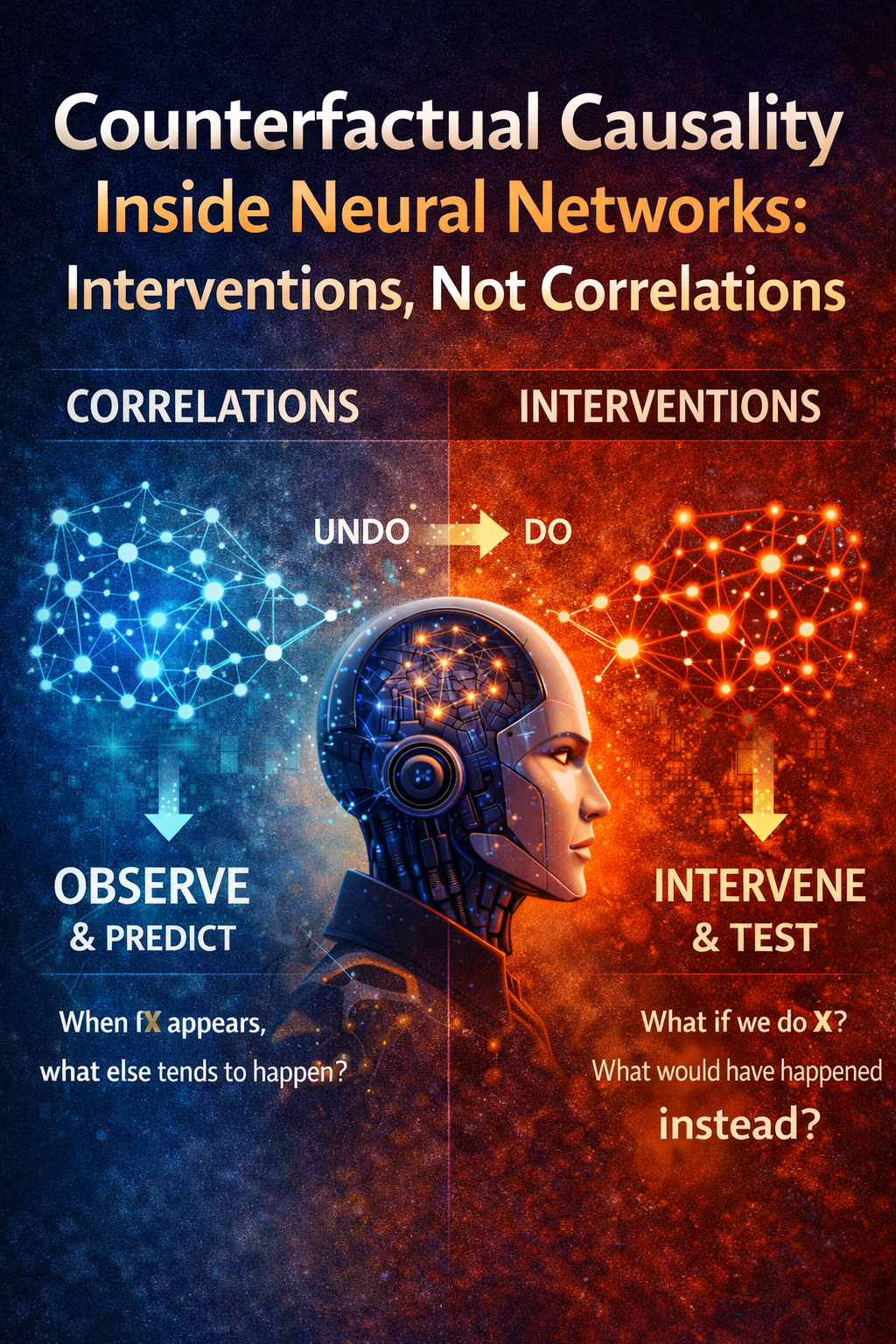
Counterfactual Causality Inside Neural Networks
Neural networks have become extraordinarily good at prediction. Trained on vast amounts of data, they can anticipate outcomes, rank risks, generate language, and spot patterns that humans often miss.
But there is a deceptively simple question that still exposes the deepest limitation of modern AI systems: what would have happened if something had been different?
This “what if” question is not philosophical decoration—it sits at the heart of science, accountability, and decision-making.
While today’s AI excels at learning correlations from the past, real trust in AI depends on counterfactual causality: the ability to reason about alternative actions, interventions, and outcomes in the same underlying situation.
Until neural networks can reliably answer those counterfactual questions, they may appear intelligent—yet remain fundamentally unfit for decisions that change the world.
Most AI systems can tell you what will happen.
Very few can tell you what would have happened if things were different.
That gap — counterfactual causality — is why AI still struggles with accountability, trust, and real decision-making.
This article explains, in plain language, why “what if?” is the hardest problem inside neural networks — and why the future of AI is about intervention, not prediction.
Why Prediction Is Not Causation
Why “what if?” questions are the hardest frontier in modern AI—across transformers, vision models, and enterprise decision systems—and how researchers test causality by intervening inside the model, not just observing outputs.
Neural networks are astonishing at prediction. Give them enough data and they will spot patterns humans miss—across text, images, sensor streams, logs, and complex signals.
But there is a question that still breaks many modern AI systems, including large language models and multimodal models:
What would have happened if something had been different?
That single sentence—what if?—is not a rhetorical flourish. It is the backbone of science, accountability, safety engineering, and good decision-making. It also sits on a different rung of intelligence than correlation.
Researchers often describe the gap using a causal hierarchy: association (seeing), intervention (doing), and counterfactuals (imagining). Counterfactuals sit at the top because they require a model of how the world would change under alternative actions—not merely what tends to co-occur in data. (web.cs.ucla.edu)
This article explains—without formulas and without jargon overload—why counterfactual causality is technically hard inside neural networks, what serious global research is doing about it, and what “real causality testing” looks like when your system is a black box.
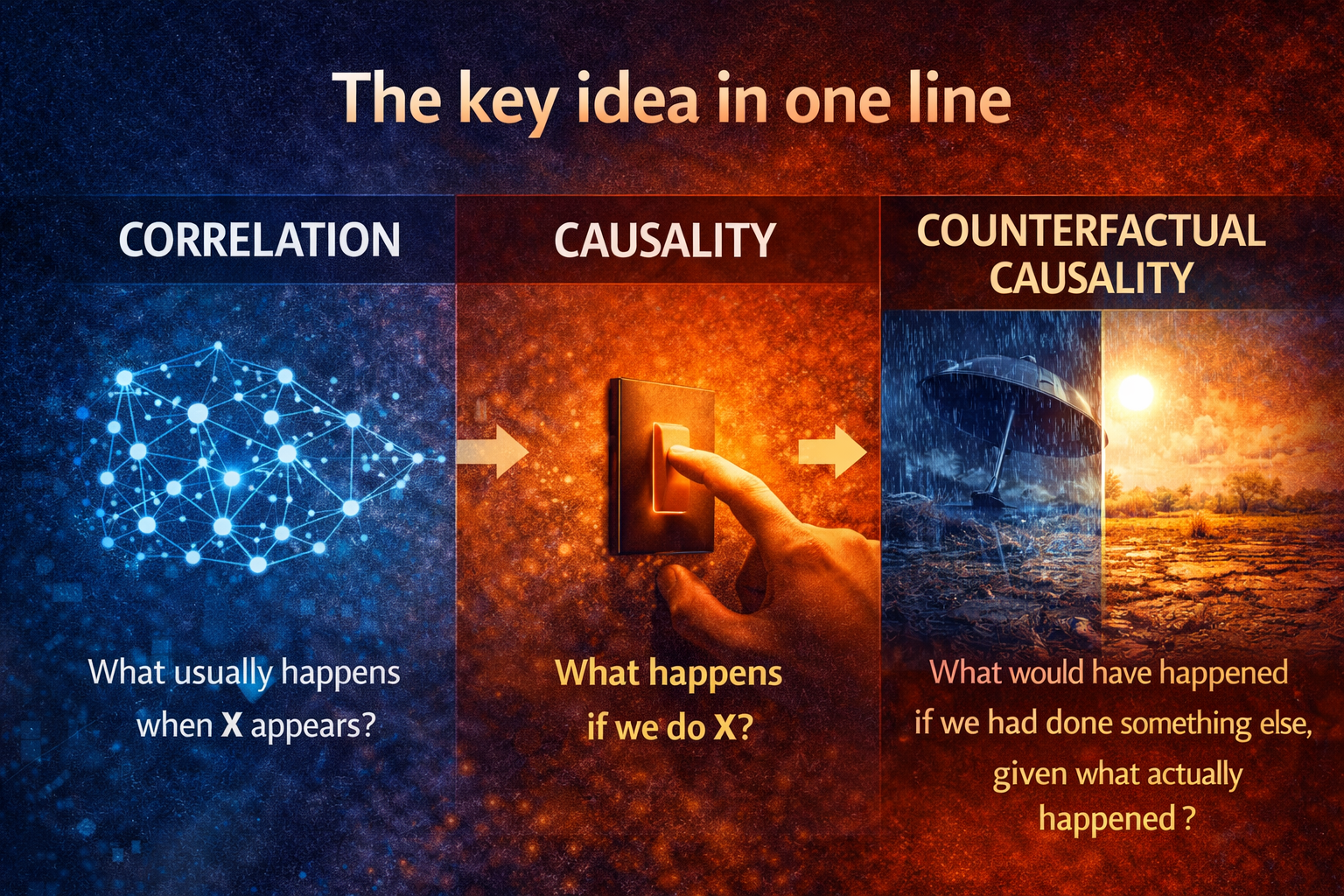
The key idea in one line
- Correlation answers: “What usually happens when X appears?”
- Causality answers: “What happens if we do X?”
- Counterfactual causality answers: “What would have happened if we had done something else, given what actually happened?”
That last one is the hardest—and it’s exactly the question enterprises face when AI decisions affect people, money, safety, access, or compliance.
Why “prediction” is not “cause” (a simple example)
Imagine a model learns these patterns:
- When it’s cloudy, people carry umbrellas.
- When people carry umbrellas, the ground is wet.
A predictive model might treat “umbrella” as a strong signal for “wet ground.” That’s correlation.
Now ask a causal question:
If we force everyone to carry umbrellas on a sunny day, will the ground become wet?
No. The umbrella did not cause the wet ground; the weather did.
This is the central trap: neural networks learn patterns that are extremely useful for prediction but can be wrong under interventions.
Counterfactual causality is even stricter:
Given that the ground was wet today, would it still have been wet if people had not carried umbrellas?
Now you’re reasoning about an alternate world while holding today’s context fixed. That is a different kind of intelligence than pattern matching.
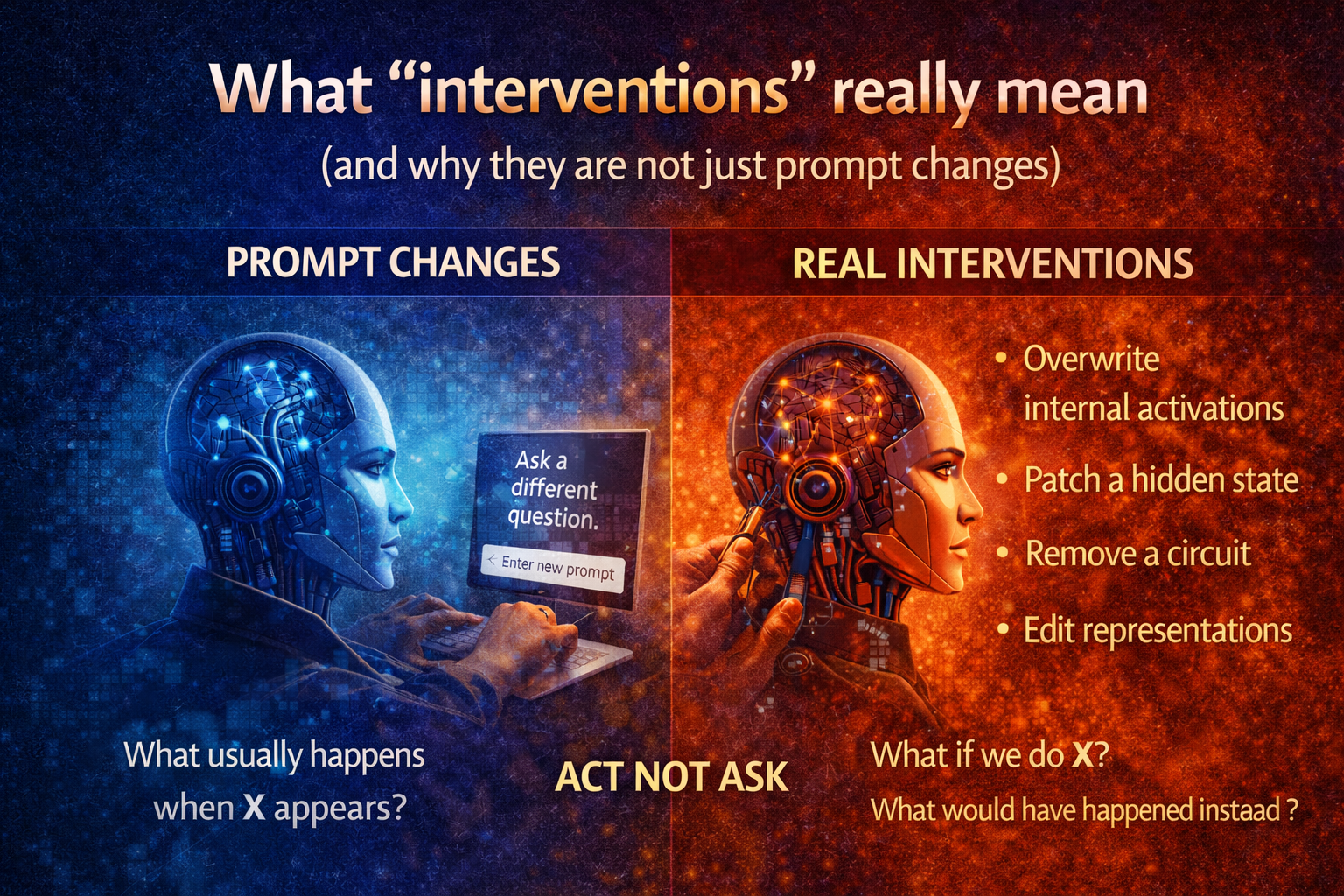
What “interventions” really mean (and why they are not just prompt changes)
In everyday AI conversation, people say “we tested it” when they change a prompt, tweak a feature, or try a different input.
That is not an intervention in the causal sense.
A causal intervention means: you actively set a variable to a value—like flipping a switch—and observe how the rest of the system responds. In causal inference, interventions are fundamentally different from passive observation. (web.cs.ucla.edu)
Inside neural networks, the closest equivalent is not “ask a different question.”
It’s more like:
- overwrite an internal activation,
- patch a hidden state from one run into another,
- remove or reroute a circuit,
- edit a representation,
- and observe what changes downstream.
This is why modern mechanistic interpretability increasingly talks in causal terms: you don’t just narrate what the model “seems to be doing”—you try to test what actually causes behavior.
The “what if?” problem: three everyday counterfactuals
Here are three counterfactual questions humans ask naturally—and why neural networks struggle to answer them without special structure.
1) Decision counterfactual (enterprise)
“If we had not blocked this transaction, would it still have become risky?”
A predictive model can estimate risk. But counterfactuals ask what happens under a different decision policy—especially when policy itself changes behavior.
2) Explanation counterfactual (user-facing)
“What is the smallest change that would have changed the decision?”
This is the idea behind counterfactual explanations in XAI—often framed as actionable recourse: “If X were different, the output would change.” (jolt.law.harvard.edu)
But many such counterfactuals are “decision-boundary counterfactuals,” not necessarily world-causal counterfactuals.
3) Mechanism counterfactual (inside the model)
“If this internal feature had not activated, would the model still produce the same output?”
This is the heart of causal testing in neural networks: counterfactuals over internal variables.
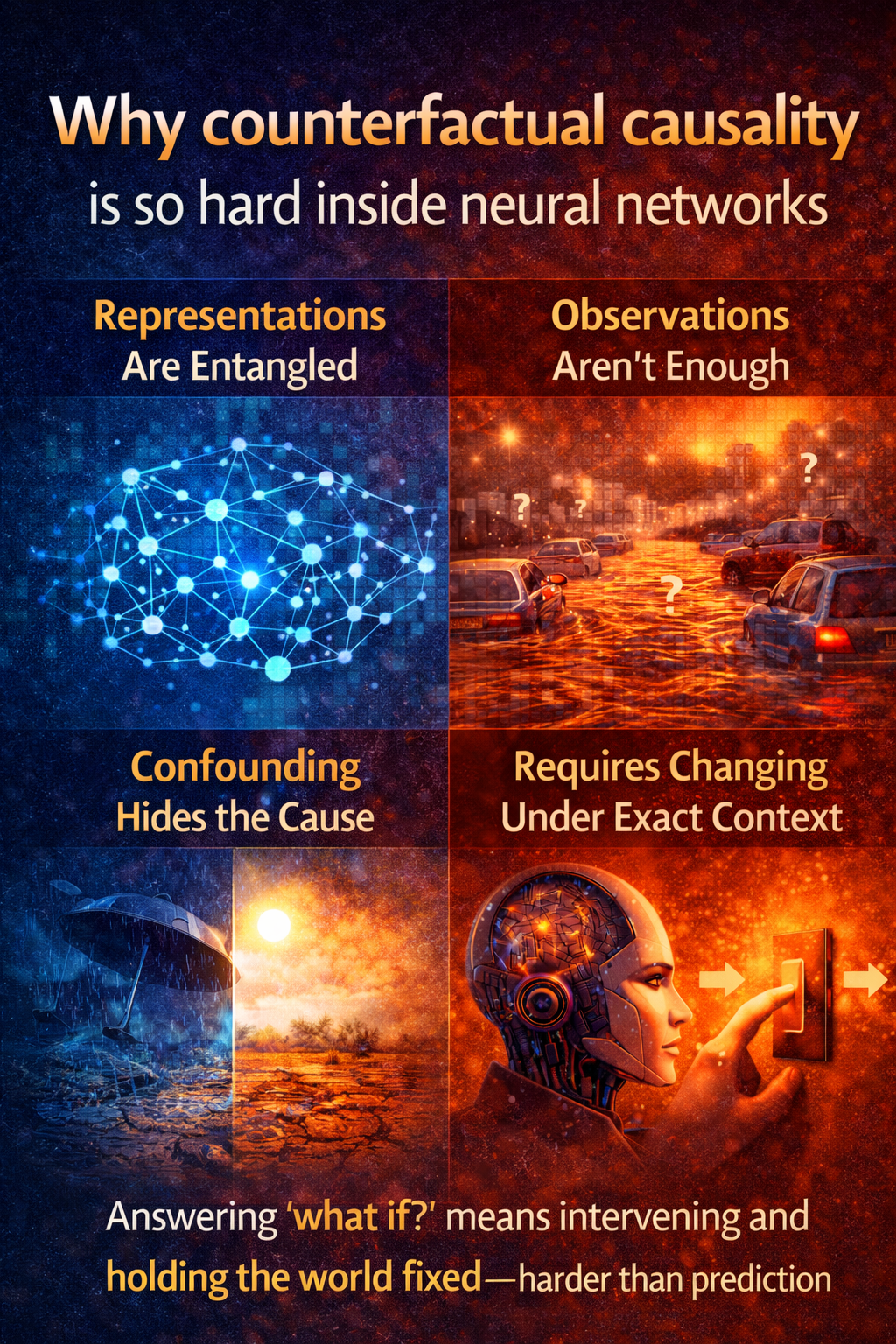
Why counterfactual causality is so hard inside neural networks
Reason 1: Representations are entangled, not clean variables
Neural networks do not store “variables” the way humans do (weather, umbrella, rain). They store distributed patterns across many neurons and layers. That makes it hard to identify the internal “switch” to flip.
This is why causal representation learning matters: it aims to discover high-level causal factors from low-level observations—rather than letting the model build arbitrary predictive features.
A major synthesis paper explains how causality could improve robustness and generalization while emphasizing how open the problem remains. (arXiv)
Reason 2: Observational data is not enough
Counterfactuals require knowing what would have happened under conditions you did not observe. Historical logs reflect a particular world: specific policies, incentives, and measurement biases.
Without intervention data or strong assumptions, “what if?” can be underdetermined—even if prediction accuracy is high.
Reason 3: Confounding hides the real driver
Confounders influence both “cause” and “effect.” In real systems, confounding is everywhere: context, incentives, measurement artifacts, feedback loops, user behavior, seasonality.
A model might learn a proxy that predicts well but fails under intervention because the proxy is not the true cause.
Reason 4: Counterfactuals require holding the world fixed while changing one thing
Counterfactuals aren’t “try a different input.” They’re “replay history with one controlled change.”
That requires a model that can keep context constant (“same situation”), while changing one lever (“different action”). Many models were never trained to represent the “same situation” as a stable object.
Reason 5: In language models, the “world” may be text, not reality
In many tasks, the “environment” is text. So the model’s internal world model is learned from corpora—not from stable causal mechanisms. This makes counterfactual claims about reality fragile.
This is why many serious techniques focus on intervening inside transformers to test causality of internal computations—without overclaiming causal truth about the external world.
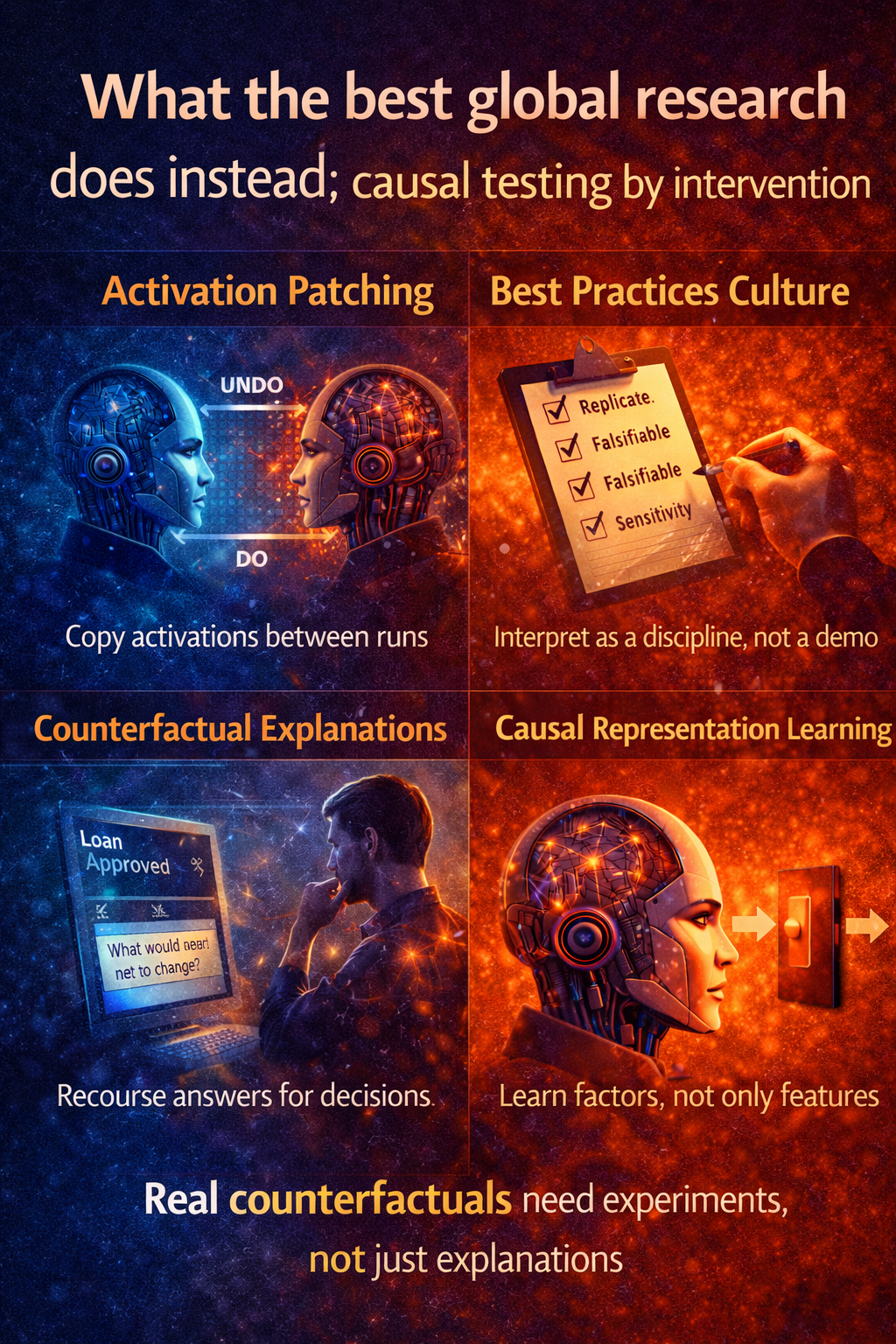
What the best global research does instead: causal testing by intervention
What the best global research does instead: causal testing by intervention
If you want counterfactual causality inside neural networks, you need experiments—not only explanations.
Here are the most useful families of methods, in simple terms.
1) Activation patching (also called causal tracing / interchange interventions)
Idea: Run the model on two related inputs: one “clean” (behaves correctly) and one “corrupted” (misleading). Then copy internal activations from the clean run into the corrupted run at specific layers/positions and see whether correct behavior is restored.
If patching a specific component restores the correct answer, you have evidence that component is a causal contributor—under that experimental setup.
A modern best-practices paper explicitly describes activation patching and its many subtleties (including that it is also referred to as interchange intervention / causal tracing). (arXiv)
A separate paper stresses methodological sensitivity: different corruption methods and metrics can change interpretability conclusions. (arXiv)
Why this matters: It is closer to “do-operations” than observational attribution.
2) “Best practices” culture: interpretability as a discipline, not a demo
Activation patching became popular because it’s powerful—but it’s also easy to misuse. The best-practice literature exists for a reason: many “interpretability wins” fail to replicate if the setup changes. (arXiv)
This is a critical maturity signal for the field: causality inside neural nets is not “a cool visualization.” It is experimental science.
3) Counterfactual explanations for decisions (useful, but different)
For human-facing systems—credit, access, eligibility—counterfactual explanations aim to answer: “What would need to change for a different outcome?” without revealing proprietary internals. Wachter, Mittelstadt, and Russell’s work is foundational here. (jolt.law.harvard.edu)
But remember: these are often recourse counterfactuals—useful for contestability—yet not automatically “true causal mechanisms of the world.”
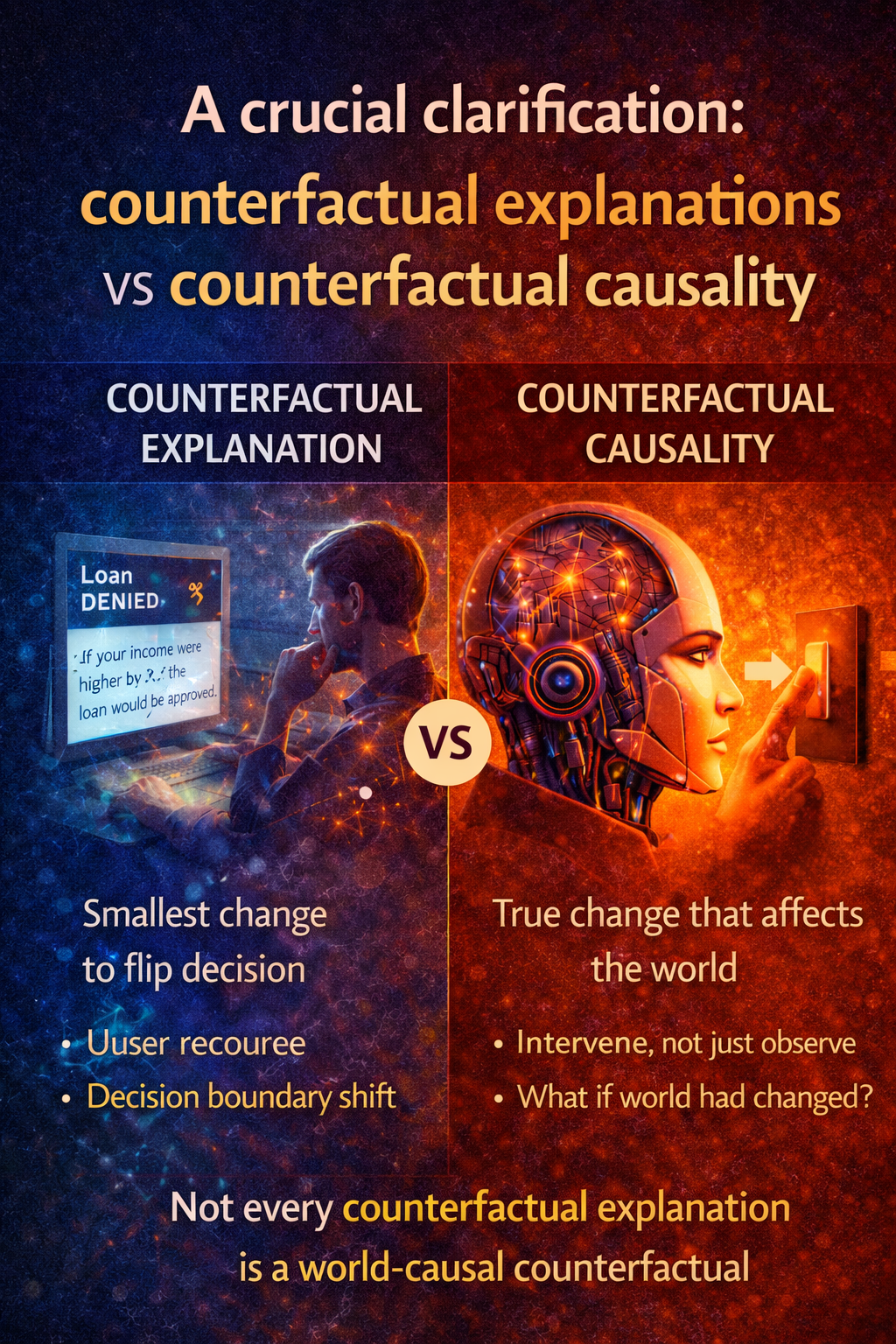
A crucial clarification: counterfactual explanations vs counterfactual causality
Many people encounter counterfactuals like this:
“If your income were higher by X, the model would approve the loan.”
This can be a legitimate counterfactual explanation used for recourse, contestability, and transparency. (jolt.law.harvard.edu)
But here is the deeper point:
A counterfactual explanation can be useful while still not being a causal claim about reality.
It may tell you how to cross a model’s decision boundary, not what would truly change outcomes in the world (where other constraints exist and the world responds).
Counterfactual causality is stricter:
- it demands interventions grounded in mechanisms,
- it demands stability under policy shifts,
- and it demands that “what if” is not just “different input,” but “different world under controlled conditions.”
What “good” looks like: a practical mental model (for leaders)
If you want to evaluate whether someone is doing serious counterfactual causality inside neural networks, ask five questions:
- What was intervened on?
Input? Internal activation? A learned concept? A circuit? - What stayed fixed?
Was “the same context” preserved—or did the entire situation change? - What is the causal claim scope?
“In this model, for this behavior”? Or “in the world”? - Was the hypothesis falsifiable?
Could the experiment have proven the story wrong? - Does it replicate across examples and conditions?
One striking case study is not a theory.
These questions turn “interpretability theater” into real causal science.
Why this matters for Enterprise AI
Even if you never train neural nets, counterfactual causality becomes unavoidable once AI systems:
- make decisions that change behavior,
- operate at scale,
- interact with policies and incentives,
- and trigger accountability.
Because every serious post-incident question is counterfactual:
- “If we had escalated earlier, would the incident have been prevented?”
- “If we had used a different threshold, would harm have reduced without increasing other risk?”
- “If the model had not relied on that proxy, would the outcome have changed?”
This is why enterprise governance must evolve from “monitor metrics” to “understand intervention points.”
If you want the broader operating model context, go through these:
- The Enterprise AI Operating Model (Raktim Singh)
- Enterprise AI Decision Failure Taxonomy (Raktim Singh)
- Enterprise AI Control Plane (2026) (Raktim Singh)
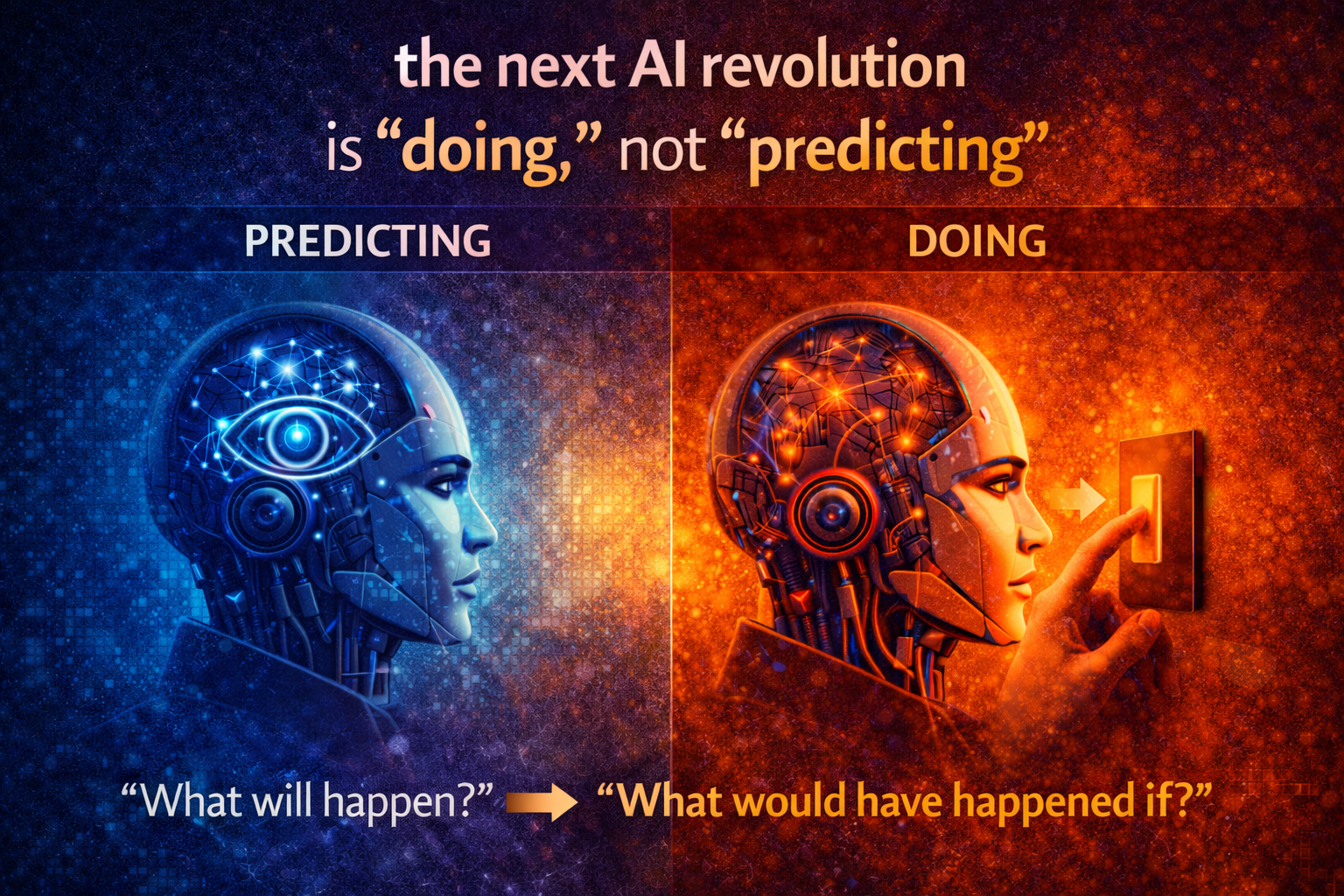
The viral takeaway: the next AI revolution is “doing,” not “predicting”
For the last decade, AI’s superpower has been seeing patterns.
The next decade’s superpower will be changing the world safely—and proving what would have happened if it changed differently.
That is why counterfactual causality is not a niche academic obsession. It is the missing bridge between:
- prediction and decision,
- explanation and accountability,
- model performance and real-world trust.
A model that can’t answer “what if?” is not ready to be trusted with “do it.”
Conclusion: what to build if you want counterfactual-ready AI
Counterfactual causality inside neural networks is hard because it asks AI to do what humans do instinctively: replay reality with one controlled change.
The path forward is becoming clearer:
- Build representations that map closer to causal factors, not just predictive embeddings (arXiv)
- Use intervention-based methods like activation patching to test what actually drives behavior (arXiv)
- Treat interpretability as experimental science: reproducible setups, falsifiable claims, sensitivity checks (arXiv)
- Use counterfactual explanations for recourse—but do not confuse them with world-causal counterfactual truth (jolt.law.harvard.edu)
- Keep the causal hierarchy honest: association ≠ intervention ≠ counterfactual (web.cs.ucla.edu)
The result is not just smarter AI. It is more governable AI—AI whose decisions can be audited not only by what it predicted, but by what would have happened if it acted differently.
That is the technical frontier behind trustworthy autonomy.
FAQ
What is counterfactual causality in neural networks?
It is the ability to answer “what would have happened if X were different,” ideally by performing controlled interventions (including on internal activations) and observing which downstream behaviors change. (web.cs.ucla.edu)
Why isn’t correlation enough?
Correlation captures patterns in observed data. Causality asks what changes under interventions—especially when policies, incentives, and environments shift. (web.cs.ucla.edu)
What is activation patching / causal tracing?
A technique where internal activations from one run are copied into another to test which components causally contribute to behavior, with important best-practice cautions. (arXiv)
Are counterfactual explanations the same as counterfactual causality?
Not always. Counterfactual explanations often support user recourse (“smallest change to flip outcome”) without claiming true causal mechanisms of the world. (jolt.law.harvard.edu)
Why does enterprise AI care about counterfactuals?
Because accountability questions after incidents are fundamentally counterfactual: “If we had acted differently, would harm have occurred?” This is central to mature governance and decision control. (Raktim Singh)
Glossary
- Association: Pattern-finding from data; correlation-level understanding. (web.cs.ucla.edu)
- Intervention: Controlled action—setting a variable and measuring downstream change. (web.cs.ucla.edu)
- Counterfactual: “What would have happened if…” under the same context. (web.cs.ucla.edu)
- Causal representation learning: Learning representations aligned with causal factors, not arbitrary predictive features. (arXiv)
- Activation patching: Replacing internal activations to test causal contribution to outputs. (arXiv)
- Counterfactual explanations: Recourse-oriented “small change → different decision” explanations, often without opening the black box. (jolt.law.harvard.edu)
References & further reading
- Pearl: The Three-Layer Causal Hierarchy (association, intervention, counterfactual). (web.cs.ucla.edu)
- Schölkopf et al.: Towards Causal Representation Learning (major synthesis on causality + ML). (arXiv)
- Heimersheim & Nanda: How to Use and Interpret Activation Patching (best practices, pitfalls). (arXiv)
- Zhang & Nanda: Towards Best Practices of Activation Patching in Language Models (method sensitivity). (arXiv)
- Wachter, Mittelstadt, Russell: Counterfactual Explanations Without Opening the Black Box (recourse framing; GDPR context). (jolt.law.harvard.edu)



Raktim Singh is an AI and deep-tech strategist, TEDx speaker, and author focused on helping enterprises navigate the next era of intelligent systems. With experience spanning AI, fintech, quantum computing, and digital transformation, he simplifies complex technology for leaders and builds frameworks that drive responsible, scalable adoption.