

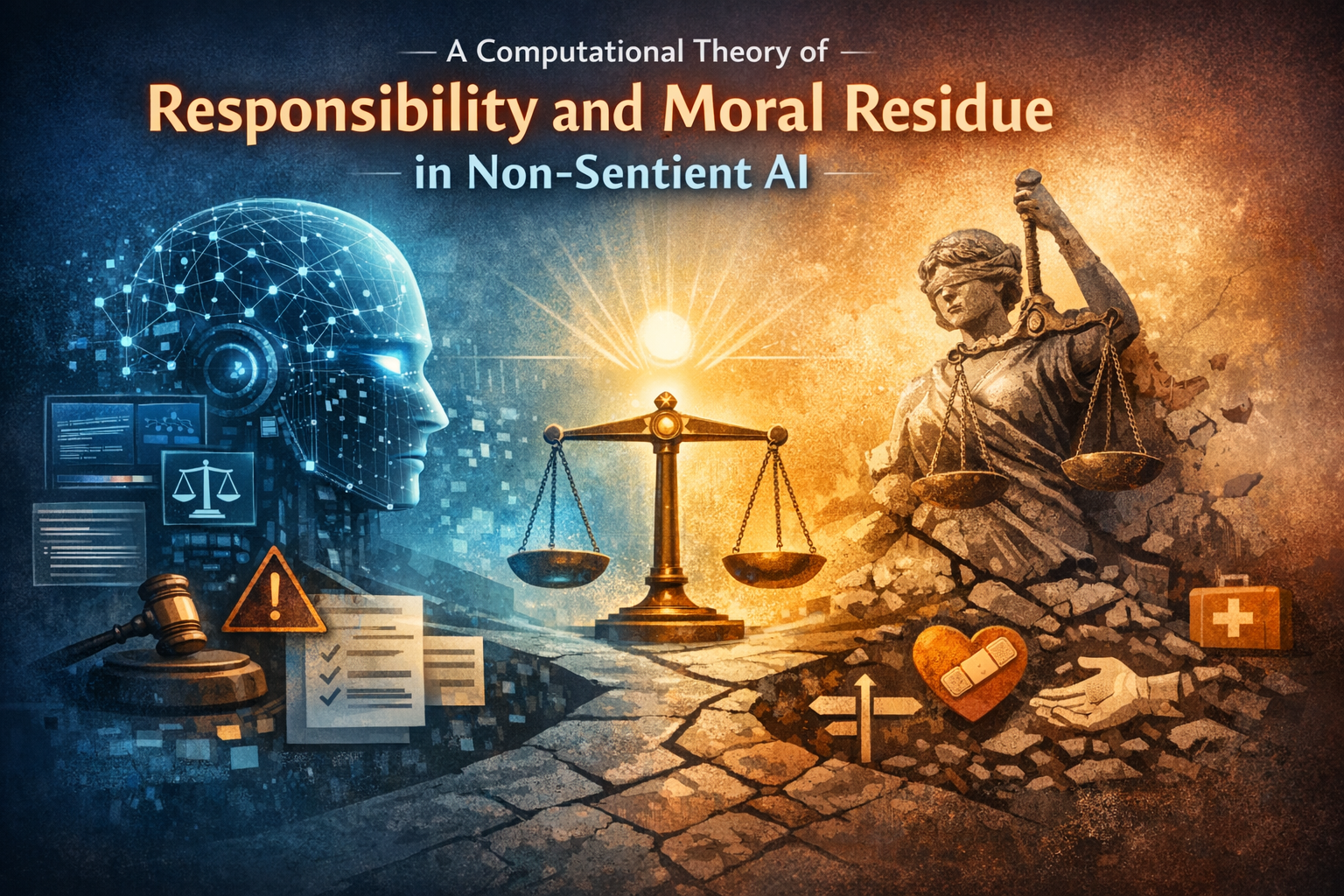
A Computational Theory of Responsibility and Moral Residue in Non-Sentient AI
A curious gap is emerging at the heart of modern AI systems—one that accuracy benchmarks, compliance checklists, and alignment frameworks consistently fail to capture.
An AI system can make a decision that is statistically correct, procedurally compliant, and fully aligned with stated policies, yet still leave behind an uncomfortable sense that something important remains unresolved.
In hospitals, banks, courts, and digital platforms, these moments are becoming familiar: the model is “right,” but the outcome still feels wrong.
This gap is not emotional noise or resistance to automation. It is a signal that accountability is not the same as responsibility—and that enterprise AI is missing a deeper, computational layer required for safe, defensible autonomy at scale.
Computational responsibility is the ability of a decision system to prove that it acted under legitimate authority, considered foreseeable harm, respected constraints, offered recourse, and executed repair—even when the outcome is painful.
Why Accurate AI Can Still Be Irresponsible: Moral Residue and the Missing Layer of Enterprise AI
A strange thing happens in real deployments that never shows up on benchmark leaderboards.
A system can make a decision that is statistically strong, procedurally compliant, and even “aligned” with a policy—yet still feel morally unfinished.
A patient is deprioritized by triage software because the survival model predicts low benefit. The model is “right.” But the clinical team feels they crossed a line.
A fraud model blocks a customer account to prevent abuse. The score is “right.” But the customer misses a medical payment.
A content moderation agent removes a post to reduce harm. The rule is “right.” But a human story disappears.
That leftover discomfort is not a bug in human emotion. It’s a signal that accountability is not the same as responsibility—and if enterprises want AI systems that can act safely at scale, they will eventually need to operationalize that difference.
This article makes two claims:
- Responsibility is a computational property of a decision process, not a personality trait.
- Moral residue is what remains when a decision is permissible, yet still leaves an unfulfilled moral demand.
Philosophers call the underlying situation a moral dilemma: a conflict between moral requirements where any available option carries real moral cost. In real institutions, these dilemmas don’t disappear when you introduce automation. They multiply.
So we need a theory that is:
- Computational (you can implement it)
- Non-sentient (no hand-wavy claims about machine feelings)
- Institution-ready (auditable, governable, defensible)
Let’s build it—without math, without mysticism, and with examples you can recognize.
Accuracy predicts outcomes. Responsibility justifies tradeoffs. A model can be accurate and still be irresponsible.
The Enterprise AI Operating Model.
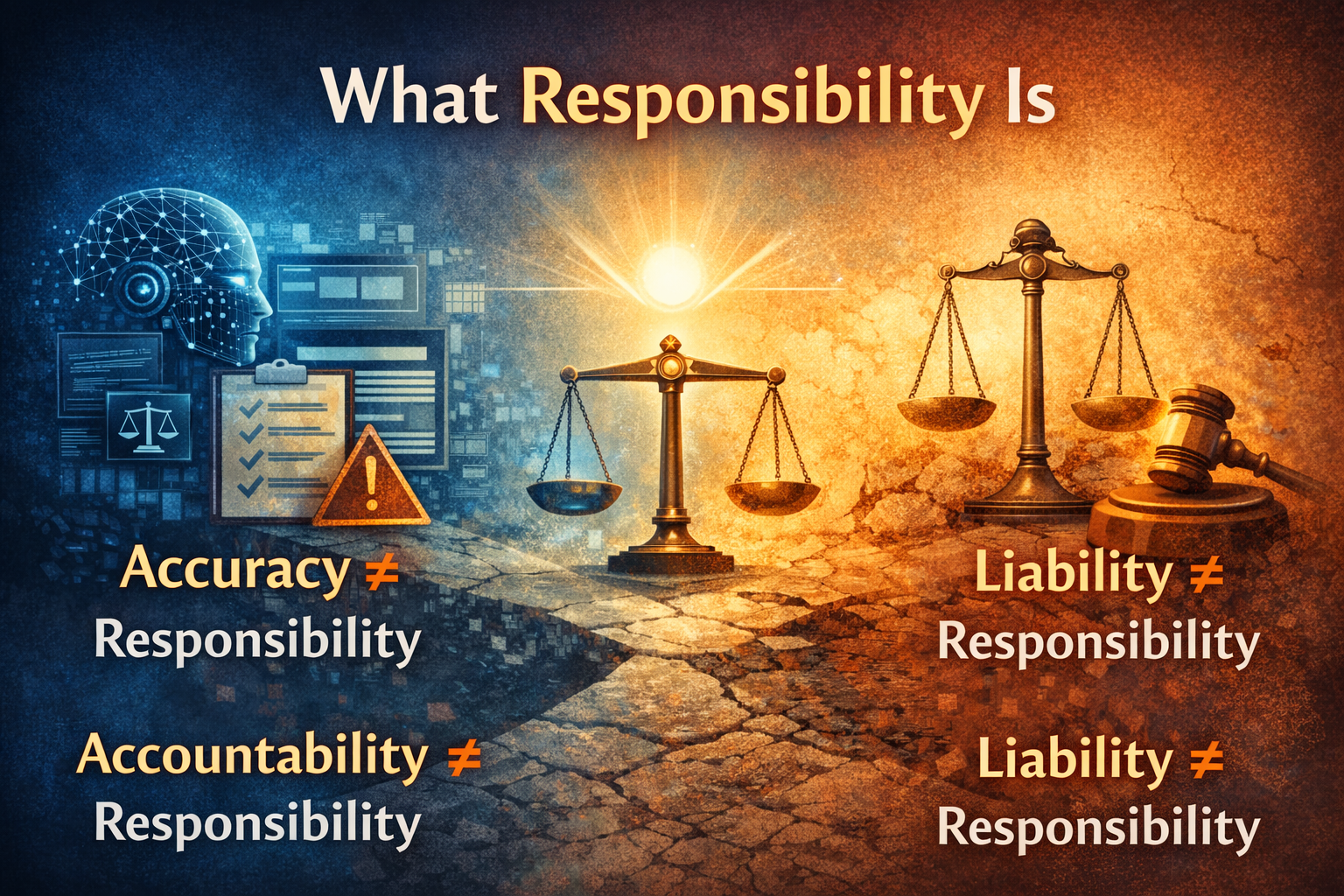
What responsibility is (and what it isn’t)
Responsibility ≠ accuracy
Accuracy predicts outcomes. Responsibility owns consequences under constraints—especially when tradeoffs are unavoidable.
A model can be accurate and still cause avoidable harm because:
- it triggers irreversible actions too easily,
- it offers no recourse,
- it optimizes internal metrics while ignoring duty-of-care realities,
- it scales decisions without scaling repair.
Responsibility ≠ accountability
Accountability answers: Who is answerable? (roles, logs, escalation paths)
Responsibility answers: Was the decision process defensible—and what do we still owe now?
A system can be accountable (excellent logs) and still irresponsible (no recourse, poor duty-of-care design).
For a deeper ownership lens, go:
Who Owns Enterprise AI? Roles, Accountability, Decision Rights
Responsibility ≠ liability
Liability is assigned after harm. Responsibility is designed before deployment.
This is why serious frameworks emphasize lifecycle governance—because responsibility is not a “model property.” It’s a system property implemented through policies, controls, and ongoing monitoring. But governance alone is not enough.
The missing layer: even with governance, you still need decision-level responsibility logic—the “why this tradeoff was acceptable” layer.
That’s where moral residue lives.
Most “Responsible AI” programs cover governance and documentation. The missing piece is decision-level moral accounting: what was sacrificed, who was harmed, why it was unavoidable, and what the institution will do next.
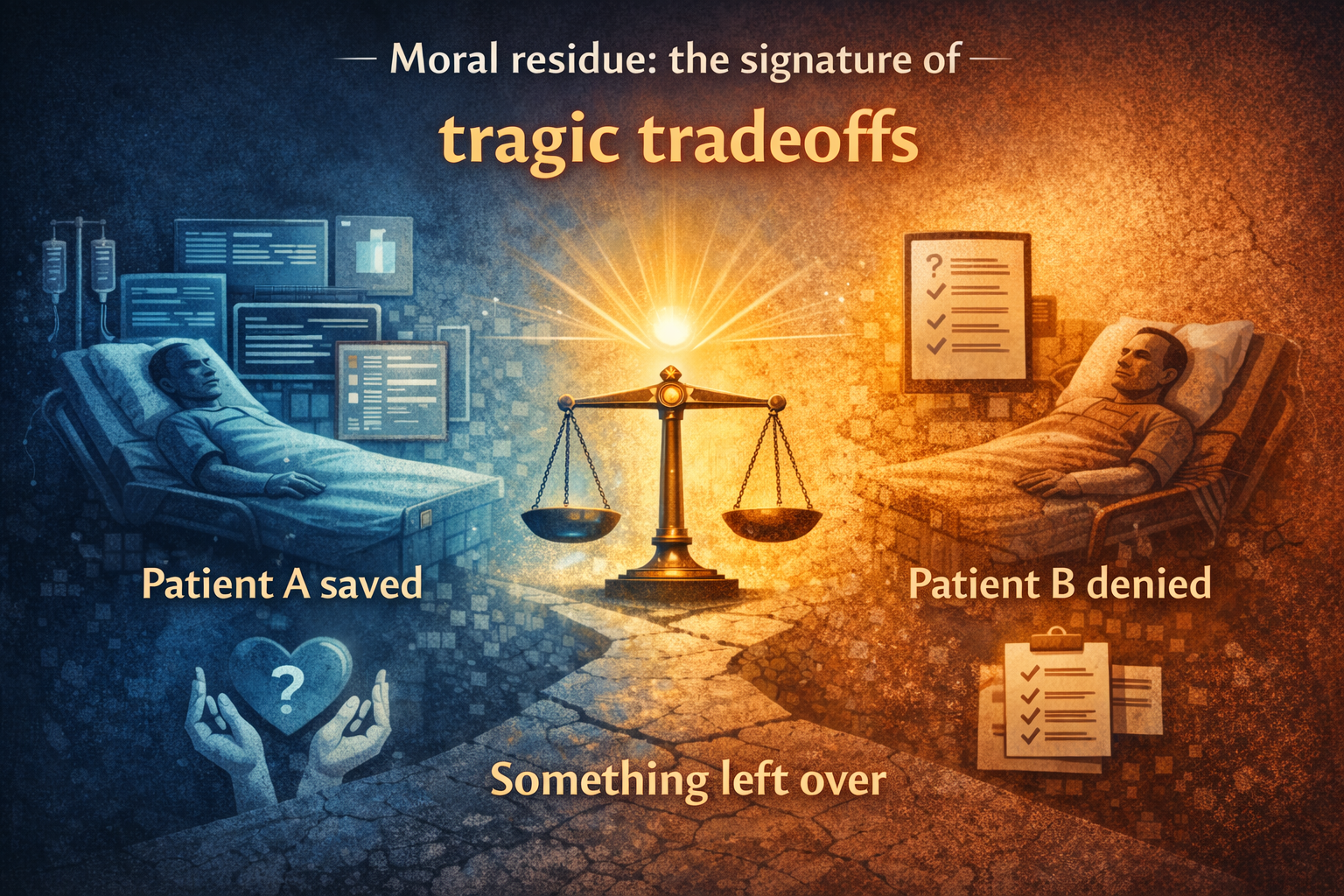
Moral residue: the signature of tragic tradeoffs
“Moral residue” is easiest to see in triage.
Example 1: Triage AI — the least-bad choice still hurts
A hospital has one ICU bed. Two patients need it. A model recommends Patient A because predicted survival benefit is higher. The team follows it.
Even if the decision is defensible, something remains:
- Patient B’s claim does not vanish.
- The institution still owes something: explanation, compassion, support, maybe policy revision.
That “something left over” is the residue: the unmet moral demand that continues after the decision.
Now notice what matters: the AI didn’t “feel” anything. The residue is not in the silicon. It exists in the moral structure of the situation—and in the institution’s obligations after the decision.
So the right question isn’t: “Can AI have moral feelings?”
The right question is: “Can an AI-mediated organization compute what it still owes after a permissible harm?”
That is the responsibility problem.
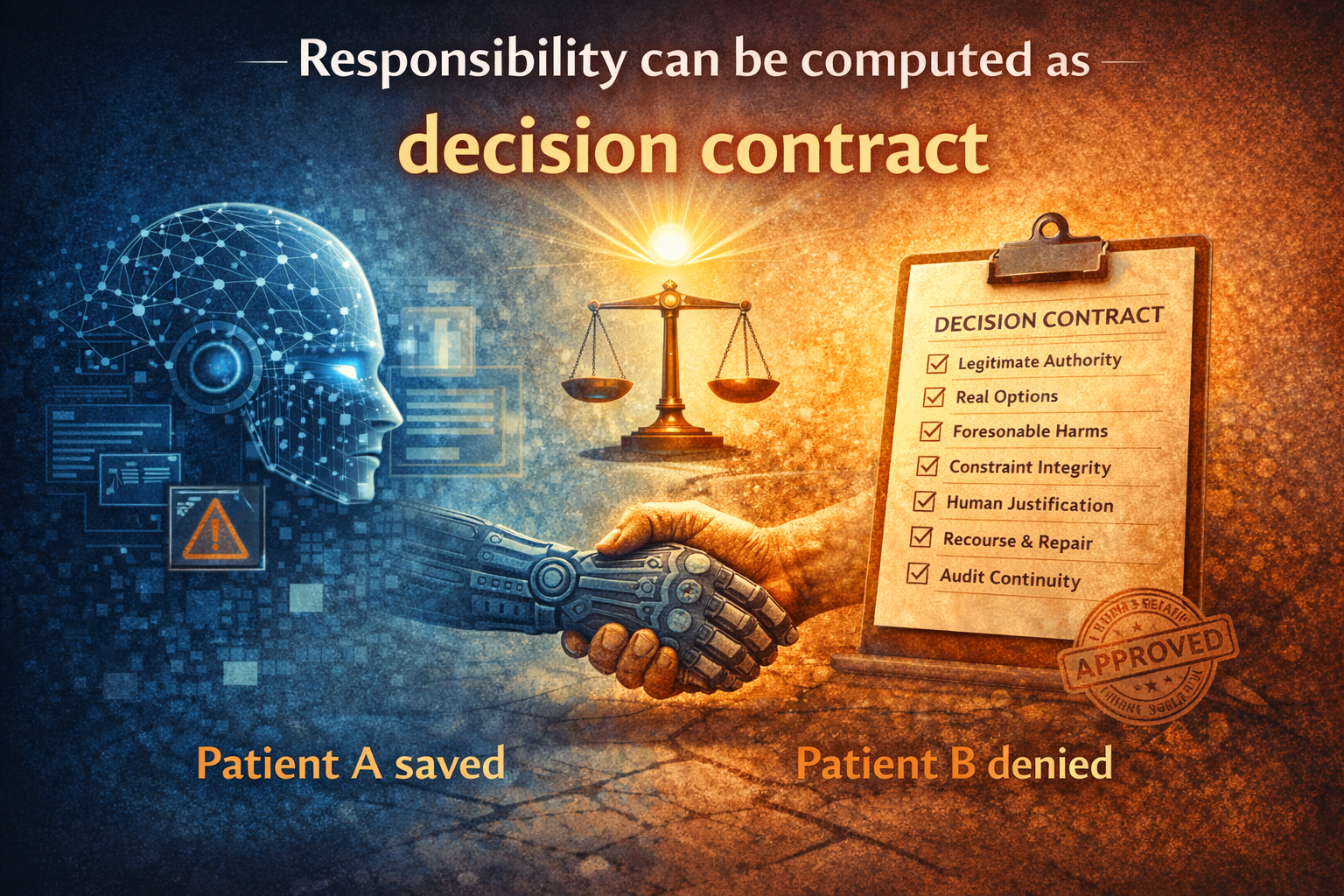
The core claim: responsibility can be computed as a decision contract
Here’s the practical definition you can implement.
A decision process is responsible to the extent that it can demonstrate—before and after action—that:
- Authority is legitimate (who/what is allowed to decide)
- Options were real (meaningful alternatives existed)
- Foreseeable harms were considered (not just predicted outcomes)
- Constraints were respected (policy, law, safety boundaries)
- Tradeoffs were justified in human terms
- Recourse and repair exist when harm occurs
- Learning does not erase accountability (audit continuity over time)
This definition is intentionally enterprise-friendly: it reads like something you can encode into operating procedures, logging requirements, oversight playbooks, and governance review.
If you want to understand Enterprise Runbook Crisis:
The Enterprise AI Runbook Crisis
Because responsibility is not one decision. It is a repeatable capability.
If your AI system cannot explain and repair the harm created by the least-bad choice, you don’t have responsible AI—you have automated harm with good metrics.
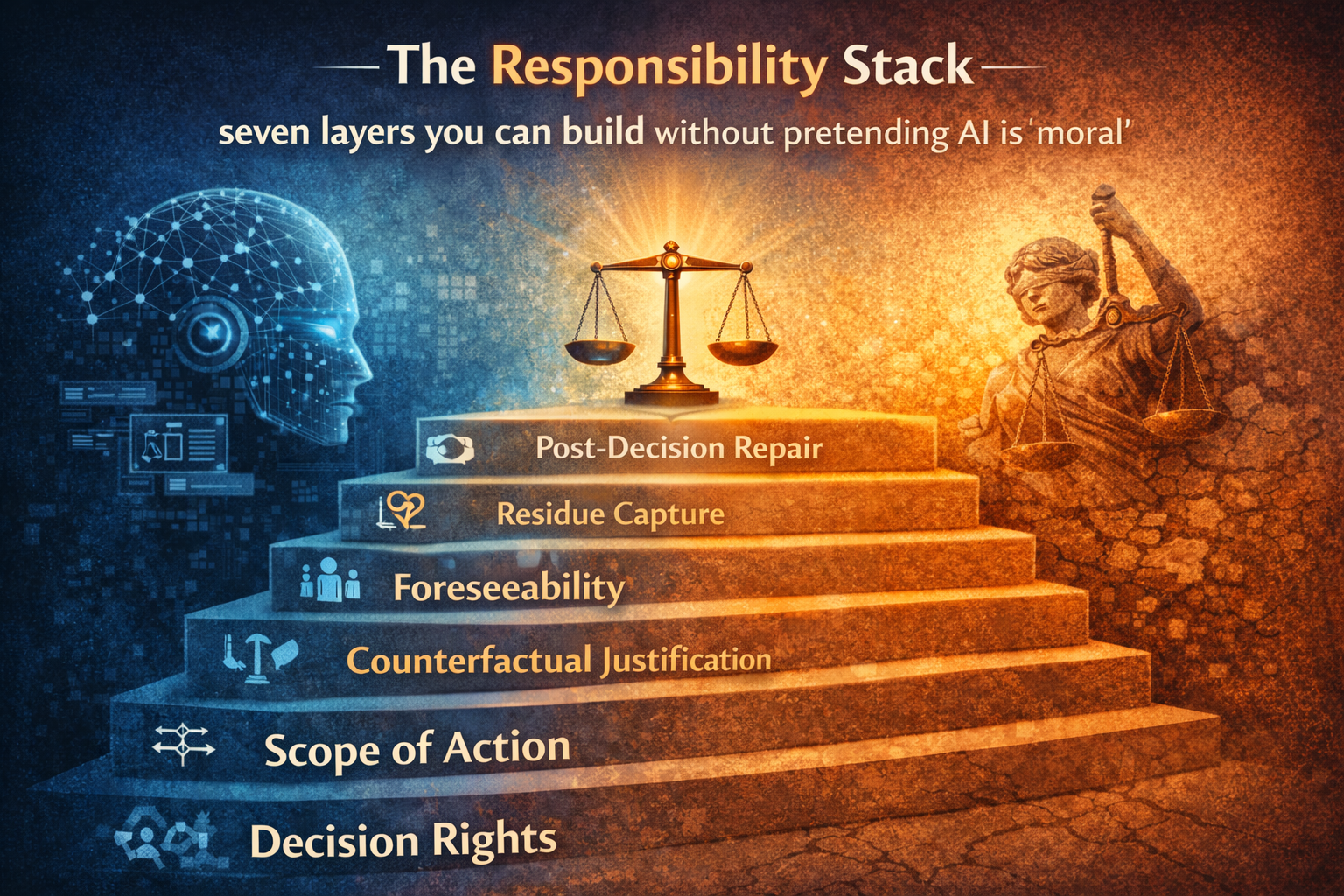
The Responsibility Stack: seven layers you can build without pretending AI is “moral”
Think of responsibility like a stack—each layer answers a different “what makes this defensible?” question.
Layer 1: Scope of action — advice vs action
Is the system recommending, or executing?
A recommender that a clinician reviews has a different responsibility profile than an agent that:
- blocks accounts,
- denies services,
- dispatches emergency resources,
- triggers legal or compliance actions.
Design pattern: define “action boundaries” and escalation gates for irreversible actions.
The more irreversible the action, the higher the burden of responsibility evidence.
Layer 2: Decision rights — legitimacy
Who owns the decision: model, operator, supervisor, committee?
Responsibility collapses when ownership is fuzzy—because “who could have stopped this?” becomes unanswerable.
Design pattern: explicit decision owner and override owner per action class.
Who Owns Enterprise AI?
Layer 3: Foreseeability — duty of care
Responsibility begins where harm is reasonably foreseeable.
This is where accuracy is insufficient. A bank model may be accurate on default risk, but responsibility requires anticipating foreseeable harms of false positives: missed rent, missed medical payments, cascading penalties.
Design pattern: foreseeable-harm mapping: “If we are wrong, how can people be harmed, and how quickly?”
A responsible system is optimized for harms, not just errors.
Layer 4: Counterfactual justification — “why this, not that?”
People don’t accept “because the model said so.” They ask:
“What would have changed the decision?”
Counterfactual explanations are a bridge between technical models and human recourse because they communicate:
- what variables mattered,
- what could realistically be changed,
- what pathway exists to appeal or improve eligibility.
Design pattern: Counterfactual Recourse (“If X had been different, Y would have happened”), paired with appeal processes.
Recourse is responsibility made visible.
Layer 5: Constraint integrity — rules that don’t melt under pressure
A responsible process must show which constraints were binding:
- safety constraints
- privacy constraints
- fairness constraints
- policy constraints
- human-rights constraints (in regulated contexts)
Design pattern: “policy-as-code” constraints + logged checks per decision.
Constraints are not ethics statements; they are executable boundaries.
Layer 6: Residue capture — record what remains morally unpaid
This is the missing layer in most AI systems.
If a decision is a tragic tradeoff, record:
- what value was compromised,
- who was harmed,
- why the compromise was unavoidable,
- what the institution will do next.
This is not sentiment. It is structured moral accounting.
Design pattern: a Moral Residue Ledger (internal, not public-facing):
- Residue type: unmet claim vs practical remainder
- Repair plan: apology, compensation, review, escalation, policy improvement
- “No-repeat” signals: how to reduce residue frequency over time
Moral residue is institutional debt. Responsible systems track and pay it down.
Layer 7: Post-decision repair — responsibility continues after action
Responsibility is not only choosing well. It is repairing well:
- rapid appeals,
- reversibility where possible,
- restitution where not,
- learning updates with audit continuity.
Design pattern: Repair SLAs + human escalation + “decision rewind” mechanisms where feasible.
Responsibility persists after the decision—because harm persists after the decision.
Three examples that expose the gap between “aligned” and “responsible”
Example 1: Loan denial that is “fair” but still irresponsible
A credit model is calibrated, bias-tested, legally reviewed. It denies a loan.
It may still be irresponsible if:
- the applicant had a simple path to eligibility but never received recourse guidance,
- the denial triggered foreseeable cascading harms,
- there is no appeal route or human review for borderline cases.
A responsible system doesn’t just output “No.”
It outputs: No + Why + What would change it + How to appeal.
“Fairness” without recourse often feels like cruelty with clean metrics.
Example 2: Fraud prevention that protects the system but harms the innocent
An aggressive fraud system blocks accounts to reduce losses. It succeeds. Yet it creates moral residue:
- “We protected the platform.”
- “We harmed a legitimate customer under uncertainty.”
A responsibility-by-design response:
- tiered actions (hold vs block),
- time-bounded holds,
- immediate escalation for hardship signals,
- residue logging when irreversibility happens.
A responsible system treats false positives as human events, not statistical noise.
Example 3: A discharge optimizer that makes efficient decisions
A discharge model optimizes bed utilization and recommends early discharge. The data says it’s safe on average.
Responsibility fails if:
- it cannot represent rare social realities (no caregiver at home),
- it lacks oversight triggers for vulnerable cases,
- it optimizes throughput while ignoring duty of care.
Here moral residue becomes a governance instrument: it flags decisions that were efficient but morally costly—and forces policy revision, not just model tuning.
Responsibility protects the outliers—because that’s where real harm lives.
Why this is uniquely hard for non-sentient AI
Humans carry residue because we understand:
- promises,
- duties,
- relationship obligations,
- sacred values,
- dignity,
- context that data cannot capture.
AI doesn’t have that substrate. So responsibility must be externalized into system design:
- constraints,
- oversight,
- counterfactual recourse,
- residue logging,
- repair workflows,
- organizational ownership.
In other words:
Responsibility is not something the model “has.”
It is something the institution implements.
This is exactly why the most important AI problems are often operating-model problems.
Understand Enterprise AI Operating model: The Enterprise AI Operating Model
Responsibility is not a model feature. It is an operating model capability.
A practical blueprint: Responsibility-by-Design for enterprise AI
If you want this to work in production, implement four artifacts.
1) The Decision Contract
A short spec per decision type:
- intended purpose,
- allowed actions,
- prohibited actions,
- escalation triggers,
- required explanations,
- required recourse.
A Decision Contract is a spec for moral defensibility.
2) The Counterfactual Recourse Bundle
For any adverse decision:
- minimal change(s) that would alter the outcome,
- an appeal path,
- time-to-resolution SLAs.
If users can’t change the outcome, you haven’t shipped a decision—you’ve shipped a verdict.
3) The Moral Residue Ledger
For tragic tradeoffs:
- record remainder,
- record repair,
- record policy lessons.
What you do after harm is part of the decision, not an afterthought.
4) The Oversight Playbook
Human oversight is not “a human in the loop.” It’s a designed capability:
- when humans must intervene,
- what they are empowered to do,
- how overrides are logged,
- how feedback changes policy.
If your organization is serious about scaling AI responsibly, this playbook is not optional.
For the “institutional reuse” angle—how a company learns across repeated decisions—read this narrative:
The Intelligence Reuse Index
Because responsibility is not only avoiding harm. It’s improving the system that keeps generating it.
The key insight : the least-bad-choice test
Here’s a one-line test worth sharing:
If your AI system cannot explain and repair the harm created by the least-bad choice, you don’t have responsible AI—you have automated harm with good metrics.
That’s the heart of moral residue.
Glossary
Computational responsibility: A decision-process property that demonstrates legitimacy, foreseeable-harm consideration, constraint integrity, justification, recourse, and repair.
Moral residue: The lingering “unpaid” moral remainder after a defensible decision that still harms someone.
Moral dilemma: A conflict between moral requirements where any option carries moral cost.
Foreseeable harm: Harm that a reasonable designer/operator should anticipate as a possible consequence of errors or misuse.
Decision rights: Explicit ownership of who can decide, override, escalate, and repair outcomes.
Counterfactual recourse: Actionable explanation of what would change the decision and how to appeal.
Constraint integrity: Assurance that safety, policy, fairness, and privacy boundaries are enforced at runtime—not just stated in documents.
Moral Residue Ledger: An internal governance artifact that records the remainder and prescribes repair workflows for tragic tradeoffs.
Post-decision repair: Appeals, reversibility, restitution, and learning updates that preserve audit continuity.
FAQ
1) Can AI be responsible without consciousness?
Not in the human sense. But responsibility can be implemented through decision contracts, oversight, counterfactual recourse, and repair workflows—so the organization computes and enforces responsibility even if the model does not “feel” it.
2) What is moral residue in AI decisions?
It is the lingering unpaid moral remainder after a defensible tradeoff—when the least-bad choice still causes unavoidable harm.
3) Why isn’t accountability enough?
Because logs and owners don’t automatically provide justification, recourse, or repair. Accountability answers “who answers?” Responsibility answers “was the process defensible—and what do we still owe now?”
4) What does “responsibility-by-design” actually mean?
It means building four artifacts: Decision Contract, Counterfactual Recourse Bundle, Moral Residue Ledger, and Oversight Playbook—so responsibility is enforceable, auditable, and improvable over time.
5) Where should enterprises start?
Start with one high-impact decision (credit denial, fraud lock, triage prioritization). Implement the four artifacts above and measure how often residue events occur—and how quickly you repair them.
1️⃣ What is computational responsibility in AI?
Answer :
Computational responsibility in AI is the ability of a decision system to prove that it acted under legitimate authority, considered foreseeable harm, respected constraints, offered recourse, and executed repair—even when the outcome is painful. Unlike accuracy or compliance, responsibility focuses on justifying tradeoffs and handling unavoidable harm. It is a property of the decision process, not the model itself.
2️⃣ What is moral residue in AI systems?
Answer:
Moral residue in AI refers to the unresolved moral demand that remains after a defensible decision still causes unavoidable harm. Even when an AI system makes the least-bad choice, moral residue captures what is still owed—such as explanation, recourse, or repair. It highlights why correct decisions can still feel morally unfinished.
3️⃣ Why is accuracy not enough for responsible AI?
Answer:
Accuracy predicts outcomes, but responsibility justifies tradeoffs. An AI system can be accurate and compliant while still causing foreseeable harm, offering no recourse, or triggering irreversible consequences too easily. Responsible AI requires mechanisms for explanation, appeal, and repair—not just correct predictions.
4️⃣ What is the difference between accountability and responsibility in AI?
Answer:
Accountability answers who is answerable for an AI decision—through roles, logs, and compliance. Responsibility answers whether the decision process itself was defensible and what the organization still owes after harm occurs. An AI system can be accountable yet irresponsible if it lacks recourse or repair mechanisms.
5️⃣ Can AI be responsible without consciousness?
Answer:
AI does not need consciousness to be responsible. Responsibility can be implemented computationally through decision contracts, human oversight, counterfactual recourse, and post-decision repair workflows. In this model, responsibility is enforced by institutional design, not machine intent.
6️⃣ What does “responsibility-by-design” mean in enterprise AI?
Answer:
Responsibility-by-design means embedding responsibility into AI systems through explicit decision rights, foreseeable-harm analysis, constraint enforcement, recourse paths, and repair workflows. Instead of relying on post-hoc blame, enterprises design responsibility as an operational capability.
7️⃣ How should AI systems handle unavoidable harm?
Answer:
When harm is unavoidable, responsible AI systems must document what value was compromised, who was harmed, why the tradeoff was necessary, and how the institution will repair or compensate. This structured handling of moral residue prevents harm from becoming invisible institutional debt.
8️⃣ What is the “least-bad-choice” problem in AI?
Answer:
The least-bad-choice problem arises when every available AI decision causes some harm. In such cases, responsibility is measured not by outcome alone but by whether the system can explain the tradeoff and repair its consequences. Moral residue is the signal that such repair is required.
9️⃣ Why do aligned AI systems still cause moral discomfort?
Answer:
Aligned AI systems optimize for stated objectives and constraints, but alignment does not guarantee responsibility. Moral discomfort arises when a system follows the rules yet violates unmodeled duties of care or leaves people without recourse. Moral residue captures this gap.
🔟 What is the responsibility layer enterprises are missing in AI?
Answer:
The missing responsibility layer in enterprise AI is the ability to justify, audit, and repair decisions that involve tragic tradeoffs. Governance and alignment manage risk, but responsibility manages moral cost. Without this layer, organizations scale harm faster than they can explain or fix it.
Conclusion: the responsibility layer enterprises have been missing
In the first wave of enterprise AI, we asked: Is the model accurate?
In the second wave, we asked: Is it governed and aligned?
The next wave asks a harder question:
When the system makes an unavoidable tradeoff, can it prove it acted responsibly—and can it compute what it still owes afterward?
That is the shift from automated decisions to accountable autonomy.
And it starts with a simple promise:
Don’t just optimize outcomes. Pay down moral residue.
References and further reading
Foundational concepts: moral dilemmas & moral residue
- Stanford Encyclopedia of Philosophy — Moral Dilemmas
https://plato.stanford.edu/entries/moral-dilemmas/
Canonical reference on moral dilemmas, moral remainder, and why “right choices” can still leave moral cost. - Stanford Encyclopedia of Philosophy — Moral Responsibility
https://plato.stanford.edu/entries/moral-responsibility/
Clarifies responsibility as a structural concept, independent of emotion or intent.
AI responsibility, governance & institutional design
- NIST — AI Risk Management Framework (AI RMF 1.0)
https://www.nist.gov/itl/ai-risk-management-framework
Defines GOVERN–MAP–MEASURE–MANAGE lifecycle approach for enterprise AI risk. - ISO/IEC 42001 — AI Management Systems
https://www.iso.org/standard/81230.html
Global standard for building organizational responsibility around AI systems. - OECD — AI Principles
https://oecd.ai/en/ai-principles
Internationally adopted principles on accountability, transparency, and human oversight.
Human oversight, duty of care & regulation
- European Union — AI Act (Article 14: Human Oversight)
https://artificialintelligenceact.eu/article/14/
Defines oversight obligations, foreseeable misuse, and risk mitigation for high-risk AI. - UK Information Commissioner’s Office — AI & Data Protection
https://ico.org.uk/for-organisations/ai/
Practical interpretation of duty-of-care, fairness, and explainability in automated decisions.
Counterfactual explanations & recourse
- Wachter, Mittelstadt, Russell — “Counterfactual Explanations Without Opening the Black Box”
https://arxiv.org/abs/1711.00399
Foundational paper on counterfactual recourse for automated decisions. - Harvard Journal of Law & Technology — Counterfactual Explanations
https://jolt.law.harvard.edu/digest/counterfactual-explanations-without-opening-the-black-box
Legal and institutional framing of counterfactual explanations.
Moral distress & residue in high-stakes professions
- Journal of Medical Ethics — Moral Distress in Healthcare
https://jme.bmj.com/content/40/6/384
Shows how unresolved moral residue accumulates even when procedures are followed. - National Library of Medicine (PMC) — Moral Residue & Ethical Distress
https://www.ncbi.nlm.nih.gov/pmc/articles/PMC5596973/
Evidence that “doing the right thing” under constraint still leaves unresolved moral burden.
Systems thinking & institutional responsibility
- MIT Sloan Management Review — Responsible AI in Practice
https://sloanreview.mit.edu/tag/artificial-intelligence/
Enterprise-level perspectives on AI responsibility beyond model accuracy. - Harvard Business Review — AI Ethics & Governance
https://hbr.org/topic/ai-and-machine-learning
Board-level discussions on responsibility, governance, and decision integrity.



Raktim Singh is an AI and deep-tech strategist, TEDx speaker, and author focused on helping enterprises navigate the next era of intelligent systems. With experience spanning AI, fintech, quantum computing, and digital transformation, he simplifies complex technology for leaders and builds frameworks that drive responsible, scalable adoption.