


In the age of autonomous systems, the real question is no longer whether a machine is right. It is whether a machine has the legitimacy to decide.
As AI moves from recommendation to action, organizations face a deeper challenge than accuracy: building systems whose decisions are authorized, contestable, governable, and institutionally defensible.
Artificial intelligence is entering a new phase. For years, most AI systems were treated as tools that generated outputs: recommendations, predictions, classifications, summaries, and draft responses. That era is now giving way to something more consequential. Increasingly, AI systems are being used in places where their outputs do not merely inform a human being. They shape what happens next. They influence who gets a loan, which patient gets priority, which job applicant is filtered out, which transaction is flagged, which insurance claim is reviewed, and which operational decision is executed in real time.
That shift changes everything.
The defining challenge of the next AI era will not be accuracy alone. It will be legitimacy. A machine can be statistically correct and still be institutionally unacceptable. It can optimize and still violate trust. It can improve efficiency and still trigger resistance, public outrage, legal scrutiny, or social rejection. Across major global governance frameworks, the direction is now clear: trustworthy AI requires more than performance. It also requires accountability, transparency, explainability, human oversight, traceability, and mechanisms to contest or remedy harmful outcomes. (NIST Publications)
That is why machine legitimacy matters.
A legitimate AI system is not merely one that gets the answer right. It is one that is authorized to act, bounded by rules, visible to oversight, accountable to institutions, and open to recourse when things go wrong. In other words, legitimacy is what turns machine intelligence into institutionally acceptable decision-making.
That distinction will shape the next wave of competitive advantage.
What is machine legitimacy in AI?
Machine legitimacy refers to the institutional acceptance of AI-driven decisions. A machine decision becomes legitimate when it is authorized by governance structures, transparent enough to be understood, accountable to human oversight, and open to recourse when mistakes occur. In modern AI systems, accuracy alone is not sufficient; legitimacy determines whether AI decisions are trusted and accepted by society.

Why accuracy is no longer enough
For much of the AI conversation, leaders have asked a narrow question: How accurate is the model? That was a reasonable place to begin. If a model cannot perform its task reliably, nothing else matters. But once AI starts influencing real-world outcomes, accuracy becomes only one layer of the problem.
Imagine two situations.
In the first, a bank uses AI to deny a small-business loan. The model may be technically correct according to historical repayment data, cash-flow signals, and probability estimates. But the applicant does not know why the decision happened, what data was used, whether biased proxies influenced the outcome, or how the decision can be challenged.
In the second, a hospital uses AI to prioritize patient risk. The model may detect deterioration earlier than clinicians can. But if doctors cannot understand the basis of the alert, if responsibility is unclear, or if no one knows when the system should be overridden, correctness alone will not create trust.
In both cases, the issue is not simply whether the machine is right. The deeper issue is whether the institution can defend the decision as legitimate.
This is why many of the most important AI failures are not failures of raw intelligence. They are failures of institutional design. NIST’s AI Risk Management Framework explicitly treats AI risk as a socio-technical problem, not merely a technical one, and identifies validity, reliability, safety, security, resilience, accountability, transparency, explainability, interpretability, privacy enhancement, and fairness as trustworthiness characteristics that must be managed in context. (NIST Publications)
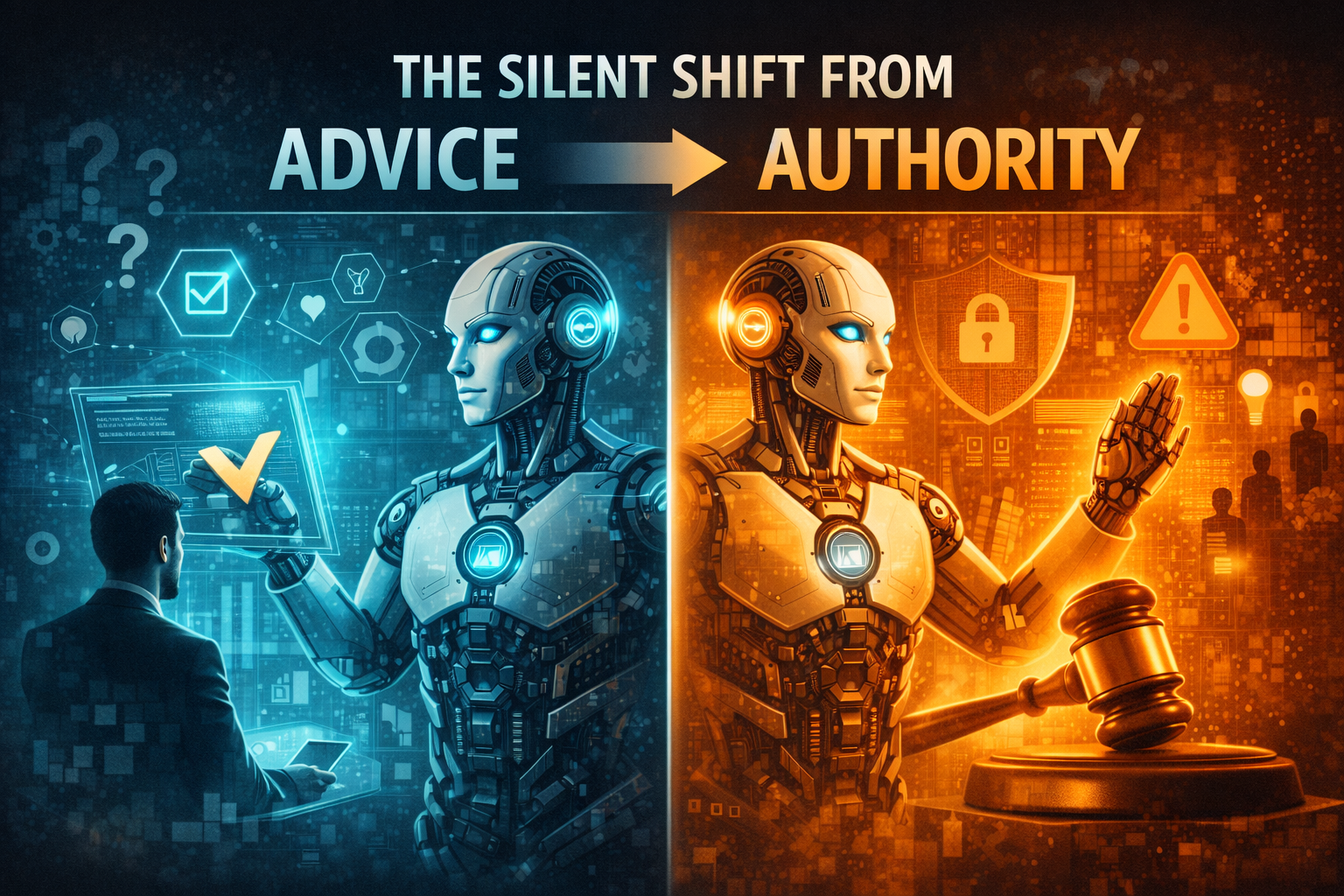
The silent shift from advice to authority
This is the transition many organizations still underestimate: AI is moving from advice to authority.
A recommendation engine is one thing. An execution engine is another.
When a model suggests, human beings remain visibly in charge. When a model triggers action, ranks people, allocates opportunity, approves access, influences enforcement, or shapes resource distribution, the system begins to exercise institutional authority. This is where legitimacy enters.
The EU AI Act reflects this distinction clearly. High-risk AI systems are subject to stronger obligations, including human oversight measures designed to prevent or minimize risks to health, safety, and fundamental rights. It also imposes logging, documentation, and operational responsibilities on deployers and providers of such systems. (Artificial Intelligence Act)
This is not just regulatory language. It points to a deeper truth: once AI begins affecting consequential outcomes, institutions must answer questions that models alone cannot answer.
Who authorized the machine to participate in this decision?
What boundaries define its role?
Who remains accountable if the output causes harm?
How can the affected person appeal or seek review?
What evidence shows the decision was made appropriately?
These are legitimacy questions, not performance questions.
This builds on two companion pieces: When Enterprise AI Makes the Right Decision for the Wrong Reason and Enterprise AI Decision Failure Taxonomy.

When systems lose legitimacy, institutions lose trust
The history of algorithmic controversy already shows this pattern.
In the Netherlands, the SyRI welfare-fraud detection system was halted after a court found that it violated human rights norms. Criticism centered on opacity, surveillance, and disproportionate impact on vulnerable communities. The issue was not merely whether the system identified fraud. The deeper issue was whether such a system had legitimate standing inside a democratic institution. (OHCHR)
In England in 2020, the exam-grading algorithm controversy revealed another form of legitimacy failure. Even though standardization was intended to maintain consistency in the absence of exams, the backlash showed that decisions affecting people’s futures could not be accepted when they felt impersonal, opaque, and disconnected from lived reality. Ofqual’s interim report documented the rationale and methodology, but the social rejection of the process made clear that technical procedure does not automatically confer public legitimacy. (GOV.UK)
In criminal justice, debates around COMPAS and similar risk-scoring tools became legitimacy debates as much as fairness debates. The controversy was not only about predictive quality. It was about whether proprietary software should influence liberty-affecting decisions when defendants, courts, and the public cannot fully interrogate its logic or limitations. (ProPublica)
Across sectors, the pattern is consistent. People do not grant legitimacy to AI simply because it is sophisticated. They grant legitimacy when the surrounding institution makes the decision process defensible.

The deeper strategic issue: institutions, not tools, decide who wins
This is where your broader Goal-2 framing becomes especially powerful.
The future AI economy will not be won by institutions that merely deploy smarter tools. It will be won by institutions that redesign themselves to make machine action legitimate.
That is why SENSE–CORE–DRIVER matters.
Most AI discussions begin too late. They begin with the model. But legitimacy starts before the model and extends beyond the model.
SENSE: what reality is allowed to become legible
SENSE is the layer where reality becomes machine-legible.
Signal means detecting events, changes, and traces from the world.
ENtity means attaching those signals to a persistent actor, object, asset, customer, or organization.
State representation means building a structured model of current condition.
Evolution means updating that state over time as new signals arrive.
If this layer is weak, legitimacy is compromised before any model runs. A machine cannot make acceptable decisions about a reality it does not represent properly. If the underlying signals are incomplete, identities are mismatched, state is stale, or change over time is not captured, then even a technically strong model may produce institutionally indefensible outcomes.
A farmer denied credit because records are partial, a merchant misclassified because of patchy transaction history, or a patient triaged using incomplete clinical context all point to the same truth: bad legitimacy often begins as bad legibility.
This is why the legitimacy problem starts earlier than most organizations realize. It begins with what an institution can see, identify, and represent in the first place.
CORE: how institutions interpret reality
CORE is the cognition layer.
This is where systems Comprehend context, Optimize decisions, Realize action logic, and Evolve through feedback. It is where models reason, classify, forecast, recommend, prioritize, and plan.
Most AI investment today is concentrated here. Organizations buy models, fine-tune systems, compare benchmark scores, deploy copilots, and tune prompts. But CORE alone cannot create legitimacy. CORE can generate reasoning. It cannot, by itself, generate authority.
Whether machine reasoning deserves institutional standing depends on what surrounds it.
DRIVER: how institutions make machine action acceptable
DRIVER is where legitimacy truly lives.
Delegation asks who authorized the machine to act.
Representation asks what model of reality it used.
Identity asks which entity is being affected.
Verification asks how the decision is checked.
Execution asks how the action is carried out.
Recourse asks what happens if the system is wrong.
This is the missing layer in most AI strategies.
Organizations often build CORE before they define DRIVER. They obsess over model performance before they define authority boundaries. They automate decisions before they design appeal mechanisms. They deploy copilots before they clarify who remains responsible. That is why so many AI initiatives feel impressive in demos but fragile in production.
Machine legitimacy is fundamentally a DRIVER problem.
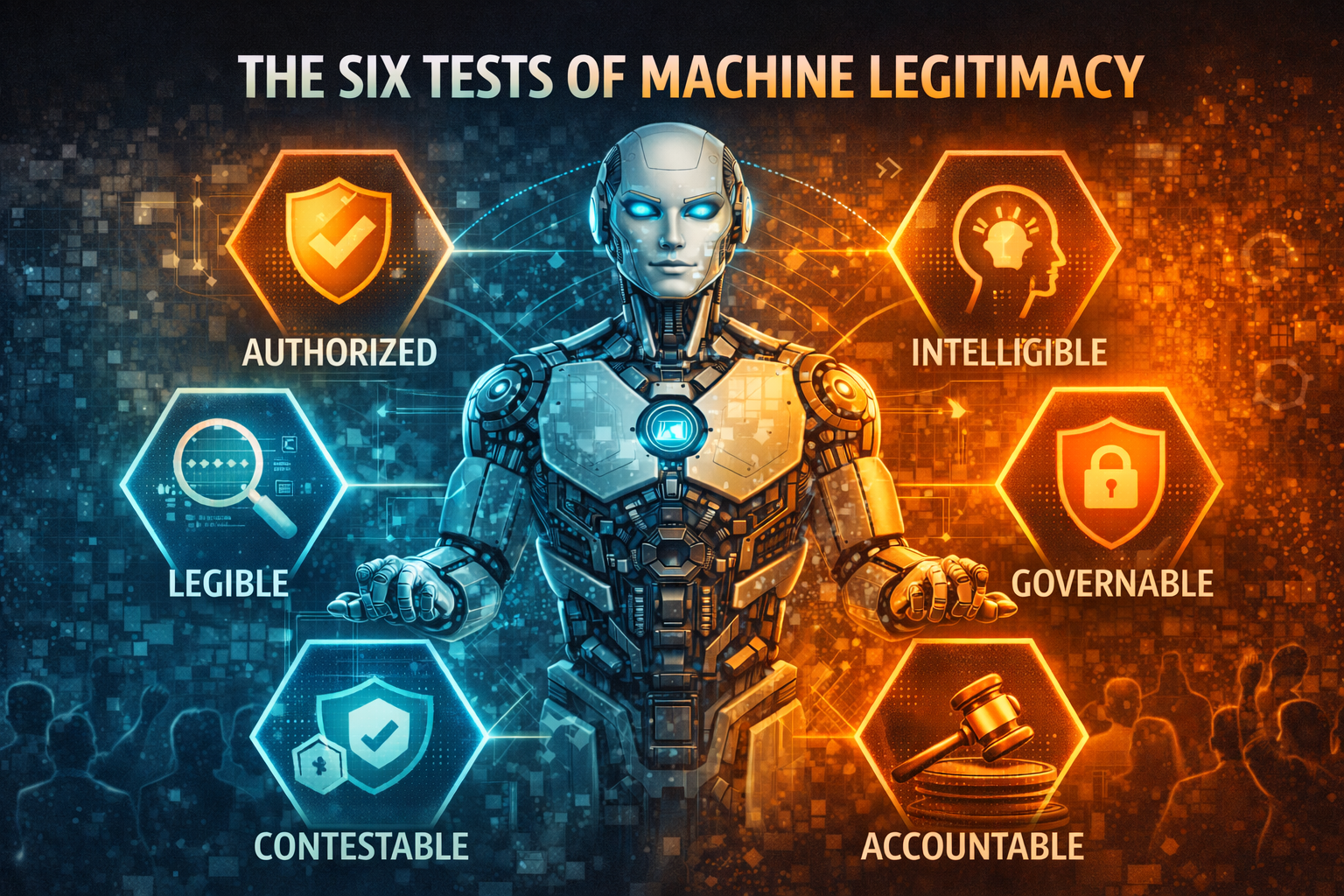
The six tests of machine legitimacy
A useful way to think about machine legitimacy is to ask whether an AI-influenced decision can pass six simple tests.
-
Is it authorized?
The institution must define which kinds of decisions a machine may influence, recommend, or execute. Not everything that can be automated should be delegated.
-
Is it legible?
The institution must know what signals, entities, and states the system is acting upon. If reality is poorly represented, legitimacy is weak from the start.
-
Is it intelligible?
The decision must be understandable enough for the relevant human roles to use, review, and challenge appropriately. Transparency does not mean exposing every model weight. It means providing meaningful explanation in the context of use. OECD guidance on trustworthy AI and accountability emphasizes this practical, role-sensitive view of transparency, traceability, and responsibility. (OECD)
-
Is it governable?
There must be logs, controls, monitoring, thresholds for intervention, and clear escalation paths. This is why modern AI governance frameworks stress lifecycle governance, not one-time compliance. (NIST Publications)
-
Is it contestable?
A person affected by a significant machine-influenced outcome should have a path to review, appeal, escalation, or remediation. Without a way back, legitimacy collapses.
-
Is it accountable?
The institution must be able to say who owns the outcome. “The model decided” is not an acceptable answer in law, governance, or management.
These six tests are simple enough for boards to grasp and rigorous enough to guide architecture.
Why this is becoming a board-level issue
Boards should care about machine legitimacy for one reason above all: illegitimate AI decisions create strategic risk.
They create legal risk when rights are affected without appropriate safeguards.
They create reputational risk when customers, citizens, or employees experience decisions as opaque or unfair.
They create operational risk when staff over-trust or under-trust the system.
They create political risk when institutions appear to hide behind technology.
They create economic risk when adoption stalls because trust never forms.
The broader direction of global governance is moving the same way. The UN’s recent report Governing AI for Humanity frames AI governance as a matter of public trust, institutional capacity, human rights, and accountable deployment, not simply innovation speed. (United Nations)
In that sense, machine legitimacy is not a moral side topic. It is an operating requirement for the AI economy.
The next competitive advantage: not just automation, but legitimation
This is the deeper strategic insight.
In the first wave of AI, advantage came from building models.
In the second wave, advantage came from applying models to workflows.
In the third wave, advantage will come from building institutions that can safely grant machine systems bounded authority.
That is a harder challenge than most firms realize.
It requires better sensing, better representation, clearer decision rights, stronger oversight, auditable execution, designed recourse, and context-appropriate governance. It requires a shift from asking, “Can the AI do this?” to asking, “Under what institutional conditions should this AI be allowed to do this?”
That is the real frontier.
The organizations that understand this early will scale AI where others remain stuck in pilot mode. Not because their models are always smarter, but because their institutions are more governable.
What boards and C-suites should do now
Machine legitimacy should become a standing strategic question in every consequential AI deployment.
Boards and executives should require five things.
First, a clear map of where AI recommendations end and where AI authority begins.
Second, explicit delegation boundaries for high-impact use cases.
Third, role-based oversight and escalation mechanisms.
Fourth, recourse design for materially affected stakeholders.
Fifth, logging and traceability that support audit, learning, and accountability.
In other words, leaders should stop treating legitimacy as a legal afterthought and start treating it as operating architecture.
Artificial intelligence is rapidly moving from advisory tools to systems that influence real-world outcomes such as lending, healthcare prioritization, hiring, and public policy. In this new phase, accuracy alone is not enough. Institutions must ensure machine legitimacy — the ability of AI systems to make decisions that are authorized, accountable, transparent, and contestable.
Using the SENSE–CORE–DRIVER framework, this article explains how organizations must redesign governance structures so that machine intelligence becomes institutionally acceptable and trustworthy.

Conclusion: the future belongs to legitimate intelligence
The biggest mistake in AI strategy is assuming that a correct answer is the same thing as an acceptable decision.
It is not.
A correct answer may still be illegible, unauditable, unchallengeable, or unauthorized. And once AI systems begin shaping real outcomes, those failures matter more than benchmark scores ever will.
The future belongs to institutions that can combine all three layers well:
SENSE, so reality becomes visible and machine-legible.
CORE, so systems can reason over that reality intelligently.
DRIVER, so machine action is bounded, accountable, and legitimate.
That is the real architecture of the AI era.
The next winners in AI will not simply be the institutions with more intelligence.
They will be the institutions with more legitimate intelligence.
In the end, the question is not whether machines can decide. It is whether institutions can make those decisions defensible.
FAQ
What is machine legitimacy in AI?
Machine legitimacy is the institutional acceptability of an AI-influenced decision. It means the system is not only accurate, but also authorized, accountable, governable, and open to challenge or recourse when needed. (NIST Publications)
Why are correct AI decisions not enough?
A correct AI decision can still be unacceptable if it is opaque, unauditable, biased in effect, impossible to contest, or made without proper authority. In high-impact settings, legitimacy matters as much as technical performance. (Artificial Intelligence Act)
What is the difference between AI accuracy and AI legitimacy?
AI accuracy measures how often a model gets an output right. AI legitimacy asks whether the institution can defend that decision ethically, operationally, legally, and socially.
Why is machine legitimacy a board-level issue?
Because illegitimate AI decisions create legal, reputational, operational, and strategic risk. Boards must govern not only what AI can do, but also what AI should be allowed to decide. (United Nations)
How does SENSE–CORE–DRIVER relate to AI legitimacy?
SENSE ensures reality is properly captured and represented. CORE enables intelligent reasoning over that reality. DRIVER ensures that machine action is bounded, verified, contestable, and accountable. Legitimacy depends on all three.
Which AI use cases need legitimacy most?
High-impact use cases such as lending, hiring, insurance, healthcare, policing, benefits administration, public services, and enterprise automation affecting customer outcomes need the strongest legitimacy design. (Artificial Intelligence Act)
Glossary
Machine legitimacy
The degree to which an AI-influenced decision is institutionally acceptable, accountable, and defensible.
Human oversight
Mechanisms that allow people to supervise, intervene in, or override AI systems where necessary. (Artificial Intelligence Act)
Contestability
The ability of an affected person or institution to challenge, review, or appeal an AI-influenced decision.
Traceability
The ability to reconstruct how an AI system was built, used, and how a given outcome was produced. (OECD)
High-risk AI
AI systems used in contexts where errors or misuse can significantly affect safety, rights, opportunity, or welfare. (Artificial Intelligence Act)
Recourse
The practical path available when an AI system causes or contributes to a harmful or disputed outcome.
References and further reading
For readers who want to go deeper, the following sources are useful starting points:
- NIST, Artificial Intelligence Risk Management Framework (AI RMF 1.0), which frames AI risk as socio-technical and defines trustworthiness characteristics for AI systems. (NIST Publications)
- EU AI Act, especially provisions on human oversight and high-risk systems. (Artificial Intelligence Act)
- OECD AI Principles and OECD work on accountability in AI, which emphasize transparency, traceability, and role-based responsibility. (OECD)
- United Nations, Governing AI for Humanity, which situates AI governance within the broader questions of public trust, human rights, and global institutional capacity. (United Nations)
- OHCHR commentary on the Dutch SyRI case, a useful example of how legitimacy failures emerge in public-sector algorithmic systems. (OHCHR)
Explore the Architecture of the AI Economy
This article is part of a broader research series exploring how institutions are being redesigned for the age of artificial intelligence.
If you want to explore the deeper framework behind these ideas, the following essays provide additional perspectives:
• The Enterprise AI Operating Model
• Decision Scale: Why Competitive Advantage Is Moving from Labor Scale to Decision Scale
• The Operating Architecture of the AI Economy: Why Intelligence Alone Will Not Transform Markets
- The Representation Economy: Why AI Institutions Must Run on SENSE, CORE, and DRIVER – Raktim Singh
- The Representation Economy Explained: 51 Questions About the SENSE–CORE–DRIVER Architecture – Raktim Singh
Together, these essays outline a central thesis:
The future will belong to institutions that can sense reality, represent it clearly, reason about it intelligently, and act through governed machine systems.



Raktim Singh is an AI and deep-tech strategist, TEDx speaker, and author focused on helping enterprises navigate the next era of intelligent systems. With experience spanning AI, fintech, quantum computing, and digital transformation, he simplifies complex technology for leaders and builds frameworks that drive responsible, scalable adoption.