

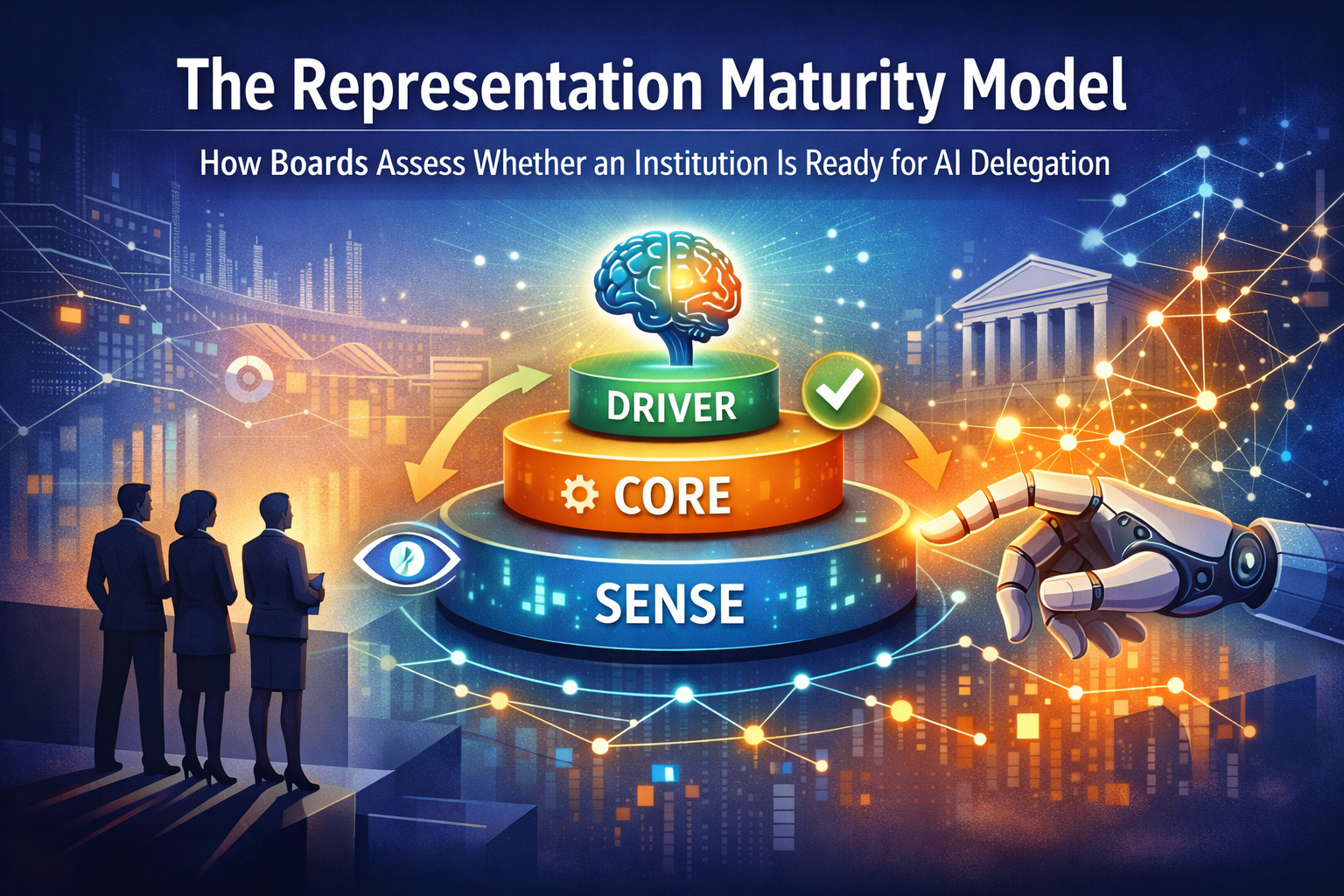
The Representation Maturity Model
In the AI era, the real governance question is no longer whether a model works. It is whether the institution is mature enough to let machine judgment influence reality.
Artificial intelligence is forcing boards to confront a question that runs deeper than technology selection.
The real issue is not merely which model is most accurate, which vendor appears most credible, or which pilot delivered the most impressive demonstration. Those questions matter, but they no longer reach the core of institutional readiness.
The deeper question is this:
Is the institution mature enough to let AI participate in decisions that matter?
That question is no longer theoretical. It is becoming central to strategy, governance, and competitive advantage. Stanford’s 2025 AI Index reports that 78% of organizations said they used AI in 2024, up from 55% the previous year, while private investment in generative AI reached $33.9 billion globally in 2024. At the same time, governance expectations are becoming more explicit. NIST’s AI Risk Management Framework emphasizes governance across the AI lifecycle through the functions of Govern, Map, Measure, and Manage, while the OECD’s AI Principles and its newer due-diligence guidance push organizations toward accountability, transparency, robustness, and oversight. (Stanford HAI)
This is why boards need a new lens.
They do not only need an AI strategy.
They need a way to assess whether the institution itself is ready for AI delegation.
That is where the Representation Maturity Model becomes useful.
This article advances a simple but consequential idea: before an institution delegates judgment, recommendations, approvals, or bounded actions to AI, it must first become mature in how it represents reality. It must know what it can see, what it can model, what it can reason about, what it can verify, and what it can safely execute.
In other words, AI delegation should follow representation maturity.
This is the board-level bridge between the Representation Economy and the SENSE–CORE–DRIVER architecture.
Article Summary
The Representation Maturity Model is a governance framework that helps boards determine whether their institution is ready to delegate certain decisions to artificial intelligence. Built on the SENSE–CORE–DRIVER architecture, the model identifies five levels of institutional maturity, ranging from fragmented visibility to adaptive AI delegation. It shifts the AI governance conversation from model accuracy to institutional readiness.
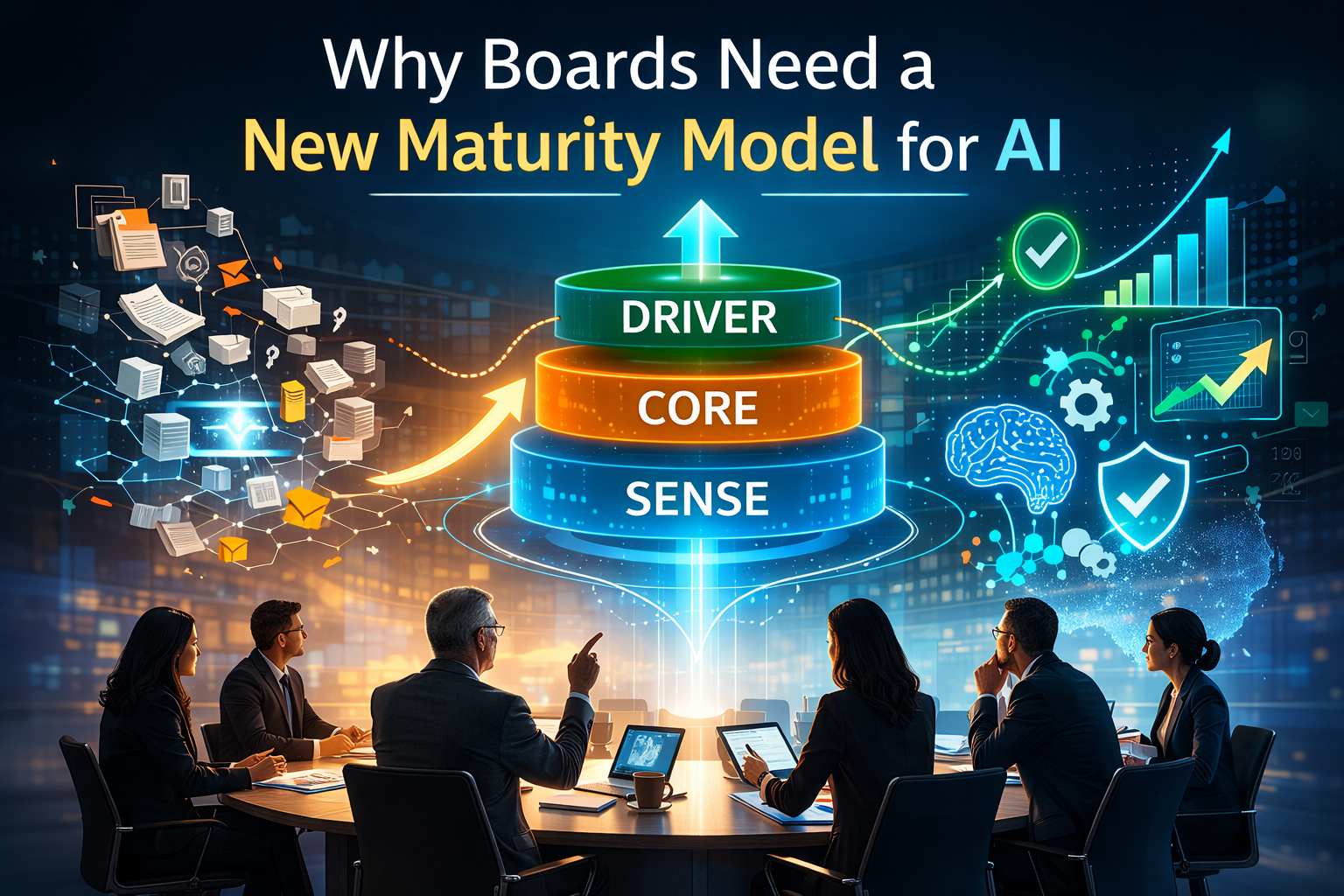
Why boards need a new maturity model for AI
Most AI governance discussions still focus on familiar themes: fairness, privacy, explainability, cyber risk, model drift, vendor dependency, and compliance. All of these are essential. But they often begin too late.
They begin after the institution has already assumed that the machine is looking at the right reality.
That assumption is dangerous.
An AI system can be technically impressive and still be institutionally immature. It may classify well, summarize well, predict well, or converse fluently. But if it does not understand the right entity, the correct state, the relevant context, the governing constraint, or the authority boundary, then delegation becomes fragile.
For a board, that is the real risk.
A bank cannot safely delegate part of lending if customer identity, cash-flow context, exception handling, and recourse paths are poorly represented. A hospital cannot safely delegate clinical workflow steps if the patient’s state is fragmented across disconnected systems. A public agency cannot safely automate benefits decisions if policy interpretation, citizen identity, and appeals logic are weakly represented.
In each case, the problem is not “bad AI” in the narrow sense. The deeper issue is immature institutional representation.
That is why this model matters. It gives boards a sharper set of questions:
- What reality can our systems actually see?
- How reliably is that reality modeled?
- How much reasoning can the institution trust?
- Where can action be delegated safely?
- Where must human authority remain primary?
These questions are becoming more urgent across jurisdictions. The European Commission states that the EU AI Act entered into force on 1 August 2024, with most provisions becoming applicable in phases and the majority applying by 2 August 2026. Meanwhile, the FCA says it wants to support the safe and responsible adoption of AI in UK financial markets, and NACD has argued that boards will need to update oversight structures, clarify committee responsibilities, and engage more deeply with management on AI. (European Commission)
So the board question is no longer abstract.
It is rapidly becoming operational.
This article introduces the Representation Maturity Model, a governance framework developed to help boards determine when institutions are ready to delegate decisions to artificial intelligence.
What is the Representation Maturity Model?
The Representation Maturity Model is a framework that helps boards and executives determine whether an institution is mature enough to delegate certain decisions to artificial intelligence systems. It evaluates how well an organization can represent reality, reason over it, and govern machine actions before allowing AI to influence or execute decisions.
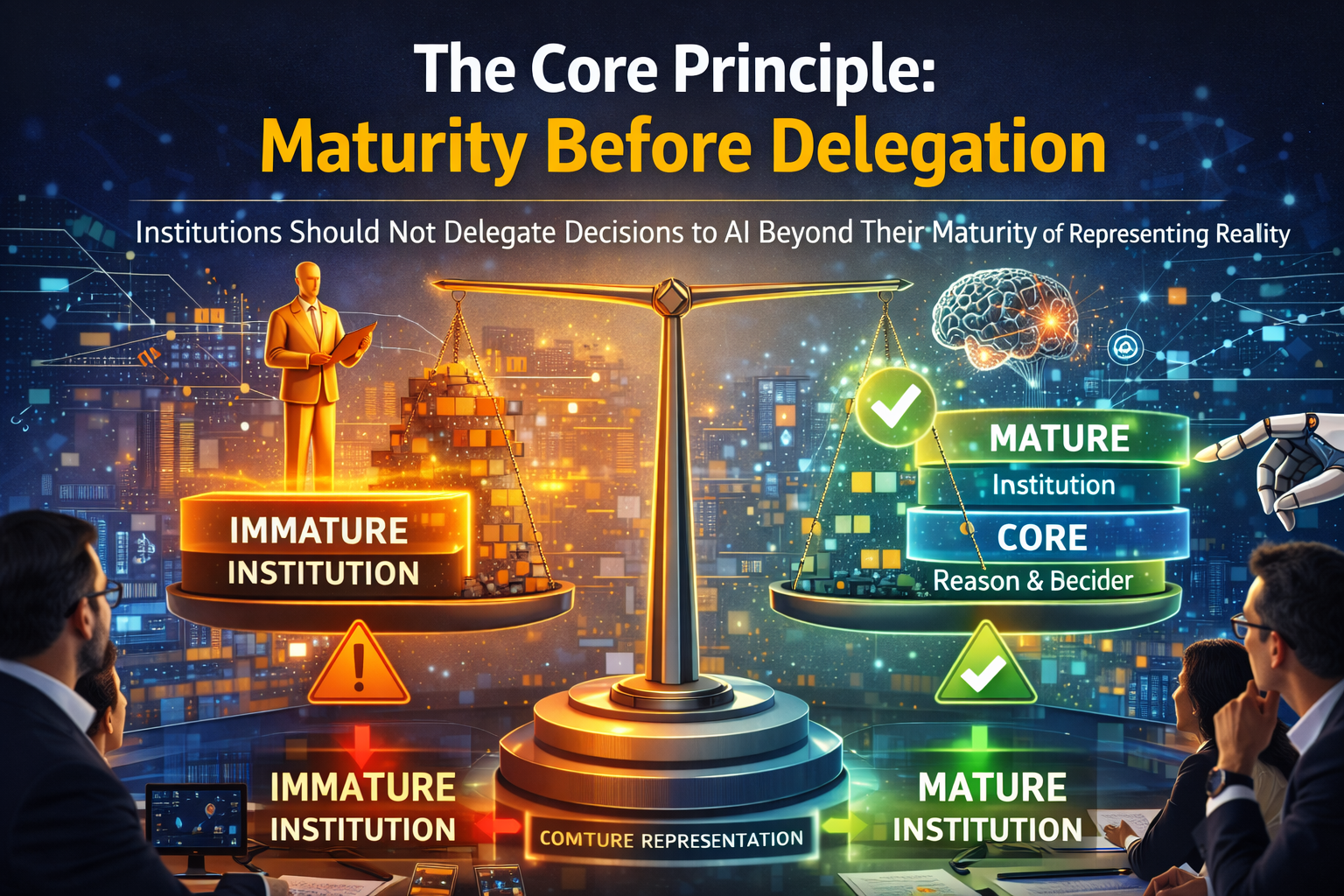
The core principle: maturity before delegation
The Representation Maturity Model starts from a simple principle:
Institutions should not delegate decisions to AI beyond the maturity of their representation layer.
That may sound conceptual, but it becomes practical when viewed through SENSE–CORE–DRIVER.
SENSE: Can the institution see reality clearly?
SENSE is the legibility layer.
Can the institution detect meaningful signals?
Can it connect those signals to the right entities?
Can it maintain a credible representation of state?
Can it track how that state evolves over time?
If the answer is no, then everything above that layer becomes unstable.
Imagine a retail bank using AI to detect fraud. If device history is incomplete, behavioral patterns are stale, merchant categories are inconsistent, and account relationships are fragmented, then the model may still look intelligent. But it is operating on a broken representation of reality.
That is not only a model problem. It is a maturity problem.
CORE: Can the institution reason over what it sees?
CORE is the cognition layer.
Once signals are available, can the institution interpret them in context? Can it compare options, apply constraints, weigh trade-offs, and explain why a recommendation emerged?
A logistics company may have thousands of real-time supply chain signals. But if it cannot reason across weather, route constraints, inventory state, customer priority, contractual obligations, and escalation logic, then it is not truly mature. It is data-rich, but decision-poor.
DRIVER: Can the institution delegate action safely?
DRIVER is the governance and legitimacy layer.
Who authorized the action?
What representation was used?
Which entity was affected?
How was the decision verified?
How is it executed?
What recourse exists if the system is wrong?
This is where many AI programs weaken. They can generate suggestions, but they cannot prove legitimate delegation.
A mature institution does not ask only whether AI can act. It asks whether AI can act under governed authority.
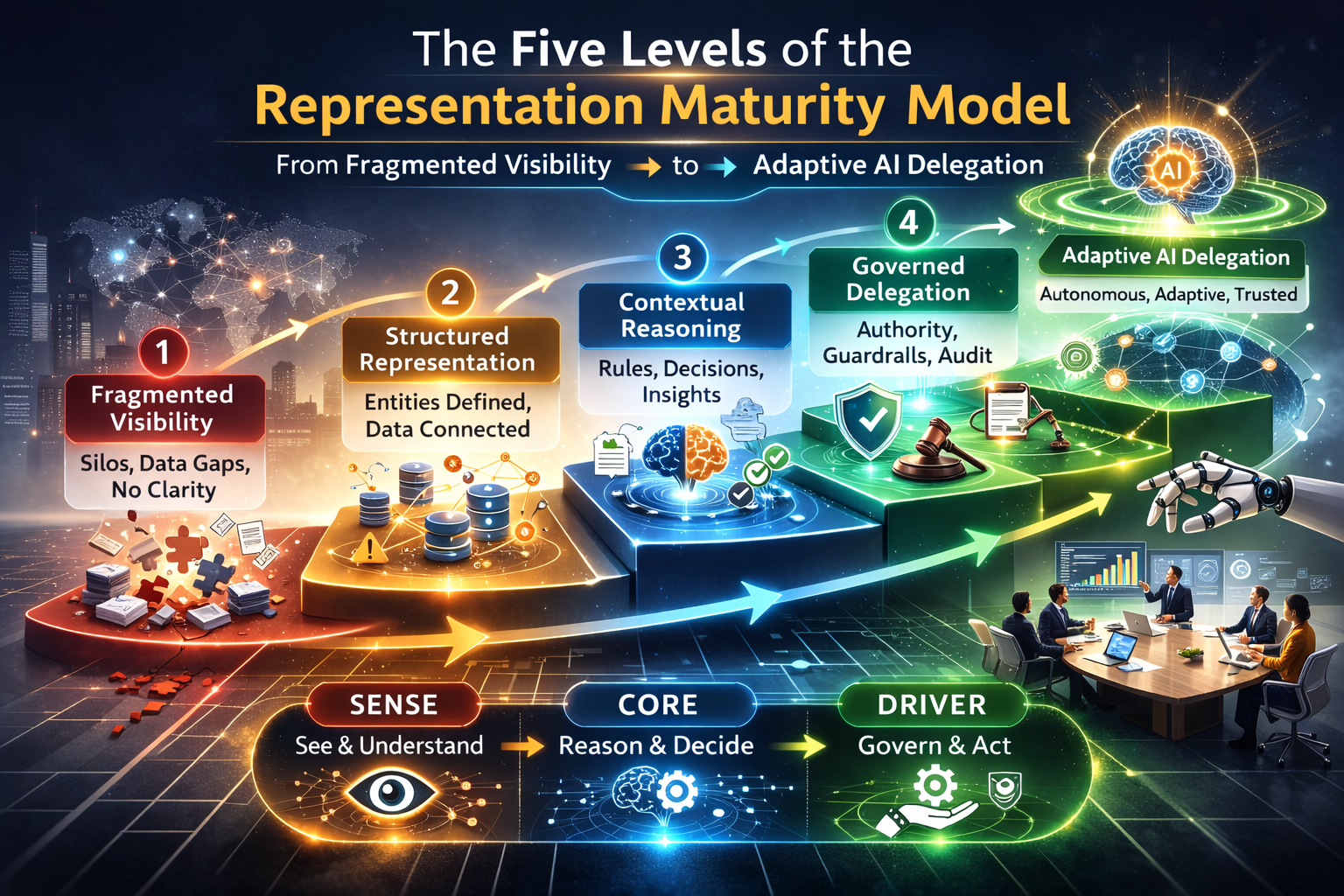
The five levels of the Representation Maturity Model
Boards need a progression model that is simple enough to use, but strong enough to shape governance decisions. A practical five-level model can help.
Level 1: Fragmented Visibility
At this stage, the institution has data, but not institutional legibility.
Systems are siloed. Definitions vary across functions. Entities do not match cleanly across departments. Exceptions are handled informally. Historical traces are incomplete. Human teams compensate through experience, workarounds, and memory.
This is where many organizations still are, even when they claim to be using AI.
Imagine a large insurer. Customer data sits in one system, claims history in another, agent notes in email, exception approvals in PDF workflows, and risk indicators in spreadsheets. AI can be placed on top of this environment, but meaningful delegation remains unsafe because the institution cannot yet see itself coherently.
At Level 1, boards should allow experimentation, but not serious AI delegation.
Level 2: Structured Representation
At this stage, the institution begins building common representations.
Key entities are defined more consistently. Important workflows have better signal capture. Teams start aligning definitions across operations, risk, product, and technology. Logs improve. Basic context becomes reusable.
This is a major shift because the institution is no longer relying entirely on tribal knowledge.
Imagine a hospital system that standardizes patient identity resolution, encounter history, medication records, and lab-event timelines. It still has gaps, but it is becoming machine-legible.
At Level 2, AI can support summarization, enterprise search, triage assistance, and bounded recommendations. But the board should still be cautious about execution-heavy delegation.
Level 3: Contextual Reasoning Readiness
At this stage, the institution does not merely store reality. It begins to reason over it in a structured way.
Business rules are better formalized. Exceptions are categorized. Decision flows become more observable. Human reviewers can inspect why recommendations emerged. Institutional memory improves through traces, logs, and feedback loops.
This is where CORE becomes meaningful.
Imagine a lender evaluating applications using income signals, repayment history, fraud indicators, policy rules, customer segment context, and exception classes within one structured decision flow. Human approval may still be required, but the system is now capable of producing reviewable and auditable recommendations.
At Level 3, boards can allow AI to materially influence decisions, provided human verification remains strong.
Level 4: Governed Delegation
This is the point where DRIVER becomes operational.
The institution can define who delegated authority, under what limits, using which policies, with what logging, with what verification, and through what escalation path. Recourse mechanisms exist. Monitoring is active. Overrides are governed. Auditability improves.
This is increasingly close to what regulators and governance bodies expect in practice. NIST’s framework makes clear that governance applies across all stages of AI risk management, not just deployment, while OECD guidance emphasizes operational due diligence instead of broad principle statements alone. (NIST Publications)
Imagine a financial institution allowing AI to pre-approve low-risk service resolutions, flag fraud holds, or recommend modest credit-line changes inside predefined thresholds. Every action is bounded, logged, reviewable, and reversible.
At Level 4, bounded AI delegation becomes realistic.
Level 5: Adaptive Institutional Delegation
This is the highest level of maturity.
The institution becomes capable of continuous representation, contextual reasoning, governed execution, and feedback-based improvement. It can expand or contract AI delegation based on confidence, risk, and context. Human involvement becomes dynamic rather than binary.
This does not mean “fully autonomous.” It means institutionally mature.
Imagine an enterprise procurement system that detects vendor anomalies, understands contract state, reasons across spend and risk, recommends actions, triggers approved workflows, and escalates unusual patterns to human oversight when thresholds are breached.
At Level 5, AI delegation becomes part of the institution’s operating model rather than a collection of disconnected pilots.
What boards should ask management now
A maturity model only matters if it changes governance behavior.
Boards should begin asking management a new class of questions.
Not only:
- Which AI tools are we using?
- What is our ROI?
- Are we compliant?
But also:
- Which institutional realities are currently machine-legible?
- Where are our entity definitions weak or inconsistent?
- Which decisions still depend on missing context or informal human workarounds?
- Where do we have decision traces, and where do we not?
- Which actions are reversible, and which create irreversible harm?
- What is our maturity level by workflow, not by aspiration?
This distinction matters because maturity is not uniform across an enterprise. An institution may be Level 4 in fraud operations, Level 2 in HR, and Level 1 in complex vendor governance. Boards should resist asking whether the company is “AI-ready” in general. That question is too broad to guide action.
The better question is more precise:
Which workflows are mature enough for bounded AI delegation, and which are not?
That is the kind of question that moves governance from posture to discipline.
Why this matters in the Representation Economy
In the Representation Economy, competitive advantage will not come only from owning more models or buying more tools.
It will come from building institutions that can represent reality more clearly, reason over it more coherently, and delegate action more legitimately.
That is why the Representation Maturity Model matters.
It shifts the conversation:
- from AI enthusiasm to institutional readiness
- from pilot success to delegation fitness
- from tool adoption to governance architecture
- from model quality to representation quality
This is the deeper strategic shift.
The institutions that win will not merely automate faster.
They will become more mature in how they see, think, and act.
That is the real edge.
Key Takeaway for Boards
Before artificial intelligence can be trusted with consequential decisions, institutions must first become mature in how they represent reality, reason over it, and govern action. The Representation Maturity Model provides a framework for assessing that readiness.
Conclusion: the board’s new duty
For years, boards were asked to oversee digital transformation.
Now they must oversee something more foundational:
the institutional conditions under which machine judgment becomes legitimate.
That is not just a software question.
It is not just a risk question.
It is not just a compliance question.
It is a representation question.
Before institutions delegate, they must first become legible to themselves.
Before AI becomes trusted, boards must know whether the institution is mature enough to let machine judgment influence reality.
That is the purpose of the Representation Maturity Model.
That is why it belongs in the boardroom.
And that is why the next era of AI governance will be defined not only by what models can do, but by whether institutions are mature enough to delegate at all. (nacdonline.org)
Glossary
Representation Maturity Model
A framework for assessing whether an institution is mature enough to delegate certain decisions or actions to AI.
Representation Economy
A view of the AI era in which competitive advantage comes from how well institutions represent reality, reason over it, and act on it.
SENSE
The legibility layer of an institution: signal detection, entity identification, state representation, and state evolution.
CORE
The cognition layer where the institution interprets context, reasons over data, compares options, and produces decision logic.
DRIVER
The governance and action layer that determines who delegated authority, how decisions are verified, how they are executed, and what recourse exists if the system is wrong.
AI Delegation
The transfer of bounded judgment, recommendation, approval, or execution from humans to AI systems within specified governance limits.
Machine-Legible Institution
An institution whose key realities are structured clearly enough for AI systems to interpret and act on reliably.
Governed Authority
A condition in which AI actions operate within approved limits, with logging, escalation, reversibility, and accountability.
Bounded Autonomy
AI action permitted only within predefined authority, policy, and risk thresholds.
Decision Trace
A record of how a machine-supported recommendation or action was generated, verified, and executed.
Institutional Readiness
The degree to which an enterprise has the data, context, controls, and oversight needed to deploy AI safely in consequential workflows.
FAQ
What is the Representation Maturity Model?
It is a board-level framework for assessing whether an institution is mature enough to let AI influence or execute decisions in specific workflows.
Why is this different from a normal AI maturity model?
Most AI maturity models focus on tooling, talent, adoption, or analytics capability. The Representation Maturity Model focuses on whether the institution can accurately represent reality before delegating judgment.
Why should boards care about representation?
Because the biggest failures in AI often begin before the model. If the institution misrepresents entities, states, context, or authority, even a high-performing model can make unsafe decisions.
Is this mainly for financial services?
No. It applies to banking, healthcare, insurance, supply chains, government, education, telecom, manufacturing, and any domain where AI may influence consequential decisions.
Does Level 5 mean full autonomy?
No. It means the institution is mature enough to adapt delegation dynamically under governance. It does not mean unbounded automation.
Can one company be at multiple maturity levels at the same time?
Yes. An enterprise may be mature in one workflow and immature in another. Boards should assess maturity by workflow, not by brand narrative.
What is the biggest mistake boards make with AI delegation?
They ask whether AI works before asking whether the institution is representationally mature enough to support AI in that workflow.
How does this connect to governance?
It gives governance a sharper question: not only whether risk is managed, but whether the institution has the right to delegate a particular class of judgment at all.
What is the first step for management teams?
Map high-consequence workflows and assess whether the underlying entities, states, rules, and exception paths are represented clearly enough for machine participation.
Why is this likely to become more important?
Because regulation, supervisory scrutiny, and enterprise dependency on AI are all increasing at the same time. (European Commission)
What is the Representation Maturity Model?
The Representation Maturity Model is a governance framework that helps institutions determine whether they are mature enough to delegate certain decisions to artificial intelligence systems.
Why do boards need an AI maturity model?
Boards need a maturity model to understand whether their institution has the data clarity, reasoning systems, and governance controls necessary for safe AI delegation.
What does SENSE–CORE–DRIVER mean?
SENSE refers to observing reality, CORE refers to reasoning and decision systems, and DRIVER refers to governance and execution authority.
What is AI delegation?
AI delegation occurs when institutions allow artificial intelligence systems to recommend, approve, or execute certain operational decisions within defined governance limits.
References and further reading
For external references, the most credible supporting sources for this article are:
- Stanford HAI, The 2025 AI Index Report — for enterprise AI adoption and global generative AI investment. (Stanford HAI)
- NIST, AI Risk Management Framework — for lifecycle governance and the Govern/Map/Measure/Manage model. (NIST)
- OECD, AI Principles and Due Diligence Guidance for Responsible AI — for trustworthy AI, accountability, and implementation-oriented governance. (OECD)
- European Commission / European Parliament, EU AI Act implementation timeline — for the shift from principle to legal operationalization. (European Commission)
- FCA, AI in financial services / AI approach — for safe and responsible adoption language in UK financial markets. (FCA)
- NACD, AI and Board Governance — for board oversight implications. (nacdonline.org)



Raktim Singh is an AI and deep-tech strategist, TEDx speaker, and author focused on helping enterprises navigate the next era of intelligent systems. With experience spanning AI, fintech, quantum computing, and digital transformation, he simplifies complex technology for leaders and builds frameworks that drive responsible, scalable adoption.