
Governance of Visibility in AI
Most conversations about artificial intelligence still begin at the wrong point.
They begin with the model.
Which model is smarter? Which agent is faster? Which system is cheaper to run? Which architecture reasons better, writes better, or scales more efficiently?
Those questions still matter. But they no longer explain where durable advantage — or durable risk — will come from.
As AI moves deeper into enterprise operations, public services, healthcare, finance, manufacturing, and digital infrastructure, a more consequential question is coming into view:
What should an AI-enabled institution be allowed to see, know, infer, retain, and act upon?
That is the question of the governance of visibility.
It is quickly becoming one of the defining questions of the AI era because visibility is no longer a neutral technical feature. The more capable our sensing, identity, data-linkage, and inference systems become, the more institutions can observe people, assets, events, behaviors, and environments in real time.
That can create enormous value. It can reduce fraud, improve logistics, personalize services, strengthen industrial coordination, and widen inclusion. But it can also create asymmetry, overreach, silent surveillance, brittle automation, and decisions built on thin, distorted, or weakly justified representations of reality.
The OECD AI Principles, updated in 2024, explicitly frame trustworthy AI around human rights, democratic values, transparency, robustness, and accountability. NIST’s AI Risk Management Framework similarly places governance, context mapping, measurement, and ongoing management at the center of trustworthy AI practice. (OECD)
That is why AI now needs rules not only for what it can compute, but for what it can see, know, and act upon.
This is not a side issue. It is a strategic issue, a governance issue, and increasingly a board-level issue.
What Is the Governance of Visibility?
The governance of visibility refers to the institutional rules that determine what AI systems are allowed to observe, infer, retain, and act upon.
In the AI economy, the ability to see reality through data is a source of power. Governing that visibility ensures that AI systems operate within legitimate boundaries of trust, accountability, and institutional oversight.

Why visibility is becoming the new locus of power
In earlier eras, competitive advantage often came from production capacity, distribution reach, or control over information flows. In the AI era, a growing share of advantage comes from the ability to make reality legible.
An institution that can observe its customers, machines, supply chains, risks, and environments more clearly will usually make better decisions. It will detect change earlier, personalize more accurately, coordinate faster, and recover from disruption more effectively. It may even be able to serve people and assets that older systems could not represent well enough to include.
But this is exactly why governance matters.
When visibility expands, institutional power expands with it.
A hospital that links records across systems can improve care coordination, but it can also widen exposure of sensitive information beyond what is appropriate. A bank that sees richer payment and behavioral signals can make better lending decisions, but it can also infer financial distress in ways customers do not understand and cannot challenge.
A city with more cameras, sensors, and real-time analytics can improve traffic management and emergency response, but it can also normalize pervasive monitoring if no boundaries exist. OECD work on governing with AI makes this tradeoff explicit: public-sector benefits depend on managing data quality, transparency, accountability, and overreliance risks rather than assuming AI visibility is automatically beneficial. (OECD)
So the issue is not whether visibility is good or bad.
The issue is whether visibility is governed.
The central mistake many AI strategies still make
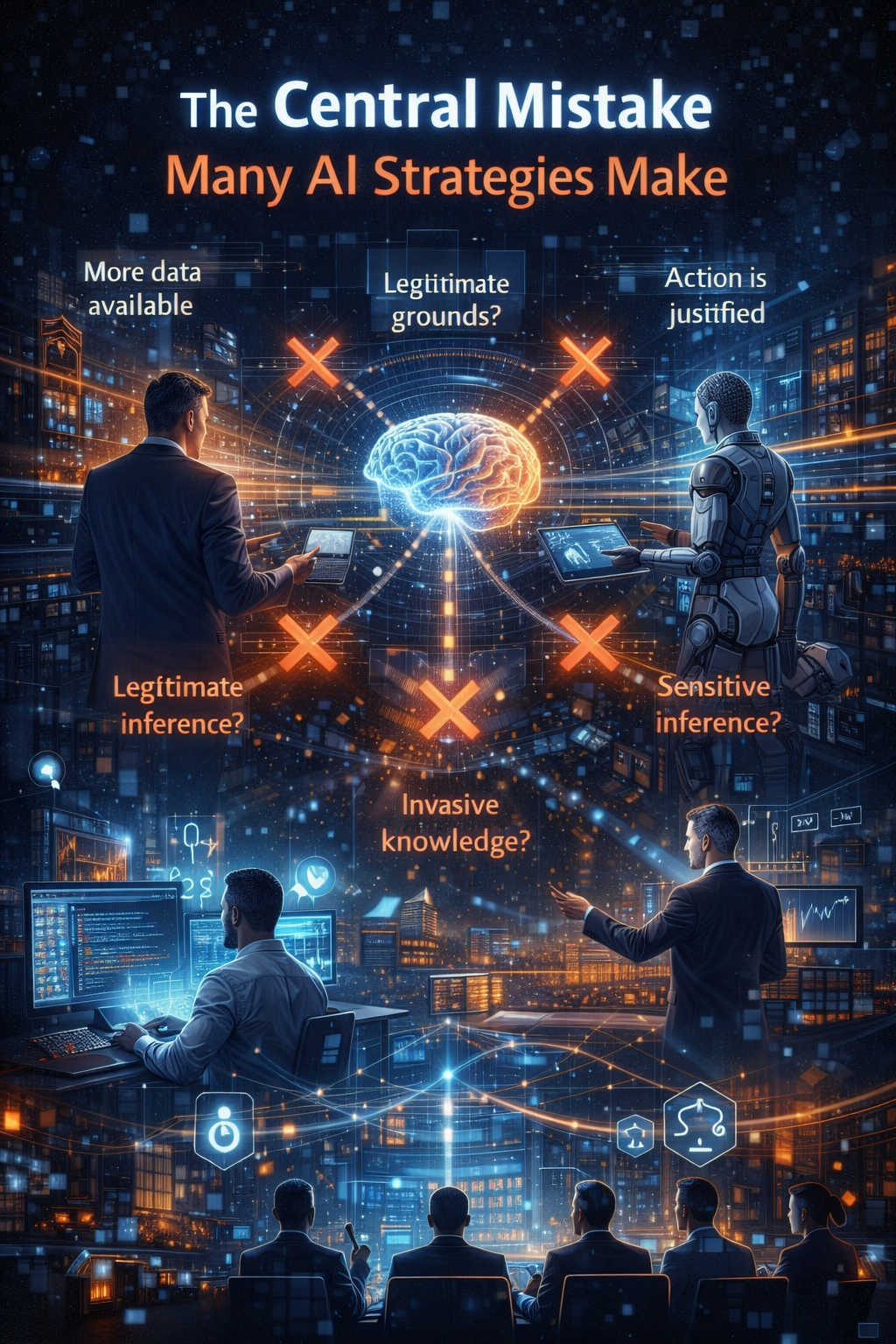
Many AI strategies still assume that once better data is available, better intelligence automatically follows — and that once better intelligence exists, action is automatically justified.
That assumption is dangerously incomplete.
A system may have access to more data and still not have legitimate grounds to use it in a particular way. It may detect patterns that should not drive decisions. It may infer things that are legally sensitive, ethically inappropriate, or contextually misleading. It may combine fragments of information that are individually harmless but collectively invasive.
In other words, the ability to see does not automatically create the right to know, and the ability to know does not automatically create the right to act.
This is where the governance of visibility becomes essential.
The EU AI Act reflects this shift clearly. Its high-risk requirements emphasize data governance, logging, record-keeping, transparency, traceability, human oversight, and risk management. Article 10 focuses on data and data governance for high-risk systems, while Article 12 requires those systems to allow automatic recording of events over their lifetime. These are not minor compliance details. They are institutional mechanisms for controlling how visibility is produced, documented, and governed. (Artificial Intelligence Act)
What the governance of visibility actually means
The governance of visibility is the set of rules, controls, norms, and institutional design choices that determine:
- what signals may be collected,
- what entities may be linked,
- what inferences may be drawn,
- what state may be represented,
- who may access that representation,
- what actions may be taken from it,
- and how those actions are reviewed, challenged, logged, and corrected.
This goes beyond privacy in the narrow sense.
Privacy is part of it, but the governance of visibility is larger. It also includes data quality, provenance, semantic meaning, inference legitimacy, human oversight, retention rules, access boundaries, auditability, and recourse. OECD’s work on data governance explicitly treats governance as a full-lifecycle issue spanning technical, policy, and regulatory frameworks from data creation to deletion and across sectors such as health, research, finance, and public administration. (OECD)
Put simply: AI needs rules for visibility because institutional seeing is becoming a source of economic, organizational, and civic power.
Why this belongs inside SENSE–CORE–DRIVER
This topic becomes much clearer when viewed through the broader architecture of intelligent institutions.
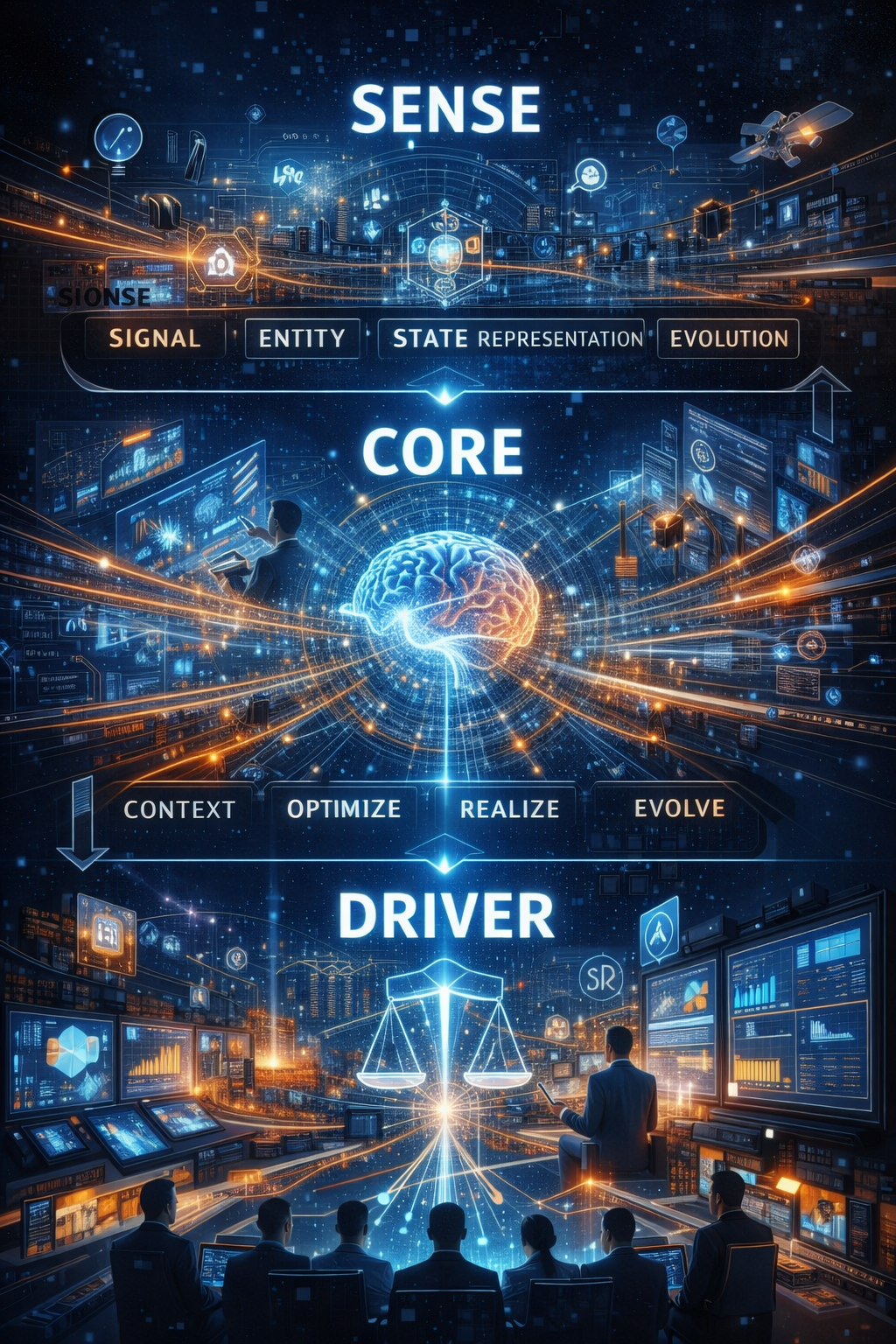
SENSE: making reality legible
In this framework, SENSE means:
Signal — detecting events, changes, and traces from the world
ENtity — attaching those signals to a persistent actor, object, location, or asset
State representation — building a structured model of the current condition of that entity
Evolution — updating that state over time as new signals arrive
SENSE is the layer where reality becomes machine-legible.
The governance of visibility begins here. It asks:
What signals should be collected?
Which entities may they be bound to?
How much representation is justified?
How fresh, complete, inferential, or persistent should that state become?
Without governance at the SENSE layer, institutions risk building visibility that is excessive, inaccurate, invasive, or weakly justified.
CORE: transforming visibility into reasoning
CORE means:
Comprehend context
Optimize decisions
Realize action
Evolve through feedback
CORE is the cognition layer. It is where visibility becomes inference.
Systems do not merely observe. They interpret, rank, predict, prioritize, recommend, and optimize.
This creates a second governance problem. Even if the observed signals were lawfully or operationally available, are the resulting inferences legitimate? Can a system infer creditworthiness from mobility patterns? Stress from typing behavior? Fraud from location anomalies? absentee risk from communication traces?
The governance of visibility must therefore cover not just raw inputs, but also what institutions treat as acceptable knowledge.
DRIVER: turning reasoning into legitimate action
DRIVER means:
Delegation — who authorized the system to act
Representation — what model of reality the system used
Identity — which entity was affected
Verification — how the decision is checked
Execution — how the action is carried out
Recourse — what happens if the system is wrong
DRIVER is the governance and legitimacy layer.
This is where visibility becomes consequential. A system that sees and infers more can deny, approve, escalate, route, restrict, flag, intervene, or recommend more aggressively.
That is why the governance of visibility ultimately belongs to DRIVER as much as SENSE. The question is not just whether something can be seen. It is whether that visibility can justifiably lead to action.
Four simple examples that make the issue real
-
Healthcare: seeing more can help care, but also widen exposure
A clinician benefits from a fuller patient picture. Better visibility can reduce medication errors, improve care coordination, and support earlier intervention. But linking too many signals without clear access controls can also expose highly sensitive information to actors who do not need it.
The problem is not visibility itself.
The problem is uncontrolled visibility.
A well-governed system asks: who should see what, for what purpose, for how long, and with what accountability?
-
Lending: richer signals can enable inclusion, but also opaque exclusion
Alternative data and real-time commercial signals can help institutions serve thin-file merchants and underrepresented borrowers. That can improve inclusion, especially where formal documentation is weak. World Bank materials on digital public infrastructure and AI readiness emphasize that foundational digital systems, interoperability, governance, and institutional capacity are critical for inclusive digital transformation. (World Bank)
But richer visibility can also create opaque exclusion if institutions use signals people do not understand and cannot challenge. A merchant may be declined because of a behavioral pattern never clearly explained, or because multiple weak indicators were combined into a strong judgment.
Governance is what separates inclusive visibility from predatory visibility.
-
Smart cities: more observability can improve services, but also normalize surveillance
Urban sensors, connected infrastructure, geospatial systems, and real-time analytics can improve transport, flood response, sanitation, and public safety. But a city must still decide what forms of visibility are proportionate, accountable, and contestable.
A city that sees more must also justify more.
That is the governance challenge.
-
Manufacturing: operational visibility is powerful, but context still matters
Industrial systems increasingly depend on telemetry, digital twins, maintenance signals, and continuously monitored production environments. This creates major gains in efficiency, resilience, and coordination. But even here, governance matters: poor-quality signals, silent drift, overcollection, weak role separation, or uncontrolled third-party access can undermine safety and trust. NIST’s AI RMF Playbook emphasizes inventories, monitoring, measurement, and risk management throughout the AI lifecycle rather than treating deployment as the endpoint. (NIST AI Resource Center)
The five rules every institution needs for governed visibility
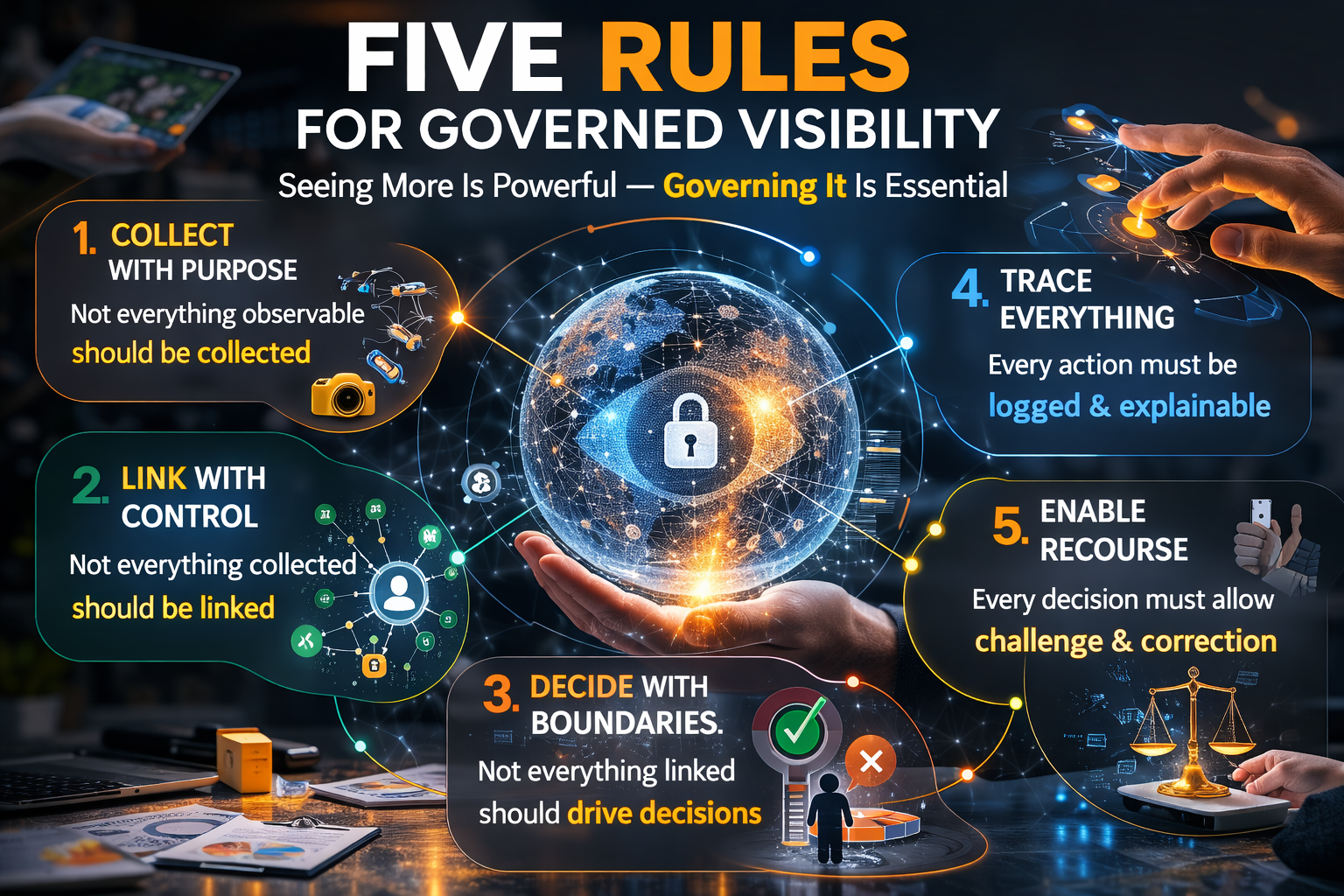
To make this practical, every serious AI institution should establish five visibility rules.
Rule 1: Not everything observable should be collected
Just because a signal exists does not mean it should enter the system. Institutions need clear purpose boundaries.
Rule 2: Not everything collected should be linked
Linking data across entities, systems, or contexts changes the power of visibility. Entity resolution should be governed, not assumed.
Rule 3: Not everything linked should become a decision variable
Some information may be useful for context but invalid for action. The move from observation to operational use must be explicit.
Rule 4: Every consequential visibility chain needs logging and traceability
If a system sees, infers, and acts, there must be a record of what was observed, how it was interpreted, and what happened next. NIST and the EU AI Act both place strong emphasis on monitoring, provenance, and logging for precisely this reason. (Artificial Intelligence Act)
Rule 5: Every visibility-driven action needs recourse
If a person, business, or asset is affected by what the system saw or inferred, there must be a path to challenge, correct, or appeal.
Without recourse, visibility becomes unilateral power.
Why this matters especially in the Global South
In many parts of the Global South, the core problem is not only excessive visibility. It is also insufficient legibility.
Millions of people, merchants, workers, and assets remain weakly represented in formal systems. That makes the governance of visibility especially important because the challenge is dual:
- create enough visibility to enable inclusion and better services,
- without creating systems of silent exclusion, asymmetry, or overreach.
This is where digital public infrastructure becomes strategically important. World Bank and related development materials describe DPI as foundational digital building blocks — such as digital identity, digital payments, and data-sharing systems — that can be reused across sectors to support both public and private services at scale. World Bank reporting also emphasizes AI readiness, data governance, and institutional reform as part of successful adoption. (World Bank)
So the governance of visibility is not anti-innovation.
It is what allows visibility to scale without destroying trust.
What boards and C-suites should ask now
This is not just for chief data officers, compliance teams, or architects. It is a board and executive agenda.
Leaders should ask:
What can our institution now see that it could not see before?
What inferences are we drawing from that visibility?
Which of those inferences are actually allowed to influence decisions?
Where are we linking signals across contexts in ways users may not expect?
What logging, oversight, and recourse exist for visibility-driven actions?
Where might we be automating on top of thin, stale, excessive, or weakly justified representations of reality?
These questions shift AI strategy from procurement to institutional design.
That is the deeper point of Goal 2. The AI era is not merely about using better tools. It is about redesigning institutions so they can sense, reason, and act with legitimacy.
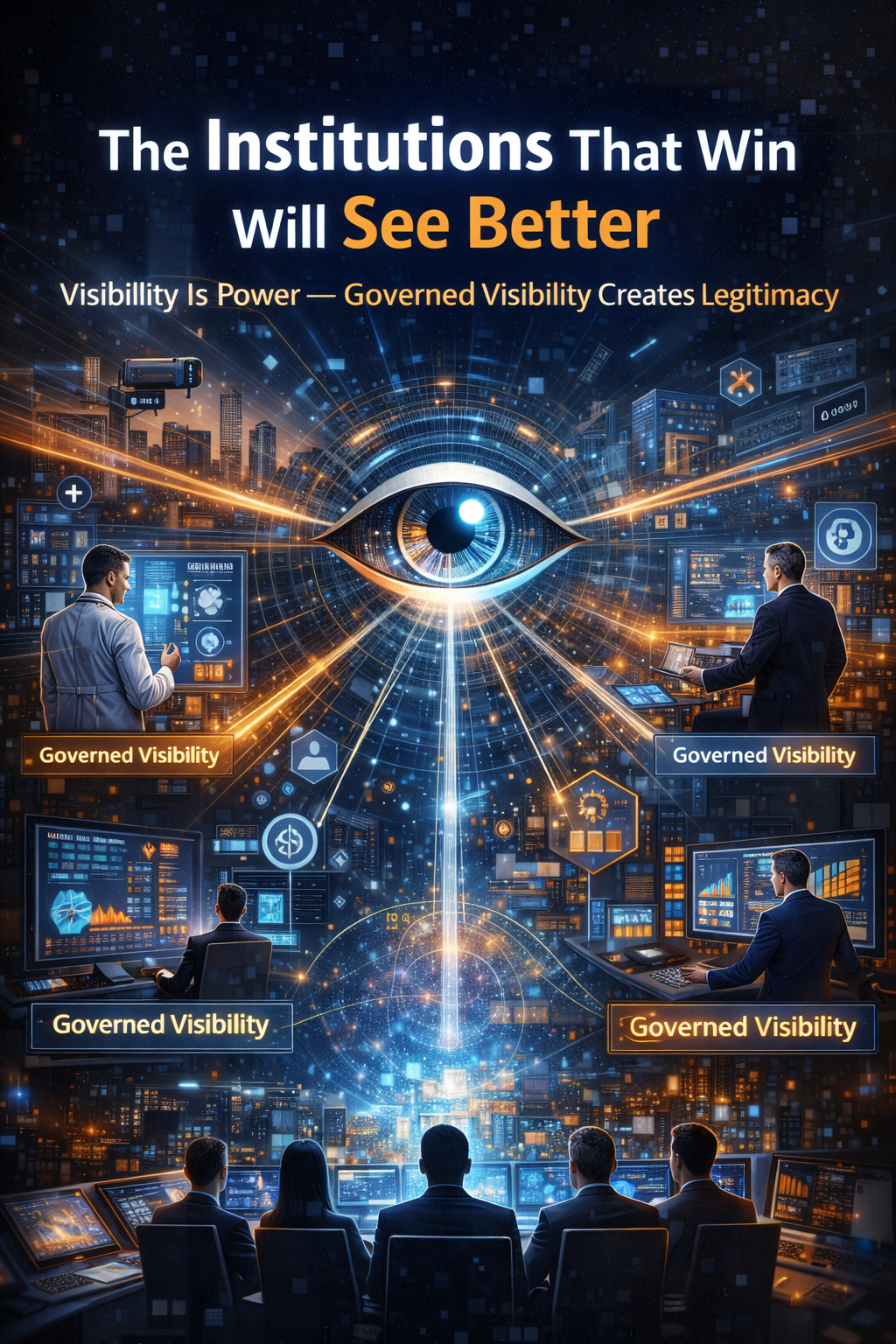
Conclusion Column: The institutions that win will not just see more. They will govern seeing better
The next AI race will not be won only by those with the biggest models, the most aggressive pilots, or the cheapest inference.
It will be won by institutions that understand something deeper:
visibility is power, and power must be governed.
The organizations that lead in the next decade will not simply collect more signals. They will define what is legitimate to observe, what is justified to infer, what is appropriate to retain, and what is acceptable to act upon. They will build systems in which visibility is not chaotic or extractive, but accountable, bounded, and aligned with institutional purpose.
That is why the governance of visibility is becoming one of the foundational questions of the AI economy.
Because in the age of intelligent institutions, the real issue is no longer only whether machines can think.
It is whether institutions know how to govern what machines are allowed to see, know, and do. (NIST)
FAQ
What is the governance of visibility in AI?
It is the set of rules, controls, and institutional norms that determine what AI systems may observe, link, infer, retain, and act upon.
Why is visibility governance different from privacy?
Privacy is part of it, but visibility governance is broader. It also includes provenance, traceability, inference legitimacy, access boundaries, oversight, retention, and recourse. (OECD)
Why does AI need rules for what can be seen and known?
Because the ability to detect or infer something does not automatically justify collecting it, using it, or acting on it. High-impact systems need purpose limits, governance, accountability, and logging. (Artificial Intelligence Act)
How does this connect to SENSE–CORE–DRIVER?
SENSE governs what reality becomes legible, CORE governs how visibility becomes reasoning, and DRIVER governs how reasoning becomes legitimate action.
Why is this important for boards and CEOs?
Because visibility affects risk, inclusion, service quality, resilience, customer trust, auditability, and the legitimacy of AI-enabled decisions.
Glossary
Governance of visibility
The institutional rules and controls that determine what can be observed, inferred, retained, shared, and acted upon.
SENSE
Signal, ENtity, State representation, Evolution — the layer where reality becomes machine-legible.
CORE
Comprehend context, Optimize decisions, Realize action, Evolve through feedback — the cognition layer.
DRIVER
Delegation, Representation, Identity, Verification, Execution, Recourse — the governance and legitimacy layer.
Traceability
The ability to reconstruct how an AI-enabled output or action emerged through logs, records, and linked evidence. (Artificial Intelligence Act)
Provenance
Information about where data or content came from and how it has changed over time. (NIST Publications)
Human oversight
Institutional capacity to supervise, intervene in, or constrain AI system behavior.
High-risk AI system
A category of AI systems subject to stronger obligations under the EU AI Act because of their potential impact on safety or fundamental rights. (Artificial Intelligence Act)
Data governance
The technical, policy, and regulatory frameworks that manage data across its lifecycle. (OECD)
References and further reading
This article is informed by official public materials including:
- NIST’s AI Risk Management Framework and associated Playbook resources on governance, measurement, and management of AI risks. (NIST)
- The OECD AI Principles, updated in 2024, and OECD materials on trustworthy AI and data governance. (OECD)
- The EU AI Act provisions on data governance, logging, and obligations for high-risk AI systems. (Artificial Intelligence Act)
- World Bank materials on digital public infrastructure, AI readiness, and the institutional foundations required for inclusive AI adoption. (World Bank)
Explore the Architecture of the AI Economy
This article is part of a broader research series exploring how institutions are being redesigned for the age of artificial intelligence.
Together, these essays examine the structural foundations of the emerging AI economy — from signal infrastructure and representation systems to decision architectures and enterprise operating models.
If you want to explore the deeper framework behind these ideas, the following essays provide additional perspectives:
- The Representation Economy: Why the AI Decade Will Be Defined by Who Gets Represented—and Who Designs Trusted Delegation
• Representation Infrastructure: Why the AI Economy Will Be Won by Those Who Make the Invisible Legible
• The Representation Stack: How Reality Becomes Identifiable, Legible, and Actionable in the AI Economy
• Identity Infrastructure: The Missing Layer Between Signals and Representation in the AI Economy
• Why Most AI Projects Fail Before Intelligence Even Begins
• The Intelligence Supply Chain: How Organizations Industrialize Cognition in the AI Economy
• The Enterprise AI Operating Model
• Decision Scale: Why Competitive Advantage Is Moving from Labor Scale to Decision Scale
• The Operating Architecture of the AI Economy: Why Intelligence Alone Will Not Transform Markets - The Silent Systems Doctrine: Why the AI Economy Will Be Won by Those Who Represent What Cannot Speak
- Signal Infrastructure: Why the AI Economy Begins Before the Model – Raktim Singh
Together, these essays outline a central thesis:
The future will belong to institutions that can sense reality, represent it clearly, reason about it intelligently, and act through governed machine systems.
This is why the architecture of the AI era can be understood through three foundational layers:
SENSE → CORE → DRIVER
Where:
- SENSE makes reality legible
- CORE transforms signals into reasoning
- DRIVER ensures that machine action remains accountable, governed, and institutionally legitimate
Signal infrastructure forms the first and most foundational layer of that architecture.
AI Economy Research Series — by Raktim Singh



Raktim Singh is an AI and deep-tech strategist, TEDx speaker, and author focused on helping enterprises navigate the next era of intelligent systems. With experience spanning AI, fintech, quantum computing, and digital transformation, he simplifies complex technology for leaders and builds frameworks that drive responsible, scalable adoption.