
The Board-Level Challenge of the AI Decade: Governing Second-Order AI and Intelligence Capital
Most leadership teams talk about AI in first-order terms: automation, productivity, cost reduction. Those gains are real—and in many industries, they will soon become table stakes.
But the companies that define the AI decade won’t win because they automated faster.
They will win because they saw what others missed:
AI does not only make existing work cheaper. It makes entirely new kinds of business possible.
That jump—from “AI improves the current model” to “AI changes what we can sell, how we price, and where value lives”—is the essence of Second-Order AI.
Second-order AI is not a technical feature. It’s a leadership capability: the ability to spot AI’s knock-on effects—how improved decision speed and precision reshape customer behavior, compress time-to-value, change willingness-to-pay, and open new profit pools.
This article is a board-level guide to:
- Recognizing second-order opportunities early
- Translating them into new revenue categories
- Building the learning discipline required to compound advantage—without hype, and without fear
If you want to understand “how to win with AI,” second-order AI is where the story shifts from adoption to value creation—the phase boards care about most. For the broader context, see my value-migration framing. Raktim Singh
This article is written for board members, CEOs, and CTOs navigating AI transformation in North America, Europe, the UK, India, the Middle East, and Asia-Pacific.

What “Second-Order AI” Really Means
First-order AI = direct impact
It changes a task or process directly:
- “We reduced call handling time.”
- “We automated document processing.”
- “We accelerated content creation.”
Second-order AI = cascading impact
It changes what becomes possible because the decision cycle and economics changed:
- Faster resolution increases trust, reduces churn, increases upsell conversion.
- Faster approvals change purchasing behavior and partner distribution.
- Faster experimentation changes demand capture and pricing power.
In one line:
First-order AI optimizes tasks. Second-order AI redesigns outcomes—and monetizes the redesign.
This also explains a common pattern: many AI programs look successful internally yet fail to move revenue. They stop at efficiency and never convert capability into new revenue logic.

Why Second-Order AI Is the Biggest Growth Opportunity of the AI Age
Two global forces are converging:
- AI is moving from analytics to action—embedded across workflows, products, channels, and decisions.
- AI is enabling new business model patterns—including decision services, agentic offerings, and new forms of “services as software.” (PwC)
Add one more structural reality you already emphasize:
When a technology wave reaches this stage, value migrates first, and value creation follows only after operating models and business models adapt. Raktim Singh
Second-order AI is the bridge from migration to creation.
It’s how you stop being an adopter—and become a category creator.
The Core Shift: From Products and Processes to Decisions and Outcomes
AI’s deepest enterprise capability is not content generation. It is decision acceleration:
- Decide faster
- Decide more precisely
- Decide with richer context
- Decide consistently across channels
- Decide at scale
When decisions improve at scale, organizations can productize them:
- “We don’t sell software; we sell approvals.”
- “We don’t sell monitoring; we sell prevention.”
- “We don’t sell analytics; we sell better choices.”
This is the birth mechanism of new revenue categories: decisions become services; outcomes become products.
For Enterprise AI framing and decision-services narrative, read these pieces. Raktim Singh
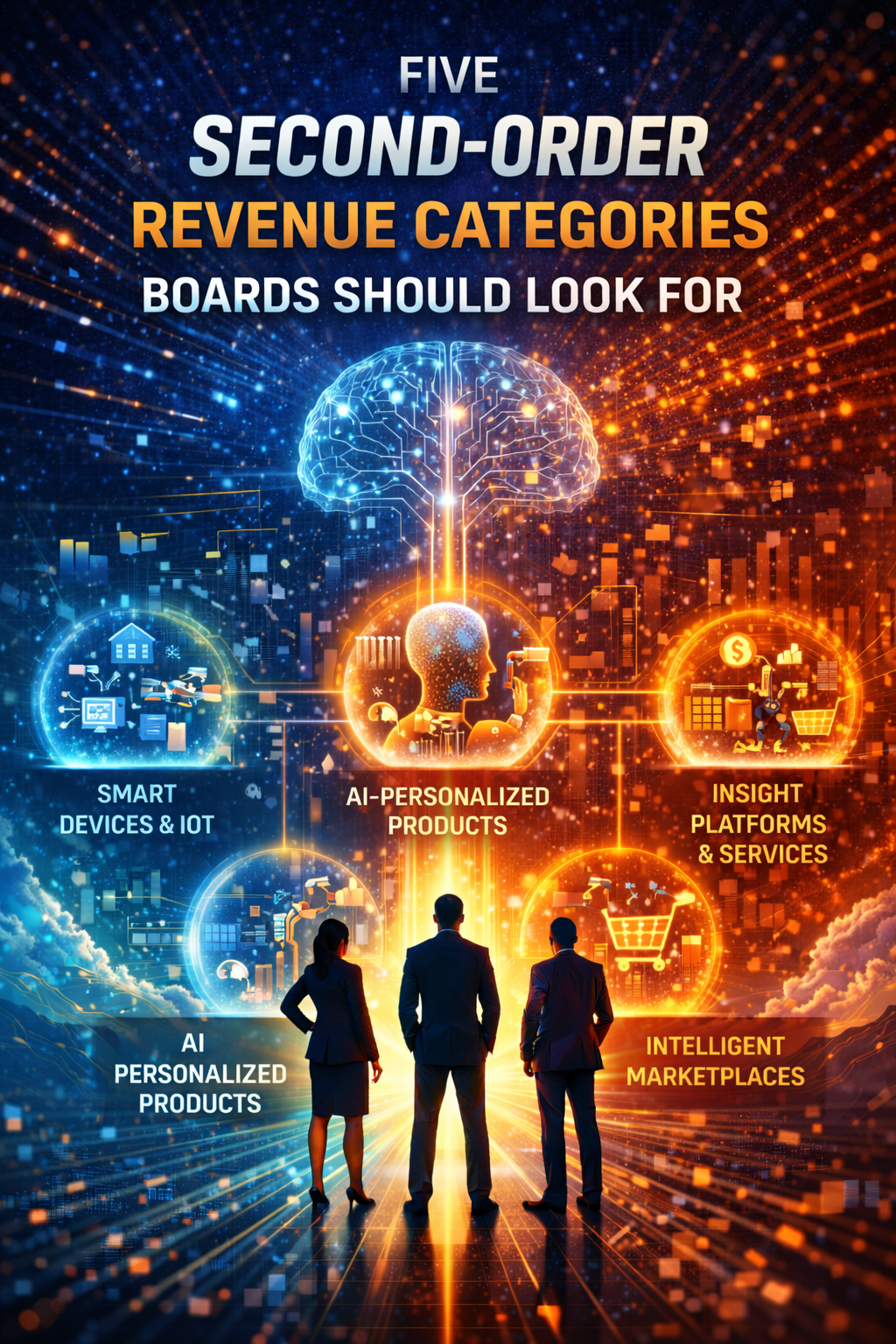
Five Second-Order Revenue Categories Boards Should Look For
The patterns below show up repeatedly when AI becomes an institutional decision capability—not a tool. Each category includes simple examples and the board questions that reveal whether it can become real revenue.
1) Decision Services: Selling the Decision, Not the Tool
A decision service is a productized decision capability delivered continuously. Instead of selling a platform, a report, or a one-time implementation, you sell an always-on, improving decision function.
Simple examples
- A logistics provider sells “on-time delivery assurance” powered by continuous routing decisions.
- A B2B vendor sells “inventory risk prevention” as a service—not dashboards.
- A financial institution sells “continuous credit decisions” embedded into partner journeys.
Why this is second-order
First-order AI improves internal decisions.
Second-order AI turns decision capability into a revenue line.
Board questions
- Which high-value decisions are repeatable enough to productize?
- Do customers pay for the tool—or the outcome?
- Can we deliver the decision through partners, marketplaces, or embedded channels?
(Read my article on decision-services) (Raktim Singh)
2) Embedded Intelligence: Monetizing “AI Inside” Across the Ecosystem
Embedded intelligence means bundling your intelligence into someone else’s workflow. This expands distribution without building a new sales channel.
Simple examples
- A manufacturer embeds predictive maintenance decisions into the service contract priced as uptime.
- A B2B software provider embeds a recommendation layer and charges for conversion uplift.
- A procurement platform embeds risk scoring and charges for prevented losses.
Why this is second order
The value migrates from your product into the customer’s context—where willingness-to-pay is higher because it sits directly inside their decision moment.
Board questions
- Where does the customer’s decision actually happen (their workflow, not ours)?
- Can our intelligence travel there with minimal friction?
- What do we price: usage, lift, avoided loss, or guaranteed outcome?
3) Outcome-Based Pricing: Charging for Results, Not Inputs
Outcome pricing becomes feasible when AI reduces uncertainty and improves predictability.
Simple examples
- A customer support provider charges for “issue solved,” not seats.
- A security provider charges for “reduction in incident impact,” not alerts.
- A marketing platform charges per qualified conversion, not impressions.
Why this is second-order
First-order AI reduces cost to deliver service.
Second-order AI changes how you price—and can expand margins when you outperform the market.
Executive reality check
Outcome pricing requires trust, explainability, and governance. Many initiatives fail because teams optimize models but can’t defend outcomes at scale—especially as AI systems become more agentic (acting, not just advising), raising the bar for reliability and control. (Business Insider)
4) Precision Expansion: Making Micro-Markets Profitable
AI makes it economical to serve segments that were previously too small, too variable, or too expensive to target.
Simple examples
- Dynamic packaging: micro-bundles tailored to precise needs.
- Personalization that changes conversion (not just content).
- Small-batch manufacturing and supply decisions optimized for micro-demand.
Why this is second-order
First-order AI increases efficiency.
Second-order AI expands the addressable market by lowering cost-to-serve enough to make micro-segments profitable.
Board questions
- Which customer segments were unprofitable because cost-to-serve was too high?
- Can AI reduce cost-to-serve enough to create a new segment business?
For the strategic foundation of this idea, my “precision growth / end of averages” thread is a strong internal companion. Raktim Singh
5) Assurance Layers: Selling Trust, Safety, and Proof
As AI proliferates, trust becomes monetizable. Customers increasingly pay for provenance, auditability, compliance automation, and proof that autonomy is safe.
Simple examples
- A regulated workflow provider sells “audit-ready decisions” with traceability.
- A content platform sells provenance-backed content pipelines.
- A vendor sells “agent governance as a service” so enterprises can automate safely.
Why this is second order
It’s not the model that becomes the differentiator. It’s the assurance wrapper that allows scaled adoption.
Read my governance/operating-model body of work, which makes the assurance argument board-credible. Raktim Singh
The Board’s Second-Order AI Playbook
Most executive teams miss second-order opportunities because they run AI like an IT modernization program.
Second-order AI requires running AI like business model discovery—supported by a learning discipline.
Step 1: Start from a “Decision Inventory,” Not a Use-Case List
List your 20–30 highest-value decisions:
- Pricing decisions
- Risk decisions
- Approval decisions
- Routing decisions
- Next-best-action decisions
Then ask:
- Which decisions are frequent?
- Which decisions are expensive when wrong?
- Which decisions change customer outcomes?
Those are your monetization candidates.
MY “Decision Scale” article frames why decision volume and speed are now strategic.Raktim Singh
Step 2: Trace Second-Order Effects Deliberately
For each decision capability, map the cascade:
Decision improves → cycle time shrinks → customer behavior shifts → revenue model becomes possible
Simple example:
- Faster onboarding decisions → customers activate sooner → drop-off decreases → lifetime value rises → a premium “guaranteed onboarding” offer becomes sellable.
Most organizations stop at “faster onboarding.”
Winners monetize the behavior change.
Step 3: Build the Learning Loop (the real moat in the GPT era)
In the GPT era, everyone can produce information. The differentiator is who learns fastest from outcomes.
Second-order value requires:
- Feedback loops
- Cross-functional learning (product, operations, risk, legal)
- Shared agreement on what “better” means
- Rapid translation of learning into policy and offerings
This is where “learning organization” becomes a revenue engine—not a cultural slogan.
MY “Intelligence Capital” framing is the right internal companion: it gives boards the language to treat learning and decision improvement as a compounding asset. Raktim Singh
Step 4: Design the Monetization Path Early
Before scaling, choose the monetization path:
- Decision-service subscription
- Embedded intelligence fee
- Outcome-based pricing
- Revenue share (lift-based)
- Assurance premium
If you don’t design pricing early, AI capability becomes “free feature creep.”
Step 5: Treat Governance as a Growth Enabler, Not a Brake
Second-order AI often fails because leaders fear risk and slow everything down.
The better stance is:
Governance is what makes scaling possible.
As autonomous and agentic systems grow, enterprises increasingly emphasize reliability, security, and trust mechanisms as prerequisites for scale. (Business Insider)
Boards should demand:
- Clear accountability for decisions
- Escalation and reversal paths
- Monitoring that captures real-world outcomes
- Cost controls (spend often spikes after “success”)
- Proof mechanisms where required
(MY Enterprise AI Operating Model and Control Plane pieces can provide you the depth (Raktim Singh)
Cross-Industry Examples (No Jargon)
These examples help executives recognize the pattern quickly:
Retail / Consumer
First-order: AI writes product descriptions faster.
Second-order: faster experimentation finds winning bundles → micro-categories emerge → “personalized bundle subscription” becomes sellable.
Manufacturing
First-order: predictive maintenance reduces downtime.
Second-order: uptime becomes the product → availability contracts replace warranties → recurring revenue grows.
Financial services
First-order: faster verification and underwriting.
Second-order: instant decisions enable embedded offers in partner journeys → new distribution and new pricing.
Healthcare operations
First-order: scheduling optimization.
Second-order: fewer no-shows changes capacity economics → premium “guaranteed access” tiers become viable.
B2B SaaS
First-order: AI support assistant reduces tickets.
Second-order: “self-healing workflows” becomes a premium outcome tier, not a feature.
The Key Insight
Here’s the sentence boards remember because it’s both simple and true:
AI doesn’t just make work cheaper. It makes new revenue logic possible.
If you want boards to associate your name with “how to win with AI,” keep returning to three truths:
- Value migrates before it is created. (Raktim Singh)
- AI changes decisions first—then business models. (PwC)
- Winners compound learning into revenue. (Raktim Singh)
Glossary
- Second-order effects: Indirect impacts that appear after the direct benefit—behavior shifts, new pricing, new markets, new profit pools.
- Decision service: A product that delivers an ongoing decision outcome (approvals, prevention, optimization), not just tools or reports.
- Embedded intelligence: Your intelligence delivered inside a customer or partner workflow.
- Outcome-based pricing: Charging for results (uptime, prevention, conversion lift) rather than seats or usage.
- Assurance layer: Trust features that enable adoption at scale—provenance, auditability, compliance, traceability, governance.
- Institutional learning loop: A repeatable process to learn from outcomes and convert learning into updated policies, thresholds, and offerings.
FAQ
1) Is second-order AI only for tech companies?
No. Any organization that makes repeatable decisions at scale can productize those decisions or embed them into partner ecosystems.
2) Why do most AI programs miss second-order value?
They optimize tasks and stop. They don’t redesign pricing, distribution, and offerings around changed customer behavior.
3) How can boards govern second-order AI without slowing innovation?
By insisting on clarity: accountability, reversal paths, outcome monitoring, and cost discipline—governance that enables speed rather than blocking it.
4) What’s the fastest way to find second-order opportunities?
Start with a decision inventory, pick the decisions that drive customer outcomes, and trace the cascade to willingness-to-pay and pricing logic.
5) What’s the risk of chasing second-order effects too early?
Overbuilding. The discipline is to test not only technical performance but willingness-to-pay and pricing acceptance before scaling.
What is board-level AI governance?
Board-level AI governance refers to strategic oversight of AI risk, capital allocation, decision automation, and intelligence compounding across the enterprise.
What is Second-Order AI?
Second-Order AI refers to AI systems that reshape business models and revenue categories — not just automate processes.
Why is AI now a board responsibility?
Because AI impacts capital allocation, compliance, risk, and competitive advantage — core fiduciary responsibilities of directors.
How should boards measure AI success?
Not by pilot counts or model accuracy, but by decision quality improvement, revenue expansion, and intelligence reuse.
Conclusion: The board-level challenge of the AI decade
AI-fication is real. The opportunity is large. But value does not arrive automatically.
Second-order winners do three things better than everyone else:
- They see cascades (systems thinking)
- They learn faster (learning organization as an operating capability)
- They convert learning into monetizable decision services (value creation)
That is how leaders unlock new revenue categories others don’t see—and how enterprises win the AI decade.
If you want to go deeper, the most natural next reads in your canon are:
- The AI Value Migration Curve (Raktim Singh)
- Decision Services: Unlocking Enterprise AI Growth (Raktim Singh)
- Intelligence Capital (Raktim Singh)
- The AI Dividend (Raktim Singh)
- Decision Scale (Raktim Singh)
- The Enterprise AI Operating Model (Raktim Singh)
References and further reading
- PwC, Nine AI-fuelled business models that leaders can’t ignore. (PwC)
- McKinsey, The economic potential of generative AI: The next productivity frontier. (McKinsey & Company)
- Business Insider, reporting on enterprise concerns and “background checks” for AI agents as autonomy increases. (Business Insider)
- Raktim Singh, The AI Value Migration Curve. (Raktim Singh)
- Raktim Singh, Decision Services: Unlocking Enterprise AI Growth. (Raktim Singh)
- Raktim Singh, Intelligence Capital. (Raktim Singh)
The Enterprise AI Doctrine: From Decision Scale to Institutional Redesign
Over the past few months, I’ve been building a structured doctrine around Enterprise AI — not as a technology trend, but as an institutional redesign agenda.
It unfolds in layers:
🔹 1️⃣ Decision Economics
- Decision Scale: Why Competitive Advantage Is Moving from Labor Scale to Decision Scale
https://www.raktimsingh.com/decision-scale-competitive-advantage-ai/
→ Establishes the core thesis: advantage is shifting from scaling labor to scaling decision quality.
🔹 2️⃣ Institutional Transformation
- The Future Belongs to Decision-Intelligent Institutions
https://www.raktimsingh.com/the-future-belongs-to-decision-intelligent-institutions/
→ Argues that AI leadership is not about tooling — it is about institutional architecture.
🔹 3️⃣ Sector-Level Redesign
- The Institutional Redesign of Indian IT: From Services Firms to Intelligence Institutions
https://www.raktimsingh.com/institutional-redesign-indian-it-intelligence-institutions/ - From Labor Arbitrage to Intelligence Arbitrage: Why Indian IT’s AI Reinvention Will Define the Next Decade
https://www.raktimsingh.com/from-labor-arbitrage-to-intelligence-arbitrage-why-indian-its-ai-reinvention-will-define-the-next-decade/
→ Examines how this shift reshapes industry structure, economics, and competitive positioning.
🔹 4️⃣ Economic Consequences
- The End of Averages: Why Precision Growth Will Define the Next Decade of Enterprise Strategy
https://www.raktimsingh.com/precision-growth-end-of-averages-enterprise-ai/ - What Is the AI Dividend? How Boards Capture Structural Gains from Enterprise AI
https://www.raktimsingh.com/ai-dividend-boards-structural-gains/
→ Explores how decision intelligence translates into measurable structural gains.
🔹 The Unifying Thesis
Together, these articles form a coherent framework:
- Competitive advantage is moving from labor scale to decision scale
- Institutions must evolve from services firms to intelligence institutions
- AI must shift from isolated pilots to structurally governed, economically accountable enterprise systems
This is not AI adoption.
It is enterprise redesign.



Raktim Singh is an AI and deep-tech strategist, TEDx speaker, and author focused on helping enterprises navigate the next era of intelligent systems. With experience spanning AI, fintech, quantum computing, and digital transformation, he simplifies complex technology for leaders and builds frameworks that drive responsible, scalable adoption.