

The uncomfortable truth: most enterprise AI “failures” are change failures
Continuous recomposition is quickly becoming one of the most important—and least discussed—capabilities in enterprise AI. While many organizations still focus on choosing the “right” model, the real differentiator has quietly shifted: the ability to change safely and continuously without breaking operations.
As AI systems move from answering questions to taking actions across workflows, policies, and systems of record, enterprises will not win by intelligence alone. They will win by how effectively they can recompose how work gets done—again and again—at enterprise speed.
In the last two years, many enterprises treated AI like every previous tech wave: select tools, run pilots, celebrate early adoption, and assume scale will follow.
Then AI crossed a threshold.
It stopped being something that merely responds—and started becoming something that acts: creating tickets, updating records, triggering workflows, initiating approvals, sending notifications, and coordinating steps across systems of record.
That moment changes the entire risk equation. Because once AI takes actions, every “small” change becomes a potential production incident.
The question leaders should now ask is no longer:
- “How smart is the model?”
It is:
- “How fast can we change safely—repeatedly—without breaking the enterprise?”
This is not a theoretical concern. Gartner has predicted that over 40% of agentic AI projects will be canceled by the end of 2027 due to escalating costs, unclear business value, or inadequate risk controls. (Gartner)
That prediction isn’t an indictment of AI capability. It’s a warning about enterprise operability.
What is continuous recomposition?
Continuous recomposition is the enterprise capability to reorganize workflows, policies, tools, and models—continuously—without operational disruption.
Practically, it means you can:
- update a policy once—and have it behave consistently across every channel and workflow
- swap a model without breaking downstream automations and controls
- add a new tool integration without creating new failure paths
- change approval thresholds region-by-region without rebuilding systems
- keep governance, auditability, and cost discipline intact while everything evolves
In one sentence:
Recomposition isn’t transformation. It’s the ability to keep transforming—without chaos.

Why “smarter AI” is not enough
Even if your model is excellent, it runs inside a world that changes daily:
- Policies get updated.
- Workflows evolve.
- Security rules tighten.
- Vendors change APIs.
- Compliance expectations shift (sometimes globally, sometimes locally).
- New vulnerabilities emerge.
- Toolchains change.
- Costs spike as usage scales.
So your AI isn’t operating in a stable environment. It’s operating on a moving ship.
The governance landscape is reinforcing the same idea: responsible AI is increasingly framed as a lifecycle discipline, not a one-time gate. The NIST AI Risk Management Framework explicitly discusses the need to identify and track emergent risks over time. (NIST Publications) And ISO/IEC 42001 is built around establishing, maintaining, and continually improving an AI management system. (ISO)
Translation: enterprises must become world-class at change—not just model selection.
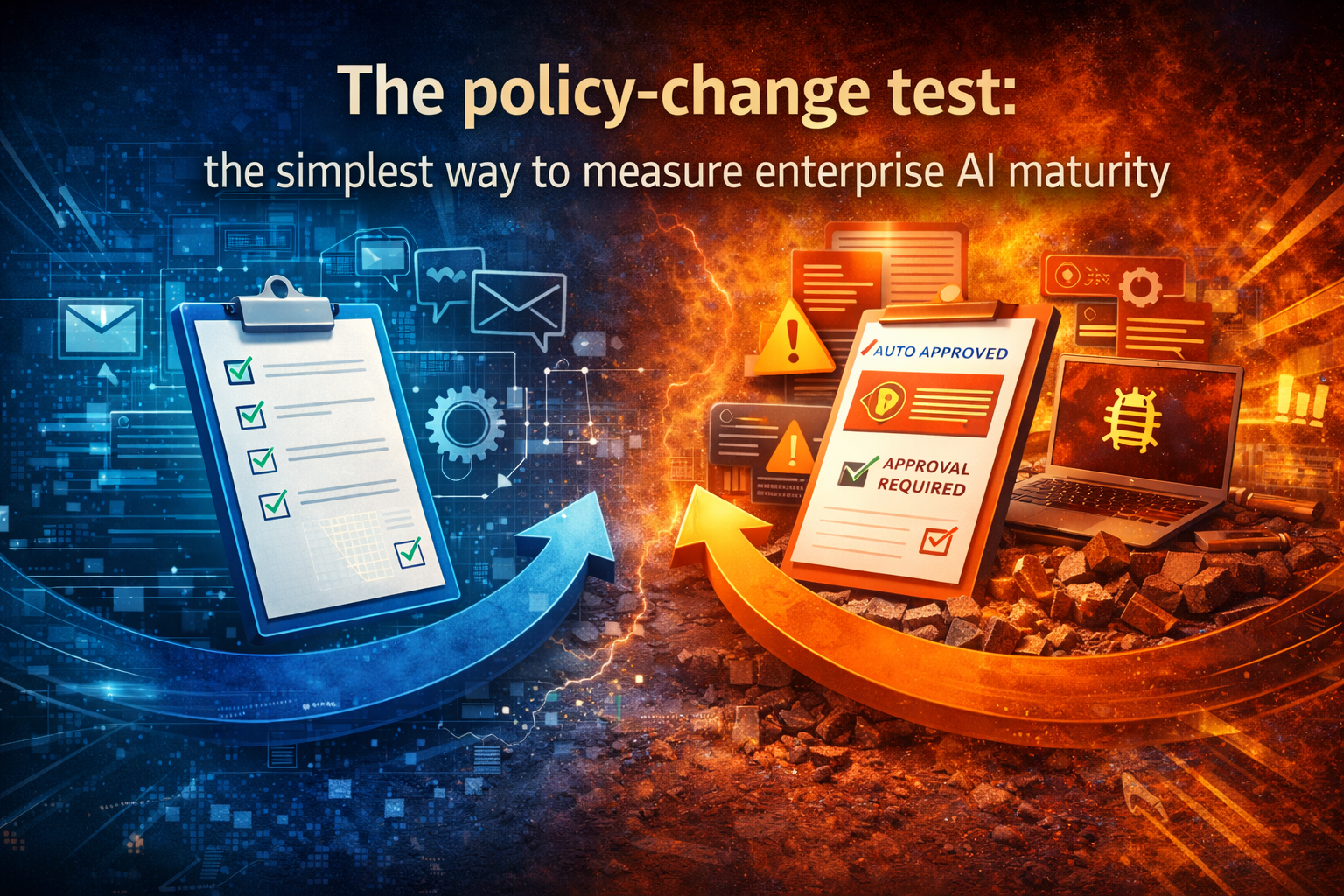
The policy-change test: the simplest way to measure enterprise AI maturity
If you want a practical maturity test that cuts through slogans, use this:
Make a small policy change.
Example:
“A request that was previously auto-approved now requires approval under specific conditions.”
Now ask:
- Does the update propagate cleanly across chat, portals, email workflows, and ticketing?
- Are outcomes consistent across channels?
- Is evidence captured in a uniform, auditable way?
- Can you roll back if signals indicate risk?
- Can you prove which policy version was used for each decision?
If that “small change” triggers:
- inconsistent behavior across channels
- multiple teams patching prompts locally
- emergency fixes in production
- audit gaps
- manual cleanup and exception storms
…your enterprise isn’t recomposing. It’s fragile.
And fragility is the hidden tax that kills AI at scale.
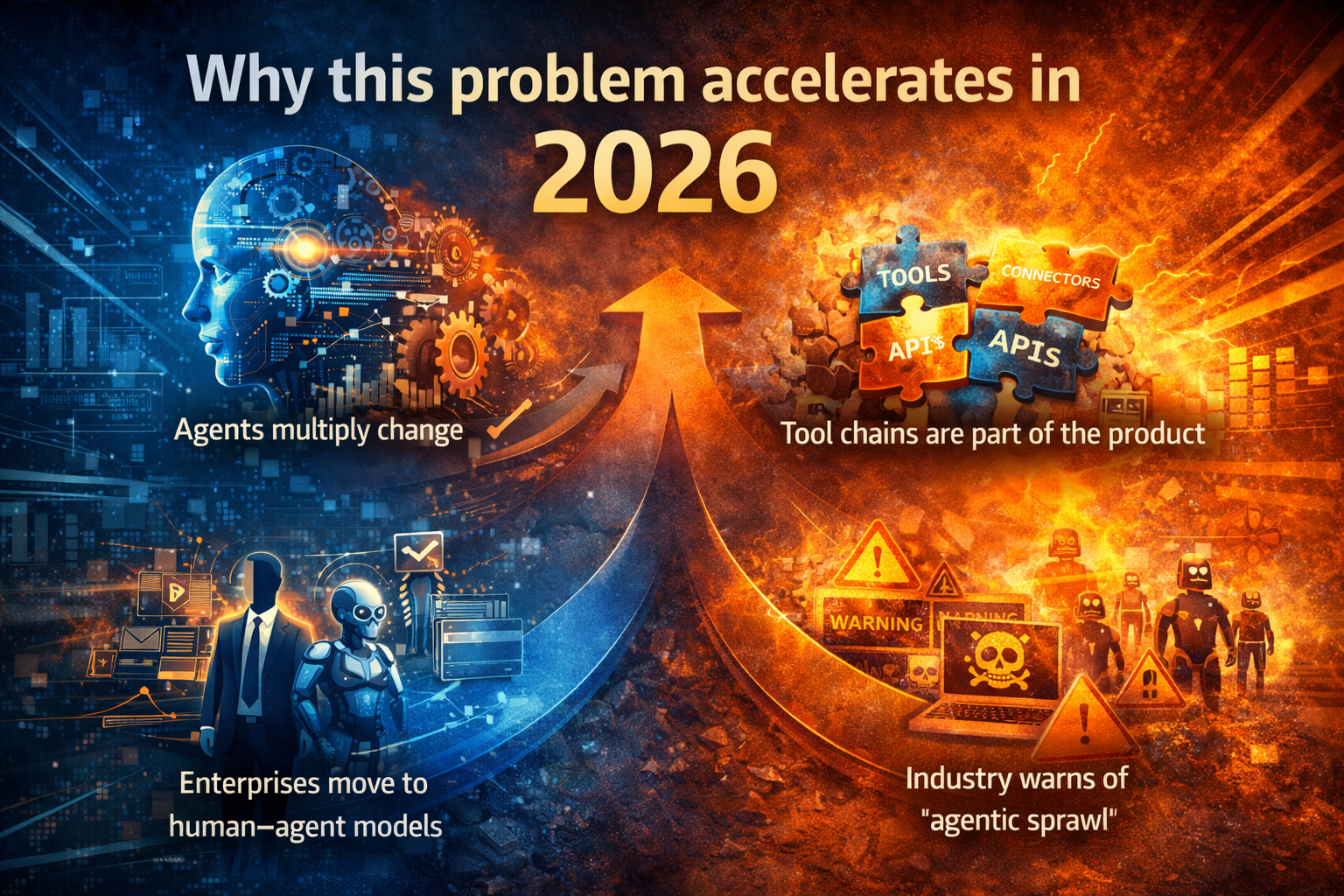
Why this problem accelerates in 2026
1) Agents multiply change, not just output
When AI only answers questions, change mostly creates content risk.
When AI takes actions, change creates operational risk.
A minor drift becomes an incident. A small prompt change becomes an outage. A vendor API tweak breaks a workflow chain.
2) Tool chains are now part of the “product”
Agentic systems are rarely standalone. They call tools—APIs, workflow engines, ticketing systems, identity platforms, data services.
Every tool update introduces a new edge case. Every connector becomes an additional “moving part.”
3) Enterprises are shifting toward human–agent operating models
The workforce is evolving toward models where humans supervise increasing volumes of autonomous work—often described in management terms like a “human-agent ratio.” (ISO)
That shift forces a new discipline: how to evolve workflows without breaking accountability.
4) The industry is warning about agentic sprawl and failure rates
The broader market narrative is converging: when governance and operability are weak, costs rise, risk rises, and initiatives stall—exactly the pattern Gartner flagged. (Gartner)
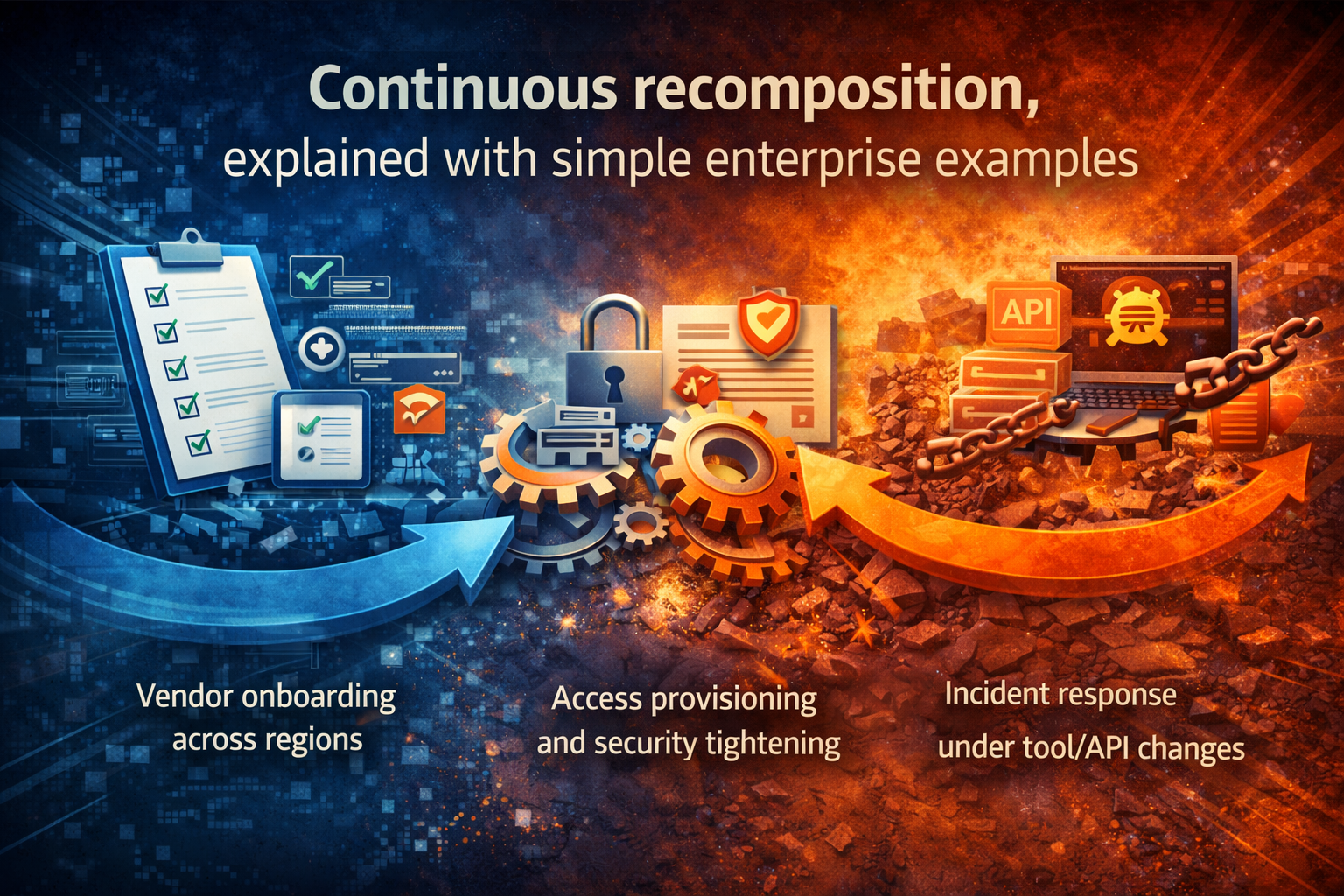
Continuous recomposition, explained with simple enterprise examples
Example 1: Vendor onboarding across regions
Vendor onboarding touches risk checks, identity, documentation, approvals, and systems of record.
Then one region updates compliance requirements:
- an extra document type is required
- an additional approval step is introduced
- evidence must be stored in a new audit format
A recomposing enterprise updates the policy/workflow once—via a governed service—and it behaves consistently everywhere.
A non-recomposing enterprise patches:
- a prompt here
- a workflow there
- an email template somewhere else
Result: it works in one channel and fails quietly in another—until a customer or auditor finds it.
Example 2: Access provisioning and security tightening
An access workflow is stable—until security updates mandate:
- shorter access durations
- stricter least-privilege mapping
- stronger logging and evidence requirements
If change isn’t centralized, versioned, and enforced consistently, you get:
- inconsistent access decisions
- audit failures
- “temporary” exceptions that become permanent
- manual escalation storms
Recomposition means policy versioning, consistent enforcement, and replayable decision traces.
Example 3: Incident response under tool/API changes
Operations workflows use monitoring + ticketing + remediation automation.
Then a tool update changes an API response shape. Automation fails mid-flow, leaving partial work and confusion.
A recomposing enterprise anticipates this by:
- validating tool contracts
- using controlled execution paths (retries, fallbacks, safe defaults)
- degrading safely (assist mode vs execute mode)
- keeping rollback/compensation ready
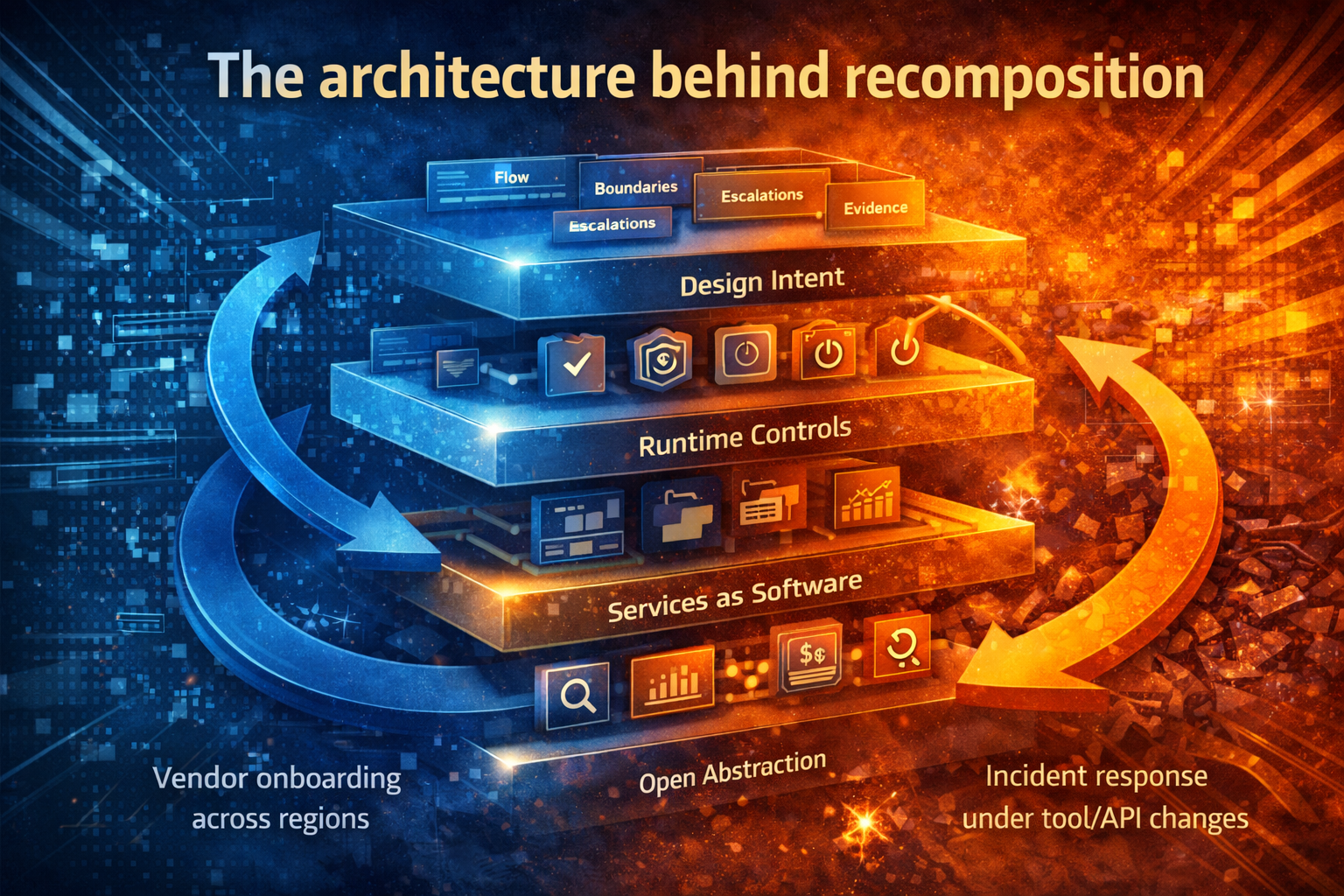
The architecture behind recomposition, in plain language
Continuous recomposition isn’t a new dashboard. It isn’t a “platform” label.
It’s a stack discipline. Five things must work together.
1) Design intent must be explicit, not implied
If you want consistent behavior, design must specify:
- the flow (steps, ordering, exceptions)
- boundaries (what is allowed vs forbidden)
- escalation triggers
- evidence requirements
Otherwise the system improvises. And improvisation is where enterprise incidents are born.
2) Runtime control must be continuous, not just gated
Many enterprises rely on gates:
- reviews before go-live
- committee approvals
- periodic audits
Those are necessary—but insufficient—because autonomy operates continuously.
So governance must operate continuously too:
- pre-execution validation
- real-time policy checks
- stop conditions and circuit breakers
- a kill-switch
- rollback or compensating actions
This is not bureaucracy. It’s what makes autonomy survivable.
3) Services-as-software becomes the unit of scale
If every team builds its own version, you get duplication and uneven controls.
Recomposition demands reusable, owned services—think:
- policy-checking as a service
- evidence capture as a service
- approval routing as a service
- safe tool execution as a service
Workflows should be composed from trusted building blocks—not rewritten repeatedly.
4) Open abstraction prevents model/tool churn from breaking everything
Models change. Prompts change. Tools change. Security protocols change.
If workflows are tightly coupled to one model or tool format, every update becomes a mini rewrite.
Recomposition requires a layer of abstraction:
- “this is the job”
- “these are approved tools”
- “this is required evidence”
- “this is rollback behavior”
Then models can evolve without destabilizing operations.
5) Monitoring is not optional—it’s governance
Governance is not just policy documents. It’s operational evidence.
NIST’s framing around lifecycle risk and emergent risks reinforces this requirement. (NIST Publications)
In practice, monitoring means:
- traceability of actions
- logs that support investigations
- drift detection (data, behavior, tool outcomes)
- cost monitoring (not just tokens—tool calls, retries, escalations)
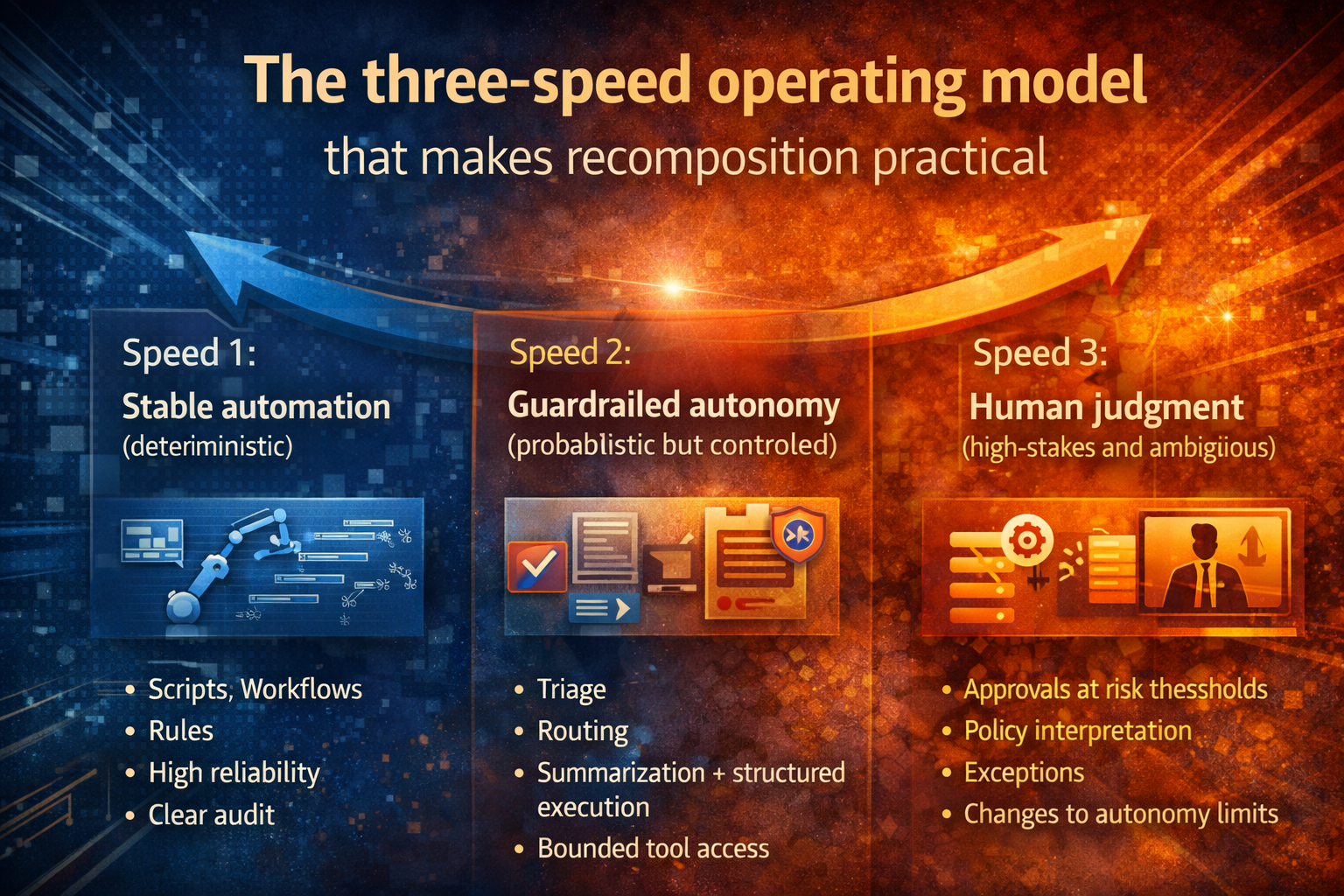
The three-speed operating model that makes recomposition practical
One of the simplest ways to implement recomposition without overwhelming teams:
Speed 1: Stable automation (deterministic)
Use workflows, scripts, rules for repeatable tasks—high reliability, clear audit.
Speed 2: Guardrailed autonomy (probabilistic but controlled)
Use AI for contextual tasks like triage, routing, summarization + structured execution, bounded tool access.
Speed 3: Human judgment (high-stakes and ambiguous)
Humans remain accountable for decisions requiring policy interpretation, exceptions, or risk acceptance.
This model reduces resistance because it makes something explicit:
humans are not replaced; they become the governance and evolution engine.
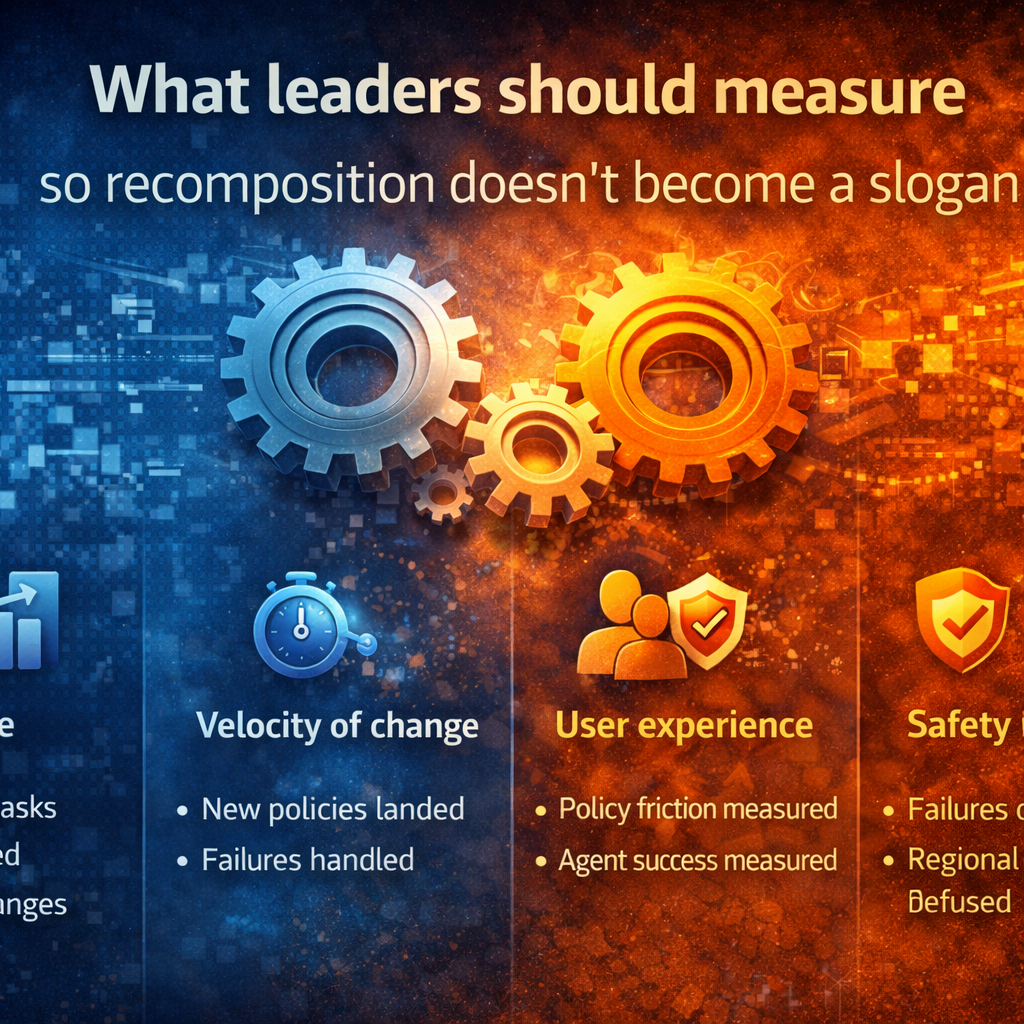
What leaders should measure so recomposition doesn’t become a slogan
To operationalize recomposition, track signals that reflect real maturity:
- Policy-to-production time: how long a policy change takes to become consistent everywhere
- Rollback readiness: whether high-impact steps have defined compensating actions
- Cross-channel consistency: outcomes match across chat, portal, email, workflow
- Evidence completeness: can you reconstruct what happened and why
- Change blast radius: updates stay localized vs cause cascading failures
- Autonomy cost envelope: spending remains within budget parameters at scale
These metrics separate AI demos from enterprise capability.
Conclusion: the recomposing enterprise wins
Enterprises rarely lose because they can’t access AI.
They lose because they can’t operate change.
In the next era, leaders will not win by selecting the “best” model. They will win by building an operating environment that can:
- ship safer changes faster than competitors
- adapt workflows across regions without reinvention
- swap models without destabilizing production
- keep audit, cost, and security intact while everything evolves
That is why change velocity—not intelligence—becomes the durable enterprise AI advantage.
Continuous recomposition is the capability that makes this possible—and it is quickly becoming the clearest signal of enterprise AI maturity.
Glossary
- Continuous recomposition: The capability to continuously change enterprise workflows, policies, tools, and models safely without operational disruption.
- Agentic AI: AI systems that plan and execute multi-step work, often by invoking tools and workflows.
- Enterprise operability: The ability to run AI reliably in production with controls, monitoring, auditability, and recovery.
- Rollback / compensating actions: Mechanisms that reverse or mitigate the impact of actions when something goes wrong.
- Services-as-software: Treating AI capabilities as reusable services with ownership, interfaces, and operational guarantees.
- Runtime governance: Continuous enforcement of policy and safety while systems run, not only at deployment time.
- Emergent risks: New or evolving risks that appear after deployment as conditions change. (NIST Publications)
FAQ
1) Is continuous recomposition the same as digital transformation?
No. Transformation is often treated as a program with phases. Continuous recomposition is a permanent operating capability—the ability to keep changing safely.
2) Do we need the “best model” to recompose effectively?
Not necessarily. Recomposition is primarily about operating discipline: controls, reuse, versioning, evidence, monitoring, and rollback.
3) What breaks recomposition most often?
In practice:
- inconsistent policy enforcement across channels
- unversioned prompts/workflows
- brittle integrations
- missing rollback paths
- lack of traceability for tool actions
4) How do we start without boiling the ocean?
Pick 2–3 high-volume workflows, build reusable services with runtime controls, and expand progressively. Avoid “agent sprawl” by scaling services—not one-off agents.
5) Why does governance matter more for agentic AI?
Because once AI takes actions, failures become operational incidents—not merely incorrect outputs. Gartner’s cancellation forecast reflects this gap in value, cost discipline, and risk controls. (Gartner)
References and further reading
- Gartner press release: “Gartner Predicts Over 40% of Agentic AI Projects Will Be Canceled by End of 2027” (June 25, 2025). (Gartner)
- NIST: Artificial Intelligence Risk Management Framework (AI RMF 1.0)—includes lifecycle framing and tracking emergent risks. (NIST Publications)
- ISO: ISO/IEC 42001:2023—AI management systems with continual improvement. (ISO)
- Forbes: Commentary on Gartner’s forecast and enterprise realities around AI agents (June 28, 2025). (Forbes)
- Why Enterprises Are Quietly Replacing AI Platforms with an Intelligence Supply Chain – Raktim Singh
- The New Enterprise Advantage Is Experience, Not Novelty: Why AI Adoption Fails Without an Experience Layer – Raktim Singh
- The Agentic Foundry: How Enterprises Scale AI Autonomy Without Losing Control, Trust, or Economics – Raktim Singh
- The One Enterprise AI Stack CIOs Are Converging On: Why Operability, Not Intelligence, Is the New Advantage – Raktim Singh



Raktim Singh is an AI and deep-tech strategist, TEDx speaker, and author focused on helping enterprises navigate the next era of intelligent systems. With experience spanning AI, fintech, quantum computing, and digital transformation, he simplifies complex technology for leaders and builds frameworks that drive responsible, scalable adoption.