
Delegation Rating Agencies : As AI systems move from advice to action, a new trust market will emerge
For the last few years, most of the AI conversation has revolved around a familiar race: better models, bigger context windows, cheaper inference, faster agents, and more automation.
That race matters. But it is no longer the deepest question.
The deeper question is this:
Who gets to let machines act?
And just as importantly:
Who decides whether that delegation can be trusted?
That question will define the next stage of the AI economy.
We are moving from a world in which AI mostly advises to one in which AI increasingly acts: approving claims, prioritizing patients, adjusting prices, routing supply chains, triaging incidents, screening vendors, initiating workflows, and coordinating with other software systems.
At the same time, governance frameworks are shifting their focus beyond performance alone toward risk, accountability, controls, lifecycle oversight, and incident reporting. The European Union’s AI Act takes a risk-based approach to AI regulation; NIST’s AI Risk Management Framework is designed to help organizations manage AI risk; ISO/IEC 42001 provides a management-system standard for organizations that develop, provide, or use AI; and the OECD has been building common incident-reporting frameworks to support accountability across jurisdictions. (Digital Strategy)
In that world, model quality will matter. But it will not be enough.
Because once AI begins to act on behalf of an institution, the central question is no longer, “Is the model smart?”
It becomes:
- What has this system been allowed to do?
- Under what conditions?
- On whose authority?
- Against what representation of reality?
- With what recourse if it gets something wrong?
That is why I believe the AI economy will produce a new class of institutions:
Delegation Rating Agencies
These would be organizations that assess the quality, safety, legitimacy, and trustworthiness of machine delegation architectures.
Not model benchmarks.
Not generic AI ethics statements.
Not one-time audits.
But institutions that evaluate whether an organization has designed machine authority well enough to deserve trust.
That may sound abstract today.
It will feel obvious very soon.
Why the AI economy needs a new kind of rating institution
Financial markets did not scale because every borrower was equally trustworthy. They scaled because institutions emerged to assess risk, standardize trust signals, and make uncertainty legible. In the United States, for example, the SEC formally recognizes nationally recognized statistical rating organizations as part of the credit-rating ecosystem. (Digital Strategy)
The AI economy is approaching a similar moment.
But this time, the thing being judged is not simply whether a borrower can repay debt.
It is whether an institution has built a system in which machine authority is:
- bounded,
- observable,
- reversible,
- evidence-linked,
- identity-aware,
- context-sensitive,
- and accountable when things go wrong.
In other words, the new object of trust is not just software.
It is delegation design.
That is a very different problem.
A company may use a powerful model and still be unsafe.
A bank may use a compliant vendor and still delegate badly.
A hospital may use advanced AI and still create unacceptable risk.
A government may adopt an AI assistant and still fail to define authority, appeal, or recourse.
This is one of the biggest blind spots in today’s AI conversation.
Most current governance language still revolves around one of three things:
- model capability,
- model risk, or
- organizational policy.
All three matter. But none fully answers the most important operational question:
Can this institution be trusted to let machines act within a legitimate boundary?
That is what Delegation Rating Agencies would evaluate.
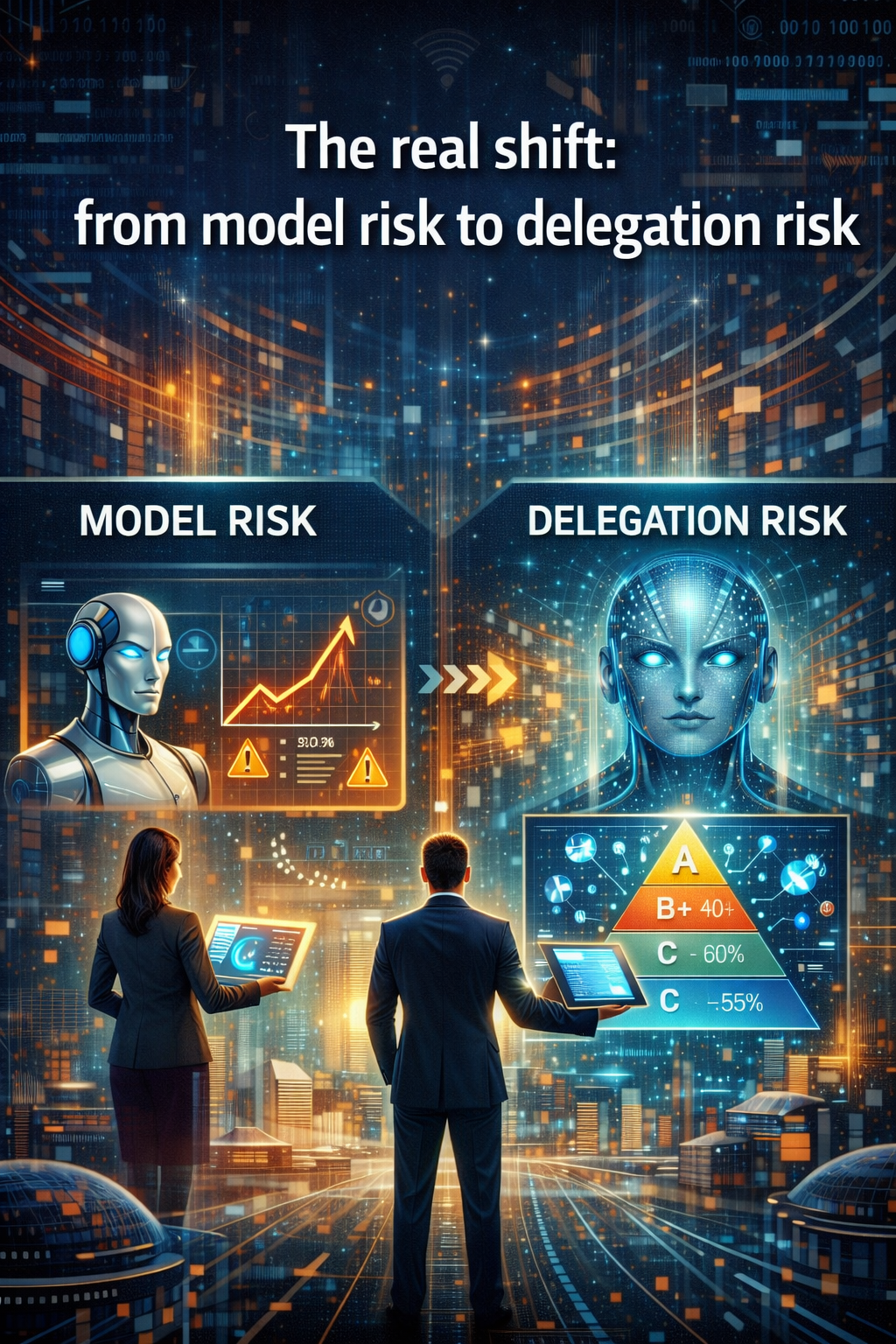
The real shift: from model risk to delegation risk
We are entering a period in which delegation risk may become more important than model risk.
That is because many serious failures in AI will not come from a model being unintelligent. They will come from a system being given the wrong authority over the wrong representation of reality.
Let’s take five simple examples.
-
Lending systems
An AI system does not merely recommend a loan priority. It can reorder queues, request additional documents, escalate suspicious applications, and influence who gets human attention first.
The biggest question is not whether the model predicts default well.
The biggest question is whether the institution has delegated authority properly:
- What data may the system rely on?
- Can it infer proxies it should not use?
- When must a human intervene?
- Can the decision be challenged?
- Is the chain of authority clear?
-
Hospital workflow assistants
Suppose an AI system helps prioritize imaging cases or flags critical notes for physician review.
Accuracy matters. But it is not enough.
The deeper issue is:
- Did the hospital define what the AI is allowed to prioritize?
- Is it acting on complete or partial patient representation?
- What happens when the patient’s true condition is not legible to the system?
- Is there a safe appeal path?
-
Procurement agents
A company lets an AI agent shortlist vendors, negotiate standard terms, and trigger low-value purchases.
This sounds efficient until the system:
- overweights stale supplier data,
- ignores crucial business context,
- fails to detect a sanctions issue,
- or optimizes cost at the expense of resilience.
The failure is not merely that “the model made a mistake.”
The failure is that the organization delegated purchasing authority without building enough context, boundary control, and recovery paths.
-
Dynamic pricing engines
A retailer deploys dynamic pricing across channels and regions.
The question is no longer only whether the algorithm improves margins.
The real question is whether the institution understands what it has delegated:
- Can the system act on inferred willingness to pay?
- What fairness or brand limits apply?
- What if it learns an undesirable pattern?
- Who can stop it, override it, or unwind it?
-
Public-sector eligibility tools
A system helps determine which cases get flagged for deeper review.
The issue is not only whether it classifies efficiently.
The deeper problem is whether citizens are being governed by a machine-delegated process without a legible explanation, a contestable path, or an appropriate boundary on automated authority.
This is why the next market will not simply ask, “How good is your AI?”
It will ask:
How well have you designed the right to delegate?
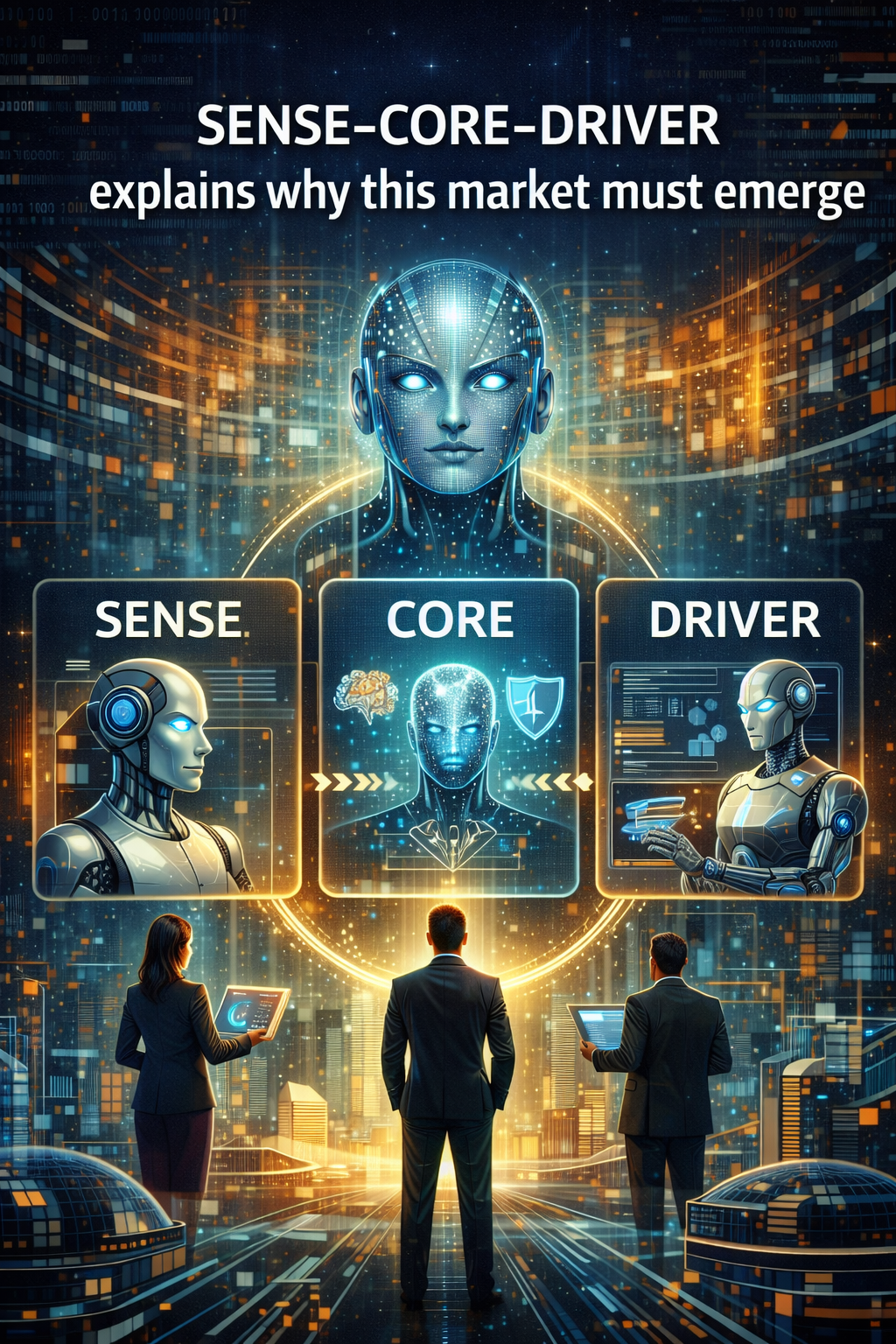
SENSE–CORE–DRIVER explains why this market must emerge
This is exactly where the SENSE–CORE–DRIVER framework becomes powerful.
Because AI failure is rarely only a CORE problem.
SENSE: Can the system see reality properly?
This means:
- detecting relevant signals,
- attaching them to the right entity,
- maintaining an accurate state representation,
- and updating that representation as reality changes.
A system cannot safely act on a reality it cannot correctly represent.
CORE: Can the system reason over that reality?
This is the layer most of the AI market obsesses over:
- intelligence,
- prediction,
- reasoning,
- optimization,
- generation,
- ranking,
- and planning.
Important, yes. But incomplete.
DRIVER: Can the system act within legitimate authority?
This is the layer of:
- delegation,
- representation,
- identity,
- verification,
- execution,
- and recourse.
And this is where the true institutional question lives.
Because an institution does not merely need a system that can think.
It needs a system that can be trusted to act.
Delegation Rating Agencies would effectively rate the strength of the DRIVER layer, while also checking whether weak SENSE and overconfident CORE make delegation unsafe.
That is why this category matters.
It is not just another AI tool category.
It is a new trust infrastructure category.
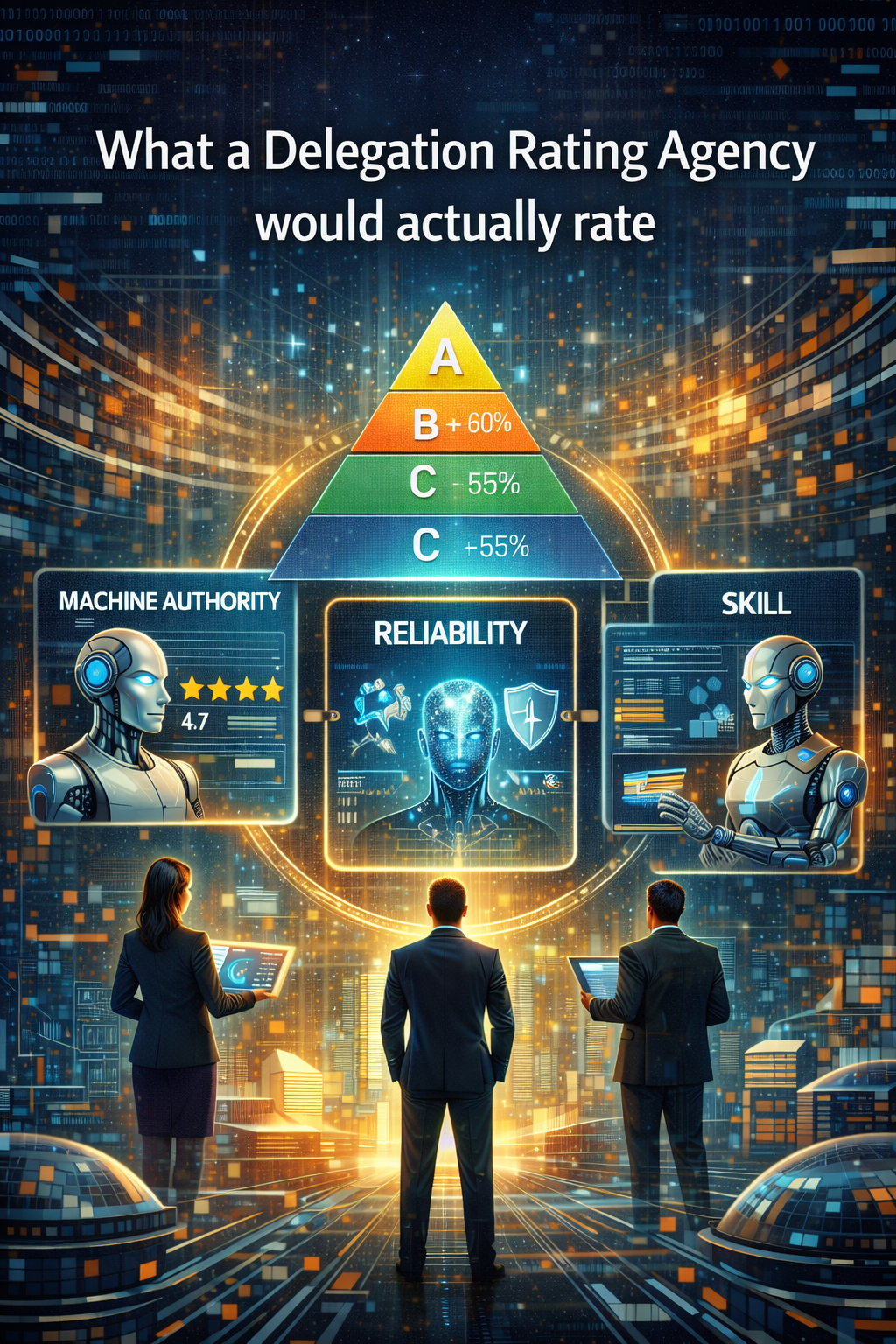
What a Delegation Rating Agency would actually rate
To become real, this concept must move beyond metaphor.
The question is not “Is this AI good?” in the abstract.
The question is whether the institution has built a delegation architecture that deserves trust.
-
Delegation clarity
Has the organization clearly defined what the machine may and may not do?
A strong system distinguishes between:
- advise,
- recommend,
- prioritize,
- simulate,
- draft,
- approve,
- execute,
- escalate,
- and autonomously act.
Most organizations still blur these categories.
That blur will become a major source of risk.
-
Representation quality
Is the AI acting on reality that is sufficiently legible, current, and relevant?
Delegation should be rated differently when the system acts on:
- clean structured data,
- noisy records,
- inferred entities,
- synthetic context,
- or fragmented state.
The same model can be safe in one representation environment and dangerous in another.
-
Identity and authority binding
Does the system know:
- who authorized the action,
- which entity is being acted upon,
- which credentials are in force,
- and what scope of authority applies?
This is the difference between a useful agent and a runaway process.
-
Reversibility
Can the action be stopped, overridden, rolled back, or corrected?
This will become one of the defining tests of machine trust.
An AI system that can act but cannot be meaningfully unwound is not mature delegation. It is institutional recklessness.
-
Recourse
If the system gets something wrong, can the affected party challenge the outcome?
As AI begins to shape real decisions, recourse is moving from a moral ideal toward an operational and economic requirement. The OECD’s work on common AI incident reporting reflects a broader international shift toward structured accountability, comparability, and response readiness. (OECD)
-
Monitoring and incident discipline
Can the organization detect when delegated authority is drifting, being misused, or producing hidden harm?
Trust will depend less on perfect prevention and more on reliable detection, reporting, and correction. That is increasingly visible in AI governance thinking across NIST, the OECD, and EU implementation work. (NIST)
-
Contextual proportionality
Is the degree of delegation appropriate for the stakes?
A spelling assistant and a medical triage assistant should not be evaluated the same way. A procurement bot and a citizen-scoring tool should not be governed alike.
The future market needs proportionate delegation, not blanket optimism.
Why this market will emerge faster than people think
This category may sound futuristic, but the pressure behind it is already here.
The world is clearly moving toward more formal AI accountability structures:
- the EU AI Act uses a risk-based approach to classify and regulate higher-risk uses of AI, (Digital Strategy)
- NIST’s AI RMF is intended to help organizations incorporate trustworthiness into the design, development, use, and evaluation of AI systems, (NIST)
- ISO/IEC 42001 provides requirements and guidance for establishing and improving an AI management system, (ISO)
- and the OECD is building common approaches to AI incidents and hazards so stakeholders can identify, compare, and respond to harms more consistently. (OECD)
But there is still a missing layer between:
- regulation,
- internal governance,
- vendor claims,
- and public trust.
That missing layer is external judgment about delegation quality.
In finance, markets did not rely only on issuer self-attestation.
In cybersecurity, buyers do not rely only on vendor marketing.
In sustainability, reporting ecosystems emerged because claims needed comparability and scrutiny.
AI will follow a similar path.
Once machine action becomes economically material, markets will want a shorthand for one key question:
How trustworthy is this organization’s delegation architecture?
That demand will create a market.
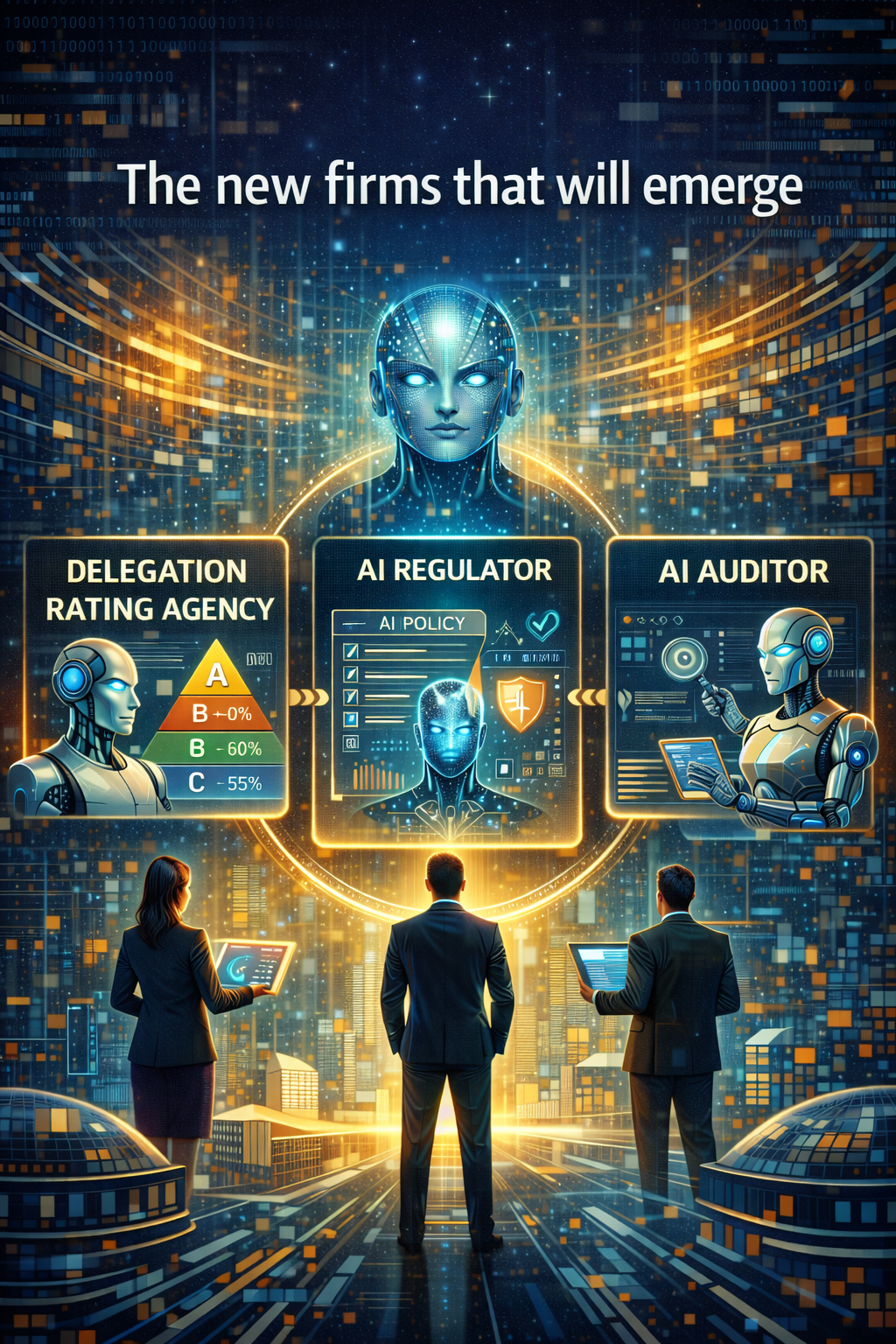
The new firms that will emerge
Delegation Rating Agencies will not all look the same.
Several business models could emerge around this category.
Pure-play delegation raters
These firms would specialize in evaluating machine-authority systems across sectors.
Sector-specific raters
Healthcare, finance, public services, insurance, logistics, and industrial operations may each produce specialized raters because delegation risk is domain-specific.
Delegation assurance platforms
Software-plus-services firms could continuously monitor delegation maturity, authority drift, and recourse readiness.
Delegation benchmark consortia
Industry groups may create shared standards for rating machine authority in specific workflows.
Embedded delegation underwriters
Insurers, auditors, and risk firms may expand into delegation scoring because premiums, liabilities, and operational exposure will increasingly depend on it.
This is how a new category usually forms:
first as an idea, then as a control need, then as a buyer requirement, then as an ecosystem.
Why boards and C-suites should care now
The biggest AI risk is not only that machines will be wrong.
It is that institutions will let them act without designing the architecture of justified trust.
That will create three kinds of companies.
The first group will delegate too slowly
They will be careful, but uncompetitive.
The second group will delegate too recklessly
They will look innovative, then suffer trust failures, operational incidents, regulatory pain, or brand damage.
The third group will win
They will build strong SENSE, disciplined CORE, and governed DRIVER.
They will know:
- what can be delegated,
- what must remain human,
- what must be contestable,
- and what must always be reversible.
Those are the companies Delegation Rating Agencies will reward.
And once markets begin to trust those ratings, the consequences will spread:
- lower friction in enterprise adoption,
- faster partner acceptance,
- stronger customer confidence,
- easier regulator dialogue,
- and eventually a premium for institutions whose machine authority is demonstrably well designed.
That is why this concept matters for the future of value creation.
Conclusion: the AI economy will run on trusted delegation
The AI era is often described as an intelligence revolution.
That is only partly true.
It is also a delegation revolution.
The real economic transformation will not come simply from machines that can generate answers. It will come from institutions that learn how to delegate safely, legitimately, and at scale.
That is why Delegation Rating Agencies matter.
Because the next great bottleneck in AI will not be raw intelligence.
It will be trusted machine authority.
And the institutions that help markets judge that authority may become some of the most important players in the AI economy.
In the end, every serious AI system will face the same test:
Not, Can it think?
But, Can we trust the way it has been allowed to act?
That is the question of the next decade.
And the organizations that answer it well will not just use AI better.
They will help define how the AI economy itself becomes governable.
In the AI economy, trust will not come from intelligence alone. It will come from how well delegation is measured, governed, and rated.
FAQ
What is a Delegation Rating Agency?
A Delegation Rating Agency is a proposed category of institution that would assess how safely, clearly, and legitimately an organization delegates authority to AI systems and agents.
How is this different from an AI audit?
An AI audit usually examines compliance, controls, or system behavior at a point in time. A Delegation Rating Agency, in this concept, would evaluate the broader architecture of machine authority: what the system is allowed to do, on whose behalf, under what boundaries, and with what recourse.
Why is delegation more important than model performance?
Because many damaging AI failures happen not because the model is weak, but because the system has been given too much authority, poor-quality representation, unclear boundaries, or no meaningful path for reversal and appeal.
How does this relate to SENSE–CORE–DRIVER?
SENSE evaluates whether reality is represented well. CORE evaluates whether the system can reason well. DRIVER evaluates whether the system is allowed to act legitimately. Delegation Rating Agencies would primarily rate the DRIVER layer, while checking whether weak SENSE and overconfident CORE make delegation unsafe.
Will this become a real market?
That is an inference, not an established fact. But it is a plausible one. As AI regulation, incident reporting, and enterprise accountability mature, markets often create intermediary trust institutions that simplify judgment for boards, buyers, insurers, regulators, and the public. (Digital Strategy)
Why should boards care?
Because AI risk increasingly sits at the level of operating authority, not just software capability. Boards will need confidence that machine delegation is bounded, observable, reversible, and defensible.
Why is delegation risk more important than model risk?
Because AI systems are now making decisions and taking actions, the biggest risk is not incorrect predictions—but incorrect actions executed with authority.
What do Delegation Rating Agencies measure?
They measure reliability, authority boundaries, accountability, governance, and recourse mechanisms in AI-driven systems.
Q1. What is delegation risk in AI?
Delegation risk refers to the risks associated with allowing AI systems to make and execute decisions autonomously.
Q2. How is delegation risk different from model risk?
Model risk focuses on prediction accuracy, while delegation risk focuses on the consequences of AI-driven actions.
Q3. Why do we need Delegation Rating Agencies?
Because enterprises need a standardized way to trust, compare, and govern AI systems that act on their behalf.
Q4. What industries will use Delegation Rating Agencies?
Finance, healthcare, supply chains, autonomous systems, and enterprise AI platforms.
Glossary
Delegation architecture
The full design of how authority is given to an AI system, including limits, approvals, identity, monitoring, and recourse.
Machine authority
The practical power an AI system has to influence or execute decisions and actions inside an organization.
Delegation risk
The risk that arises when AI is given authority it should not have, is acting on poor representation, or lacks proper oversight and recovery paths.
Representation quality
How accurately and usefully the system’s inputs reflect real-world entities, context, state, and change over time.
Reversibility
The ability to stop, override, roll back, or correct an AI-triggered action.
Recourse
The mechanism through which an affected person, employee, customer, citizen, or partner can challenge or appeal an AI-mediated outcome.
Contextual proportionality
The principle that the level of AI delegation should match the stakes of the situation.
Trust infrastructure
The broader set of institutions, standards, controls, and signals that make it possible for markets and societies to trust AI at scale.
Delegation Risk → Risk arising when AI systems are given authority to act autonomously
Model Risk → Risk of incorrect predictions or outputs from AI models
Machine Authority → The level of decision-making power assigned to AI systems
Delegation Rating Agency → Institution that evaluates AI decision authority and governance
AI Governance → Frameworks ensuring AI operates safely, ethically, and reliably
Recourse Mechanism → Ability to correct or reverse AI decisions
References and further reading
To keep the article clean and human in tone, place these in a short “References and Further Reading” section at the end of the webpage rather than cluttering the body:
- European Commission, AI Act overview and implementation materials. (Digital Strategy)
- NIST, AI Risk Management Framework. (NIST)
- ISO, ISO/IEC 42001 AI management systems. (ISO)
- OECD, Towards a Common Reporting Framework for AI Incidents and related incident-monitoring work. (OECD)
-
- Emerging Technology Solutions | Infosys Topaz Fabric: How AI Is Quietly Changing the Way Enterprise Services Are Delivered
- Emerging Technology Solutions | What Is Infosys Topaz Fabric? The Missing Layer for Scalable Enterprise AI
- Emerging Technology Solutions | Infosys Topaz Fabric: Enterprise AI Infrastructure for Scalable, Governed, and Cost-Aware AI Exec
- Explore the Architecture of the AI Economy
This article is part of a broader research series exploring how institutions are being redesigned for the age of artificial intelligence. Together, these essays examine the structural foundations of the emerging AI economy — from signal infrastructure and representation systems to decision architectures and enterprise operating models.
If you want to explore the deeper framework behind these ideas, the following essays provide additional perspectives:
-
- The Representation Economy: Why AI Institutions Must Run on SENSE, CORE, and DRIVER – Raktim Singh
- The Representation Economy: Why Intelligent Institutions Will Run on the SENSE–CORE–DRIVER Architecture – Raktim Singh
- Representation Failure: Why AI Systems Break When Institutions Misread Reality – Raktim Singh
- The Firm of the AI Era Will Be Built Around Representation: Why Institutions Must Redesign Themselves for the SENSE–CORE–DRIVER Economy – Raktim Singh
- The Representation Stack: The New Architecture of Intelligent Institutions in the AI Economy – Raktim Singh
- Representation Economics: The New Law of Value Creation in the AI Era – Raktim Singh
- Representation Alpha: Why Competitive Advantage Will Come from Better Representation, Not Better Models – Raktim Singh
- Representation Fragility and Exclusion: The Hidden Fault Line That Will Break the AI Economy – Raktim Singh
- Representation Drift & Labor: Why AI Systems Fail When Reality Moves Faster Than Machines – Raktim Singh
- Representation Monopolies: Why the AI Economy Will Be Controlled by Those Who Define Reality – Raktim Singh
- Representation Forensics: The Missing Layer of AI—Why the Future Will Be Decided by What Systems Thought Reality Was – Raktim Singh
- • Why Most AI Projects Fail Before Intelligence Even Begins
- What Is the Representation Economy? (raktimsingh.com)
- The Representation Economy: Why AI Institutions Must Run on SENSE, CORE, and DRIVER (raktimsingh.com)
- Decision Scale: Why Competitive Advantage Is Moving from Labor Scale to Decision Scale (raktimsingh.com)
- Firms Won’t Be Defined by Employees. They Will Be Defined by Delegation – Raktim Singh
- The New Company Stack: The 7 Business Categories That Will Emerge in the Representation Economy – Raktim Singh
- The Representation Attack Surface: Why AI’s Biggest Threat Is Reality Hacking, Not Model Hacking – Raktim Singh
- The Chief Representation Officer: Why Institutions Collapse When Machine-Readable Reality Falls Behind – Raktim Singh
- The Scarcity of Reality: Why the AI Economy Will Be Defined by the Lifecycle of High-Trust Representation – Raktim Singh
Together, these essays outline a central thesis:
The future will belong to institutions that can sense reality, represent it clearly, reason about it intelligently, and act through governed machine systems.
This is why the architecture of the AI era can be understood through three foundational layers:
SENSE → CORE → DRIVER
Where:
- SENSE makes reality legible
- CORE transforms signals into reasoning
- DRIVER ensures that machine action remains accountable, governed, and institutionally legitimate
Signal infrastructure forms the first and most foundational layer of that architecture.
AI Economy Research Series — by Raktim Singh
-
-



Raktim Singh is an AI and deep-tech strategist, TEDx speaker, and author focused on helping enterprises navigate the next era of intelligent systems. With experience spanning AI, fintech, quantum computing, and digital transformation, he simplifies complex technology for leaders and builds frameworks that drive responsible, scalable adoption.