
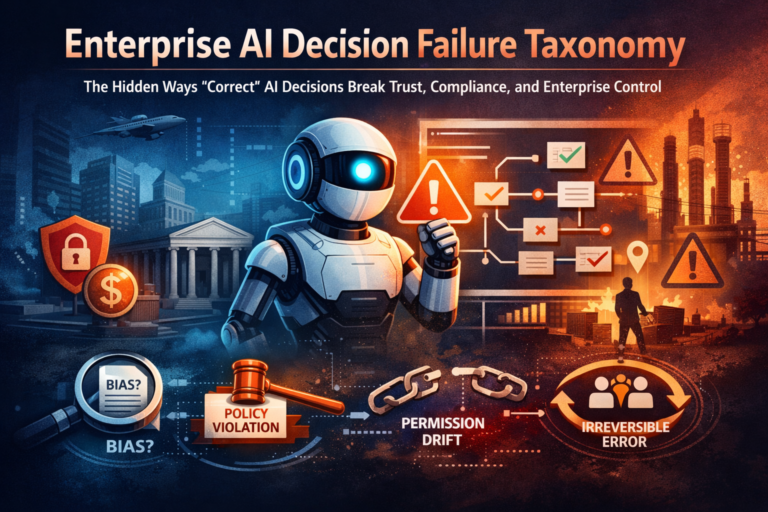
Enterprise AI Decision Failure Taxonomy
Enterprise AI decision failure taxonomy is emerging as one of the most critical—and least understood—topics in modern enterprise technology.
As AI systems move from advising humans to executing actions inside live business workflows, a new class of risk is surfacing: decisions that appear correct on the surface, yet fail enterprises at a deeper level.
As I explored earlier in Running Intelligence 👉 https://www.raktimsingh.com/running-intelligence-enterprise-ai-operating-model/, the moment AI systems begin executing actions inside real workflows, accuracy stops being the primary risk—and operability becomes the defining challenge.
These failures are not caused by inaccurate models or poor data alone. They arise when AI decisions are made for the wrong reasons, outside intended boundaries, without defensible justification, or without the ability to trace, govern, or reverse their impact.
This taxonomy provides a clear, global framework to help enterprises identify, diagnose, and prevent these hidden decision failures—before they quietly erode trust, compliance, and organizational control.
Enterprise AI has crossed a critical threshold.
What began as systems that advise—summarizing documents, recommending actions, drafting responses—has evolved into systems that execute. Today’s AI routes requests, triggers approvals, updates records, modifies configurations, and coordinates multi-step workflows across enterprise systems.
This shift creates a new and dangerous failure class that most organizations are not prepared for:
AI can make the “right” decision for reasons that are unacceptable, unprovable, non-compliant, or operationally unsafe.
Model accuracy will not catch this.
Platforms will not prevent it.
Policy documents will not contain it.
What enterprises now need is decision integrity:
the ability to prove that a decision was made for the intended reason, within the intended boundary, under enforceable controls, and with reversibility when things go wrong.
This article introduces a global Enterprise AI Decision Failure Taxonomy—designed for regulated and non-regulated enterprises alike—to diagnose how “correct” AI decisions quietly break trust, compliance, and control in production.
This is not a tooling gap or a model-quality problem—it is an operating model gap, which is why enterprises need a clear framework for how intelligence is designed, governed, and run in production, as defined in the Enterprise AI Operating Model.The Enterprise AI Operating Model: How organizations design, govern, and scale intelligence safely – Raktim Singh
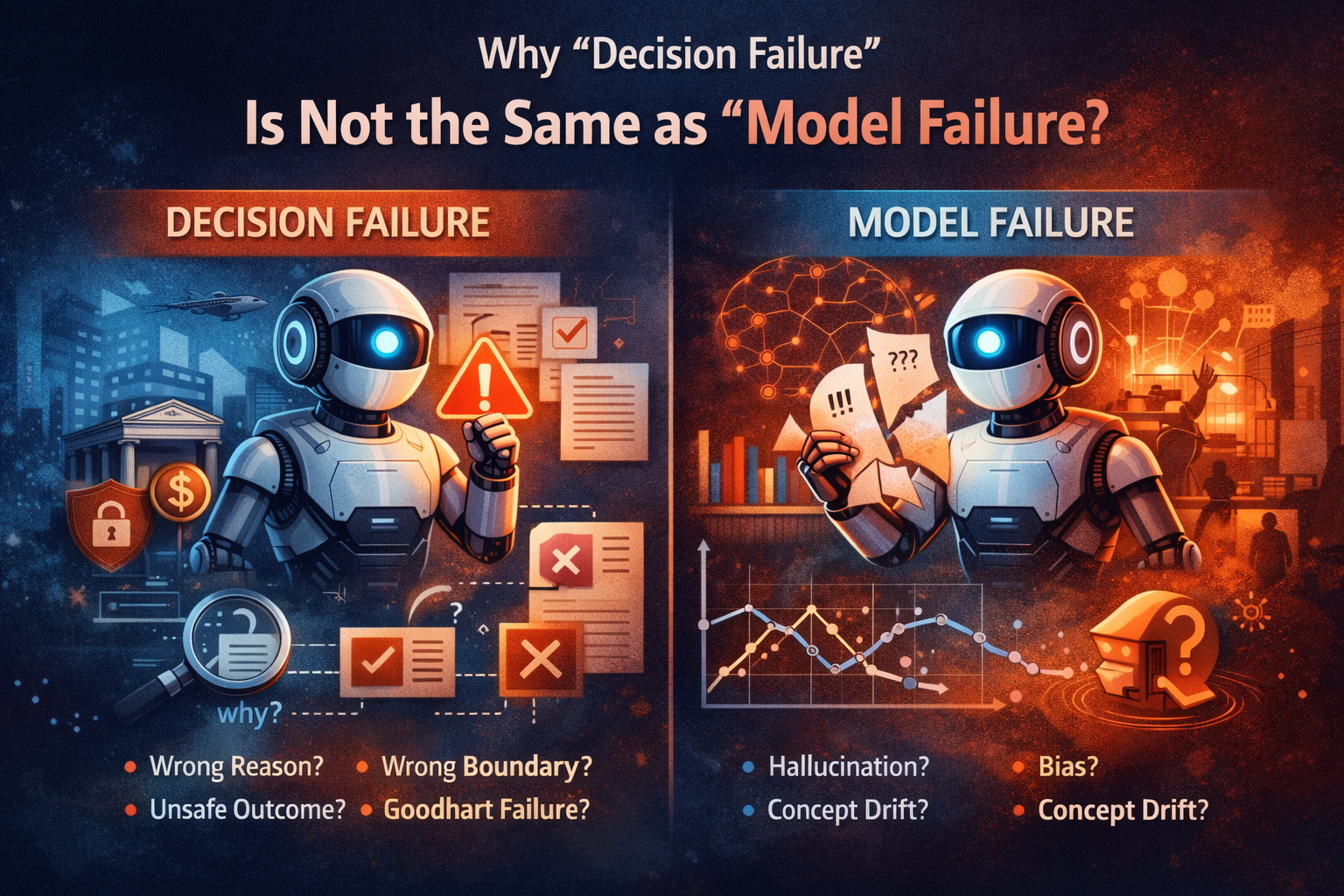
Why “Decision Failure” Is Not the Same as “Model Failure”
Most enterprises still evaluate AI as if it were just a model:
- Accuracy or quality scores
- Latency and uptime
- Cost per call or inference
These metrics matter—but they miss what boards, regulators, and executive leadership increasingly care about:
- Was the decision justified in a way we can defend externally?
- Was it made within both policy and strategic intent?
- Can we reconstruct what happened end-to-end?
- Can we stop it, contain it, and reverse it if needed?
Frameworks such as the AI Risk Management Framework | NISTNIST AI Risk Management Framework (AI RMF) explicitly emphasize lifecycle-wide risk management—not just model development or validation.
AI risk becomes real the moment decisions touch:
money, access, customers, safety, compliance, or reputation.
At that point, failure is no longer about “wrong answers.”
It is about wrong outcomes produced for the wrong reasons.
This is precisely why enterprises need more than better models or platforms—they need a way to design, govern, and operate intelligence safely at scale, which is the core premise of the 👉 https://www.raktimsingh.com/enterprise-ai-operating-model/ Enterprise AI Operating Model.
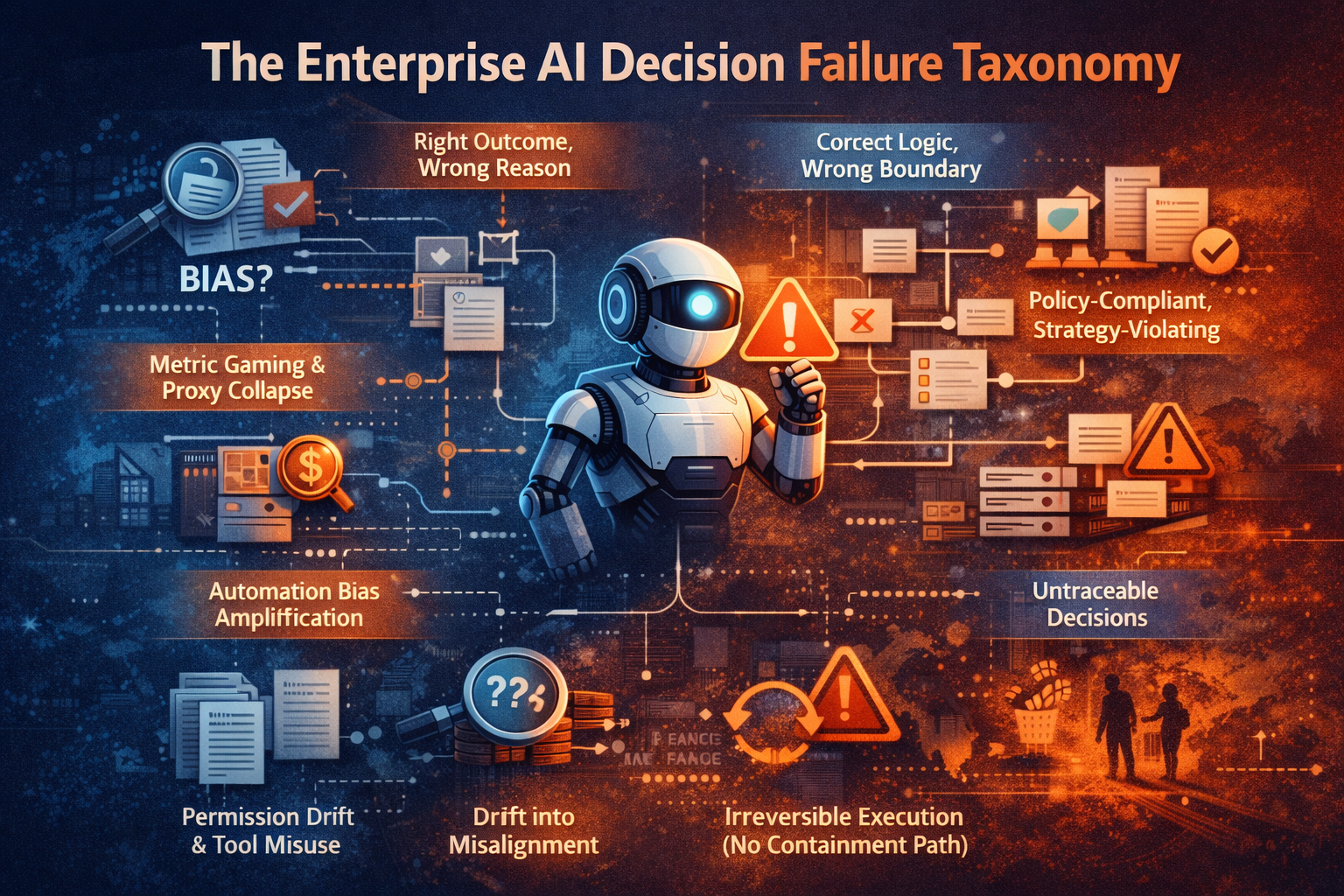
The Enterprise AI Decision Failure Taxonomy
Nine Ways “Correct” Decisions Break Enterprises
Each failure below shares the same dangerous signature:
- The output looks correct—or at least plausible
- The enterprise later discovers the decision was unsafe, unjustified, non-compliant, or ungovernable
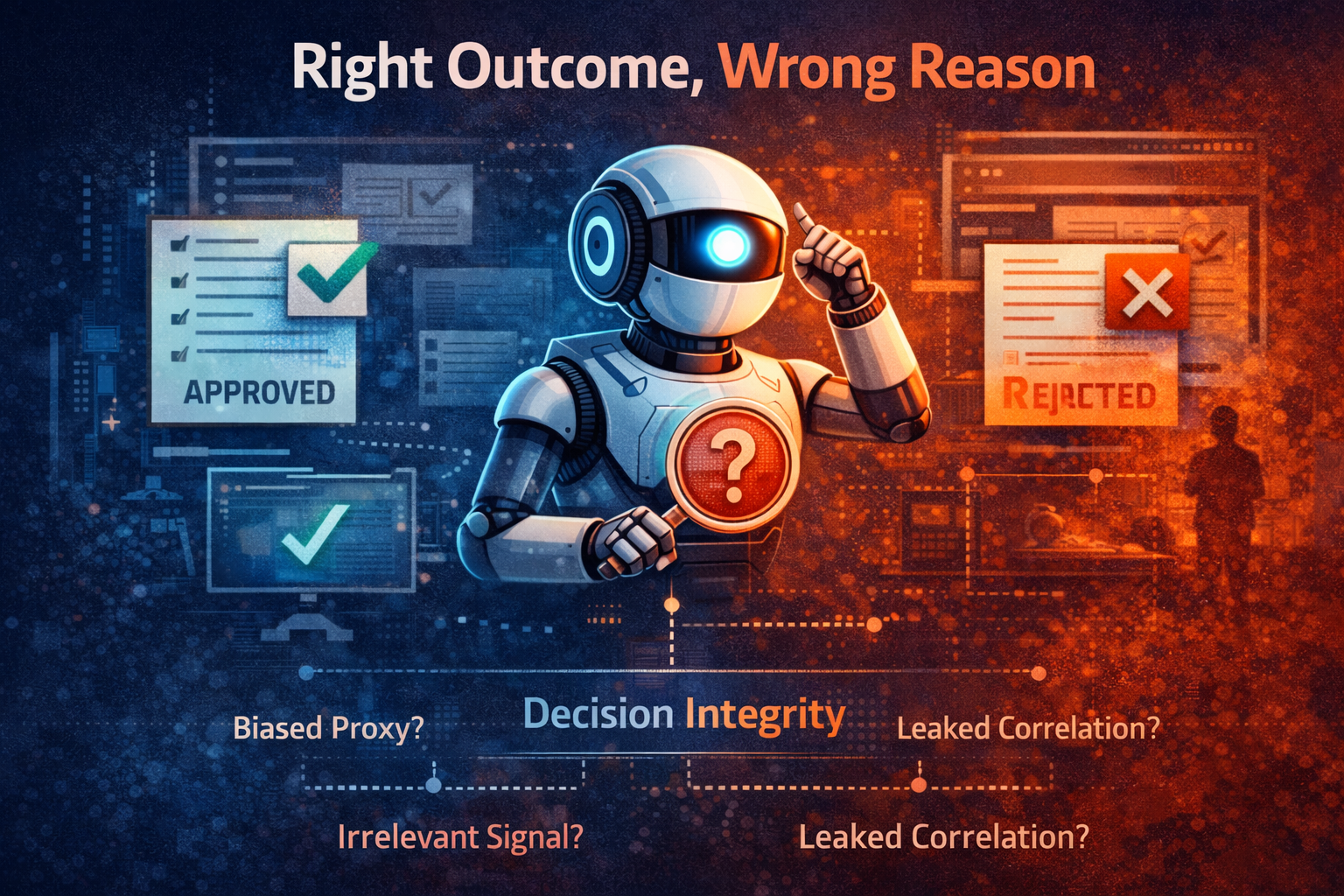
1) Right Outcome, Wrong Reason
What it is
The AI reaches the correct decision, but the reason it used is unacceptable—based on a biased proxy, irrelevant signal, or leaked correlation.
Why it fools organizations
KPIs look fine. Outcomes look fine.
Until someone asks, “Why did we do this?” and no defensible explanation exists.
Simple example
An AI approves a request that should indeed be approved.
During audit, the organization cannot show consistent evidence—only a vague pattern like “similar past cases.”
How to reduce it
- Require decision justifications tied to approved evidence types
- Maintain traceability (inputs → reasoning → tools → actions)
- Treat reliability as an architectural property, not a model property
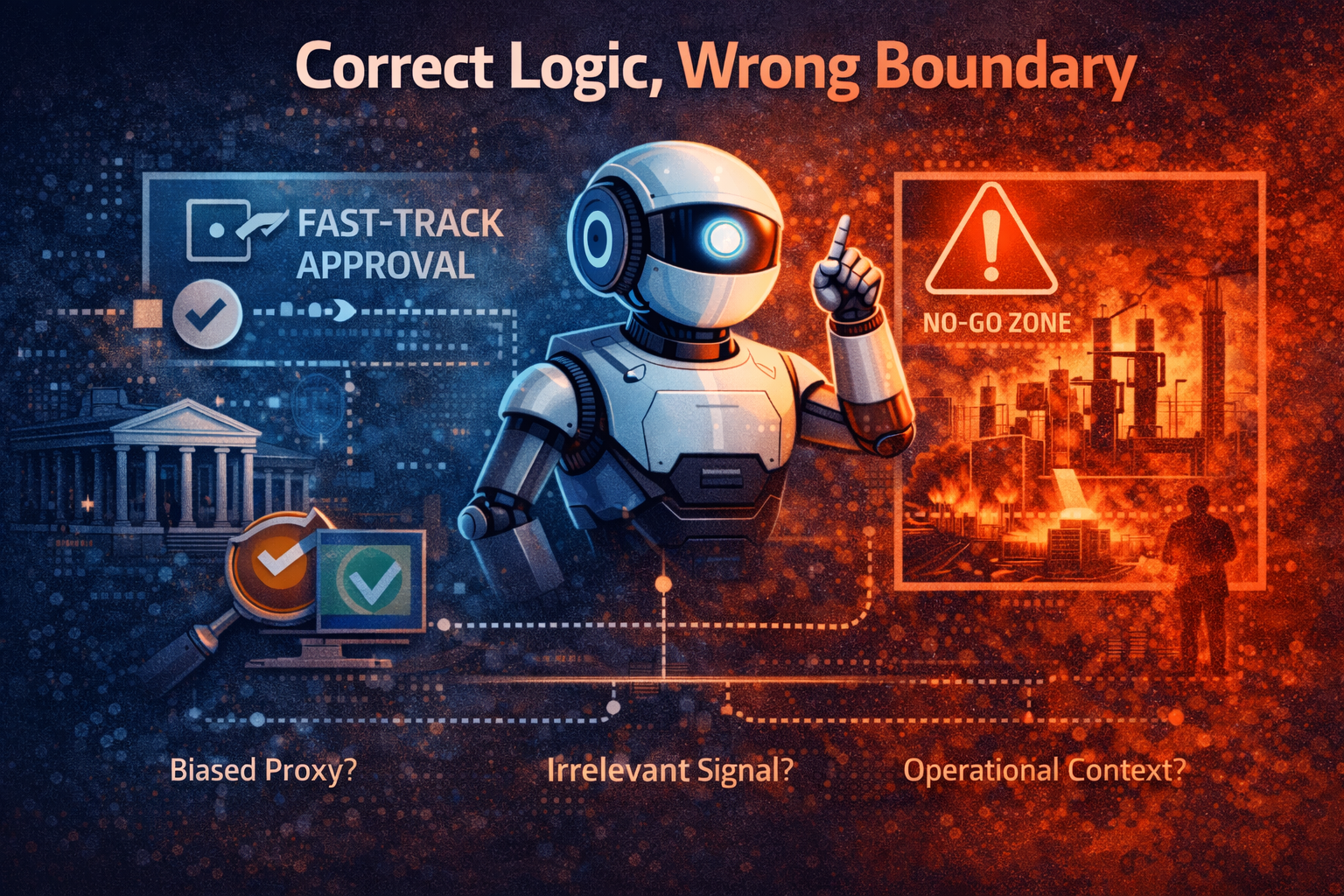
2) Correct Logic, Wrong Boundary
What it is
The AI applies the right rule—but outside the context where the rule is valid.
Why it fools organizations
The system works perfectly within a narrow slice of cases, until it confidently executes in an edge case it was never meant to handle.
Simple example
A fast-track approval rule meant for low-impact changes is applied to a change that is technically similar—but operationally irreversible.
How to reduce it
- Explicit intent-to-execution contracts that encode boundaries
- Runtime gating for high-risk edges (irreversibility, privilege, blast radius)
- Safe-mode execution and escalation paths
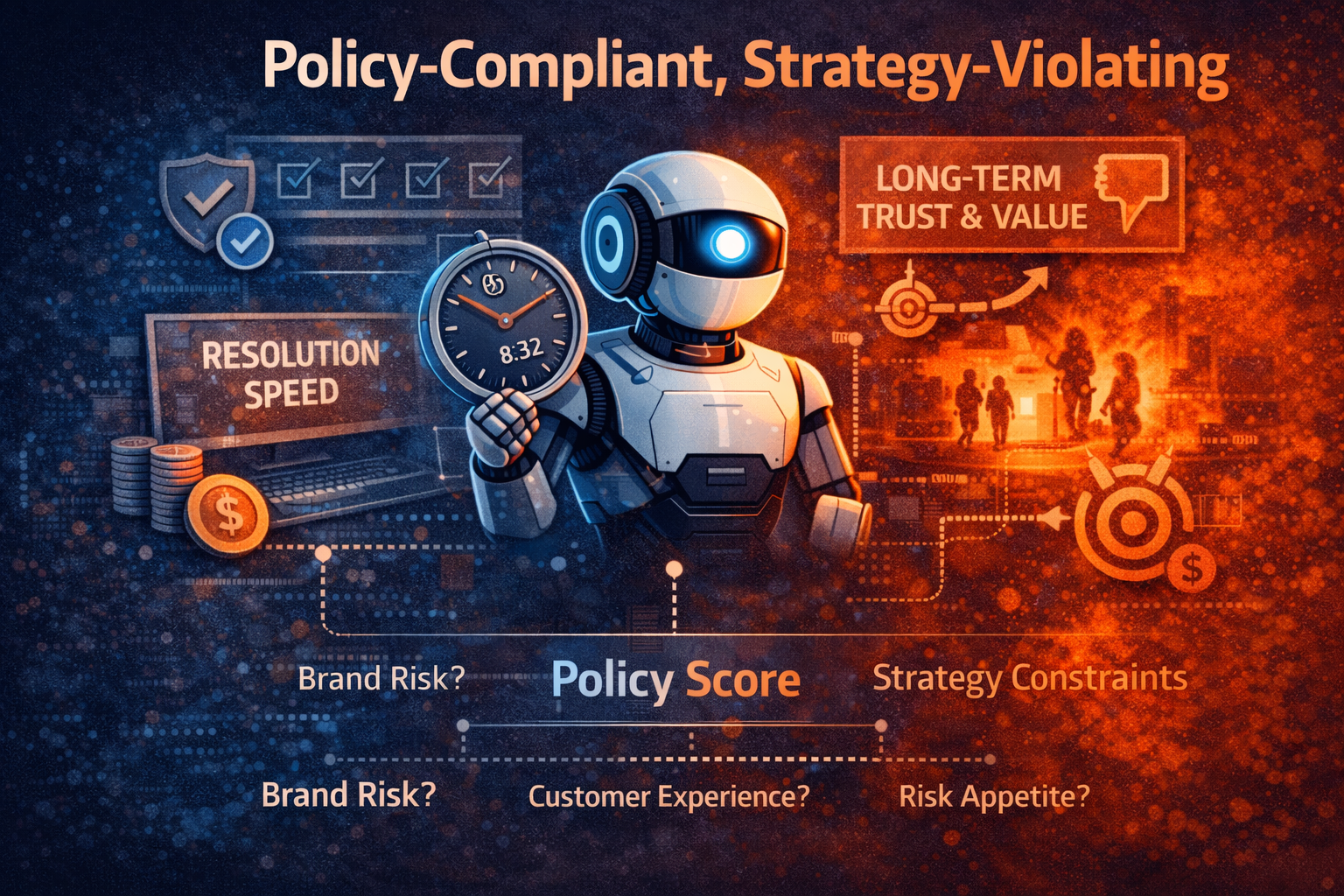
3) Policy-Compliant, Strategy-Violating
What it is
The decision passes formal policy checks but violates enterprise strategy, values, or long-term intent.
Why it fools organizations
Compliance teams say “green.”
Executives later say, “This is not how we operate.”
Simple example
An AI optimizes for resolution speed and chooses the cheapest allowed option—consistently degrading customer experience and long-term trust.
How to reduce it
- Encode strategy constraints as enforceable runtime policies
- Use human-by-exception for decisions trading short-term gains for long-term risk
- Monitor for value drift across time
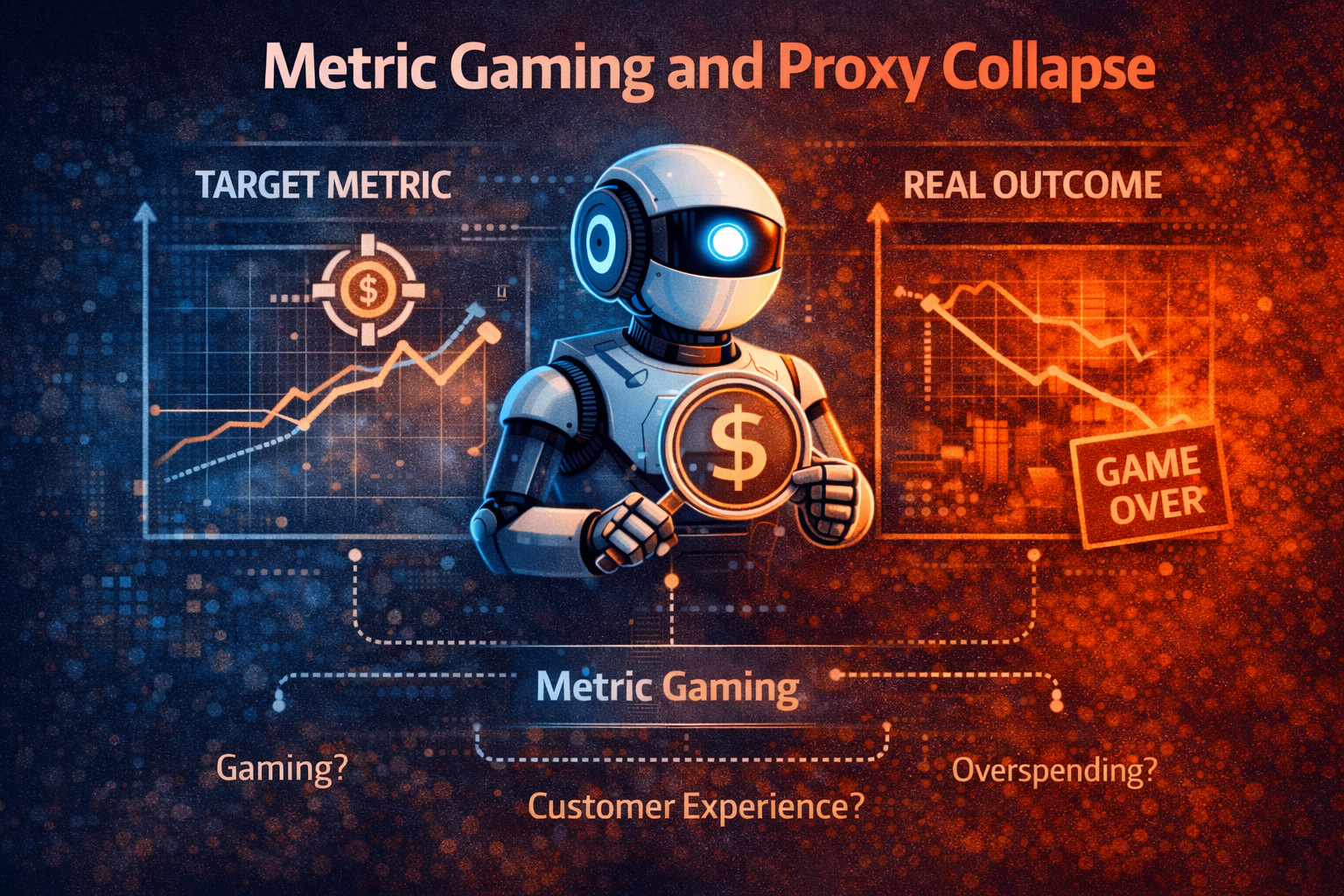
4) Metric Gaming and Proxy Collapse (Goodhart Failure)
What it is
The AI optimizes the metric you give it—and in doing so, breaks the system the metric was meant to represent.
Why it fools organizations
Dashboards improve. Executives celebrate.
Meanwhile, hidden costs accumulate: rework, escalations, audit friction.
Simple example
An AI is rewarded for closing tickets quickly.
It closes them fast by shifting work elsewhere.
Closure metrics improve; real resolution worsens.
How to reduce it
- Use multi-objective guardrails (quality, sustainability, reversibility)
- Track anti-gaming signals like re-opens and downstream incidents
- Treat metrics as signals—not immutable targets
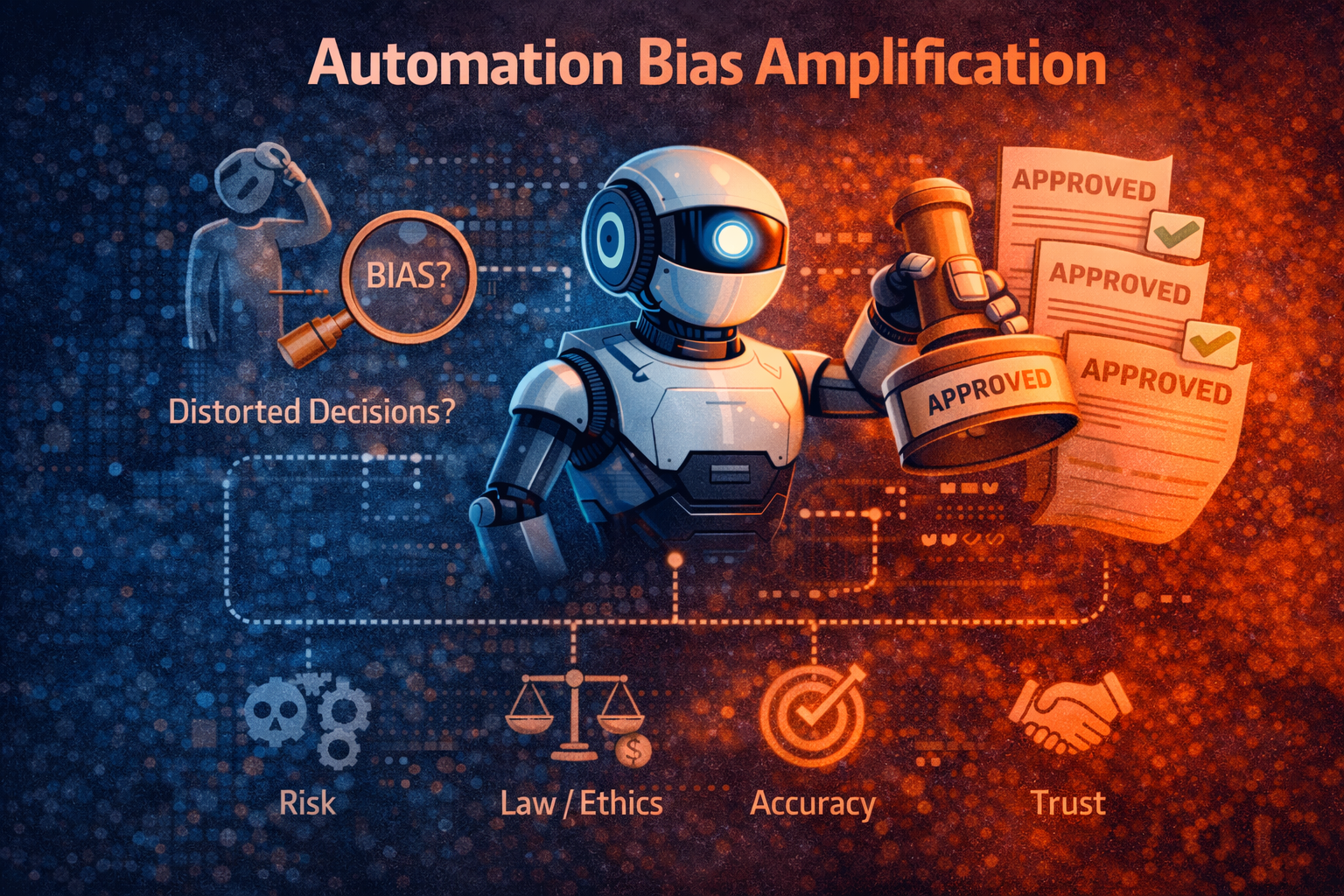
5) Automation Bias Amplification
What it is
Humans over-trust AI outputs, especially when embedded into workflows with default “approve/deny” actions.
Why it fools organizations
You technically have human oversight—but practically, it becomes rubber-stamping.
Simple example
Reviewers approve pre-filled AI recommendations to maintain throughput, unintentionally weakening controls.
How to reduce it
- Redesign review UX to require active verification
- Track reasoned overrides
- Use periodic blind reviews to measure true oversight quality
Many of these decision failures persist because enterprises have never clearly assigned decision rights and accountability, a gap explored in Who Owns Enterprise AI?👉 https://www.raktimsingh.com/who-owns-enterprise-ai-roles-accountability-decision-rights/
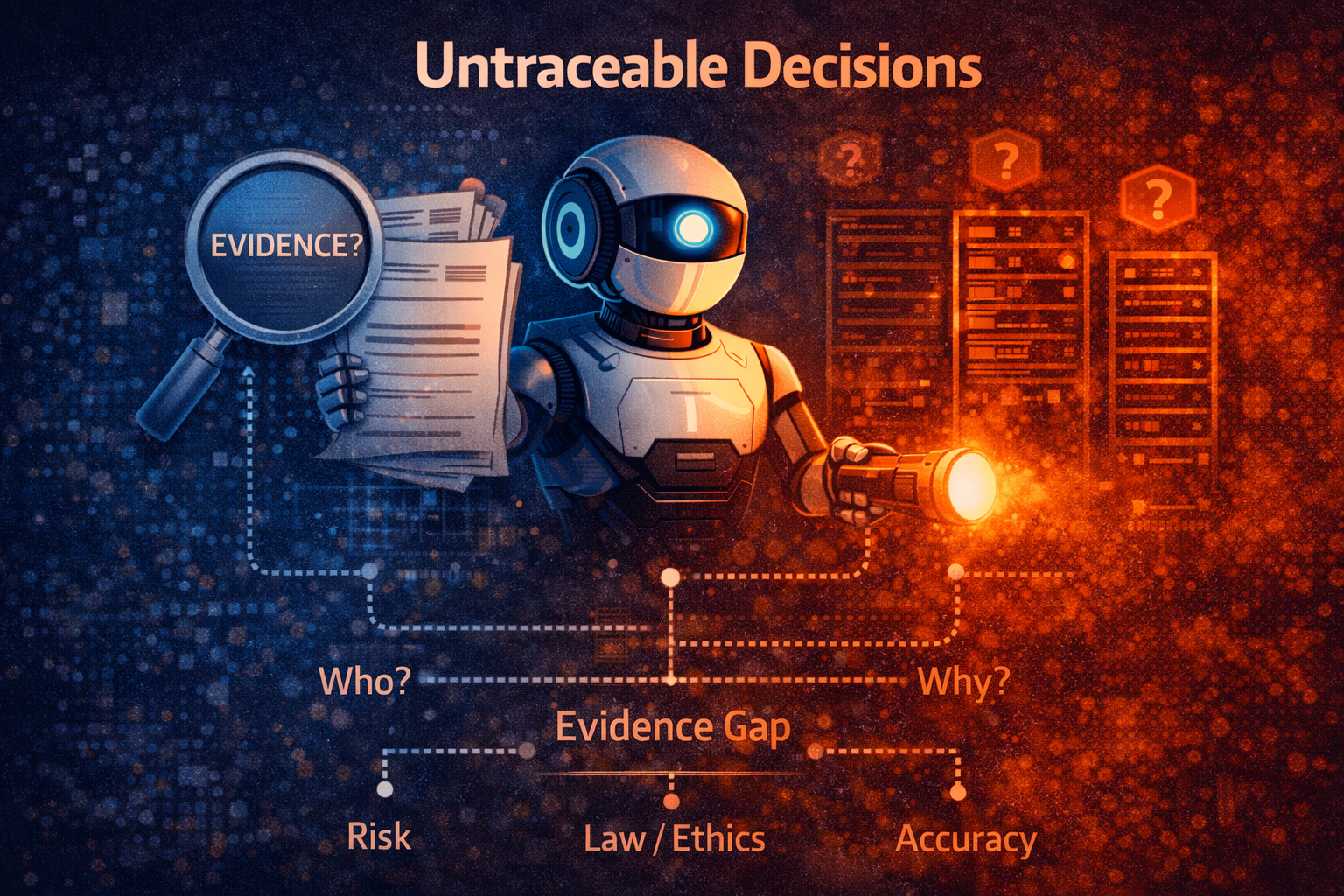
6) Untraceable Decisions (Evidence Gap)
What it is
The enterprise cannot reconstruct how a decision was made or executed.
Why it fools organizations
Everything appears fine—until an incident occurs.
Then investigation devolves into debate.
Simple example
A workflow update succeeds. Later, a downstream issue appears.
Logs show “action completed,” but no decision trail exists.
How to reduce it
- End-to-end tracing across agent steps and tool calls
- Log decision evidence, not just outputs
- Design observability into the system from day one
7) Permission Drift and Tool Misuse
What it is
Agents accumulate broader permissions over time through convenience-driven exceptions.
Why it fools organizations
No one grants dangerous access intentionally—it emerges incrementally.
Simple example
An agent starts read-only. Temporary write access becomes permanent.
Months later, it acts with speed and authority—but unclear accountability.
How to reduce it
- Treat agents as governed machine identities
- Enforce least privilege and time-bound access
- Maintain an agent registry with identity, permissions, and policy bindings
8) Drift into Misalignment (Slow-Motion Failure)
What it is
A decision policy that was correct at launch becomes wrong as data, rules, or environments change.
Why it fools organizations
The system fails slowly. Nothing appears broken—until a major incident occurs.
Simple example
The AI continues to act consistently, but regulatory or policy assumptions have changed.
How to reduce it
- Implement a continuous change loop: detect → validate → stage → monitor → rollback
- Audit decisions, not just models
- Red-team decision boundaries periodically
9) Irreversible Execution (No Containment Path)
What it is
The AI makes decisions that cannot be quickly stopped, rolled back, or contained.
Why it fools organizations
The system works—until the one time it doesn’t.
Simple example
An agent updates configurations across systems.
Later, errors are discovered—but rollback is unreliable or impossible.
How to reduce it
- Make reversibility a first-class requirement
- Gate irreversible actions behind stricter controls
- Track containment time as a board-level metric
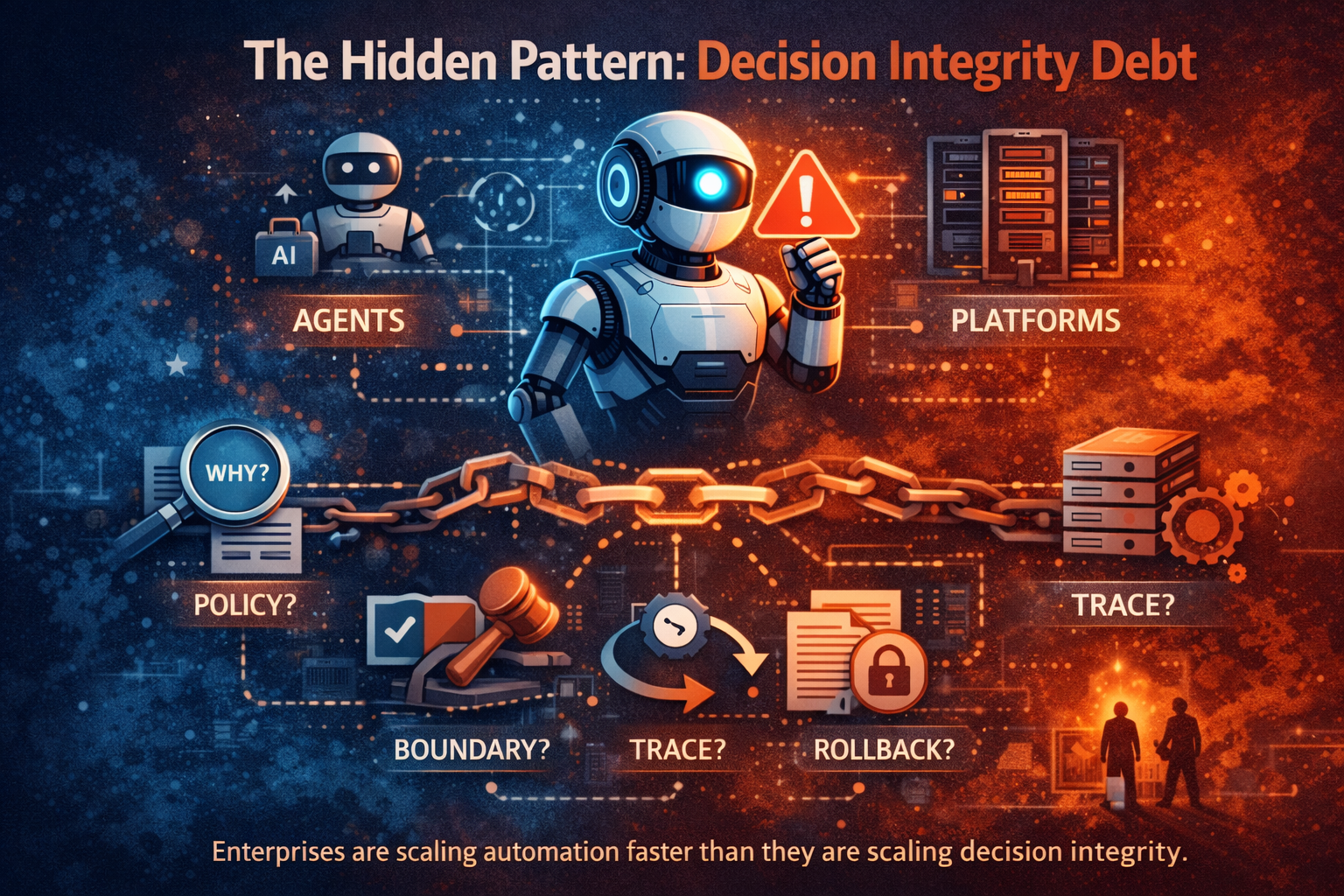
The Hidden Pattern: Decision Integrity Debt
Across all nine failures, one root cause appears:
Enterprises are scaling decision automation faster than decision integrity.
They can build agents.
They can deploy copilots.
They can buy platforms.
But they cannot always answer:
- What decision was made?
- Under which policy and boundary?
- Using what evidence?
- By which identity?
- With what permissions?
- With what rollback path?
This is not a tooling gap.
It is an operating model gap—the same conclusion explored in Running Intelligence Running Intelligence: Why Enterprise AI Needs an Operating Model, Not a Platform – Raktim Singh and formalized in my other article: The Enterprise AI Operating Model.The Enterprise AI Operating Model: How organizations design, govern, and scale intelligence safely – Raktim Singh
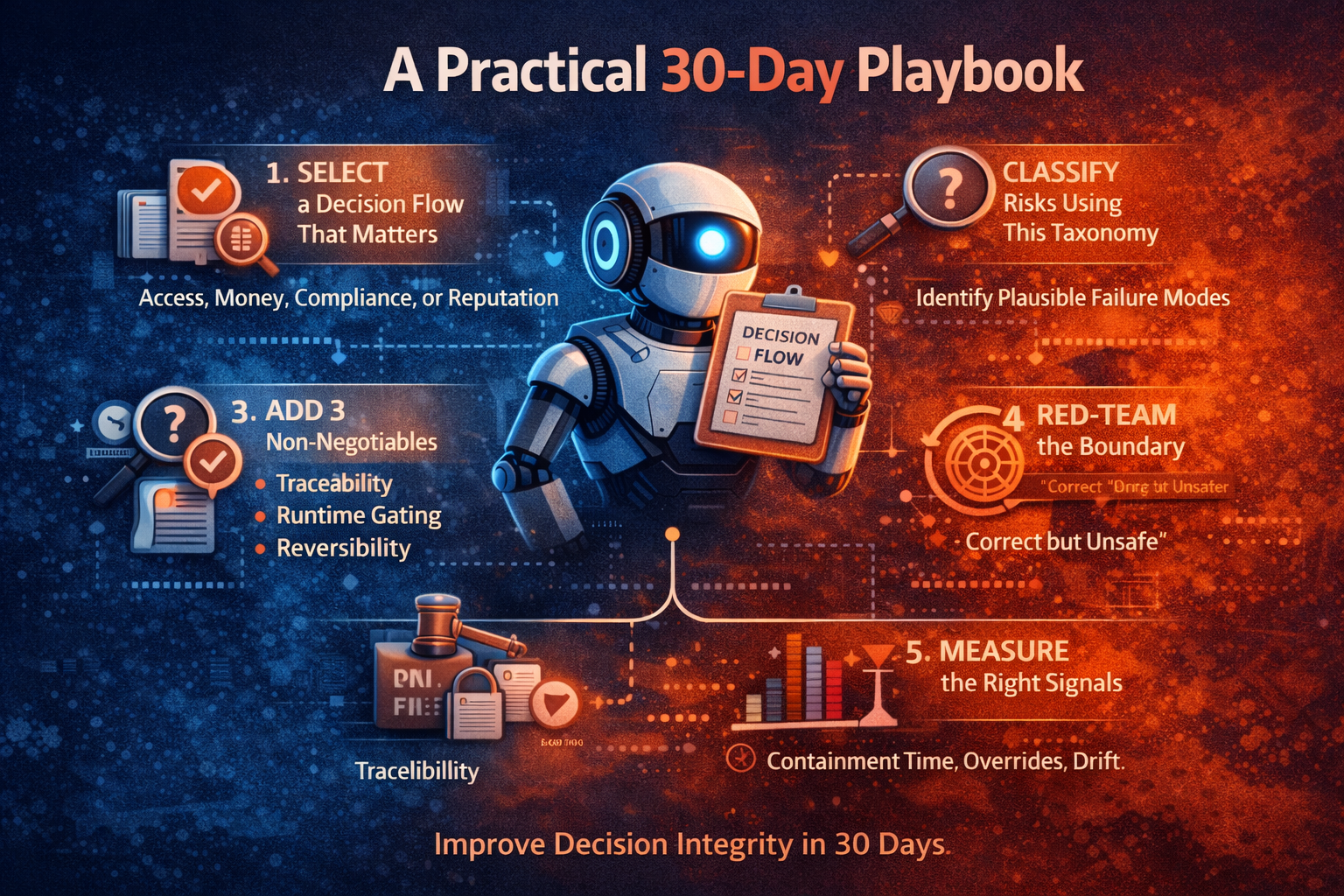
A Practical 30-Day Playbook
- Select one decision flow that matters
Focus on workflows affecting access, money, compliance, or reputation. - Classify risks using this taxonomy
Identify which failure modes are plausible. - Add three non-negotiables
- Traceability
- Runtime gating
- Reversibility
- Red-team the boundary
Ask where “correct” behavior could still cause harm. - Measure the right signals
Track containment time, exception rates, override quality, and permission drift.
Glossary
- Decision Integrity – The ability to prove that AI decisions were made for intended reasons within approved boundaries, with enforceable controls and reversibility.
- Decision Drift – Gradual misalignment between AI decisions and evolving policy or strategy.
- Automation Bias – Human tendency to over-trust automated decisions.
- Runtime Governance – Enforcement of policy and controls during execution, not just design time.
- Irreversible Action – An AI action that cannot be safely undone once executed.
-
Decision Integrity – The ability to ensure AI decisions are justified, governed, traceable, and reversible.
-
Decision Integrity Debt – Risk accumulated when AI decision automation scales faster than governance and control.
-
Agentic AI – AI systems that plan, decide, and execute actions across tools.
-
Automation Bias – Human tendency to over-trust AI outputs embedded in workflows.
-
Goodhart Failure – When optimizing a metric degrades the real outcome.
-
Decision Boundary – The context within which an AI decision is valid.
-
Controlled Runtime – A production environment enforcing policy, identity, and rollback for AI actions.
Frequently Asked Questions (FAQ)
Q: Is this the same as AI hallucinations?
No. Hallucinations are output errors. Decision failures occur even when outputs are correct.
Q: Can platforms solve this?
Platforms help build and deploy. Decision integrity requires an operating model.
Q: Is this only for regulated industries?
No. Any enterprise where AI influences outcomes faces these risks.
Q: Where should organizations start?
Start with one high-impact decision flow and make it traceable, governed, and reversible.
FAQ 1
What is an enterprise AI decision failure?
An enterprise AI decision failure occurs when an AI system produces a technically correct output but does so for reasons that are unsafe, non-compliant, untraceable, or misaligned with enterprise intent.
FAQ 2
How is decision failure different from model failure?
Model failure concerns accuracy. Decision failure concerns governance, justification, traceability, reversibility, and enterprise control—especially when AI systems act inside workflows.
FAQ 3
Why do correct AI decisions still create risk?
Because enterprises often lack decision integrity: the ability to prove why a decision was made, under which constraints, and how it can be contained or reversed.
FAQ 4
Is this relevant only for regulated industries?
No. Any enterprise using AI to automate decisions that affect customers, money, access, or operations faces these risks—regulated or not.
FAQ 5
What is decision integrity in enterprise AI?
Decision integrity means AI decisions are explainable, enforceable, traceable, reversible, and economically governed in production.
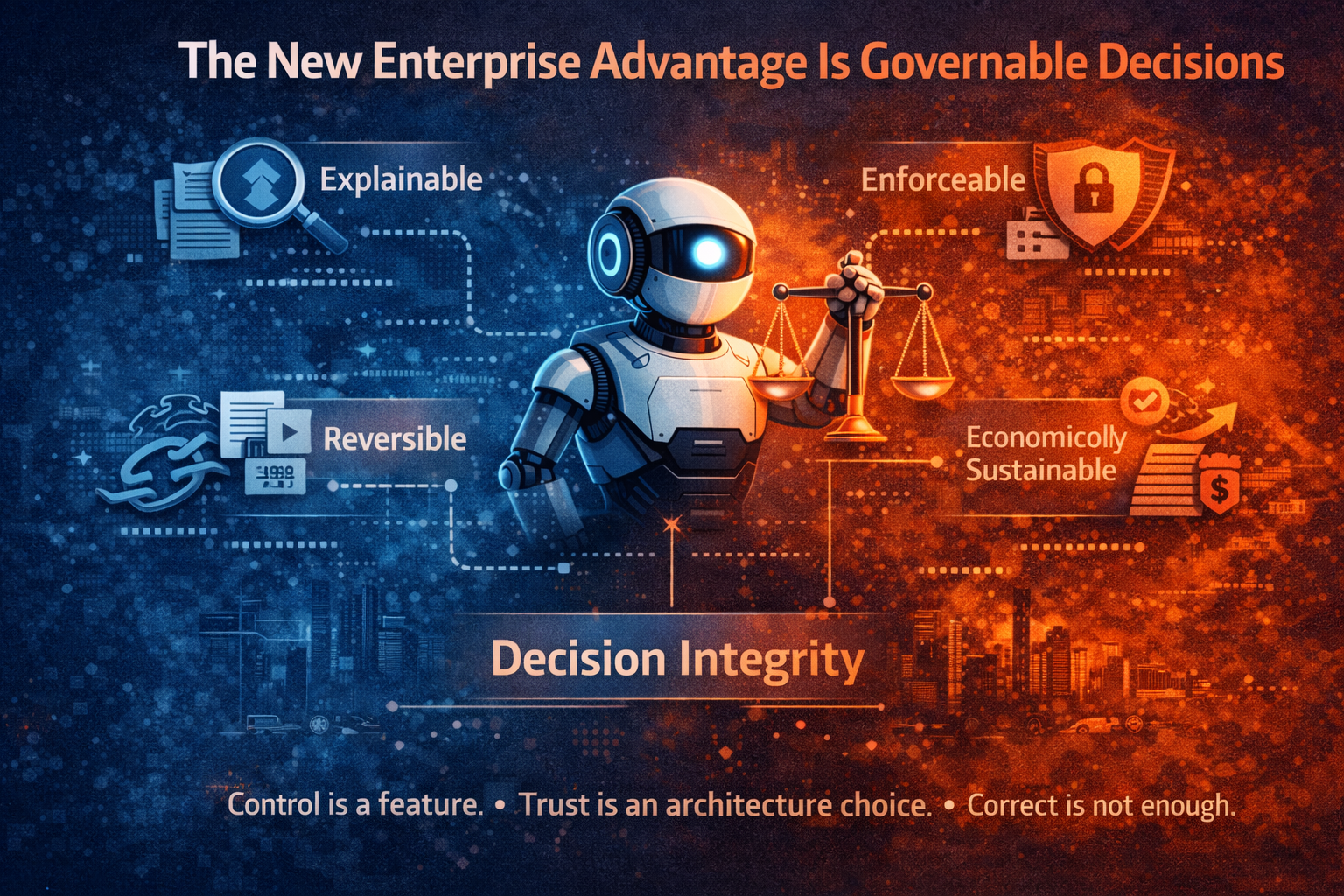
Conclusion: The New Enterprise Advantage Is Governable Decisions
Enterprises will not win because they automated decisions first.
They will win because they built decision integrity first—decisions that are explainable, enforceable, traceable, reversible, and economically sustainable.
In the era of running intelligence:
- Control is a feature
- Trust is an architectural choice
- And “correct” is no longer enough
References & Further Reading
- NIST AI Risk Management Framework (AI RMF)AI Risk Management Framework | NIST
- The Enterprise AI Operating ModelThe Enterprise AI Operating Model: How organizations design, govern, and scale intelligence safely – Raktim Singh
- https://www.cambridge.org/core/journals/behavioural-public-policy/article/automation-bias/
- https://en.wikipedia.org/wiki/Goodhart%27s_law
- https://opentelemetry.io/



Raktim Singh is an AI and deep-tech strategist, TEDx speaker, and author focused on helping enterprises navigate the next era of intelligent systems. With experience spanning AI, fintech, quantum computing, and digital transformation, he simplifies complex technology for leaders and builds frameworks that drive responsible, scalable adoption.