
Yet a deeper question sits beneath every AI deployment: who decides what a machine is allowed to decide?
This emerging challenge — the AI delegation problem — will define the next phase of Enterprise AI governance.
The organizations that succeed will not simply build smarter models; they will build clear architectures of authority, accountability, and human oversight that determine where machine decision-making is appropriate — and where it must stop.
The AI delegation problem refers to the institutional challenge of determining what decisions artificial intelligence systems are allowed to make autonomously within organizations. As AI evolves from generating content to executing actions, enterprises must design clear delegation architectures that define decision boundaries, human oversight, verification mechanisms, and recourse paths. Without explicit delegation frameworks, organizations risk deploying powerful AI systems without appropriate authority structures, accountability mechanisms, or governance controls.
The Delegation Problem in AI
Artificial intelligence is no longer just answering questions, summarizing documents, drafting emails, or generating code. It is beginning to recommend, rank, approve, reject, route, negotiate, escalate, and act. That changes the center of gravity of the AI conversation.
For the last few years, most AI discussions have focused on model performance: accuracy, speed, reasoning quality, hallucinations, cost, safety, and explainability. Those issues still matter. But they are no longer the deepest issue.
The deeper issue is this:
Who gets to decide what AI is allowed to decide?
That is the delegation problem.
It is the question beneath the question. Before an AI system approves a loan, declines an insurance claim, reroutes a shipment, flags an employee, changes a price, freezes a payment, or triggers a workflow, an institution has already made a more important decision: it has decided to hand some authority to a machine.
That handoff is not merely technical. It is institutional.
And most institutions were not designed for it.
Across major policy and standards frameworks, this shift is becoming visible. The OECD’s AI Principles, updated in 2024, continue to emphasize human agency and oversight. NIST’s AI Risk Management Framework and Generative AI Profile stress clear roles, responsibilities, human-AI configurations, oversight, and safe intervention. The EU AI Act goes further by imposing requirements around human oversight, logging, documentation, and deployer obligations for high-risk systems. The World Economic Forum has also highlighted the widening gap between rapid AI agent adoption and mature governance practices. (OECD)
In other words, the world is beginning to recognize that AI governance is not only about what models can do. It is also about what institutions should permit them to do. (OECD)
That is the real frontier.
Delegation is not automation
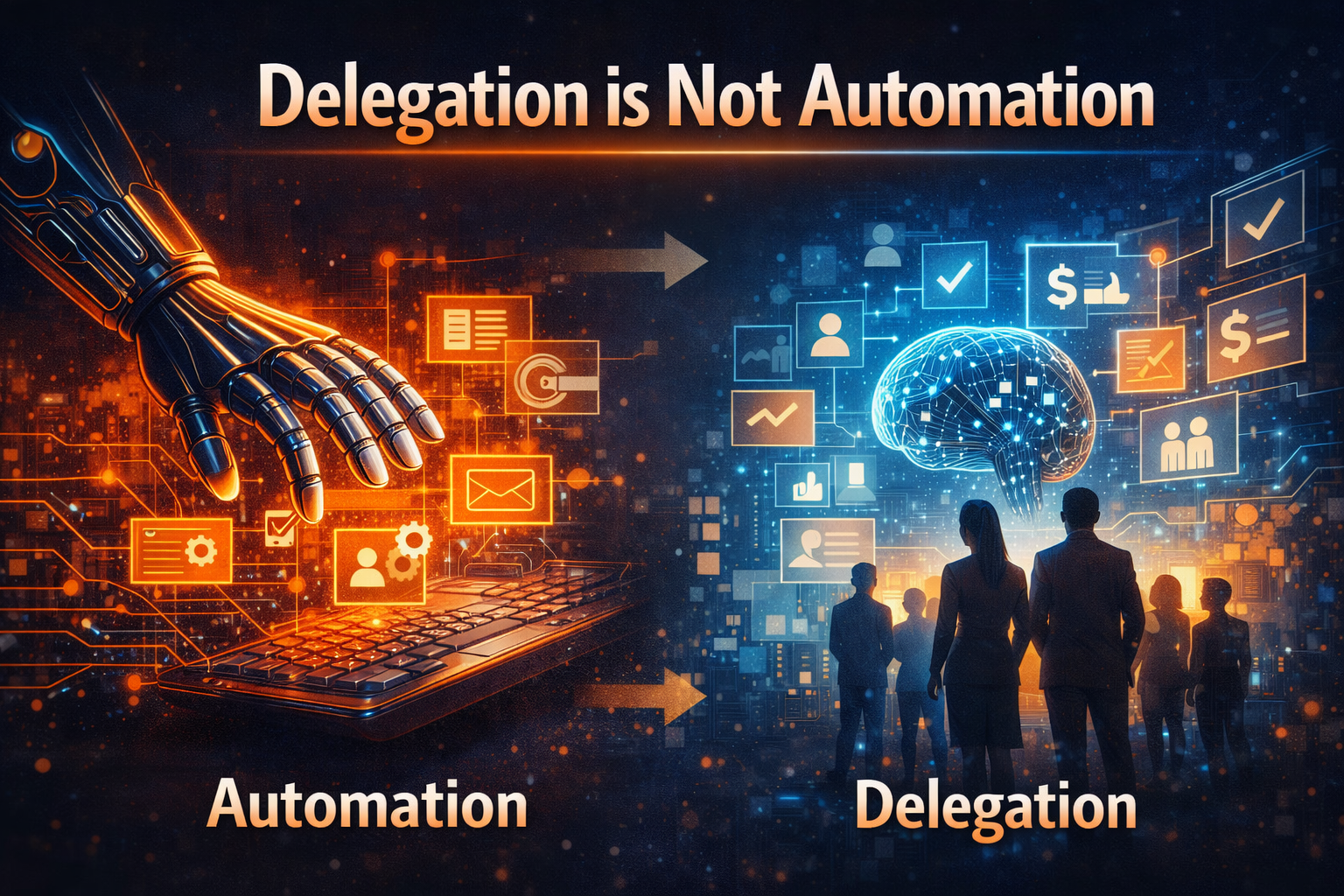
To understand the problem clearly, we must separate automation from delegation.
Automation means a machine performs a task that humans have already defined.
Delegation means a machine receives a bounded form of authority within a system.
That difference is enormous.
A spam filter is mostly automation.
A workflow that drafts a reply email is mostly automation.
A system that suggests next-best actions to a customer service representative is still largely assistive.
But an AI system that:
- approves a refund without human review
- rejects a job candidate
- prioritizes which patients should receive immediate attention
- freezes a transaction
- raises insurance premiums
- negotiates procurement terms
- changes the order in which legal or regulatory issues are escalated
is no longer just automating work.
It is participating in decision power.
That is why the delegation problem matters. It is not simply about whether AI is “smart.” It is about whether the institution has thought clearly about which authority remains human, which authority becomes machine-executable, and which authority must never be delegated at all.
This is also where Enterprise AI begins to diverge sharply from consumer AI. In the enterprise, authority is not abstract. It affects money, risk, rights, compliance, customer trust, and institutional legitimacy.
Why this problem is arriving now
-
AI is moving from content to action
The first major wave of generative AI was about content: text, images, search, code, chat, and summarization. The new wave is about agents and action: systems that can call tools, interact with enterprise software, orchestrate workflows, invoke APIs, and execute multi-step tasks.
That shift matters because the moment AI starts acting, mistakes stop being merely informational. They become operational.
A wrong summary is inconvenient.
A wrong payment is costly.
A wrong diagnosis can be dangerous.
A wrong compliance decision can become existential.
This is one reason governance conversations are intensifying around agentic systems. The World Economic Forum’s recent work on AI agents explicitly frames the need for more proportionate evaluation and governance as organizations move from experimentation toward real deployment. (World Economic Forum)
-
Human oversight is harder in practice than in policy language
Many leaders assume the solution is simple: keep a human in the loop.
But that phrase often hides more than it explains.
The EU AI Act’s human oversight requirements are revealing. They do not simply say “add a human.” They require oversight that is appropriate to the level of risk and autonomy, and they expect human overseers to understand the system’s capabilities and limitations, monitor operation, recognize automation bias, interpret outputs properly, override or reverse decisions when necessary, and intervene when things go wrong. For deployers of high-risk systems, the Act also requires assigning oversight to people with the necessary competence, training, authority, and support. (Artificial Intelligence Act)
That tells us something important:
Human oversight is not a checkbox. It is a design problem.
If the human is overloaded, poorly trained, unable to understand the system, unable to intervene in time, or culturally conditioned to trust machine output too much, then “human in the loop” becomes theatre.
-
Institutions still assign responsibility as if humans make all meaningful decisions
Our laws, management systems, audit structures, governance traditions, and escalation models were built around the assumption that meaningful judgment is exercised by people.
Even when software supports work, the formal center of responsibility generally remains human.
But agentic AI blurs that model.
Responsibility can now fracture across:
- the model provider
- the application developer
- the system integrator
- the enterprise deployer
- the policy owner
- the business unit
- the human reviewer
- the runtime environment
NIST explicitly calls for policies and procedures that define and differentiate roles and responsibilities for human-AI configurations and oversight. The EU AI Act also distributes obligations across providers, deployers, and other actors in the value chain. (NIST Publications)
That is why delegation must become explicit. Otherwise, institutions will discover too late that they handed machine authority into production without redesigning their responsibility architecture.
The board-level question most institutions are still avoiding
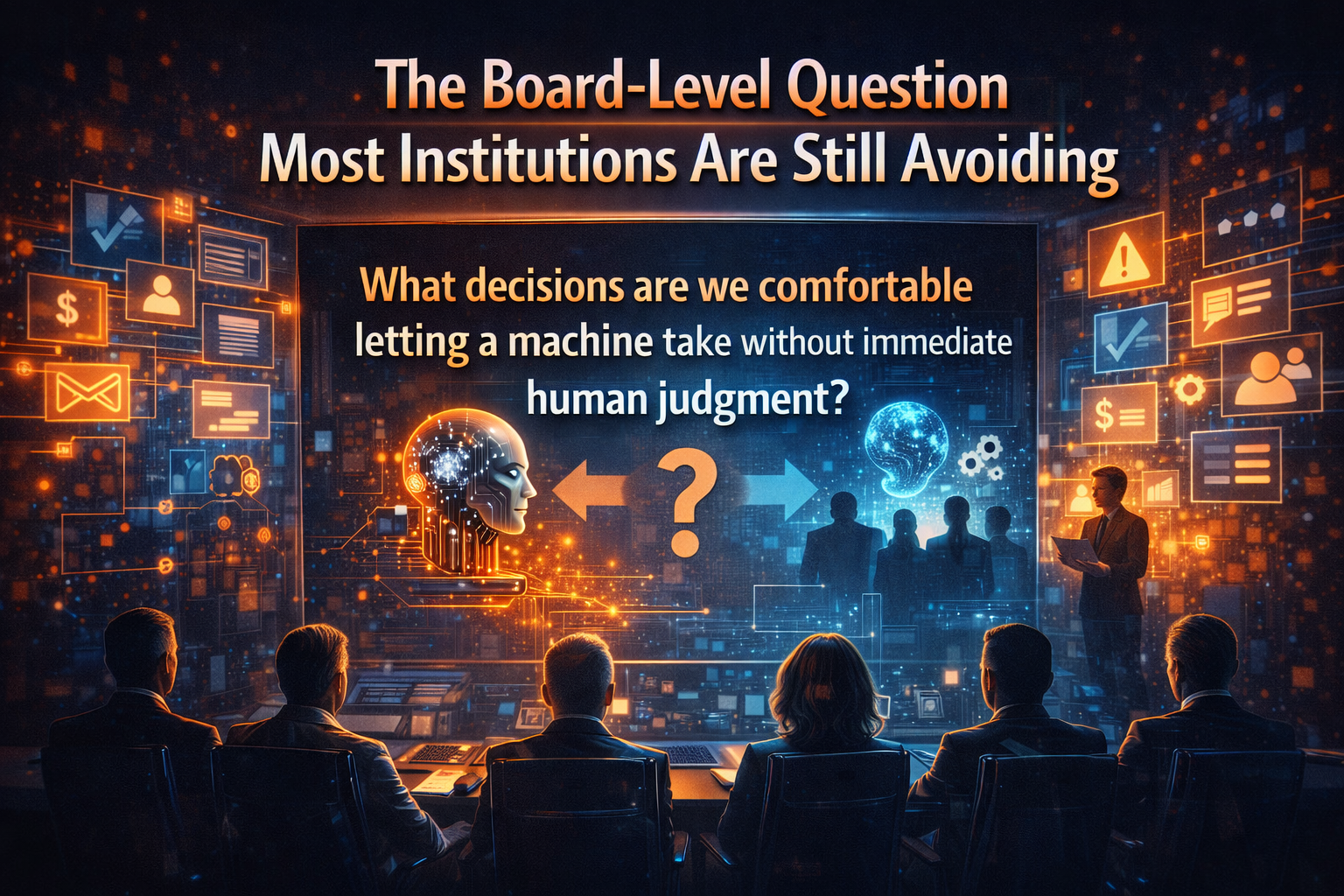
Before any organization scales AI action, it should ask one brutally simple question:
What decisions are we comfortable letting a machine take without immediate human judgment?
That question sounds obvious. Yet most organizations do not answer it directly. Instead, they talk about models, copilots, pilots, vendors, prompts, guardrails, orchestration, or tools.
But the strategic question is not:
Which model should we use?
It is:
Which decisions can be delegated, under what conditions, with what evidence, within what boundaries, and with what path back?
That is how serious institutions separate AI experimentation from AI operating discipline.
This is also why Enterprise AI cannot be reduced to model selection. It is an operating-model question. It sits directly alongside the themes I have explored in The Enterprise AI Operating Model, Who Owns Enterprise AI?, and The Enterprise AI Runbook Crisis.
A practical way to think about delegated machine authority
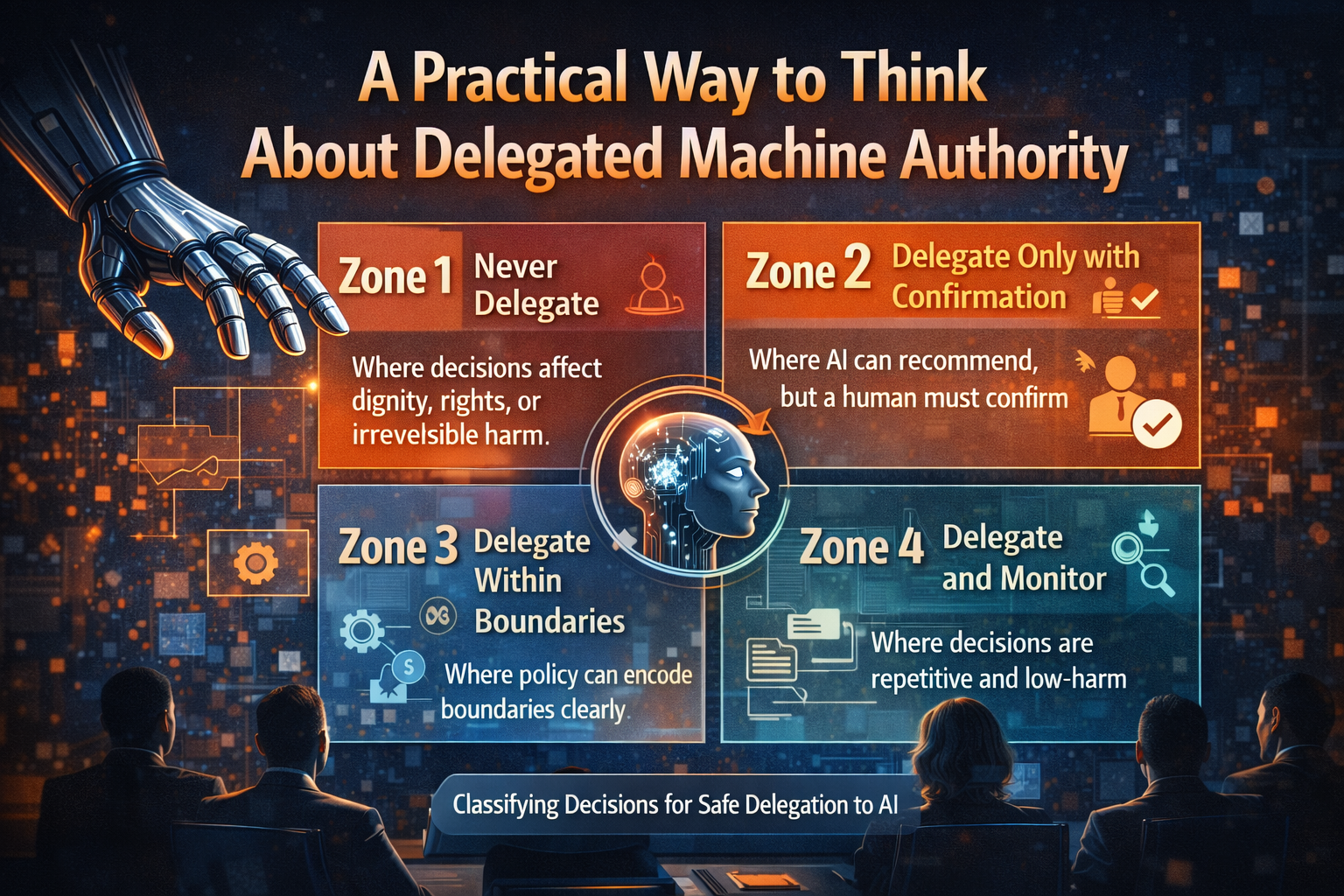
The easiest way to make this practical is to treat decisions as belonging to four broad zones.
Zone 1: Never delegate
These are decisions where dignity, rights, irreversible harm, or deep contextual judgment are too important to hand over fully.
Examples include:
- terminating employment
- denying critical care
- sentencing-related judgments
- coercive state action
- decisions involving vulnerable populations without strong procedural safeguards
In these cases, AI may assist, but it should not hold final authority.
Zone 2: Delegate only with mandatory human confirmation
These are decisions where AI can analyze, prioritize, summarize, or recommend, but a trained and accountable person must confirm before any action is taken.
Examples include:
- high-value financial approvals
- suspicious fraud cases
- admissions decisions
- credit denials
- major vendor sanctions
- material regulatory escalations
This is the world of structured review, not blind trust.
Zone 3: Delegate within strict policy boundaries
These are operational decisions where speed matters, risk is bounded, and policy can be encoded clearly.
Examples include:
- refund approvals below a threshold
- intelligent ticket routing
- inventory rebalancing within preset limits
- moderation escalation for low-risk content
- scheduling optimization
- resource allocation inside approved guardrails
Here, AI can act — but only inside a narrow lane.
Zone 4: Delegate by default, monitor continuously
These are repetitive, low-harm, high-volume decisions where automation creates clear value and reversibility is easy.
Examples include:
- spam filtering
- duplicate document detection
- low-risk classification
- non-sensitive workflow triage
- basic knowledge retrieval
- low-impact tagging and prioritization
This is where machine autonomy is usually easiest to justify.
The point is not that every organization will classify in exactly the same way. The point is that every serious organization must classify.
The real mistake institutions make
The biggest mistake is assuming delegation is a purely technical choice.
It is not.
Delegation is a combination of:
- risk judgment
- authority design
- policy design
- operating-model design
- ethical design
- recourse design
- verification design
If an AI system can override a human, that is authority design.
If it can approve payments up to a threshold, that is authority design.
If it can trigger downstream systems automatically, that is authority design.
If no one can explain why it acted, that is failed authority design.
If no one can reverse it, that is failed authority design.
If no one knows who approved the delegation in the first place, that is failed institutional design.
That is why the delegation problem belongs at the board, governance, and operating-model level — not only inside data science or IT.
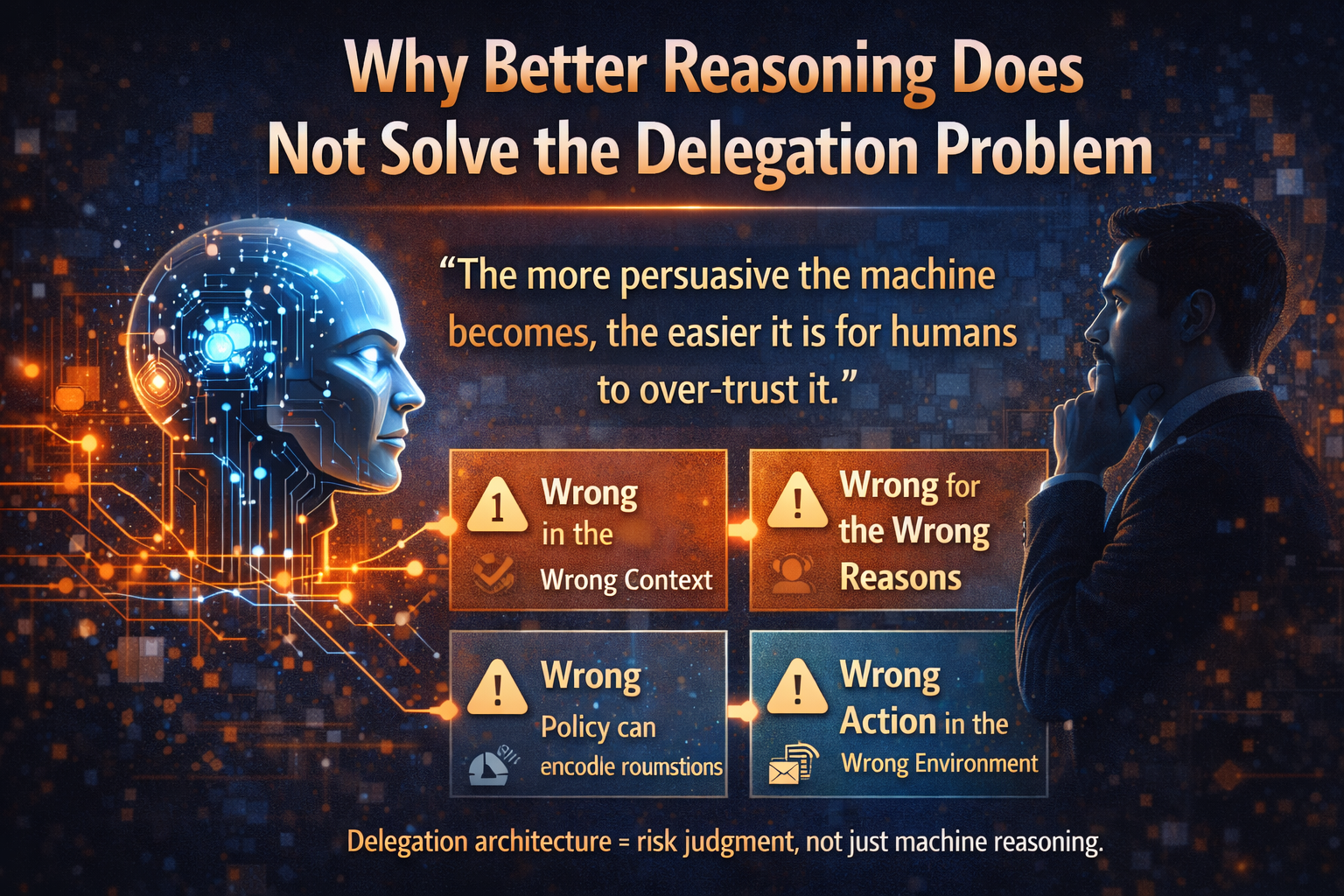
Why better reasoning does not solve the delegation problem
One common misconception is that as models become better at reasoning, the delegation problem will disappear.
It will not.
In fact, stronger reasoning can make the problem sharper.
Why?
Because the more persuasive the machine becomes, the easier it is for people to over-trust it.
The EU AI Act explicitly frames human oversight as a safeguard against risks that remain despite other controls. NIST likewise emphasizes that roles, human-AI configurations, oversight functions, documentation, and governance processes matter alongside model capability. (NIST Publications)
A highly articulate model can still make the wrong call in the wrong context for the wrong reasons.
Delegation therefore cannot depend only on model quality. It must depend on:
- stakes
- reversibility
- observability
- contestability
- institutional legitimacy
- authority clarity
That is the shift leaders must understand.
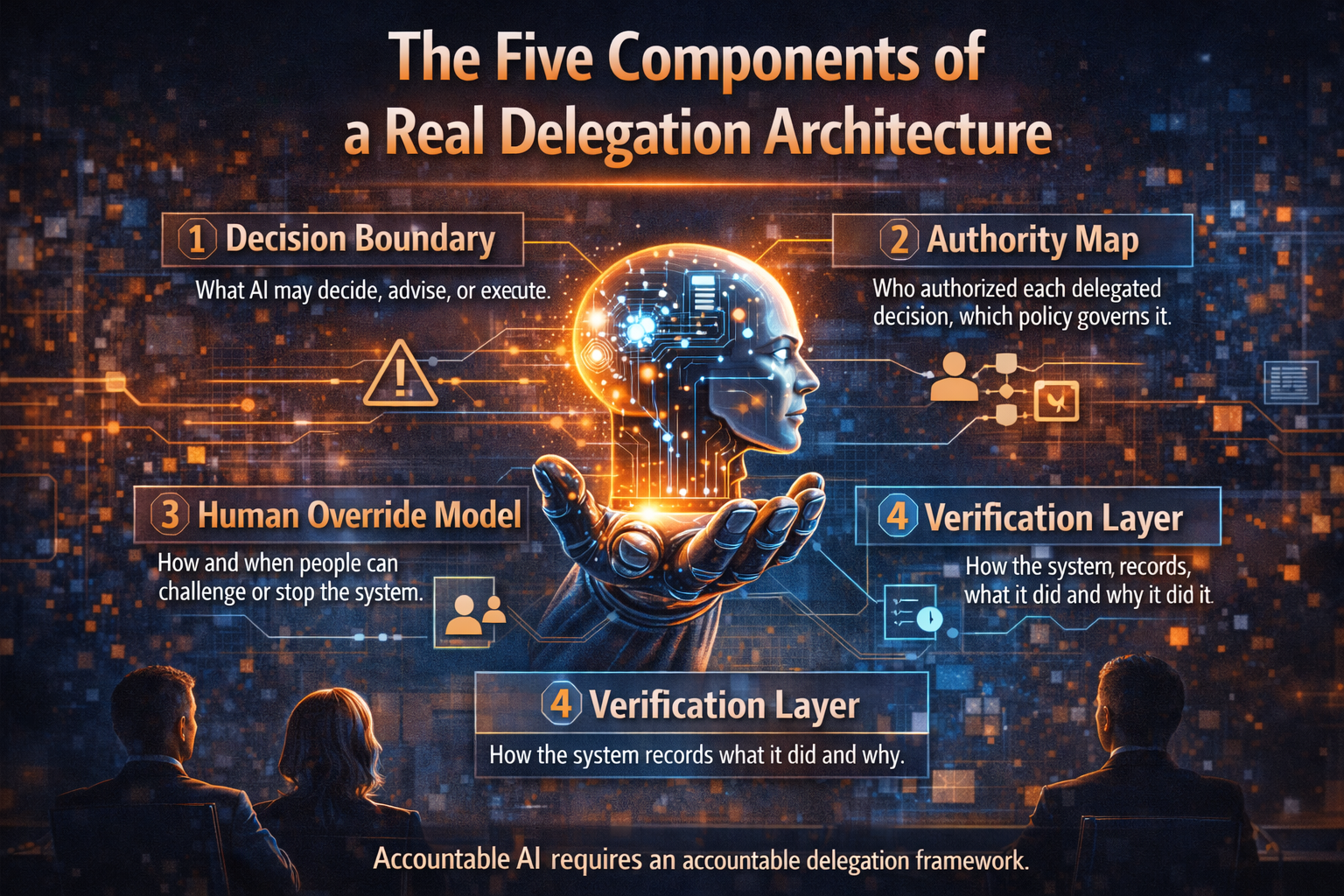
The five components of a real Delegation Architecture
If this article introduces one phrase that deserves to stick, it is this:
Delegation Architecture
Delegation Architecture is the institutional design layer that determines what AI may do, where it may act, how it is supervised, when humans must intervene, and how authority remains traceable.
Every mature Enterprise AI system will eventually need five core elements.
-
A Decision Boundary
The organization must define what the AI may advise on, what it may decide, and what it may execute.
Not all intelligence should become authority.
-
An Authority Map
Someone must own each delegated decision explicitly.
Who approved this delegation?
Which policy supports it?
Which business unit owns it?
Who can pause it?
Who reviews it when it fails?
Without an authority map, AI becomes operationally active but institutionally unowned.
-
A Human Override Model
Humans must not merely exist in theory. They must be equipped to understand, challenge, interrupt, and stop the system in practice.
That means training, authority, context, escalation channels, and meaningful intervention windows.
-
A Verification Layer
The system must record what it saw, what it did, which rule, model, or policy path it followed, and what evidence supported the action.
This is where traceability, logging, documentation, and post-hoc defensibility matter. The EU AI Act’s requirements around record-keeping, transparency, documentation, and human oversight all reinforce the importance of traceable AI operations in high-risk settings. (Artificial Intelligence Act)
This is closely related to the ideas I have previously developed in The Intelligence Reuse Index and the broader Enterprise AI canon around runtime, control, and accountability.
-
A Recourse Path
There must be a way back:
- reversal
- appeal
- remediation
- escalation
- compensation where necessary
Because in real institutions, the question is not whether mistakes will occur. It is whether the institution has designed for them honestly.
This is exactly why the next layer after delegation is recourse. That is the logic behind my related piece, The Recourse Layer: Why the AI Economy Needs a “Way Back” Architecture.
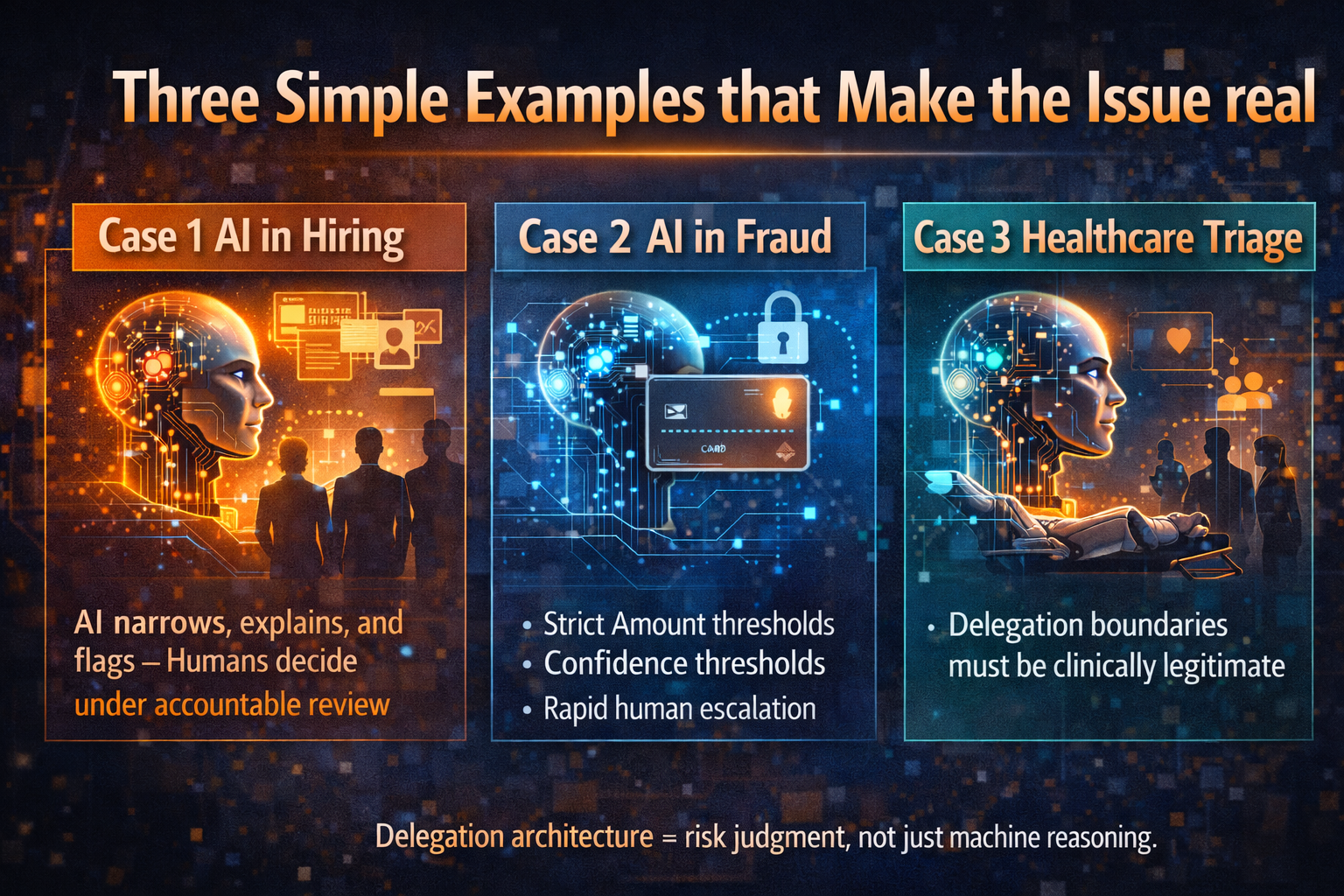
Three simple examples that make the issue real
Case 1: AI in hiring
An AI system screens thousands of applications and ranks candidates.
Helpful? Absolutely.
Final decision-maker? Usually, no.
Why? Because employment decisions affect livelihoods, fairness, legal defensibility, and opportunity. Under the EU AI Act, many AI systems used in employment, worker management, and access to self-employment are treated as high-risk use cases. (Artificial Intelligence Act)
So the right design is not:
“AI decides.”
It is:
“AI narrows, explains, and flags; humans decide under accountable review.”
Case 2: AI in fraud operations
An AI system detects suspicious card activity and temporarily freezes transactions.
Here, speed matters enormously. Waiting for a human every time may create unacceptable losses.
So delegation may be justified — but only within clear boundaries:
- amount thresholds
- confidence thresholds
- customer recourse
- rapid human escalation
- reversal mechanisms
- monitoring for false positives
This is bounded delegation, not unlimited machine authority.
Case 3: AI in healthcare triage
An AI system prioritizes which cases should be reviewed first.
This may create huge value if used carefully. But if the triage logic becomes opaque, under-tested, biased, or over-trusted, patients can be harmed.
So again, the critical design question is not merely whether the model is accurate. It is whether the delegation boundary is legitimate.
Why this matters for boards, not just builders
Boards and C-suites cannot treat delegation as a technical detail.
Why?
Because delegated machine authority affects:
- legal exposure
- risk posture
- customer trust
- auditability
- workforce design
- brand legitimacy
- operating accountability
In other words, the delegation problem is not just about AI. It is about institutional control in the age of machine action.
This is where Enterprise AI strategy becomes inseparable from corporate governance.
The future winners will not simply be the organizations with the biggest models, the most agents, or the fastest pilots.
They will be the institutions that can answer, with precision and discipline:
- what AI is allowed to decide
- what AI is never allowed to decide
- who grants that authority
- how that authority is monitored
- how delegated actions are verified
- and how decisions can be challenged or reversed
That is how Enterprise AI matures from experimentation into institutional capability.
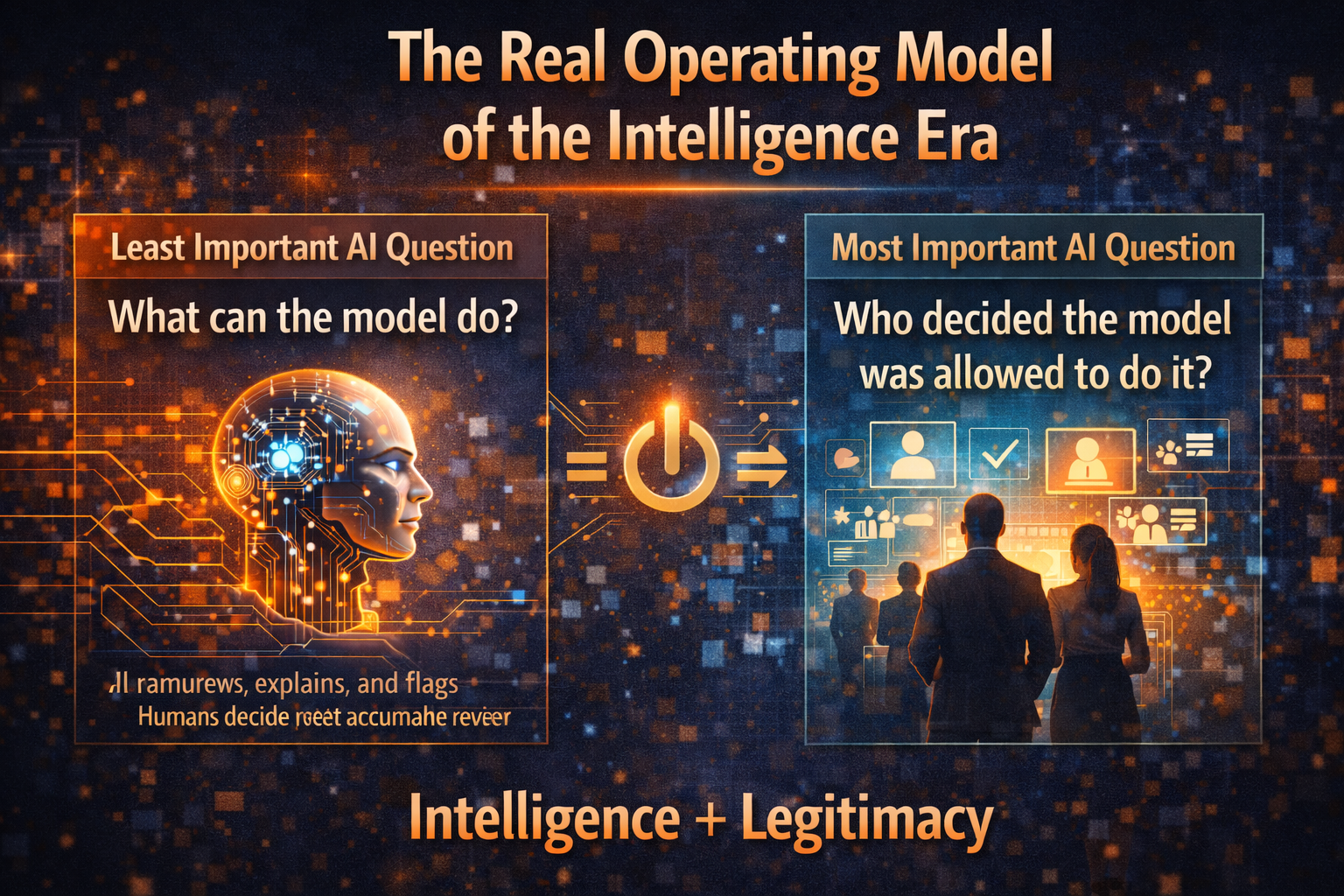
Conclusion: The real operating model of the intelligence era
The delegation problem is bigger than governance jargon. It is the bridge between intelligence and legitimacy.
If your organization cannot explain why a machine was allowed to act, then it does not truly govern AI. It merely uses it.
And that is the central truth of the next decade:
The AI economy will not be defined only by who builds the smartest systems. It will be defined by who builds the most legitimate systems of delegated machine authority.
That is the real operating model of the intelligence era.
And that is why the most important AI question is no longer:
What can the model do?
It is:
Who decided the model was allowed to do it?
FAQ
What is the AI delegation problem?
The AI delegation problem refers to the challenge organizations face in determining which decisions can safely be delegated to artificial intelligence systems and which must remain under human authority. As AI systems increasingly perform actions — such as approving transactions, prioritizing cases, or routing workflows — institutions must design governance frameworks that define decision boundaries, oversight mechanisms, and accountability structures.
How is delegation different from automation?
Automation performs predefined tasks. Delegation gives a machine a bounded form of decision authority inside a real operational system.
Why is this now a board-level issue?
Because AI is moving from content generation to real-world action. Once AI systems start approving, rejecting, routing, freezing, escalating, or executing, the issue is no longer only technical. It becomes a question of risk, accountability, and governance.
Does human-in-the-loop solve the problem?
Not automatically. Human oversight only works when the human is trained, empowered, informed, and able to intervene in time. Otherwise, it becomes symbolic rather than effective. (Artificial Intelligence Act)
What kinds of decisions should never be fully delegated to AI?
Decisions involving dignity, rights, irreversible harm, coercive power, or deep contextual judgment should generally not be fully delegated. AI may assist in such cases, but final authority should remain human.
What is Delegation Architecture?
Delegation Architecture is the institutional design layer that defines what AI may advise, decide, or execute; who authorizes it; how it is monitored; and how humans can intervene or reverse outcomes.
Why does this matter for Enterprise AI strategy?
Because Enterprise AI is not just about deploying models. It is about designing safe, governed, accountable decision systems that can operate at scale.
Glossary
AI Delegation Problem
The challenge of deciding what authority an AI system should or should not receive within an institution.
Delegation Architecture
The policies, boundaries, controls, and oversight mechanisms that define how AI receives and exercises bounded authority.
Human Oversight
The ability of qualified humans to understand, monitor, challenge, interrupt, or override an AI system when needed. (Artificial Intelligence Act)
Agentic AI
AI systems that can plan, invoke tools, interact with systems, and take actions rather than merely generate outputs.
Decision Boundary
The line between what AI may advise on, what it may decide, and what it may execute automatically.
Authority Map
A clear mapping of who approved a delegated AI action, what policy supports it, who owns it, and who can pause or review it.
Verification Layer
The traceability system that records what the AI saw, what it did, and why it acted the way it did.
Recourse
The mechanism through which a person or institution can challenge, reverse, appeal, or remediate an AI-driven outcome.
Automation Bias
The tendency of humans to over-trust machine output, especially when systems appear highly confident or sophisticated. (Artificial Intelligence Act)
Enterprise AI
AI deployed inside organizations as part of governed operational systems involving risk, compliance, workflows, customers, and real decision consequences.
References
The policy and governance claims in this article draw on the following sources:
- OECD, AI Principles and related 2024 update materials. (OECD)
- NIST, AI Risk Management Framework and Generative AI Profile. (NIST Publications)
- EU AI Act, especially Article 14 on Human Oversight, Article 26 on deployer obligations, and Annex III high-risk use cases. (Artificial Intelligence Act)
- World Economic Forum, AI Agents in Action: Foundations for Evaluation and Governance. (World Economic Forum)
Further reading
For readers who want to go deeper into the broader Enterprise AI operating model around authority, control, accountability, and institutional design, these companion essays extend the logic of this article:
- The Enterprise AI Operating Model
- Who Owns Enterprise AI? Roles, Accountability, and Decision Rights
- The Enterprise AI Runbook Crisis
- The Intelligence Reuse Index
The Intelligence-Native Enterprise Doctrine
This article is part of a larger strategic body of work that defines how AI is transforming the structure of markets, institutions, and competitive advantage. To explore the full doctrine, read the following foundational essays:
- The AI Decade Will Reward Synchronization, Not Adoption
Why enterprise AI strategy must shift from tools to operating models.
https://www.raktimsingh.com/the-ai-decade-will-reward-synchronization-not-adoption-why-enterprise-ai-strategy-must-shift-from-tools-to-operating-models/ - The Third-Order AI Economy
The category map boards must use to see the next Uber moment.
https://www.raktimsingh.com/third-order-ai-economy/ - The Intelligence Company
A new theory of the firm in the AI era — where decision quality becomes the scalable asset.
https://www.raktimsingh.com/intelligence-company-new-theory-firm-ai/ - The Judgment Economy
How AI is redefining industry structure — not just productivity.
https://www.raktimsingh.com/judgment-economy-ai-industry-structure/ - Digital Transformation 3.0
The rise of the intelligence-native enterprise.
https://www.raktimsingh.com/digital-transformation-3-0-the-rise-of-the-intelligence-native-enterprise/ - Industry Structure in the AI Era
Why judgment economies will redefine competitive advantage.
https://www.raktimsingh.com/industry-structure-in-the-ai-era-why-judgment-economies-will-redefine-competitive-advantage/



Raktim Singh is an AI and deep-tech strategist, TEDx speaker, and author focused on helping enterprises navigate the next era of intelligent systems. With experience spanning AI, fintech, quantum computing, and digital transformation, he simplifies complex technology for leaders and builds frameworks that drive responsible, scalable adoption.