
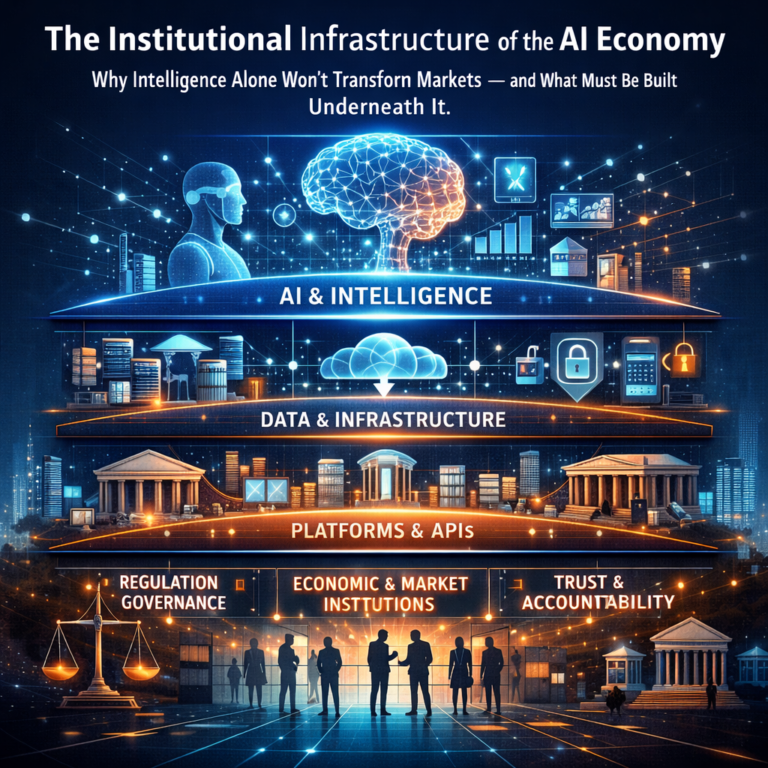
Artificial intelligence is advancing at extraordinary speed. New models can write software, generate images, analyze markets, and assist human decision-making across nearly every industry. Yet despite this rapid progress, a deeper reality is becoming clear: intelligence alone does not transform economies.
The true transformation happens when intelligence is embedded within institutional infrastructure—the systems of governance, trust, economic rules, and operational frameworks that allow intelligence to operate safely, reliably, and at scale.
Just as electricity required power grids and the internet required protocols, the AI economy will require a new foundation of institutional systems beneath the intelligence layer.
The Institutional Infrastructure of the AI Economy
Artificial intelligence is often described as an intelligence revolution.
Better models.
Better reasoning.
Better automation.
But intelligence alone does not transform economies.
What actually transforms economies are institutions.
Institutions are the invisible systems that make decisions legible, accountable, verifiable, and contestable. Contracts, audits, courts, compliance systems, safety rules, operating standards — these are the mechanisms that allow markets to function safely at scale.
Artificial intelligence is now entering that same domain.
AI is no longer only generating text or insights. It is beginning to prioritize customers, approve transactions, route workflows, detect fraud, optimize supply chains, and make operational decisions.
Once AI starts participating in decisions, the key question is no longer about model capability.
The real question becomes:
What institutional infrastructure allows artificial intelligence to operate safely inside the economy?
Because the future of the AI economy will not be determined only by better models.
It will be determined by whether organizations build the institutional systems that make machine intelligence trustworthy, governable, and accountable.
The Central Constraint of the AI Economy
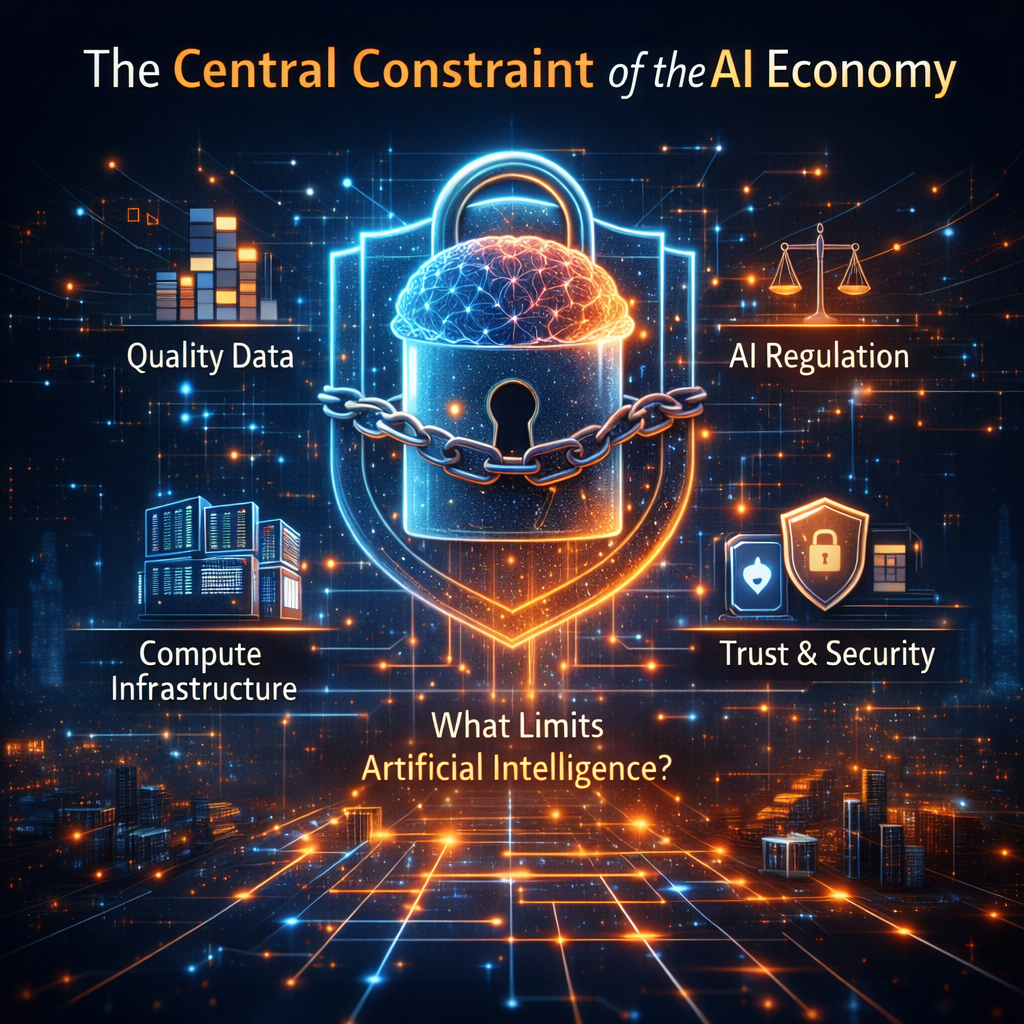
A model can be technically brilliant and still fail in the real world.
Why?
Because the real economy demands answers to questions that models alone cannot provide.
For example:
- What information was used to make the decision?
- Who is responsible for the outcome?
- Can we prove how the decision was made?
- Can the decision be challenged?
- Can the decision be reversed if it causes harm?
These questions belong to the domain of institutions, not algorithms.
This is why global governance frameworks such as the National Institute of Standards and Technology AI Risk Management Framework emphasize lifecycle governance rather than model performance alone.
The implication is clear:
The AI economy is not simply a technology problem.
It is an institutional design problem.
The AI economy will not be defined solely by advances in models, algorithms, or compute power. Instead, it will be shaped by the infrastructure that governs how intelligence interacts with markets, organizations, and societies.
This infrastructure includes data pipelines, governance frameworks, verification mechanisms, economic institutions, and trust systems that allow artificial intelligence to operate as a reliable component of economic activity. Understanding this institutional foundation is essential for leaders, policymakers, and enterprises preparing for the next phase of the AI economy.
The Institutional Infrastructure of the AI Economy
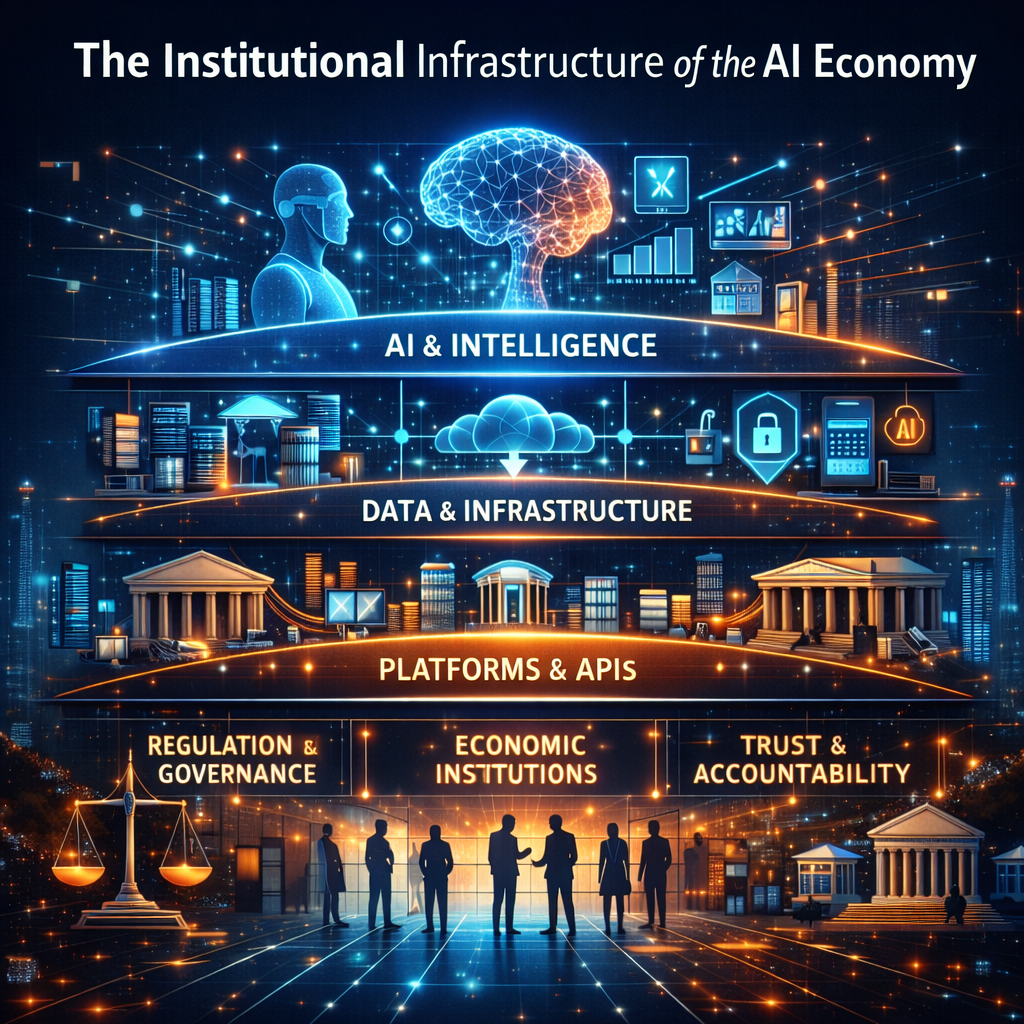
To function safely at scale, the AI economy requires four foundational infrastructures.
These infrastructures determine how intelligence becomes operational, accountable, and legitimate.
They can be summarized through the D.R.V.R. framework:
D.R.V.R.
D — Delegation Infrastructure
R — Representation Infrastructure
V — Verification Infrastructure
R — Recourse Infrastructure
These four layers form the institutional foundation of the AI economy.
Without them, even the most advanced AI systems will struggle to operate safely inside real markets.
C.O.R.E.—The Intelligence Loop
Before exploring the institutional infrastructure, it is important to understand how AI actually functions inside organizations.
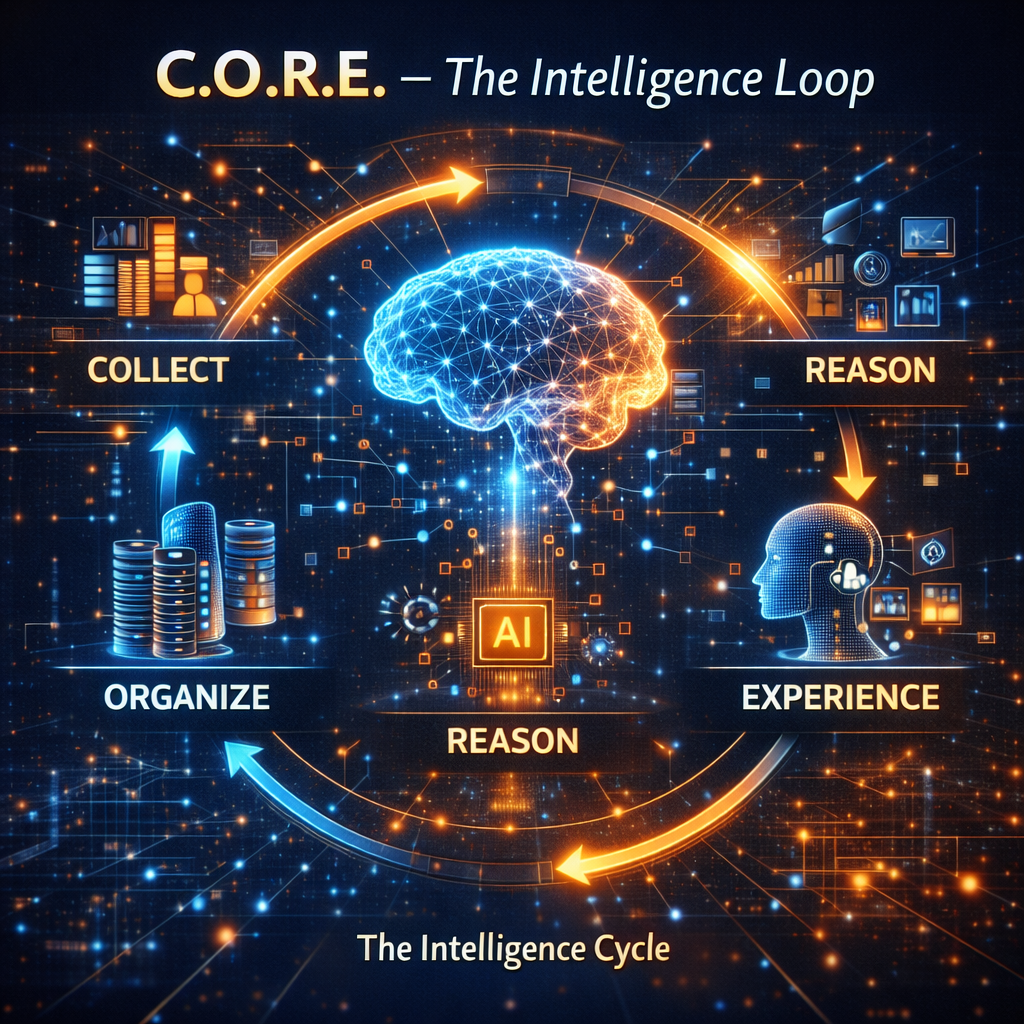
At the center of the intelligence-native enterprise is a continuous institutional cognition cycle called C.O.R.E.
C.O.R.E. describes how organizations transform artificial intelligence from isolated tools into a living decision system.
C — Comprehend context
AI absorbs signals from across the operating environment:
- customer intent
- transaction patterns
- operational telemetry
- policy constraints
- market conditions
Comprehension converts raw data into situational awareness.
It answers the most important question in intelligent systems:
What is actually happening right now?
Without comprehension, AI is blind pattern recognition.
With comprehension, AI becomes context-aware institutional intelligence.
O — Optimize decisions
AI generates possible actions, evaluates trade-offs, and ranks alternatives under uncertainty.
Optimization is not a single-point prediction.
It is structured choice under constraints.
AI evaluates:
- risk
- opportunity
- cost
- timing
- regulatory constraints
- operational policies
Optimization converts situational awareness into decision readiness.
R — Realize action
AI executes decisions through tools and APIs such as:
- ticketing systems
- workflow automation
- routing engines
- approval mechanisms
- operational systems
Execution is where AI advice becomes institutional behavior.
At this point, intelligence stops being theoretical and becomes real operational action.
E — Evolve through evidence
Every decision generates feedback signals:
- outcomes
- escalations
- reversals
- error patterns
- drift signals
- human overrides
AI systems learn from these signals and continuously recalibrate their decision quality.
The system improves because it evolves through evidence rather than assumptions.
C.O.R.E. is not a workflow tool.
It is an institutionalized cognition engine.
But cognition alone is not enough.
For intelligence to operate safely in the real world, institutions must also provide the infrastructure of trust and accountability.
This is where D.R.V.R. becomes critical.
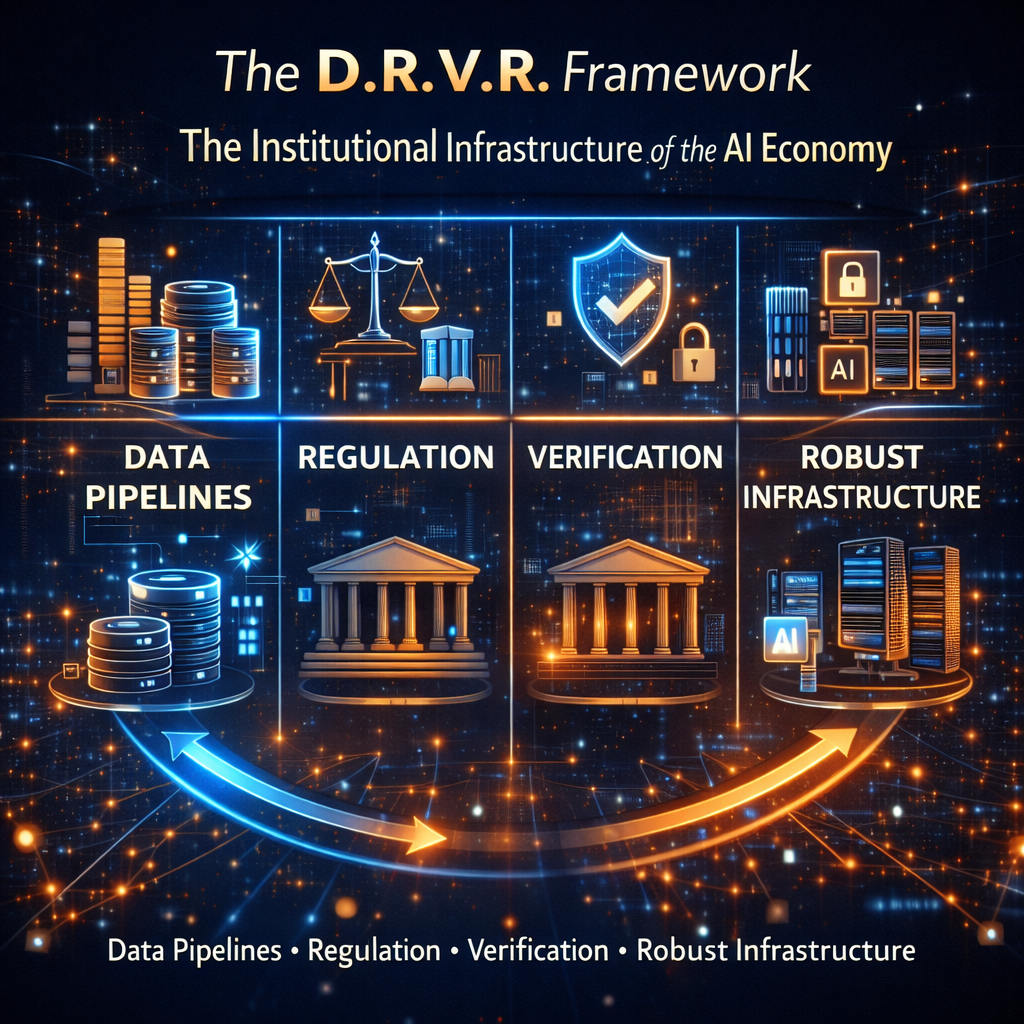
The D.R.V.R. Framework
The Institutional Infrastructure of the AI Economy
While C.O.R.E. explains how intelligence operates, D.R.V.R. explains how institutions govern intelligence.
The four infrastructures ensure that AI systems can operate safely inside real markets and organizations.
Representation Infrastructure
Making the Invisible Legible
AI can only reason about what it can observe.
Representation infrastructure converts complex real-world activity into machine-readable signals without losing context.
This includes:
- structured data systems
- data governance and lineage
- shared ontologies
- metadata and context
- sensor and telemetry systems
Example
Imagine a logistics organization deploying AI to optimize delivery routing.
If delivery data is inconsistent — missing timestamps, inaccurate locations, incomplete shipment records — the AI system cannot produce reliable recommendations.
The problem is not the model.
The problem is the representation layer.
Representation infrastructure determines whether reality becomes legible to machines.
Delegation Infrastructure
Allowing Humans to Safely Delegate Decisions to Machines
The AI economy is fundamentally a delegation economy.
As machine cognition becomes cheaper, humans begin delegating more decisions to intelligent systems.
But delegation without structure creates chaos.
Delegation infrastructure defines:
- what AI is allowed to do autonomously
- what requires human approval
- what actions are reversible
- what thresholds trigger escalation
- who is accountable for outcomes
Example
An AI system may automatically approve low-risk refunds.
However, high-value refunds or suspicious patterns may require human review.
Delegation infrastructure defines the authority boundaries between humans and machines.
Without these boundaries, automation either becomes dangerous or completely unusable.
Verification Infrastructure
Proving What AI Did and Why
Trust at scale requires evidence at scale.
Verification infrastructure ensures that AI decisions can be:
- audited
- explained
- reproduced
- validated
This includes:
- decision logs
- model traceability
- policy enforcement records
- reasoning traces
- monitoring systems
Example
A financial transaction is blocked by an AI system.
The customer asks why.
The regulator asks for justification.
The audit team asks whether policies were followed.
Verification infrastructure ensures that the organization can provide clear evidence rather than vague explanations.
International governance standards such as those from the Organisation for Economic Co-operation and Development increasingly emphasize this principle of accountability and transparency in AI systems.
Recourse Infrastructure
Enabling Contestability and Reversibility
Every mature economic system contains a way back.
Contracts can be disputed.
Transactions can be reversed.
Decisions can be appealed.
AI systems must support the same capability.
Recourse infrastructure enables:
- appeals processes
- human review
- decision reversal
- compensation mechanisms
- incident investigation
Example
An AI system mistakenly blocks a customer account.
Without recourse infrastructure:
- the customer has no path to resolution
- trust collapses
- regulators intervene
With recourse infrastructure:
- the decision can be challenged
- the evidence can be examined
- the error corrected
- the system improved
Recourse transforms automation into accountable intelligence.
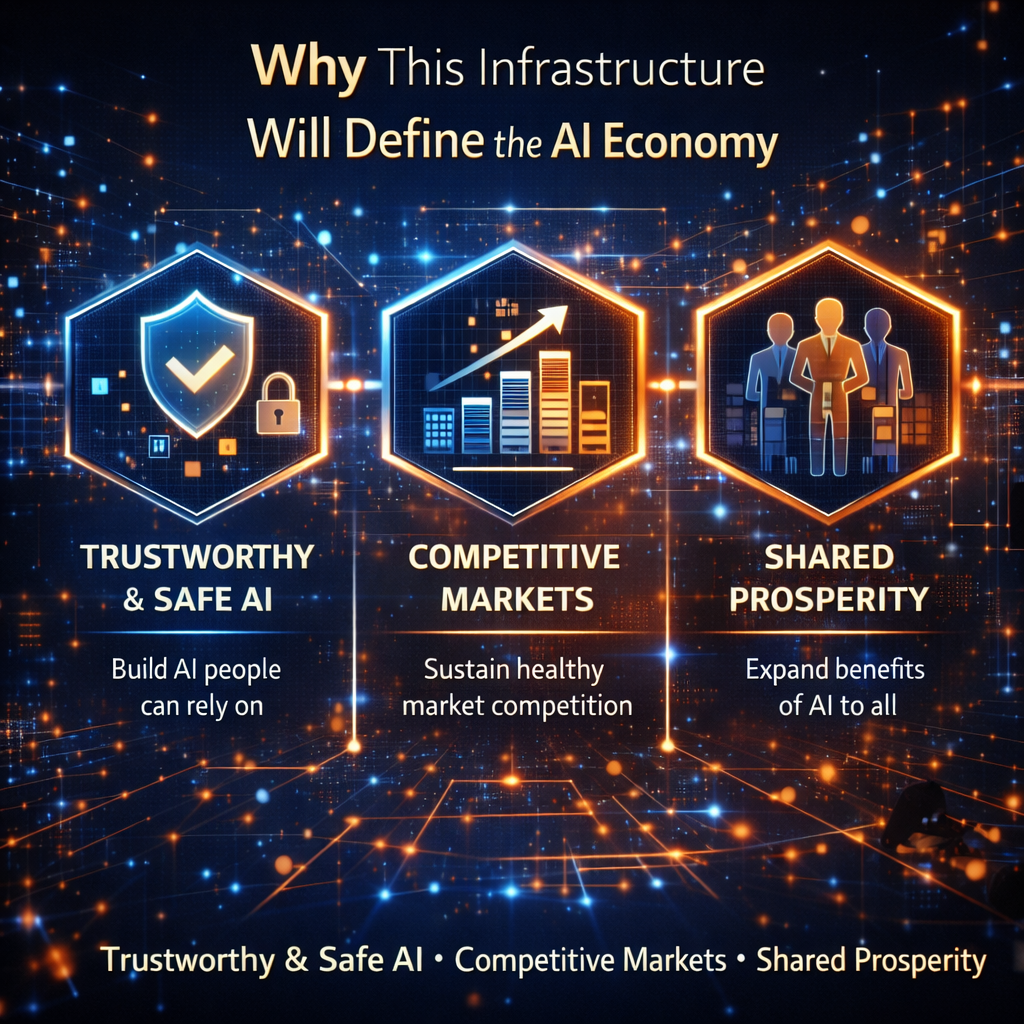
Why This Infrastructure Will Define the AI Economy
As AI technology becomes more widely available, competitive advantage will shift away from model capability.
Instead, advantage will come from institutional capability.
Organizations that build strong D.R.V.R. infrastructure will be able to:
- deploy AI safely at scale
- delegate more decisions to intelligent systems
- maintain regulatory trust
- adapt faster to new economic conditions
In other words, the real platform advantage of the AI era will not come from intelligence alone.
It will come from institutionalizing intelligence.
The Next Phase of the AI Economy
The early phase of AI adoption focused on models and tools.
The next phase will focus on institutions.
Organizations will need to design systems that combine:
C.O.R.E. — the intelligence loop that powers decision systems
with
D.R.V.R. — the institutional infrastructure that makes those decisions safe, accountable, and reversible.
When these two layers work together, AI becomes something far more powerful than a productivity tool.
It becomes a decision infrastructure for the modern economy.
And the institutions that build this infrastructure first will shape the future of markets, governance, and digital society.
FAQ
What is institutional infrastructure in AI?
Institutional infrastructure refers to the governance systems, operational mechanisms, and oversight processes that allow AI systems to operate safely and responsibly in real-world economic environments.
Why is institutional infrastructure important for the AI economy?
Without mechanisms for delegation, verification, and recourse, AI decisions cannot be trusted, audited, or corrected, which prevents organizations from deploying AI at scale.
What is the D.R.V.R. framework?
D.R.V.R. describes the four infrastructures required for the AI economy: Delegation, Representation, Verification, and Recourse.
How does C.O.R.E. relate to institutional AI?
C.O.R.E. defines the intelligence loop through which AI comprehends context, optimizes decisions, realizes actions, and evolves through evidence.
Glossary
Institutional Infrastructure
The governance and operational systems that enable AI to operate safely within organizations and markets.
Representation Infrastructure
Systems that convert real-world information into machine-readable signals.
Delegation Infrastructure
Mechanisms that define how decision authority is shared between humans and AI systems.
Verification Infrastructure
Systems that allow AI decisions to be audited, explained, and validated.
Recourse Infrastructure
Processes that enable decisions to be challenged, reversed, or corrected.
The Intelligence-Native Enterprise Doctrine
This article is part of a larger strategic body of work that defines how AI is transforming the structure of markets, institutions, and competitive advantage. To explore the full doctrine, read the following foundational essays:
- The AI Decade Will Reward Synchronization, Not Adoption
Why enterprise AI strategy must shift from tools to operating models.
https://www.raktimsingh.com/the-ai-decade-will-reward-synchronization-not-adoption-why-enterprise-ai-strategy-must-shift-from-tools-to-operating-models/ - The Third-Order AI Economy
The category map boards must use to see the next Uber moment.
https://www.raktimsingh.com/third-order-ai-economy/ - The Intelligence Company
A new theory of the firm in the AI era — where decision quality becomes the scalable asset.
https://www.raktimsingh.com/intelligence-company-new-theory-firm-ai/ - The Judgment Economy
How AI is redefining industry structure — not just productivity.
https://www.raktimsingh.com/judgment-economy-ai-industry-structure/ - Digital Transformation 3.0
The rise of the intelligence-native enterprise.
https://www.raktimsingh.com/digital-transformation-3-0-the-rise-of-the-intelligence-native-enterprise/ - Industry Structure in the AI Era
Why judgment economies will redefine competitive advantage.
https://www.raktimsingh.com/industry-structure-in-the-ai-era-why-judgment-economies-will-redefine-competitive-advantage/
Institutional Perspectives on Enterprise AI
Many of the structural ideas discussed here — intelligence-native operating models, control planes, decision integrity, and accountable autonomy — have also been explored in my institutional perspectives published via Infosys’ Emerging Technology Solutions platform.
For readers seeking deeper operational detail, I have written extensively on:
- What Makes an Enterprise Intelligence-Native? The Blueprint for Third-Order AI Advantage
https://blogs.infosys.com/emerging-technology-solutions/artificial-intelligence/what-is-enterprise-ai-the-operating-model-for-compounding-institutional-intelligence.html - Why “AI in the Enterprise” Is Not Enterprise AI: The Operating Model Difference Most Organizations Miss
https://blogs.infosys.com/emerging-technology-solutions/artificial-intelligence/why-ai-in-the-enterprise-is-not-enterprise-ai-the-operating-model-difference-that-most-organizations-miss.html - The Enterprise AI Control Plane: Governing Autonomy at Scale
https://blogs.infosys.com/emerging-technology-solutions/artificial-intelligence/the-enterprise-ai-control-plane-governing-autonomy-at-scale.html - Enterprise AI Ownership Framework: Who Is Accountable, Who Decides, and Who Stops AI in Production
https://blogs.infosys.com/emerging-technology-solutions/artificial-intelligence/enterprise-ai-ownership-framework-who-is-accountable-who-decides-and-who-stops-ai-in-production.html - Decision Integrity: Why Model Accuracy Is Not Enough in Enterprise AI
https://blogs.infosys.com/emerging-technology-solutions/artificial-intelligence/decision-integrity-why-model-accuracy-is-not-enough-in-enterprise-ai.html - Agent Incident Response Playbook: Operating Autonomous AI Systems Safely at Enterprise Scale
https://blogs.infosys.com/emerging-technology-solutions/artificial-intelligence/agent-incident-response-playbook-operating-autonomous-ai-systems-safely-at-enterprise-scale.html - The Economics of Enterprise AI: Designing Cost, Control, and Value as One System
https://blogs.infosys.com/emerging-technology-solutions/artificial-intelligence/the-economics-of-enterprise-ai-designing-cost-control-and-value-as-one-system.html
Together, these perspectives outline a unified view: Enterprise AI is not a collection of tools. It is a governed operating system for institutional intelligence — where economics, accountability, control, and decision integrity function as a coherent architecture.



Raktim Singh is an AI and deep-tech strategist, TEDx speaker, and author focused on helping enterprises navigate the next era of intelligent systems. With experience spanning AI, fintech, quantum computing, and digital transformation, he simplifies complex technology for leaders and builds frameworks that drive responsible, scalable adoption.