
Intelligence Capital: The New Asset Class Boards Must Allocate in the AI Economy
For decades, boards have mastered the language of capital allocation. Financial capital compounds through disciplined investment.
Human capital creates advantage when talent and incentives align. Technology capital—cloud, data platforms, cybersecurity—has become foundational infrastructure.
But AI is introducing a new question into boardrooms from New York to London to Bengaluru: what if intelligence itself is becoming a capital asset—one that can be built, scaled, governed, and compounded?
AI is not just another software layer or productivity tool.
It is an engine for repeatable, improvable decision-making embedded into the core workflows of the enterprise. And when decision quality improves at scale—across pricing, risk, operations, product design, and customer experience—value does not merely shift between competitors. It expands.
The organizations that understand this shift early will not treat AI as experimentation or automation. They will treat it as Intelligence Capital—a compounding institutional asset that defines competitive advantage in the AI economy.
Why AI Is Forcing a Rethink of Capital Allocation
Most boards already understand capital.
They know how financial capital compounds through disciplined allocation. They know how human capital creates advantage when talent, incentives, and culture align. They know how technology capital—cloud, data platforms, cybersecurity—has become essential infrastructure.
But AI is forcing a new question into boardrooms across the US, EU, India, and the global economy:
What if “intelligence” itself is becoming a capital asset—one that can be built, scaled, governed, and compounded?
Many leaders can sense this shift, but few can say it cleanly. AI is still discussed as “tools,” “use cases,” or “automation.” That framing misses the real strategic opportunity.
Because AI is not just software.
It is an engine for repeatable, improvable decision-making.
And when decisions improve at scale—across pricing, risk, operations, customer experience, and product—value doesn’t merely move. Value expands.
That expansion is not an accident. It is the result of allocating resources into a new asset class:
Intelligence Capital.
Definition: Intelligence Capital
Intelligence Capital is the enterprise capability to compound decision quality through AI-driven learning systems embedded in governed workflows.
Executive summary for boards
- AI’s economic upside is large, with credible estimates placing generative AI’s annual potential value in the trillions of dollars. (McKinsey & Company)
- The winning strategy is not “more pilots.” It is building decision infrastructure that compounds—measurably improving outcomes while remaining defensible.
- Boards should treat AI as capital allocation, funding not only “build,” but also compounding (feedback, monitoring) and defense (governance, auditability).
- This is an opportunity story—but credibility requires acknowledging the workforce transition and designing for complementarity, not chaos. (IMF)
Why boards need a new asset-class vocabulary
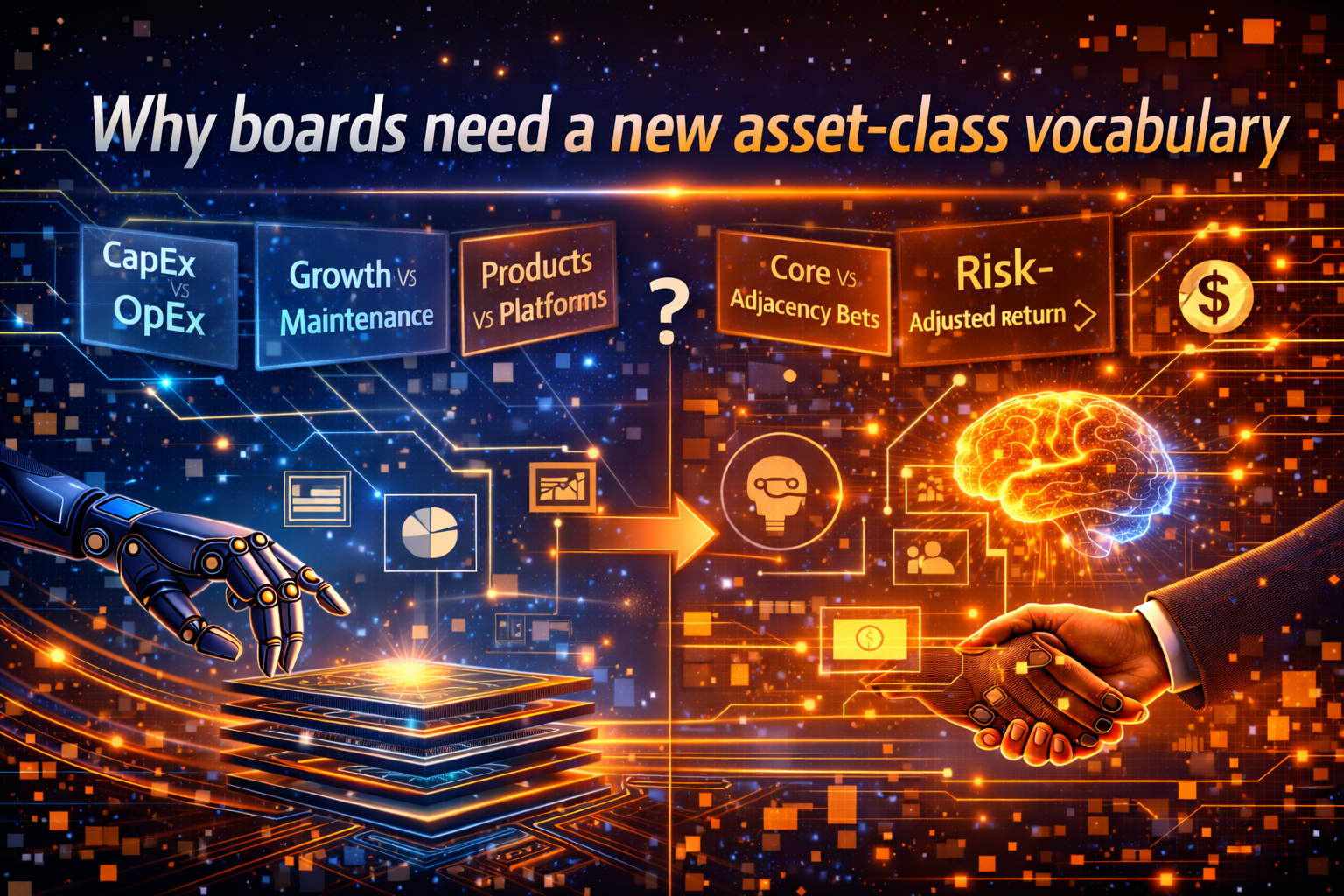
Boards rely on clear categories to govern investment:
- CapEx vs OpEx
- growth vs maintenance
- products vs platforms
- core vs adjacency bets
- risk-adjusted return
AI breaks these familiar buckets.
A modern AI program can be simultaneously:
- a productivity lever,
- a growth engine,
- a risk system,
- a data discipline,
- and increasingly an “acting layer” inside workflows.
It also creates spillovers: improving one decision loop can improve many others. That is what makes AI capital-like rather than project-like.
Credible research underscores the scale of the prize.
McKinsey estimates generative AI could add the equivalent of $2.6T–$4.4T annually across the use cases they analyzed. (McKinsey & Company) Goldman Sachs argues generative AI could drive a ~7% increase in global GDP over time, with a meaningful uplift to productivity growth. (Goldman Sachs)
But the board opportunity is not “AI is big.”
The board opportunity is:
How do we convert AI into a compounding asset—rather than a series of expensive experiments?
That conversion is Intelligence Capital.
What is Intelligence Capital?
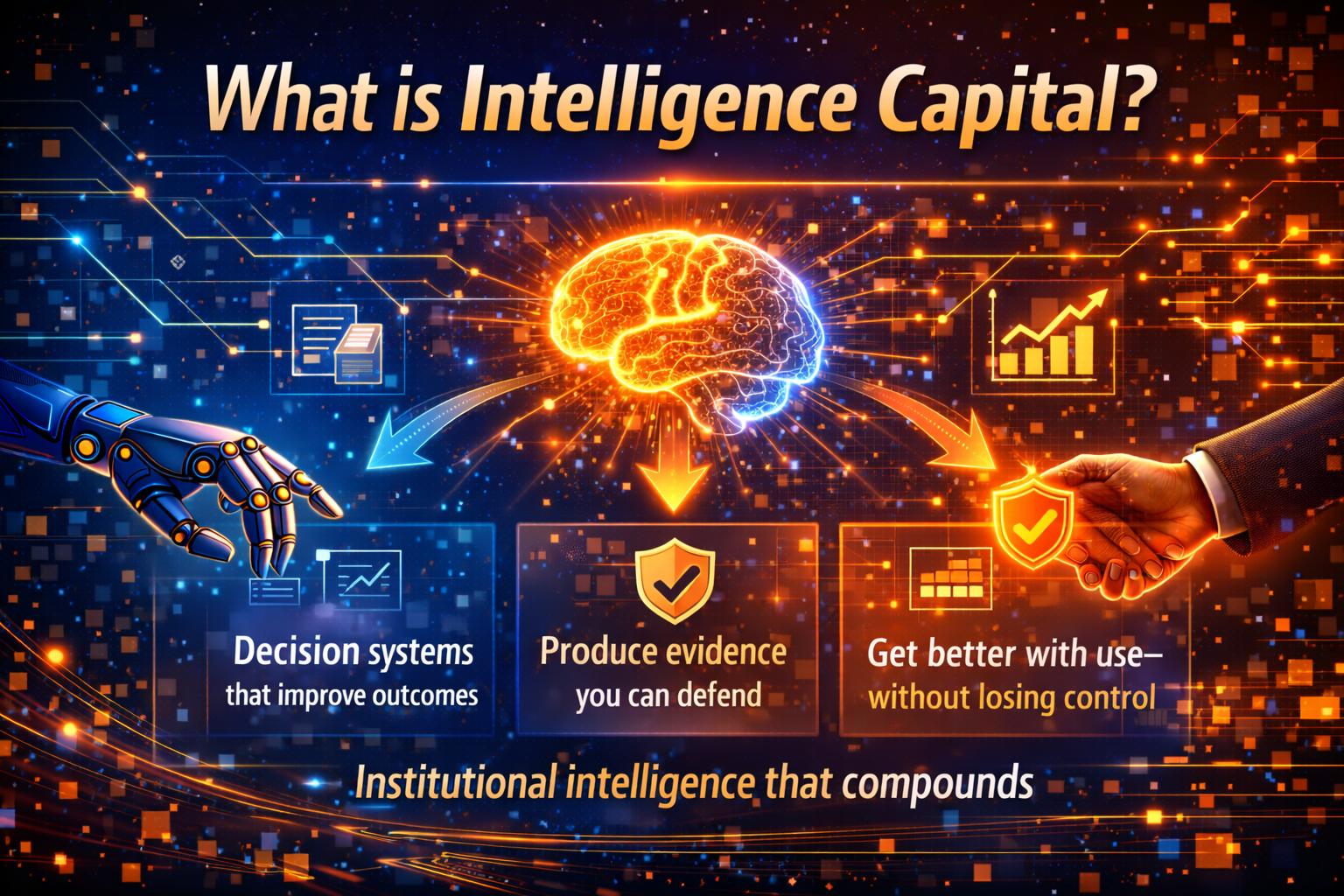
Intelligence Capital is the enterprise capability to repeatedly make better decisions—faster, safer, and more context-aware—by combining data, models, workflows, governance, and human judgment into learning systems.
It is not “having an LLM.”
It is not “deploying copilots.”
It is not “automating tasks.”
It is:
- decision systems that improve outcomes,
- produce evidence you can defend,
- and get better with use—without losing control.
In other words: institutional intelligence that compounds.
Decisions are the unit of value
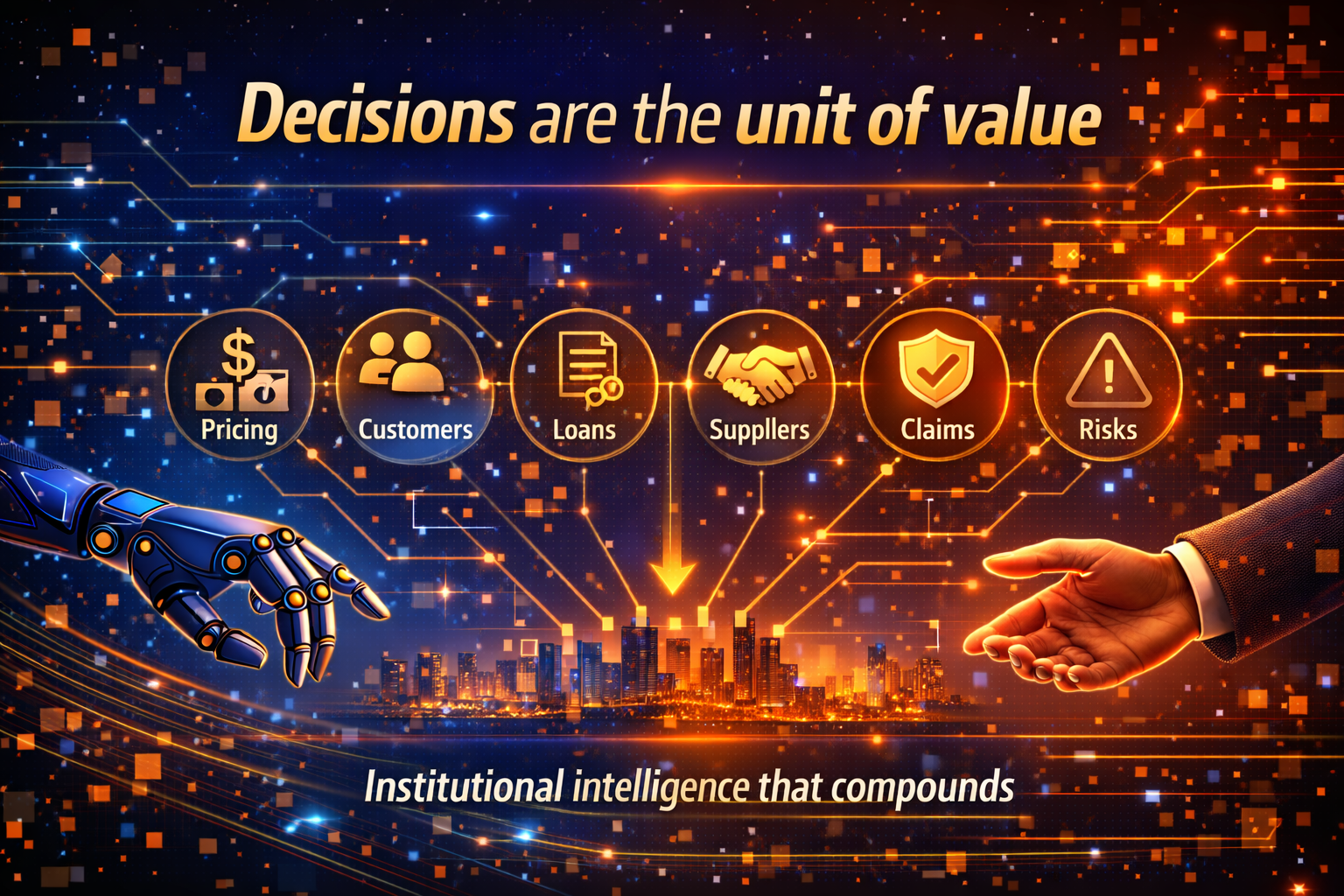
Every enterprise is a machine that converts uncertainty into decisions:
- What price do we set?
- Which customer gets which offer?
- Which loan is approved?
- Which supplier is trusted?
- Which claim is paid?
- Which incident becomes a crisis?
- Which features ship?
- Which risks escalate?
In most organizations, these decisions are distributed across spreadsheets, meetings, tribal knowledge, and managerial intuition. That worked when markets moved slowly and variance was manageable.
In an AI-accelerated economy, the decision surface area expands:
- more channels, more personalization, more regulatory scrutiny, more volatility, less attention, more competitors.
In that world, the enterprise that compounds decision quality wins—not once, but repeatedly.
This is where your broader doctrine—Enterprise AI as an operating capability—becomes the unifying frame.
Intelligence Capital is the board-level abstraction that ties the canon together (Operating Model, Decision Scale, AI Dividend, Precision Growth).
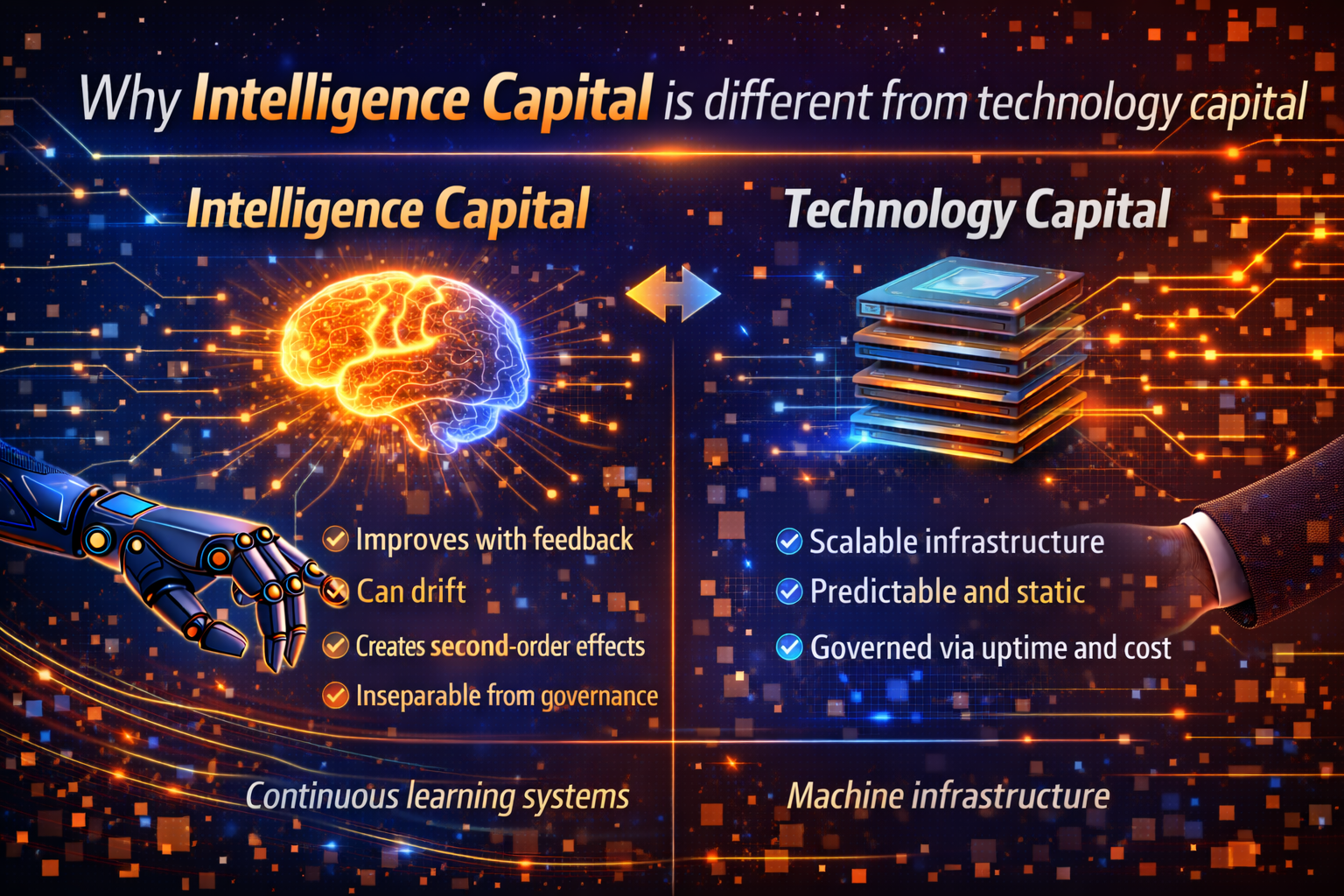
Why Intelligence Capital is different from technology capital
Technology capital (cloud, ERP, data platforms) tends to be:
- scalable infrastructure,
- relatively predictable once implemented,
- governed through uptime, cost, and security.
Intelligence Capital behaves differently:
1) It improves with feedback
The asset is not static; it learns.
2) It can drift
The environment changes; the decision system must adapt.
3) It creates second-order effects
Faster decisions change organizational behavior: cadence, incentives, escalations, customer expectations.
4) It is inseparable from governance
If governance is bolted on, trust breaks. If governance is designed in, advantage compounds.
This is why boards must allocate not only to models, but to the full decision system: workflows, telemetry, policy intent, oversight, and accountability.
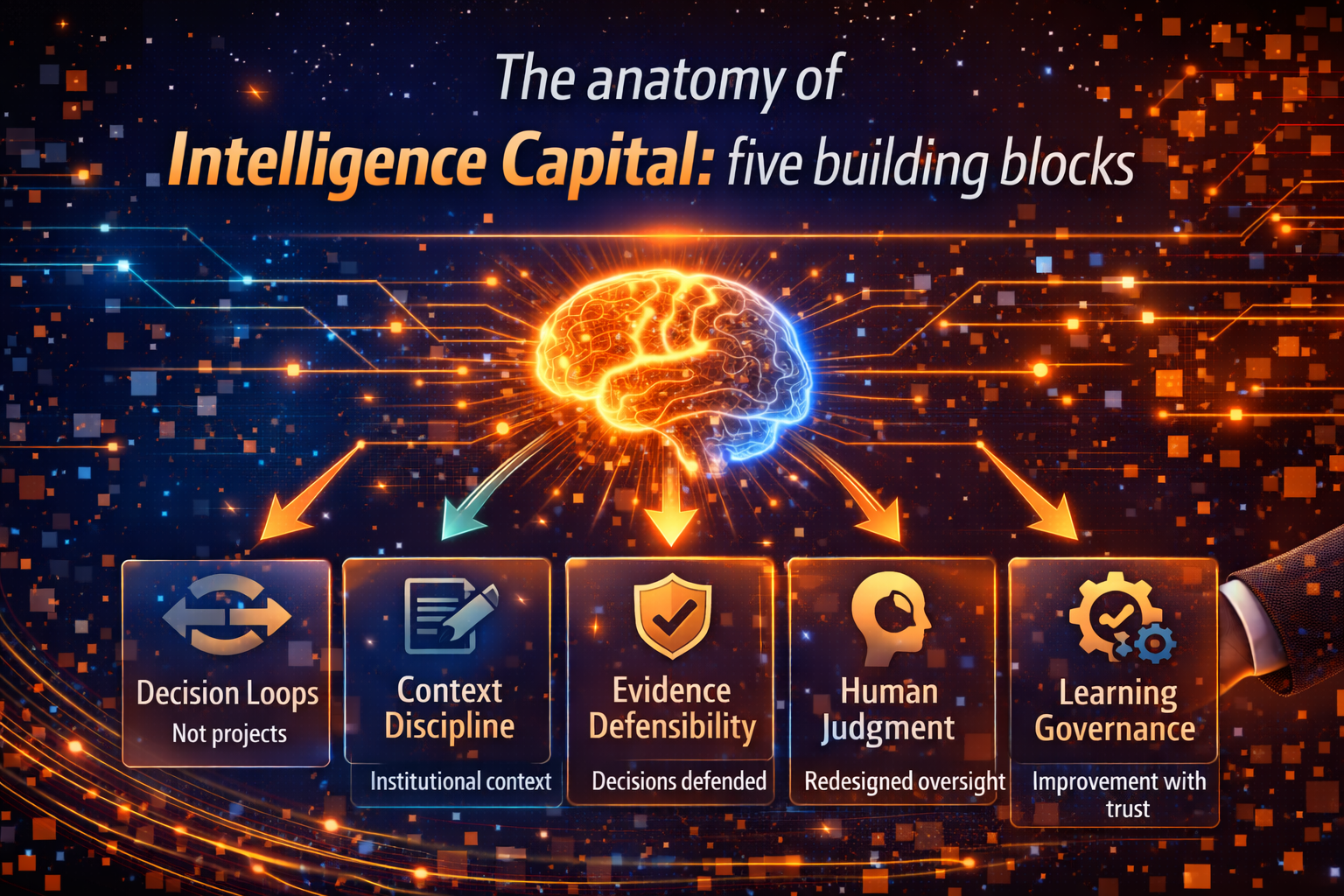
The anatomy of Intelligence Capital: five building blocks
1) Decision loops, not AI projects
Stop funding “AI use cases” as isolated deliverables. Fund decision loops as assets.
A decision loop includes:
- input signals
- context assembly (what matters right now?)
- recommendation or action
- human review when needed
- measurement of outcomes
- learning and improvement
Simple example (retail):
Not “AI demand forecasting.”
A decision loop that links assortment + pricing + replenishment + promotions—and learns weekly.
2) Context is a first-class resource
AI without context is fluent guesswork.
Boards should insist on context discipline:
- shared definitions,
- trusted sources,
- policy constraints,
- explicit “what must never happen” rules.
This is how AI becomes institution-grade, not demo-grade.
3) Evidence and defensibility
If decisions matter, you must be able to defend them:
- to regulators,
- to customers,
- to auditors,
- to your own risk committee.
This isn’t fear. It’s durability.
OECD research on enterprise AI adoption highlights that outcomes depend on organizational capabilities and enabling conditions—not just tool access. (OECD)
4) Human judgment as a designed layer
Winning enterprises don’t “remove humans.” They redesign the human role:
- from doing routine work → supervising edge cases,
- from approving everything → designing boundaries,
- from intuition-first → evidence-first judgment.
This is also the most practical way to handle workforce transition responsibly. The IMF notes AI exposure is large globally, with both displacement and complementarity effects—making redesign, reskilling, and policy choices central. (IMF)
5) Learning governance: improvement that stays safe
Intelligence Capital must improve without breaking trust.
That requires governance that is:
- continuous (not quarterly),
- measurable (not rhetorical),
- operational (not just policy PDFs).
How boards should allocate to Intelligence Capital
Boards don’t need to approve every model choice. But they do need to allocate capital with clarity.
The key shift is to fund three categories explicitly:
1) Intelligence Production
Capabilities that create decision systems:
- data readiness
- model development or procurement
- workflow integration
- evaluation and QA
2) Intelligence Compounding
Capabilities that make the asset improve:
- feedback loops
- monitoring
- drift detection
- retraining and policy updates
- incident response
3) Intelligence Defense
Capabilities that make the asset trustworthy:
- policy constraints
- auditability
- access controls
- accountability
- evidence trails
If you fund only production, you get pilots.
If you fund compounding + defense, you get advantage.
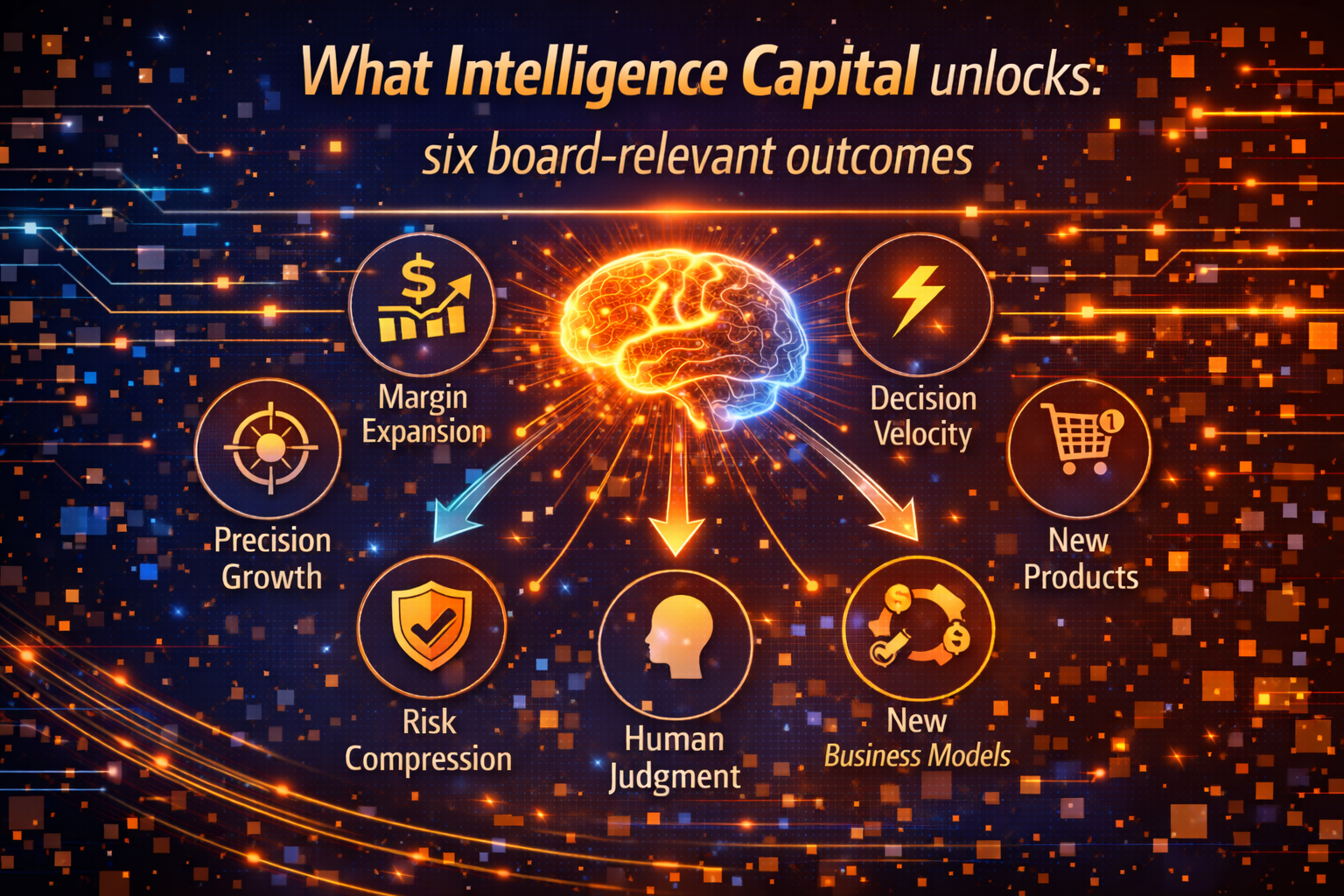
What Intelligence Capital unlocks: six board-relevant outcomes
1) Margin expansion through coordination collapse
AI reduces the coordination tax: rework, approvals, reconciliation, meeting loops.
That is not a cost-cutting story.
That is an operating leverage story.
2) Precision growth instead of average growth
Boards aren’t funding “marketing AI.”
They’re funding a compounding revenue engine—pricing, retention, personalization, channel optimization.
3) Risk compression, not risk accumulation
Smarter detection, faster triage, fewer repeated small errors.
4) Decision velocity as market power
Signal → insight → action compression becomes strategic leverage.
5) New products with intelligence features
Copilots, recommendations, scenario simulators, policy-aware assistants—these become differentiators.
6) New business models
Outcome-based contracts, decision-as-a-service, autonomous managed services—these emerge when decision costs fall.
This is the pattern boards should remember: value migrates first, then value is created. The winners are the institutions that are ready when creation begins.
What can go wrong—and how winning boards prevent it
This is an opportunity-first doctrine. But it must remain credible. Common failure modes include:
- Pilot inflation: many demos, no compounding asset
- Cost after success: usage scales, economics drift
- Trust erosion: decisions cannot be defended
- Skill erosion: automation quietly degrades critical judgment
- Fragmentation: dozens of isolated copilots instead of a governed decision system
Boards prevent this by asking one better quarterly question:
Which decisions improved measurably—and what evidence proves it?
(As a practical signal of the moment we’re in: OECD reporting indicates firm adoption is expanding in recent years, reinforcing that “whether to engage” is no longer the question—“how to build advantage” is. (OECD))
A board-level scoreboard for Intelligence Capital
Ask these five questions every quarter:
- Which decision loops are measurably better than last quarter?
- Where did we reduce coordination friction—and what did that release?
- What evidence do we have that AI decisions are defensible?
- Are we building reusable intelligence assets—or isolated tools?
- Are we compounding learning safely (monitoring, drift, incident response)?
If you can answer these clearly, you’re allocating like an Intelligence Economy board.
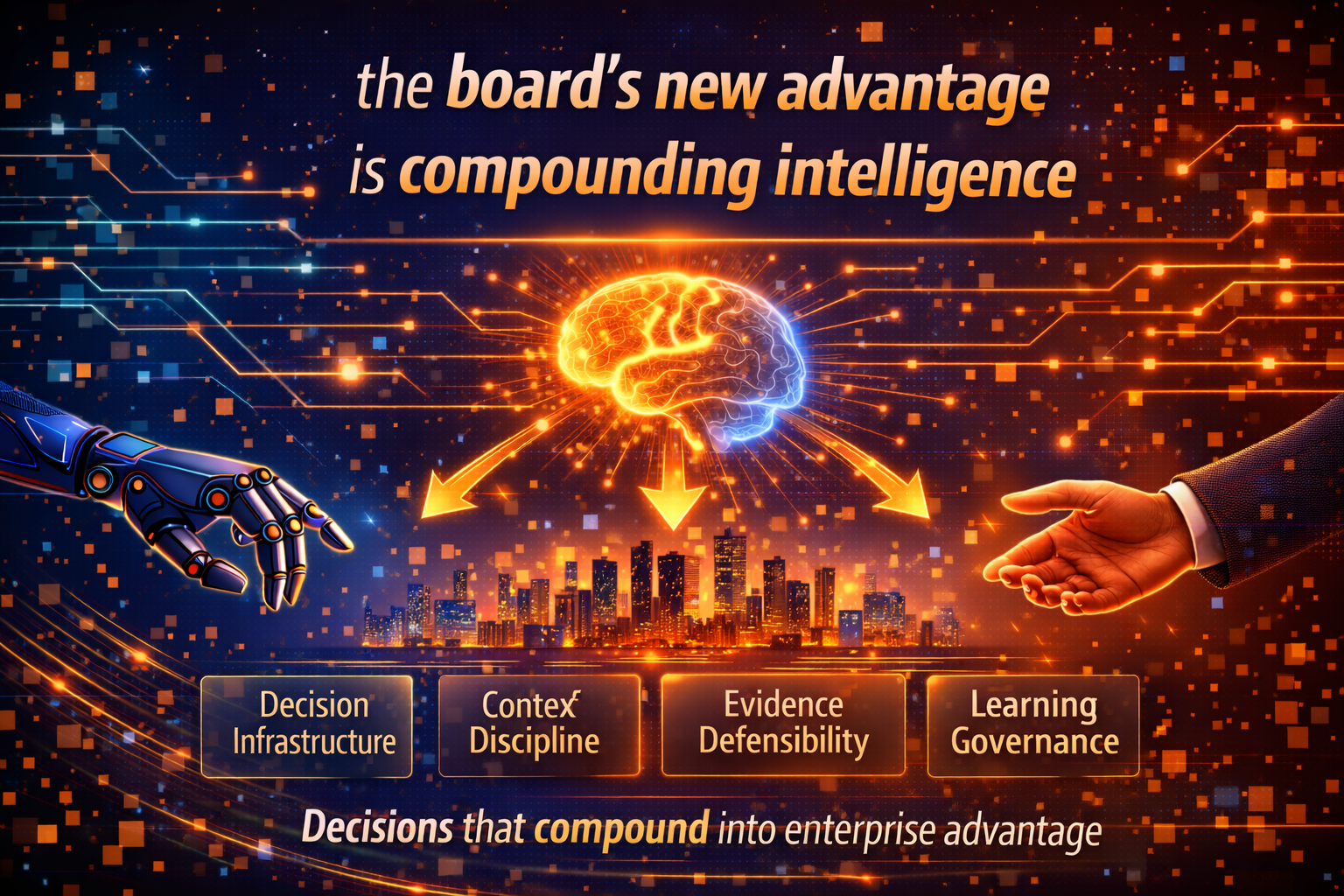
Conclusion: the board’s new advantage is compounding intelligence
The internet created value by digitizing distribution and transactions.
AI will create value by digitizing—and then compounding—judgment at scale.
That is why Intelligence Capital is the new asset class boards must learn to allocate toward.
Not as hype.
As institutional design.
The organizations that win in the AI decade will not be those who “adopt AI tools fastest.”
They will be those who build governed decision infrastructure that improves continuously—turning intelligence into a compounding enterprise asset.
And that is the most optimistic truth about AI:
It can make institutions smarter—not just faster.
Boards don’t lose to companies that use more AI.
They lose to companies that compound intelligence faster.
FAQ
1) What is Intelligence Capital in simple terms?
It’s the enterprise capability to make better decisions repeatedly—using AI embedded in workflows with feedback loops and governance.
2) How is this different from buying AI tools?
Tools improve tasks. Intelligence Capital improves decision systems and compounds over time through reuse, feedback, and defensibility.
3) What should boards fund first?
A small portfolio of high-value decision loops (revenue, cost, risk) plus compounding and defense layers (monitoring, governance, evidence).
4) Is this mainly a cost-saving strategy?
No. Cost reduction is a benefit. The bigger upside is margin expansion, precision growth, risk compression, and new business models.
5) Why does governance matter for opportunity?
Because governance turns AI from demos into scalable, defensible advantage—especially as AI begins to influence real decisions. (OECD)
The Enterprise AI Doctrine: From Decision Scale to Institutional Redesign
Over the past few months, I’ve been building a structured doctrine around Enterprise AI — not as a technology trend, but as an institutional redesign agenda.
It unfolds in layers:
🔹 1️⃣ Decision Economics
- Decision Scale: Why Competitive Advantage Is Moving from Labor Scale to Decision Scale
https://www.raktimsingh.com/decision-scale-competitive-advantage-ai/
→ Establishes the core thesis: advantage is shifting from scaling labor to scaling decision quality.
🔹 2️⃣ Institutional Transformation
- The Future Belongs to Decision-Intelligent Institutions
https://www.raktimsingh.com/the-future-belongs-to-decision-intelligent-institutions/
→ Argues that AI leadership is not about tooling — it is about institutional architecture.
🔹 3️⃣ Sector-Level Redesign
- The Institutional Redesign of Indian IT: From Services Firms to Intelligence Institutions
https://www.raktimsingh.com/institutional-redesign-indian-it-intelligence-institutions/ - From Labor Arbitrage to Intelligence Arbitrage: Why Indian IT’s AI Reinvention Will Define the Next Decade
https://www.raktimsingh.com/from-labor-arbitrage-to-intelligence-arbitrage-why-indian-its-ai-reinvention-will-define-the-next-decade/
→ Examines how this shift reshapes industry structure, economics, and competitive positioning.
🔹 4️⃣ Economic Consequences
- The End of Averages: Why Precision Growth Will Define the Next Decade of Enterprise Strategy
https://www.raktimsingh.com/precision-growth-end-of-averages-enterprise-ai/ - What Is the AI Dividend? How Boards Capture Structural Gains from Enterprise AI
https://www.raktimsingh.com/ai-dividend-boards-structural-gains/
→ Explores how decision intelligence translates into measurable structural gains.
🔹 The Unifying Thesis
Together, these articles form a coherent framework:
- Competitive advantage is moving from labor scale to decision scale
- Institutions must evolve from services firms to intelligence institutions
- AI must shift from isolated pilots to structurally governed, economically accountable enterprise systems
This is not AI adoption.
It is enterprise redesign.
Glossary
- Intelligence Capital: the enterprise capability to compound decision quality through AI-driven learning systems.
- Decision Loop: context → decision/action → outcome measurement → learning → improvement.
- Institutional Intelligence: an organization’s ability to learn and improve decisions over time (not just individual brilliance).
- Decision Infrastructure: workflows, policies, telemetry, and controls that make decisions repeatable and governable.
- Decision Velocity: speed at which the enterprise converts signal into action.
- Precision Growth: real-time, context-aware growth decisions across pricing, retention, and personalization.
References and further reading
- McKinsey (2023): generative AI economic potential ($2.6T–$4.4T annually). (McKinsey & Company)
- Goldman Sachs Research (2023): generative AI could raise global GDP by ~7% over time; productivity uplift framing. (Goldman Sachs)
- IMF (2024): AI exposure across global jobs; complementarity vs displacement dynamics. (IMF)
- OECD/BCG/INSEAD (2025): evidence on AI adoption in firms; organizational and policy factors. (OECD)
- OECD (Jan 2026): recent update on firm adoption trend (indicator context). (OECD)
This article builds on a broader Enterprise AI doctrine, including The Enterprise AI Operating Model, Decision Scale, The AI Dividend, and Precision Growth. Together, they outline how institutions move from AI experimentation to AI advantage.



Raktim Singh is an AI and deep-tech strategist, TEDx speaker, and author focused on helping enterprises navigate the next era of intelligent systems. With experience spanning AI, fintech, quantum computing, and digital transformation, he simplifies complex technology for leaders and builds frameworks that drive responsible, scalable adoption.