
That was enough when AI merely advised humans. It fails the moment AI begins acting: changing eligibility, adjusting pricing, reallocating risk, triggering workflows, or representing actors who cannot fully advocate for themselves digitally.
In the AI decade, intelligence is becoming cheap. What becomes scarce — and strategically decisive — is legitimacy.
The institutions that win will not be those with better models. They will be those that can engineer authority, traceability, guardrails, coverage, and recourse into the core of how AI operates.
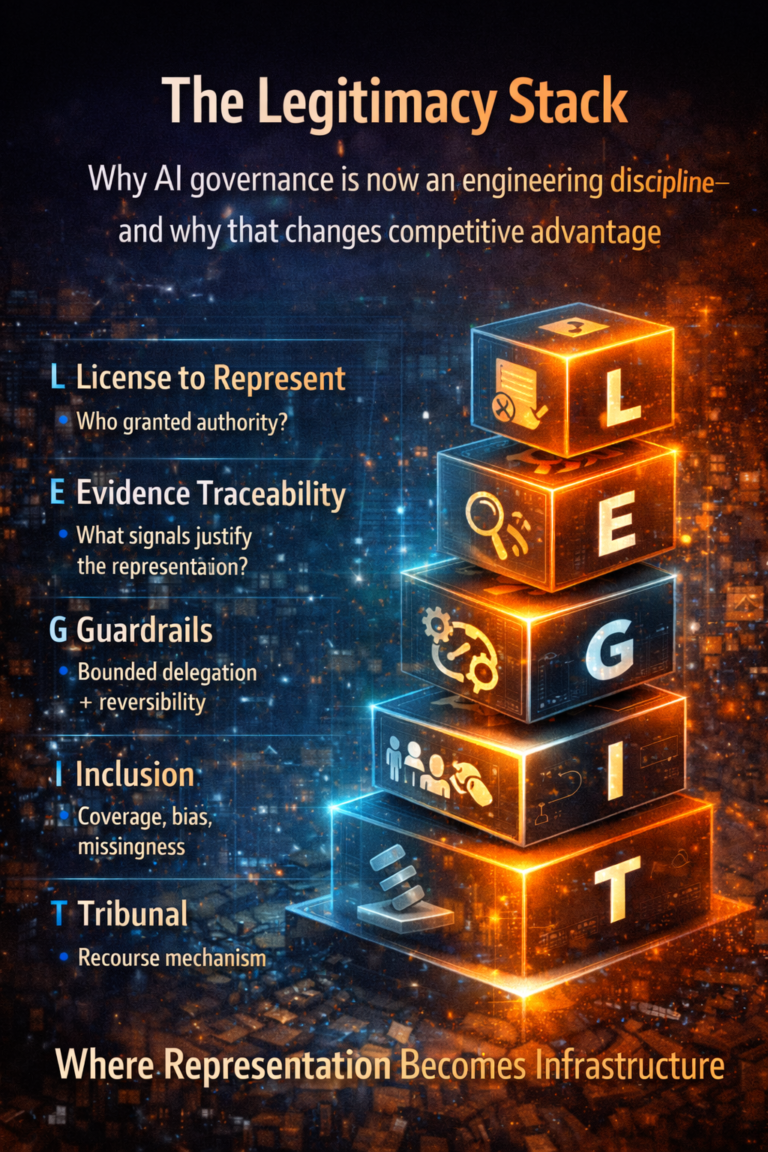
That architecture is what I call the Legitimacy Stack.
The Legitimacy Stack
For years, leaders treated AI governance as a “responsible AI” slide deck: principles, committees, checklists, approvals. That approach was tolerable when AI stayed in advisor mode—producing recommendations humans could override.
It breaks the moment AI moves closer to outcomes—changing eligibility, pricing, access, prioritization, risk posture, escalation, and fulfillment at machine speed.
In the AI decade, intelligence is getting cheap. What becomes scarce is something else:
legitimate representation and trusted delegation.
Not legitimacy in the public-relations sense. Legitimacy in the institutional sense:
- Who granted authority for the system to represent an entity?
- What evidence supports the system’s interpretation right now?
- Which guardrails bound autonomy—and what must remain reversible?
- Who is missing, under-covered, or represented through risky proxies?
- What recourse exists when representation is wrong?
If an enterprise cannot answer these questions operationally, it is not governing AI.
It is witnessing AI.
That is why global governance is converging on traceability, lifecycle controls, and management-system discipline—not just ethical intent.
For example, the EU AI Act includes record-keeping/logging expectations for certain high-risk systems. (ai-act-service-desk.ec.europa.eu) NIST frames AI risk governance as a lifecycle discipline. (ai-act-service-desk.ec.europa.eu) And ISO/IEC 42001 positions AI governance as an organization-wide management system. (ISO)
This article introduces a board-ready, buildable architecture for legitimacy at scale:
The Legitimacy Stack (L.E.G.I.T.) — five engineering primitives that make AI representation and delegation credible, auditable, and contestable.
Read next: representation-ledger-ai-governance and representation-economy-ai-institutional-power
The Legitimacy Stack is a five-layer engineering architecture that enables enterprises to scale AI responsibly and competitively.
It consists of License to Represent, Evidence Traceability, Guardrails, Inclusion, and Tribunal. As AI systems move from advisory tools to action-taking agents, governance shifts from policy to enforceable infrastructure.
Companies that build legitimacy as an operational capability will define the next wave of competitive advantage in the AI economy.
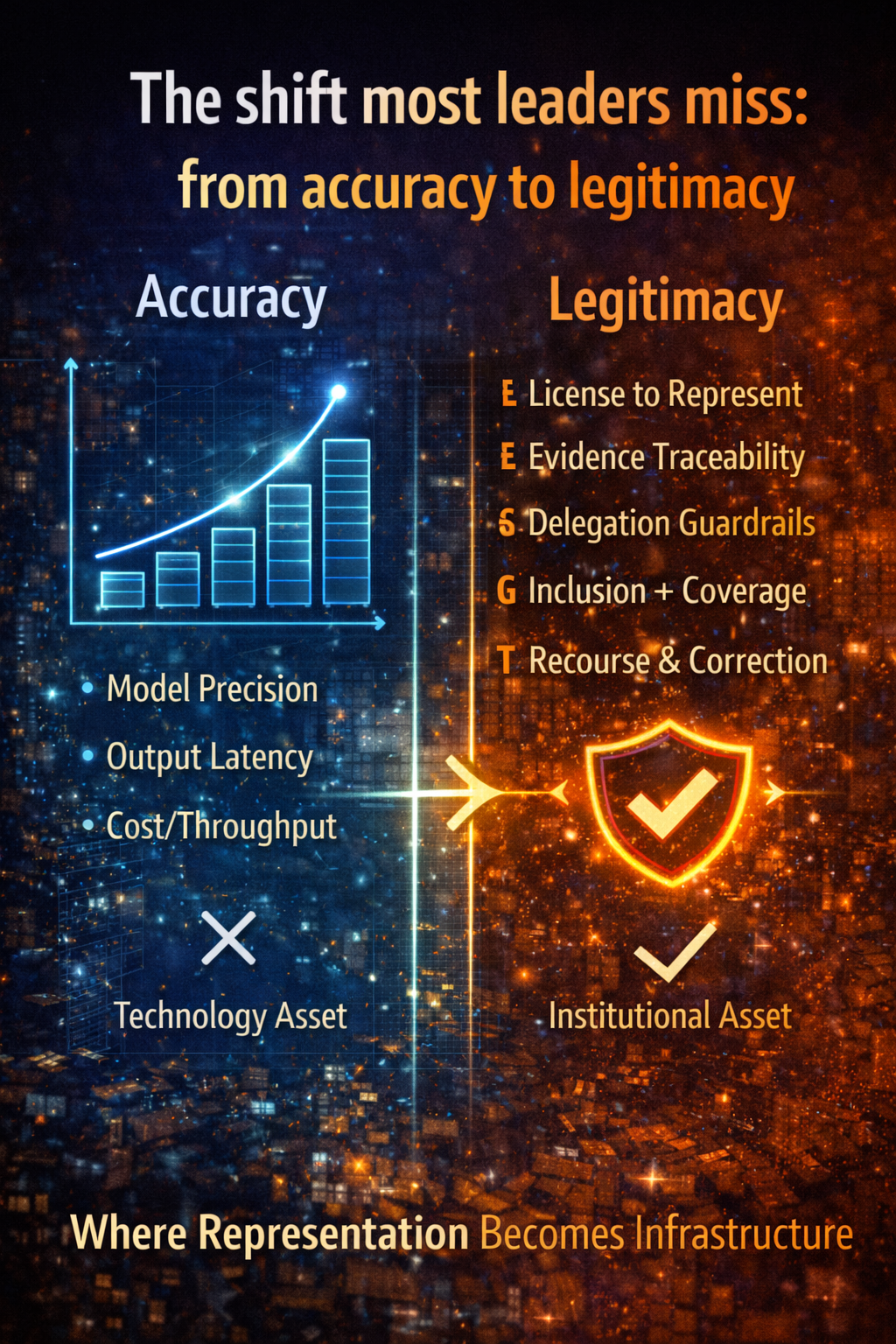
The shift most leaders miss: from accuracy to legitimacy
Most AI conversations still orbit the familiar metrics: accuracy, latency, cost, throughput. Those matter.
But they are not the strategic frontier anymore.
Because once AI begins representing entities that cannot fully self-advocate digitally—small suppliers buried in complex ecosystems, physical assets emitting weak signals, or environments interpreted through partial sensing—representation becomes an institutional act.
And once representation can trigger action, legitimacy becomes the binding constraint:
- You can have high model accuracy and still have low institutional legitimacy.
- You can optimize decisions and still create a trust collapse.
- You can automate workflows and still fail the moment someone asks: “On what authority?”
This is the subtle reframe boards need:
Accuracy is a model property. Legitimacy is a system property.
And system properties are not governed by policies alone. They are governed by architecture.
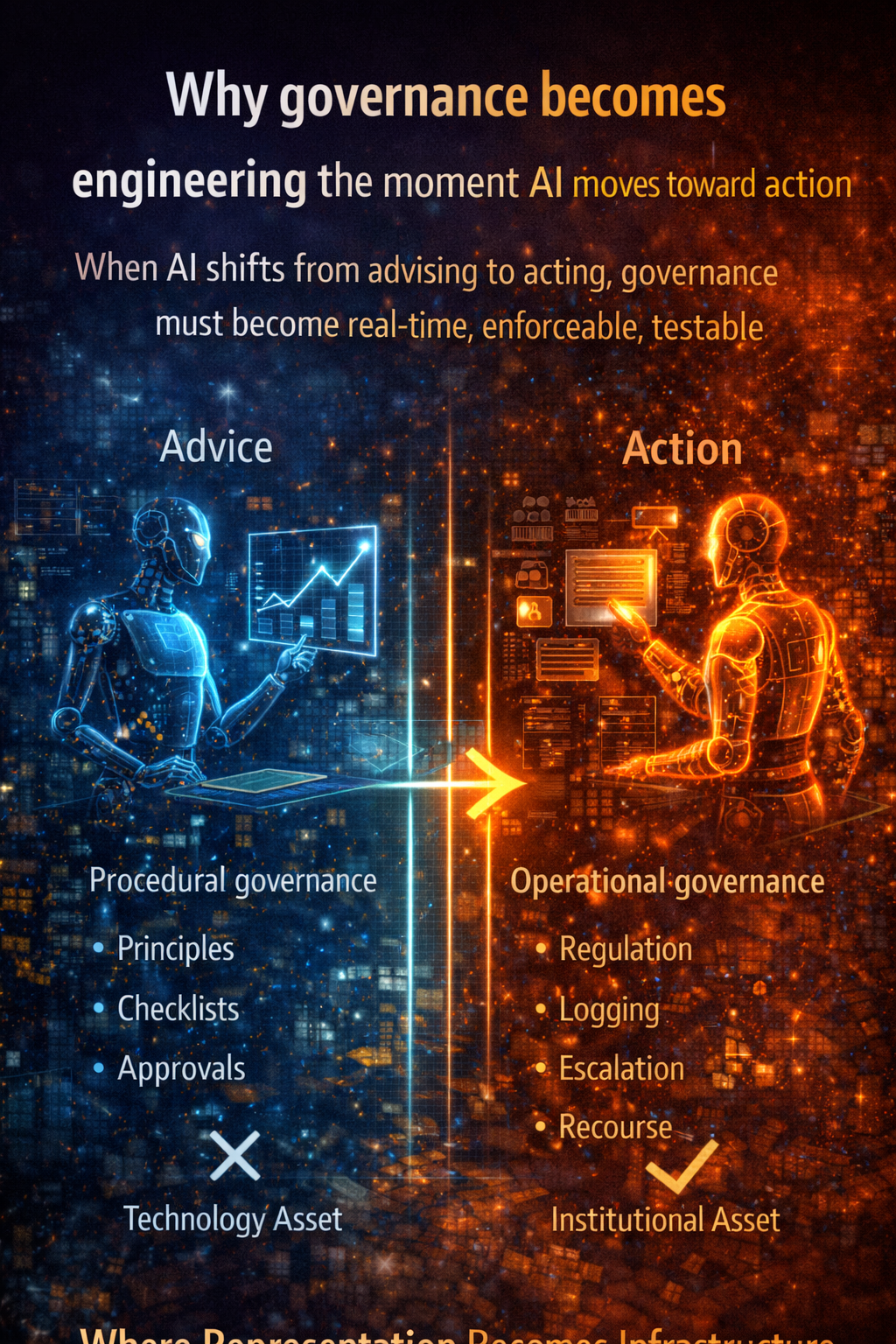
Why governance becomes engineering the moment AI moves toward action
Why governance becomes engineering the moment AI moves toward action
When AI stays in advisor mode, governance can remain mostly procedural. Humans are the control plane.
When AI moves toward actor mode—tool-calling agents, automated workflows, dynamic pricing corridors, continuous risk recalibration—governance must become:
- real-time (enforced before action),
- testable (verifiable under stress),
- versioned (auditable across change),
- observable (reconstructable post-incident),
- correctable (with recourse and reversibility).
That’s engineering.
You can see this shift in three global signals:
-
Logging and record-keeping are becoming obligations in higher-impact settings.
The EU AI Act’s operational expectations include record-keeping/logging for certain high-risk AI systems to support traceability and oversight. (ai-act-service-desk.ec.europa.eu)
-
AI risk governance is being framed as lifecycle discipline, not one-time review.
The NIST AI RMF emphasizes governance and risk management across the AI lifecycle (GOVERN, MAP, MEASURE, MANAGE). (ai-act-service-desk.ec.europa.eu)
-
AI governance is moving into certifiable management systems.
ISO describes ISO/IEC 42001 as establishing an organization-wide AI management system—embedding policies, procedures, and accountability across operations. (ISO)
The pattern is familiar: this is what cybersecurity became.
At first: policies and awareness.
Then: controls, logging, incident response, continuous testing.
AI is now on the same path.
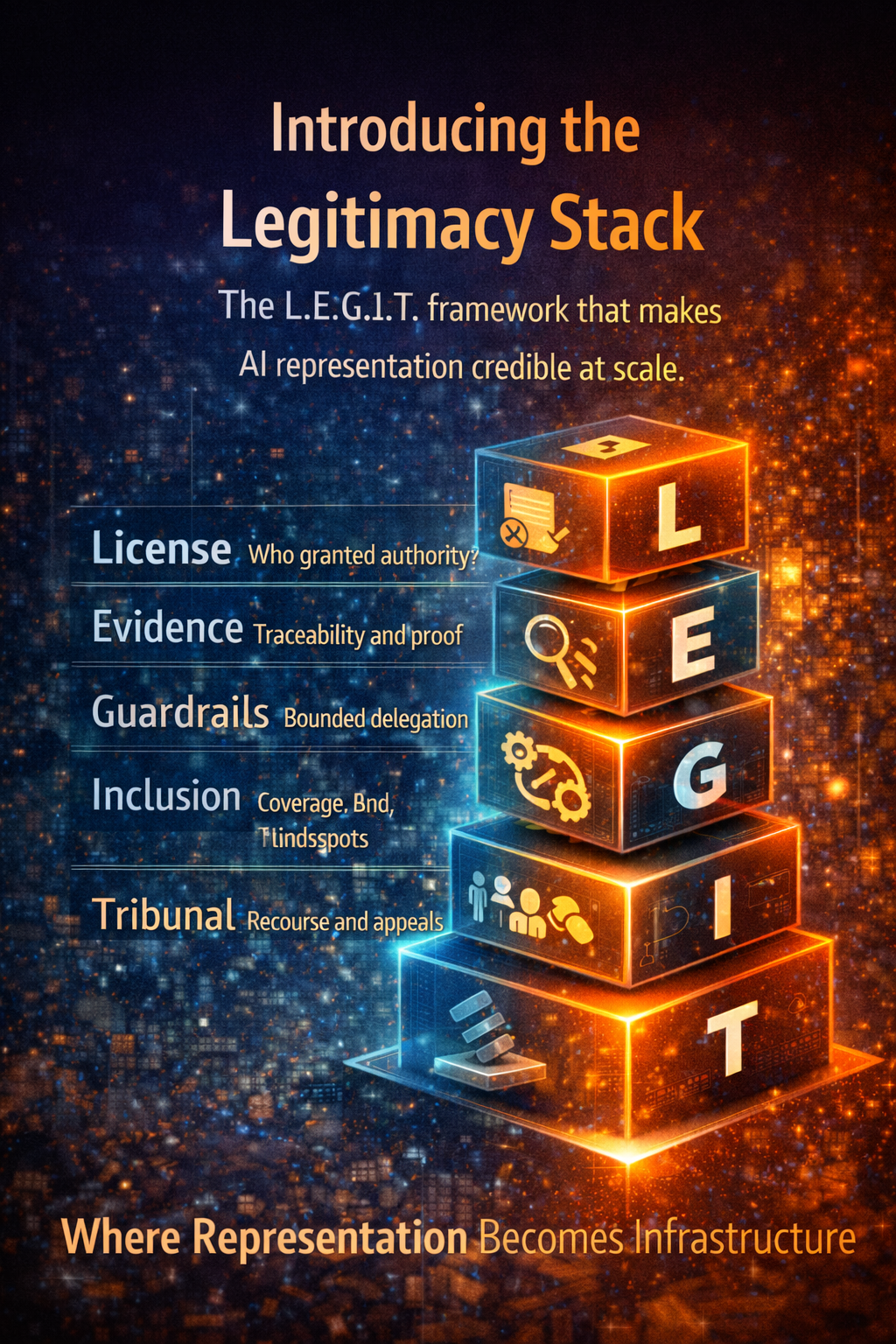
Introducing the Legitimacy Stack (L.E.G.I.T.)
Introducing the Legitimacy Stack (L.E.G.I.T.)
Think of legitimacy like uptime for trust.
You do not get uptime from values.
You get uptime from architecture.
The Legitimacy Stack is five primitives that make AI representation and delegated action credible at scale:
L — License to Represent
Authority is the first dependency. Before a system represents an entity, the institution must be able to show why it is allowed to.
“License” can come from consent, contract, policy mandate, delegated authority, or governance charter—depending on context.
Simple example:
A procurement AI flags a supplier as “high risk,” which automatically increases inspections and delays approval. The supplier asks: “On what basis are you monitoring and classifying me?”
A legitimacy-ready institution can point to:
- contractual monitoring scope,
- permitted signal sources,
- stated purpose limits,
- and what the system is explicitly not allowed to infer.
A legitimacy-poor institution says: “The model decided.”
What boards should demand:
- Where does authority live—consent, contract, policy, regulator?
- What is the purpose limit and scope boundary?
- What is explicitly prohibited?
E — Evidence Traceability
Once authority exists, legitimacy depends on evidence—evidence that can be traced, not asserted.
Evidence traceability answers:
- What signals were used?
- Which were proxies?
- What was missing?
- How fresh was the data?
- What changed since last time?
This is why logging/record-keeping is increasingly central in governance regimes: it is the bridge between “AI acted” and “we can reconstruct why.” (ai-act-service-desk.ec.europa.eu)
Simple example:
An automated system changes eligibility for a service. A legitimacy stack means you can reconstruct, in plain language:
- which evidence categories mattered (e.g., operational performance signals, compliance status, recent anomalies),
- what policy boundaries applied,
- whether the change was automated or confirmed,
- which version of logic executed.
Without traceability, you inherit the worst combination:
automated action + unexplainable outcomes.
G — Guardrails for Delegation
Legitimacy collapses when action is unbounded.
Guardrails are not “ethics principles.” They are engineering controls:
- thresholds and confidence gates
- rate limits / blast-radius limits
- reversibility constraints
- escalation rules
- human confirmation triggers
- policy-as-code enforcement
Simple example:
An AI agent is allowed to propose and negotiate within a pricing corridor—but cannot finalize certain terms without confirmation, and cannot deviate from compliance constraints.
That isn’t bureaucracy. That is control engineering.
In the AI era, delegation must be designed as bounded autonomy—or it becomes institutional risk.
I — Inclusion and Coverage
The most dangerous failures won’t be “wrong answers.”
They will be wrong representation—because key signals are missing, certain segments are under-covered, or proxy data encodes structural gaps.
Inclusion here is not a slogan. It’s a coverage discipline:
- Where is the system blind?
- What’s the missingness map?
- Which signals are proxies for something the system cannot directly observe?
- Where does performance degrade under stress?
Simple example:
An asset monitoring system performs well on modern equipment because sensors are rich—but under-represents older equipment because telemetry is sparse. The model looks “accurate” overall while failing precisely where risk is highest.
Legitimacy requires declared blind spots, not hidden ones.
T — Tribunal and Recourse
Recourse is where trust becomes real.
If representation affects outcomes, the represented party needs:
- a way to challenge,
- a way to correct,
- a way to reverse (when possible),
- a way to seek remedy when harm occurs.
This aligns with the direction of global principles emphasizing transparency and accountability in AI.
Simple example:
A supplier is flagged high-risk and loses priority. A legitimacy-ready system provides:
- a human-readable reason category,
- what evidence types can challenge it,
- the review path (human/independent),
- and what reversals look like operationally.
Without recourse, “trustworthy AI” is just branding.
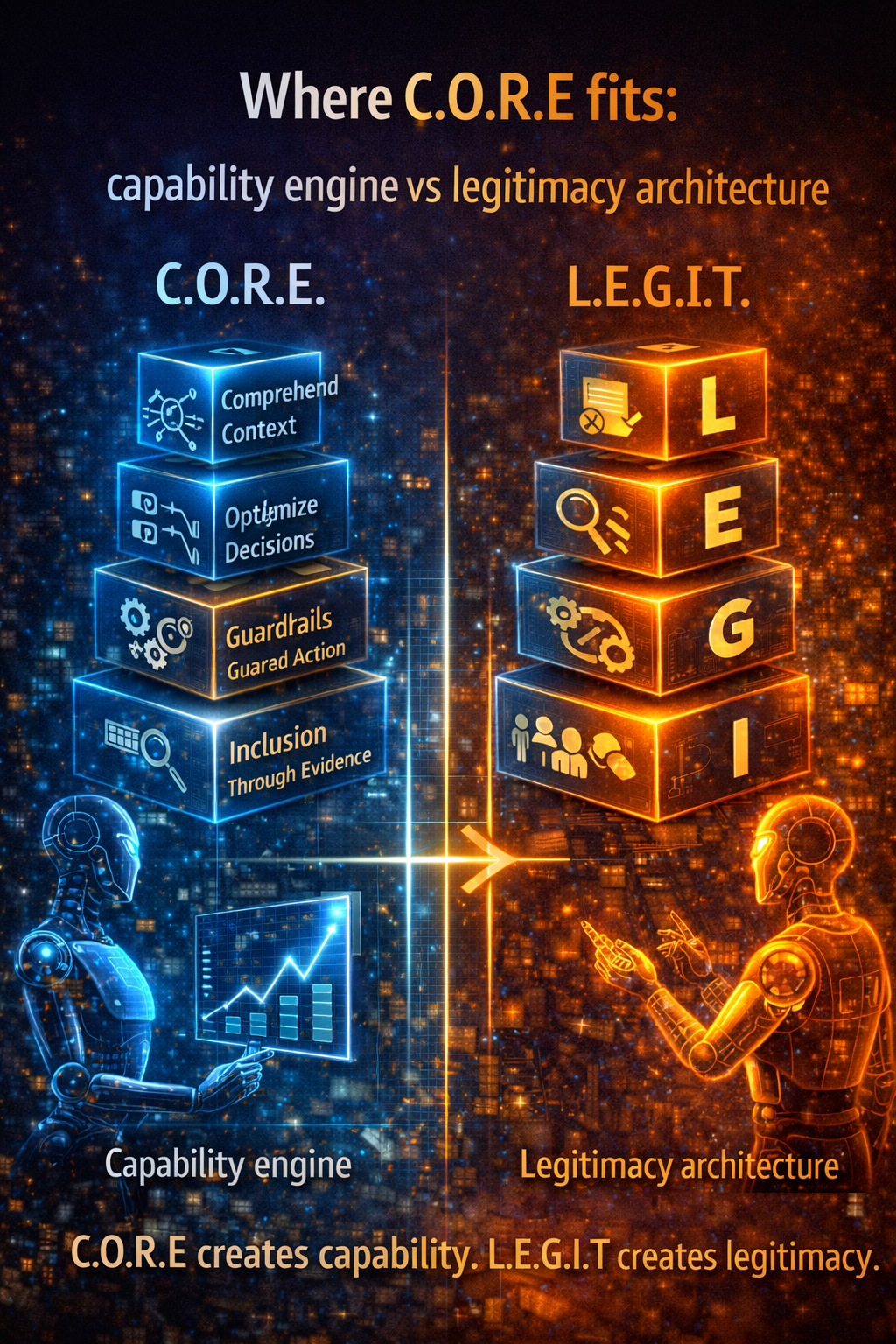
Where C.O.R.E fits: capability engine vs legitimacy architecture
MY doctrine explains the micro-engine by which cheap cognition becomes market advantage:
C.O.R.E. — the continuous loop:
-
C — Comprehend context
Capture demand signals from interactions: constraints, evidence requests, where negotiation fails, what triggers switching.
-
O — Optimize and orchestrate decisions
Continuously tune bundles, pricing corridors, eligibility rules, and risk controls.
-
R — Regulate and realize action
Execute safely through policy checks, workflow triggers, provisioning and fulfillment—bounded by guardrails.
-
E — Evolve through evidence
Close the loop through disputes, churn triggers, agent feedback, SLA signals, and trust outcomes.
C.O.R.E is the engine. But every powerful engine needs a legitimacy chassis.
L.E.G.I.T is that chassis:
- L licenses what context can be comprehended
- E makes optimization evidence-based and reconstructable
- G bounds realization of action
- I forces coverage discipline so context is not selectively legible
- T makes evolution accountable via correction pathways
In one line:
C.O.R.E creates capability. L.E.G.I.T creates legitimacy.
Together, they turn governance from a compliance tax into competitive advantage.
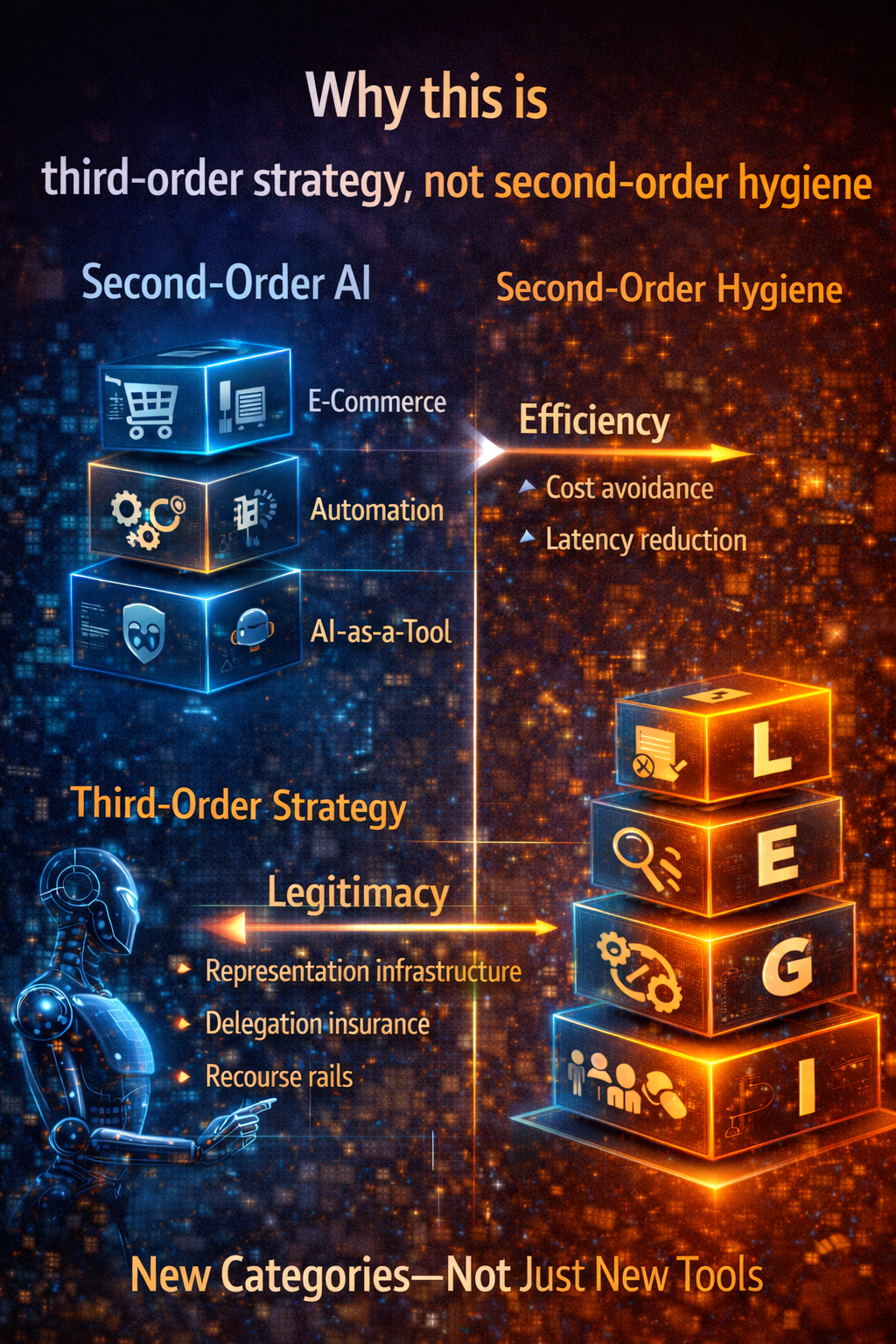
Why this is third-order strategy, not second-order hygiene
Second-order AI is already clear to many boards:
embed intelligence into decisions to reduce cost, risk, latency, and failures.
Third-order AI is where new categories emerge—because the scarce advantage shifts from intelligence to legitimacy.
Once legitimacy becomes a buildable stack, markets form around it—just as the internet created identity and payments as primitives.
Expect “legitimacy primitives as services”:
- traceability and evidence infrastructure providers
- policy-as-code guardrail platforms
- independent coverage/missingness auditors
- recourse and dispute-resolution providers
- delegation risk underwriting (“delegation insurance”)
- ISO-aligned continuous assurance layers (ISO)
This is the “Uber moment” of institutional AI:
not a better app—a new coordination layer.
The board questions that matter now
If you want a simple leadership filter, use these questions:
- Where are we already representing actors who cannot fully self-advocate digitally?
- What is our license to represent—and what are our purpose limits?
- Do we have evidence traceability strong enough to reconstruct outcomes under scrutiny?
- Are our guardrails enforceable in real time—or just documented?
- Where are our coverage blind spots and missingness risks?
- What is our recourse pathway—and is it usable under stress?
- Can we audit legitimacy with the seriousness we audit financial and cyber controls?
If these answers are unclear, your AI program is accumulating legitimacy debt—a hidden liability that shows up later as reversals, contestation, reputation loss, and regulatory exposure.
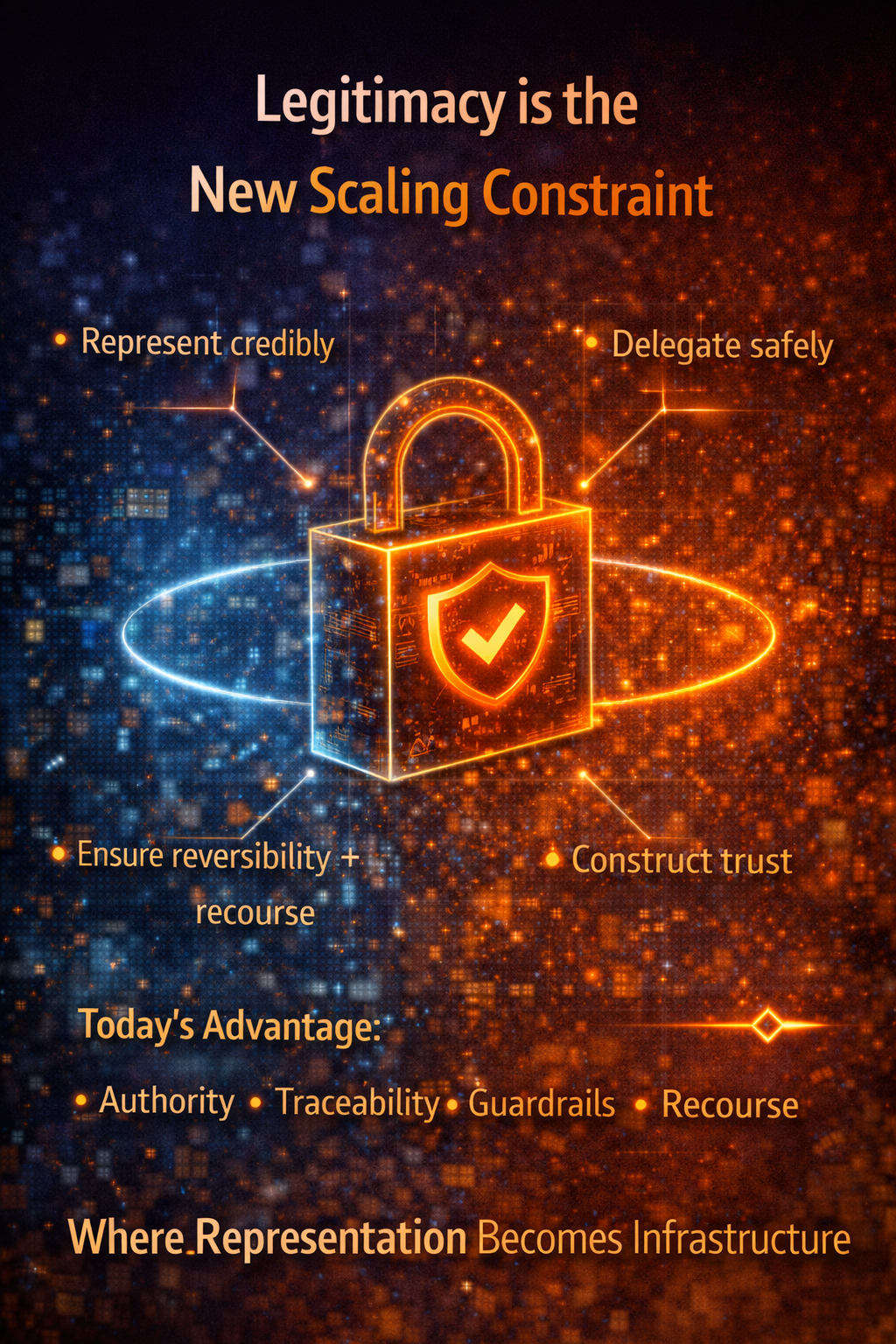
Conclusion: legitimacy is the new scaling constraint
In the first wave of AI, advantage came from deploying models.
In the next wave, advantage comes from redesigning decisions.
In the emerging wave, advantage comes from something deeper:
the ability to represent reality credibly and delegate action safely.
That is legitimacy.
And legitimacy will not be won through slogans or committees.
It will be won through engineering:
authority, evidence traceability, guardrails, coverage discipline, and recourse—implemented as a stack.
The Legitimacy Stack is not a “responsible AI framework.”
It is the infrastructure that decides who gets trusted with representation power in the AI age.
Read next: enterprise-ai-operating-model and who-owns-enterprise-ai-roles-accountability-decision-rights
Glossary
Legitimacy Stack (L.E.G.I.T.): Five buildable primitives that make AI representation and delegation credible at scale: License, Evidence, Guardrails, Inclusion, Tribunal.
- License to Represent: The authority basis (consent, contract, policy mandate, delegated authority) and its limits.
- Evidence Traceability: Ability to reconstruct what signals and controls led to representation and action; supported by logging/record-keeping. (ai-act-service-desk.ec.europa.eu)
- Guardrails: Enforceable constraints (thresholds, escalation, reversibility, policy-as-code) that bound AI autonomy.
- Coverage Discipline: Operational tracking of blind spots, missingness, proxy risks, and degraded performance zones.
- Tribunal / Recourse: Practical pathway to contest, correct, reverse, or remedy AI-driven outcomes.
- AI Management System: Organization-wide system embedding accountability, policies, procedures, and continual improvement for AI. (ISO)
FAQ
1) Isn’t AI governance mainly a legal/compliance function?
It starts there, but it cannot end there. Once AI influences outcomes at scale, governance must be implemented as controls—logging, guardrails, escalation, and recourse. NIST explicitly frames AI risk governance across the lifecycle. (ai-act-service-desk.ec.europa.eu)
2) Why is “logging” suddenly so important?
Because traceability is the foundation of oversight. If you can’t reconstruct what happened, you can’t govern, audit, or improve it. EU AI governance for high-risk contexts emphasizes record-keeping/logging for oversight. (ai-act-service-desk.ec.europa.eu)
3) How does this relate to ISO/IEC 42001?
ISO/IEC 42001 establishes an organization-wide AI management system—making governance auditable and operational, not just advisory. (ISO)
4) What is the biggest failure mode if we ignore legitimacy?
Legitimacy debt: AI scales decisions faster than trust can scale—leading to contestation, reversals, reputational damage, and regulatory exposure.
5) Is the Legitimacy Stack only for regulated industries?
No. Any enterprise using AI to classify, prioritize, allocate, price, approve, or trigger workflows is already in the legitimacy game.
What is the Legitimacy Stack in AI governance?
The Legitimacy Stack is a structured architecture that ensures AI systems operate with authority, traceability, bounded delegation, coverage discipline, and recourse mechanisms.
Why is AI governance becoming an engineering discipline?
Because AI systems increasingly trigger automated actions at scale. Governance must therefore be enforceable, testable, logged, and auditable in real time.
How does the EU AI Act influence enterprise AI governance?
The EU AI Act introduces logging, record-keeping, lifecycle oversight, and risk-tiered obligations — reinforcing governance as operational infrastructure rather than advisory guidance.
What is the difference between responsible AI and legitimacy engineering?
Responsible AI focuses on principles and ethics. Legitimacy engineering builds enforceable, testable infrastructure that operationalizes those principles at scale.
Why does legitimacy create competitive advantage?
As AI intelligence becomes commoditized, trust, authority, and safe delegation become scarce assets. Institutions that engineer legitimacy scale faster and face fewer reversals, disputes, and regulatory shocks.
References and further reading
- EU AI Act Service Desk — Article 12: record-keeping/logging expectations for certain high-risk AI systems. (ai-act-service-desk.ec.europa.eu)
- NIST AI Risk Management Framework (AI RMF 1.0). (ai-act-service-desk.ec.europa.eu)
- ISO — Responsible AI governance and impact standards package describing ISO/IEC 42001 as an organization-wide AI management system foundation. (ISO)
- OECD AI Principles (high-level principles for trustworthy AI).
The Intelligence-Native Enterprise Doctrine
This article is part of a larger strategic body of work that defines how AI is transforming the structure of markets, institutions, and competitive advantage. To explore the full doctrine, read the following foundational essays:
- The AI Decade Will Reward Synchronization, Not Adoption
Why enterprise AI strategy must shift from tools to operating models.
https://www.raktimsingh.com/the-ai-decade-will-reward-synchronization-not-adoption-why-enterprise-ai-strategy-must-shift-from-tools-to-operating-models/ - The Third-Order AI Economy
The category map boards must use to see the next Uber moment.
https://www.raktimsingh.com/third-order-ai-economy/ - The Intelligence Company
A new theory of the firm in the AI era — where decision quality becomes the scalable asset.
https://www.raktimsingh.com/intelligence-company-new-theory-firm-ai/ - The Judgment Economy
How AI is redefining industry structure — not just productivity.
https://www.raktimsingh.com/judgment-economy-ai-industry-structure/ - Digital Transformation 3.0
The rise of the intelligence-native enterprise.
https://www.raktimsingh.com/digital-transformation-3-0-the-rise-of-the-intelligence-native-enterprise/ - Industry Structure in the AI Era
Why judgment economies will redefine competitive advantage.
https://www.raktimsingh.com/industry-structure-in-the-ai-era-why-judgment-economies-will-redefine-competitive-advantage/
Institutional Perspectives on Enterprise AI
Many of the structural ideas discussed here — intelligence-native operating models, control planes, decision integrity, and accountable autonomy — have also been explored in my institutional perspectives published via Infosys’ Emerging Technology Solutions platform.
For readers seeking deeper operational detail, I have written extensively on:
- What Makes an Enterprise Intelligence-Native? The Blueprint for Third-Order AI Advantage
https://blogs.infosys.com/emerging-technology-solutions/artificial-intelligence/what-is-enterprise-ai-the-operating-model-for-compounding-institutional-intelligence.html - Why “AI in the Enterprise” Is Not Enterprise AI: The Operating Model Difference Most Organizations Miss
https://blogs.infosys.com/emerging-technology-solutions/artificial-intelligence/why-ai-in-the-enterprise-is-not-enterprise-ai-the-operating-model-difference-that-most-organizations-miss.html - The Enterprise AI Control Plane: Governing Autonomy at Scale
https://blogs.infosys.com/emerging-technology-solutions/artificial-intelligence/the-enterprise-ai-control-plane-governing-autonomy-at-scale.html - Enterprise AI Ownership Framework: Who Is Accountable, Who Decides, and Who Stops AI in Production
https://blogs.infosys.com/emerging-technology-solutions/artificial-intelligence/enterprise-ai-ownership-framework-who-is-accountable-who-decides-and-who-stops-ai-in-production.html - Decision Integrity: Why Model Accuracy Is Not Enough in Enterprise AI
https://blogs.infosys.com/emerging-technology-solutions/artificial-intelligence/decision-integrity-why-model-accuracy-is-not-enough-in-enterprise-ai.html - Agent Incident Response Playbook: Operating Autonomous AI Systems Safely at Enterprise Scale
https://blogs.infosys.com/emerging-technology-solutions/artificial-intelligence/agent-incident-response-playbook-operating-autonomous-ai-systems-safely-at-enterprise-scale.html - The Economics of Enterprise AI: Designing Cost, Control, and Value as One System
https://blogs.infosys.com/emerging-technology-solutions/artificial-intelligence/the-economics-of-enterprise-ai-designing-cost-control-and-value-as-one-system.html
Together, these perspectives outline a unified view: Enterprise AI is not a collection of tools. It is a governed operating system for institutional intelligence — where economics, accountability, control, and decision integrity function as a coherent architecture.



Raktim Singh is an AI and deep-tech strategist, TEDx speaker, and author focused on helping enterprises navigate the next era of intelligent systems. With experience spanning AI, fintech, quantum computing, and digital transformation, he simplifies complex technology for leaders and builds frameworks that drive responsible, scalable adoption.