
The Machine-Customer Era
The last decade trained leaders to think of customers as humans who browse, compare, decide, and buy.
The next decade will train leaders to compete in a different reality:
Customers will increasingly show up as software.
Not in the metaphorical sense of “digital-first.” In the literal sense that a growing share of demand will be represented by AI agents—systems that can research options, evaluate trade-offs, negotiate terms, execute purchases, and trigger switching decisions on behalf of individuals and organizations.
Harvard Business Review has been explicit that brands must adapt as AI agents enter the shopping journey, and that AI is already reshaping both how people find and buy products. (Harvard Business Review) World Economic Forum has also emphasized the opportunity—and the trust, identity, and accountability risks—when agents act and transact. (World Economic Forum)
This is not a “tools trend.”
It is a market structure change.
And that is exactly why it belongs inside my doctrine:
- Third-Order AI Economy (macro): when intelligence becomes market infrastructure
- Intelligence-Native Enterprise (execution): the firm redesign required to compete
- C.O.R.E. (engine): Comprehend → Optimize → Realize → Evolve
In the Machine-Customer Era, the front door of demand changes—and with it, distribution power, pricing power, switching costs, and brand advantage.
Key insight to remember:
In the Machine-Customer Era, you don’t just market to humans. You compete for machine decisions.
What Is a Machine Customer?
A machine customer is not a robot buying random products.
A machine customer is an AI agent acting as a decision delegate. It represents preferences, constraints, budgets, policies, and context. It can:
- interpret intent (“I need a better plan, with fewer hidden fees.”)
- compare offerings across suppliers
- negotiate terms (“match this price, include these conditions.”)
- execute transactions
- monitor performance post-purchase
- recommend renewal, downgrade, replacement, or switching
This is already emerging in consumer shopping assistants and enterprise procurement flows.
The point isn’t the feature set.
The point is decision authority—what these agents are gradually allowed to do. Forbes has highlighted exactly the governance question boards should be asking: if an AI agent makes a purchase, who authorized it? (Forbes)
Why This Changes Competition More Than “AI Adoption” Ever Did
Most leaders still frame AI as:
- productivity improvement
- workflow automation
- better decision support
That’s second-order change (inside the enterprise).
The Machine-Customer Era is third-order:
It changes how markets clear.
When AI agents represent buyers, demand becomes:
- faster (less friction)
- more comparable (less noise, more structured evaluation)
- more negotiable (terms become computable)
- less loyal (switching becomes easier to trigger)
- more audited (buyers will ask for proof, not persuasion)
In other words: the market starts behaving like an always-on negotiation system.
And the winners will be organizations that make their offerings:
- agent-readable
- agent-trustworthy
- agent-negotiable
…without losing margin or control.
The A.G.E.N.T. Buying Stack
To make this practical, here is a simple lens you can reuse across industries.
A — Acquisition
How do agents discover options?
In the human era, brands optimized for:
- search engines
- app store rankings
- ads
- influencer reach
In the machine era, discovery increasingly shifts toward:
- structured catalogs
- authoritative sources
- verifiable claims
- machine-readable specs
- credible third-party evidence
HBR’s marketing analysis is already pointing out that conversational AI is changing discovery, shrinking traditional click-based traffic, and shifting advantage toward brands whose information is structured, trusted, and easy for AI systems to synthesize. (Harvard Business Review)
Board implication: distribution advantage moves from “brand awareness” to machine discoverability + trust footprint.
G — Grounding
What data does the agent trust?
Agents will privilege:
- transparent policies
- clear pricing rules
- verifiable service commitments
- warranty and dispute terms
- consistent documentation
WEF has emphasized that the identity and accountability infrastructure built now will determine whether agentic commerce drives prosperity—or becomes a new frontier for fraud. (World Economic Forum) It has also argued that trust must be designed into agent systems through accountability frameworks—not added later. (World Economic Forum)
Board implication: trust is no longer PR. It becomes conversion infrastructure.
E — Evaluation
How do agents compare and decide?
Agents will evaluate:
- total cost of ownership (not just price)
- constraints (delivery windows, cancellation rules)
- compatibility (integration requirements, policy constraints)
- risk (uncertainty, hidden fees, reliability signals)
This is why “beautiful landing pages” won’t be enough. Agents will compute value.
Board implication: competitive advantage shifts toward clear, computable value.
N — Negotiation
How do terms get set?
Negotiation becomes scalable when:
- pricing is structured
- bundles are modular
- constraints are explicit
- approvals are policy-based
MIT’s Negotiation Journal has explored both the promise and risks of automated negotiation systems: automation can be powerful, but it also introduces strategic and ethical risks, including exploiting biases and gaming dynamics. (MIT Press Direct)
Meanwhile, mainstream business coverage is now converging on the governance reality: negotiation implies authority, and authority requires clear authorization and oversight. (Forbes)
Board implication: your pricing model must become negotiation-native—without becoming margin-leaky.
T — Transaction + Trace
How do we prove what happened?
When agents transact, disputes will not be solved by “what a user remembers.”
They will be solved by:
- logs
- evidence trails
- authorization proofs
- policy checks
- reversible actions
Forbes’ “who authorized it?” framing is important because it shifts the discussion from “cool automation” to institutional accountability. (Forbes)
Board implication: “proof” becomes a customer requirement—not just a compliance need.

Three Simple Examples That Make the Shift Obvious
Example 1: Subscription switching becomes automatic
A customer agent notices:
- usage patterns changed
- a cheaper plan exists
- fees are creeping up
- a competitor offers better terms
It triggers:
- renegotiation request
- downgrade or switch
- cancellation workflow
In the human era, inertia protects suppliers.
In the machine era, inertia collapses.
Example 2: Procurement agents rewrite enterprise buying
A business agent monitors:
- vendor performance
- SLA misses
- renewal terms
- security posture updates
Then it recommends:
- renegotiate contract
- switch provider
- split the contract across suppliers
Forbes has argued agents are poised to influence software buying—surfacing specifications, comparing providers, and reshaping purchasing readiness. (Forbes)
Example 3: Negotiation becomes a product feature
A seller exposes a controlled negotiation interface:
- price corridors
- allowable bundles
- policy constraints
- approval thresholds
The agent negotiates inside guardrails. Humans intervene only for exceptions.
WEF has explicitly discussed how brands must design experiences for “agentic” environments—customer experience when the customer may not be the one clicking. (World Economic Forum)
What Breaks First in Most Companies
The Machine-Customer Era doesn’t fail because the model is weak.
It fails because the enterprise isn’t designed for machine demand.
Here are the common breakpoints:
1) Your catalog is not agent-readable
If your product specs are inconsistent, your agent conversion collapses.
2) Your pricing is not structured
Agents can’t negotiate with ambiguity. Ambiguity becomes friction.
3) Your trust surface is thin
Agents discount claims without evidence, provenance, and clear policy. (World Economic Forum)
4) Your authorization and reversibility are weak
Agents acting means errors happen. Without reversibility, you create customer harm—and reputational debt. (Forbes)
5) You can’t measure agent-driven demand
If you can’t observe “agent traffic,” you can’t defend distribution.
A practical warning is already appearing in the public discourse: if third-party agents sit between you and the customer, you can lose customer insight and strategic control—much like earlier platform shifts changed who owned the relationship. (Financial Times)
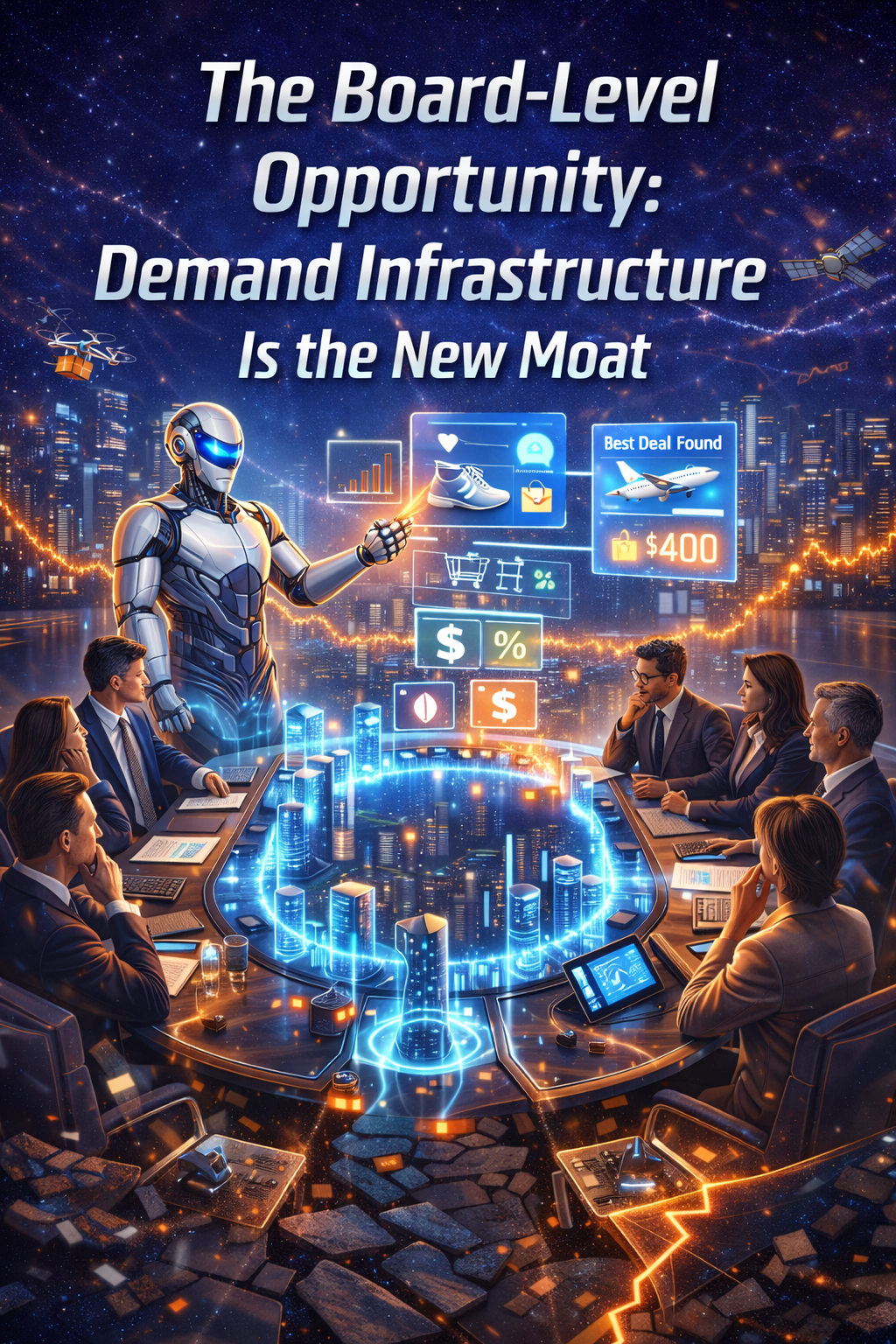
The Board-Level Opportunity: Demand Infrastructure Is the New Moat
In the Third-Order AI Economy, moats shift.
In the Machine-Customer Era, the moat is:
- agent discoverability
- trust infrastructure
- negotiation-native pricing
- transaction evidence
- continuous improvement loops
This is exactly why HBR is telling brands to prepare for agentic environments, not just deploy chatbots. (Harvard Business Review)
Insight for the Board:
If customers arrive as agents, the real competitive question becomes: are we “agent-readable” by design—or “human-readable” by habit?
How C.O.R.E. Becomes Your Competitive Engine
Understand the C.O.R.E. framework
C — Comprehend context
Capture demand signals from agent interactions:
- what constraints agents carry
- what evidence they request
- where negotiation fails
- which terms trigger switching
O — Optimize decisions
Use AI to continuously tune:
- bundles
- pricing corridors
- eligibility rules
- risk controls
R — Realize action
Execute safely:
- automated quote generation
- negotiation workflows
- policy checks
- provisioning and fulfillment triggers
E — Evolve through evidence
Close the loop:
- dispute outcomes
- churn triggers
- agent feedback
- SLA and trust signals
In the Machine-Customer Era, C.O.R.E. is not just operations. It becomes demand competitiveness.
What Leaders Should Do Now
1) Build “Agent-Ready Product Truth”
Create a single source of truth for:
- specs
- pricing rules
- policies
- compatibility constraints
- proof artifacts
2) Create a Negotiation Interface With Guardrails
Expose:
- bundles that can be modified
- price corridors
- approval thresholds
- what is non-negotiable
3) Treat Trust as Conversion Infrastructure
Make trust computable:
- evidence trails
- service commitments
- dispute resolution clarity
- authorization visibility
WEF emphasizes that trust and safeguards determine whether agent ecosystems scale safely. (World Economic Forum)
4) Engineer “Switching Defense” Ethically
Don’t trap customers. Instead:
- make value obvious
- reduce hidden fees
- improve reliability
- create measurable outcomes
Agents punish friction and opacity.
5) Add “Agent Observability” to Your Growth Dashboard
Track:
- agent-driven leads
- agent conversion rates
- negotiation win/loss reasons
- churn triggers initiated by agents
- proof requests and failure points
If you can’t measure agent demand, you can’t compete for it.
The Intelligence-Native Enterprise Doctrine
This article is part of a larger strategic body of work that defines how AI is transforming the structure of markets, institutions, and competitive advantage. To explore the full doctrine, read the following foundational essays:
- The AI Decade Will Reward Synchronization, Not Adoption
Why enterprise AI strategy must shift from tools to operating models.
https://www.raktimsingh.com/the-ai-decade-will-reward-synchronization-not-adoption-why-enterprise-ai-strategy-must-shift-from-tools-to-operating-models/ - The Third-Order AI Economy
The category map boards must use to see the next Uber moment.
https://www.raktimsingh.com/third-order-ai-economy/ - The Intelligence Company
A new theory of the firm in the AI era — where decision quality becomes the scalable asset.
https://www.raktimsingh.com/intelligence-company-new-theory-firm-ai/ - The Judgment Economy
How AI is redefining industry structure — not just productivity.
https://www.raktimsingh.com/judgment-economy-ai-industry-structure/ - Digital Transformation 3.0
The rise of the intelligence-native enterprise.
https://www.raktimsingh.com/digital-transformation-3-0-the-rise-of-the-intelligence-native-enterprise/ - Industry Structure in the AI Era
Why judgment economies will redefine competitive advantage.
https://www.raktimsingh.com/industry-structure-in-the-ai-era-why-judgment-economies-will-redefine-competitive-advantage/

Conclusion: A New Kind of Customer Has Entered the Market
AI adoption is not the story that will define winners.
Market recomposition is.
The Machine-Customer Era is one of the clearest, most executive-relevant signals that we have entered the Third-Order AI Economy:
- demand becomes programmable
- negotiation becomes continuous
- switching becomes automated
- trust becomes infrastructure
The strategic question is no longer:
“Are we using AI?”
It is:
“Are we designed to sell to machine customers—without losing trust, margin, or control?”
Those who answer early will not just defend market share.
They will define the next category of advantage.
Glossary
Agentic AI: AI systems that can take actions (not just generate content) under constraints, with accountability requirements. (World Economic Forum)
Machine Customer: An AI agent representing buyer intent, constraints, and delegated authority.
Agentic Commerce: Commerce mediated by AI agents that research, compare, negotiate, and transact. (Harvard Business Review)
Negotiation-Native Pricing: Pricing designed to support structured negotiation within guardrails. (MIT Press Direct)
Trust Infrastructure: Identity, accountability, evidence trails, and policy enforcement that make autonomous action reliable at scale. (World Economic Forum)
Transaction Traceability: The ability to prove what an agent did, under whose authority, with what evidence. (Forbes)
Switching Automation: Agent-triggered churn based on computed value and policy constraints.
Third-Order AI Economy: The phase where AI becomes market infrastructure and reorganizes industries (macro doctrine).
Intelligence-Native Enterprise: The operating model redesign that lets enterprises compound intelligence (execution doctrine).
C.O.R.E.: Comprehend, Optimize, Realize, Evolve — the compounding intelligence loop.
FAQ
1) Is the Machine-Customer Era only about consumer retail?
No. It applies anywhere buying involves comparison, renewal, negotiation, compliance, or performance guarantees—especially recurring contracts and service markets. (Forbes)
2) Why does switching accelerate in this era?
Agents reduce friction: they monitor value continuously, compare alternatives instantly, and can initiate cancellation or renegotiation as a default behavior.
3) What is the biggest risk for companies?
Not “AI mistakes.” The bigger risk is unclear authorization, weak evidence trails, and poor reversibility—leading to disputes and trust collapse. (Forbes)
4) What does “agent-readable” actually mean?
Your offerings must be legible to machine evaluation: structured specs, consistent policies, transparent pricing logic, and verifiable claims that an agent can summarize and compare.
5) How should boards measure readiness?
Track agent discoverability, negotiation success within guardrails, proof/evidence completeness, and agent-triggered churn drivers—alongside traditional conversion metrics.
A machine customer is an AI system that independently evaluates options, negotiates pricing, and executes purchases on behalf of humans or enterprises.
What is a machine customer?
A machine customer is an AI system that independently evaluates options, negotiates pricing, and executes purchases on behalf of humans or enterprises.
How are AI agents changing competition?
AI agents compress decision cycles, eliminate switching friction, and force companies to compete on machine-readable value rather than marketing narratives.
Why does demand infrastructure matter?
Because when machines control demand, the competitive moat shifts from branding and distribution to programmable access, APIs, and decision interoperability.
Is this part of the Third-Order AI Economy?
Yes. The Machine-Customer Era represents market recomposition—where AI doesn’t just optimize firms but reorganizes demand itself.
References and Further Reading
- Harvard Business Review: How Brands Can Adapt When AI Agents Do the Shopping (Harvard Business Review)
- Harvard Business Review: Preparing Your Brand for Agentic AI (Harvard Business Review)
- Harvard Business Review: AI Is Upending Marketing on Two Fronts (Harvard Business Review)
- World Economic Forum: AI agents… trust / identity / accountability (World Economic Forum)
- World Economic Forum: How to design for trust in the age of AI agents (World Economic Forum)
- MIT Negotiation Journal: The Promise and Peril of Automated Negotiators (MIT Press Direct)
- Forbes: Your AI Agent Just Made A Purchase—Do You Know Who Authorized It? (Forbes)
- Forbes: AI Agents Are Poised To Take Over Software Buying… (Forbes)
- Modern Retail: Why the AI shopping agent wars will heat up in 2026 (Modern Retail)
- Financial Times (letter): What retailers give up when chatbots do the shopping (Financial Times)



Raktim Singh is an AI and deep-tech strategist, TEDx speaker, and author focused on helping enterprises navigate the next era of intelligent systems. With experience spanning AI, fintech, quantum computing, and digital transformation, he simplifies complex technology for leaders and builds frameworks that drive responsible, scalable adoption.