
Representation Accounting:
In the AI era, trust will depend not only on better models, but on whether institutions can prove that their machine-readable view of reality is current, grounded, governed, and fit for action.
Most AI conversations still begin in the wrong place. They begin with the model.
Which model is more powerful?
Which model is cheaper?
Which model reasons better?
Which model can automate more work?
Those questions matter. But they are no longer the deepest questions.
The deeper question is this: What can an institution legitimately claim to know when that knowledge is produced, updated, filtered, and acted on by AI systems?
That is where the next major shift will happen.
For decades, accounting helped institutions answer a basic question: What do we have? What do we owe? What can others trust about our financial position? Standards such as IAS 38 were designed to help organizations recognize and disclose certain intangible assets, even as IFRS research and IASB staff work have continued to highlight the difficulty of reflecting many internally generated intangibles in financial statements. (IFRS Foundation)
But the AI economy introduces a different class of institutional claim. Now organizations increasingly act on assertions such as:
- We know this customer well enough to make an offer.
- We know this supplier well enough to predict disruption.
- We know this patient state well enough to trigger an intervention.
- We know this transaction well enough to flag fraud.
- We know this document well enough to let an agent draft, recommend, or act.
These are not small operational assumptions anymore. They are becoming economically consequential knowledge claims.
That is why we need a new discipline. I call it Representation Accounting.
Representation Accounting is the discipline of making institutional knowledge claims inspectable in a world where systems do not act on reality directly. They act on representations of reality.
That changes everything.
What is Representation Accounting?
Representation Accounting is a new discipline that defines how institutions measure, validate, and govern what their AI systems claim to know before making decisions. It ensures that machine-readable representations of reality are accurate, current, traceable, and trustworthy enough for action.
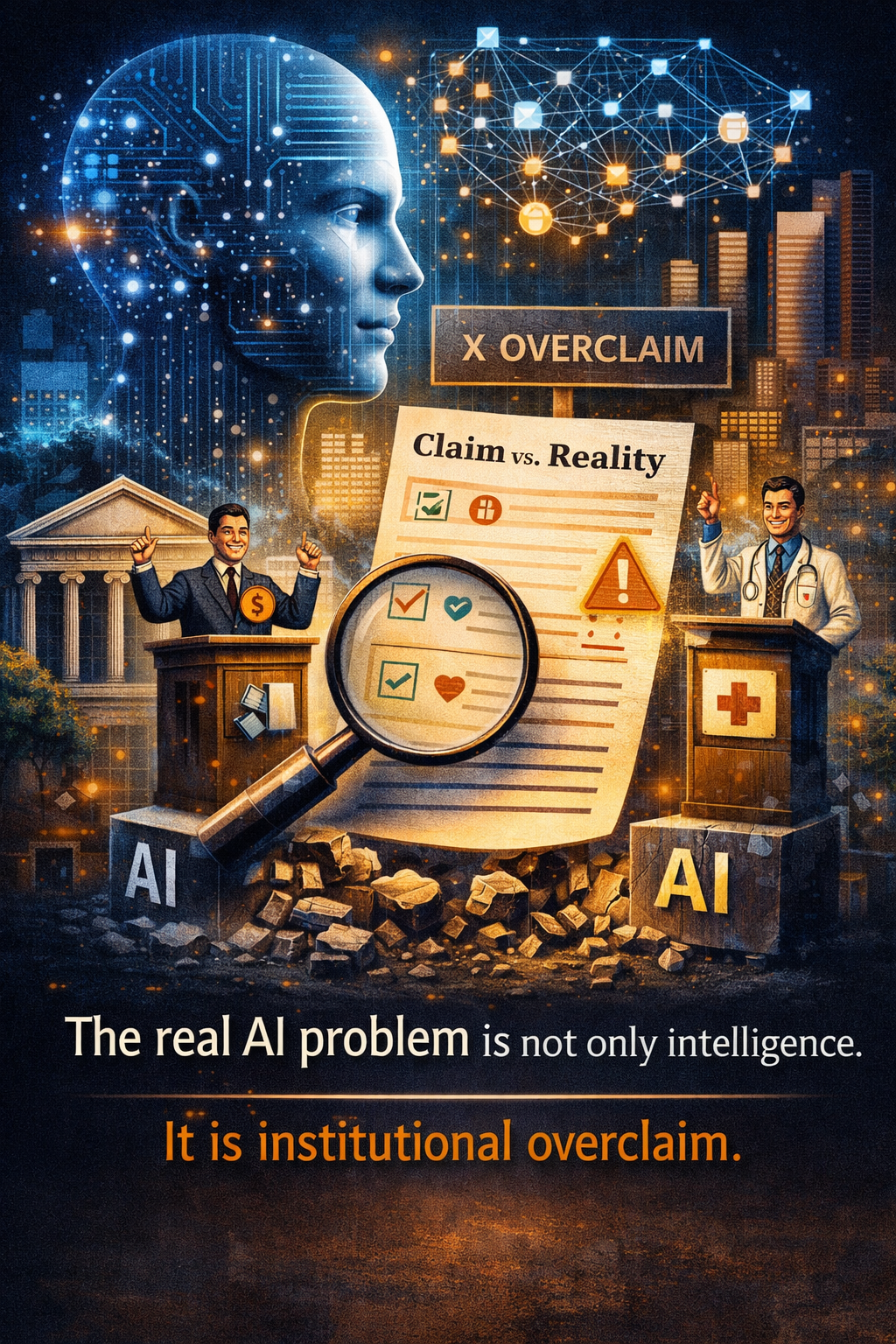
The real AI problem is not only intelligence. It is institutional overclaim.
An AI system never sees the world directly. It works on data, labels, schemas, identifiers, embeddings, events, histories, and inferred states. In other words, it works on a constructed representation.
A lending model does not see a borrower. It sees a profile.
A supply chain platform does not see a shipment. It sees a status object.
A hospital workflow does not see a patient in full. It sees records, lab values, consent flags, risk scores, and care histories.
A public-sector system does not see a citizen in totality. It sees applications, documents, events, eligibility states, and linked databases.
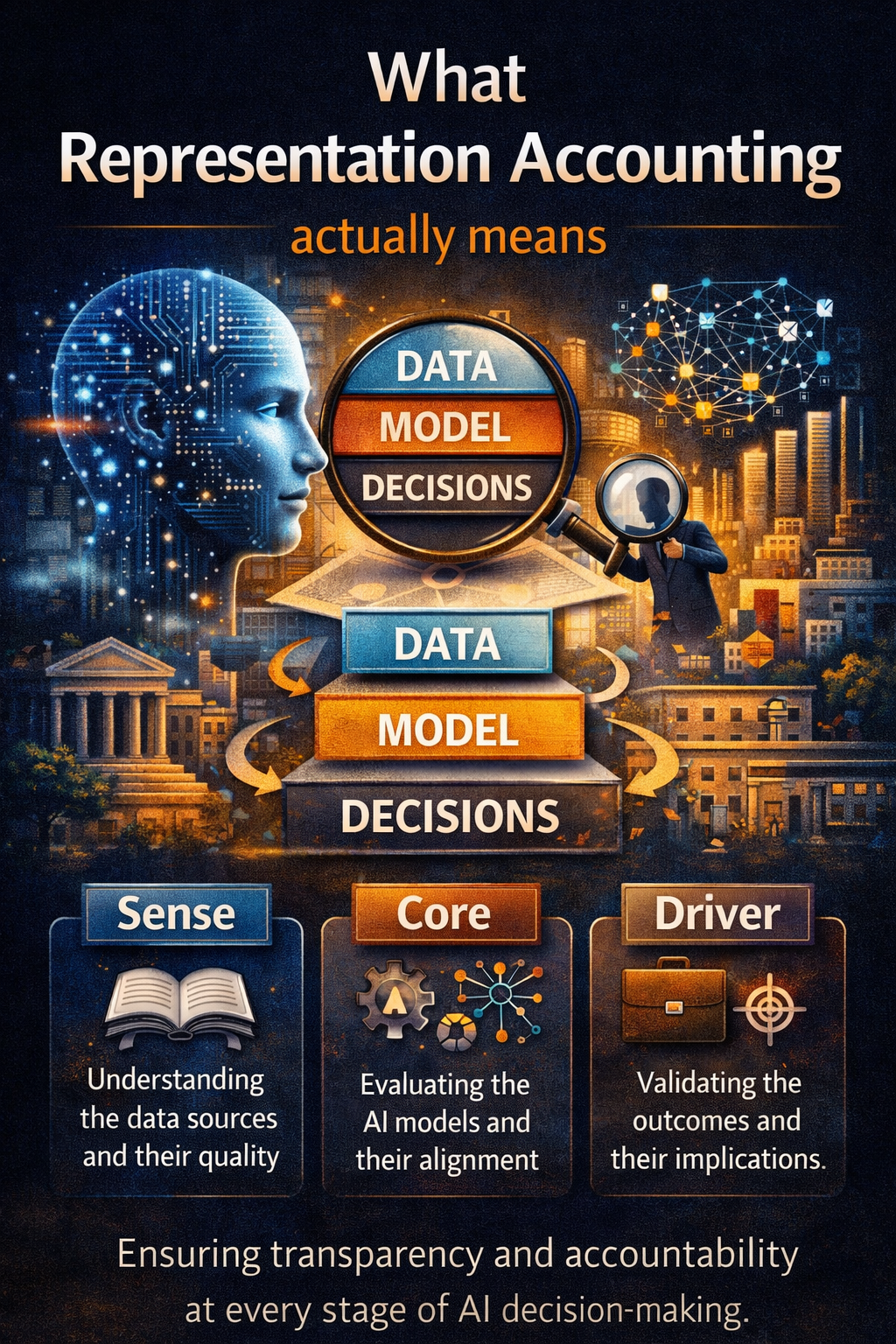
This is exactly why the SENSE–CORE–DRIVER framework matters.
SENSE: Where reality becomes machine-legible
SENSE is the legibility layer. It turns the world into signals, entities, state representations, and evolving records.
CORE: Where systems reason
CORE is the cognition layer. It interprets, ranks, predicts, reasons, and recommends.
DRIVER: Where action becomes legitimate
DRIVER is the execution and legitimacy layer. It governs who can act, on what authority, against which representation, under what checks, and with what recourse if the system is wrong.
Most organizations still overinvest in CORE and underinvest in SENSE and DRIVER. They buy intelligence before they build legibility. They automate decisions before they build institutional proof. The result is predictable: they begin acting with high confidence on low-quality representations.
That is not just a technical flaw. It is an accounting flaw of a new kind.
Why traditional reporting is no longer enough
Financial accounting was built for a world in which the most important institutional claims were financial. AI introduces a world in which many of the most important claims are representational.
The question is no longer only whether a number is booked correctly. It is whether a system’s underlying picture of reality is strong enough to justify the decision that follows.
That is why global governance and standards efforts are moving toward more documentation, transparency, governance, monitoring, and oversight.
NIST’s AI Risk Management Framework describes trustworthy AI in terms such as validity and reliability, safety, security and resilience, accountability and transparency, explainability, privacy enhancement, and fairness with harmful bias managed. ISO/IEC 42001 provides requirements for establishing, implementing, maintaining, and continually improving an AI management system. The EU AI Act adds concrete obligations for high-risk systems around data governance, technical documentation, logging, transparency, human oversight, and robustness. (NIST Publications)
These developments are significant. But they still do not fully answer the strategic question.
They help answer whether an AI system is governed.
Representation Accounting asks whether an institution’s knowledge claims are governed.
That is the next frontier.
What Representation Accounting actually means
Representation Accounting is not accounting in the narrow financial sense. It is a discipline for declaring the quality of machine-readable reality inside an institution.
It asks questions such as:
- What entity is this representation about?
- Which signals were used to construct it?
- How recent is it?
- Who created or updated it?
- What assumptions shaped it?
- What is missing?
- What confidence should attach to it?
- What decisions depend on it?
- Who is accountable if it is wrong?
- What recourse exists for correction?
In simple language, it is the difference between saying, “Our system knows,” and saying, “Our system knows this much, from these sources, updated at this time, under these limits, and should be trusted only for these kinds of decisions.”
That difference will become one of the most important distinctions in modern business.
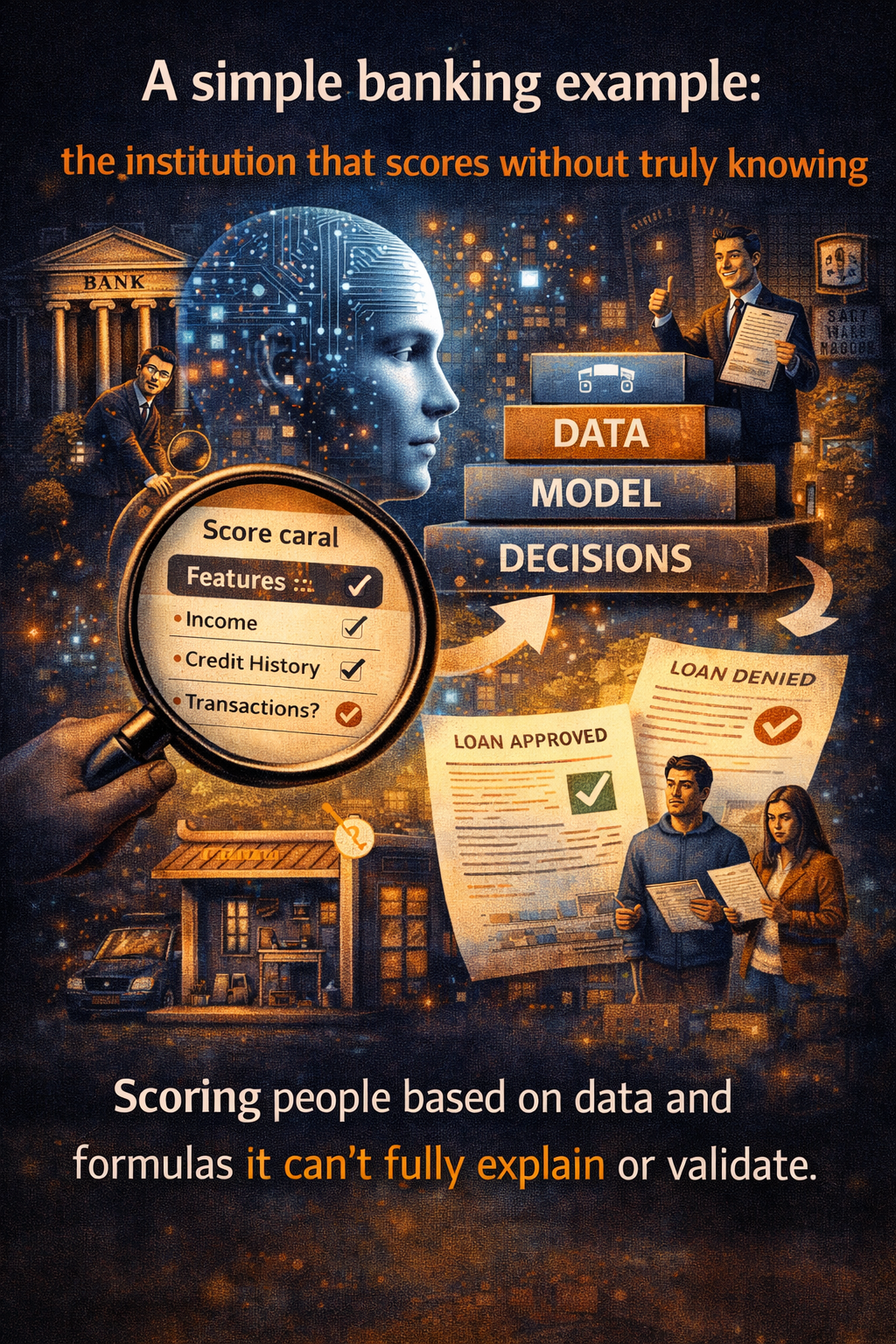
A simple banking example: the institution that scores without truly knowing
Imagine two banks using AI for small-business lending.
Bank A has a sophisticated model, but fragmented customer data. Income records are delayed. Cash-flow histories are incomplete. Ownership structures are not well resolved. The system scores the applicant anyway.
Bank B has a somewhat weaker model, but much stronger SENSE. It has better entity resolution, fresher transaction histories, clearer provenance for documents, better consent records, and visible separation between what is known, what is inferred, and what is stale.
Which bank actually knows the customer better?
In the old AI conversation, Bank A might win because the model looks more impressive. In the Representation Economics conversation, Bank B may hold the real institutional advantage because its representation is more trustworthy.
That is what Representation Accounting changes. It shifts attention from algorithmic cleverness alone to the quality of the institutional claim.
Over time, that affects default rates, auditability, capital allocation, regulatory resilience, and customer trust.
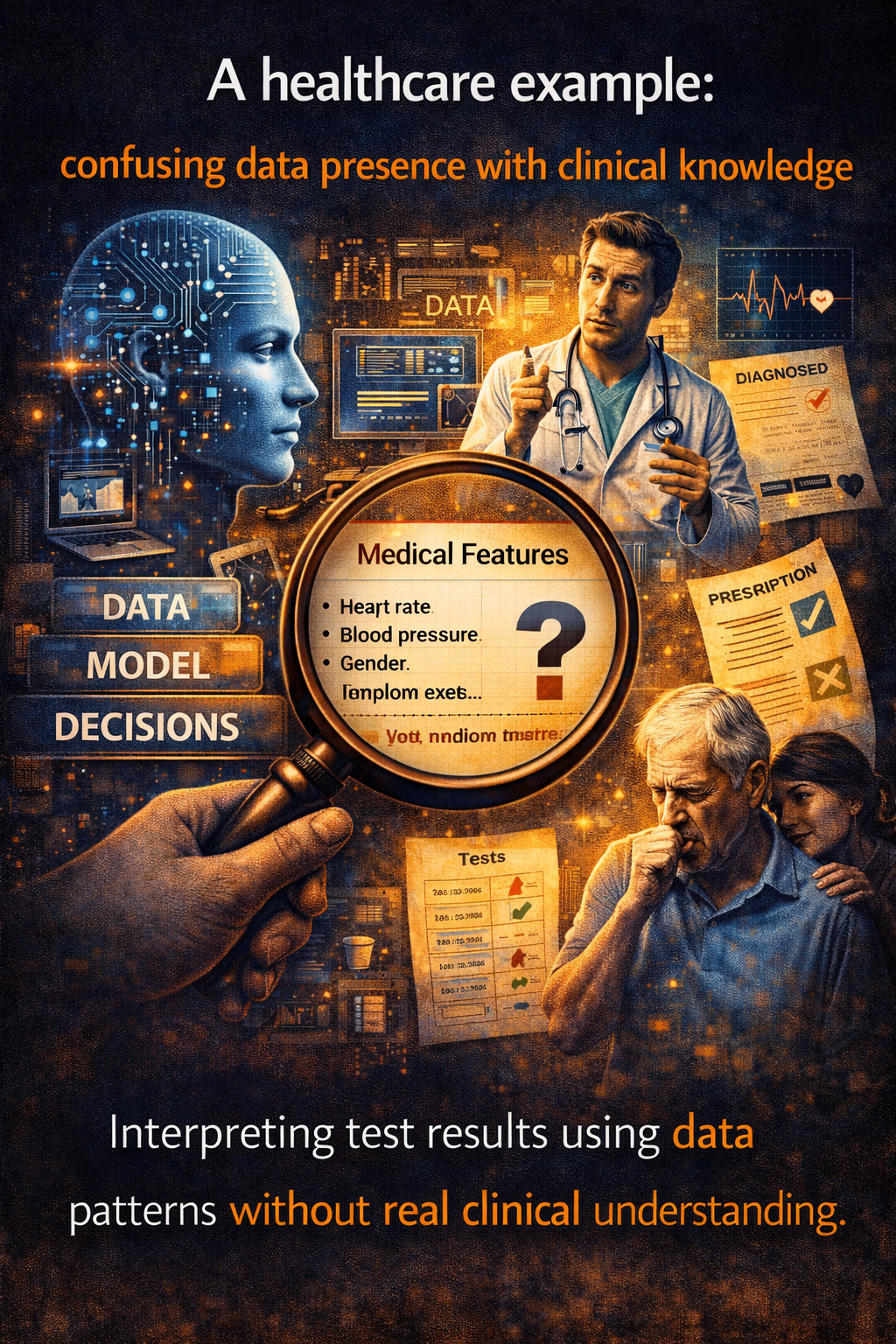
A healthcare example: confusing data presence with clinical knowledge
Healthcare systems are full of data. But data presence is not the same as reliable knowledge.
A patient may have lab results in one system, imaging in another, medication history elsewhere, and consent restrictions that are poorly surfaced across the workflow. An AI layer sitting above this fragmented landscape may still produce recommendations. But does the institution genuinely know the patient state well enough to act?
Representation Accounting would force a distinction between:
- data available,
- data reconciled,
- data clinically current,
- data fit for a specific decision,
- and data with traceable provenance and accountability.
That is far more meaningful than simply saying, “We use AI in care delivery.”
The same logic applies to insurance, public services, industrial operations, compliance, HR systems, logistics, and enterprise procurement.
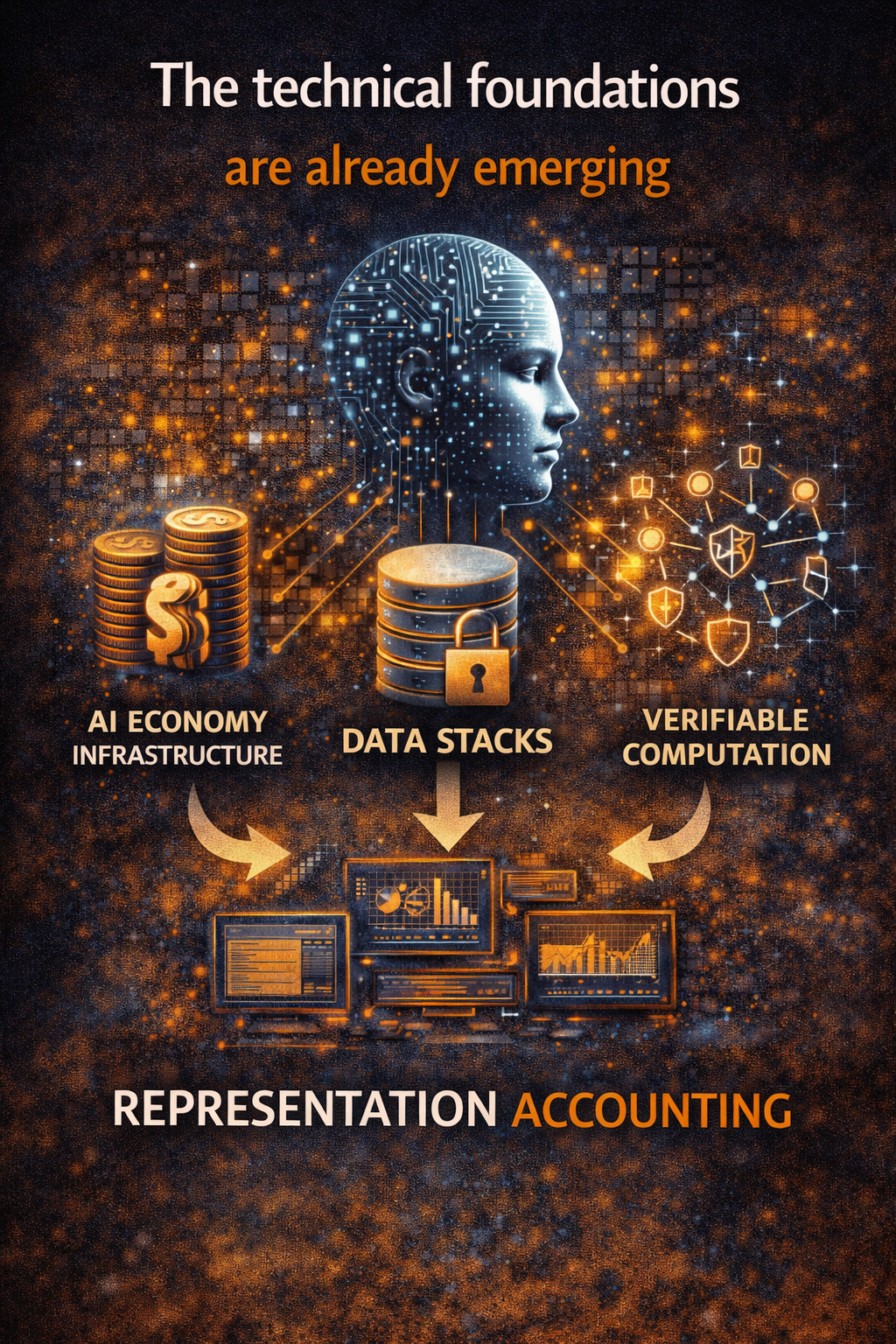
The technical foundations are already emerging
Representation Accounting is not science fiction. Important pieces of it already exist.
The W3C’s PROV family defines provenance as information about entities, activities, and people involved in producing a piece of data or thing, so that others can assess quality, reliability, and trustworthiness.
The W3C’s Verifiable Credentials model describes tamper-evident digital claims in a three-party ecosystem of issuers, holders, and verifiers. C2PA and Content Credentials are building practical standards for media provenance and authenticity, including cryptographically bound provenance records for digital assets. (W3C)
Taken together, these are not isolated technical projects. They are early signs of a larger institutional shift: the world is moving toward a future in which claims about digital reality must be more grounded, inspectable, and contestable.
Representation Accounting gives that shift a name, a business logic, and a strategic frame.

The next competitive advantage will come from “knowing with proof”
In the AI economy, many firms will continue describing themselves as data-driven. Far fewer will be able to prove that their internal representations are decision-grade.
That will separate winners from losers.
The winners will do five things especially well.
-
Resolve the entity correctly
They will know which customer, asset, supplier, employee, shipment, patient, or document a representation actually refers to.
-
Track provenance
They will know where a claim came from, who updated it, what systems touched it, and how it changed over time.
-
Measure freshness
They will know whether the representation is current enough for the decision being made.
-
Expose confidence and limits
They will not treat every field, score, or state estimate as equally trustworthy.
-
Build recourse
They will create mechanisms for correction when a representation is wrong, stale, incomplete, or harmful.
This is why Representation Accounting will not remain a niche governance concept. It will become an economic capability.
Institutions that can claim to know with proof will move faster with less fragility. They will automate more safely. They will attract regulators and partners more easily. They will recover trust faster after failure. And they will be in a stronger position to deploy agents because their DRIVER layer will rest on stronger SENSE.
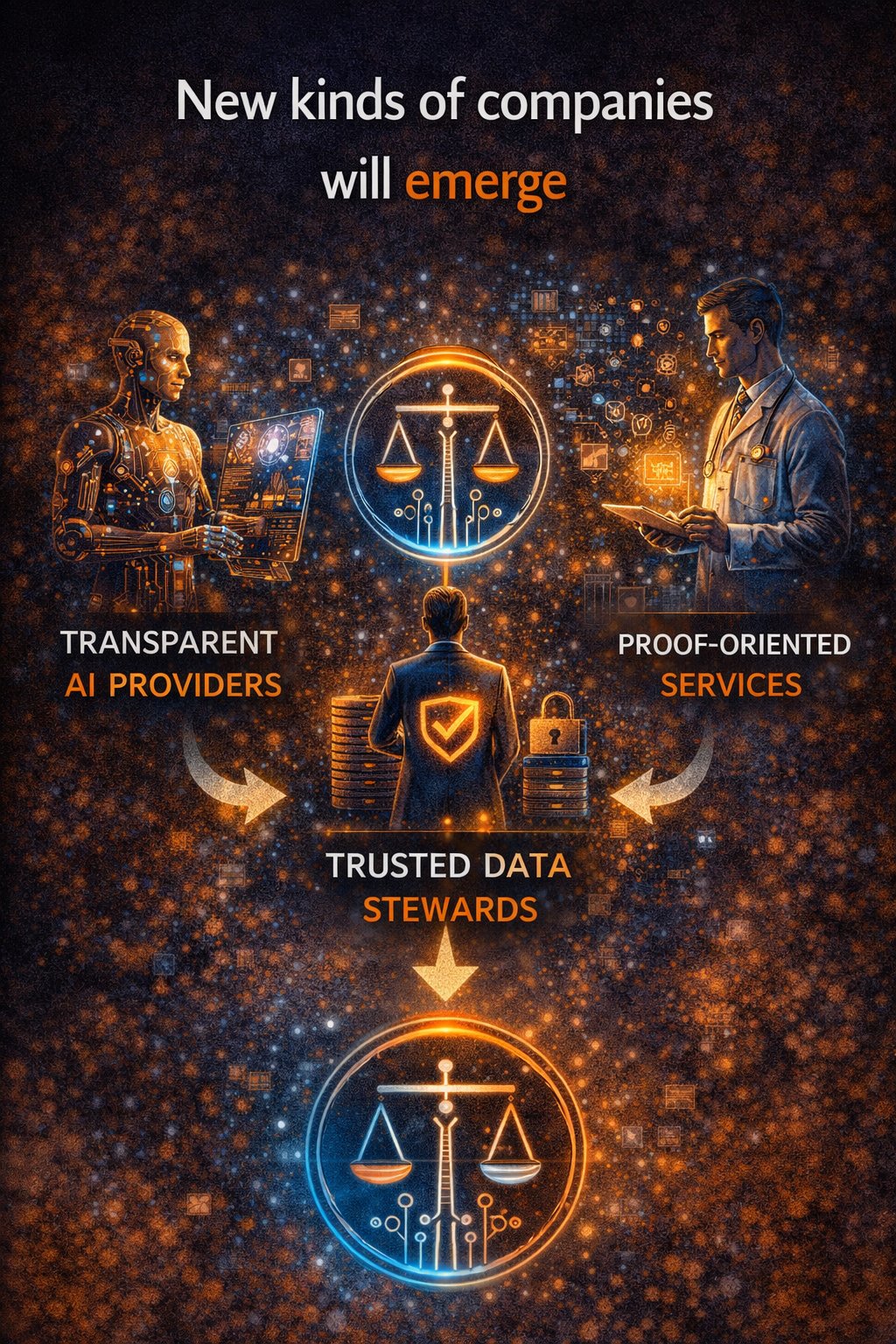
New kinds of companies will emerge
Every major institutional shift creates new categories of firms. Representation Accounting will be no different.
Some companies will help enterprises measure representation quality across fragmented systems.
Some will provide provenance and state-history infrastructure.
Some will certify machine-readable claims.
Some will monitor representation drift after deployment.
Some will specialize in recourse workflows when automated systems misrepresent a customer, supplier, worker, or citizen.
Some will become the assurance layer between raw data and trusted action.
This is one of the most important implications of Representation Economics: the companies of the next decade will not only sell intelligence. They will sell verified legibility.
That opens space for new markets in assurance, monitoring, traceability, entity resolution, representation governance, and institutional trust infrastructure.
What boards and CEOs should ask now
Most executive teams still ask, “Where can AI create efficiency?”
That is too narrow.
The stronger board-level question is this: Where are we making institutional claims without sufficient representation quality to justify them?
Boards should ask:
- Where are we acting on stale or fragmented representations?
- Which critical decisions rely on inferred states that are poorly governed?
- Where do we lack provenance, auditability, or recourse?
- Which parts of our AI stack are strong in CORE but weak in SENSE or DRIVER?
- Where could a representation failure become a financial, regulatory, legal, or reputational event?
This is not a compliance checklist. It is a strategic audit of institutional reality.
Why this matters beyond business
Representation Accounting is not only about operational control. It is about legitimacy.
As AI systems increasingly shape access to credit, insurance, healthcare, employment, pricing, identity, benefits, and public services, the question of what an institution can claim to know becomes a civic question too.
When systems classify people incorrectly, deny access unfairly, or act on stale state, the damage is not merely operational. It affects dignity, opportunity, trust, and the perceived legitimacy of institutions themselves.
That is why the future of AI will not be decided only by better reasoning systems. It will also be decided by whether societies build better standards for representing reality responsibly.
The real shift
The AI era is often described as a shift from software to intelligence.
That is true, but incomplete.
The deeper shift is from recording transactions to governing representations.
In the industrial era, accounting helped institutions justify financial claims.
In the AI era, Representation Accounting will help institutions justify knowledge claims.
That will become one of the defining disciplines of the next decade.
Because in a world run by machine-mediated decisions, the most important question will no longer be, “What can your model do?”
It will be:
What can your institution honestly claim to know — and prove — before it acts?

Conclusion: the next standard of institutional strength
Representation Accounting is not a side concept. It is the missing discipline between AI capability and institutional legitimacy.
Enterprises that master it will not simply deploy better AI. They will make stronger claims, take safer actions, govern autonomy more effectively, and build deeper trust with customers, regulators, partners, and boards.
That is why this idea matters far beyond accounting. It points to a new standard of institutional strength in the AI economy.
The next great enterprises will not be defined only by how much intelligence they possess. They will be defined by how responsibly, transparently, and credibly they represent reality before they act on it.
That is the real threshold the AI economy is now approaching.
Glossary
Representation Accounting
A proposed discipline for making an institution’s machine-readable knowledge claims inspectable, governable, and fit for action.
Representation Economics
The idea that competitive advantage in the AI era increasingly comes from how well institutions represent reality, not just how powerful their models are.
SENSE
The legibility layer where signals are captured, entities are identified, states are represented, and changes over time are tracked.
CORE
The reasoning layer where systems interpret information, generate predictions, prioritize options, and support decisions.
DRIVER
The execution and legitimacy layer that governs authority, action, verification, accountability, and recourse.
Provenance
Information about where a data point, claim, or digital asset came from, how it was produced, and who or what modified it. W3C PROV treats provenance as a basis for judging quality, reliability, and trustworthiness. (W3C)
Verifiable Credential
A tamper-evident digital claim issued by one party, held by another, and verified by a third. W3C’s model explicitly describes issuer, holder, and verifier roles. (W3C)
Content Credentials
A practical provenance framework, associated with C2PA, that helps disclose how digital content was created or edited and whether provenance information can be verified. (C2PA)
Decision-grade representation
A machine-readable view of reality that is sufficiently current, traceable, and reliable for a specific decision context.
Institutional overclaim
The condition in which an organization acts as though it knows more than its underlying representation quality actually justifies.
FAQ
What is Representation Accounting in simple language?
Representation Accounting is a way of showing what an institution’s systems actually know, how they know it, how current that knowledge is, and whether it is reliable enough to support action.
How is Representation Accounting different from financial accounting?
Financial accounting explains economic claims such as assets, liabilities, and performance. Representation Accounting explains knowledge claims: what the institution believes about customers, suppliers, assets, patients, transactions, or documents before AI-driven actions are taken.
Why does this matter in the AI era?
Because AI systems do not act on reality directly. They act on representations of reality. If those representations are stale, incomplete, or poorly governed, even a powerful model can produce harmful or misleading decisions.
How does this connect to AI governance?
AI governance typically focuses on model risk, documentation, oversight, and monitoring. Representation Accounting goes deeper by asking whether the institution’s underlying knowledge claims are strong enough to justify action in the first place.
Is this already happening in standards and regulation?
Parts of it are. NIST AI RMF, ISO/IEC 42001, the EU AI Act, W3C provenance standards, Verifiable Credentials, and C2PA all point toward stronger expectations around provenance, documentation, transparency, governance, and inspectability. (NIST Publications)
Which industries will feel this first?
Banking, insurance, healthcare, public services, supply chains, and any enterprise deploying agentic AI in high-stakes decisions.
What new types of companies could emerge?
Firms focused on provenance infrastructure, representation assurance, state reconciliation, recourse management, entity resolution, and machine-readable trust infrastructure.
What should boards do first?
Boards should identify the most consequential decisions being made or influenced by AI, then ask whether the underlying representations are current, traceable, decision-fit, and contestable.
References and further reading
For the financial reporting background on intangibles, see IAS 38 and the IFRS Foundation’s recent research and staff materials on the limits of current reporting for many internally generated intangibles. (IFRS Foundation)
For AI governance and risk-management context, see NIST’s AI Risk Management Framework, the Generative AI Profile, and ISO/IEC 42001. (NIST Publications)
For regulatory direction on high-risk AI, see the EU AI Act’s requirements on data governance, transparency, documentation, logging, and human oversight. (Artificial Intelligence Act)
For provenance and verifiable claims infrastructure, see W3C PROV, Verifiable Credentials, and the C2PA / Content Credentials ecosystem. (W3C)
If you want, I can next turn this into a final website-publishable package with a stronger opening hook, featured image prompts, schema-ready FAQ formatting, meta fields, comma-separated tags, and 3 HBR/MIT-style title variants.
Explore the Architecture of the AI Economy
This article is part of a broader research series exploring how institutions are being redesigned for the age of artificial intelligence. Together, these essays examine the structural foundations of the emerging AI economy — from signal infrastructure and representation systems to decision architectures and enterprise operating models.
If you want to explore the deeper framework behind these ideas, the following essays provide additional perspectives:
-
- • Why Most AI Projects Fail Before Intelligence Even Begins
- The Representation Economy: Why AI Institutions Must Run on SENSE, CORE, and DRIVER – Raktim Singh
- The Representation Economy: Why Intelligent Institutions Will Run on the SENSE–CORE–DRIVER Architecture – Raktim Singh
- The Representation Economy Explained: 51 Questions About the SENSE–CORE–DRIVER Architecture – Raktim Singh
- The Representation Deficit: Why Institutions Fail When Reality Cannot Enter the Decision System – Raktim Singh
- The Representation Maturity Model: How Boards Decide When AI Can Be Trusted With Real Decisions – Raktim Singh
- Representation Capital: The Invisible Asset That Will Decide Which Institutions Win the AI Economy – Raktim Singh
- Representation Failure: Why AI Systems Break When Institutions Misread Reality – Raktim Singh
- The Board’s Representation Strategy: How Intelligent Institutions Decide What Must Be Seen, Modeled, Governed, and Delegated – Raktim Singh
- The Representation Premium: Why Institutions That Are Easier for AI to See, Trust, and Coordinate With Will Win the Next Economy – Raktim Singh
- The Firm of the AI Era Will Be Built Around Representation: Why Institutions Must Redesign Themselves for the SENSE–CORE–DRIVER Economy – Raktim Singh
- The Representation Stack: The New Architecture of Intelligent Institutions in the AI Economy – Raktim Singh
- Representation Economics: The New Law of Value Creation in the AI Era – Raktim Singh
- The Representation Reserve Currency: Why AI Will Trust Only a Few Forms of Reality – Raktim Singh
- The Machine-Readable Boundary of the Firm: How AI Is Redefining What Companies Own, Outsource, and Orchestrate – Raktim Singh
- Representation Insurance: Why Machine-Readable Trust Will Power the AI Economy – Raktim Singh
- The Representation Commons: Why Broad-Based AI Value Begins Before the Model – Raktim Singh
- The Representation Access Economy: Why AI Will Decide Who Gets Seen, Structured, and Trusted – Raktim Singh
- Representation Bankruptcy: Why AI Will Break Companies That Machines Cannot Trust – Raktim Singh
- The Representation Kill Zone: Why Companies Become Invisible Before They Realize They Are Losing – Raktim Singh
- Representation Alpha: Why Competitive Advantage Will Come from Better Representation, Not Better Models – Raktim Singh
- Representation Fiduciaries: The Missing Institution the AI Economy Cannot Scale Without – Raktim Singh
- The Representation Commons: Why Broad-Based AI Value Begins Before the Model – Raktim Singh
- The Representation Conversion Industry: Why the Biggest AI Companies Will Rebuild Reality Before They Build Intelligence – Raktim Singh
- Representation Alpha: Why Competitive Advantage Will Come from Better Representation, Not Better Models – Raktim Singh
- Representation Fiduciaries: The Missing Institution the AI Economy Cannot Scale Without – Raktim Singh
Together, these essays outline a central thesis:
The future will belong to institutions that can sense reality, represent it clearly, reason about it intelligently, and act through governed machine systems.
This is why the architecture of the AI era can be understood through three foundational layers:
SENSE → CORE → DRIVER
Where:
- SENSE makes reality legible
- CORE transforms signals into reasoning
- DRIVER ensures that machine action remains accountable, governed, and institutionally legitimate
Signal infrastructure forms the first and most foundational layer of that architecture.
AI Economy Research Series — by Raktim Singh



Raktim Singh is an AI and deep-tech strategist, TEDx speaker, and author focused on helping enterprises navigate the next era of intelligent systems. With experience spanning AI, fintech, quantum computing, and digital transformation, he simplifies complex technology for leaders and builds frameworks that drive responsible, scalable adoption.