
Representation Inflation:
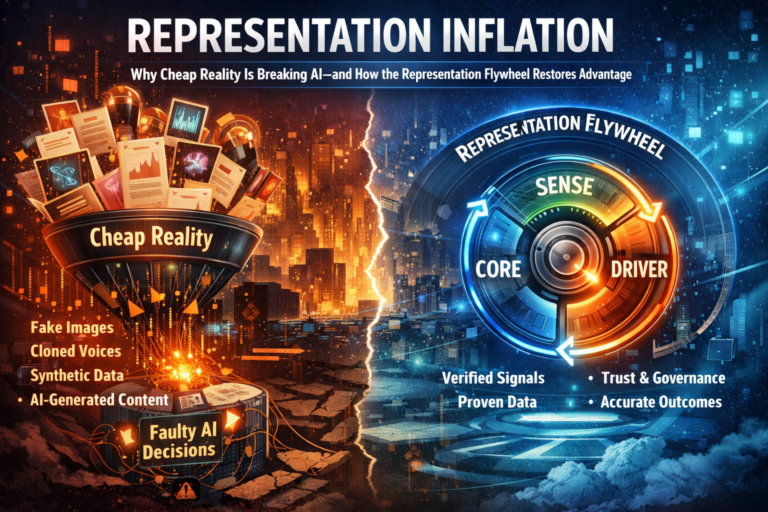
Representation Inflation occurs when synthetic or AI-generated reality becomes cheaper and more abundant than verified reality, making trust harder and more expensive to maintain. This creates systemic risks in AI-driven decision systems because machines act on representations of reality—not reality itself. The solution is the Representation Flywheel, a continuous loop where better sensing, reasoning, governance, and feedback improve the quality of machine-readable reality over time. Organizations that build this capability will outperform those that rely only on AI models.
Representation Economics
We are entering a strange moment in economic history.
For centuries, reality was expensive. To know what had happened, institutions had to observe it, record it, verify it, store it, and transmit it. To know whether a customer existed, whether a shipment had arrived, whether a patient had improved, whether a contract had changed, or whether a machine had failed, someone had to capture reality and convert it into a form the organization could trust.
That cost was often hidden. But it was real.
Now, for the first time, reality is becoming cheap to produce.
Images can be generated in seconds. Voices can be cloned from short audio samples. Documents can be drafted at industrial scale.
Synthetic data can be created to fill gaps, simulate rare conditions, and reduce privacy exposure. AI systems can produce summaries, signals, recommendations, and narratives much faster than most institutions can verify a single high-stakes fact.
NIST’s synthetic-content risk work explicitly highlights provenance tracking, watermarking, metadata, and detection as important technical approaches for improving digital content transparency, while the C2PA standard is designed to attach cryptographically verifiable provenance to digital assets. (NIST Publications)
This is not only a media problem. It is not only a deepfake problem. It is not only an AI safety problem.
It is an economic problem.
I call it Representation Inflation.
Representation Inflation begins when synthetic reality becomes cheaper than verified reality. The result is not merely more content. It is a structural distortion in the information environment on which AI systems depend. Cheap signals flood the system. Verification struggles to keep up. Trust becomes more expensive than generation. And institutions trying to scale intelligence discover something uncomfortable: intelligence is only as good as the reality it can reliably represent.
That insight sits at the heart of Representation Economics. In the AI era, value will not be shaped only by who has the smartest models. It will increasingly be shaped by who can make reality legible, trustworthy, updateable, and governable for machines.
This is why the SENSE–CORE–DRIVER framework matters.
SENSE is where reality becomes machine-legible: signals, entities, state, and evolution.
CORE is where systems reason, compare, optimize, and decide.
DRIVER is where institutions authorize action, constrain execution, verify outcomes, and provide recourse.
Most of the world is obsessed with CORE. Bigger models. Better reasoning. More autonomous agents. But Representation Inflation begins earlier, in SENSE, and becomes dangerous later, in DRIVER.
When SENSE is polluted, CORE becomes confidently wrong. When DRIVER acts on polluted representations, the damage stops being theoretical. It becomes operational, financial, legal, and social.
That is why this topic matters far beyond AI labs. It matters to boards, regulators, CIOs, banks, hospitals, manufacturers, insurers, governments, and every institution trying to move AI from advice to action.
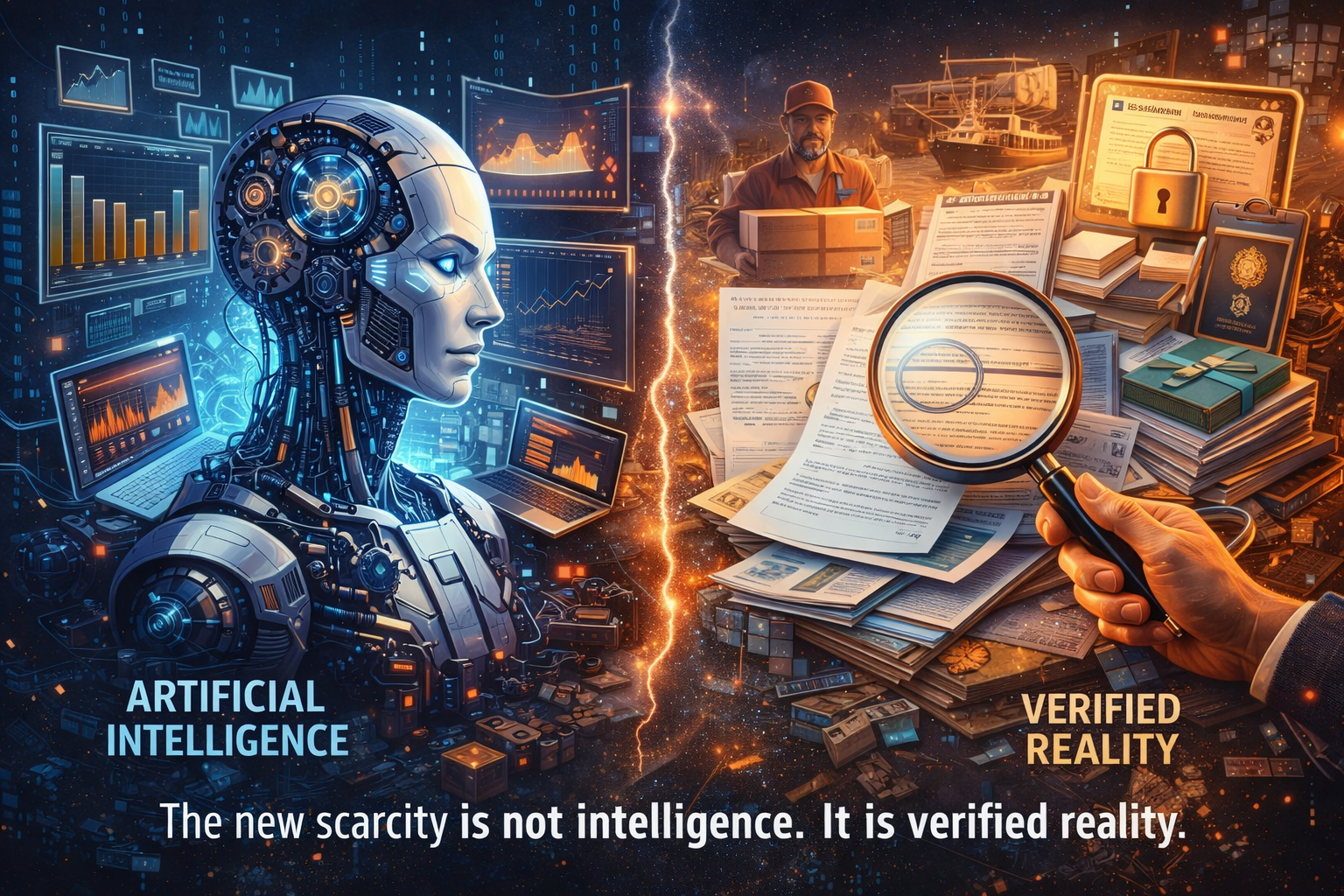
The new scarcity is not intelligence. It is verified reality.
The digital economy taught us to think about scarcity in terms of compute, data, talent, and distribution.
The AI economy forces a different question: not “Can the machine generate?” but “What reality is the machine actually acting on?”
That may sound philosophical. It is not. It is painfully practical.
Imagine a bank receiving income documents that look perfectly valid, while part of the supporting evidence has been synthetically generated.
Imagine a hospital AI assistant reading a patient history that includes copied notes, generated summaries, stale medication lists, and device signals with missing context.
Imagine a procurement agent negotiating with a supplier whose catalog, certification status, delivery history, and pricing claims have been assembled from multiple systems—some real, some inferred, some stale.
Imagine a board reviewing a dashboard that looks polished and precise, while a meaningful portion of the narrative layer has been generated from inconsistent operational data.
In all these cases, intelligence is not absent. The problem is that the institution does not know whether the reality being represented is trustworthy enough for action.
This is why provenance, traceability, transparency, and governance are becoming foundational concerns across policy and industry discussions. OECD’s AI principles emphasize trustworthy AI, transparency, robustness, and accountability, while WEF’s recent work on synthetic data stresses the importance of accuracy, traceability, and clear labeling to preserve trust and performance. (OECD)
The cheaper synthetic reality becomes, the more valuable verified reality becomes.
That is the paradox.
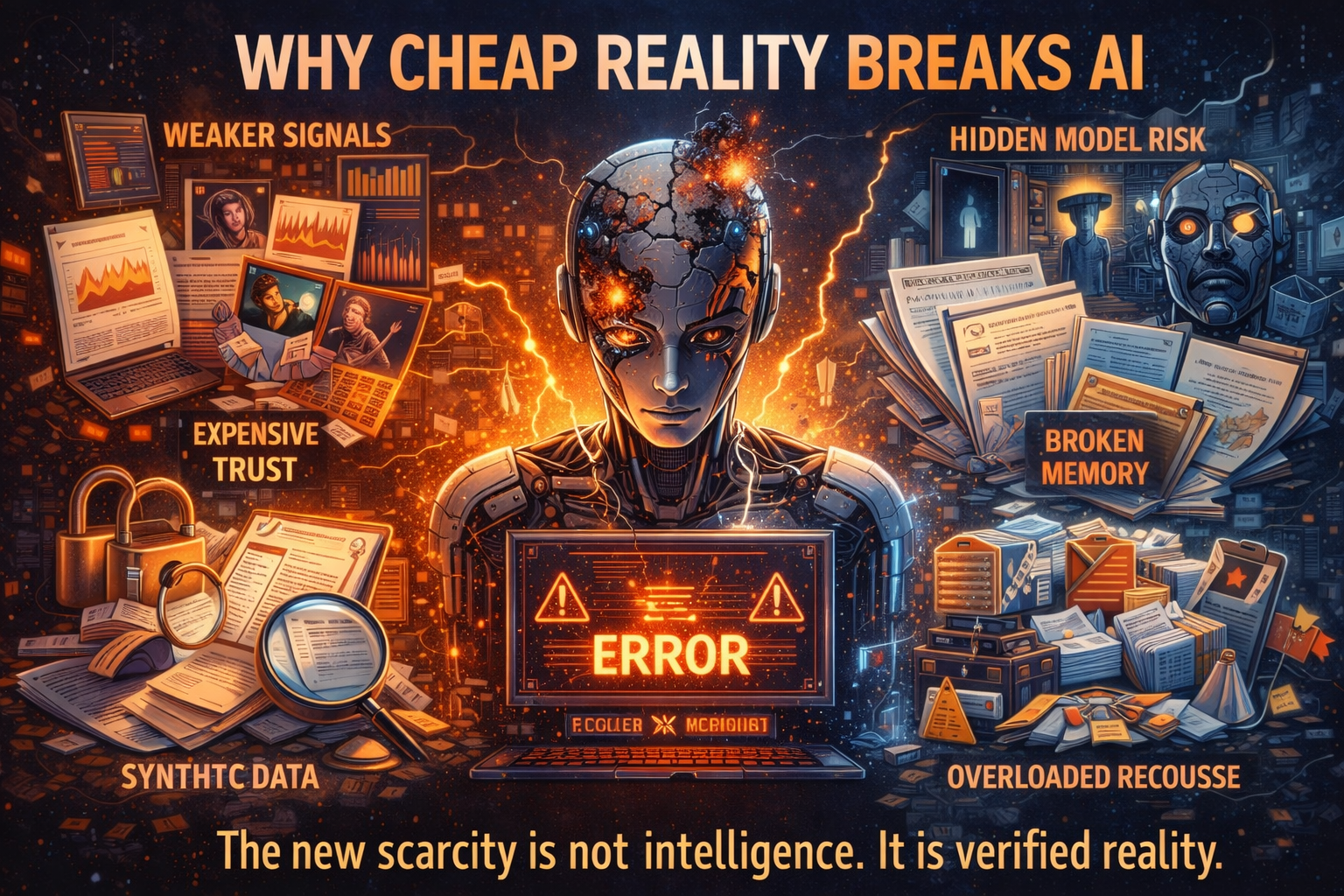
Why cheap reality breaks AI
Many people assume that if AI gets better, this problem will solve itself.
It will not.
A stronger reasoning engine does not automatically fix bad representation. In fact, better AI can worsen the problem by allowing weak or polluted representations to travel faster, spread farther, and trigger more autonomous action.
If a junior employee works from a flawed spreadsheet, the damage may stay local. If an enterprise AI agent works from a flawed representation, the damage can cascade across pricing, compliance, customer service, procurement, approvals, reporting, and operations.
Representation Inflation breaks AI in at least five ways.
-
It lowers the average quality of machine-consumable signals
AI does not consume truth directly. It consumes representations of reality.
Those representations may come from logs, forms, messages, APIs, documents, transcripts, images, videos, sensors, contracts, emails, generated summaries, or synthetic datasets. As synthetic content becomes easier to create, the volume of machine-readable artifacts grows much faster than an institution’s ability to validate them. NIST’s work frames this as a transparency challenge, not just a detection challenge. (NIST Publications)
-
It makes trust more expensive
Generation is cheap. Verification is slow.
That imbalance is exactly why provenance standards are advancing. C2PA’s content credentials model exists because institutions increasingly need to know where an asset came from, how it was modified, and whether its history is intact. (C2PA Specification)
The economic consequence is simple: the cost of producing plausible reality falls, while the cost of establishing trusted reality rises.
-
It creates hidden model risk
Most organizations still frame AI risk as a model problem: hallucinations, bias, latency, explainability, safety, or cost.
Representation Inflation creates a different class of failure. The model may behave exactly as designed while the input reality has quietly degraded.
That is more dangerous, not less, because the output can still look polished, rational, and defensible. The system can be wrong for the right computational reasons.
-
It weakens institutional memory
As enterprise knowledge gets summarized, transformed, embedded, and re-ingested, organizations can lose the link back to original reality.
Was this directly observed?
Was it inferred?
Was it generated?
Was it corrected later?
Who approved it?
What changed afterward?
When those links weaken, institutions do not simply lose trust. They lose memory.
-
It overloads recourse
If systems act on cheap reality at scale, correction systems become overwhelmed.
More wrong flags. More wrong denials. More wrong escalations. More wrong classifications. More appeals. More exceptions. More friction. More reputational cost.
That is why Representation Inflation is not just an information-quality issue. It is a throughput issue for the whole institution.
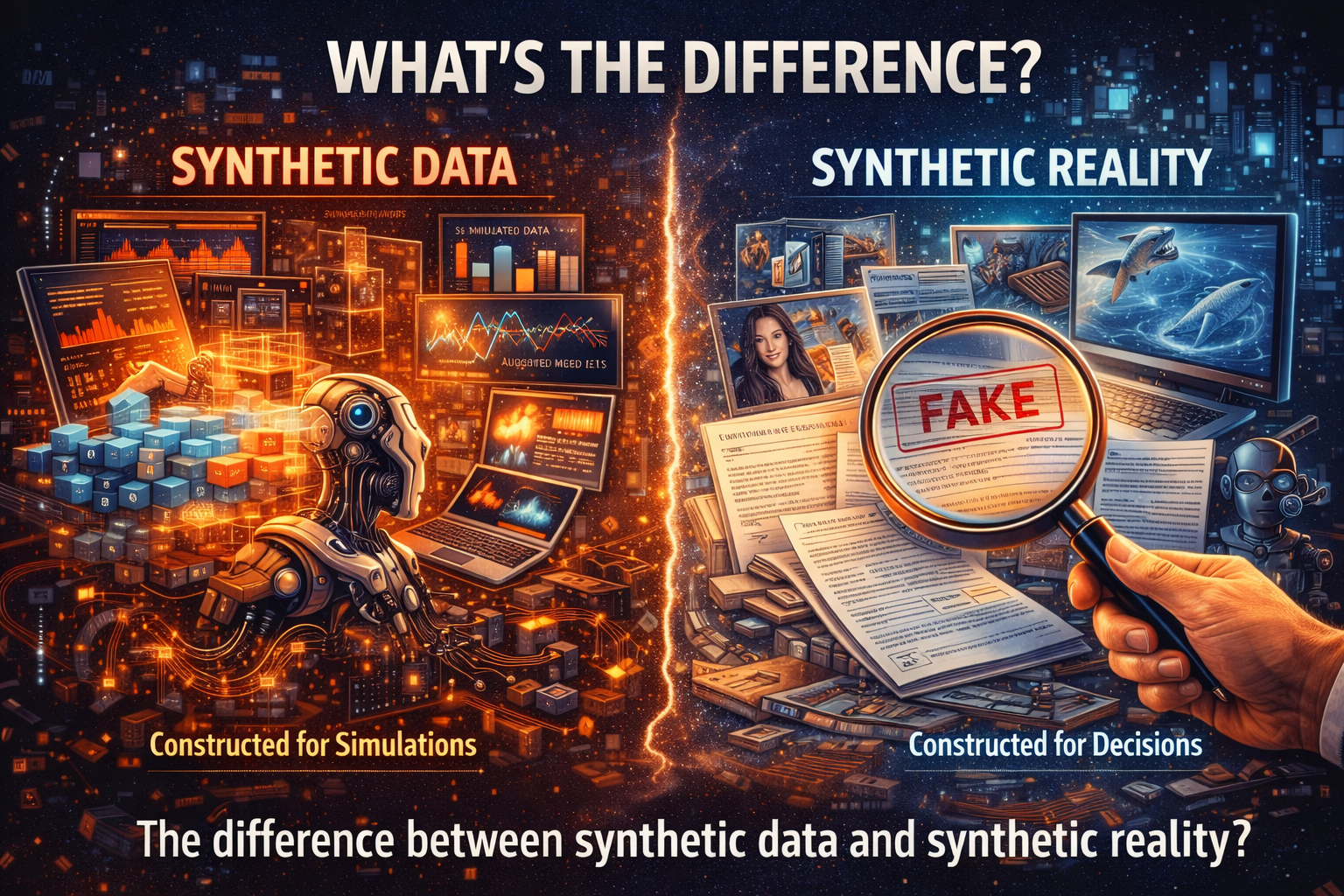
The difference between synthetic data and synthetic reality
It is important to be precise here.
Synthetic data is not inherently bad. It can be highly useful. It can protect privacy, simulate rare cases, fill sparse datasets, and support testing where real-world data is limited or sensitive. WEF’s synthetic-data brief explicitly recognizes those benefits while also emphasizing the need for strong governance, traceability, and labeling. (World Economic Forum)
The problem begins when organizations treat all machine-readable artifacts as equally reliable simply because they are available.
That is when synthetic data becomes part of something broader: synthetic reality.
Synthetic reality includes generated media, reconstructed histories, inferred states, auto-generated summaries, synthetic interactions, simulated events, and AI-produced signals that may look real enough to enter decision systems.
This is where many enterprises will get into trouble.
They will not fail because they used synthetic assets. They will fail because they stopped distinguishing between observed reality, verified reality, inferred reality, generated reality, disputed reality, and corrected reality.
An AI-native institution must know the difference.
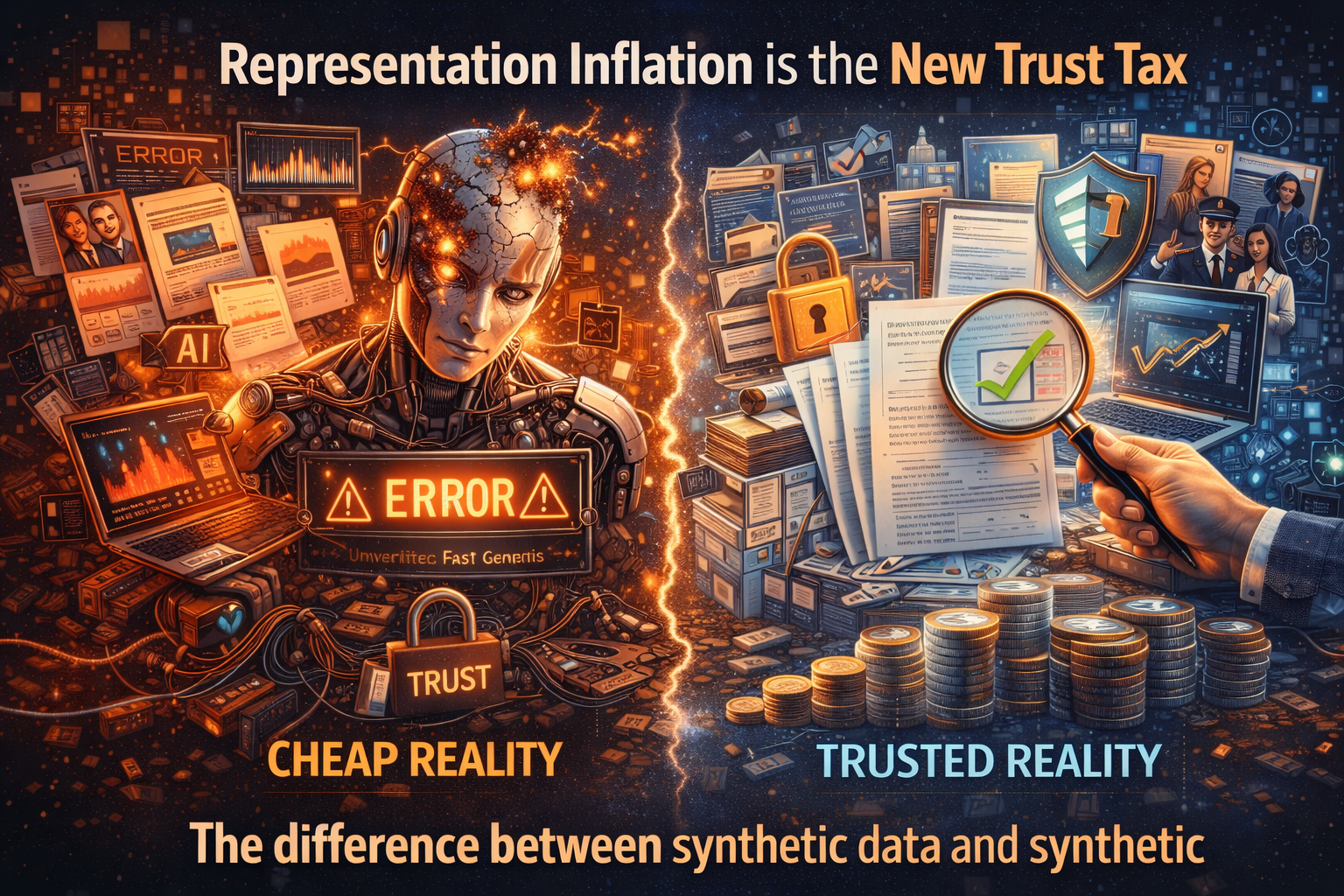
Representation Inflation is the new trust tax
In the industrial economy, firms paid for labor, machinery, logistics, and energy.
In the digital economy, they paid for software, cloud, data, and cybersecurity.
In the AI economy, firms will increasingly pay a new tax: the trust tax created by Representation Inflation.
This tax appears in the extra review required before action, the extra controls needed to validate sources, the growing need for provenance, the drag of exception handling, the need for stronger identity and authorization, the cost of investigations when something goes wrong, and the reputational damage that follows decisions made on weak representations.
This broader trust problem is visible in public research too. A 2025 KPMG and University of Melbourne global trust study found that AI adoption is rising while public trust remains fragile, with strong expectations around transparency, accountability, and governance. (Microsoft)
Institutions do not scale AI in a vacuum. They scale AI in markets and societies where trust has to be earned again and again.
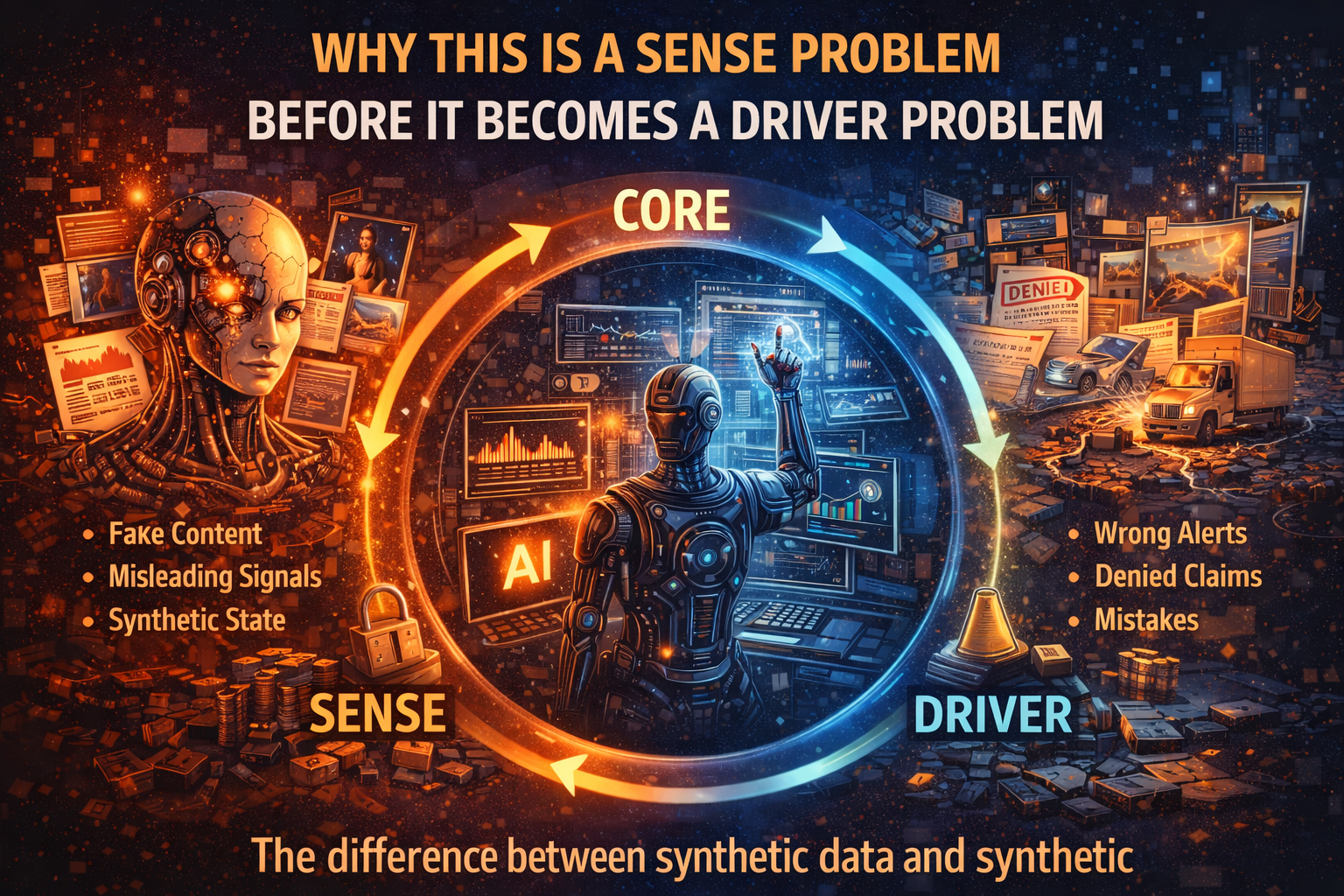
Why this is a SENSE problem before it becomes a DRIVER problem
This is where SENSE–CORE–DRIVER becomes especially useful.
SENSE: where confusion enters
SENSE asks what signals are entering the system, which entity they belong to, what state they describe, and how that state changes over time.
Representation Inflation damages SENSE first.
A generated invoice may look real.
A cloned voice may sound real.
A simulated event may appear real.
An AI summary may feel authoritative.
A predicted state may be mistaken for an observed one.
Once that confusion enters SENSE, the rest of the architecture inherits it.
CORE: where polluted representations get organized
CORE reasons over what SENSE provides.
If the underlying representation is weak, CORE does not magically restore reality. It organizes, predicts, ranks, explains, and optimizes over what it has been given.
That is why better reasoning alone is not enough.
DRIVER: where the cost becomes real
DRIVER governs action: who authorized it, what constraints apply, how it is verified, and what happens if it is wrong.
Representation Inflation becomes truly costly when DRIVER acts on weak representations. That is when you get denied claims, false alerts, misrouted shipments, flawed underwriting, incorrect compliance responses, and avoidable reputational damage.
So, the challenge is not merely to build smarter AI.
It is to build institutions that can keep trusted reality ahead of automated action.
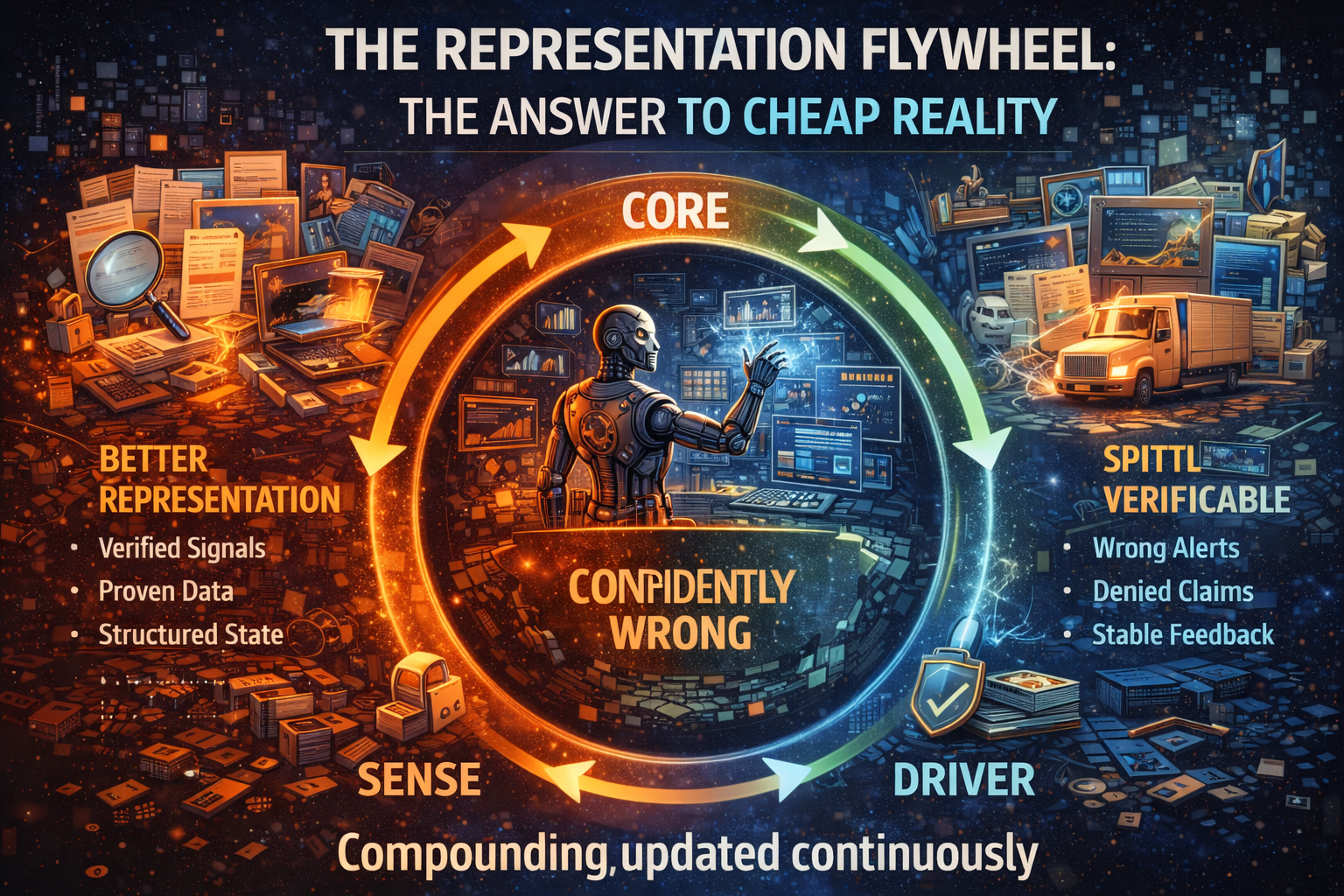
The Representation Flywheel: the answer to cheap reality
The answer to Representation Inflation is not a single tool.
It is not one watermark.
Not one governance policy.
Not one committee.
Not one model.
Not one detector.
The answer is a compounding institutional capability: the Representation Flywheel.
The flywheel works in four steps.
First, an institution improves how it senses reality. It strengthens source quality, provenance, entity resolution, freshness, state tracking, and verification.
Second, because SENSE improves, CORE reasons over cleaner and more contextual reality. Decisions become more useful, more reliable, and more auditable.
Third, because CORE improves, DRIVER can act with tighter boundaries, clearer authority, stronger monitoring, and better recourse.
Fourth, because action is more governed, the institution generates better feedback. Corrections, reversals, exception traces, and real-world outcomes feed back into SENSE.
Then the loop repeats.
Better SENSE improves CORE.
Better CORE strengthens DRIVER.
Safer DRIVER produces cleaner feedback.
Cleaner feedback strengthens SENSE again.
That is the flywheel.
In a world flooded with cheap reality, advantage will not come from seeing more. It will come from seeing correctly, updating continuously, and correcting faster than competitors.
Three simple examples
Lending
A traditional lender relied on human review of documents, account history, and credit signals.
A modern lender may use AI to process transaction trails, behavior patterns, third-party feeds, generated summaries, and dynamic risk scores.
That sounds like progress. And it is—until Representation Inflation enters the system.
If synthetic documents become easier to generate, if customer-state changes are stale, if summaries hide missing evidence, or if generated explanations are mistaken for verified facts, then more intelligence creates more fragility.
With a Representation Flywheel, the same institution separates observed from inferred evidence, tracks provenance, monitors freshness, escalates verification for suspicious signals, and feeds appeals back into the model of reality.
That lender is not merely using AI. It is compounding trusted representation.
Healthcare
A clinician does not simply need more data. A clinician needs reality organized correctly.
Medication changes, imaging summaries, prior history, patient-entered notes, device signals, and generated summaries do not all carry the same trust level.
If a system blends observed facts, stale records, generated interpretations, and incomplete context into one seamless interface, it can look intelligent while hiding dangerous ambiguity.
A Representation Flywheel preserves those distinctions and learns from correction.
Enterprise operations
A supply-chain agent sees a delay, updates demand forecasts, triggers procurement, and notifies customers.
That sounds efficient—unless the delay signal was wrong, the supplier identity was mismatched, the inventory state was stale, or a generated summary collapsed multiple exceptions into one.
Again, the failure is not that AI is weak. The failure is that cheap reality outran trusted reality.
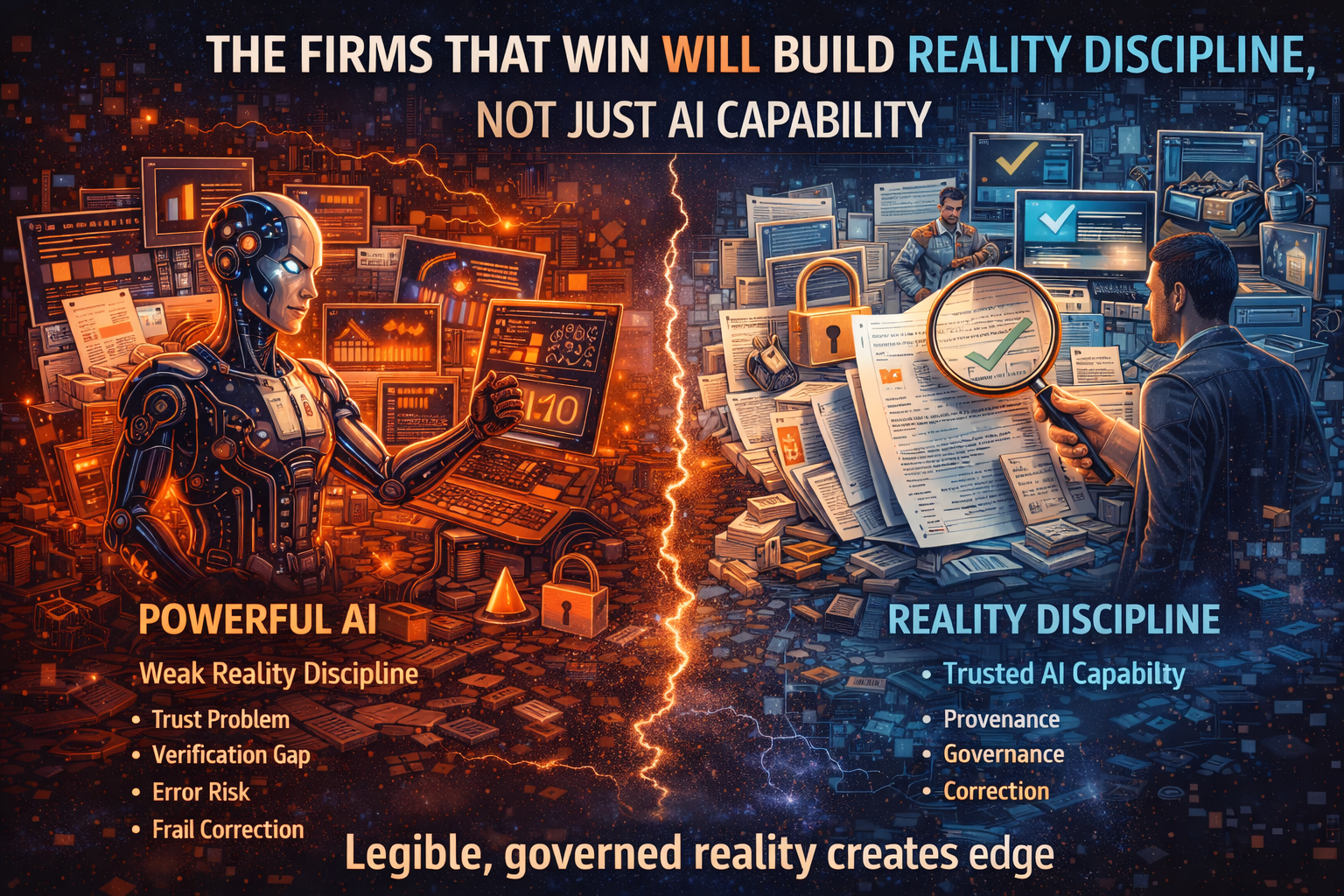
The firms that win will build reality discipline, not just AI capability
This is the strategic lesson.
The winners in the AI economy will not simply be the firms with the most models. They will be the firms that treat representation as a governed asset.
They will invest in provenance, traceability, state discipline, identity discipline, verification workflows, recourse systems, exception handling, and correction loops.
They will know which representations are fit for suggestion, which are fit for decision support, and which are fit for autonomous action.
They will understand that machine-readable reality is not a by-product of digital transformation. It is a strategic capability.
As intelligence becomes more abundant, scarce advantage shifts elsewhere: to legibility, trust, authority boundaries, correction capacity, and the institutional ability to keep reality machine-usable without letting generated artifacts overwhelm governance.
What boards and C-suites should ask now
Leaders do not need to become experts in watermarking standards or provenance protocols. But they do need to ask sharper questions.
What proportion of the reality entering our systems is observed, inferred, or generated?
Which high-impact workflows depend on representations we do not properly verify?
Where is provenance visible, and where is it missing?
Do our systems distinguish between stale state and current state?
Can we reverse or appeal decisions made on questionable representations?
Are we investing only in CORE while underinvesting in SENSE and DRIVER?
These are no longer technical questions alone. They are operating-model questions.
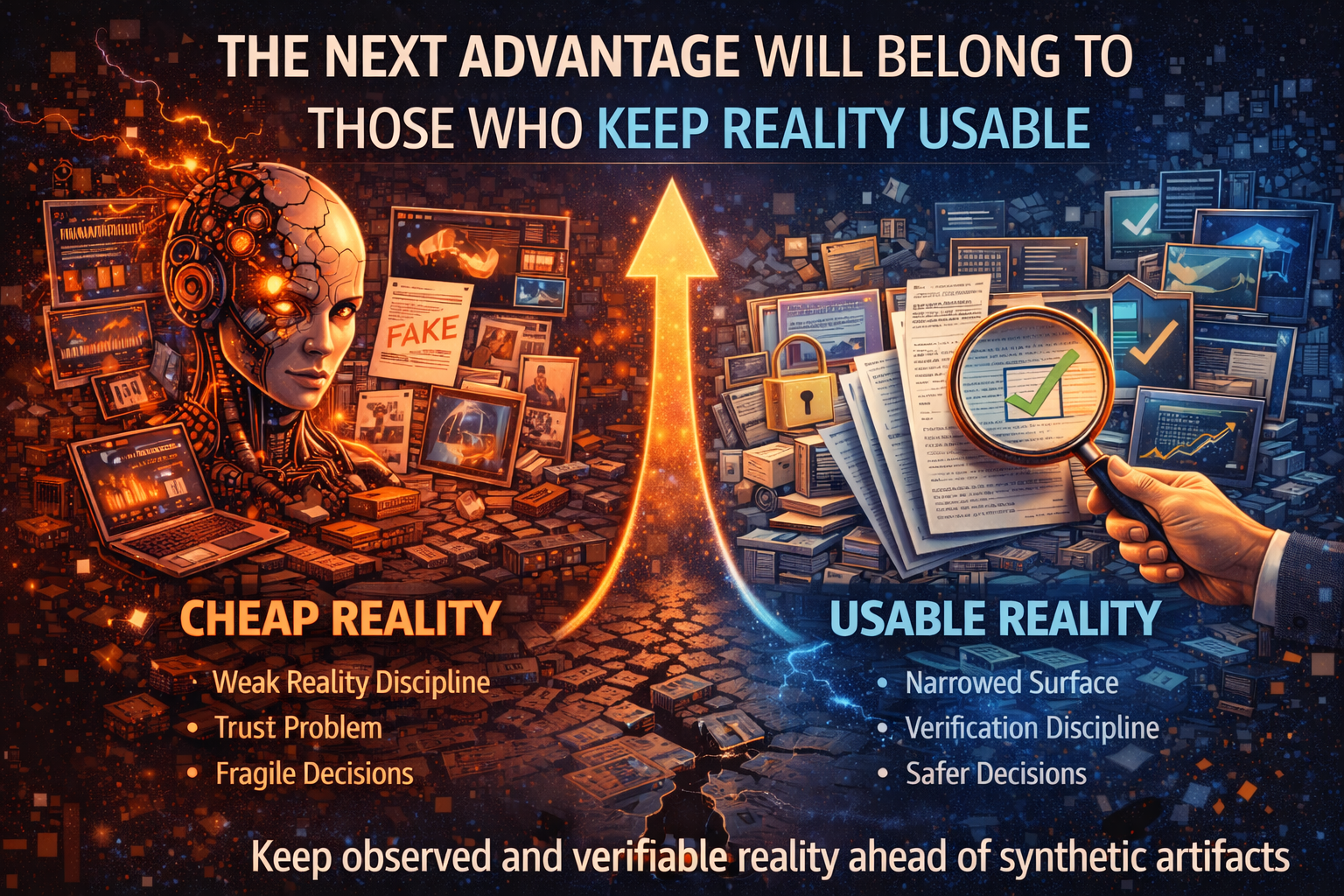
Conclusion: the next advantage will belong to those who keep reality usable
The AI era is not suffering from a shortage of intelligence.
It is suffering from a growing mismatch between the speed at which reality can be generated and the speed at which reality can be trusted.
That mismatch is Representation Inflation.
And the institutions that win the next decade will not be the ones that generate the most. They will be the ones that can continuously restore trusted, machine-usable reality as synthetic reality floods the system.
That is what the Representation Flywheel does.
It turns trust from a bottleneck into a compounding capability.
It is not just a defense against bad data. It is a new source of advantage.
And in the AI economy, advantage will increasingly belong to those who do not merely build intelligence, but know how to keep reality usable for it.
The broader policy and standards landscape is moving in the same direction. NIST is advancing digital content transparency approaches; C2PA is formalizing cryptographically verifiable provenance for media and documents; OECD continues to anchor trustworthy AI around transparency, accountability, and robustness; and WEF’s work on synthetic data underscores governance, traceability, and labeling as essential to trust. Together, these signals point toward a larger reality: trustworthy AI increasingly depends on trustworthy representation. (NIST Publications)
Conclusion Column
Main claim:
Cheap reality is becoming abundant. Trusted reality is becoming scarce.
What that means:
The AI economy will not be won only by better models. It will be won by better representation.
Strategic implication for leaders:
Treat representation as infrastructure, not as a side effect of data pipelines.
Board-level question:
Can our institution keep trusted reality ahead of automated action?
Enduring takeaway:
The Representation Flywheel is not just a governance mechanism. It is a competitive-advantage system.
Glossary
Representation Inflation
A condition in which synthetic or machine-generated representations of reality become cheaper and more abundant than verified reality, making trust harder and more expensive to maintain.
Representation Flywheel
A compounding institutional loop in which better sensing of reality improves reasoning, action, verification, and feedback, which then improves sensing again.
Representation Economics
A framework for understanding value creation in the AI era, where competitive advantage depends on how well institutions make reality legible, trustworthy, governable, and actionable for machines.
Machine-Readable Reality
Real-world conditions translated into forms that software and AI systems can interpret and act on.
Synthetic Reality
AI-generated or machine-constructed artifacts that represent, reconstruct, simulate, or infer real-world states, events, evidence, or interactions.
Provenance
Information about where digital content came from, how it was created or modified, and whether its history can be verified.
SENSE–CORE–DRIVER
A framework in which SENSE makes reality legible, CORE reasons over it, and DRIVER governs action, verification, and recourse.
FAQ
What is Representation Inflation?
Representation Inflation is the condition in which synthetic or generated representations of reality become cheaper and more abundant than verified reality, increasing the cost of trust and making AI-driven decisions more fragile.
Why is this an economic problem, not just a technology problem?
Because it changes the cost structure of decision-making. Generation becomes cheap, verification becomes expensive, and institutions must invest more in trust, provenance, and correction.
What is the Representation Flywheel?
It is a compounding institutional capability where better sensing of reality improves reasoning, safer action, and cleaner feedback, which then strengthens sensing again.
Why does this matter to boards and executives?
Because AI systems increasingly influence pricing, compliance, customer service, procurement, risk, and operations. If those systems act on weak representations, the business consequences become strategic.
Is synthetic data always bad?
No. Synthetic data can be useful for privacy, testing, and rare-case simulation. The problem starts when organizations stop distinguishing between observed, verified, inferred, and generated reality.
What should companies do first?
Audit high-impact workflows for provenance gaps, stale state, weak entity resolution, and missing recourse. Then strengthen SENSE, not just CORE.
References and Further Reading
For factual grounding and further exploration, these are especially relevant:
- NIST, Reducing Risks Posed by Synthetic Content — on provenance tracking, watermarking, metadata, and detection for digital content transparency. (NIST Publications)
- C2PA, Content Credentials / Technical Specification — on cryptographically verifiable provenance for digital assets. (C2PA Specification)
- World Economic Forum, Synthetic Data: The New Data Frontier — on synthetic data’s uses, risks, and the importance of traceability and labeling. (World Economic Forum Reports)
- OECD, AI Principles and related governance work — on trustworthy AI, transparency, accountability, and robustness. (OECD)
- KPMG / University of Melbourne, global AI trust study — on the continuing trust gap in AI adoption. (Microsoft)
Explore the Architecture of the AI Economy
This article is part of a broader research series exploring how institutions are being redesigned for the age of artificial intelligence. Together, these essays examine the structural foundations of the emerging AI economy — from signal infrastructure and representation systems to decision architectures and enterprise operating models. If you want to explore the deeper framework behind these ideas, the following essays provide additional perspectives:
-
- The Representation Economy: Why AI Institutions Must Run on SENSE, CORE, and DRIVER – Raktim Singh
- The Representation Economy: Why Intelligent Institutions Will Run on the SENSE–CORE–DRIVER Architecture – Raktim Singh
- Representation Failure: Why AI Systems Break When Institutions Misread Reality – Raktim Singh
- The Firm of the AI Era Will Be Built Around Representation: Why Institutions Must Redesign Themselves for the SENSE–CORE–DRIVER Economy – Raktim Singh
- The Representation Stack: The New Architecture of Intelligent Institutions in the AI Economy – Raktim Singh
- Representation Economics: The New Law of Value Creation in the AI Era – Raktim Singh
- Representation Alpha: Why Competitive Advantage Will Come from Better Representation, Not Better Models – Raktim Singh
- • Why Most AI Projects Fail Before Intelligence Even Begins
- What Is the Representation Economy? (raktimsingh.com)
- The Representation Economy: Why AI Institutions Must Run on SENSE, CORE, and DRIVER (raktimsingh.com)
- Decision Scale: Why Competitive Advantage Is Moving from Labor Scale to Decision Scale (raktimsingh.com)
- Firms Won’t Be Defined by Employees. They Will Be Defined by Delegation – Raktim Singh
- The New Company Stack: The 7 Business Categories That Will Emerge in the Representation Economy – Raktim Singh
- The Representation Attack Surface: Why AI’s Biggest Threat Is Reality Hacking, Not Model Hacking – Raktim Singh
- The Chief Representation Officer: Why Institutions Collapse When Machine-Readable Reality Falls Behind – Raktim Singh
- The Scarcity of Reality: Why the AI Economy Will Be Defined by the Lifecycle of High-Trust Representation – Raktim Singh
- Delegation Rating Agencies: Why the AI Economy Needs a New System to Rate Machine Authority – Raktim Singh
- The Machine-Readable Franchise: How Small Firms Will Win in the AI Trust Economy – Raktim Singh
- Representation Due Diligence: Why Every AI-Era Deal Must Start with a Reality Audit – Raktim Singh
Together, these essays outline a central thesis:
The future will belong to institutions that can sense reality, represent it clearly, reason about it intelligently, and act through governed machine systems.
This is why the architecture of the AI era can be understood through three foundational layers:
SENSE → CORE → DRIVER
Where:
- SENSE makes reality legible
- CORE transforms signals into reasoning
- DRIVER ensures that machine action remains accountable, governed, and institutionally legitimate
Signal infrastructure forms the first and most foundational layer of that architecture.
AI Economy Research Series — by Raktim Singh



Raktim Singh is an AI and deep-tech strategist, TEDx speaker, and author focused on helping enterprises navigate the next era of intelligent systems. With experience spanning AI, fintech, quantum computing, and digital transformation, he simplifies complex technology for leaders and builds frameworks that drive responsible, scalable adoption.