

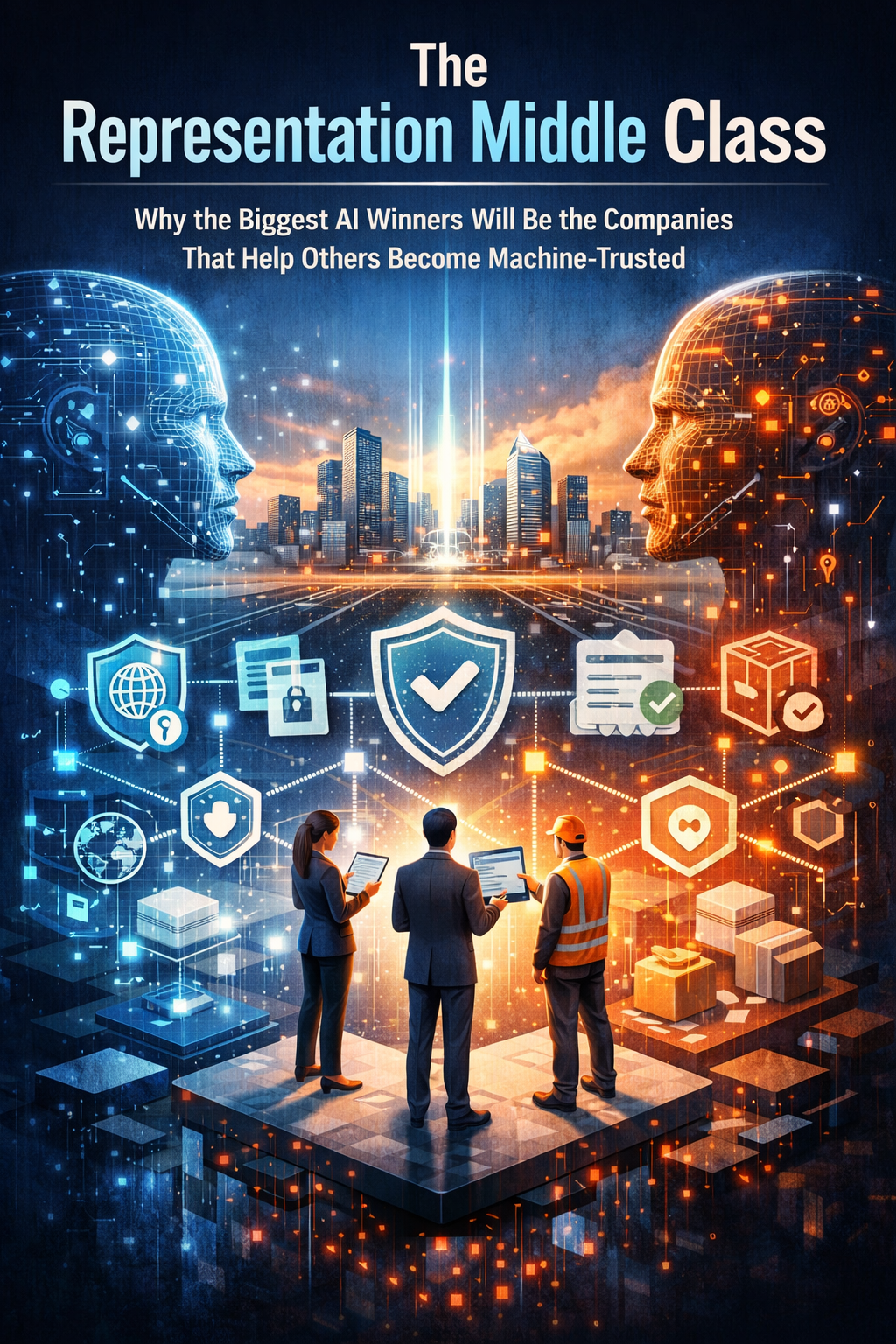
The Representation Middle Class: The market most people still cannot see
Everyone is looking for the big winners of the AI era.
Some point to model companies.
Some point to chip makers.
Some point to cloud platforms.
Some point to software firms embedding AI into products.
All of them matter.
But there is another category growing quietly in the background — and it may become one of the most durable business classes of the next decade.
It is not the company that builds the most powerful model.
It is not even the company that owns the most data.
It is the company that helps other organizations become machine-trusted.
That phrase may sound technical. The underlying idea is not.
In the industrial era, large fortunes were made not only by inventing new machines, but also by helping businesses become electrified, standardized, compliant, and scalable. In the internet era, many firms won not by inventing the web, but by helping others become searchable, transactable, secure, and cloud-ready.
The AI era is creating a similar middle layer.
I call it the Representation Middle Class.
These are the companies that help a business, institution, product, worker, asset, or service become easier for machines to identify, interpret, verify, compare, trust, and act upon. They may not always be the most visible firms in AI. But they may become some of the most important ones.
That is because the AI economy will not run only on intelligence.
It will run on trusted representation.
And trusted representation is not created automatically by a model.
What “machine-trusted” actually means
Let us start with a simple question.
What does it mean for a company to be machine-trusted?
It does not mean an AI model likes the company.
It does not mean the company has a chatbot.
It does not mean it uploaded a few PDFs and hoped a large language model would somehow understand them.
It means something much deeper.
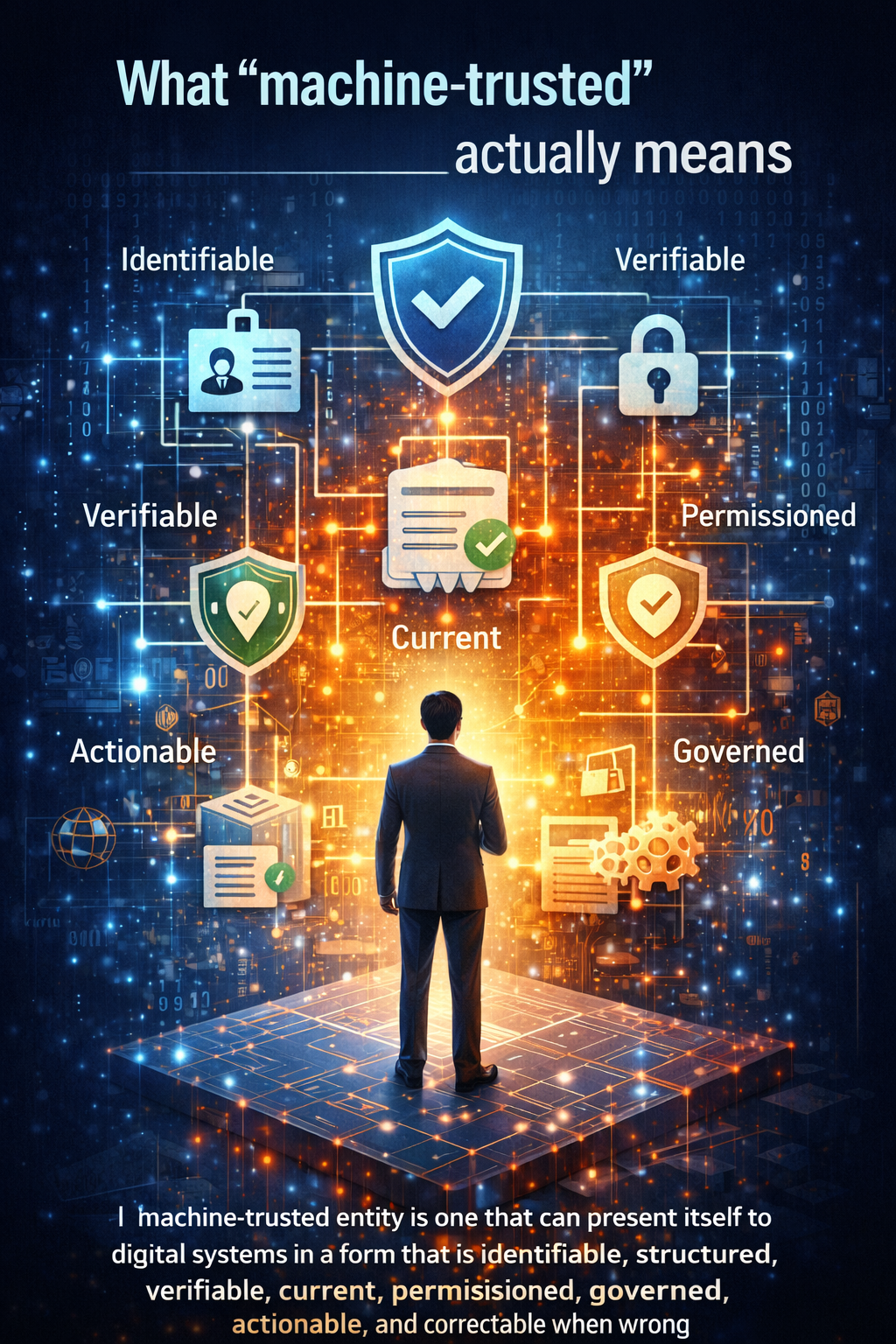
A machine-trusted company is one whose reality can be presented to digital systems in a form that is:
- identifiable
- structured
- verifiable
- current
- permissioned
- governed
- actionable
- correctable when wrong
In plain language, the machine can tell who the company is, what it claims, what evidence supports those claims, whether that evidence is valid, what actions are allowed, and what happens if something goes wrong.
That is a much higher standard than visibility.
It is the difference between being mentioned and being usable.
It is the difference between being online and being machine-ready.
A simple example: the small exporter
Imagine two small manufacturing firms in different countries.
Both make high-quality industrial valves.
Both have a decent website.
Both have customer testimonials.
Both are real businesses.
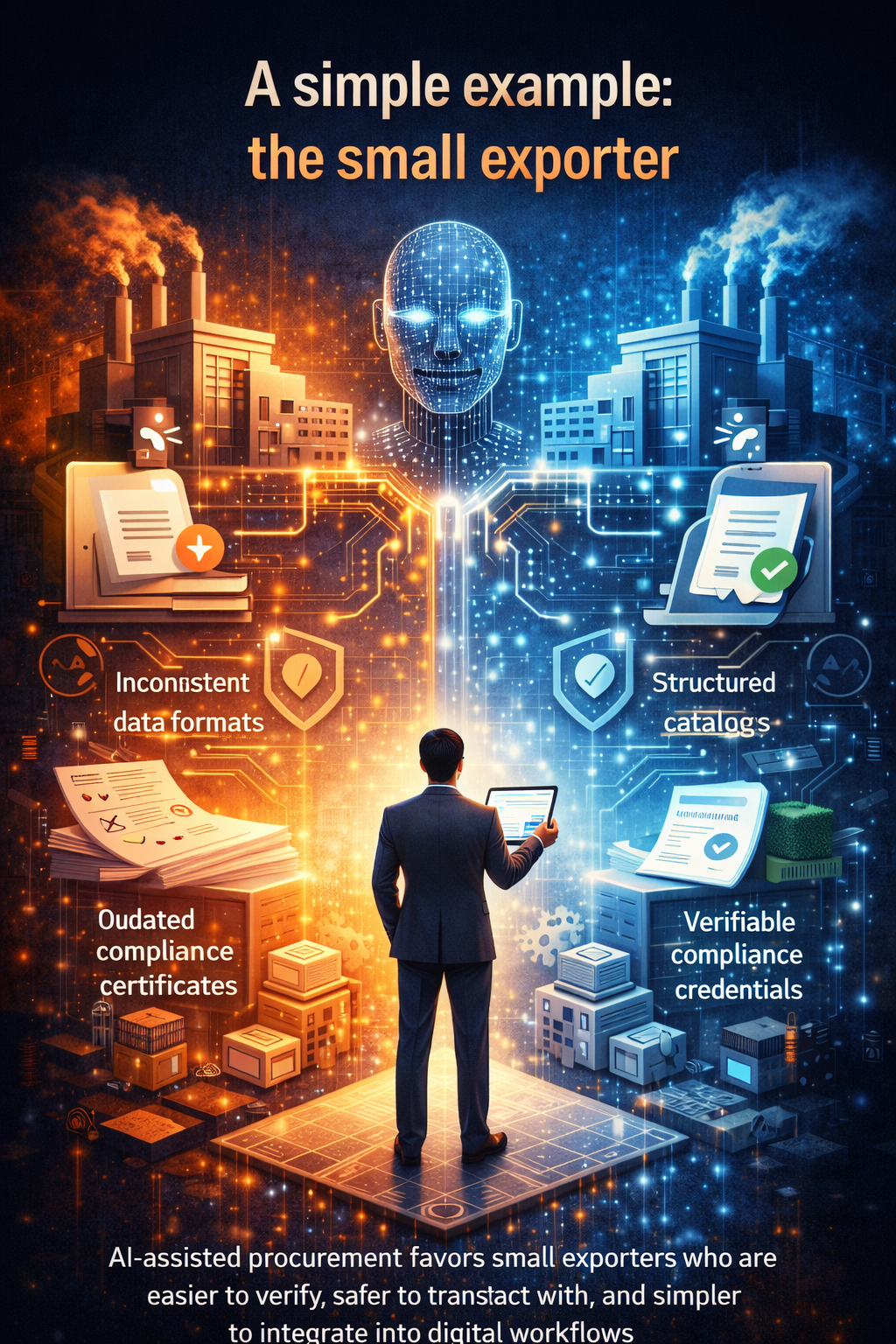
But the first company has product data in inconsistent formats, outdated compliance certificates, no machine-readable identity layer, weak traceability, scattered supplier records, and no trustworthy way for automated procurement systems to verify its claims.
The second company has structured product identifiers, verifiable compliance credentials, trusted digital signatures, traceable supply records, machine-readable catalogues, and a clear process for proving certifications and updating changes.
Which company will an AI-assisted procurement system prefer?
Not necessarily the one with the prettier website.
It will prefer the one that is easier to verify, safer to transact with, and simpler to integrate into a digital workflow.
That is the core idea.
As AI systems begin to assist with supplier discovery, contract review, fraud checks, lending decisions, content ranking, insurance assessment, identity verification, compliance validation, logistics routing, and customer service escalation, being understandable to humans will remain necessary — but being trustworthy to machines will become a new source of advantage.
The hidden market between intelligence and action
When most people imagine the AI economy, they see two layers:
- the intelligence layer
- the application layer
But that picture is incomplete.
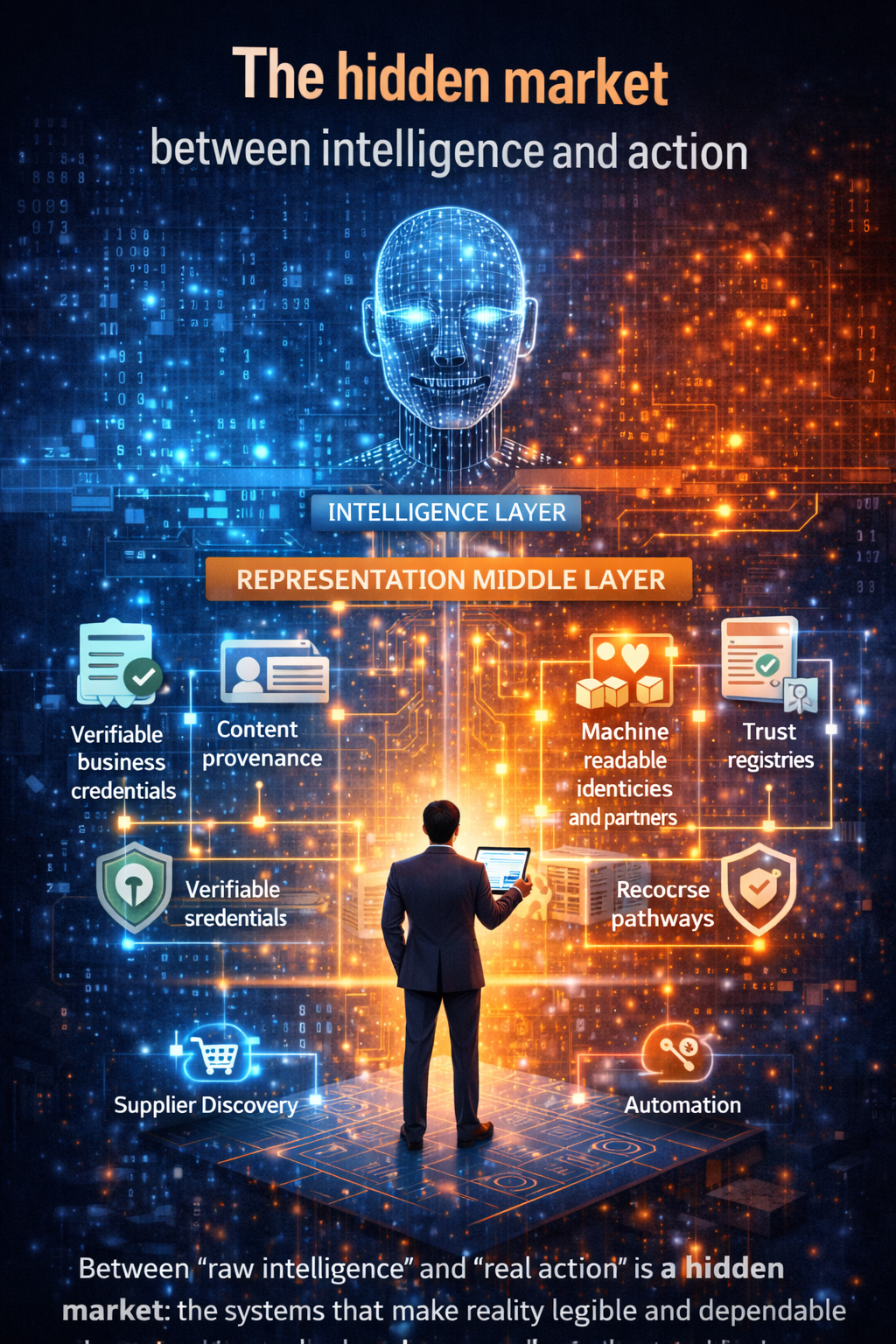
Between “raw intelligence” and “real economic action” sits a missing layer: the systems that make reality legible and dependable enough for machines to use safely.
This is where the Representation Middle Class comes in.
These companies will do work such as:
- issuing and managing verifiable business credentials
- proving content provenance
- structuring machine-readable product and supplier identities
- maintaining trust registries
- enabling machine-verifiable compliance
- creating recourse and dispute pathways
- translating messy real-world data into governable machine representations
- helping institutions define what an AI system is allowed to rely on
This is not glamorous work.
But it is economically foundational.
A surprising amount of AI value will be created not by making machines smarter, but by making the world cleaner, more provable, and safer for machine interaction.
Why this market is arriving now
This is not just a theory. Important pieces of the trust stack are already becoming more formalized across the world.
The W3C published Verifiable Credentials Data Model 2.0 as a W3C Recommendation on May 15, 2025, giving the digital ecosystem a stronger standards base for cryptographically secure, privacy-respecting, machine-verifiable credentials. The OpenID Foundation has also been expanding standards for verifiable credential issuance and wallet interoperability, and said in April 2026 that dozens of governments and ecosystem operators have selected its standards for wallet and credential programs. (W3C)
In Europe, the EU Digital Identity Wallet framework is moving toward deployment, with Member States expected to make wallets available by the end of 2026 under the updated eIDAS framework. Separately, the European Commission published a proposal for European Business Wallets in November 2025 to help firms securely identify themselves and exchange trusted documents across borders. (Digital Strategy EU)
In media and content, the C2PA / Content Credentials ecosystem is establishing a practical method for attaching provenance information to digital assets so users and systems can inspect the history of content rather than consume it blindly. (C2PA)
In products and supply chains, GS1 Digital Link is standardizing how product identifiers become web-resolvable, machine-usable links, while digital product passport efforts are pushing toward richer, more portable product traceability. (GS1)
At the governance layer, the EU AI Act entered into force on August 1, 2024, with staged applicability through 2026 and beyond, while NIST continues to expand the AI Risk Management Framework and related profiles. Together, these developments reinforce a broader shift: AI systems are no longer judged only on output quality, but increasingly on traceability, accountability, transparency, and risk-managed use in real institutions. (NIST)
Put these together and a pattern emerges.
The world is not only building smarter AI.
It is building more formal ways to answer five foundational questions:
- Who are you?
- What do you know?
- How do you prove it?
- What are you allowed to do?
- Who is accountable if the system is wrong?
That is exactly the environment in which the Representation Middle Class grows.
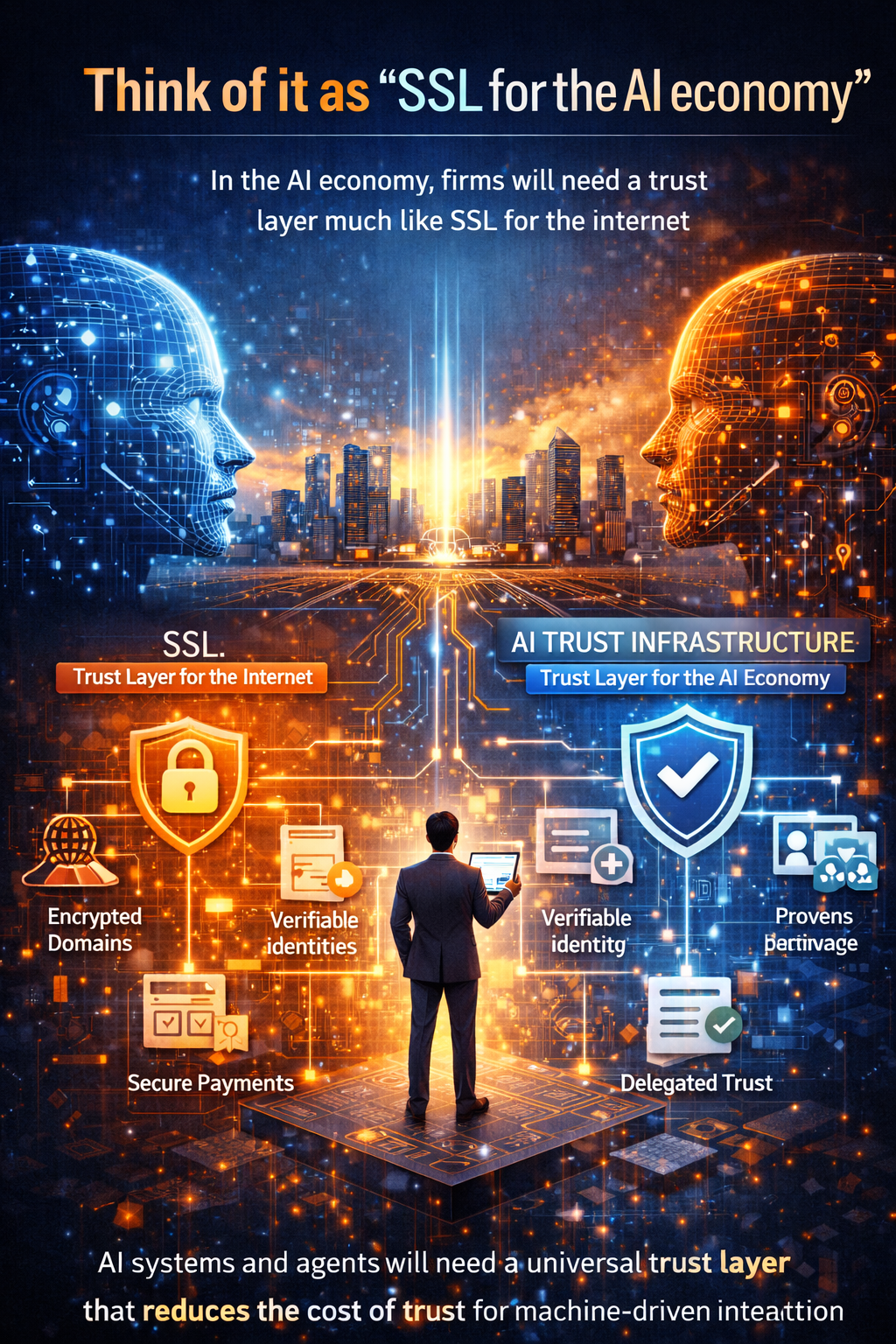
Think of it as “SSL for the AI economy”
The internet did not become commercially powerful just because websites existed.
It became commercially useful because trust layers emerged: domain verification, encryption, payment rails, authentication, certificates, identity checks, and fraud controls.
The AI economy will require something similar.
Not one product.
Not one vendor.
Not one standard.
Not one regulator.
An entire middle layer of trust-enabling capabilities.
The World Economic Forum argued in January 2026 that agentic commerce needs a universal trust layer “much like SSL certificates for websites” to allow legitimate commerce while introducing friction for malicious activity. That comparison is highly instructive. It suggests that the next commercial wave will not be built only on intelligence, but on the infrastructures that make autonomous interaction trustworthy. (World Economic Forum)
That trust layer will not be built only by the largest model companies.
It will also be built by the Representation Middle Class.
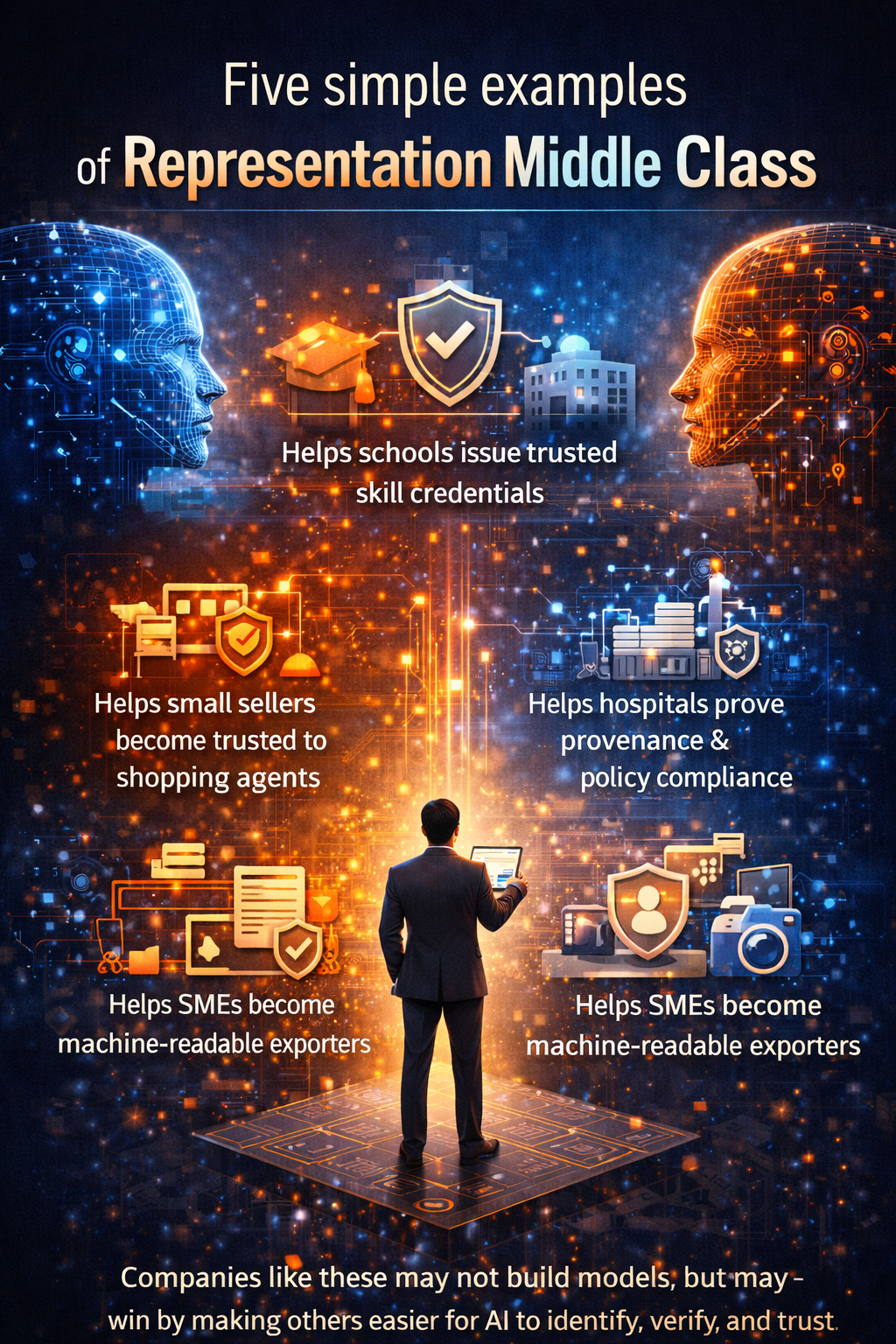
Five simple examples of the Representation Middle Class
1) The firm that helps schools issue trusted skill credentials
A student completes a program, earns a certificate, and applies for work.
A human recruiter may skim the PDF.
An AI hiring system will increasingly want something stronger:
Is this credential real?
Who issued it?
What skills does it certify?
Has it expired?
Was it revoked?
The winner here may not be the AI recruiter.
It may be the firm that helps schools and training providers issue credentials that machines can verify.
2) The firm that helps small sellers become trusted to AI shopping agents
Imagine a future where shopping agents compare sellers on behalf of consumers.
Those agents will care about more than price.
They will care about product authenticity, return policy, delivery history, warranty validity, merchant identity, provenance signals, and dispute pathways.
The winner may be the company that helps thousands of small merchants expose those signals in machine-usable form.
3) The firm that helps hospitals prove provenance and policy compliance
A hospital may have excellent doctors and strong care systems. But if AI is being used in diagnostics, workflow support, triage, billing, or care coordination, provenance, auditability, permission boundaries, and data lineage become essential.
The opportunity may lie with the company that helps the hospital become machine-trusted across those layers.
4) The firm that helps SMEs become machine-readable exporters
Many small firms do not fail because they are weak.
They fail because they are hard to verify at scale.
They are invisible to automated procurement.
Difficult to score across compliance requirements.
Expensive to integrate into digital trade networks.
The next winner may be the company that turns such firms into machine-trusted participants in global commerce.
5) The firm that helps creators prove provenance in an AI-saturated media ecosystem
As synthetic content proliferates, simple visibility becomes weaker and provenance becomes more valuable.
Not every creator will manage this stack alone. Many will depend on intermediaries that attach, preserve, and present trustworthy content history.
That intermediary belongs to the Representation Middle Class.
Why this matters more than it first appears
At first glance, this may sound like a support market.
It is not.
It may become one of the most important compounding advantage layers in the AI economy.
Why?
Because once machines begin mediating more economic decisions, the cost of being hard to trust rises sharply.
A company that is difficult to verify becomes slower to buy from, slower to lend to, slower to insure, slower to recommend, slower to integrate, and easier to exclude.
That means the Representation Middle Class does not merely create convenience.
It creates:
- discoverability
- eligibility
- insurability
- interoperability
- financing readiness
- market access
- lower friction
- lower trust cost
That is real economic value.
Where this fits inside Representation Economics
This is where the idea becomes bigger than a niche trust market.
My broader argument in Representation Economics is that AI value does not come only from the model. It depends on a deeper architecture of institutional capability.
That architecture can be understood through three layers:
SENSE
How reality becomes legible
CORE
How systems interpret, reason, and decide
DRIVER
How action is authorized, executed, and governed
The Representation Middle Class sits across all three.
In the SENSE layer
These firms help the world become more machine-legible.
They improve signal quality.
They attach signals to stable entities.
They structure state.
They help maintain current, usable representations over time.
In the CORE layer
They improve machine reasoning by improving what enters the reasoning system.
A model can only decide well if the inputs it receives are meaningful, structured, current, and trustworthy.
In the DRIVER layer
They help define permissions, proofs, accountability, recourse, and execution boundaries.
In other words, they do not merely make reality visible.
They make action defensible.
That is why this category matters so much.
Why the biggest AI companies may not own this layer
There is a common assumption that hyperscalers or frontier labs will absorb every profitable layer of the AI stack.
That will happen in some places.
But not everywhere.
There are at least four reasons the Representation Middle Class may remain large and valuable.
First, trust is local and sector-specific
Healthcare, trade, education, finance, media, industrial supply chains, and public services all define trust differently.
Second, representation is messy
It involves documents, workflows, claims, identities, exceptions, revocations, disputes, audit trails, and regional compliance. This is not a neat one-size-fits-all abstraction.
Third, institutions want control
Many organizations will not want a single external AI giant to define how they are represented, verified, and acted upon.
Fourth, standards create room for ecosystems
Open standards do not eliminate markets. In many cases, they create them by reducing ambiguity and enabling interoperability.
That is why this middle layer can become enormous.
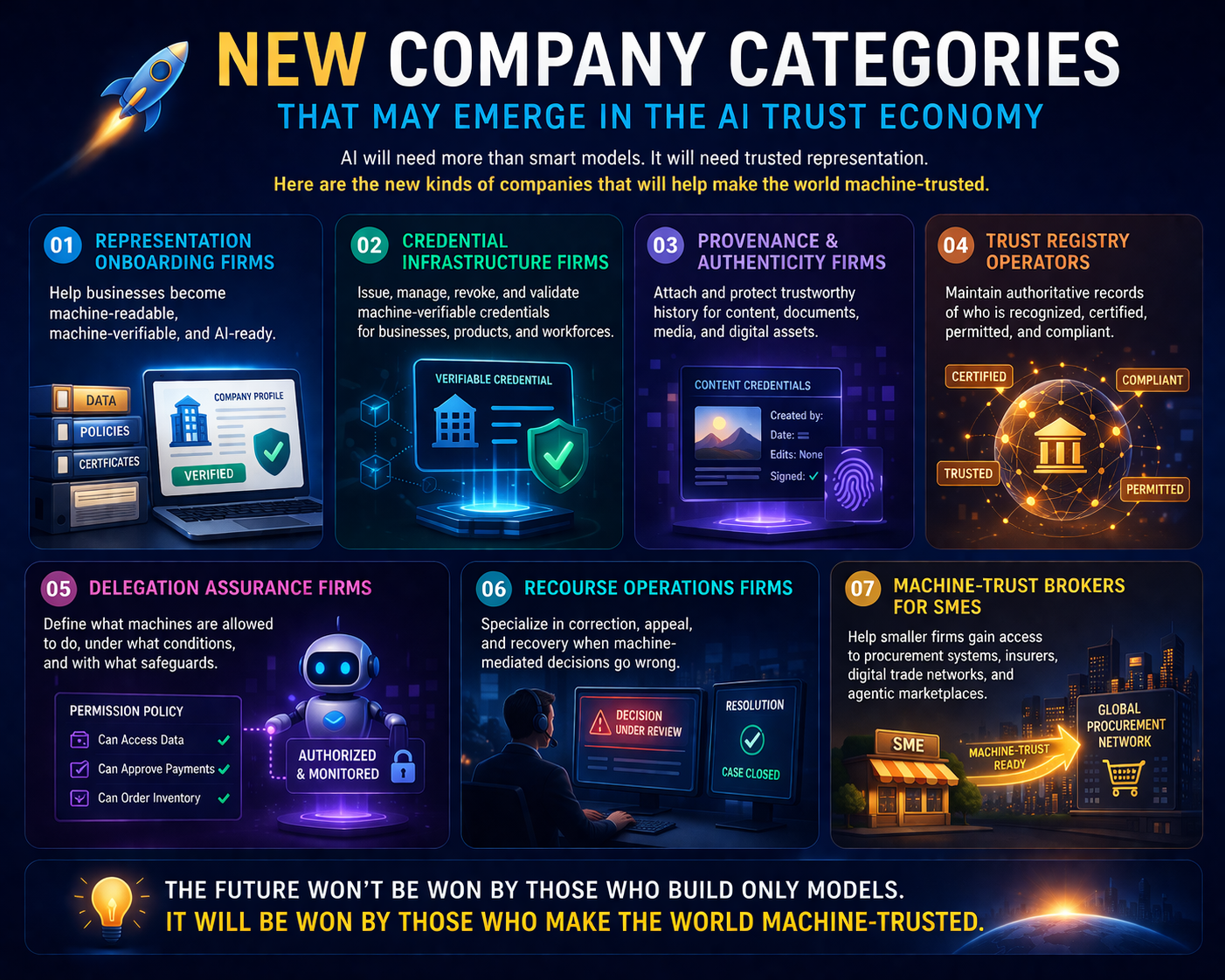
New company categories that may emerge
The Representation Middle Class is not one market. It is a family of markets.
Here are some of the company types that may emerge or grow rapidly.
Representation onboarding firms
They help businesses become machine-readable, machine-verifiable, and AI-ready.
Credential infrastructure firms
They issue, manage, revoke, and validate machine-verifiable business, workforce, product, or compliance credentials.
Provenance and authenticity firms
They attach trustworthy history to content, documents, media, and digital assets.
Trust registry operators
They maintain authoritative or semi-authoritative records of who is recognized, certified, permitted, or compliant.
Delegation assurance firms
They help define what machines are allowed to do on behalf of organizations, and under what checks.
Recourse operations firms
They specialize in correction, appeal, and recovery when machine-mediated decisions go wrong.
Machine-trust brokers for SMEs
They help smaller firms gain access to procurement systems, insurer workflows, digital trade networks, or agentic marketplaces.
This is why I call it a middle class.
It is not one monopoly.
It is not one dominant platform.
It is a broad economic stratum.
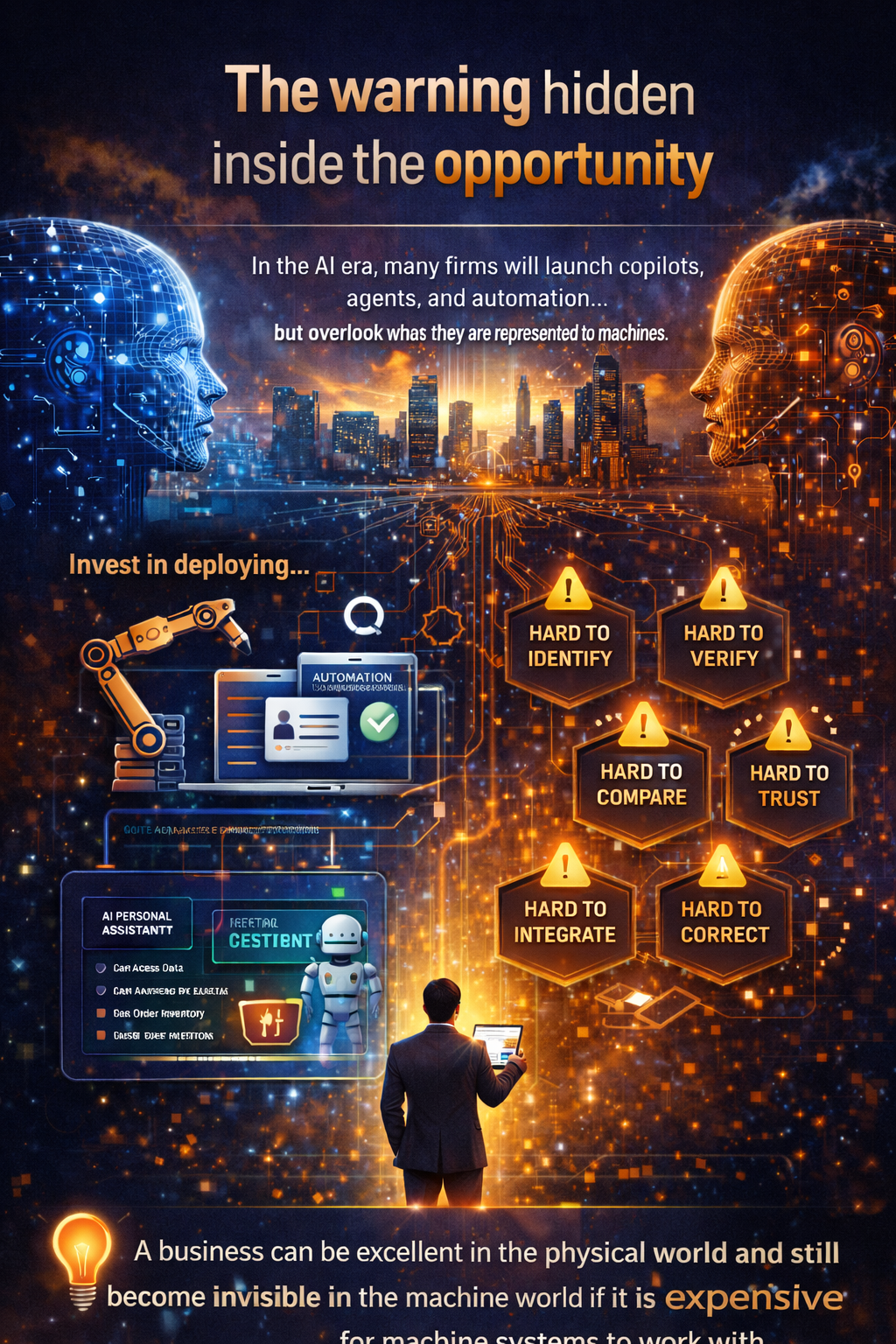
The warning hidden inside the opportunity
This idea is also a warning.
In the AI era, many firms will focus on copilots, agents, and automation while underinvesting in how they are represented to machines.
That is risky.
A business can be excellent in the physical world and still become economically weaker in the machine-mediated world if it is:
- hard to identify
- hard to verify
- hard to compare
- hard to trust
- hard to integrate
- hard to correct
This is how invisibility happens in the AI economy.
Not because the company disappeared.
Because it became too expensive for machine systems to work with.
How existing companies can win
You do not need to become a frontier model company to win this decade.
But you do need to ask a different set of strategic questions.
- Can a machine reliably identify us?
- Can a machine verify our claims?
- Can a machine understand our products, services, and capabilities?
- Can a machine know what is current versus obsolete?
- Can a machine detect permission boundaries?
- Can a machine escalate uncertainty or correct a wrong action?
- Can our identity, compliance, provenance, and trust posture travel across ecosystems?
These are no longer technical hygiene questions.
They are strategic questions.
The firms that answer them early will enjoy lower transaction friction, better interoperability, stronger trust posture, and greater machine-era competitiveness.
Why boards and C-suites should care now
Board members and senior executives should not read this as a narrow infrastructure story.
They should read it as a market redesign story.
In the coming years, AI systems will increasingly influence who gets discovered, who gets shortlisted, who gets financed, who gets insured, who gets integrated, and who gets excluded.
That means competitive advantage will not come only from internal productivity gains.
It will also come from how well an institution can present itself to machine-mediated markets.
This is why the Representation Middle Class matters so much.
It reduces the cost of trust.
And in machine-mediated markets, reducing the cost of trust may become one of the deepest new sources of value creation.
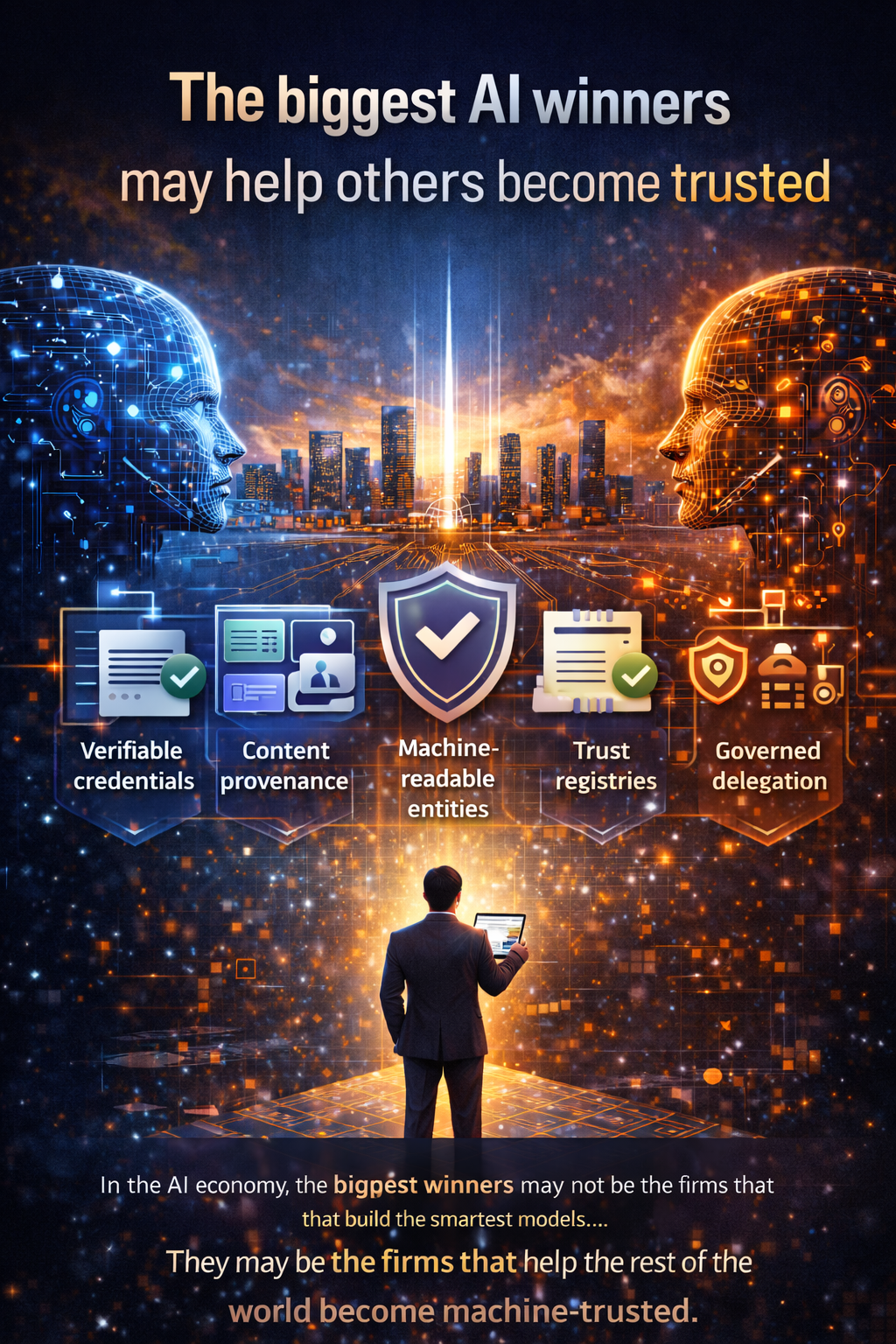
Conclusion: the biggest AI winners may help others become trusted
The biggest AI story of the next decade may not be the race to build the smartest model.
It may be the race to decide whose version of reality becomes machine-trusted — and which companies profit by helping the rest of the world earn that trust.
That is why the Representation Middle Class matters.
It is not a side market.
It is not just middleware.
It is not a temporary services wave.
It is the emerging economic class that will help institutions cross the distance between being digitally present and being economically actionable in a machine-mediated world.
In Representation Economics, we often focus on the firms that own the models, the chips, the clouds, or the applications.
But many of the most important winners may sit somewhere else.
They will be the companies that help other companies become machine-trusted.
And in the AI economy, that may prove to be one of the most valuable roles of all.
Conclusion Column: What leaders should do next
For boards, CEOs, CIOs, and strategy teams, the practical takeaway is simple:
Do not ask only, “How do we use AI?”
Also ask, “How do we become machine-trusted?”
That means:
- auditing how your firm appears to machine systems
- strengthening identity, provenance, and credential layers
- making product, supplier, and compliance information more machine-readable
- defining what AI systems may rely on and what they may not
- building recourse into digital decision flows
- treating trust infrastructure as strategic infrastructure
The companies that move early will not merely adopt AI better.
They will become easier for the AI economy to see, trust, and work with.
That is a deeper advantage.
Glossary
Representation Economics
A way of understanding the AI economy in which value increasingly depends on how reality is represented, verified, governed, and made actionable for machines.
Representation Middle Class
The emerging group of firms that help other organizations become machine-trusted through identity, credentials, provenance, structured data, governance, and recourse.
Machine-trusted
A state in which a person, firm, product, asset, or claim can be reliably identified, verified, governed, and used safely in machine-mediated workflows.
Verifiable Credentials
Cryptographically secured digital credentials that can be checked by software systems and shared in privacy-preserving, interoperable ways. (W3C)
Content Credentials
A provenance approach associated with the C2PA ecosystem that helps users and systems inspect the origin and history of digital media. (C2PA)
Digital Product Passport
A structured digital record intended to make product-related information more portable, traceable, and usable across value chains and regulatory environments. (GS1)
SENSE–CORE–DRIVER
A framework for understanding how AI systems first represent reality, then reason over it, and finally act within permission, accountability, and governance boundaries.
FAQ
What is the Representation Middle Class in AI?
It is the set of companies that help others become machine-trusted. They do this through identity, credentials, provenance, registries, compliance proofs, structured data, and governed delegation.
Why is this category important?
Because more business decisions are being mediated by software and AI systems. That makes machine trust a competitive advantage, not just a technical feature.
Is this only about regulation?
No. Regulation accelerates the need, but the deeper driver is economic. When machines assist in discovery, ranking, qualification, procurement, and action, firms that are easier to trust become easier to transact with.
Who benefits most from this shift?
SMEs, exporters, hospitals, schools, financial firms, creators, manufacturers, logistics players, and any enterprise that must prove identity, quality, provenance, or permission in digital workflows.
Is this connected to digital identity wallets and verifiable credentials?
Yes. The global move toward digital wallets, verifiable credentials, and interoperable trust infrastructure is one of the clearest signals that machine-verifiable trust is becoming mainstream. (OpenID Foundation)
Why should boards care?
Because AI-mediated markets will increasingly influence who gets discovered, financed, contracted, and trusted. Machine trust is becoming a strategic issue, not just a technical one.
How should companies respond?
They should audit how they appear to machine systems, strengthen structured trust signals, improve provenance and credential layers, and design clear governance and recourse paths before autonomous systems become normal in their market.
Not every institution will win the representation race outright — but a representation middle class is forming: organizations legible enough to participate in the AI economy without yet commanding the premium the leaders will capture.


Raktim Singh is an AI and deep-tech strategist, TEDx speaker, and author focused on helping enterprises navigate the next era of intelligent systems. With experience spanning AI, fintech, quantum computing, and digital transformation, he simplifies complex technology for leaders and builds frameworks that drive responsible, scalable adoption.