
Representation Orphans
Why the AI economy is creating visible entities without clear custodians—and why that may become one of its deepest governance and market failures
The next AI failure will not always be invisibility. It will be abandoned visibility.
Most discussions about AI still revolve around a familiar concern: exclusion.
Who gets left out?
Who remains invisible to digital systems?
Who is missing from the data?
These are important questions. But they are no longer the only ones.
A second problem is now emerging, and in some ways it may prove even more dangerous:
What happens when a person, firm, asset, or event becomes visible to machines—but no institution is clearly responsible for maintaining, correcting, or defending that representation?
That is the world of Representation Orphans.
A Representation Orphan is not fully invisible. It is not outside the system. It has already entered machine-readable reality. It appears in databases, scoring systems, risk engines, identity rails, workflow tools, recommendation models, fraud systems, compliance filters, and operational dashboards.
But no one clearly owns the long-term integrity of that representation.
No one ensures it stays current.
No one ensures that errors are corrected quickly.
No one ensures that context travels with the data.
No one ensures that appeals are meaningful.
No one ensures that when machines act, the represented entity is being treated fairly, coherently, and accurately.
This is where the next layer of the AI economy begins.
In the Representation Economy, value flows toward what can be seen, modeled, trusted, and acted upon. But as machine visibility expands, a harder question appears:
Who owns the burden of keeping machine-readable reality alive once it exists?
That is no longer a technical question. It is becoming an institutional one.
Representation Orphans are people, firms, or assets that become visible to AI systems but lack any institution responsible for maintaining, correcting, or defending their machine-readable representation. In the AI economy, visibility without stewardship creates systemic risk.
What is a Representation Orphan?
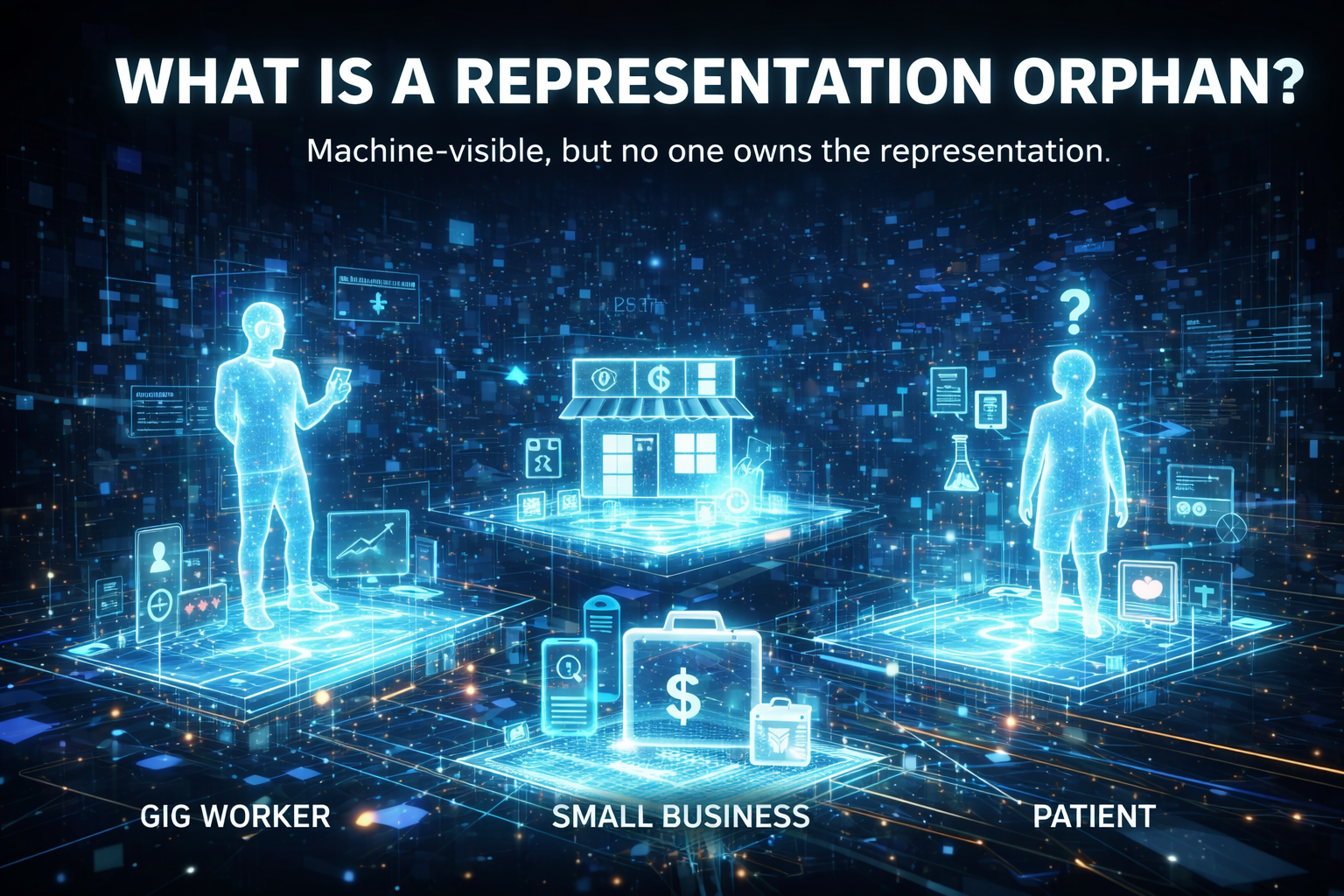
A Representation Orphan is a person, firm, asset, or state of reality that has become machine-visible but lacks a clear institutional custodian for its representation.
This sounds abstract until you look at how modern systems actually work.
A gig worker may exist across ratings, GPS traces, payment histories, identity checks, performance dashboards, and customer complaints. Many systems can “see” fragments of that person. But who owns the full integrity of that machine-readable identity across platforms? In most cases, no one.
A small business may be visible to lenders through payments data, visible to tax systems through filings, visible to marketplaces through reviews, visible to logistics providers through shipments, and visible to fraud systems through anomaly checks. But if those representations drift apart, decay, or conflict, who is responsible for reconciliation? Again, often no one.
A patient may leave traces across hospitals, labs, insurers, pharmacies, devices, wearables, and apps. The patient is data-rich, but institutionally fragmented. Machine visibility exists. Representation ownership does not.
That is the orphan condition.
The orphan is not unseen.
The orphan is seen without stewardship.
“This article is part of the broader Representation Economics framework, which explains how value in the AI era depends on what institutions can see (SENSE), understand (CORE), and responsibly act on (DRIVER).”
Why this problem will grow in the AI economy
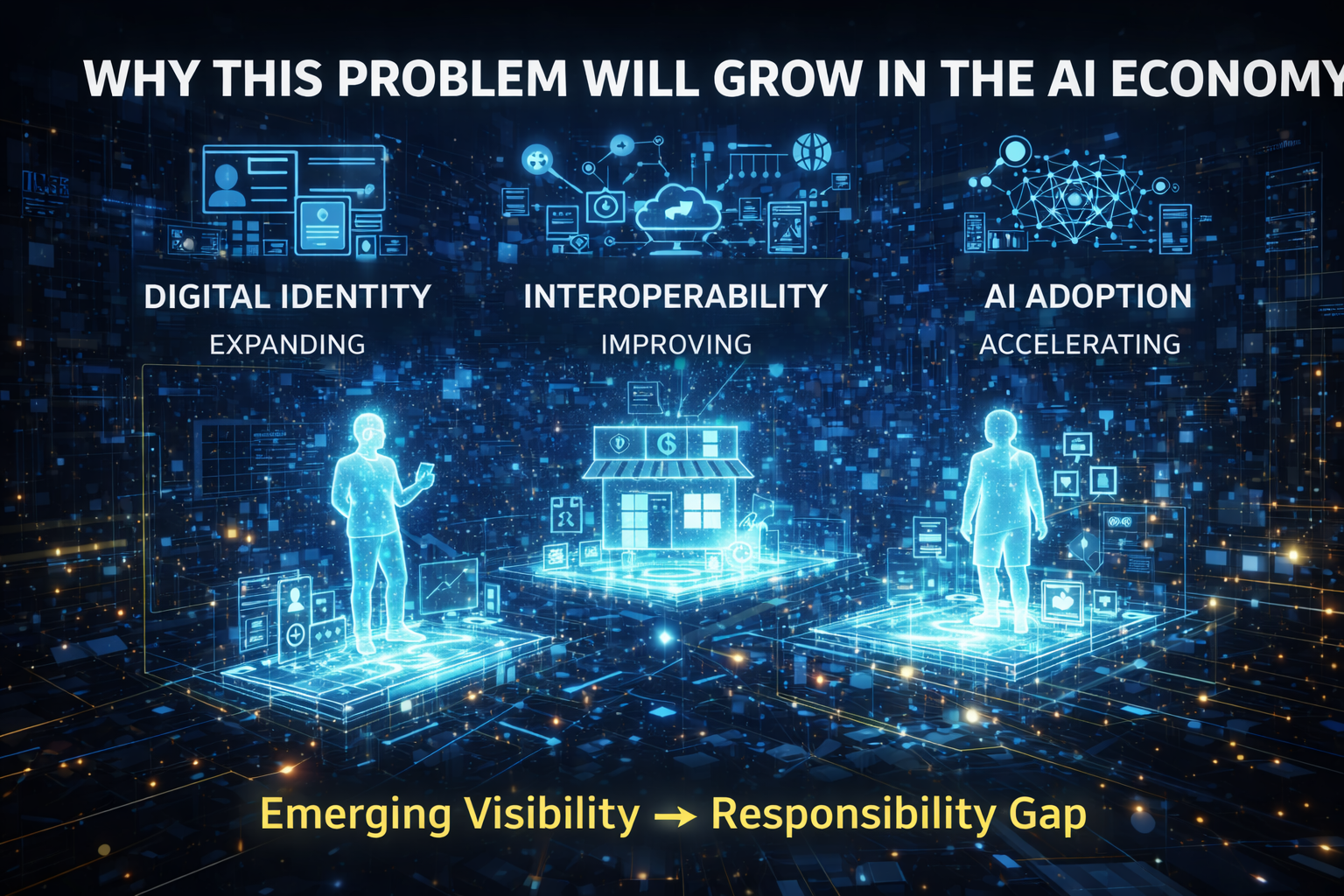
The AI economy generates more machine-readable traces every day.
Digital identity systems are expanding. Interoperability is improving in some sectors. AI systems are already being used to classify, score, detect anomalies, automate routing, personalize interaction, assist with forms, and support decisions across government, healthcare, finance, logistics, and labor markets. OECD’s recent framework on AI in government highlights uses such as answering citizen queries, assisting with forms, improving productivity, and detecting fraud, while emphasizing that these benefits depend on strong data and information management, engagement processes, and guardrails. (OECD)
OECD’s 2025 work on AI in social security makes a similar point: AI can improve service access and efficiency, but only when digital infrastructure, interoperability, and governance frameworks are in place. (OECD)
The World Bank’s 2025 AI foundations work reinforces the same broader idea. It argues that inclusive and sustainable AI adoption depends on foundations such as connectivity, compute, context, and capability—and that many countries and institutions still lack them. (World Bank)
This is exactly why Representation Orphans matter.
As machine visibility expands faster than institutional accountability, we create a growing class of entities that are visible enough to be acted upon, but not governed well enough to be represented safely.
In other words, the next AI divide will not only be between those who are visible and invisible. It will also be between those whose machine-readable reality is properly governed and those whose reality is merely captured and abandoned.
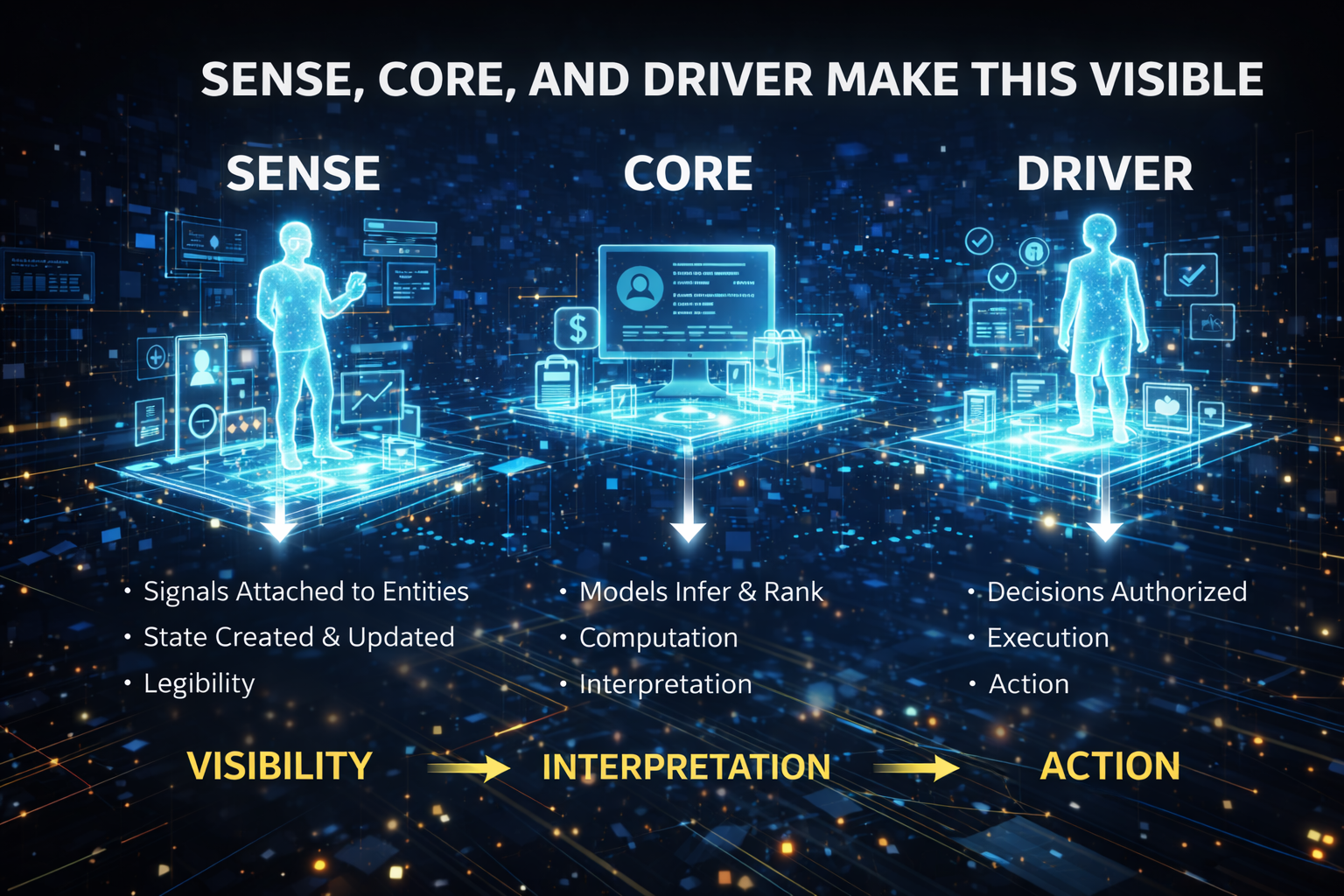
SENSE, CORE, and DRIVER make this visible
This is where the SENSE–CORE–DRIVER framework becomes especially useful.
SENSE: reality becomes machine-legible
SENSE is where institutions detect signals, attach them to entities, create state representations, and update those states over time.
This is the layer where Representation Orphans are born.
The moment an entity is sensed across systems, it starts becoming legible to machines. A person gets a digital profile. A supplier gets a risk score. A vehicle acquires telematics traces. A business acquires transaction history. A worker accumulates ratings. A patient leaves interoperable health signals.
But sensing is easier than stewardship.
The system can collect signals without committing to the ongoing quality of representation. That is the danger.
What begins as visibility can quickly become abandonment if no one takes responsibility for continuity, correction, and context.
CORE: fragmented representation becomes computed reality
CORE is where models infer, rank, predict, score, and decide.
Once fragmented representations enter CORE, they begin shaping real outcomes:
- loan approvals,
- priority routing,
- compliance flags,
- hiring screens,
- insurance pricing,
- service escalation,
- fraud suspicion,
- benefit eligibility.
At this point, the machine no longer just sees. It interprets.
And when no institution clearly owns the representation, bad interpretations persist longer than they should.
The same fragmented identity may produce one risk score in one system, another in a second system, and silent exclusion in a third. The represented entity rarely sees the full picture, and often cannot repair it.
DRIVER: action happens without a true custodian
DRIVER is where institutions authorize action, verify evidence, execute decisions, and provide recourse.
This is where the orphan problem becomes serious.
If no institution owns the integrity of the representation, then who is accountable when action is taken on it?
Who ensures that a wrong risk flag can be corrected?
Who ensures that a business profile is not silently downgraded?
Who ensures that a worker’s fragmented digital trail does not suppress opportunity?
Who ensures that a patient’s scattered data does not create harmful gaps in care?
Without DRIVER discipline, orphaned representation becomes a legitimacy problem.
This is one reason current AI governance discussions increasingly stress not only model risk, but operating processes, human validation, and accountability structures. McKinsey’s 2025 State of AI work found that organizations seeing higher bottom-line impact were more likely to have CEO oversight of AI governance and defined processes for when model outputs require human validation. (McKinsey & Company)
SENSE creates visibility.
CORE turns visibility into interpretation.
DRIVER turns interpretation into action.
Representation Orphans emerge when visibility exists without stewardship across these layers.
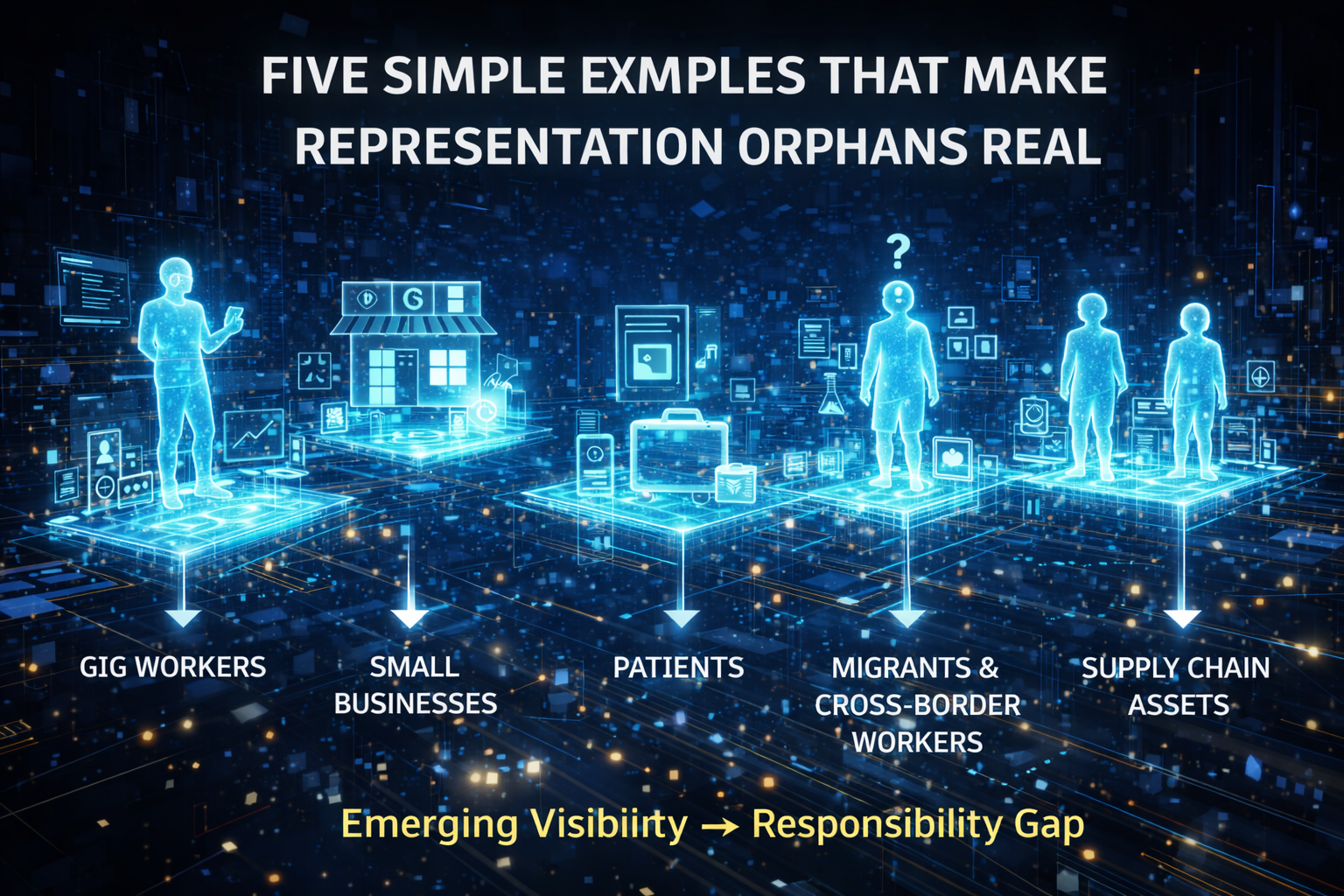
Five simple examples that make Representation Orphans real
-
Gig workers
A driver or delivery worker may be represented across ratings, GPS traces, earnings histories, cancellation data, identity checks, complaints, and productivity dashboards. But no single institution owns the worker’s full machine-readable identity. The worker becomes visible to many systems, yet defensible to none.
-
Small businesses
A small merchant may exist across tax systems, payment platforms, review sites, logistics records, ad systems, supplier networks, and lender models. Machines can see pieces of the business. But if those pieces conflict, who repairs the business’s machine-readable reality? Usually the burden falls on the business itself, often without the tools or leverage to do so.
-
Patients
In fragmented health systems, a patient’s representation may be distributed across hospitals, labs, insurers, pharmacy systems, diagnostic tools, and consumer apps. Interoperability can improve care, but fragmented stewardship can still create orphaned representations that no one fully curates. WEF’s recent work on digital public infrastructure and connected futures underscores that trusted, interoperable systems are increasingly essential to scalable digital outcomes. (World Economic Forum)
-
Migrants and cross-border workers
A person moving across jurisdictions may be partially visible in identity systems, employment records, payment systems, benefits systems, and border systems. Each institution sees something. Few own the whole continuity of representation.
-
Supply chain assets
A shipment, component, or vendor may be represented in ERPs, customs systems, tracking systems, ESG disclosures, compliance tools, and financing platforms. But when inconsistencies arise, the asset may become machine-visible without any single custodian responsible for cross-system truth.
These are not edge cases.
They are previews of a wider structural problem.
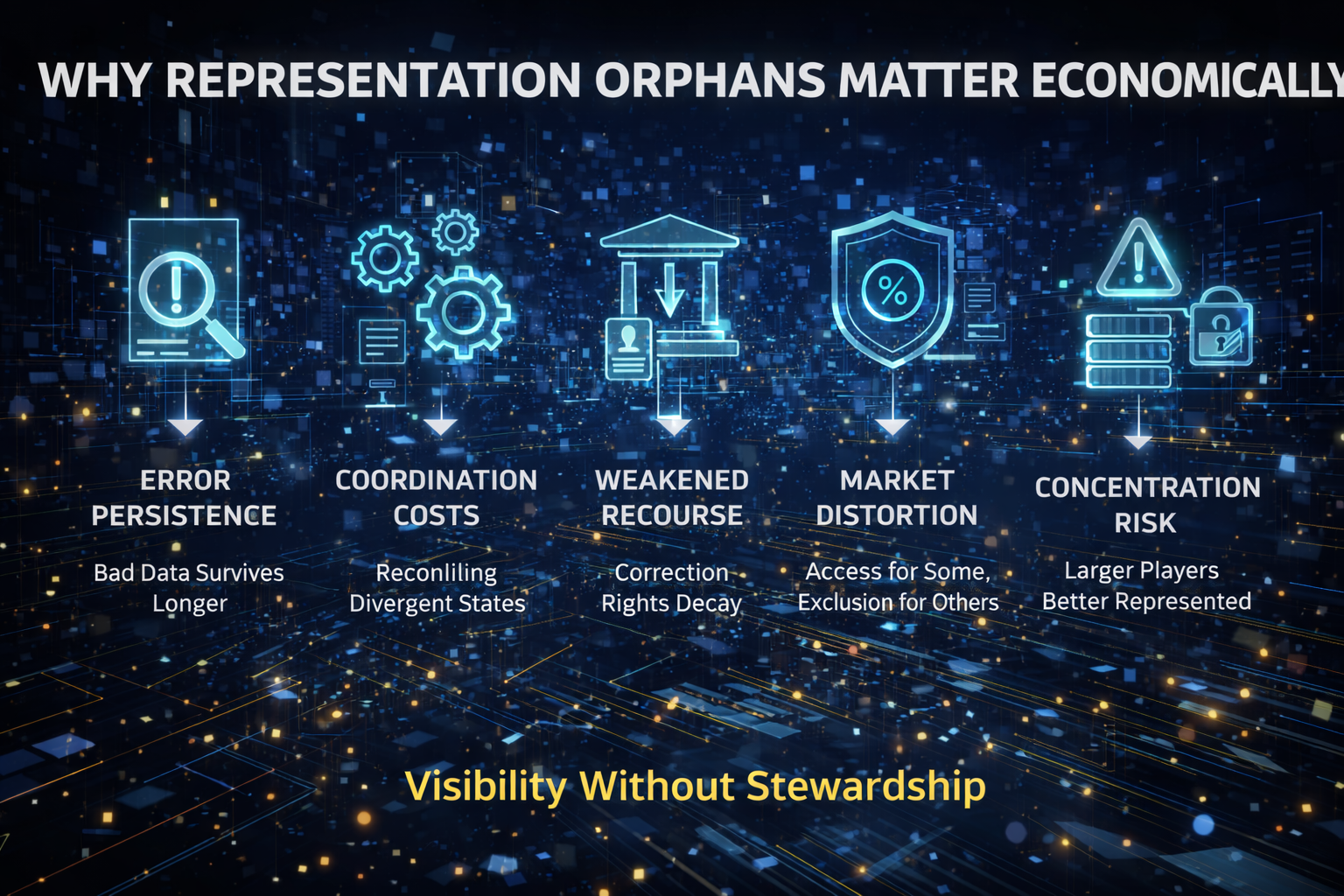
Why Representation Orphans matter economically
This is not only a moral or governance issue. It is an economic one.
Representation Orphans create hidden costs across the AI economy.
They increase error persistence
If no institution clearly owns representation quality, wrong data and outdated states survive longer.
They raise coordination costs
Multiple systems can see the same entity, but no one is clearly responsible for reconciliation.
They weaken recourse
A person or firm may know the system is wrong, yet have no clear place to correct the representation.
They distort market access
Entities may be visible enough to be judged, but not well represented enough to compete fairly.
They increase concentration risk
Larger players can often manage, defend, synchronize, and repair their machine-readable reality better than smaller ones.
This is where Representation Economics sharpens the conversation. In the AI era, value does not merely flow to intelligence. It flows to institutions that can build and maintain machine-readable reality with legitimacy.
Representation Orphans are what happen when visibility expands faster than responsibility.
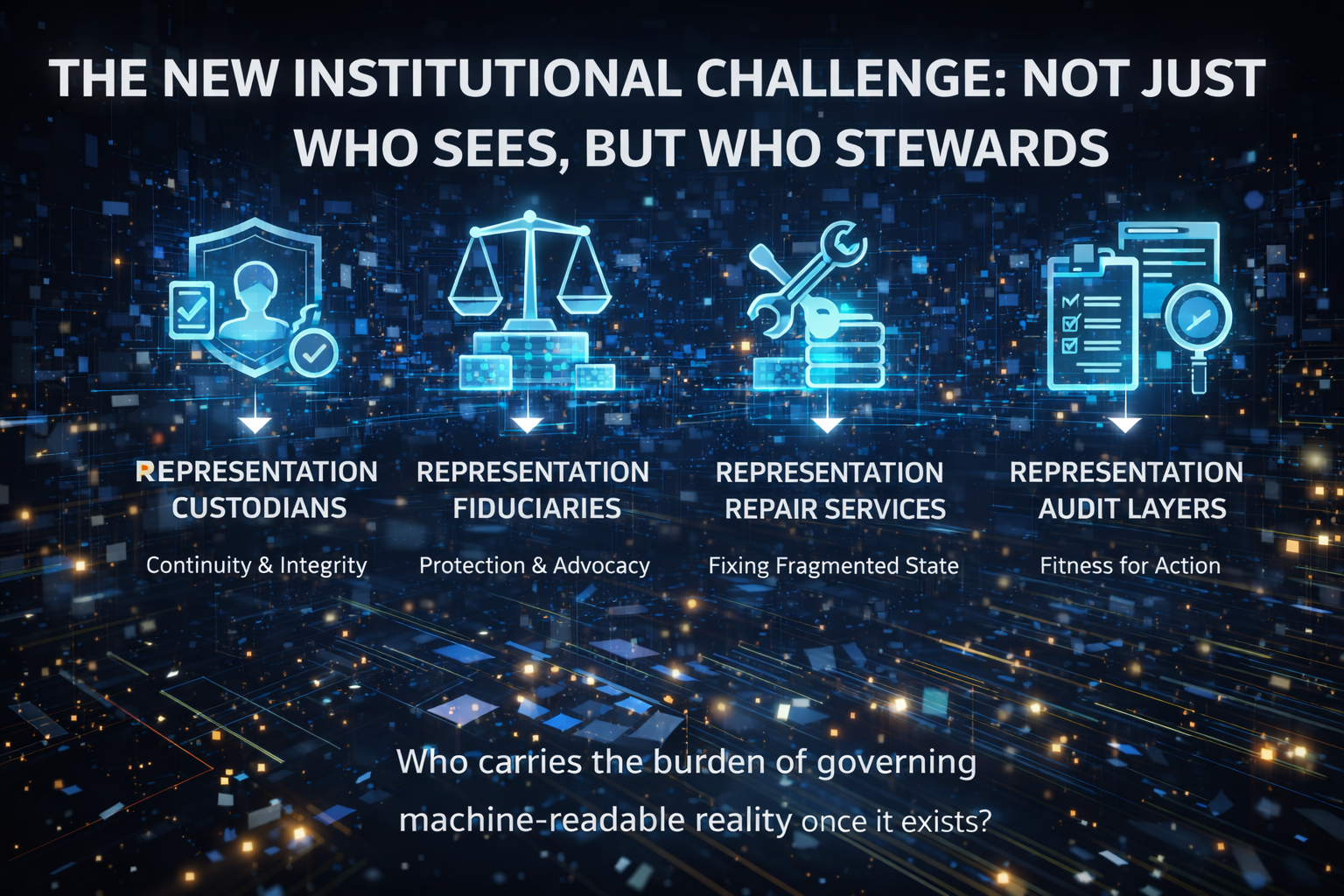
The new institutional challenge: not just who sees, but who stewards
This is the next strategic question for boards, regulators, and platform leaders:
Who is the custodian of machine-readable identity once an entity enters the AI economy?
That question matters because sensing reality is no longer the hard part alone. Increasingly, the harder challenge is:
- maintaining continuity,
- preserving context,
- handling correction,
- governing cross-system identity,
- and deciding who carries the burden of representation quality over time.
This suggests that the AI economy may need new institutional forms.
Representation custodians
Entities responsible for maintaining the continuity and integrity of machine-readable representations over time.
Representation fiduciaries
Trusted actors who protect the interests of the represented, especially where the represented entity lacks bargaining power.
Representation repair services
Institutions that help reconcile broken, inconsistent, or outdated machine-readable reality.
Representation audit layers
Mechanisms that test whether a machine-readable entity is fit for action across systems.
This is one reason your broader Representation Economics body of work matters. Ideas such as recourse platforms, fiduciaries, and clearinghouses become more compelling once we name the condition that makes them necessary in the first place.
That condition is not only invisibility.
It is abandoned visibility.
The board-level implication
Most leaders still ask:
How do we make our business visible to AI?
A better question is:
Which entities in our ecosystem are becoming machine-visible without proper representation ownership?
That question changes the conversation.
It forces leaders to examine:
- where customer profiles fragment,
- where supplier identities drift,
- where employee or contractor records diverge,
- where product or asset states lose continuity,
- where correction rights are weak,
- and where machines act on entities that no institution fully stewards.
That is a much more serious AI strategy conversation than simply asking which model to buy.
McKinsey’s recent survey results suggest that value creation from AI is increasingly tied to organizational rewiring, governance, operating model discipline, and validation processes—not just access to powerful models. (McKinsey & Company)
Boards that ignore the orphan problem may think they are scaling intelligence when, in reality, they are scaling brittle, fragmented, and weakly governed representation.
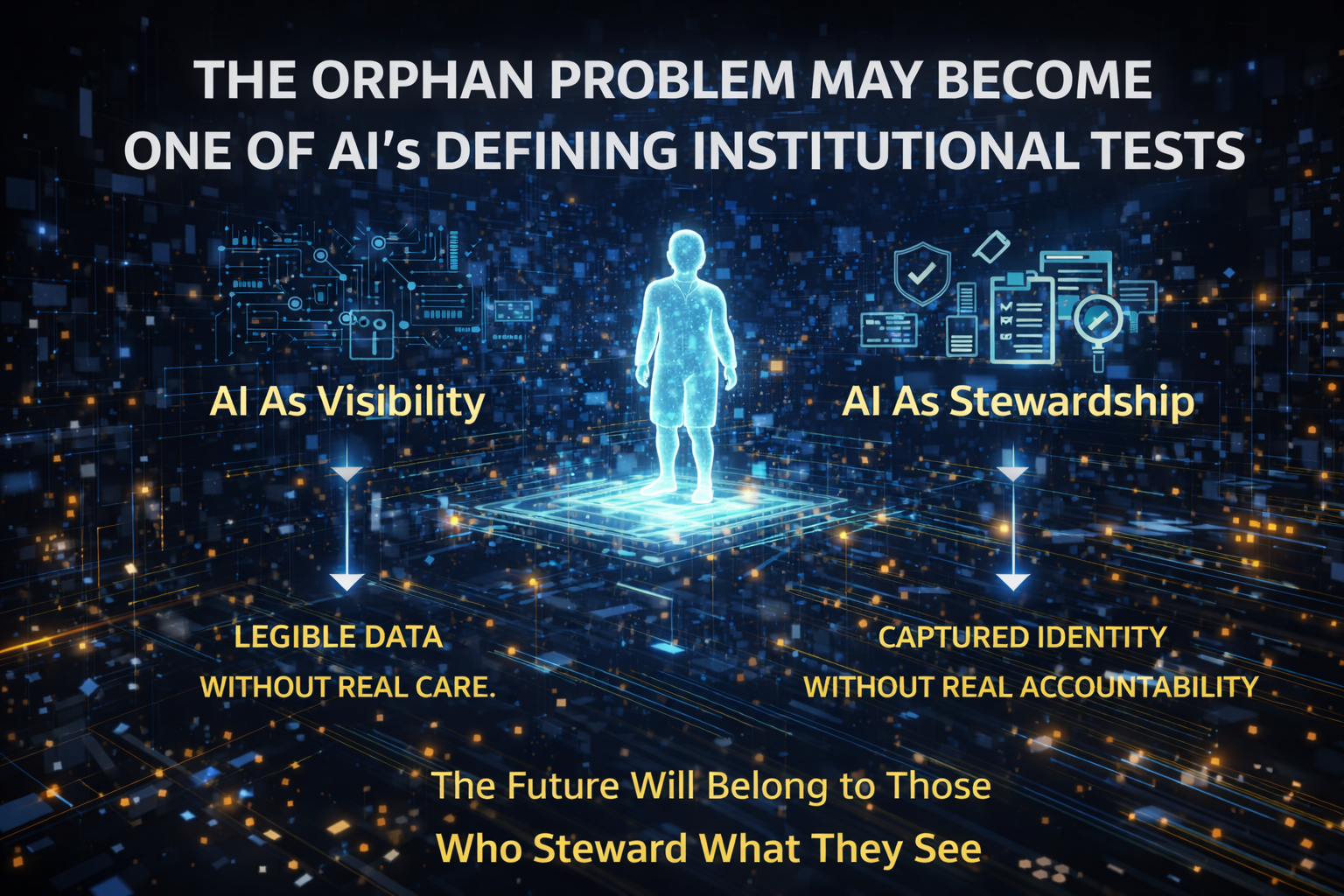
Conclusion: the orphan problem may become one of AI’s defining institutional tests
In the early digital era, the challenge was inclusion.
How do we get more people, firms, and assets into digital systems?
In the AI era, the challenge is becoming more demanding.
How do we ensure that what enters machine-readable reality does not become abandoned inside it?
That is the real significance of Representation Orphans.
The future will not belong only to those who can sense more.
It will belong to those who can steward what they sense.
The institutions that win in the AI economy will not simply have stronger CORE intelligence. They will invest in SENSE with discipline and build DRIVER with legitimacy. They will understand that machine-readable reality is not a one-time technical artifact. It is a living institutional responsibility.
Because in the end, the danger is not only that machines fail to see.
The deeper danger is that machines see—and no one remains fully responsible for what they think they see.
That is where Representation Economics moves from theory to necessity.
Glossary
Representation Orphans
People, firms, assets, or states of reality that become machine-visible without any institution clearly owning the responsibility to maintain, correct, or defend their representation.
Representation Economics
A framework for understanding how value in the AI era depends on what institutions can sense, model, govern, and act upon.
SENSE
The layer where signals are detected, attached to entities, modeled as state, and updated over time.
CORE
The reasoning layer where AI systems infer, predict, rank, recommend, and optimize.
DRIVER
The action layer where institutions authorize, verify, execute, and provide recourse for machine-influenced decisions.
Machine-readable reality
A version of the world structured enough for software and AI systems to interpret and act upon.
Representation custodian
An entity responsible for maintaining the continuity and integrity of a machine-readable representation.
Representation fiduciary
A trusted actor that protects the interests of represented entities, especially where power is unequal.
Abandoned visibility
A condition in which an entity becomes visible to machines without clear long-term stewardship of its representation.
FAQ
What are Representation Orphans?
Representation Orphans are people, firms, assets, or events that become visible to AI systems but lack any institution clearly responsible for maintaining, correcting, or defending that representation.
Why do Representation Orphans matter?
Because AI systems can act on fragmented or outdated representations, creating risks in lending, hiring, healthcare, benefits, logistics, and compliance.
How does this connect to SENSE–CORE–DRIVER?
SENSE creates visibility, CORE interprets that visibility, and DRIVER turns it into action. Orphans emerge when visibility exists without stewardship across these layers.
Are Representation Orphans only a public-sector issue?
No. They can emerge in private markets, platform ecosystems, supply chains, labor platforms, finance, healthcare, and cross-border digital systems.
Why is this economically important?
Because orphaned representation increases error persistence, coordination costs, weakens recourse, distorts market access, and can deepen concentration.
What should leaders do about this?
Leaders should identify which entities in their ecosystem are becoming machine-visible without clear representation ownership, correction pathways, and accountability.
References and further reading
OECD’s 2025 framework on trustworthy AI in government emphasizes the role of data and information management, engagement processes, guardrails, and institutional design in responsible public-sector AI use. (OECD)
OECD’s 2025 work on AI in social security highlights how AI can improve service access and efficiency while underscoring the need for digital infrastructure, interoperability, and governance frameworks. (OECD)
The World Bank’s 2025 AI foundations work argues that inclusive and sustainable AI depends on readiness foundations such as connectivity, compute, context, and capability. (World Bank)
McKinsey’s 2025 State of AI research shows that stronger governance and defined human-validation processes are associated with greater self-reported bottom-line impact from AI deployment. (McKinsey & Company)
The World Economic Forum’s recent work on digital public infrastructure and connected futures highlights the importance of identity continuity, interoperability, safety, and trust as digital ecosystems become more AI-enabled. (World Economic Forum)
Explore the Architecture of the AI Economy
This article is part of a broader research series exploring how institutions are being redesigned for the age of artificial intelligence. Together, these essays examine the structural foundations of the emerging AI economy — from signal infrastructure and representation systems to decision architectures and enterprise operating models. If you want to explore the deeper framework behind these ideas, the following essays provide additional perspectives:
-
- The Representation Economy: Why AI Institutions Must Run on SENSE, CORE, and DRIVER – Raktim Singh
- The Representation Economy: Why Intelligent Institutions Will Run on the SENSE–CORE–DRIVER Architecture – Raktim Singh
- Representation Failure: Why AI Systems Break When Institutions Misread Reality – Raktim Singh
- The Firm of the AI Era Will Be Built Around Representation: Why Institutions Must Redesign Themselves for the SENSE–CORE–DRIVER Economy – Raktim Singh
- The Representation Stack: The New Architecture of Intelligent Institutions in the AI Economy – Raktim Singh
- Representation Economics: The New Law of Value Creation in the AI Era – Raktim Singh
- What Is the Representation Economy? (raktimsingh.com)
- The Representation Economy: Why AI Institutions Must Run on SENSE, CORE, and DRIVER (raktimsingh.com)
- Decision Scale: Why Competitive Advantage Is Moving from Labor Scale to Decision Scale (raktimsingh.com)
- Firms Won’t Be Defined by Employees. They Will Be Defined by Delegation – Raktim Singh
- The New Company Stack: The 7 Business Categories That Will Emerge in the Representation Economy – Raktim Singh
- The Representation Attack Surface: Why AI’s Biggest Threat Is Reality Hacking, Not Model Hacking – Raktim Singh
- The Chief Representation Officer: Why Institutions Collapse When Machine-Readable Reality Falls Behind – Raktim Singh
- The Scarcity of Reality: Why the AI Economy Will Be Defined by the Lifecycle of High-Trust Representation – Raktim Singh
- Delegation Rating Agencies: Why the AI Economy Needs a New System to Rate Machine Authority – Raktim Singh
- The Machine-Readable Franchise: How Small Firms Will Win in the AI Trust Economy – Raktim Singh
- Representation Due Diligence: Why Every AI-Era Deal Must Start with a Reality Audit – Raktim Singh
- Recourse Platforms (raktimsingh.com)
- The New Company Stack (raktimsingh.com)
- Representation Economy and the SENSE–CORE–DRIVER Framework — foundational architecture for how institutions see, think, and act. (raktimsingh.com)
- The Representation Utility Stack — on interoperable reality as the next competitive layer. (raktimsingh.com)
- Representation Due Diligence — why AI-era deals must start with a reality audit. (raktimsingh.com)
- Recourse Platforms — why correction, appeal, and recovery become core AI infrastructure. (raktimsingh.com)
- The New Company Stack — business categories emerging in the Representation Economy. (raktimsingh.com)
- Representation Cold Start — why some industries cannot use AI until reality becomes machine-ready. (raktimsingh.com)
- The Representation Boundary: Why AI Systems Replace Reality—and Why It Will Define Who Wins the AI Economy – Raktim Singh
- Representation Collapse: Why AI Systems Fail Between Too Little Reality and Too Much – Raktim Singh
Together, these essays outline a central thesis:
The future will belong to institutions that can sense reality, represent it clearly, reason about it intelligently, and act through governed machine systems.
This is why the architecture of the AI era can be understood through three foundational layers:
SENSE → CORE → DRIVER
Where:
- SENSE makes reality legible
- CORE transforms signals into reasoning
- DRIVER ensures that machine action remains accountable, governed, and institutionally legitimate
Signal infrastructure forms the first and most foundational layer of that architecture.
AI Economy Research Series — by Raktim Singh
Written by Raktim Singh, AI thought leader and author of Driving Digital Transformation, this article is part of an ongoing body of work defining the emerging field of Representation Economics and the SENSE–CORE–DRIVER framework for intelligent institutions.
This article is part of a larger series on Representation Economics, including topics such as Representation Utility Stack, Representation Due Diligence, Recourse Platforms, and the New Company Stack.
This article is part of a broader framework called Representation Economics, which explains how AI changes value creation by redefining how reality is seen, modeled, and acted upon.
- Representation Economics: The New Law of AI Value Creation (raktimsingh.com)
- The Representation Utility Stack: Why AI’s Next Competitive Advantage Will Come from Interoperable Reality (raktimsingh.com)
- Decision Scale: Why Competitive Advantage Is Moving from Labor Scale to Decision Scale (raktimsingh.com)
- The New Company Stack: The 7 Business Categories That Will Emerge in the Representation Economy (raktimsingh.com)
- Why Entire Industries Cannot Use AI Until Reality Becomes Machine-Ready (raktimsingh.com)



Raktim Singh is an AI and deep-tech strategist, TEDx speaker, and author focused on helping enterprises navigate the next era of intelligent systems. With experience spanning AI, fintech, quantum computing, and digital transformation, he simplifies complex technology for leaders and builds frameworks that drive responsible, scalable adoption.