
Executive summary
AI pilots fail because intelligence is easy to demo—but hard to operate. Enterprises don’t need more agents. They need services-as-software.
Most enterprises are discovering the same truth: AI is easy to pilot, hard to industrialize.
The barrier is rarely model intelligence—it’s the lack of an enterprise operating environment that makes autonomy reliable, reusable, and secure across real systems. Services-as-software is the response: deliver AI not as isolated projects, but as modular, integrated services spanning Operations, Transformation, Quality Engineering, and Cybersecurity.
This approach creates continuity in an ecosystem where models, tools, data, and regulations evolve quickly.
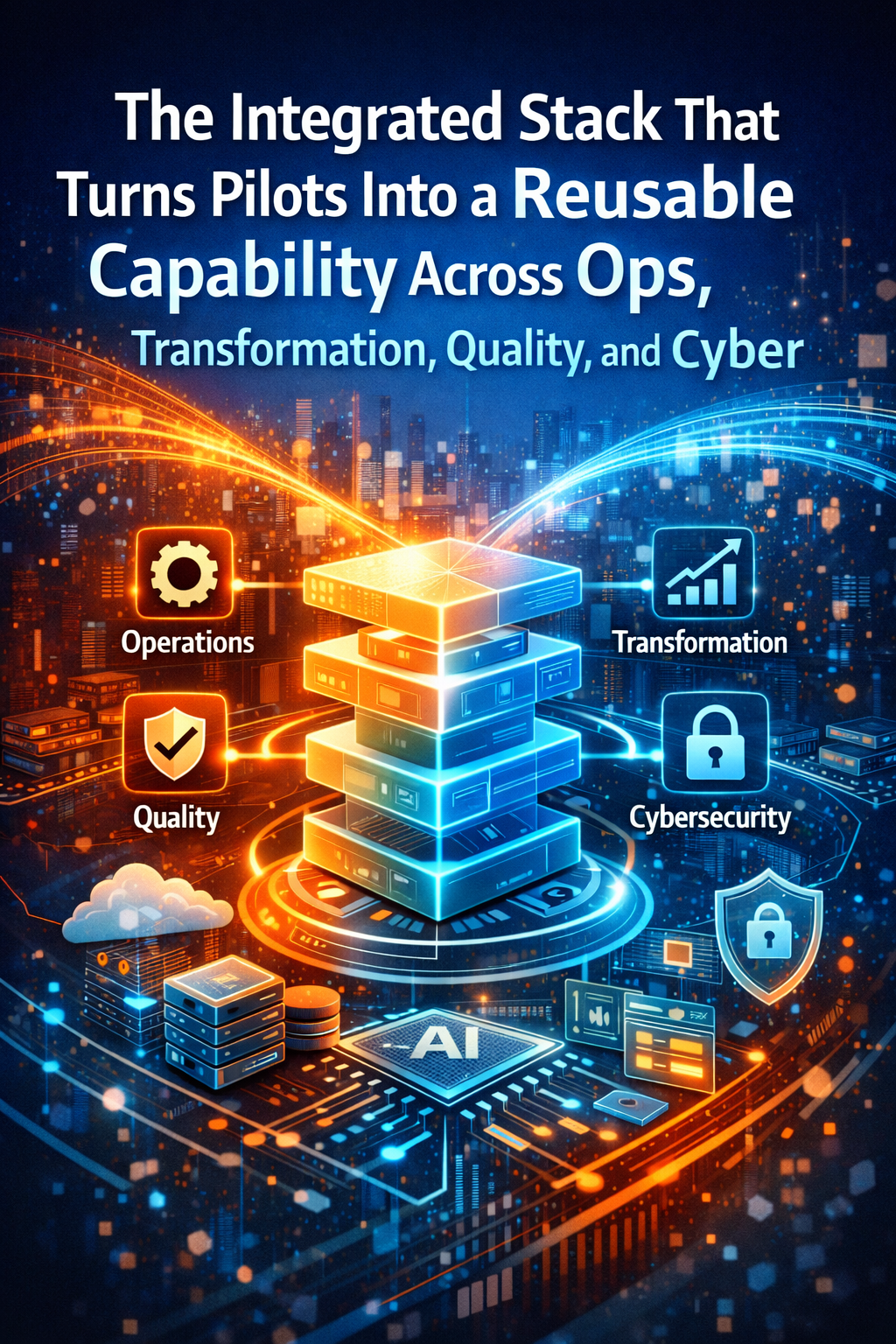
It also enables an AI-first, cloud-first, partner-first posture: intelligence designed into workflows, deployed with elastic foundations, and integrated openly across vendors and platforms—without lock-in.
The endgame is simple: move from a “pilot factory” to a capability factory, where trusted AI services (policy Q&A with evidence, incident triage, access approvals, supervised orchestration) can be reused across the enterprise with governance by default.
A leadership team watches a demo and sees the future. A chatbot answers flawlessly. A copilot drafts in seconds what used to take hours. An “agent” completes a workflow end-to-end. The pilot succeeds. A few teams become believers.
Then the enterprise tries to scale—and the questions change.
Not “Can it write?” but “Can we run it?”
Not “Is it accurate in a demo?” but “Will it remain safe and reliable when policies, data, tools, and models change?”
Not “Can one team adopt it?” but “Can a hundred teams reuse it without duplicating risk, cost, and integration work?”
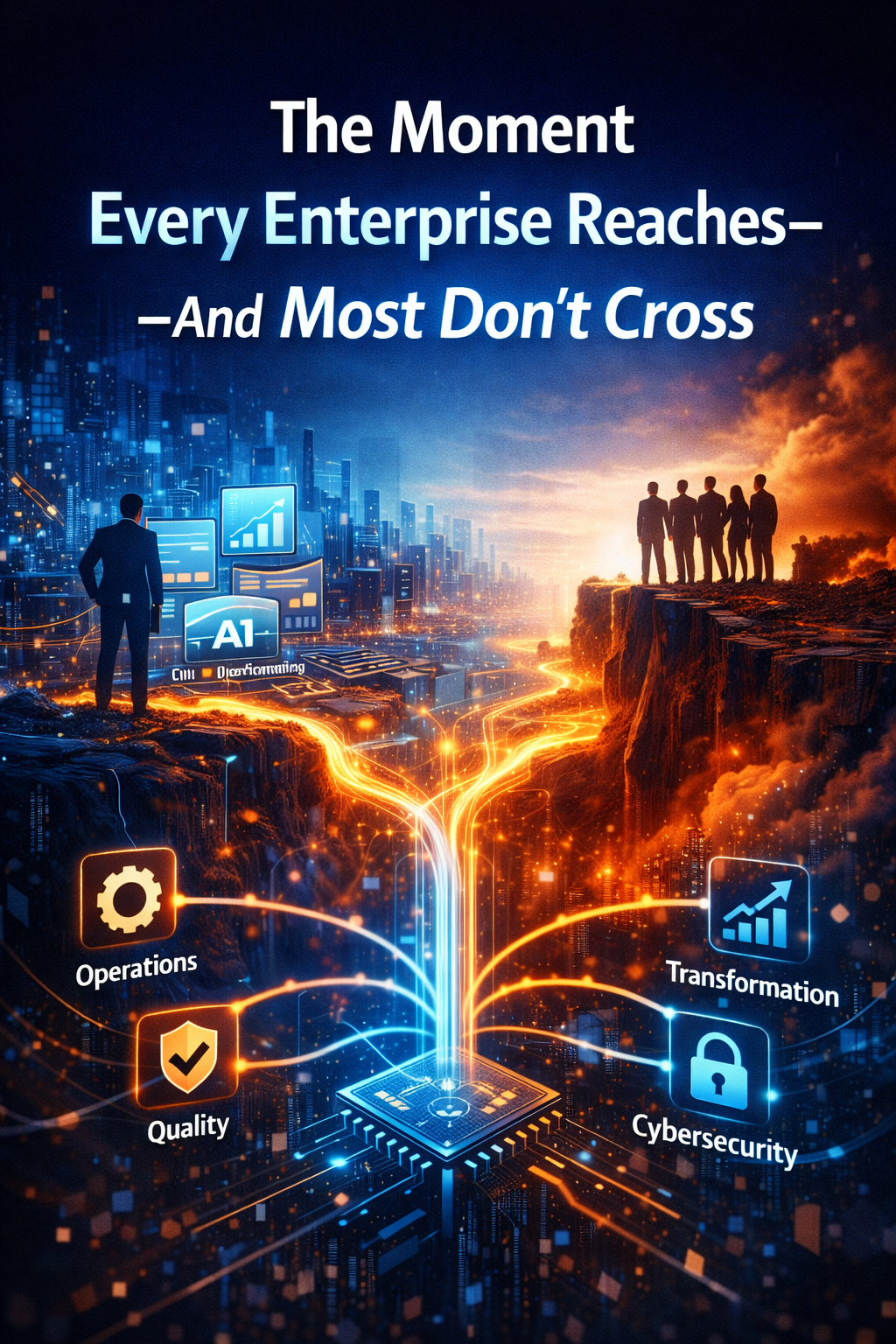
That is the cliff edge between pilots and capability.
Gartner has publicly warned that a meaningful share of GenAI initiatives will be abandoned after proof-of-concept because organizations run into the operational realities of production: data quality, risk controls, cost pressure, and value realization. And as “agents” become more common, Gartner has also forecast significant cancellation risk for agentic AI initiatives that are not governed and industrialized.
This is not a verdict on AI. It’s a verdict on operating models.
The next phase of enterprise AI is not “more pilots.” It’s industrialization: turning intelligence into a reusable capability the enterprise can safely consume again and again—like a utility.
What “services-as-software” actually means
Services-as-software is a simple idea with radical implications:
Deliver enterprise AI as modular, integrated services—not one-off projects—across the four domains AI disrupts simultaneously: Operations, Transformation, Quality Engineering, and Cybersecurity.
In other words: stop treating AI like an experiment each team rebuilds from scratch. Start treating AI like an enterprise capability you productize, govern, and reuse.
This is the same logic that helped enterprises scale cloud and DevOps. They didn’t ask every team to become infrastructure experts. They built self-service with guardrails—a paved road that lets teams move fast safely. Microsoft describes platform engineering in precisely these terms: better developer experience, secure self-service, and governance by default.
Services-as-software applies that platform thinking to intelligence.
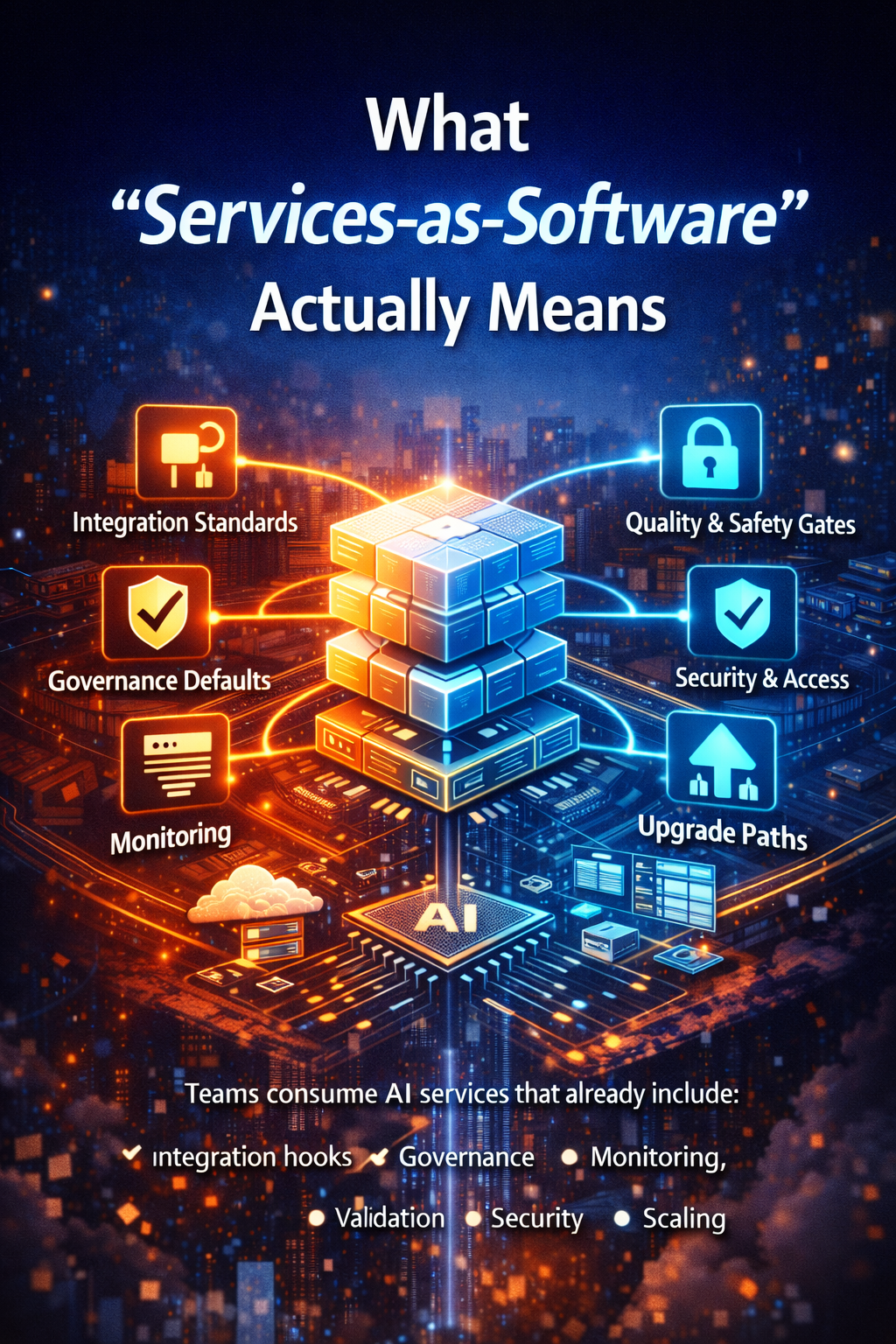
Instead of teams “building AI,” teams consume AI services that already include:
- integration standards
- governance defaults
- monitoring and incident hooks
- quality and safety gates
- security and access controls
- upgrade paths as models and tools evolve
It’s the difference between:
- “We built an AI bot.”
and - “We shipped a reusable enterprise service.”
The second sentence is how organizations scale anything that matters.
Services-as-Software for Enterprise AI
A model where AI is delivered as reusable, governed enterprise services — with built-in observability, security, quality engineering, and lifecycle control — rather than as isolated projects or pilots.
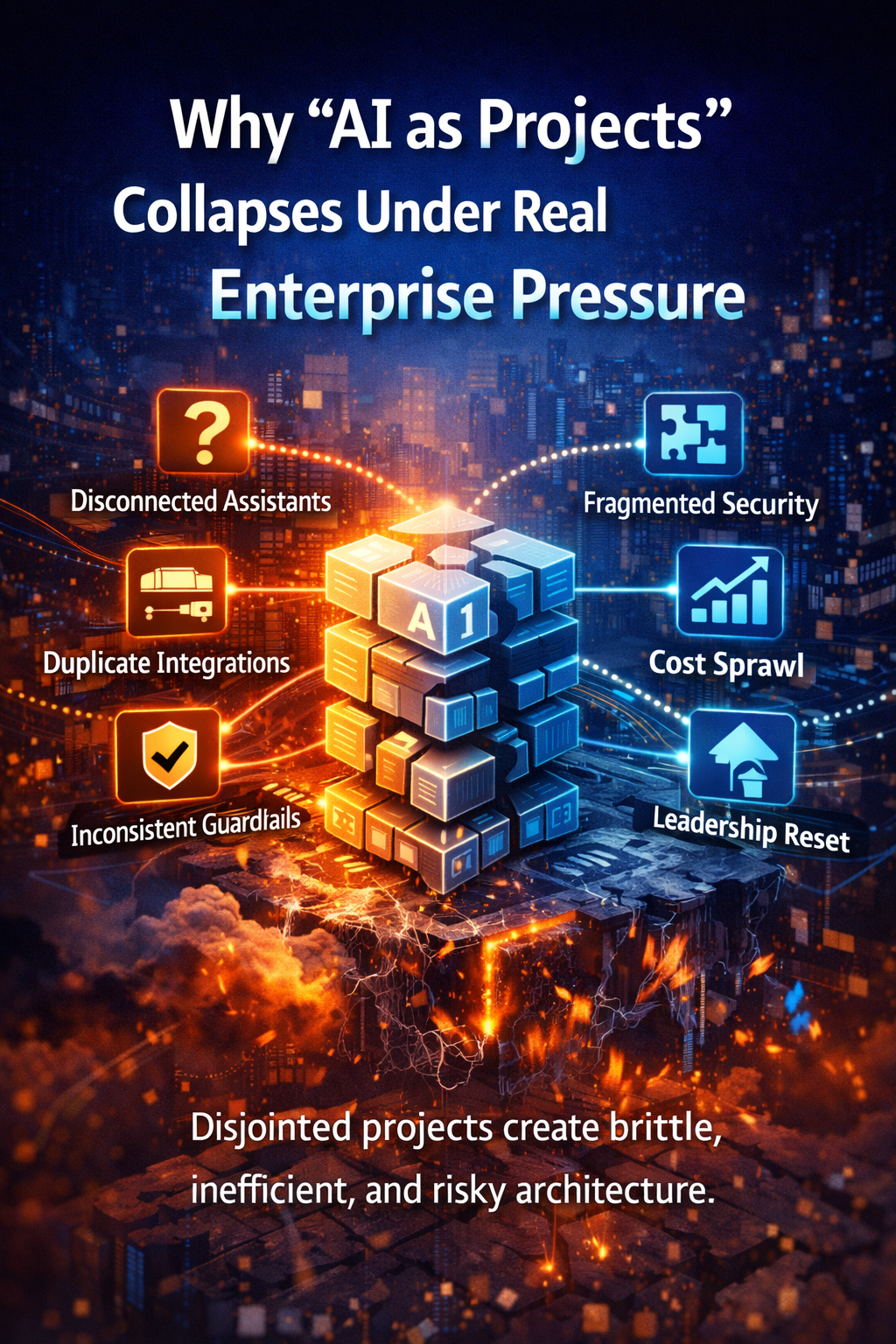
Why “AI as projects” collapses under real enterprise pressure
Projects are how enterprises deliver change. But AI—especially agentic AI—behaves like a living production system:
- It can produce different outputs for the same input.
- It can fail in ways that look confident.
- It depends on evolving context: policies, prompts, knowledge, tool APIs, user behavior.
- It creates new security and governance failure modes at machine speed.
So when each business unit builds its own AI solution, you don’t get “enterprise AI.” You get an enterprise-wide integration tax:
- disconnected assistants
- duplicated integrations into the same systems
- inconsistent guardrails (privacy, approvals, auditability)
- no shared observability (no single view of behavior, drift, incidents)
- fragmented security posture
- cost sprawl across inference, retrieval, orchestration, monitoring
- one serious incident away from a leadership reset
This is not a talent problem. It’s an architecture problem.
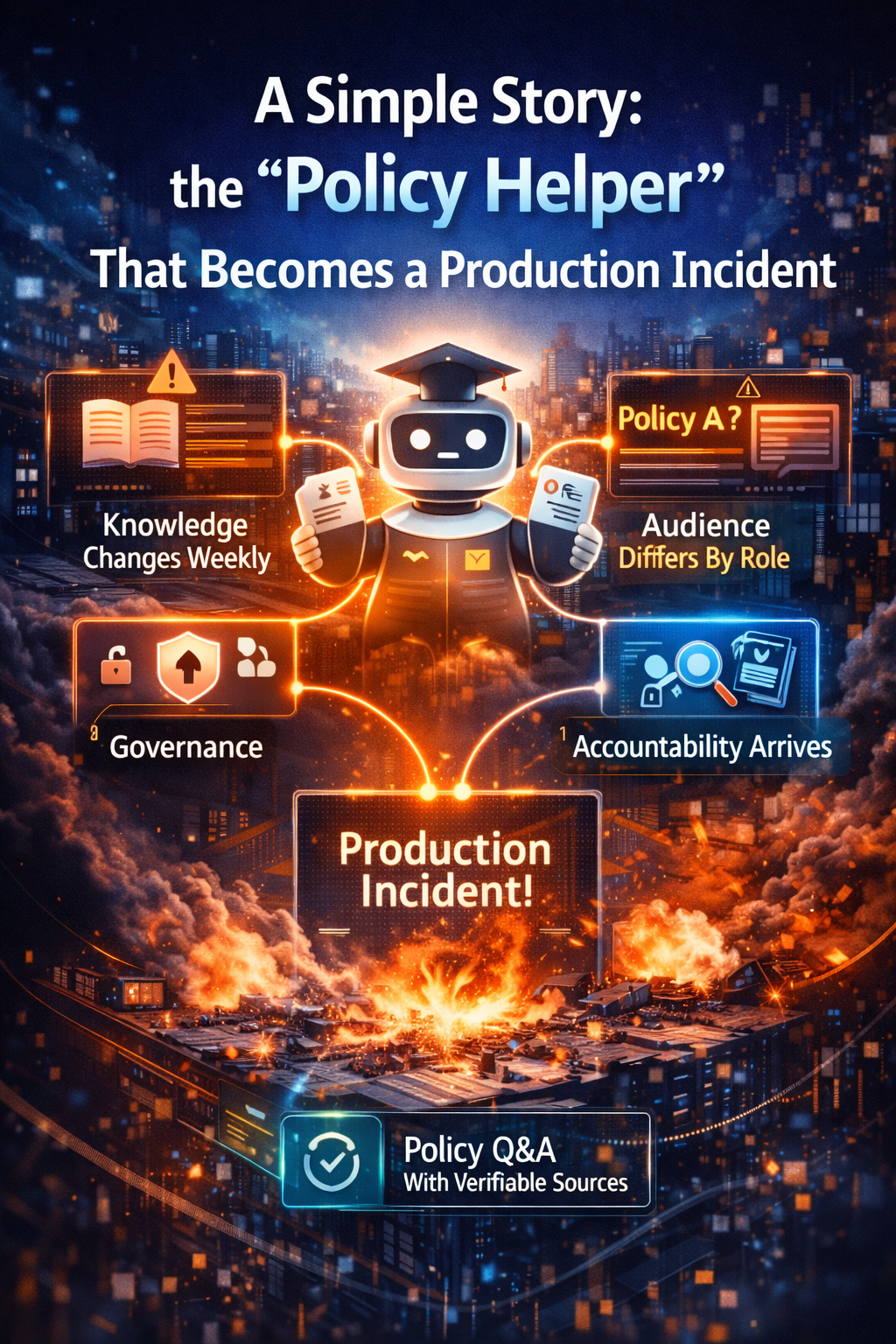
A simple story: the “Policy Helper” that becomes a production incident
A team launches a policy chatbot. In pilot, it’s great.
Then it scales, and three inevitable things happen:
1) Knowledge changes weekly.
Policies update. Exceptions appear. Without managed retrieval and refresh, the bot starts answering with yesterday’s truth.
2) The audience differs by role.
Different groups have different permissions and exceptions. Now you need access control, segmentation, and governance workflows.
3) Accountability arrives.
Security asks a question that changes the conversation:
“Show evidence. What sources did it use? What did it ignore? Which version was approved?”
Suddenly, a “simple bot” needs:
- retrieval controls
- identity and access enforcement
- audit trails and evidence logs
- monitoring and drift detection
- safe rollout and rollback
If it’s a project, this becomes endless bespoke rework.
If it’s a service, the enterprise gets a reusable capability:
Policy Q&A with verifiable sources, consumable across teams—built once, governed once, improved continuously.
That’s the services-as-software difference in one example.

The philosophy that makes scalable AI possible
AI-first, cloud-first, partner-first—built for continuity, not disruption
Many enterprises stall because they assume AI must replace the existing landscape. In reality, the most durable AI operating environments are built to extend what already exists—without pausing delivery.
That is why modern integrated stacks converge on three principles:
AI-first
AI is not treated as a feature bolted onto workflows. It is designed into workflows from the beginning:
- decision points are AI-augmented by default
- knowledge access is mediated through retrieval + reasoning layers
- exceptions go to humans only when needed
- improvement loops are operational, not aspirational
This is the shift from “AI tools you use” to “work that runs.”
Cloud-first
Enterprise AI needs elasticity:
- inference demand spikes unpredictably
- models and tooling evolve frequently
- enterprises require resilience across regions
- data and platforms are distributed
Cloud-first isn’t vendor rhetoric; it’s architectural adaptability—the ability to scale and evolve without rewrites.
Partner-first
No enterprise builds AI alone. Real environments must integrate:
- frontier models and specialist smaller models
- enterprise platforms and data platforms
- partner ecosystems—without locking the enterprise into one model era
That’s why open abstraction across models, prompts, and tools matters: it lets enterprises adopt new AI capabilities without rebuilding every workflow.
The deeper point is this:
AI-first without cloud-first becomes brittle. Cloud-first without partner-first becomes isolated. Partner-first without AI-first becomes fragmented.
Only together do they create continuity.
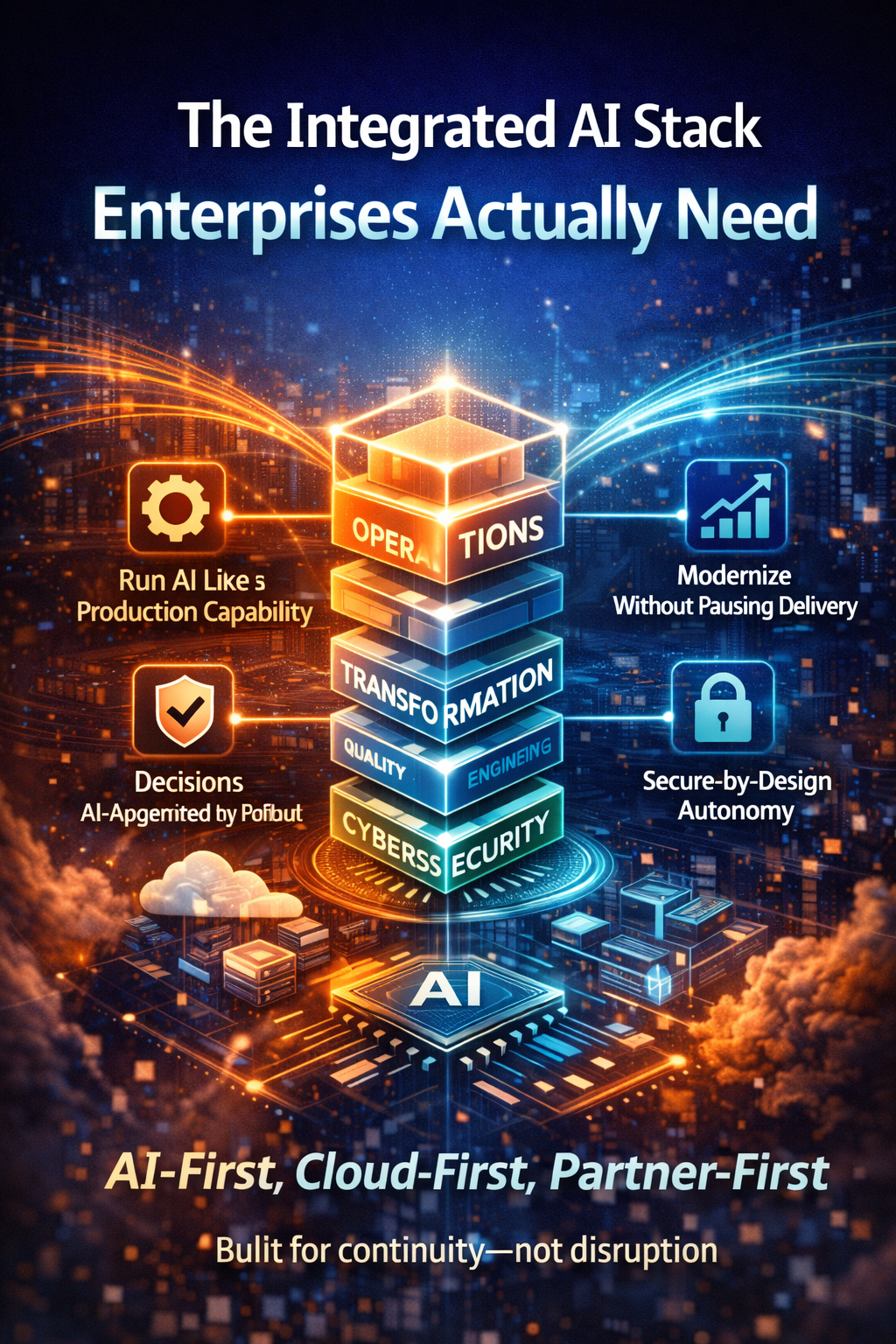
The integrated AI stack enterprises actually need
Services-as-software works only when the stack is integrated across the four domains AI breaks at once.
1) Operations: run AI like a production capability
When AI touches live processes, you need operational excellence—observability, reliability, incident response, and continuous improvement.
Example: Incident Triage Assistant
In pilot, it reads alerts and drafts recommendations. At scale, the production questions arrive:
- What data and tools did it use?
- When did behavior change?
- Can it be safely rolled back?
- How do we detect degradation before it becomes an incident?
This is why enterprise platforms are converging on lifecycle management, observability, and policy enforcement for agents.
Services-as-software turns these requirements into shared operational services:
- telemetry and tracing for AI actions
- evidence logging (what, why, based on what)
- incident workflows for AI behavior
- release/rollback controls for prompt/model/tool changes
Reliability becomes reusable—not negotiated each time.
2) Transformation: modernize without pausing delivery
Enterprises run mixed estates: legacy platforms plus modern SaaS plus custom apps. AI value compounds when modernization is continuous:
- incremental migration
- integration rationalization
- workflow automation
- refactoring and remediation
Services-as-software makes transformation repeatable: standardized interfaces, reusable integration patterns, and modernization pipelines that can be applied again and again.
3) Quality Engineering: prevent confident failures
Traditional QA validates deterministic behavior. AI behavior can shift when you change:
- the model
- the system prompt
- retrieval configuration
- tool APIs
- underlying knowledge and policy
So the enterprise question becomes:
How do we validate a system that can change behavior without changing its code?
Services-as-software productizes AI-first QE:
- behavioral regression tests
- safety test suites
- evaluation gates before rollout
- continuous production validation
- red-teaming as a routine discipline
Prompt injection isn’t theoretical. OWASP explicitly documents it as a primary LLM risk category—especially dangerous when tool access is involved.
4) Cybersecurity: secure-by-design autonomy
Autonomy expands the attack surface:
- tool calling
- credential access
- data retrieval
- workflow execution
Security can’t be bolted on later. It must be embedded into identity, authorization, policy enforcement, evidence trails, and least privilege—responsible AI by design as a default.
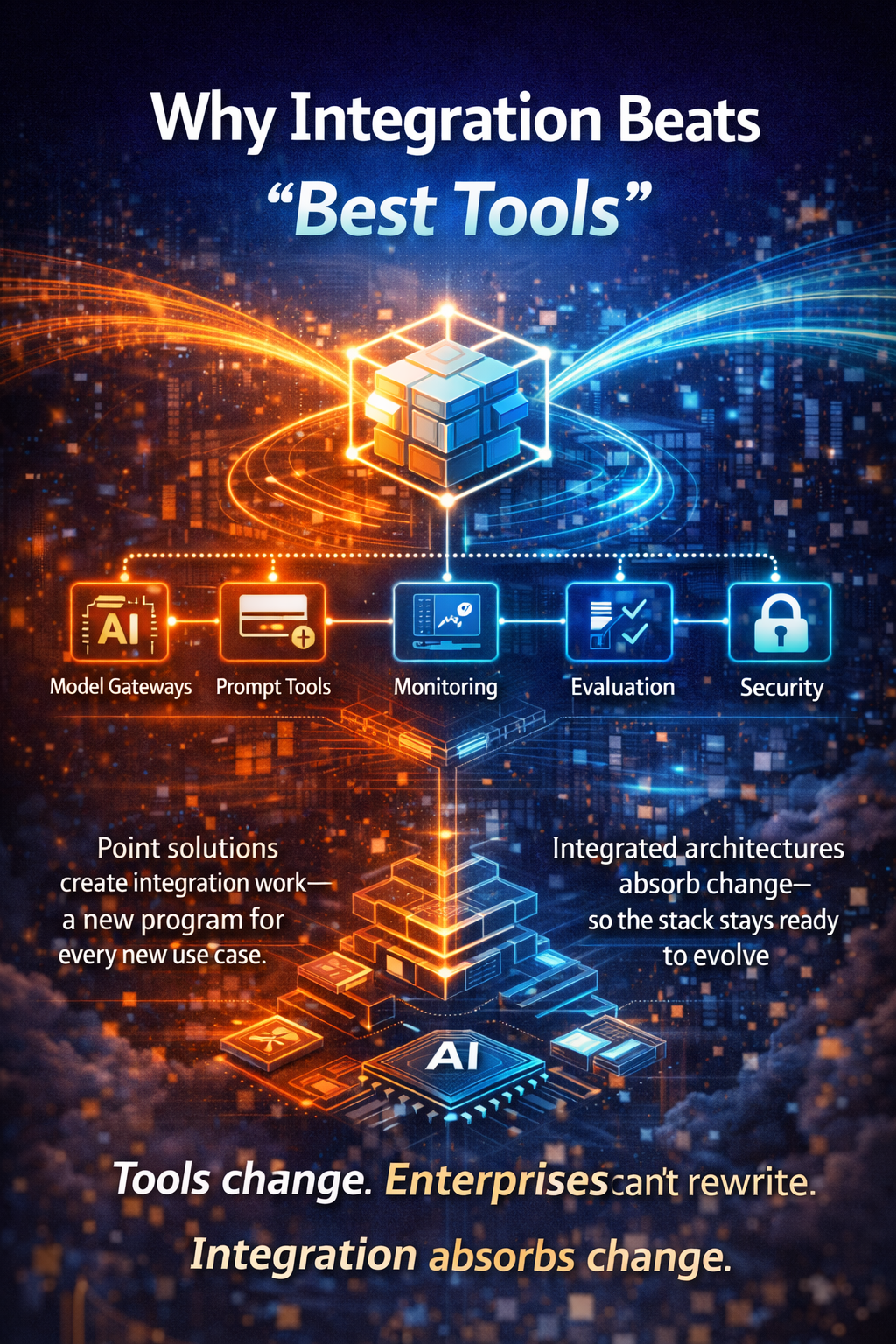
Why integration beats “best tools”
Many enterprises buy excellent point solutions:
- model gateways
- prompt tools
- monitoring products
- evaluation frameworks
- security scanners
But stitched together ad hoc, you create the integration trap: every new AI use case becomes a new integration program.
That’s why integrated, modular, open architectures win—because they make upgrades survivable.
In simple terms:
- Tools change fast.
- Enterprises can’t rewrite fast.
- The stack must absorb change.
Pre-built, composable AI services
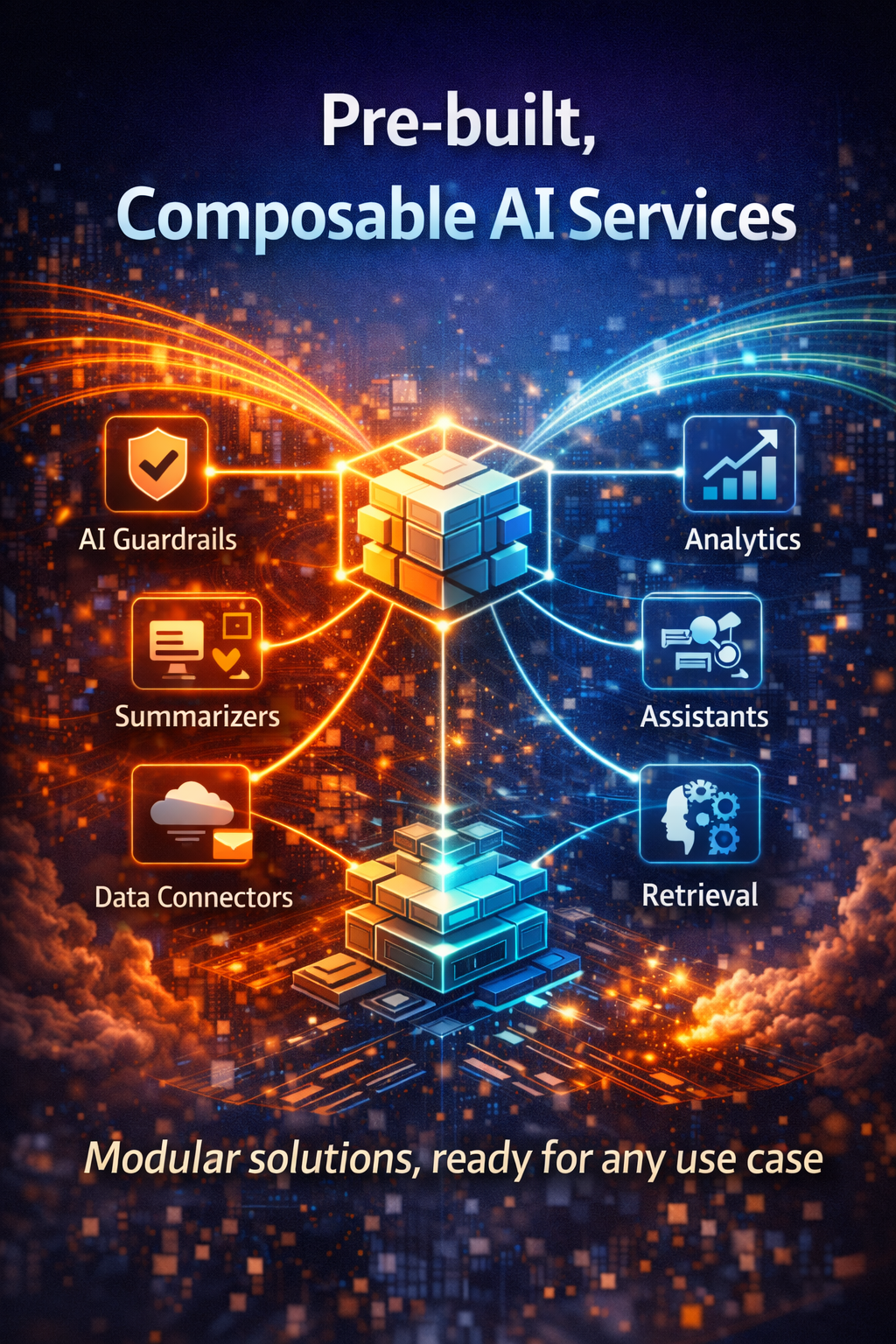
Another quiet reason AI stalls: enterprises try to build every capability from the ground up.
Scalable operating environments rely on pre-built, composable services: reusable building blocks designed to plug into real workflows with governance already baked in. Pre-integration across enterprise and data platforms is one of the biggest accelerants to adoption and interoperability.
Here are examples of composable services enterprises actually reuse:
1) Policy & Knowledge Q&A with verifiable sources
- retrieves approved content
- answers with citations/evidence
- enforces access controls
- logs provenance for audit
2) Incident triage & root-cause recommendation
- clusters incidents
- proposes likely causes
- drafts remediation steps
- escalates when confidence is low
3) Access approval & risk recommendation
- evaluates requests against policy + context
- recommends approve/deny/escalate
- records reasoning and evidence
4) Document processing & intelligence extraction
- classification, extraction, summarization
- compliance checks
- standardized outputs and controls
5) Workflow orchestration with human oversight
- AI handles routine steps
- humans approve sensitive actions
- exceptions are routed by policy and confidence
Why composability matters more than “features”: it standardizes trust.
Each service arrives with operational hooks, quality gates, security controls, and governance defaults—so innovation doesn’t multiply risk.
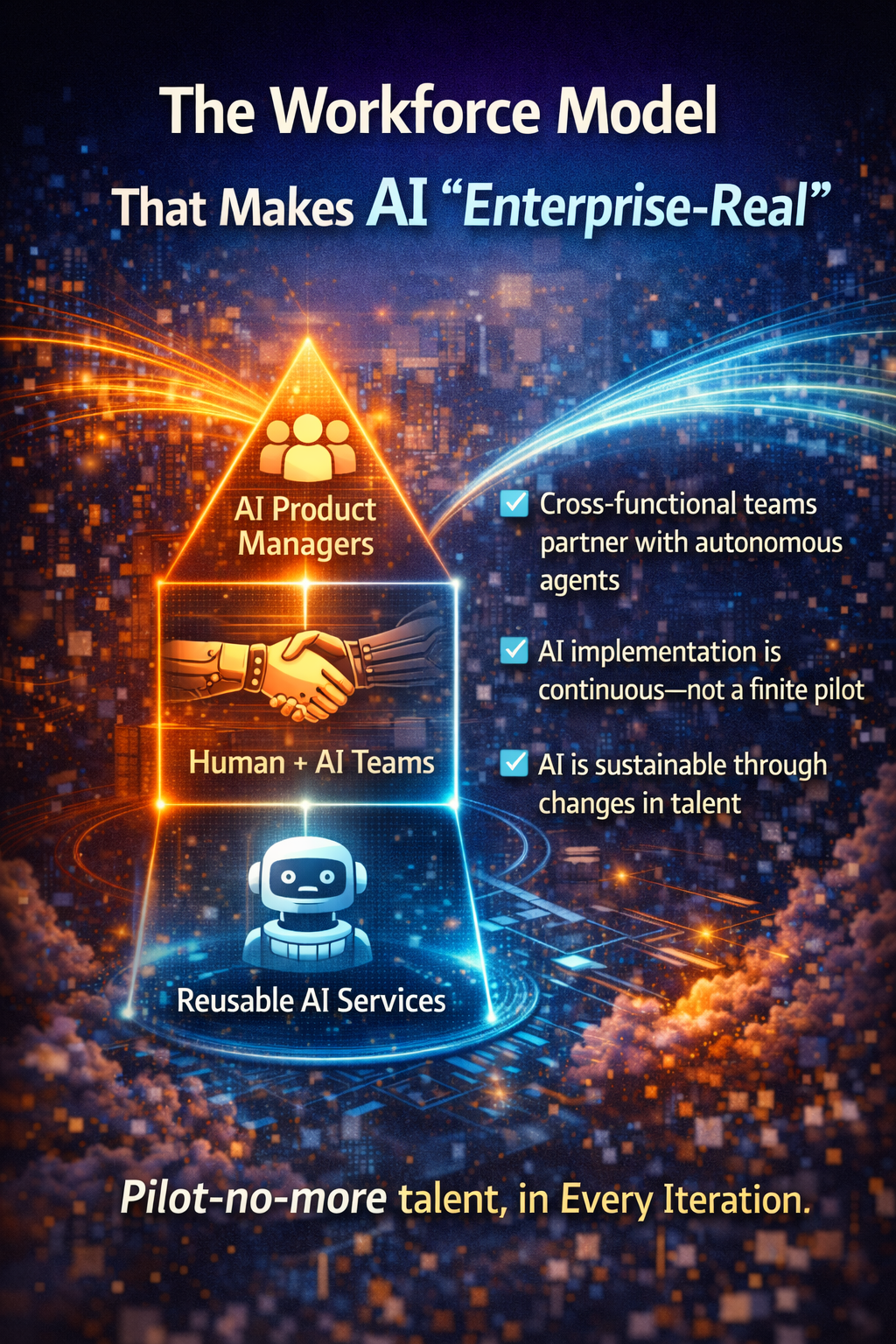
The workforce model that makes AI “enterprise-real”
A practical way to understand scalable AI is as a synergetic workforce:
- Digital workers: deterministic workflows, tools, bots, APIs
- AI workers: reasoning, orchestration, prediction, recommendations
- Human workers: creativity, strategy, governance, improvement
This model captures how modern stacks deliver future-ready services: deterministic automation where possible, AI where value exists, and humans governing by exception.
It’s not about replacing people. It’s about engineering a system where work is executed reliably.

What CXOs are really buying
What CXOs are really buying
Executives aren’t buying “AI features.” They’re buying outcomes with controlled risk—often summarized as:
- higher velocity
- superior quality
- optimal cost
- sustained ROI and continuity without disruption
This is why services-as-software is a better executive question than “which agent platform?”
It reframes the choice:
Do we want scattered experiments—or a reusable enterprise capability?
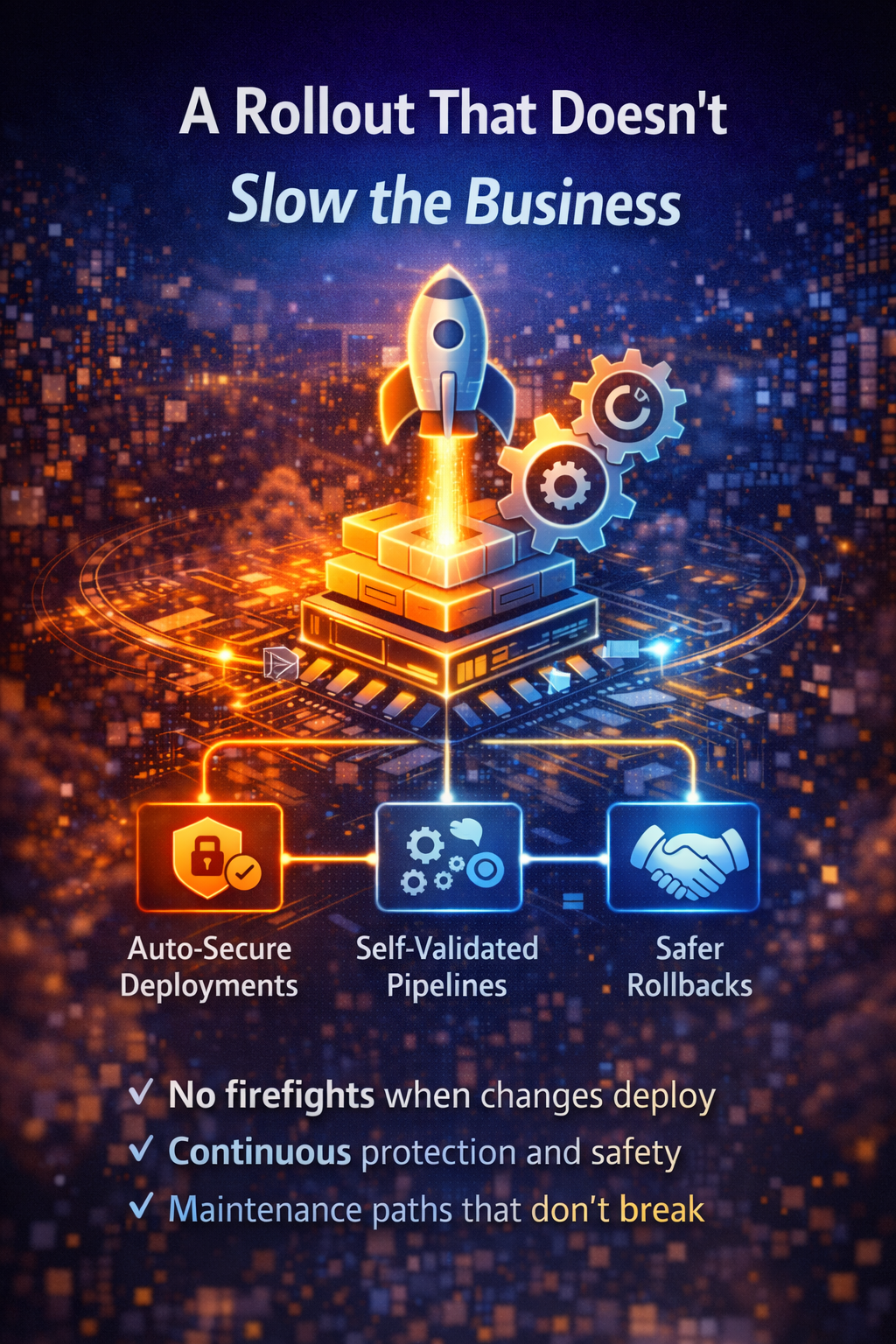
A rollout that doesn’t slow the business
You don’t big-bang this. You build it like a product.
Days 0–30: establish the paved road
- standardize access to models, tools, and enterprise data
- define baseline policies: identity, approvals, logging, audit
- create a minimal observability + evaluation loop
This mirrors platform engineering’s “secure self-service with guardrails” approach.
Days 31–60: productize 3–5 reusable services
Start with high-reuse services (policy Q&A, incident triage, access approvals, document intelligence, supervised orchestration).
Days 61–90: scale via consumption, not reinvention
- publish a service catalog
- onboard teams via templates
- add QE gates + security scanning into release workflows
- measure adoption via service SLOs and business outcomes
The goal is to shift from a pilot factory to a capability factory.
Conclusion: industrializing intelligence is the new advantage
The first chapter of enterprise AI was experimentation: pilots, copilots, prototypes.
The second chapter is industrialization: reusable, governed capabilities that can be adopted across teams without duplicating risk, rework, and cost.
That is what services-as-software enables.
Because in the agent era, the advantage is no longer intelligence alone.
It is the ability to operate intelligence—reliably, securely, and repeatedly—across the enterprise.
FAQ
What is services-as-software for enterprise AI?
Delivering AI as reusable enterprise services with built-in governance, monitoring, security, and quality gates—rather than one-off projects.
Why do AI pilots fail to scale?
Common blockers include poor data quality, inadequate risk controls, escalating costs, and unclear business value after proof of concept.
Is this just MLOps?
No. MLOps is necessary but narrower. Services-as-software integrates Ops, Transformation, Quality Engineering, and Cybersecurity so AI runs as a reusable enterprise capability.
What security risks become critical when agents can act?
Prompt injection is a widely recognized risk category where inputs manipulate model behavior—especially risky when tools and privileged actions are involved.
How does this reduce vendor lock-in?
By using open architecture that abstracts models, prompts, and tools so new models and technologies can be integrated without rebuilding workflows.
Glossary
- Services-as-software: AI delivered as reusable, modular enterprise services—integrated and reliable at scale.
- Composable services: Reusable building blocks (policy Q&A, incident triage, access approvals) that can be assembled without rebuilding controls.
- Self-service with guardrails: Teams move fast within predefined, stakeholder-approved safety boundaries.
- Prompt injection: Inputs crafted to alter an LLM’s behavior or bypass safeguards.
- Synergetic workforce: Digital workers + AI workers + human workers operating together as an enterprise delivery model.
- Open abstraction layer: Decouples workflows from specific models/prompts/tools for continuity as the ecosystem evolves.
References
- Gartner: forecast that a significant share of GenAI projects will be abandoned after proof of concept (drivers include data, risk, cost, unclear value).
- Gartner: forecast that a large share of agentic AI projects may be canceled without proper governance/industrialization.
- Microsoft Learn: platform engineering and secure self-service with guardrails.
- OWASP: Top risks for LLM applications, including prompt injection.
- Infosys Topaz Fabric page for the integrated “services-as-software” stack framing across Ops/Transformation/QE/Cyber and open, composable approach.
Further reading
- Recent reporting and analysis on governance pressures and risk patterns as AI agents gain autonomy.
- Enterprise platform perspectives on building blocks for agentic systems and lifecycle management.
- The Advantage Is No Longer Intelligence—It Is Operability: How Enterprises Win with AI Operating Environments – Raktim Singh
- The AI Platform War Is Over: Why Enterprises Must Build an AI Fabric—Not an Agent Zoo – Raktim Singh
- Why Every Enterprise Needs a Model-Prompt-Tool Abstraction Layer (Or Your Agent Platform Will Age in Six Months) – Raktim Singh
- The Synergetic Workforce: How Enterprises Scale AI Autonomy Without Slowing the Business – Raktim Singh
- The Agentic AI Platform Checklist: 12 Capabilities CIOs Must Demand Before Scaling Autonomous Agents | by RAKTIM SINGH | Dec, 2025 | Medium
- The Enterprise AI Design Studio: How Business Teams Build Trusted AI Agents Without Breaking Security or Compliance | by RAKTIM SINGH | Dec, 2025 | Medium
- Services-as-Software: Why the Future Enterprise Runs on Productized Services, Not AI Projects | by RAKTIM SINGH | Dec, 2025 | Medium
- The Composable Enterprise AI Stack: Agents, Flows, and Services-as-Software — Built Open, Interoperable, and Responsible | by RAKTIM SINGH | Dec, 2025 | Medium



Raktim Singh is an AI and deep-tech strategist, TEDx speaker, and author focused on helping enterprises navigate the next era of intelligent systems. With experience spanning AI, fintech, quantum computing, and digital transformation, he simplifies complex technology for leaders and builds frameworks that drive responsible, scalable adoption.