

Skill Erosion in the Age of Reasoning Machines
Enterprises are rushing to deploy a new class of systems that do more than automate tasks—they think, reason, and decide. These reasoning machines promise faster decisions, cleaner workflows, and unprecedented scale.
And in the short term, they deliver. But beneath these gains sits a quiet, compounding risk that most organizations are not measuring, governing, or even naming: skill erosion. As AI systems increasingly perform the cognitive work once done by humans, enterprises are becoming operationally faster while their people are becoming less practiced at judgment, sense-making, and recovery.
The result is a dangerous paradox—the smarter AI becomes, the weaker human capability quietly grows, leaving organizations fragile precisely when autonomy fails, uncertainty rises, or something goes wrong.
Why “AI that thinks” can quietly make humans worse at thinking—and how enterprises can stop it
Enterprises are celebrating a new milestone: reasoning machines that don’t just generate text—they draft decisions, propose actions, justify steps, and optimize workflows.
And that’s exactly the problem.
When a system starts doing the “thinking work,” humans do what humans always do: they adapt. Not because people are lazy—because the brain is efficient. If something reliably reduces effort, we take the shortcut. Over time, the organization looks faster and smoother… while the people inside it become less practiced at the very skills they’ll need when AI fails, drifts, or encounters an unfamiliar edge-case.
That slow decline is skill erosion: the gradual loss of human judgment, situational awareness, and core craft because the machine performs the task “well enough” most of the time.
We’ve seen versions of this long before modern AI:
- Human–automation research describes the out-of-the-loop performance problem: when automation runs the loop, human operators lose situational awareness and become slower and weaker when they must take over again. (Maritime Safety Innovation Lab LLC)
- In navigation, greater reliance on GPS has been associated with worse spatial memory during self-guided navigation. (Nature)
- In healthcare, multiple reviews flag AI-induced deskilling and “upskilling inhibition” concerns around decision support—where routine assistance can reduce unassisted performance and learning opportunities. (Springer)
Now replace “GPS” with “reasoning model.” Replace “route planning” with “decision planning.” Replace “clinical decision support” with “enterprise decision support.” The pattern is the same—only the blast radius is larger.
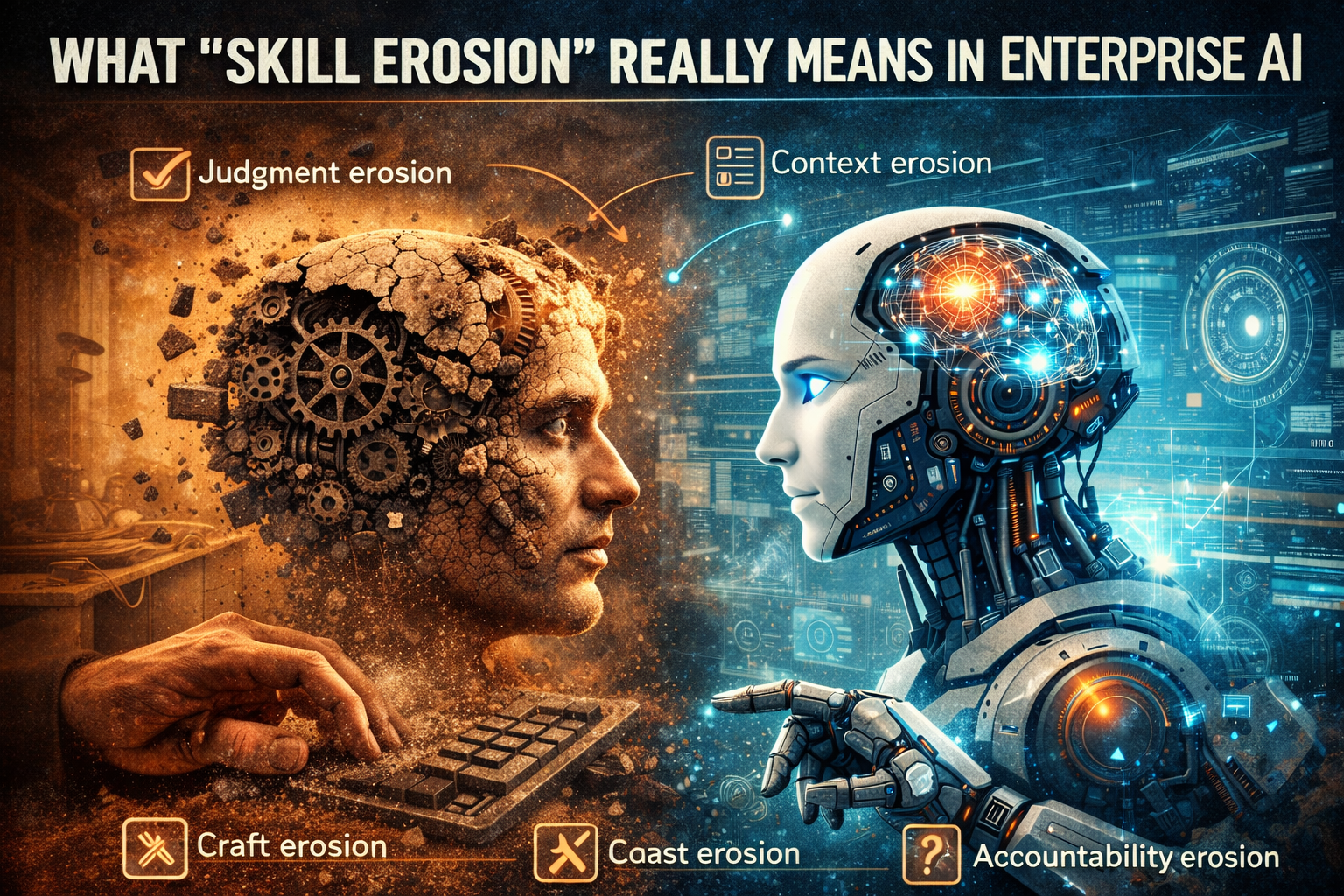
What “skill erosion” really means in Enterprise AI
What “skill erosion” really means in Enterprise AI
Skill erosion is not one failure. In Enterprise AI, it usually arrives as a stack of erosions—each subtle on its own, catastrophic in combination.
1) Judgment erosion
People stop practicing the art of choosing under uncertainty because the system pre-selects and pre-ranks options. The human shifts from decider to approver.
2) Context erosion
People stop building a full mental model because the system provides a summary. The enterprise slowly loses “deep context carriers”—the people who can see second-order effects before they happen.
3) Craft erosion
People lose hands-on proficiency: how to run a process end-to-end, how to troubleshoot, how to notice weak signals, how to handle the messy exceptions.
4) Accountability erosion
When something goes wrong, people can’t confidently explain why a decision was made—because they did not truly make it, and they did not truly review it.
This is why skill erosion is not an HR problem. It’s an operating model problem.
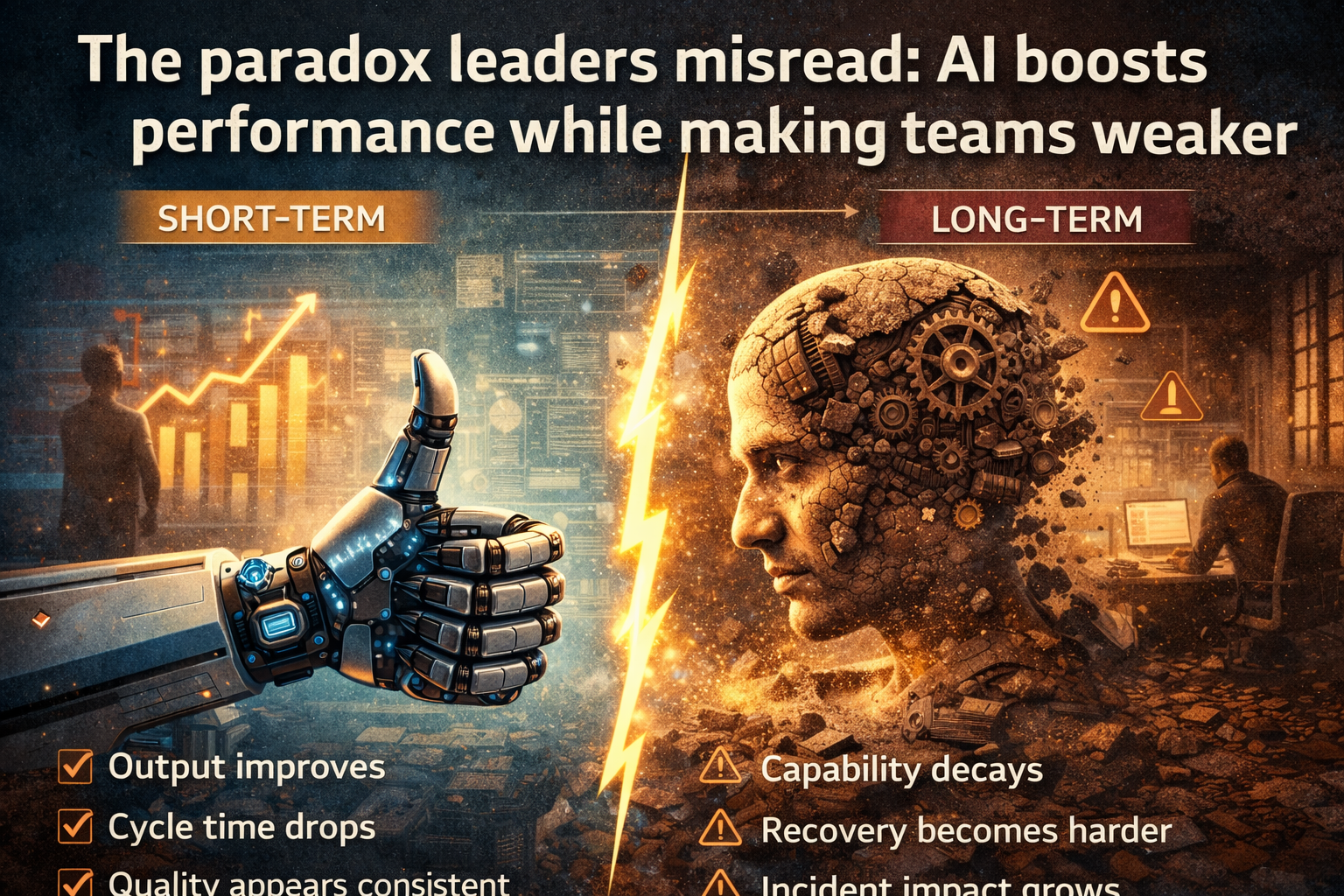
The paradox leaders misread: AI boosts performance while making teams weaker
Reasoning machines create a paradox that looks like success—until the first real failure.
- Short-term: output improves, cycle time drops, quality appears consistent.
- Long-term: capability decays, recovery becomes harder, incident impact grows.
Automation research repeatedly warns that passive monitoring increases the risk of complacency, weak detection of system errors, and degraded takeover performance when automation fails. (ScienceDirect)
In plain terms:
AI can raise your average day while lowering your worst-day resilience.
Enterprises don’t lose trust in AI on average days. They lose trust during exceptions—the one moment you need sharp human judgment most.
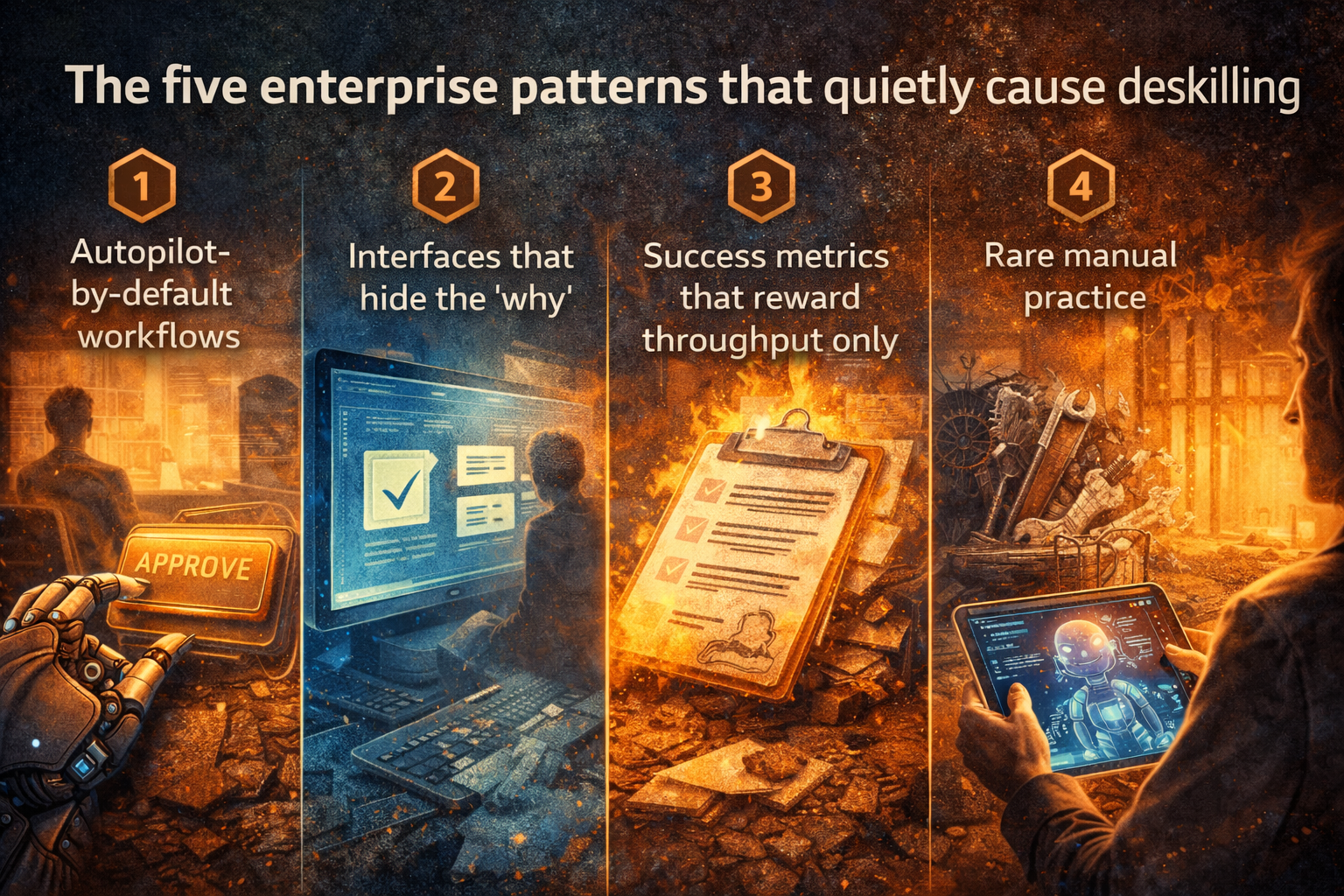
The five enterprise patterns that quietly cause deskilling
Pattern 1: Autopilot-by-default workflows
If AI suggestions are always present—and the human only approves—humans become button-pressers. You get throughput, but you also train dependency.
Signal you’re here: approvals are near-instant; reviewers can’t explain the rationale beyond “the AI said so.”
Pattern 2: Interfaces that hide the “why”
When outputs are presented as final answers, not as inspectable reasoning with evidence, learning collapses.
This is why “receipts” matter: provenance, alternatives, uncertainty, assumptions, and trade-offs. (More on this in the control section.)
Pattern 3: Success metrics that reward throughput only
If teams are rewarded for “closing more,” they will accept automation even when it erodes craft. The enterprise becomes efficient—and fragile.
Pattern 4: Rare manual practice
When humans are needed only during emergencies, they will be least prepared at the exact moment they’re most needed. Skill decay after periods of non-use is widely discussed in high-risk domains. (MDPI)
Pattern 5: “AI as the teacher” without independent verification
If the learning loop becomes “ask the model,” people stop forming their own first-pass reasoning. The result is subtle but decisive: fewer original hypotheses, less curiosity, weaker intuition.
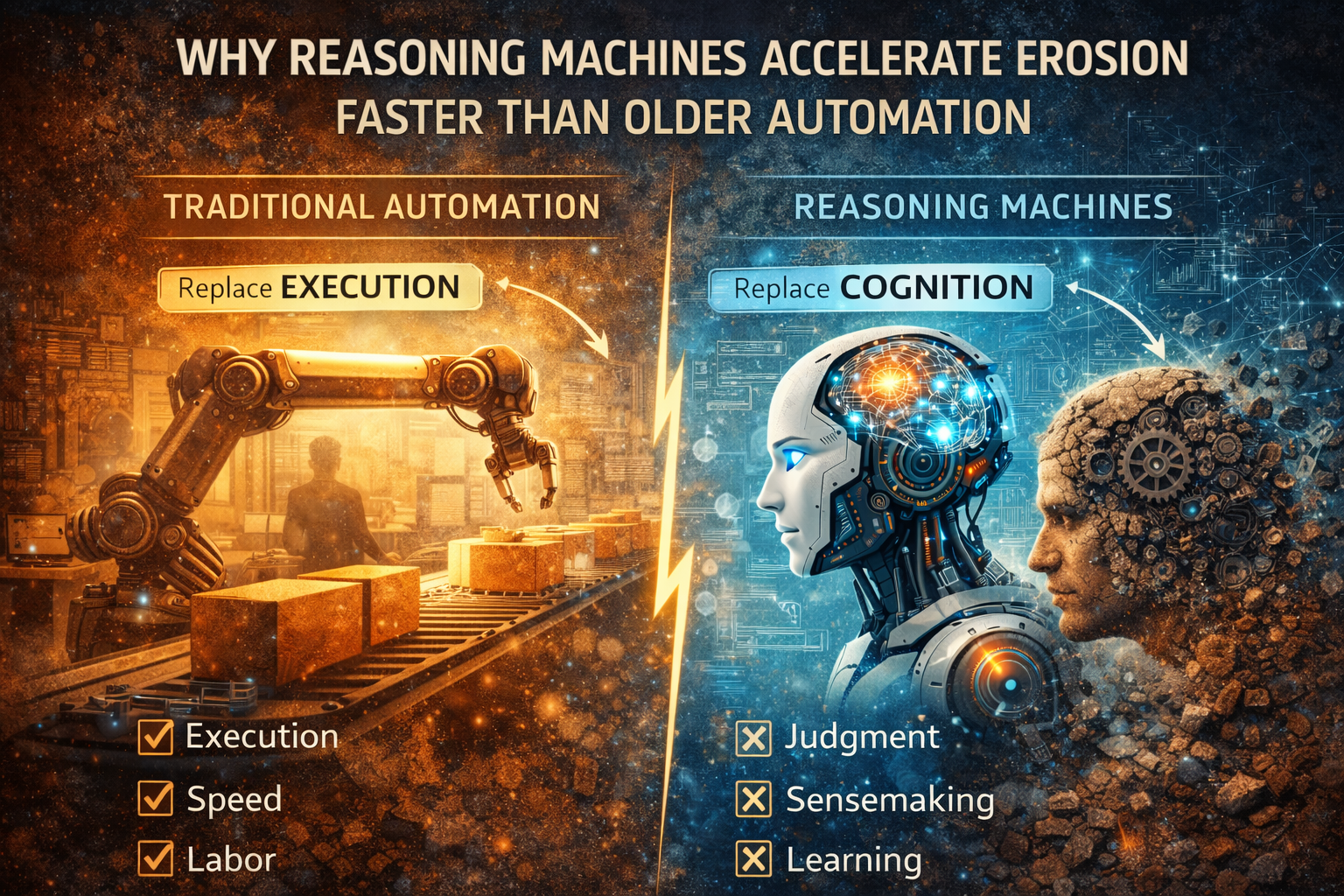
Why reasoning machines accelerate erosion faster than older automation
Traditional automation replaced execution (“do the thing”). Reasoning machines replace cognition (“decide what the thing should be”).
That’s why the erosion is deeper:
- It targets judgment, not just procedure.
- It targets sensemaking, not just speed.
- It targets learning, not just labor.
The deskilling concern is explicit in domains where decision support has been studied for years. (Springer)
Enterprise implication: once you cross from “AI assists” to “AI decides,” you are no longer managing a tool. You are managing a human capability transition.
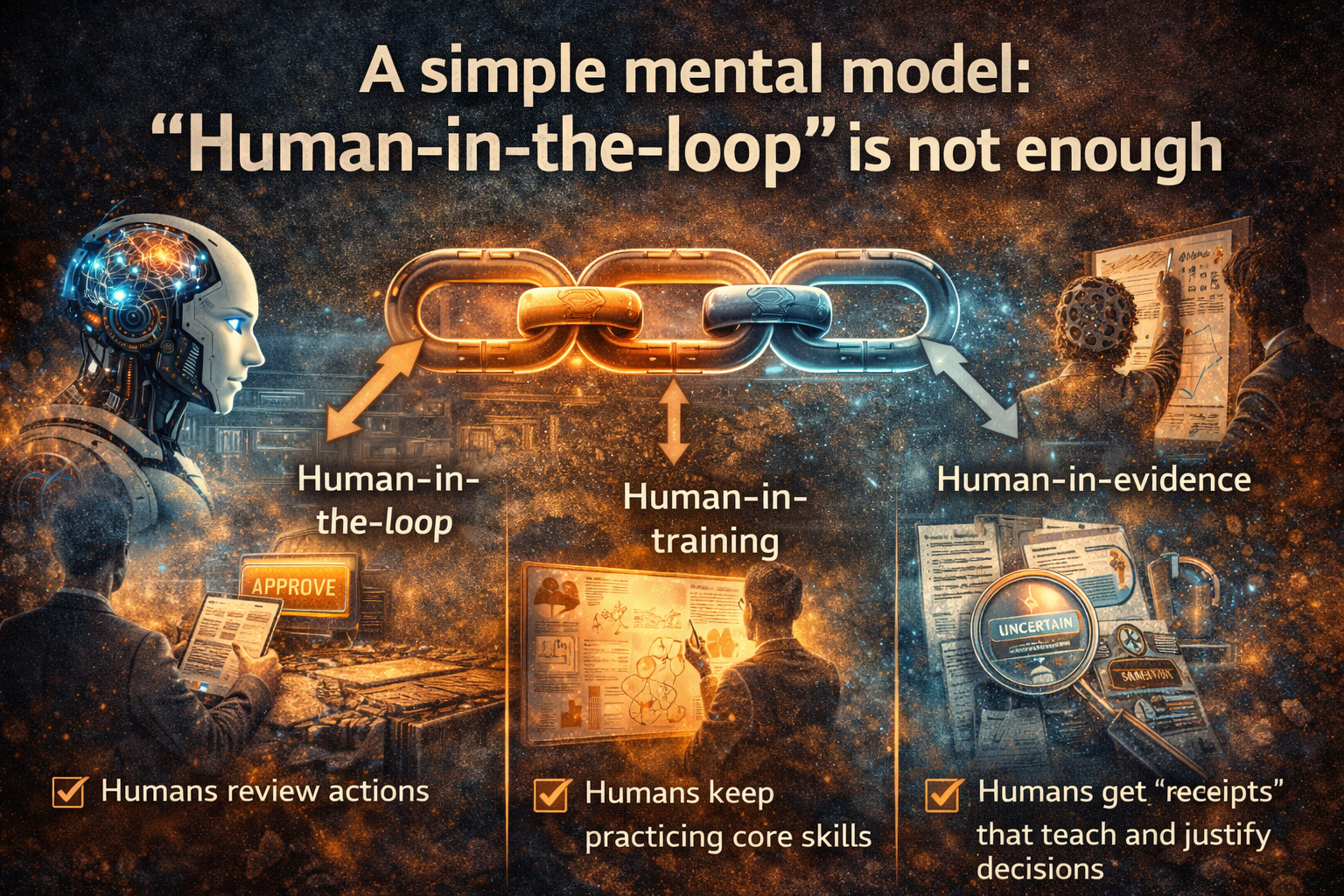
A simple mental model: “Human-in-the-loop” is not enough
Most enterprises say “human-in-the-loop” as if it solves everything.
It doesn’t—because in practice you often get:
- Human-in-the-loop (the human approves)
but also - Human-out-of-practice (the human no longer knows)
A safer enterprise standard is:
Human-in-the-loop + Human-in-training + Human-in-evidence
Meaning:
- Humans review actions
- Humans keep practicing core skills
- Humans get “receipts” that teach and justify decisions
This is exactly aligned with Enterprise AI as an operating model: operability, governance, defensibility—not just intelligence.
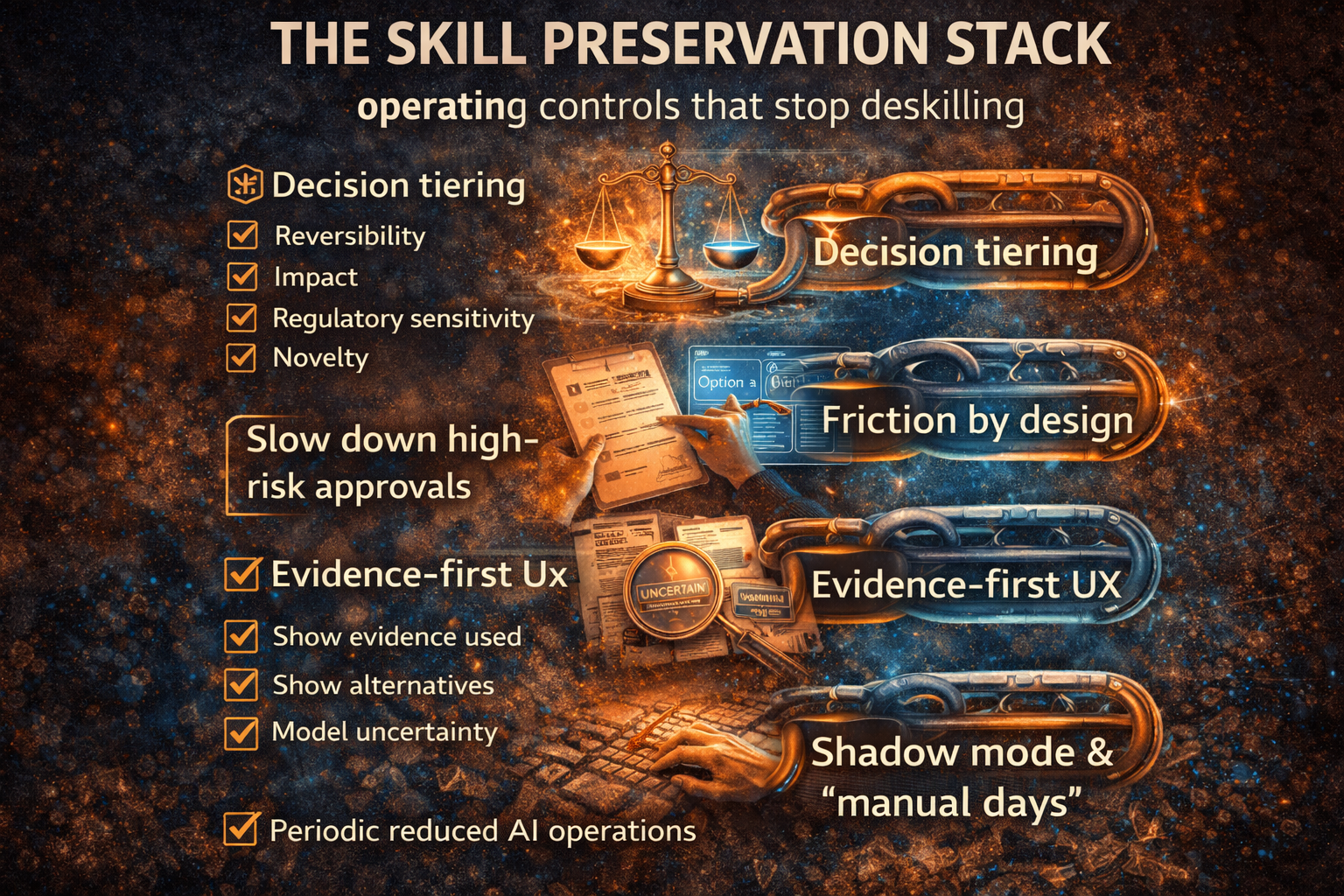
The Skill Preservation Stack: operating controls that stop deskilling
If Enterprise AI is “how intelligence runs in production,” then skill preservation must be treated as a production control, not a cultural hope.
1) Decision tiering (who must practice what)
Not every decision needs the same human involvement. Classify decisions by:
- reversibility
- impact radius
- novelty
- regulatory sensitivity
- downstream coupling
Then define: which human skills must remain sharp for each tier. The goal isn’t maximal human involvement. The goal is capability retention where it matters.
2) Friction by design (slow down high-risk approvals)
High-impact decisions should not be “one-click approvals.” Introduce deliberate review steps where they matter:
- second reviewer for high-impact classes
- structured checklist (“What assumption would make this wrong?”)
- forced comparison with at least one alternative
Friction is not bureaucracy when it prevents catastrophic errors. It’s a safety feature.
3) Evidence-first UX (make learning unavoidable)
For each AI recommendation, show:
- evidence used (systems, documents, signals)
- alternatives considered
- what the model is uncertain about
- what assumptions it made
This converts approvals into micro-training moments and reduces blind trust—an automation risk repeatedly highlighted in the literature. (ScienceDirect)
4) Shadow mode and “manual days”
Run periodic operations where AI is reduced or removed for selected workflows—so humans retain muscle memory and situational awareness. In navigation research, passive guidance is argued to reduce spatial learning; the analog holds strongly for decision learning. (PubMed Central)
5) Decision-incident drills (for cognition, not just infrastructure)
Most companies drill outages. Few drill decision failures:
- wrong approvals
- missed signals
- over-trust in automation
- slow takeover
Yet “takeover weakness” is exactly what out-of-the-loop research warns about. (Maritime Safety Innovation Lab LLC)
Enterprise AI Operating Model
Enterprise AI scale requires four interlocking planes:
Read about Enterprise AI Operating Model The Enterprise AI Operating Model: How organizations design, govern, and scale intelligence safely — Raktim Singh
- Read about Enterprise Control Tower The Enterprise AI Control Tower: Why Services-as-Software Is the Only Way to Run Autonomous AI at Scale — Raktim Singh
- Read about Decision Clarity The Shortest Path to Scalable Enterprise AI Autonomy Is Decision Clarity — Raktim Singh
- Read about The Enterprise AI Runbook Crisis The Enterprise AI Runbook Crisis: Why Model Churn Is Breaking Production AI — and What CIOs Must Fix in the Next 12 Months — Raktim Singh
- Read about Enterprise AI Economics Enterprise AI Economics & Cost Governance: Why Every AI Estate Needs an Economic Control Plane — Raktim Singh
Read about Who Owns Enterprise AI Who Owns Enterprise AI? Roles, Accountability, and Decision Rights in 2026 — Raktim Singh
Read about The Intelligence Reuse Index The Intelligence Reuse Index: Why Enterprise AI Advantage Has Shifted from Models to Reuse — Raktim Singh
Read about Enterprise AI Agent Registry Enterprise AI Agent Registry: The Missing System of Record for Autonomous AI — Raktim Singh
The business case leaders actually care about
Skill erosion is expensive in three ways.
1) Recovery costs explode
When AI fails, humans can’t recover quickly. The org pays in downtime, rework, customer friction, and compounding operational risk.
2) Audit and accountability weaken
If people can’t explain decisions, your defensibility collapses—especially where governance is not optional. Deskilling and reduced human capability also raise the stakes of automation bias. (Springer)
3) Talent development breaks
Junior staff learn by doing. If AI does the “thinking steps,” the pipeline of future experts shrinks.
This is capability bankruptcy: the enterprise looks productive while its competence quietly drains.
What to do on Monday: 10 practical controls to prevent deskilling
- Define “skills we must not lose” (judgment, craft, situational awareness) per domain.
- Instrument over-reliance signals (approval time too fast, low variance, low exploration).
- Require a structured “disagree mode” (periodic challenge + alternative proposal).
- Make evidence-first UX mandatory (uncertainty, assumptions, alternatives).
- Rotate ownership so humans retain end-to-end understanding.
- Run shadow operations where humans reason first—AI second.
- Schedule manual drills for critical workflows (quarterly, not yearly).
- Create escalation playbooks that assume humans are rusty—and train them.
- Align incentives to resilience, not throughput alone.
- Treat skill health as an operational KPI (because it is).
Glossary
- Skill erosion (deskilling): Loss of proficiency due to reduced practice when automated systems perform cognitive work. (MDPI)
- Out-of-the-loop performance problem: Reduced ability to detect issues and intervene effectively after long periods of automation control. (Maritime Safety Innovation Lab LLC)
- Automation complacency: Over-trust in automated outputs leading to reduced monitoring and slower detection of errors. (ScienceDirect)
- Human-on-call: A pattern where humans only intervene during exceptions—often when they’re least prepared.
- Evidence-first AI: AI that provides provenance, assumptions, alternatives, and uncertainty so decisions remain defensible and educational.
- Capability preservation: Operating controls designed to keep human judgment and craft strong while using AI at scale.
- Decision drills: Practice scenarios focused on decision failures and takeover performance, not just system outages.
- Up skilling inhibition: Reduction in opportunities to acquire skills because AI assistance removes learning-by-doing pathways. (Springer)
FAQ
1) Is skill erosion inevitable with reasoning AI?
No—but it becomes the default unless you design against it. Human takeover performance and situational awareness can degrade when automation dominates the loop. (ScienceDirect)
2) Isn’t “human-in-the-loop” enough?
Not if the human becomes a rubber stamp. You need human-in-training and human-in-evidence to keep review meaningful and skills alive.
3) Should enterprises slow down AI adoption to avoid deskilling?
No. The right move is adopting AI with an Enterprise AI operating model—so you scale autonomy without losing competence and resilience.
4) What’s the fastest way to detect deskilling in an organization?
Watch for: approvals getting faster over time, fewer challenges to AI outputs, weaker explanations under audit, and slow recovery when AI is unavailable.
5) Where does skill preservation belong in Enterprise AI architecture?
In the operating layer—alongside decision governance, incident response, and enforcement controls—because it directly affects production safety and accountability.
Conclusion: Enterprise AI’s promise isn’t “replace humans.” It’s “scale intelligence without losing competence.”
Reasoning machines will make enterprises faster. That’s not the debate.
The real question is whether your organization will still know how to think when the machine is wrong, uncertain, or misaligned—because that moment is not hypothetical. It’s inevitable.
The winners won’t be the organizations with the smartest models.
They’ll be the organizations with the best Enterprise AI Operating Model—one that treats human judgment as a critical capability worth preserving, training, and continuously refreshing as autonomy scales.
https://www.raktimsingh.com/enterprise-ai-operating-model/
References and further reading
- Kaber, D. & Endsley, M. “Out-of-the-loop performance problems…” (Maritime Safety Innovation Lab LLC)
- Agnisarman, S. et al. Survey on automation-enabled human-in-the-loop systems (out-of-the-loop characterization). (ScienceDirect)
- Dahmani, L. & Bohbot, V. “Habitual use of GPS negatively impacts spatial memory…” (Scientific Reports). (Nature)
- Clemenson, G. et al. “Rethinking GPS navigation…” (review; PMC). (PubMed Central)
- Natali, C. et al. “AI-induced Deskilling in Medicine…” (review; Springer). (Springer)
- Peiffer-Smadja, N. et al. ML clinical decision support: deskilling and automation bias concerns (ScienceDirect). (ScienceDirect)
- Klostermann, M. et al. Skill decay definition and interventions (MDPI). (MDPI)
- NATO STO report: Skill fade and competence retention (technical review). (publications.sto.nato.int)



Raktim Singh is an AI and deep-tech strategist, TEDx speaker, and author focused on helping enterprises navigate the next era of intelligent systems. With experience spanning AI, fintech, quantum computing, and digital transformation, he simplifies complex technology for leaders and builds frameworks that drive responsible, scalable adoption.