
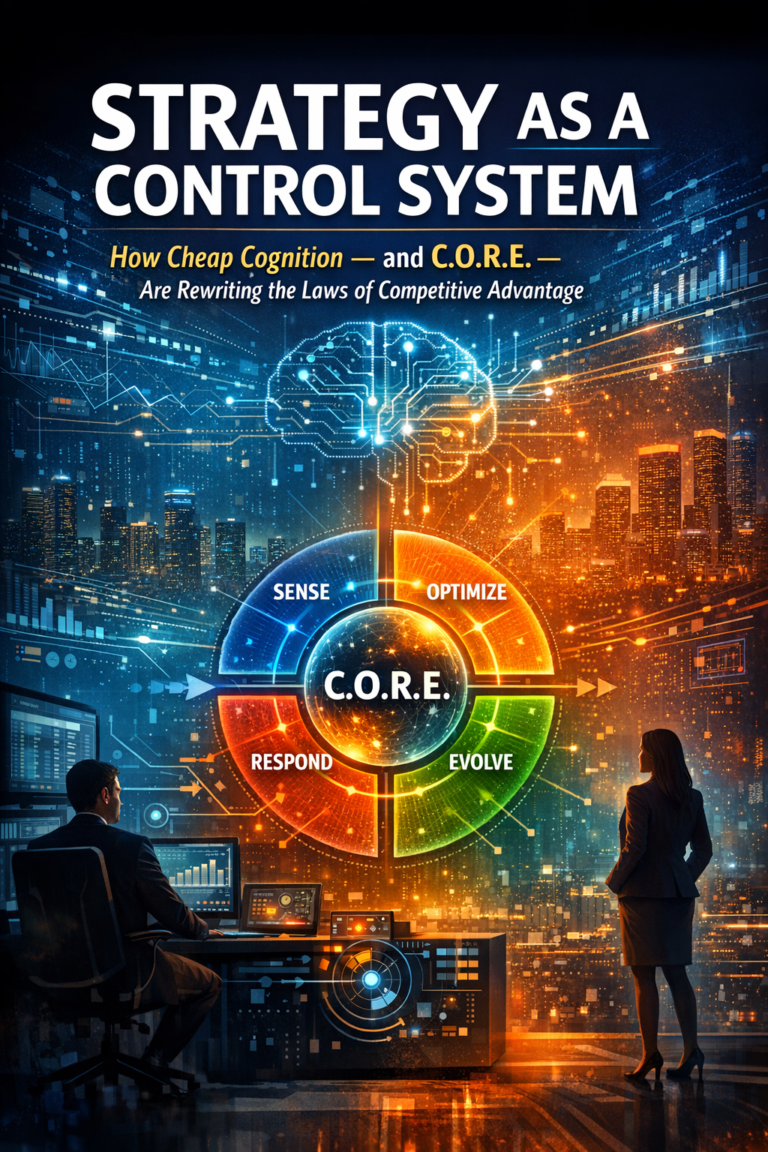
When cognition becomes cheap, decision latency collapses, and adaptation becomes continuous, strategy can no longer live in PowerPoint decks or board binders. It must operate as a control system—continuously sensing reality, optimizing choices, responding under governance, and evolving over time.
In the Third-Order AI Economy, competitive advantage will not belong to the firm with the best plan. It will belong to the firm with the best feedback loop.
Strategy as a Control System is a governance and operating model in which an enterprise continuously senses, optimizes, responds, and evolves using AI-enabled feedback loops, rather than relying on static planning cycles.
Executive Summary (For Boards & CXOs)
Artificial Intelligence does not merely automate work.
It changes the physics of competition.
When cognition becomes cheap, decision latency collapses, and adaptation becomes continuous, strategy can no longer be a static document. It must become a governed, adaptive control system.
This article introduces:
- Why traditional strategy cycles are structurally mismatched in the AI era
- Why competitive advantage shifts from planning to feedback loops
- The C.O.R.E. framework as the operating architecture of adaptive strategy
- What boards must govern in an intelligence-native enterprise
- How this connects to the Third-Order AI Economy
If you are a board member, CEO, or senior executive, this is not a technology conversation.
It is a governance and capital allocation conversation.
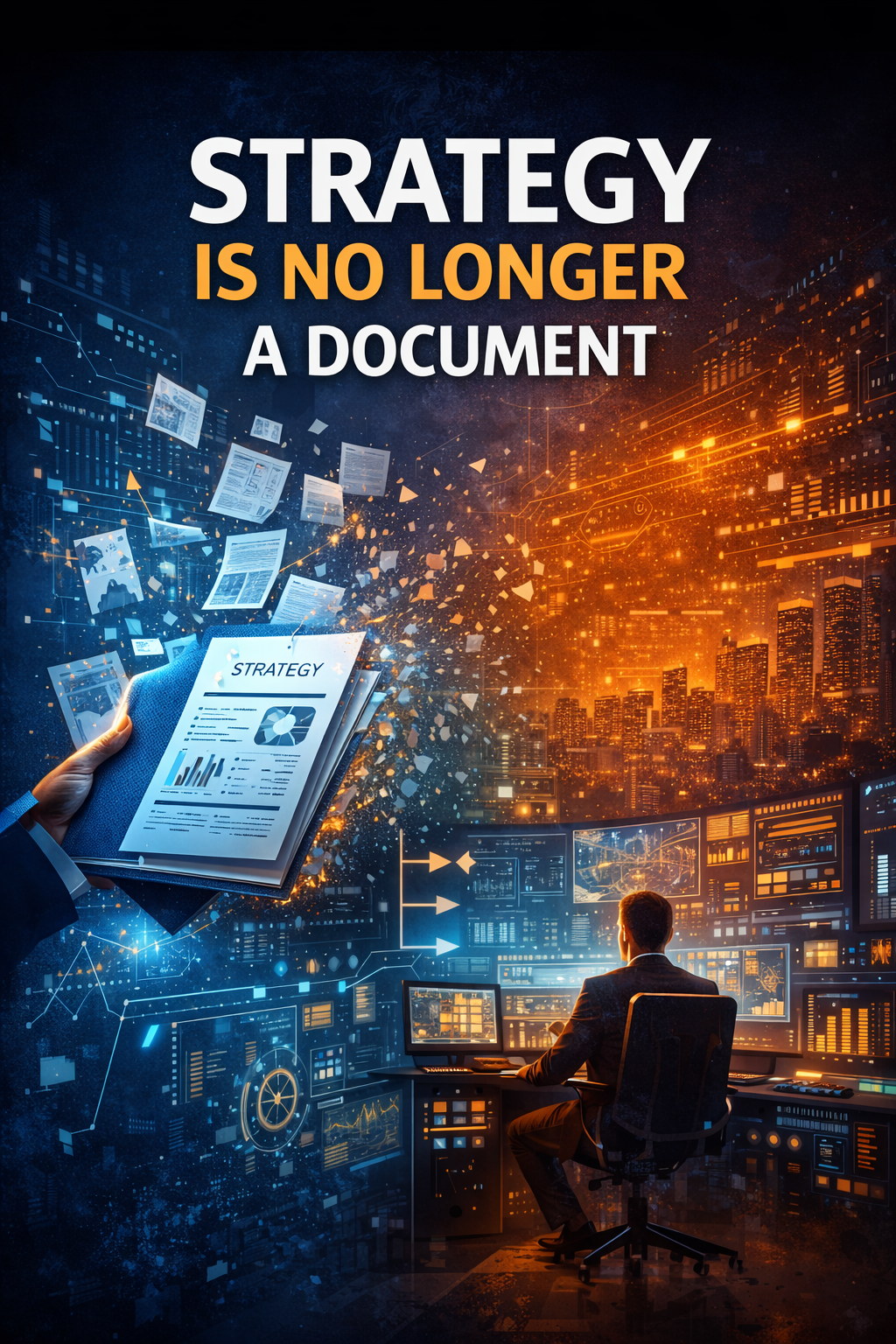
Strategy Is No Longer a Document
For decades, strategy has followed a predictable rhythm:
- Annual offsite
- Multi-year roadmap
- Quarterly review
- Budget alignment
- Risk oversight
This made sense in a world where:
- Information was scarce
- Analysis was expensive
- Market changes were periodic
- Decision cycles were slow
In that world, the bottleneck was thinking.
But AI changes the underlying physics.
When AI makes cognition abundant, three structural shifts occur:
- Cognition becomes cheap
- Decision latency collapses
- Adaptation becomes continuous
Once these shifts occur, strategy cannot remain a periodic planning exercise.
It must become a living, governed system.
It must become a control system.
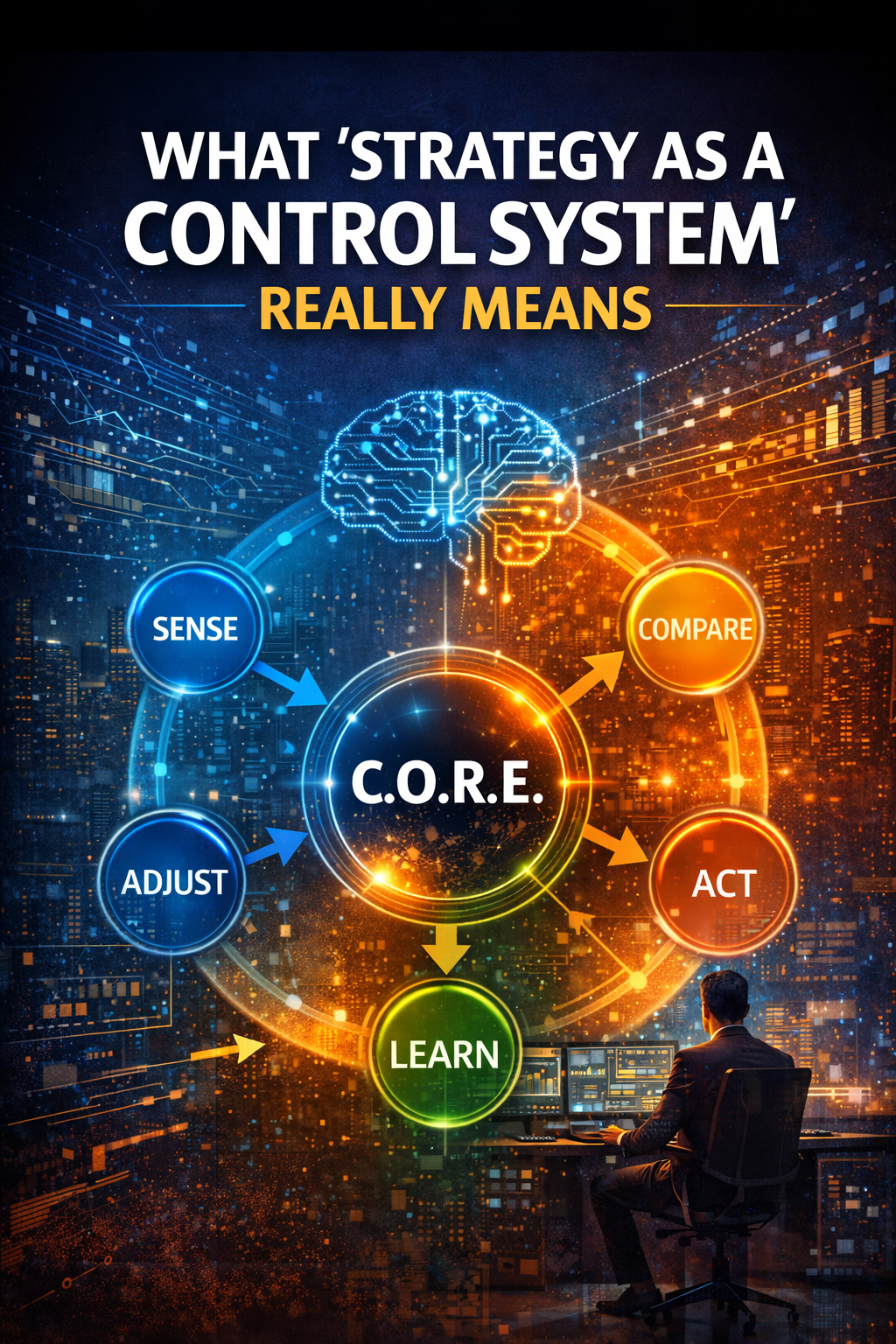
What “Strategy as a Control System” Really Means
A control system continuously:
- Senses reality
- Compares it against goals
- Acts within constraints
- Learns from outcomes
- Adjusts policies
- Repeats the loop
Airplanes use control systems.
Power grids use control systems.
Autonomous vehicles use control systems.
In the AI era, enterprises must do the same.
Competitive advantage shifts from “better plans” to “better feedback loops.”
This is not operational improvement.
It is a shift in the nature of strategy itself.
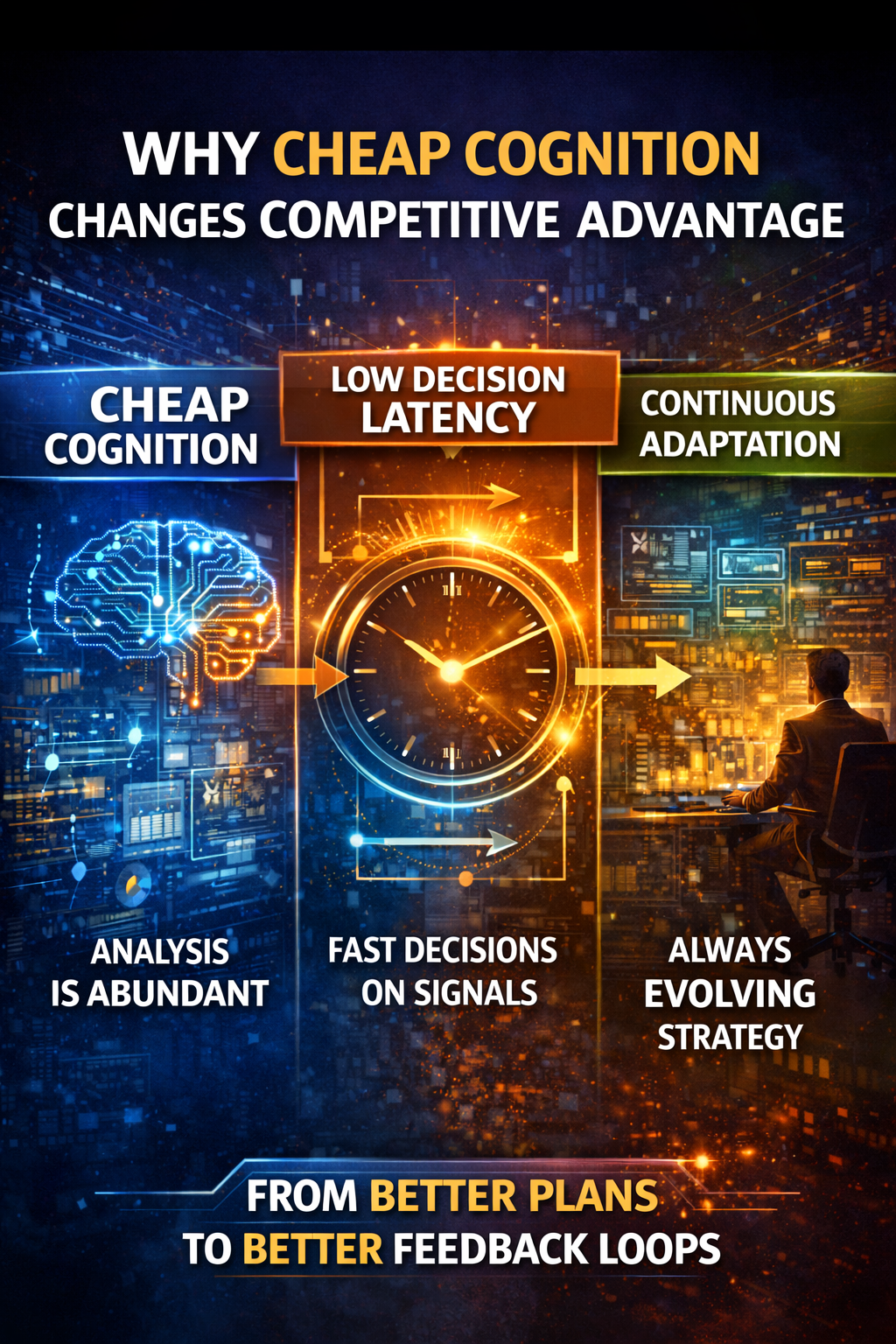
Why Cheap Cognition Changes Competitive Advantage
1️⃣ Cognition Becomes Cheap
Previously, strategic analysis required:
- Specialized expertise
- Consulting cycles
- Manual modeling
- Weeks of interpretation
Now:
- Scenario simulation is instant
- Pattern detection is continuous
- Risk scoring is automated
- Monitoring is always-on
Thinking is no longer scarce.
Execution under constraints becomes scarce.
The question shifts from:
“Can we analyze this?”
to:
“Can we act safely, quickly, and repeatedly?”
2️⃣ Decision Latency Collapses
Old world decision flow:
Signal → Report → Meeting → Approval → Action
AI-enabled decision flow:
Signal → Model → Decision → Execution
Latency shrinks dramatically.
But speed without governance creates instability.
Fast mistakes compound faster than slow mistakes.
Control becomes essential.
3️⃣ Adaptation Becomes Continuous
Markets update daily.
Customer preferences shift in real time.
Risk profiles evolve dynamically.
If your strategy updates quarterly, you are structurally mismatched with reality.
Strategy must evolve at the pace of the environment.
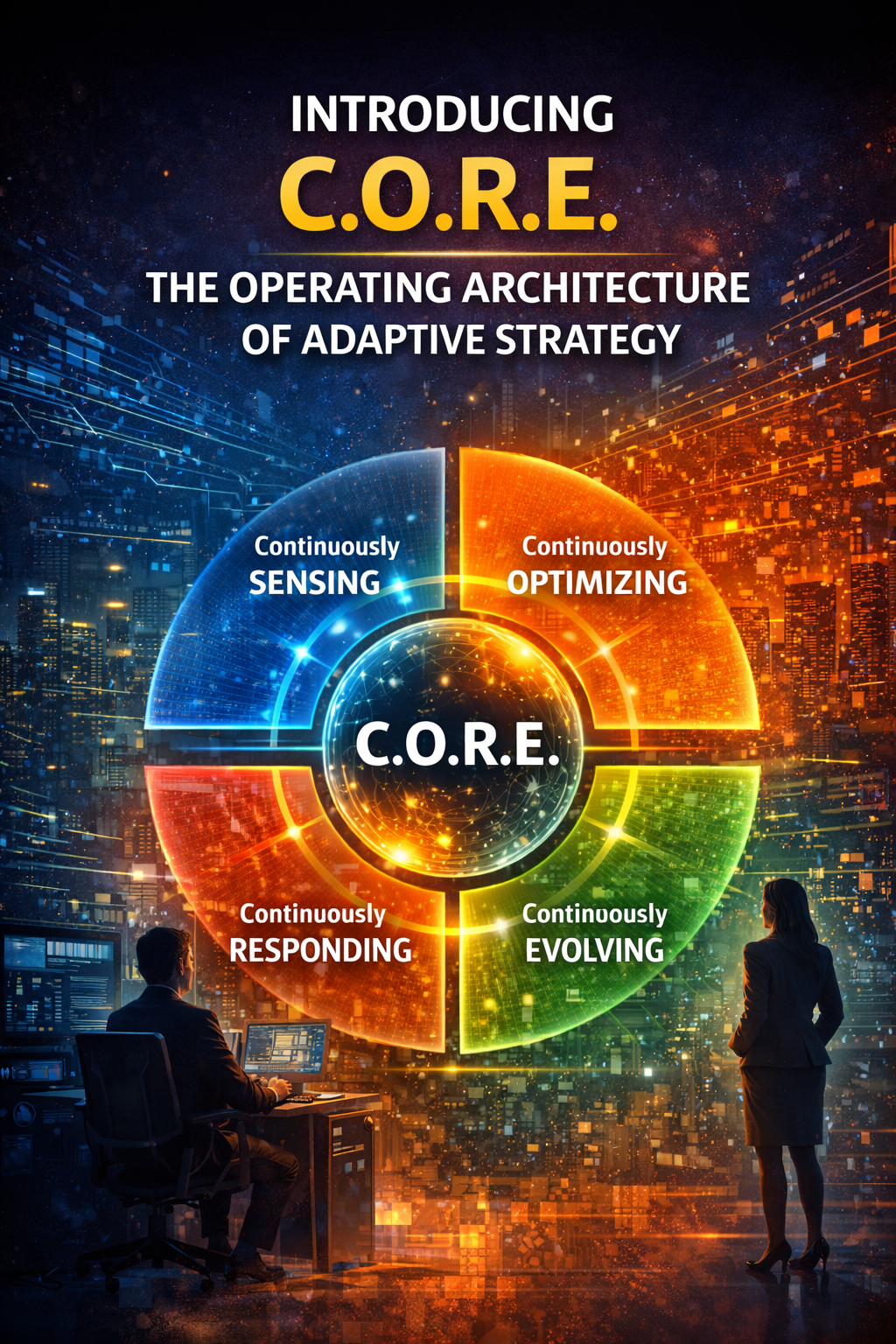
Introducing C.O.R.E.: The Operating Architecture of Adaptive Strategy
C.O.R.E. is not a digital transformation tool.
It is a strategic control architecture for the Intelligence-Native Enterprise.
It defines how strategy runs when cognition is cheap.
C — Continuously Sensing
Traditional strategy relies on lagging indicators.
C.O.R.E. strategy instruments reality.
Examples:
- Real-time customer sentiment
- Operational anomaly detection
- Early churn signals
- Live demand shifts
- Competitive pricing movements
Without sensing, control is impossible.
Sensing reduces strategic blindness.
O — Continuously Optimizing
Optimization is not cost-cutting.
It is dynamic alignment to strategic objectives.
Examples:
- Dynamic pricing
- Portfolio rebalancing
- Credit risk threshold tuning
- Resource reallocation
- Marketing spend recalibration
Cheap cognition enables constant recalibration.
Optimization reduces strategic drift.
R — Continuously Responding
Response means execution speed under governance.
Examples:
- Automated fraud blocking
- Instant credit approvals
- Supply chain rerouting
- Real-time policy escalation
Response reduces decision latency.
But response must operate within guardrails.
Without governance, speed creates instability.
E — Continuously Evolving
Evolution is the most powerful dimension.
It means updating:
- Decision policies
- AI models
- Incentive structures
- Capital allocation logic
- Organizational design
Evolution ensures the system itself improves.
This is where intelligence compounds.
Why C.O.R.E. Becomes the New Competitive Moat
In the AI era, firms may use similar models.
The difference lies in loop discipline.
C.O.R.E. creates three structural moats:
1️⃣ The Instrumentation Moat
Do you see reality earlier than competitors?
Early detection:
- Shortens reaction time
- Reduces losses
- Captures opportunities first
2️⃣ The Control Moat
Can you scale autonomy safely?
Control requires:
- Embedded policy logic
- Real-time constraints
- Auditability
- Human override mechanisms
Trust becomes competitive advantage.
3️⃣ The Learning Moat
Can you improve faster without breaking things?
Learning speed becomes structural advantage.
Firms that evolve safely outperform those that react periodically.
Practical, Real-World Illustrations
Customer Experience
Old model:
Quarterly NPS review → slow script updates
C.O.R.E. model:
- Real-time sentiment sensing
- Script optimization
- Instant escalation
- Weekly policy refinement
The advantage is not chatbot adoption.
It is faster, governed learning.
Supply Chain
Old model:
Monthly forecasts → high buffers
C.O.R.E. model:
- Continuous demand sensing
- Inventory optimization
- Automated replenishment
- Policy updates after disruption
Result:
Lower working capital + resilience.
Risk & Compliance
Old model:
Manual audits → static approval matrices
C.O.R.E. model:
- Real-time anomaly detection
- Continuous risk scoring
- Instant blocking
- Dynamic threshold updates
Result:
Lower fraud + faster approvals + better compliance.
What This Means for Boards
Boards traditionally oversee:
- Capital allocation
- Risk
- CEO performance
- Strategic direction
In a C.O.R.E. world, boards must govern:
1️⃣ Feedback Loop Integrity
Are we sensing the right signals?
2️⃣ Guardrail Design
Where is autonomy permitted?
Where must humans intervene?
3️⃣ Update Cadence
Are policies evolving fast enough — but safely?
The board’s role shifts from approving plans to governing adaptive systems.
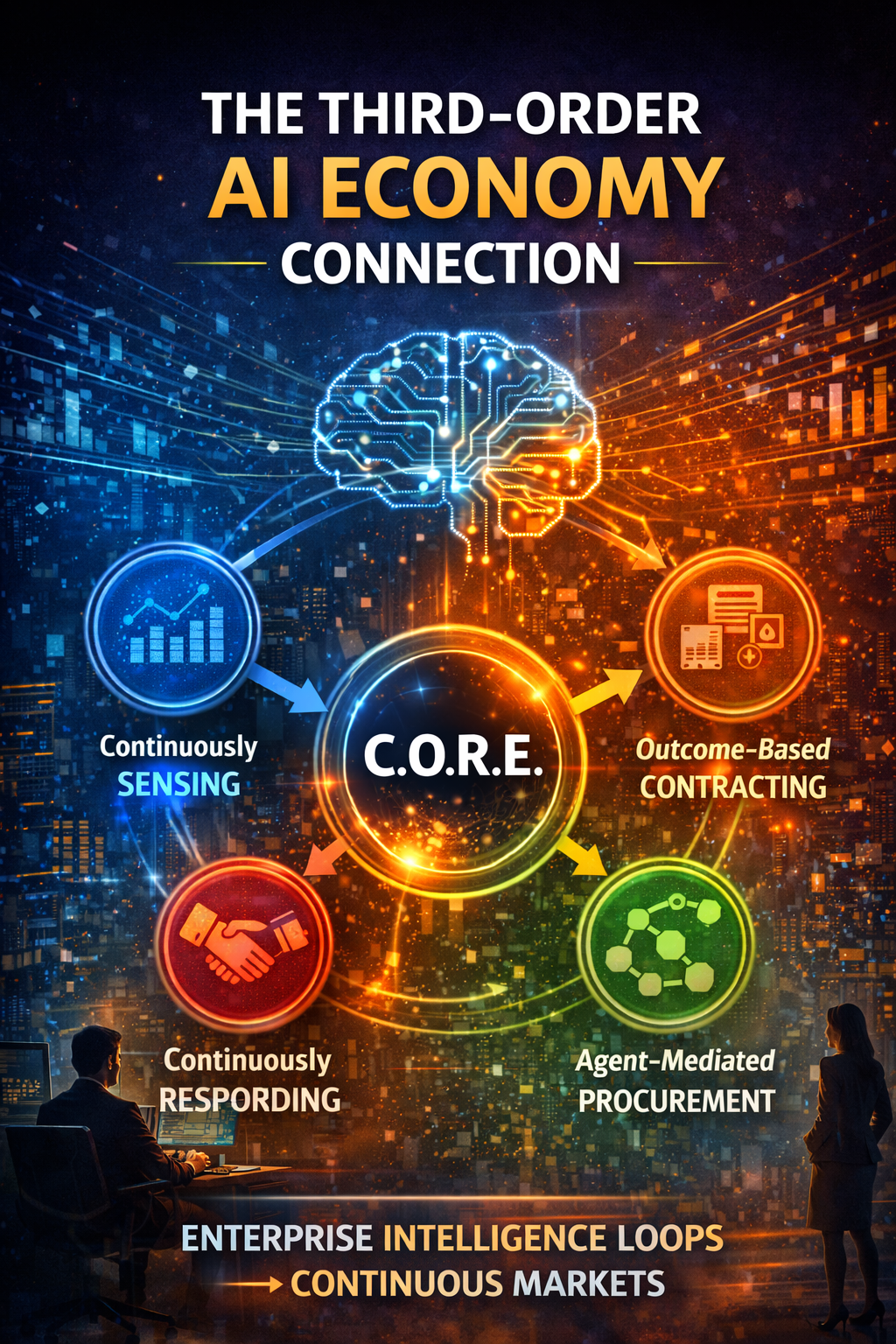
The Third-Order AI Economy Connection
The Third-Order AI Economy Connection
Once enterprises adopt C.O.R.E., markets evolve.
Continuous enterprise loops lead to:
- Continuous pricing markets
- Outcome-based contracting
- Agent-mediated procurement
- Decision infrastructure utilities
C.O.R.E. inside firms becomes continuous markets outside firms.
The Intelligence-Native Enterprise Doctrine
This article is part of a larger strategic body of work that defines how AI is transforming the structure of markets, institutions, and competitive advantage. To explore the full doctrine, read the following foundational essays:
- The AI Decade Will Reward Synchronization, Not Adoption
Why enterprise AI strategy must shift from tools to operating models.
https://www.raktimsingh.com/the-ai-decade-will-reward-synchronization-not-adoption-why-enterprise-ai-strategy-must-shift-from-tools-to-operating-models/ - The Third-Order AI Economy
The category map boards must use to see the next Uber moment.
https://www.raktimsingh.com/third-order-ai-economy/ - The Intelligence Company
A new theory of the firm in the AI era — where decision quality becomes the scalable asset.
https://www.raktimsingh.com/intelligence-company-new-theory-firm-ai/ - The Judgment Economy
How AI is redefining industry structure — not just productivity.
https://www.raktimsingh.com/judgment-economy-ai-industry-structure/ - Digital Transformation 3.0
The rise of the intelligence-native enterprise.
https://www.raktimsingh.com/digital-transformation-3-0-the-rise-of-the-intelligence-native-enterprise/ - Industry Structure in the AI Era
Why judgment economies will redefine competitive advantage.
https://www.raktimsingh.com/industry-structure-in-the-ai-era-why-judgment-economies-will-redefine-competitive-advantage/
Institutional Perspectives on Enterprise AI
Many of the structural ideas discussed here — intelligence-native operating models, control planes, decision integrity, and accountable autonomy — have also been explored in my institutional perspectives published via Infosys’ Emerging Technology Solutions platform.
For readers seeking deeper operational detail, I have written extensively on:
- What Makes an Enterprise Intelligence-Native? The Blueprint for Third-Order AI Advantage
https://blogs.infosys.com/emerging-technology-solutions/artificial-intelligence/what-is-enterprise-ai-the-operating-model-for-compounding-institutional-intelligence.html - Why “AI in the Enterprise” Is Not Enterprise AI: The Operating Model Difference Most Organizations Miss
https://blogs.infosys.com/emerging-technology-solutions/artificial-intelligence/why-ai-in-the-enterprise-is-not-enterprise-ai-the-operating-model-difference-that-most-organizations-miss.html - The Enterprise AI Control Plane: Governing Autonomy at Scale
https://blogs.infosys.com/emerging-technology-solutions/artificial-intelligence/the-enterprise-ai-control-plane-governing-autonomy-at-scale.html - Enterprise AI Ownership Framework: Who Is Accountable, Who Decides, and Who Stops AI in Production
https://blogs.infosys.com/emerging-technology-solutions/artificial-intelligence/enterprise-ai-ownership-framework-who-is-accountable-who-decides-and-who-stops-ai-in-production.html - Decision Integrity: Why Model Accuracy Is Not Enough in Enterprise AI
https://blogs.infosys.com/emerging-technology-solutions/artificial-intelligence/decision-integrity-why-model-accuracy-is-not-enough-in-enterprise-ai.html - Agent Incident Response Playbook: Operating Autonomous AI Systems Safely at Enterprise Scale
https://blogs.infosys.com/emerging-technology-solutions/artificial-intelligence/agent-incident-response-playbook-operating-autonomous-ai-systems-safely-at-enterprise-scale.html - The Economics of Enterprise AI: Designing Cost, Control, and Value as One System
https://blogs.infosys.com/emerging-technology-solutions/artificial-intelligence/the-economics-of-enterprise-ai-designing-cost-control-and-value-as-one-system.html
Together, these perspectives outline a unified view: Enterprise AI is not a collection of tools. It is a governed operating system for institutional intelligence — where economics, accountability, control, and decision integrity function as a coherent architecture.
What to Preserve — What to Change
Preserve
- Long-term direction
- Ethical principles
- Capital discipline
- Accountability
Transform
- Review cycles
- Decision latency
- Policy update cadence
- Organizational rigidity
Strategy becomes:
Stable vision + Adaptive C.O.R.E. engine
The 7-Question Executive Diagnostic
- What are our highest-impact decisions?
- Are they continuously sensed?
- Where is decision latency highest?
- What guardrails define safe autonomy?
- How frequently do we evolve policies?
- Do we capture institutional memory?
- Are we running strategy as a document — or as a loop?
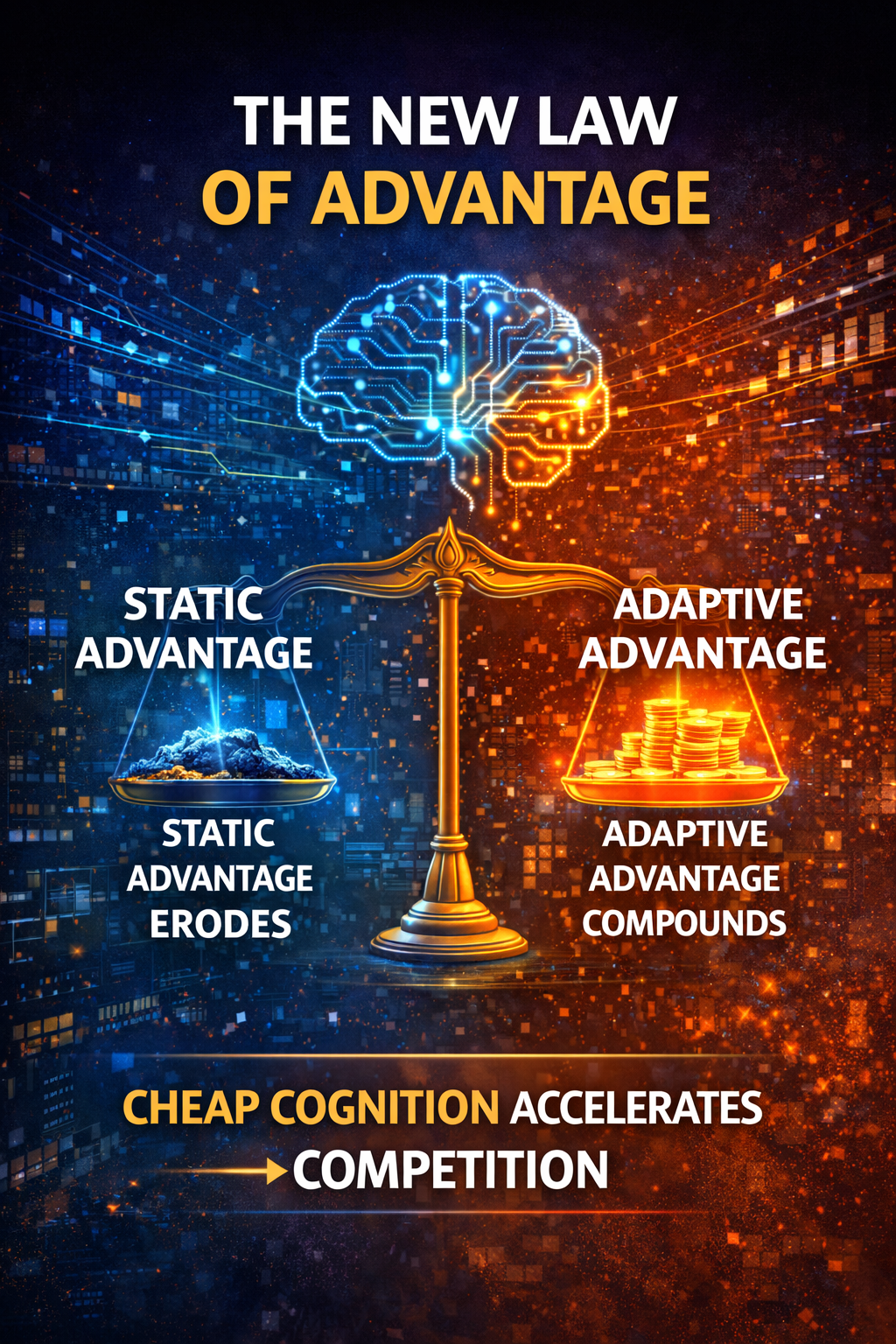
Conclusion: The New Law of Advantage
Cheap cognition does not eliminate competition.
It accelerates it.
Static advantage erodes.
Adaptive advantage compounds.
C.O.R.E. is the mechanism of compounding.
When cognition becomes programmable, strategy stops being periodic.
It becomes a governed, adaptive system.
The enterprises that master C.O.R.E. will:
- Sense earlier
- Decide safer
- Act faster
- Learn continuously
- Evolve deliberately
That is how organizations become intelligence-native.
That is how competitive advantage is rewritten.
And that is how boards win in the Third-Order AI Economy.
Frequently Asked Questions (FAQ)
What is Strategy as a Control System?
Strategy as a Control System is an AI-enabled operating model where enterprises continuously sense, optimize, respond, and evolve using feedback loops rather than relying on static planning cycles.
Why does cheap cognition change competitive advantage?
When AI makes analysis abundant and inexpensive, the bottleneck shifts from planning to adaptation. Advantage comes from faster, safer, and more disciplined feedback loops.
What is the C.O.R.E. framework?
C.O.R.E. stands for Continuously Sensing, Optimizing, Responding, and Evolving. It is an adaptive strategy architecture for intelligence-native enterprises.
What is the Third-Order AI Economy?
The Third-Order AI Economy describes the phase where AI does not just improve decisions inside firms but reshapes markets themselves through continuous adaptation and decision infrastructure.
What should boards focus on in the AI era?
Boards must govern feedback loop quality, guardrail design, policy update cadence, and institutional learning—not just approve static strategic plans.
Glossary
Strategy as a Control System
A governance and operating model in which an enterprise continuously senses, optimizes, responds, and evolves using AI-enabled feedback loops instead of relying on static planning cycles.
Cheap Cognition
The structural shift caused by AI where analytical capability, pattern recognition, and scenario modeling become abundant and low-cost, removing thinking as a bottleneck in decision-making.
Decision Latency
The time between signal detection and action. In AI-enabled enterprises, decision latency collapses from weeks or days to seconds or minutes.
Continuous Adaptation
The ability of an organization to update policies, models, capital allocation, and execution mechanisms in near real time as market conditions evolve.
C.O.R.E. Framework
A strategic control architecture for adaptive enterprises consisting of:
- C — Continuously Sensing: Instrumenting reality with real-time data and signals
- O — Continuously Optimizing: Dynamically aligning resources and decisions to objectives
- R — Continuously Responding: Executing actions rapidly under governance guardrails
- E — Continuously Evolving: Updating models, policies, and incentives to compound intelligence
Intelligence-Native Enterprise
An organization designed from the ground up to embed AI-driven feedback loops into its strategy, governance, and operating model.
Third-Order AI Economy
The phase of AI evolution where AI does not just improve efficiency (First Order) or optimize decisions (Second Order), but reshapes entire market structures, business models, and competitive dynamics.
Adaptive Advantage
A new form of competitive advantage based on superior feedback loop quality, learning speed, and controlled responsiveness rather than static positioning.
Continuous Markets
Markets where pricing, risk allocation, contracting, and procurement are dynamically updated through AI-enabled sensing and response systems.
Control Architecture
The structural design of feedback loops, guardrails, and governance mechanisms that allow AI-driven autonomy without destabilizing the enterprise.



Raktim Singh is an AI and deep-tech strategist, TEDx speaker, and author focused on helping enterprises navigate the next era of intelligent systems. With experience spanning AI, fintech, quantum computing, and digital transformation, he simplifies complex technology for leaders and builds frameworks that drive responsible, scalable adoption.