
The Intelligence Expansion: Why Enterprise AI Redefines Value Creation
Most enterprises are experimenting with AI.
Very few are compounding intelligence.
In the next decade, competitive advantage will not belong to companies that merely deploy models.
It will belong to organizations that systematically accumulate, reuse, govern, and improve decision intelligence across time.
The critical question for boards and CEOs is no longer, “Are we adopting AI?”
It is: Are we building an intelligence-compounding enterprise?
The first digital era connected information.
The next era compounds intelligence.
Enterprise AI is not a feature, a productivity tool, or a wave of automation.
It is the foundation for institutional intelligence — the ability of organizations to systematically improve, reuse, and govern decision-making at scale.
The companies that win the next decade will not be those that “adopt AI,” but those that design systems where intelligence compounds.
Are You Building an Intelligence-Compounding Enterprise?
If you sit on a board today, AI probably shows up in two familiar forms:
- a productivity promise (“we’ll automate work”), and
- a risk headline (“we’ll lose jobs / trust / control”).
Both are real. Both are incomplete.
The internet did not change the world because it made communication cheaper. It changed the world because it re-wired distribution, discovery, and transactions—and then created entirely new categories of business: marketplaces, platforms, on-demand services, and digital ecosystems.
AI is similar—but deeper.
Because AI is not primarily a communications technology.
It is a decision technology.
And when decisions improve—at scale—value doesn’t just shift. It expands.
That expansion is the core opportunity boards should be excited about.
This article is written for board members and C-suite executives who want to lead with optimism—without falling into hype.
The goal is simple: help you see where value is moving, how new value will be created, and what must change so your organization captures the upside.
Executive takeaway: AI is building a new economic layer
The internet gave enterprises digital distribution.
AI is giving enterprises something rarer: institutional intelligence that compounds.
Not “intelligence” as a buzzword.
Intelligence as a practical operating advantage:
faster decisions, better decisions, decisions that learn, decisions that are defensible.
The best board question in 2026 is not, “Are we using AI?”
It is:
“Are we building decision infrastructure that compounds value over time?”
The recurring pattern: value migrates first, value is created next
Every major technology shift follows a predictable sequence:
- Value migration (quiet, structural)
- Value creation (visible, explosive)
- Institutional advantage (durable, compounding)
The internet’s early wave moved value from offline to online discovery and commerce. The next wave created platforms and on-demand ecosystems.
AI is in the value migration phase right now.
Not all value is moving. But the most valuable kind is:
Value Inside Decisions.
Pricing decisions. Credit decisions. Hiring decisions. Medical triage decisions.
Fraud decisions. Supply chain decisions. Customer retention decisions. Risk decisions.
Boards that recognize the migration early can guide their enterprises into the creation phase—where AI becomes a durable advantage, not a temporary tool.
Why AI is different from the internet
The internet connected people to information.
AI connects information to action.
That sounds subtle until you feel the implications:
- The internet lowered the cost of communication and distribution.
- AI lowers the cost of judgment, coordination, and execution—when designed well.
This is why credible research estimates that generative AI alone could create $2.6T–$4.4T in annual economic value across a broad set of use cases. (McKinsey & Company)
In board language: AI is not just an efficiency lever.
It is a new operating lever.

The real opportunity: enterprises can finally compound “institutional intelligence”
Most companies do not compound intelligence.
They compound assets (plants, products), distribution (channels), and capital (cash flows). But decision quality often resets every quarter because it lives inside:
- local managers,
- fragmented dashboards,
- inconsistent definitions,
- politics and incentives,
- disconnected workflows.
AI makes possible something enterprises have historically struggled to do at scale:
build institutional learning loops.
A learning loop is straightforward:
- capture decision context (signals, constraints, intent)
- choose the best action available
- measure the outcome (not just the output)
- learn what worked and why
- improve the next decision—safely, repeatedly, and fast
That is compounding intelligence.
And it is the engine of the intelligence expansion.
The board misconception: “AI = efficiency”
Efficiency matters, but it’s not the headline.
If your AI program only automates tasks, you may get incremental productivity. If your AI program improves decisions across revenue, cost, and risk, you unlock structural advantage.
Goldman Sachs, for example, has argued that generative AI could drive a meaningful boost in productivity and—even at the macro level—contribute to a sizable rise in global output over time. (Goldman Sachs)
So the board question is not:
“Are we adopting AI tools?”
It is:
“Are we redesigning the enterprise so decision quality and decision velocity improve together?”
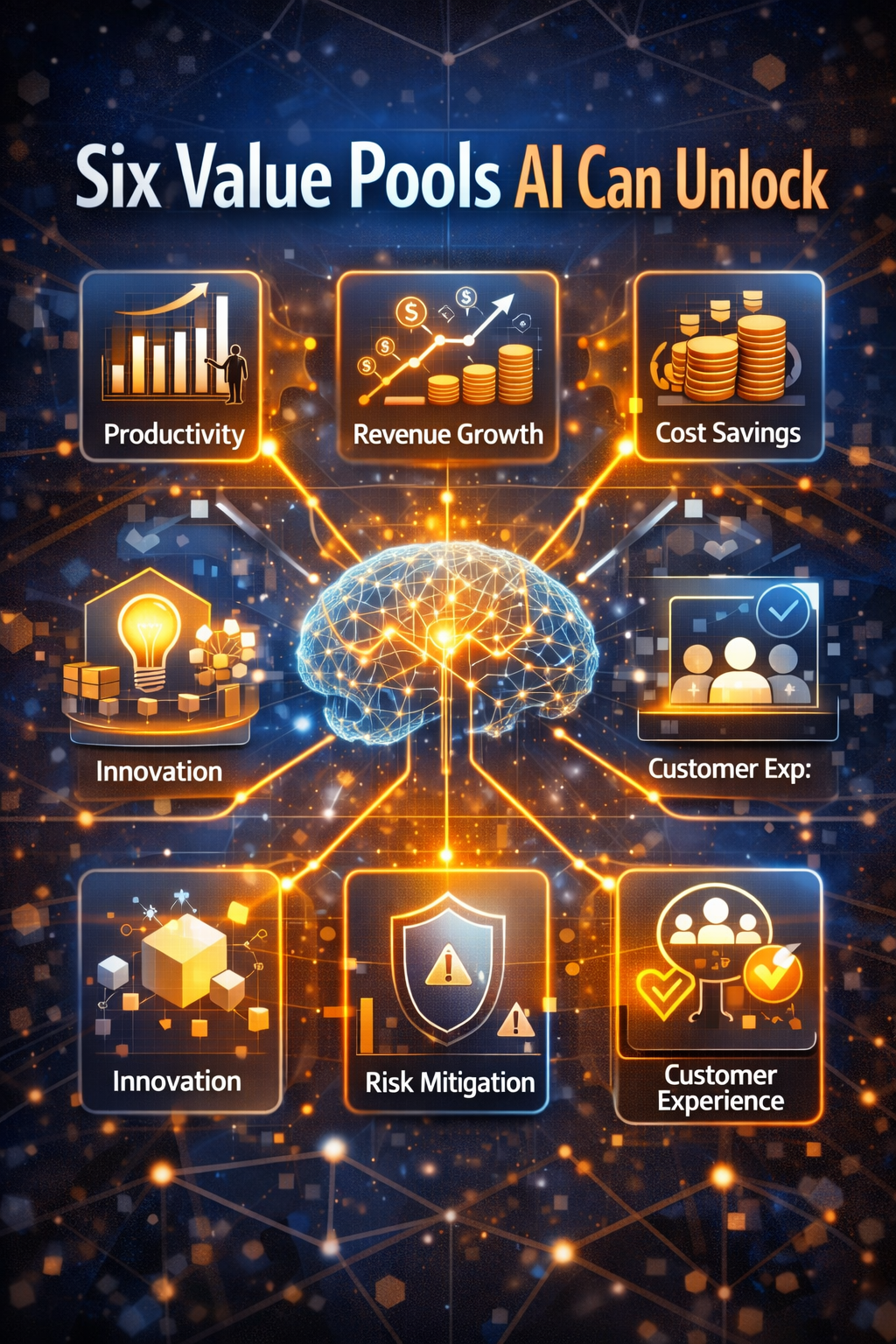
Six value pools AI can unlock (with simple examples)
1) Precision revenue: growth stops being average-based
Most enterprises still price and segment using broad averages.
AI enables precision growth: real-time, context-aware revenue decisions embedded into workflows—not personalization as marketing glitter, but revenue discipline at the micro level.
Example:
A telecom operator stops treating churn as a single problem. AI learns which customers are price-sensitive, which are service-sensitive, and which are trust-sensitive. The enterprise responds with the right intervention—price, plan, service outreach, or experience upgrade—before churn happens.
The upside isn’t “more offers.”
The upside is less revenue leakage—and higher lifetime value.
Understand more at: The End of Averages: Why Precision Growth Will Define the Next Decade of Enterprise Strategy
https://www.raktimsingh.com/precision-growth-end-of-averages-enterprise-ai/
2) Margin expansion: AI removes the coordination tax
Many costs aren’t production costs. They are coordination costs:
approvals, reconciliations, rework, meeting loops, policy ambiguity, compliance afterthoughts.
AI reduces these by making work more self-navigating.
Example:
A bank’s loan approval process often includes manual document checks, repeated clarifications, and late-stage risk review. With AI-assisted intake, triage, and policy-aware checking, many cycles disappear—reducing time-to-cash and operational drag.
This is not just “automation.”
This is institutional friction removal.
3) Risk compression: fewer “unknown unknowns” in operations
Most risk losses don’t come from one catastrophic failure. They come from small decision errors repeated thousands of times.
AI can:
- detect anomalies earlier,
- flag drift in patterns,
- identify emerging risk clusters,
- route edge cases to humans faster.
This is why policy and governance institutions emphasize trustworthy, risk-based approaches to AI adoption. (OECD)
Understand more at: What Is the AI Dividend? How Boards Capture Structural Gains from Enterprise AI
https://www.raktimsingh.com/ai-dividend-boards-structural-gains/
4) Decision velocity: time becomes a competitive weapon
In many sectors, whoever compresses signal → insight → action wins.
Example:
A retailer sees demand shifts in near real time and updates assortment, pricing, and inventory across regions—without waiting for a quarterly planning cycle.
That’s not analytics.
That’s strategic latency reduction.
Understand more at: Decision Scale: Why Competitive Advantage Is Moving from Labor Scale to Decision Scale
https://www.raktimsingh.com/decision-scale-competitive-advantage-ai/
5) New products: intelligence features become a category
In the internet era, software features became standard.
In the AI era, intelligence features become standard:
proactive copilots, explainable recommendations, scenario exploration, personalized experiences, and eventually agent-driven workflows.
This changes product strategy. AI is no longer a back-office tool. It becomes part of the customer promise.
6) New business models: value creation after migration
Once decisions get cheaper and faster, markets reorganize.
New business models emerge:
- outcome-based contracts (pay for measurable results)
- decision-as-a-service (domain decision engines)
- autonomous managed services (run workflows with bounded autonomy)
- intelligence subscriptions (continuous upgrades to decision quality)
This is the “value creation after migration” pattern that followed the internet: first the infrastructure spreads, then new institutions appear.
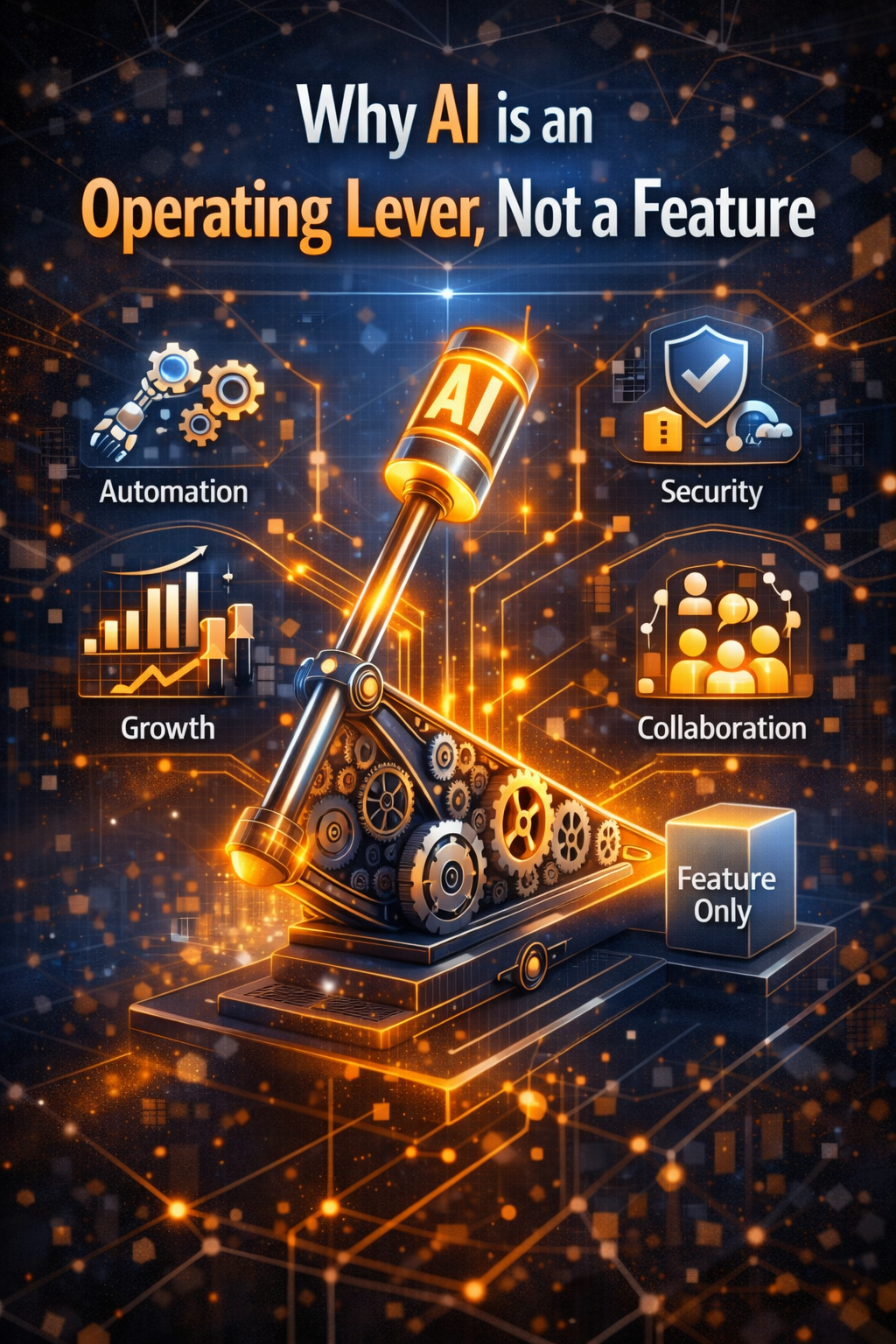
The technical explanation, without math: why AI is an operating lever, not a feature
Boards don’t need model internals. But they do need the mechanism.
AI creates value when it does three things well:
- Perception: interpret messy reality (documents, conversations, images, logs)
- Prediction: forecast what might happen (risk, demand, churn, fraud)
- Policy-aware action: recommend or act within constraints
Generative AI is particularly strong at perception (unstructured understanding) and assisted action (drafting, summarizing, composing). Traditional ML remains strong at prediction. The frontier is combining them into closed loops that learn.
This is also why “chatbot adoption” is not the finish line. Real gains come from redesigning workflows so AI is embedded where decisions happen—not bolted on as a layer of convenience.
Understand more at: The Enterprise AI Operating Model
https://www.raktimsingh.com/enterprise-ai-operating-model/
Why boards should be optimistic, without being naïve
Yes, AI will reshape labor markets. The IMF has highlighted significant job exposure globally and especially in advanced economies. (IMF)
But the opportunity-led framing is stronger and more useful for boards:
- AI will create and reshape roles around oversight, quality, safety, governance, and decision design. (IMF)
- AI adoption is expanding—but advantage accrues to organizations that operationalize it well, not those that merely deploy tools. (OECD)
- The upside is large enough that “getting it right” becomes a strategic imperative, not a technology bet. (McKinsey & Company)
Optimism is not denial.
Optimism is intentional design.
The board’s opportunity agenda: what to embrace, what to change, what to watch
What to embrace
- AI as decision infrastructure, not an IT project
- measurable decision outcomes, not tool usage
- Human + AI advantage as a leadership redesign problem
- a portfolio of high-value decision loops (revenue, cost, risk)
What to change
- decision rights clarity (who owns which decision, with what authority)
- data definitions + policy intent (so AI optimizes the right outcome)
- operating model ownership (AI is a board capability, not a side experiment)
- governance as an enabler, not a brake
What to watch
- whether AI is improving outcomes or merely increasing activity
- whether costs rise after “success” (usage, review load, process overhead)
- whether automation is quietly eroding critical skills
- whether you can explain and defend decisions when it matters
Understand more at: The Future Belongs to Decision-Intelligent Institutions
https://www.raktimsingh.com/the-future-belongs-to-decision-intelligent-institutions/

A simple board scoreboard: “Are we building an intelligence-compounding enterprise?”
Ask these five questions each quarter:
- Which decisions improved measurably—and how do we know?
- Where did AI reduce coordination friction (rework, approvals, reconciliation)?
- Which learning loops are now self-improving—with guardrails?
- Are we creating reusable intelligence assets or one-off pilots?
- Are we strengthening trust while scaling?
If you can answer these cleanly, you are already moving from migration to value creation.
Conclusion: the biggest value creation engine since the internet
The internet created massive value by transforming how we communicate, distribute, and transact.
AI will create massive value by transforming how we decide, coordinate, and act.
The winners will not be those with the most pilots.
They will be those who redesign their institutions so intelligence compounds safely—and advantage grows quietly, quarter after quarter.
For boards, that is the exciting mandate:
- build decision infrastructure,
- spot the value migration early, and
- lead your enterprise into the creation phase—where AI expands value, not just efficiency.
FAQ
1) Why compare AI to the internet?
Because both reshape the operating logic of markets. The internet rewired distribution; AI rewires decisions and execution.
2) Is AI mainly about cost reduction?
No. Cost reduction is a first-order benefit. The bigger upside is decision quality, margin expansion, and new business models.
3) What should boards do first?
Choose a small set of high-value decisions (revenue, risk, cost) and redesign the workflows so AI improves outcomes with governance built in.
4) How do we avoid hype?
Measure decision outcomes, not tool usage. Treat AI as a governed operating capability, not a collection of pilots.
5) Why is governance part of opportunity—not just risk?
Because governance turns AI from “interesting demos” into scalable, defensible value creation—especially in regulated environments. (OECD)
1. What does it mean to compound intelligence in an enterprise?
It means systematically improving and reusing decision intelligence across workflows so that institutional capability increases over time.
2. How is intelligence compounding different from AI adoption?
AI adoption introduces tools. Intelligence compounding redesigns the organization to accumulate and improve decisions.
3. Why is governance critical for intelligence compounding?
Without governance, AI deployments create fragmented intelligence that does not scale or persist.
4. Can small and mid-sized companies build intelligence-compounding systems?
Yes — if they design feedback loops, structured data capture, and decision accountability from the start.
5. What role do boards play in intelligence compounding?
Boards must treat AI as a strategic operating system, not a productivity feature.
The Enterprise AI Doctrine: From Decision Scale to Institutional Redesign
Over the past few months, I’ve been building a structured doctrine around Enterprise AI — not as a technology trend, but as an institutional redesign agenda.
It unfolds in layers:
🔹 1️⃣ Decision Economics
- Decision Scale: Why Competitive Advantage Is Moving from Labor Scale to Decision Scale
https://www.raktimsingh.com/decision-scale-competitive-advantage-ai/
→ Establishes the core thesis: advantage is shifting from scaling labor to scaling decision quality.
🔹 2️⃣ Institutional Transformation
- The Future Belongs to Decision-Intelligent Institutions
https://www.raktimsingh.com/the-future-belongs-to-decision-intelligent-institutions/
→ Argues that AI leadership is not about tooling — it is about institutional architecture.
🔹 3️⃣ Sector-Level Redesign
- The Institutional Redesign of Indian IT: From Services Firms to Intelligence Institutions
https://www.raktimsingh.com/institutional-redesign-indian-it-intelligence-institutions/ - From Labor Arbitrage to Intelligence Arbitrage: Why Indian IT’s AI Reinvention Will Define the Next Decade
https://www.raktimsingh.com/from-labor-arbitrage-to-intelligence-arbitrage-why-indian-its-ai-reinvention-will-define-the-next-decade/
→ Examines how this shift reshapes industry structure, economics, and competitive positioning.
🔹 4️⃣ Economic Consequences
- The End of Averages: Why Precision Growth Will Define the Next Decade of Enterprise Strategy
https://www.raktimsingh.com/precision-growth-end-of-averages-enterprise-ai/ - What Is the AI Dividend? How Boards Capture Structural Gains from Enterprise AI
https://www.raktimsingh.com/ai-dividend-boards-structural-gains/
→ Explores how decision intelligence translates into measurable structural gains.
🔹 The Unifying Thesis
Together, these articles form a coherent framework:
- Competitive advantage is moving from labor scale to decision scale
- Institutions must evolve from services firms to intelligence institutions
- AI must shift from isolated pilots to structurally governed, economically accountable enterprise systems
This is not AI adoption.
It is enterprise redesign.
Glossary
Intelligence Expansion: compounding enterprise value created when AI improves decisions and coordination at scale.
Decision Infrastructure: systems, workflows, policies, and telemetry that make decisions repeatable, governable, and improvable.
Decision Velocity: speed at which an enterprise converts signal into action.
Precision Growth: growth driven by real-time, context-aware decisions across pricing, retention, and personalization.
Institutional Intelligence: an organization’s ability to learn and improve decisions over time—not just individual brilliance.
Decision Scale: competitive advantage from scaling decision quality and velocity across the enterprise.
Intelligence Compounding – The systematic accumulation and reuse of decision intelligence over time, leading to increasing institutional capability.
Institutional Intelligence – The collective decision-making capability embedded in enterprise systems, workflows, and governance.
Enterprise AI Operating Model – The structured framework governing AI deployment, accountability, economics, and value realization.
Decision Intelligence – The discipline of improving decision quality using data, AI, governance, and feedback systems.
AI Governance – Policies, control mechanisms, and accountability structures ensuring responsible AI use.
References and further reading
- McKinsey Global Institute / McKinsey Digital: estimates of generative AI economic potential ($2.6T–$4.4T annually). (McKinsey & Company)
- Goldman Sachs Research: potential macroeconomic uplift from generative AI (including GDP/productivity framing). (Goldman Sachs)
- IMF (Jan 2024): AI exposure and workforce implications; productivity vs displacement dynamics. (IMF)
- OECD (2025) The Adoption of Artificial Intelligence in Firms + OECD AI updates (2026): adoption evidence and policy context. (OECD)



Raktim Singh is an AI and deep-tech strategist, TEDx speaker, and author focused on helping enterprises navigate the next era of intelligent systems. With experience spanning AI, fintech, quantum computing, and digital transformation, he simplifies complex technology for leaders and builds frameworks that drive responsible, scalable adoption.