
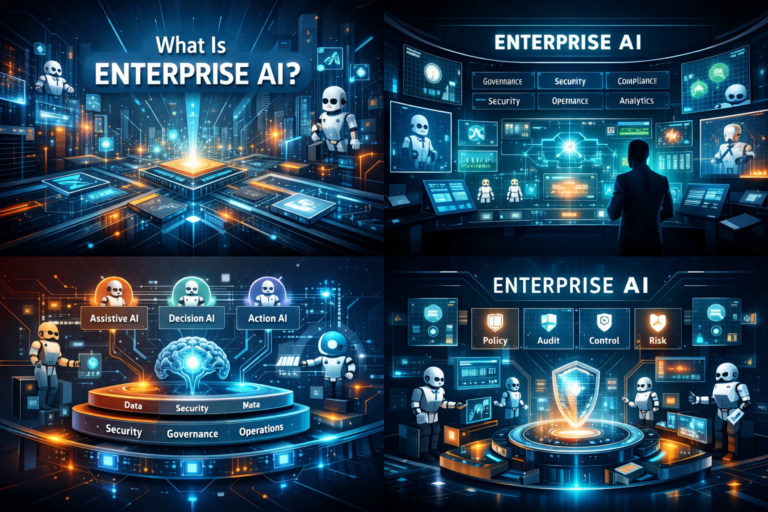
What Is Enterprise AI?
For the last two years, enterprises around the world have been busy “adopting AI.” Copilots have been rolled out, chat interfaces embedded into workflows, and pilot projects announced with impressive early results.
Yet beneath the momentum, a quieter realization is taking hold among CIOs, CTOs, and boards: much of what is being deployed today is AI inside the enterprise, not Enterprise AI.
The distinction is subtle, but decisive. As AI systems move from answering questions to shaping outcomes, organizations are discovering that intelligence alone is not the challenge—operability, governance, and accountability are.
For the last two years, enterprises have been busy “adopting AI.”
They have rolled out copilots.
They have experimented with chat interfaces.
They have piloted models across functions.
They have announced transformation programs.
And yet, beneath the optimism, a quiet unease is spreading among CIOs, CTOs, risk leaders, and boards.
The systems look impressive.
The demos work.
The early productivity gains are real.
But something feels unresolved.
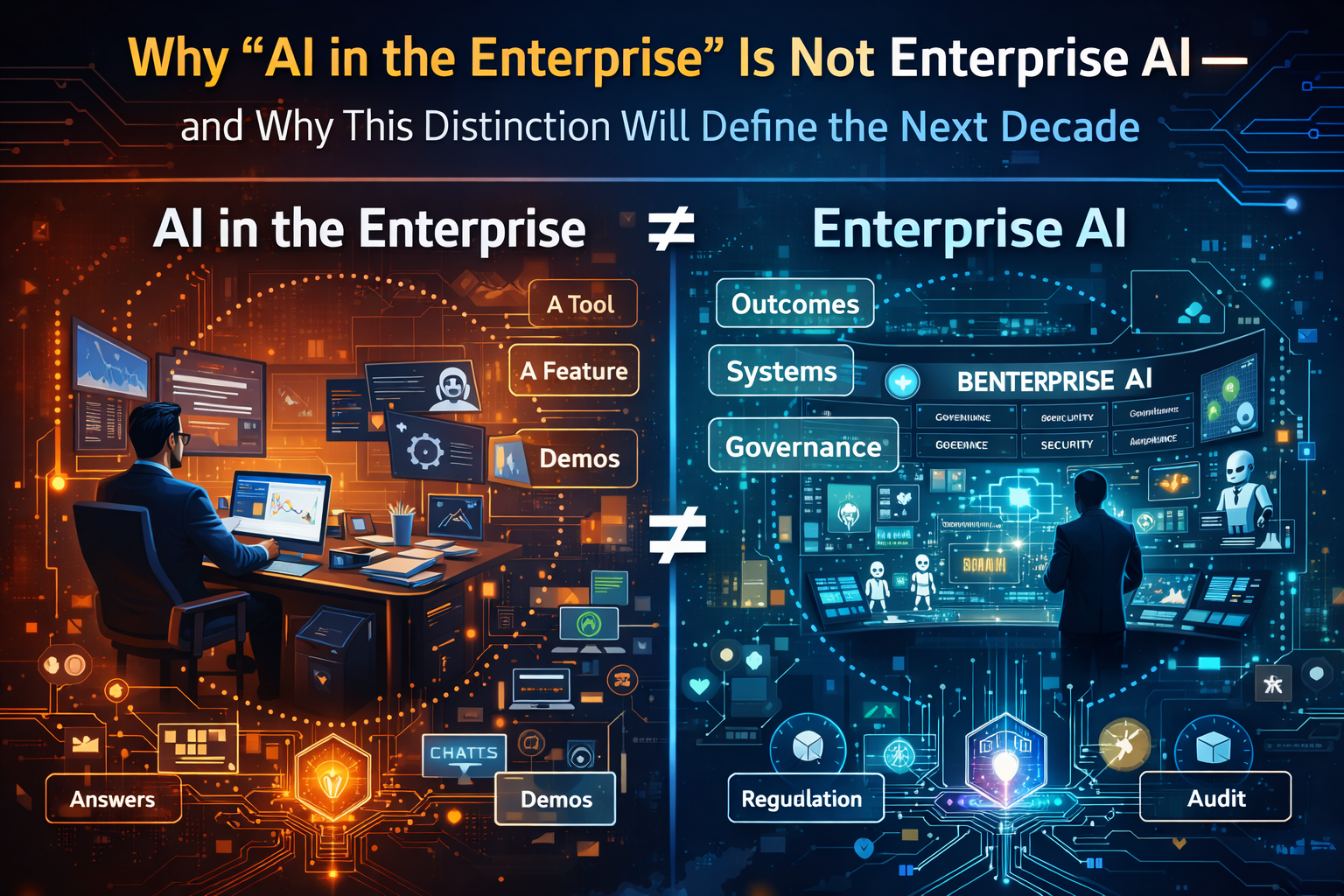
Because once AI moves from answering questions to shaping outcomes, the familiar playbook for enterprise technology stops working.
This is where a crucial distinction emerges — one that most organizations have not yet articulated clearly:
There is a difference between “AI in the enterprise” and Enterprise AI.
That difference is not semantic.
It is architectural.
It is operational.
And it will decide which organizations scale AI safely — and which quietly lose control of it.
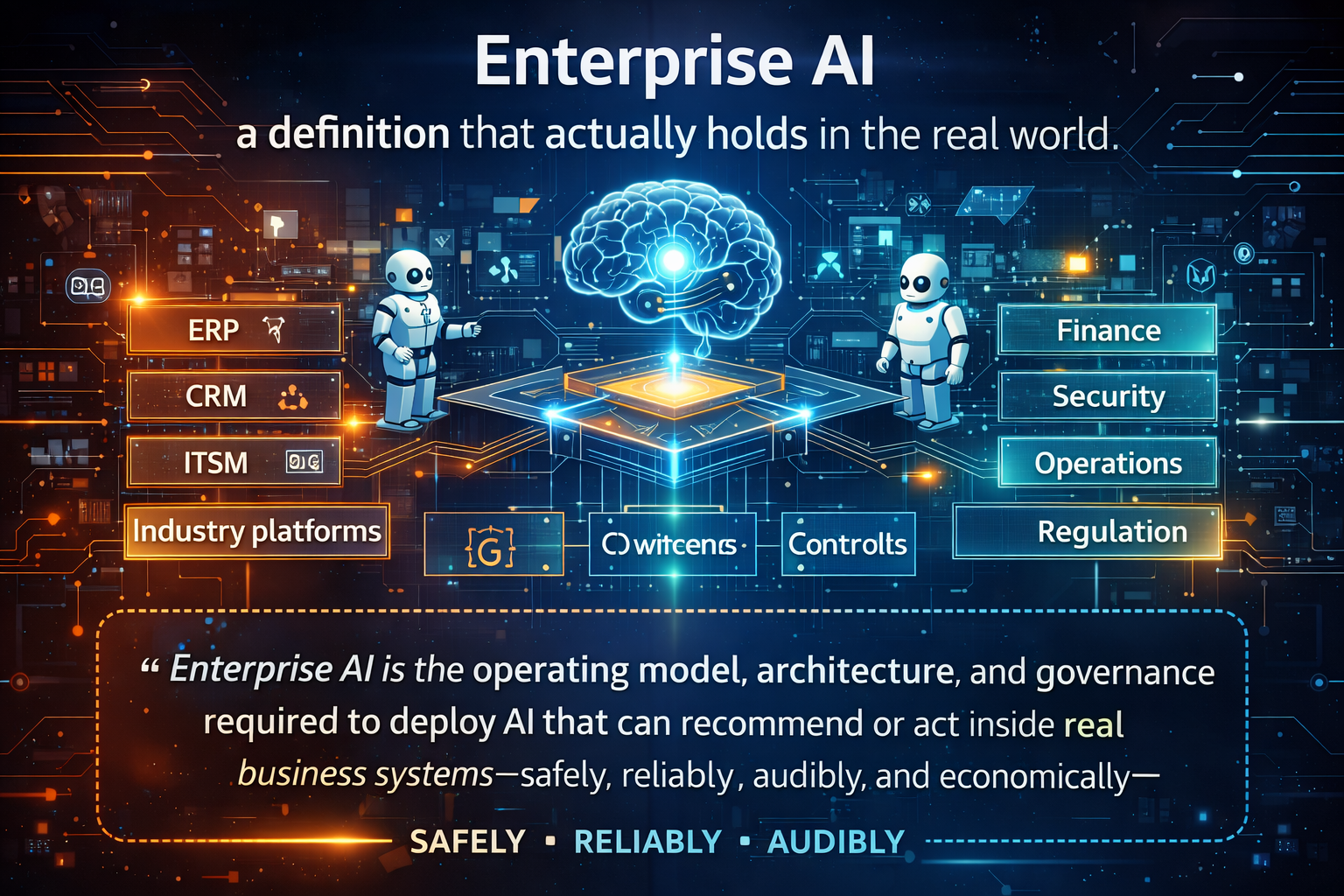
Enterprise AI: a definition that actually holds in the real world
Let’s start with a definition that survives contact with reality.
Enterprise AI is the discipline of turning AI — models, copilots, agents, and decision systems — into repeatable, governable, auditable business capability inside large organizations.
Not a demo.
Not a chatbot.
Not a clever automation.
Enterprise AI begins when AI must operate under the conditions that define enterprises themselves:
- Multiple core systems (ERP, CRM, ITSM, industry platforms, data estates)
- Multiple stakeholders (security, risk, legal, compliance, operations, finance)
- Formal policies (access control, approvals, retention, segregation of duties)
- High failure costs (regulatory exposure, financial loss, customer harm, reputational risk)
In simple terms:
Consumer AI optimizes for usefulness and delight.
Enterprise AI must optimize for accountability under uncertainty.
That single shift — from delight to accountability — is why Enterprise AI is not just “more AI,” but a fundamentally different operating problem.
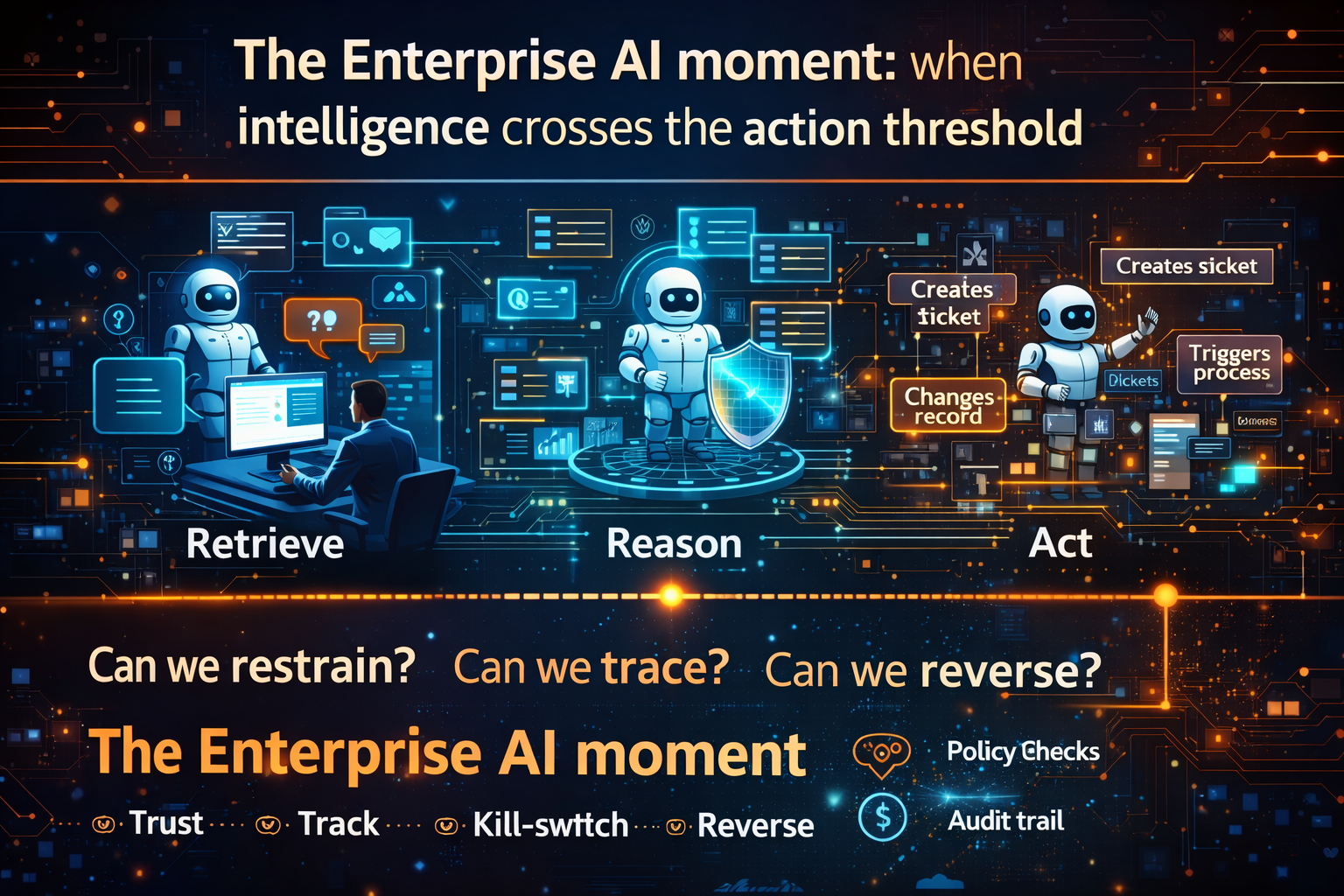
The Enterprise AI moment: when intelligence crosses the action threshold
For decades, enterprise software followed a predictable pattern:
- Systems stored data
- Humans made decisions
- Software executed instructions
AI disrupts this separation.
Modern AI systems don’t just retrieve information or automate predefined rules. They interpret context, recommend decisions, and increasingly take action — creating tickets, changing records, triggering workflows, initiating approvals, coordinating across systems.
This transition — from AI that talks to AI that acts — is the moment Enterprise AI truly begins.
It is also the moment where many organizations experience their first real friction.
Because the question is no longer:
“Is the AI accurate?”
It becomes:
- Can we trust it at scale?
- Can we explain its behavior?
- Can we contain failures?
- Can we reverse decisions?
- Can we prove compliance after the fact?
These are not model questions.
They are enterprise questions.

Why “AI in the enterprise” fails as a mental model
Most early AI initiatives fail not because the models are weak, but because the framing is wrong.
“AI in the enterprise” treats AI as another tool category:
- deploy it
- integrate it
- train users
- measure adoption
That framing breaks down the moment AI becomes consequential.
Enterprise AI is not a feature rollout.
It is the introduction of autonomous behavior into institutional systems.
And institutions — by design — care deeply about:
- predictability
- accountability
- traceability
- controllability
This is why enterprises do not fear AI because it is powerful.
They fear it because power without structure destabilizes systems.
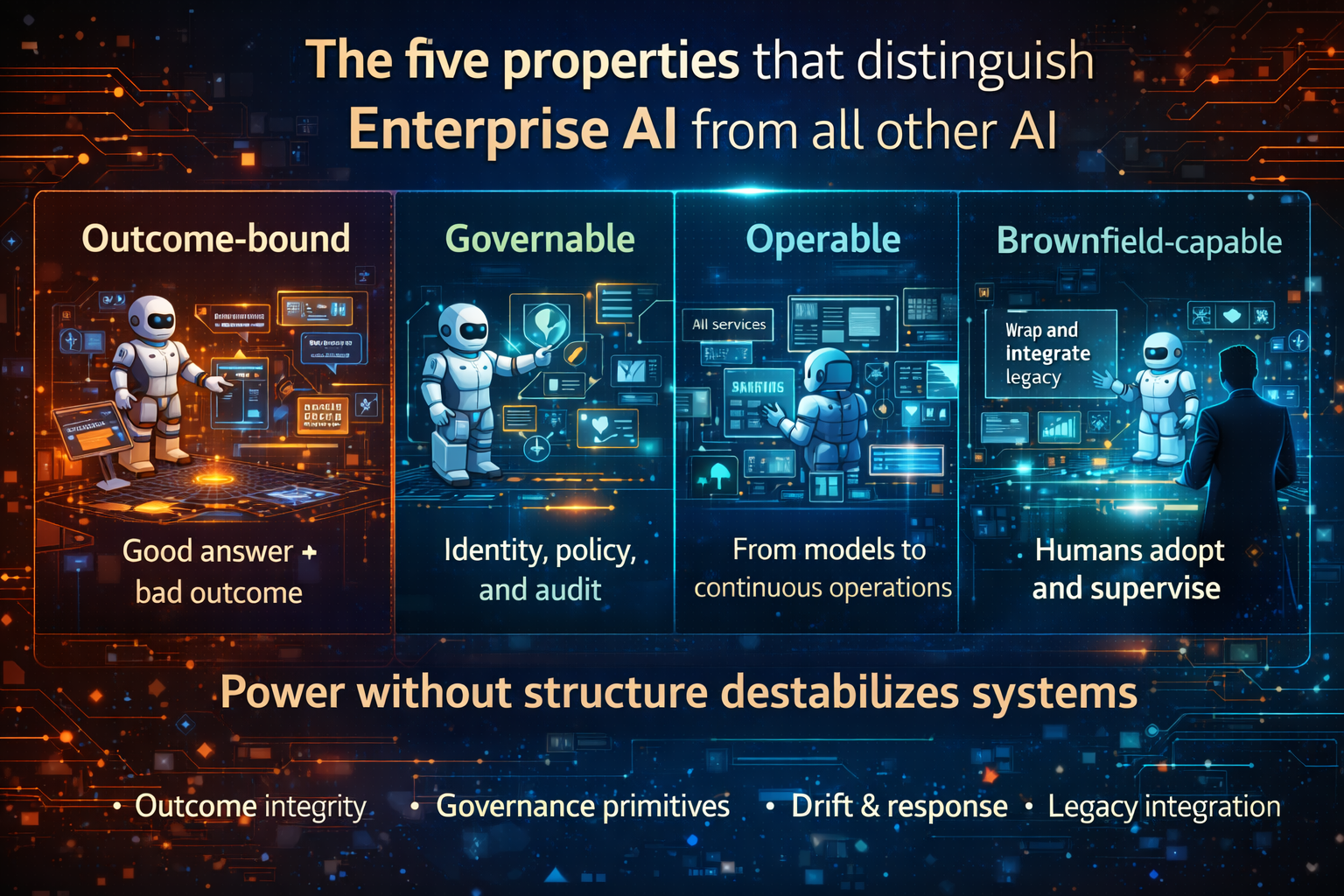
The five properties that distinguish Enterprise AI from all other AI
- Enterprise AI is outcome-bound, not answer-bound
A system can generate excellent answers and still produce disastrous outcomes.
This is the most underestimated shift.
In enterprise environments:
- a “reasonable” approval can violate policy
- a “helpful” action can create regulatory exposure
- a “logical” decision can break downstream processes
Enterprise AI success is therefore measured not by response quality, but by outcome integrity — whether the system consistently produces outcomes aligned with business intent, policy, and risk tolerance.
- Enterprise AI must be governable by construction, not after the fact
In enterprises, governance cannot be bolted on.
Every serious deployment immediately triggers questions such as:
- Who authorized this action?
- Under which policy?
- Using which data?
- With what confidence?
- Can we reconstruct the decision months later?
- Can we halt or reverse behavior instantly?
These are not optional concerns. They are the price of operating inside regulated, multi-stakeholder environments.
This is why Enterprise AI requires governance primitives — identity, permissions, policy enforcement, auditability — as first-class design elements, not compliance overlays.
Enterprise IT Is Becoming an App Store: From Projects to Services-as-Software: By Raktim Singh
- Enterprise AI must be operable at scale, not just intelligent
The hardest problems appear after the pilot succeeds.
When organizations move from:
- 5 AI use cases to 50
- 50 agents to 500
- one team to dozens of business units
the problem shifts decisively from intelligence to operations.
At scale, Enterprise AI must support:
- continuous monitoring and drift detection
- cost governance tied to business outcomes
- incident response and rollback
- controlled releases and versioning
- change management across systems and teams
This is why enterprises don’t “deploy models.”
They run AI systems, continuously.
Enterprise IT Is Becoming an App Store: From Projects to Services-as-Software: By Raktim Singh
- Enterprise AI must survive brownfield reality
Most enterprises are not greenfield startups.
They are living systems built over decades.
They contain:
- legacy cores
- vendor platforms
- customized workflows
- exception handling logic
- institutional knowledge embedded in process
Enterprise AI must therefore wrap, integrate, and coexist long before it can replace.
Architectures that assume clean-slate redesign rarely survive first contact with reality.
- Enterprise AI is socio-technical by nature
Enterprise AI does not fail only when models break.
It fails when people lose trust.
Employees ask:
- Will this system expose me to risk?
- Will it override my judgment?
- Will I be accountable for decisions I didn’t make?
This is why successful Enterprise AI requires more than intelligence. It requires an experience layer that makes autonomy legible, predictable, and safe for humans.
Trust is not a soft issue in Enterprise AI.
It is the hardest operational constraint.
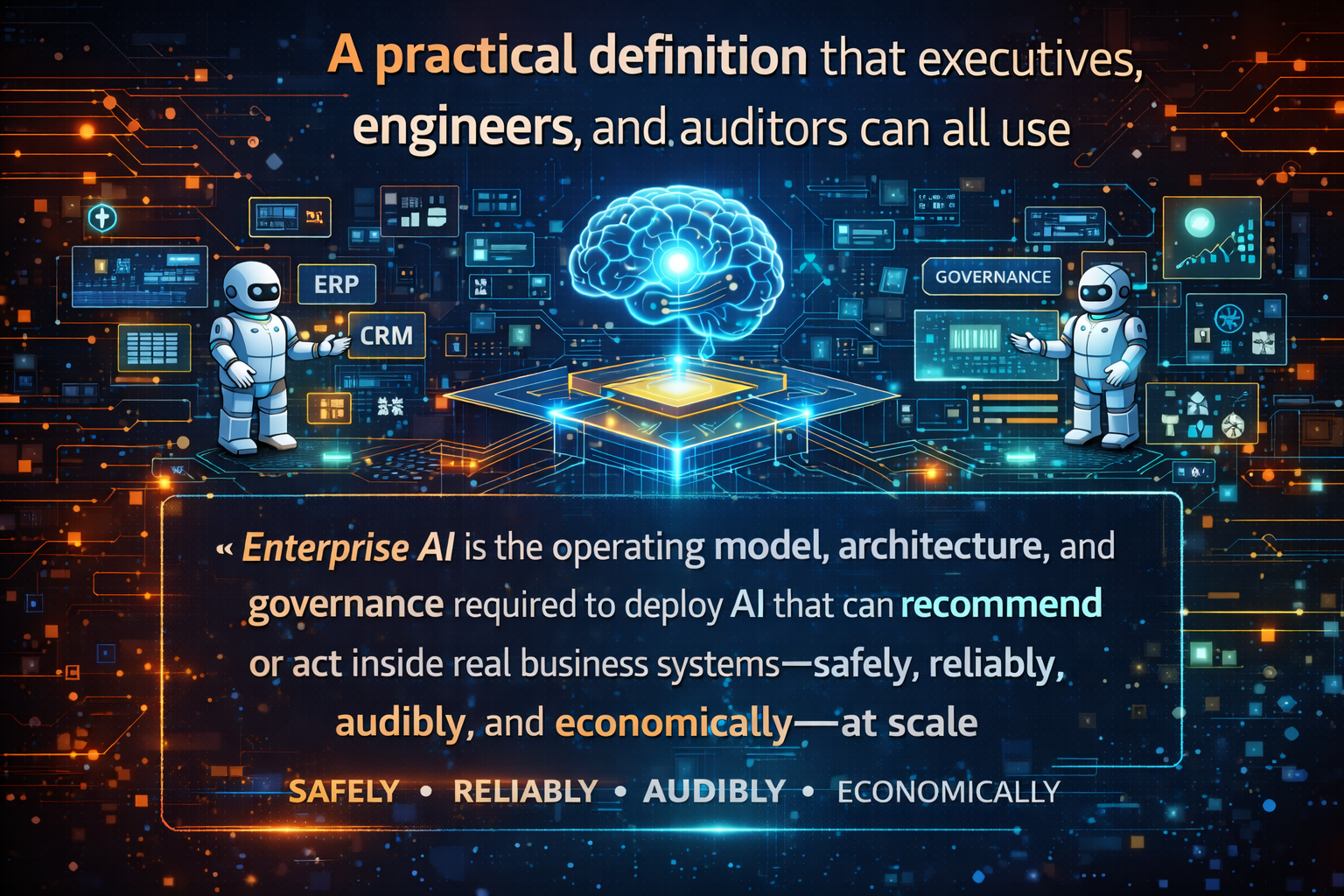
A practical definition that executives, engineers, and auditors can all use
Here is the most robust definition:
Enterprise AI is the operating model, architecture, and governance required to deploy AI that can recommend or act inside real business systems — safely, reliably, audibly, and economically — at scale.
This definition matters because it shifts focus away from models and toward capability.
Enterprise AI is not about what the AI is.
It is about how the organization runs it.
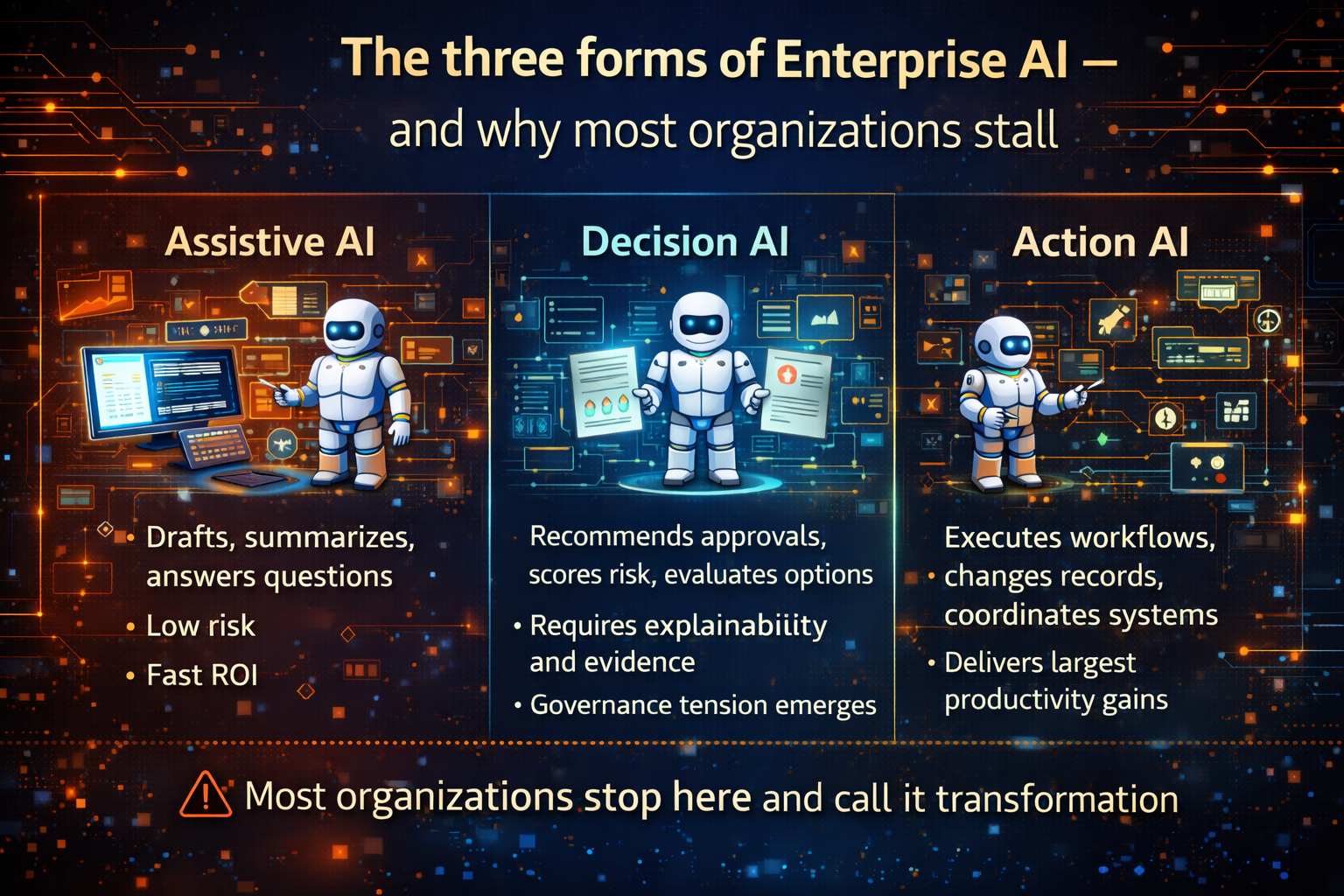
The three forms of Enterprise AI — and why most organizations stall
Type A: Assistive AI
- Drafts, summarizes, answers questions
- Low risk, fast ROI
- Still requires data governance
Type B: Decision AI
- Recommends approvals, scores risk, evaluates options
- Requires explainability and evidence
- Often where governance tension begins
Type C: Action AI
- Executes workflows, changes records, coordinates systems
- Delivers the largest productivity gains
- Introduces real operational risk
Most organizations stop at Type A and call it transformation.
Enterprise AI begins in earnest at Type C — when autonomy becomes operational.
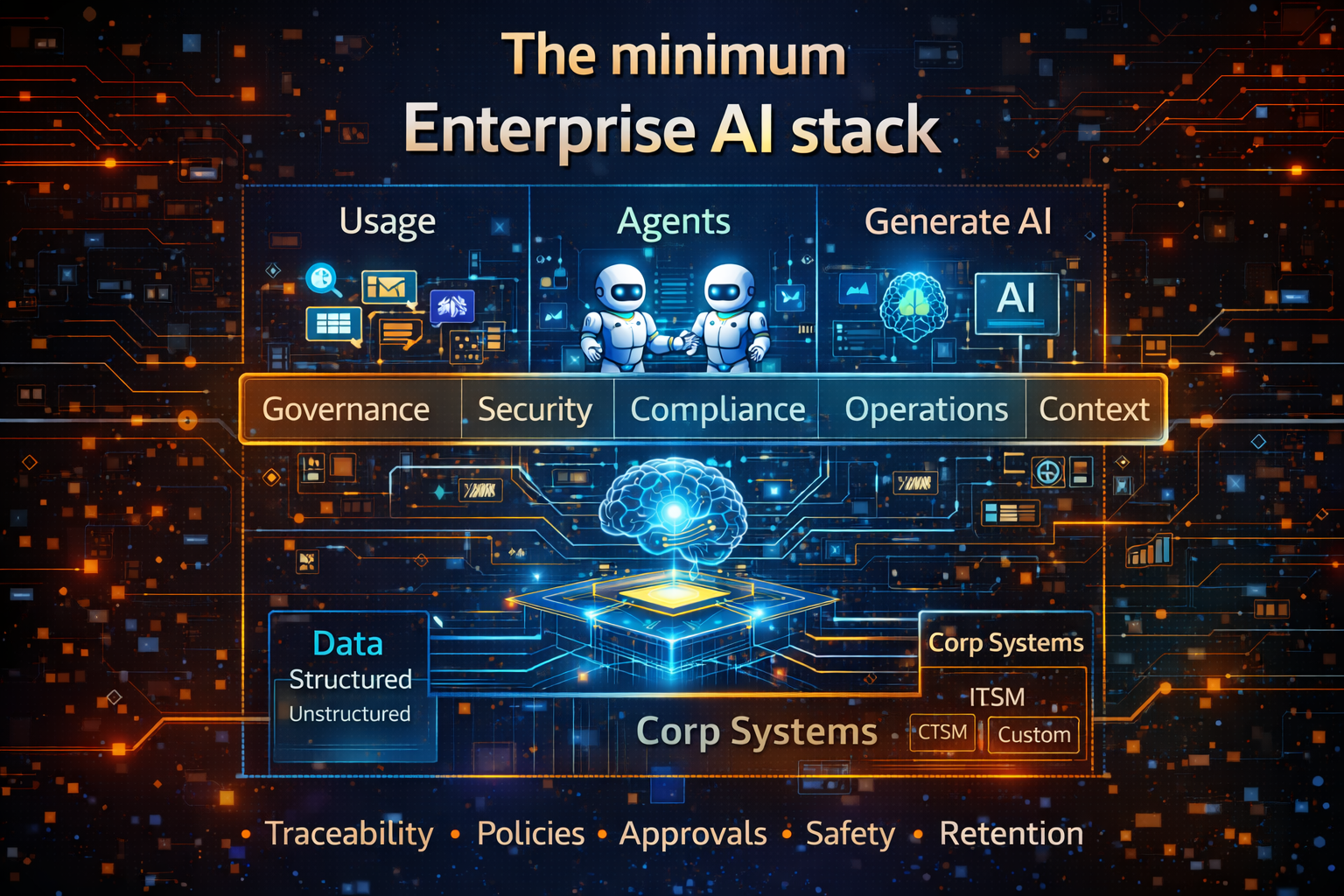
The minimum Enterprise AI stack (what actually works in practice)
Enterprise AI requires a stack that looks far more like enterprise infrastructure than experimentation tooling.
The AI Platform War Is Over: Why Enterprises Must Build an AI Fabric—Not an Agent Zoo – Raktim Singh
- AI Build Plane
Where intent is defined:
- workflows
- policies
- evaluation criteria
- approval gates
- Continuous Recomposition: Why Change Velocity—Not Intelligence—Is the New Enterprise AI Advantage – Raktim Singh
- AI Runtime
Where behavior is constrained:
- tool permissions
- sandboxes
- confidence thresholds
- fallback logic
- Studio-to-Runtime: Why Enterprise AI Fails Without a Build Plane and a Production Kernel – Raktim Singh
- AI Control Plane
Where accountability lives:
- identity and authorization
- policy enforcement
- observability
- audit and rollback
- The Enterprise AI Control Tower: Why Services-as-Software Is the Only Way to Run Autonomous AI at Scale – Raktim Singh
- AI Service Catalog
Where capability becomes reusable:
- ownership
- SLAs
- cost envelopes
- versioning
- Service Catalog of Intelligence: How Enterprises Scale AI Beyond Pilots With Managed Autonomy – Raktim Singh
- AI SRE / AgentOps
Where AI becomes operable:
- incident playbooks
- drift response
- controlled releases
- continuous evaluation
This is the difference between AI as a project and AI as infrastructure.
Why this matters now: the 2026 inflection point
We are entering a period where:
- AI agents will operate continuously
- decision velocity will outpace human review
- failures will propagate faster than manual controls
In this environment, intelligence alone is not an advantage.
Operability is.
The organizations that win will not be those with the most advanced models, but those with the most mature Enterprise AI operating fabric.
Conclusion: Enterprise AI is the operating system of accountable autonomy
Enterprise AI is not a trend.
It is the inevitable outcome of introducing autonomy into institutional systems.
The next decade will not be defined by who adopts AI first, but by who learns to run it responsibly, repeatably, and at scale.
The real enterprise advantage is not intelligence.
It is the ability to make intelligence safe, trusted, and sustainable.
That is Enterprise AI.
Glossary
- Enterprise AI: Governed, auditable AI capability operating inside enterprise systems
- Agentic AI: AI systems capable of planning and executing actions
- Control Plane: Governance, policy, and observability layer for AI
- AI Runtime: Execution environment with constraints and safeguards
- AI SRE: Reliability engineering discipline for AI systems
- AgentOps: Lifecycle management of AI agents
- Outcome Integrity: Alignment between AI behavior and business intent
- Brownfield Architecture: Systems evolved over time, not built from scratch
Raktim Singh is a technology strategist, enterprise AI thought leader, and author of Driving Digital Transformation. He writes about enterprise AI operating models, agentic systems, governance, and the future of intelligent enterprises. His work focuses on making advanced AI safe, operable, and scalable in real organizations.



Raktim Singh is an AI and deep-tech strategist, TEDx speaker, and author focused on helping enterprises navigate the next era of intelligent systems. With experience spanning AI, fintech, quantum computing, and digital transformation, he simplifies complex technology for leaders and builds frameworks that drive responsible, scalable adoption.