

The Enterprise AI Estate Crisis: Why CIOs No Longer Know What AI Is Running — And Why That Is Now a Board-Level Risk
In 2025, enterprises quietly crossed a dangerous threshold: most CIOs can no longer say with confidence what AI is running inside their organization.
What began as a handful of copilots, chatbots, and automation experiments has grown into a sprawling Enterprise AI Estate—one that spans SaaS platforms, internal workflows, agentic systems, and embedded decision-making logic.
As AI systems move from answering questions to taking actions, this lack of visibility is no longer a technical inconvenience. It has become a board-level operational, regulatory, and reputational risk across the US, EU, UK, India, APAC, and the Middle East.
Executive takeaway
A new kind of “estate” has formed inside modern enterprises: the AI estate—copilots, chatbots, autonomous agents, model APIs, prompt libraries, orchestration tools, vector databases, and AI features quietly embedded inside SaaS. The problem is no longer “Should we use AI?” It is:
Do we know what AI is running, where it’s running, what it can touch, what it can do, and who is accountable when it goes wrong?
CIO.com has been calling this the rise of shadow AI—entire workflows quietly powered by unapproved models, vendor APIs, and agents that never went through oversight. (CIO)
This is why the AI estate has become a board-level risk: AI is moving from advice to action, and action requires governance you can prove.

A new kind of estate has quietly formed inside your company
CIOs have spent decades learning how to manage “estates”:
- Application estate: what software exists, who owns it, what it costs
- Data estate: where data lives, who can access it, how it’s governed
- Cloud estate: accounts, workloads, spend, security posture
- Identity estate: users, roles, permissions, audit trails
In 2025, another estate arrived faster than most organizations realized:
The Enterprise AI Estate
It includes everything from copilots and chatbots to autonomous agents, model endpoints, prompt libraries, tool plugins, vector databases, and AI capabilities embedded into SaaS products.
The crisis is simple to describe:
Many enterprises no longer know what AI is running, where it is running, who approved it, what data it touches, what actions it can take, and who is accountable when it goes wrong.
This is not “technical debt.” It’s an operational visibility failure. And once AI can act—not just answer—visibility becomes a governance requirement, and governance becomes board risk.
Why this problem exploded in late 2025
1) AI is no longer a single platform decision
A few years ago, “enterprise AI” often meant a small number of centrally approved initiatives.
Now it enters through many doors:
- A product team integrates a model API for customer support
- A sales team adopts an AI tool that drafts emails and updates CRM records
- A finance team uses an assistant for invoice classification
- An HR team pilots an automated screening workflow
- SaaS vendors “turn on” AI features through updates—sometimes without a formal procurement cycle
None of these changes looks dramatic on its own. Together, they create a sprawling estate—without a map.
2) Agents + automation moved from “helpful” to “dangerous” overnight
Agentic AI is being positioned as the next leap in enterprise software. Gartner has publicly predicted that over 40% of agentic AI projects will be canceled by end of 2027, citing escalating costs, unclear value, and inadequate risk controls. (Gartner)
This matters because the operational risk changes the moment AI goes from:
- suggesting a response
to - executing steps (creating tickets, changing records, triggering workflows, initiating approvals)
Reuters also highlighted Gartner’s warning about “agent washing” (rebranding older tools as “agents”), which increases confusion about what is truly autonomous and what is not. (Reuters)
3) Regulation and audits are catching up
Regulators are moving toward a world where enterprises must demonstrate control, monitoring, and traceability. In the EU AI Act framework, deployers of high-risk AI systems have explicit obligations including human oversight and log retention (often discussed as at least six months for deployers, and broader record-keeping requirements for high-risk systems). (Artificial Intelligence Act)
Even if you don’t operate in the EU, the direction is unmistakable: governance is becoming evidence-based.
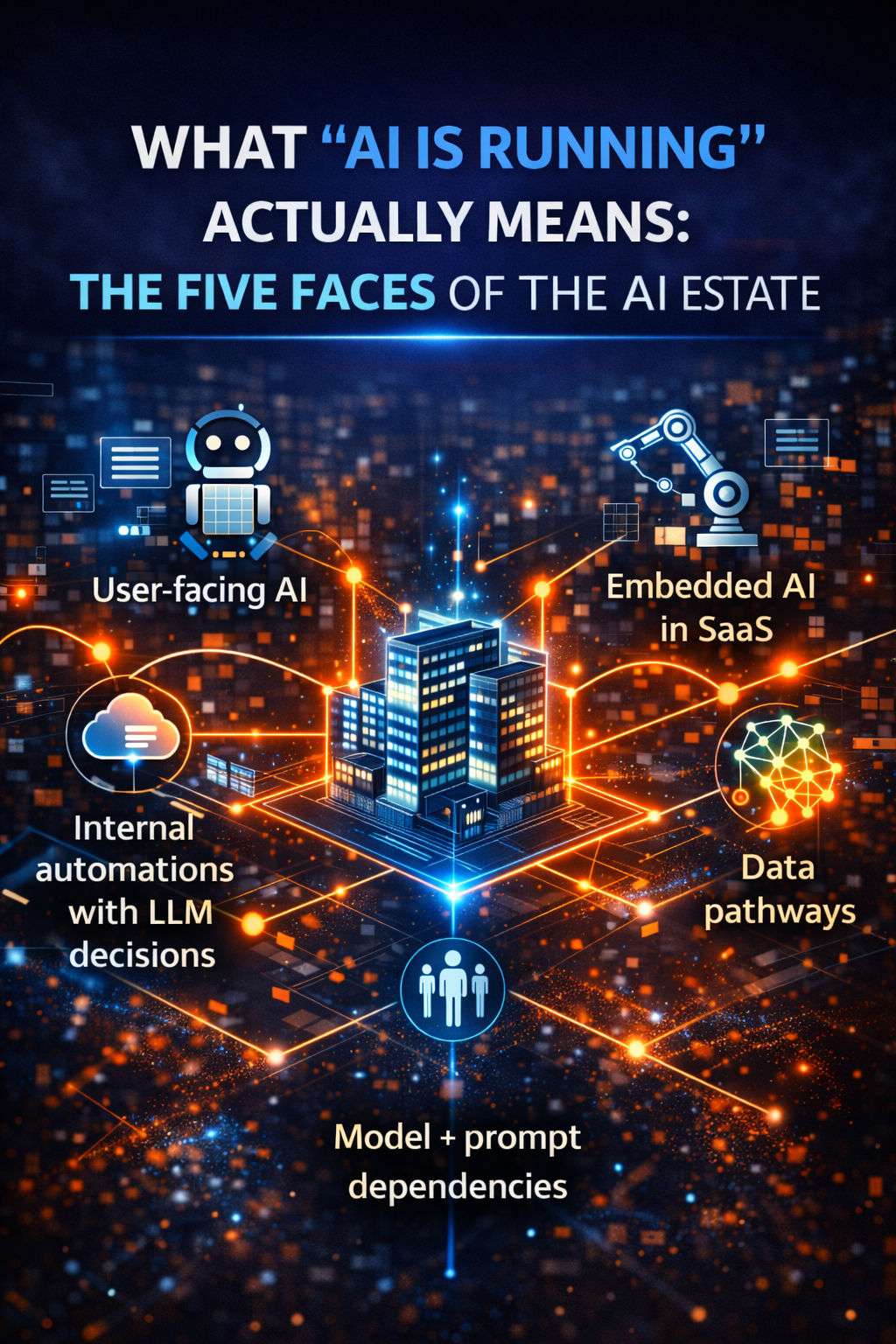
What “AI is running” actually means: the five faces of the AI estate
When boards ask, “What AI do we have?”, many enterprises answer too narrowly—usually naming a few flagship pilots. A real AI estate includes at least five categories:
- User-facing AI
Chatbots, copilots, and agentic assistants in employee/customer workflows. - Embedded AI in SaaS
AI features inside CRM/ERP/ITSM tools you don’t host, but that still act on your data and processes. - Internal automations augmented by LLM decisions
Scripts, RPA, workflow engines, and “smart routing” tools that now include probabilistic decisions. - Model + prompt dependencies
Model endpoints, prompt templates, agent frameworks, tool plugins, orchestration layers. - Data pathways
What data is accessed, summarized, embedded, cached, logged, or retained.
The crisis emerges when these are not tracked as one estate.

Simple examples of how the estate crisis forms (without anyone being careless)
Example 1: The “helpful” support agent that becomes a policy risk
A customer support team deploys an AI assistant to draft responses.
- Month 1: It suggests text
- Month 3: It starts categorizing tickets and setting priority
- Month 6: It triggers refunds under a threshold and closes tickets automatically
No one ever announced: “We are deploying an autonomous decision-maker.”
It simply evolved.
Now the estate questions appear:
- Who approved the refund logic?
- What logs exist if a customer disputes a refund?
- What data did the model see?
- Which region’s rules apply (US/EU/UK/India/APAC)?
- Can we prove why the decision happened?
This is where governance moves beyond “model risk” into operational accountability.
Example 2: Shadow AI inside procurement
A procurement analyst uses a browser-based AI tool to summarize vendor contracts. Then they paste sensitive clauses into an assistant to generate negotiation language.
No malice. No intent to leak. Just speed.
But the estate impact is real:
- Sensitive data exposure
- Untracked tool usage
- No formal policy enforcement
- No audit trail
CIO.com has repeatedly warned that shadow AI turns innovation into risk “before anyone notices.” (CIO)
Example 3: The SaaS feature that quietly changes your risk posture
A major SaaS platform enables “AI agents” for workflow automation. Your teams turn it on because it’s built-in.
Now a third party is effectively running autonomous steps inside your business processes.
Do you know:
- What permissions those agents have?
- What data they can access?
- How actions are logged?
- How you disable or roll back behavior fast?
If the answer is “not sure,” you don’t have an AI tool problem. You have an estate management problem.
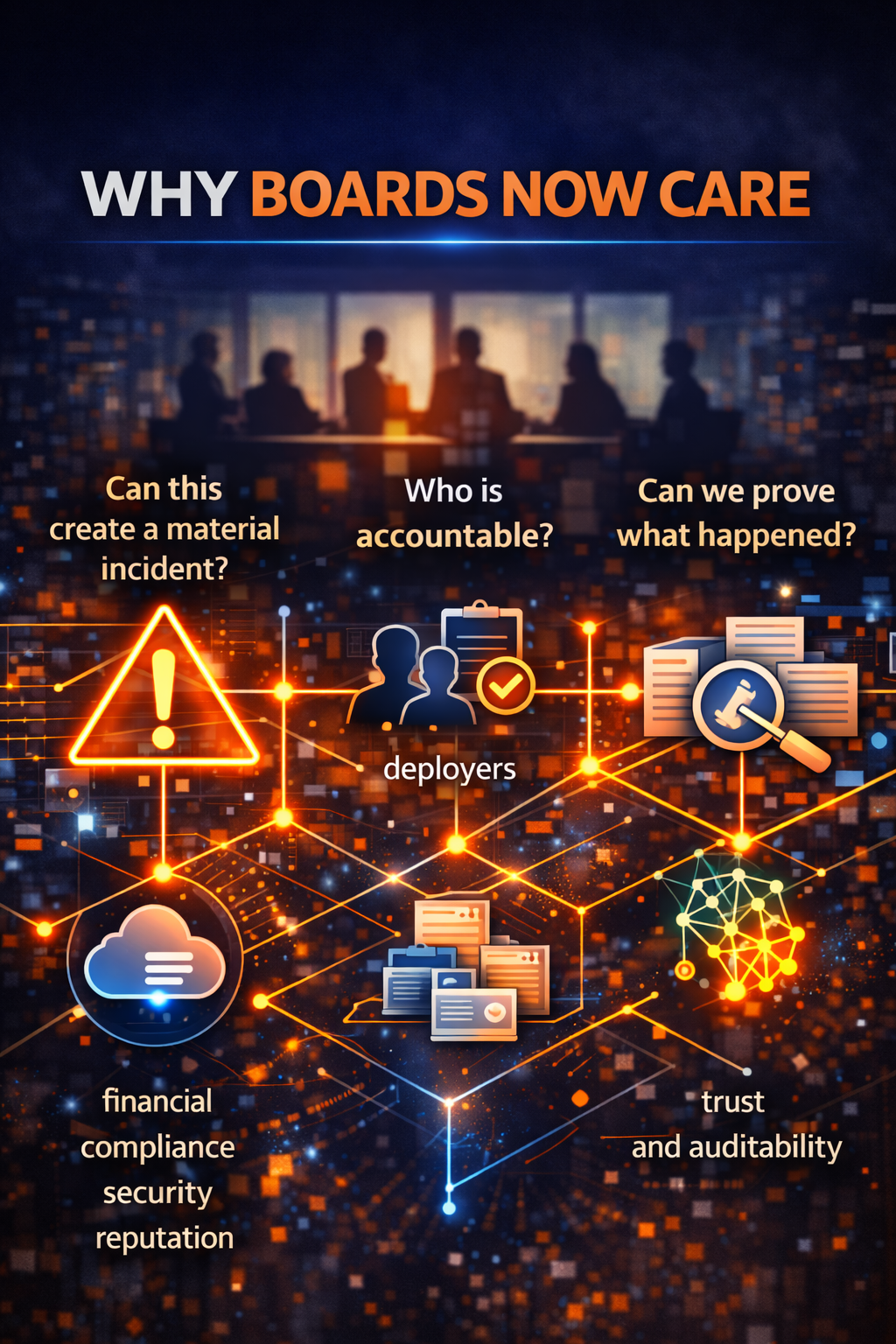
Why boards now care (even if the AI seems “fine”)
Why boards now care (even if the AI seems “fine”)
Boards don’t need to understand model architectures. They care about three questions:
1) Can this create a material incident?
If AI can take actions, it can create:
- Financial loss (wrong refunds, incorrect approvals)
- Compliance exposure (improper processing, missing logs)
- Security risk (data leakage via unapproved tools)
- Reputation damage (public-facing errors)
2) Who is accountable?
If AI makes a decision, accountability cannot be “the vendor” or “the model.” The enterprise is the deployer. Regulations increasingly reflect this expectation. (Artificial Intelligence Act)
3) Can we prove what happened?
Modern risk is audit-driven. If you can’t reconstruct:
- what AI was used
- what inputs were considered
- what action was taken
- what oversight existed
…then trust becomes unprovable.
That is why frameworks like NIST AI RMF emphasize lifecycle risk management and governance. (NIST)
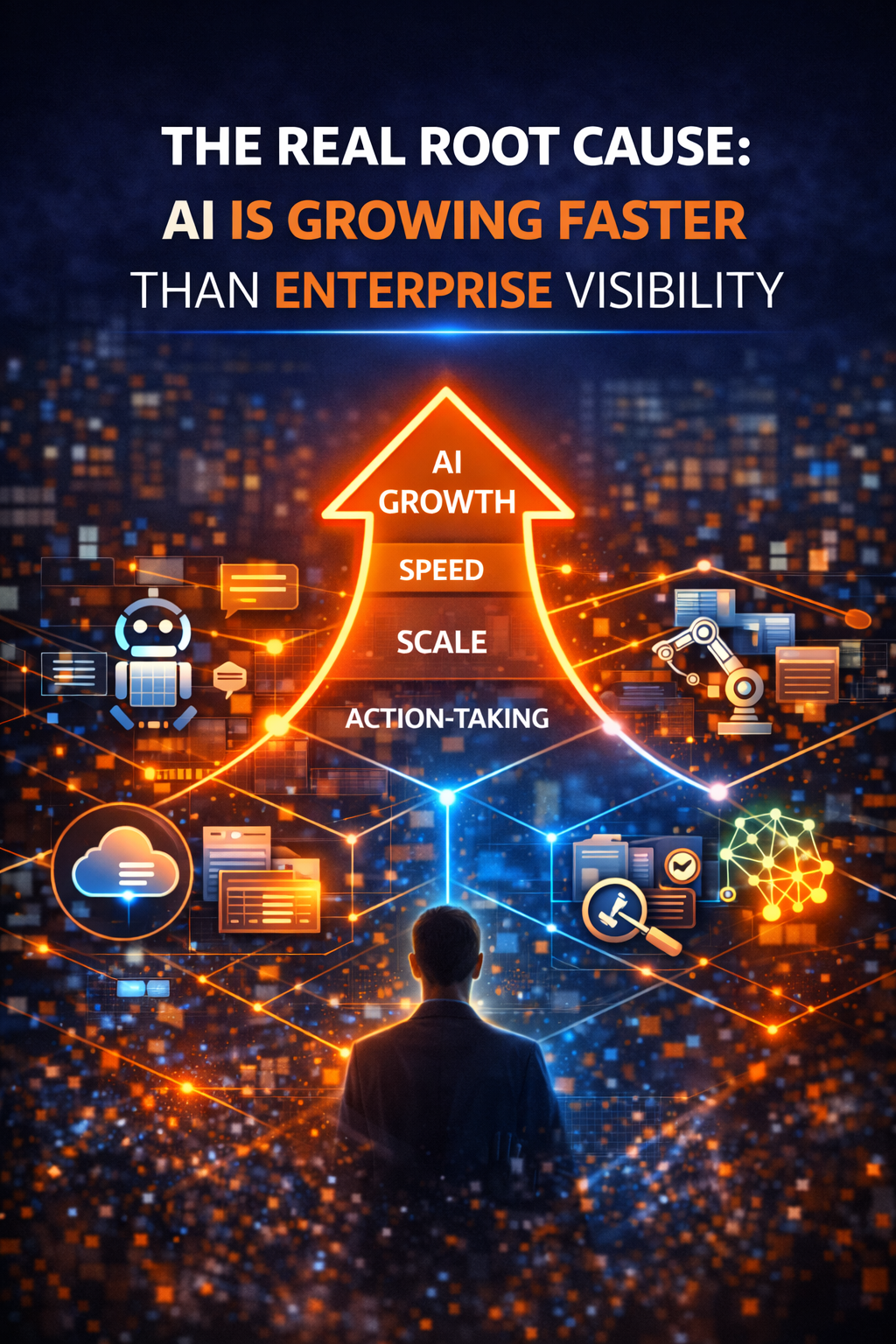
The real root cause: AI is growing faster than enterprise visibility
It’s tempting to believe the solution is “more governance policies.”
But the estate crisis isn’t mainly a policy problem.
It’s a visibility and operability problem:
You can’t govern what you can’t see.
You can’t secure what you can’t inventory.
You can’t optimize what you can’t measure.
NIST AI RMF-aligned guidance explicitly calls out the need for mechanisms to inventory AI systems as a governance capability (“GOVERN 1.6”). (Ankura.com)

What AI estate management looks like in practice
What AI estate management looks like in practice
1) An AI inventory that’s real—not a spreadsheet
You need an always-current view of:
- AI agents and copilots in production
- AI capabilities embedded in SaaS
- Model endpoints and dependencies
- Prompt libraries and toolchains
- Data access patterns and log/retention behavior
NIST AI RMF implementation guidance has directly emphasized inventory mechanisms as foundational governance. (Ankura.com)
2) Ownership that matches business risk
Every AI capability needs named ownership:
- Technical owner (reliability, runtime, observability)
- Business owner (outcome accountability)
- Risk owner (policy, compliance, audit readiness)
If nobody owns it, the board will assume the risk exists—and the controls don’t.
3) Permissioning for AI the way you do identity for humans
Agents are not “features.” They are actors.
They need:
- identities
- roles
- least-privilege access
- revocation
- audit trails
Without this, you are granting production access to a system whose behavior you cannot fully predict.
4) Logging that can survive an audit
Regulatory signals are strong: high-risk contexts increasingly require record-keeping and human oversight. (AI Act Service Desk)
Even outside regulated categories, logs are the foundation of:
- incident response
- forensics
- post-incident trust restoration
- vendor dispute resolution (“prove what happened”)
5) A kill switch and rollback as normal features
Every operational system has:
- rollback
- change control
- incident management
AI systems that act must have the same. Because the fastest way to lose trust is not making a mistake—it’s not being able to stop the mistake from repeating.
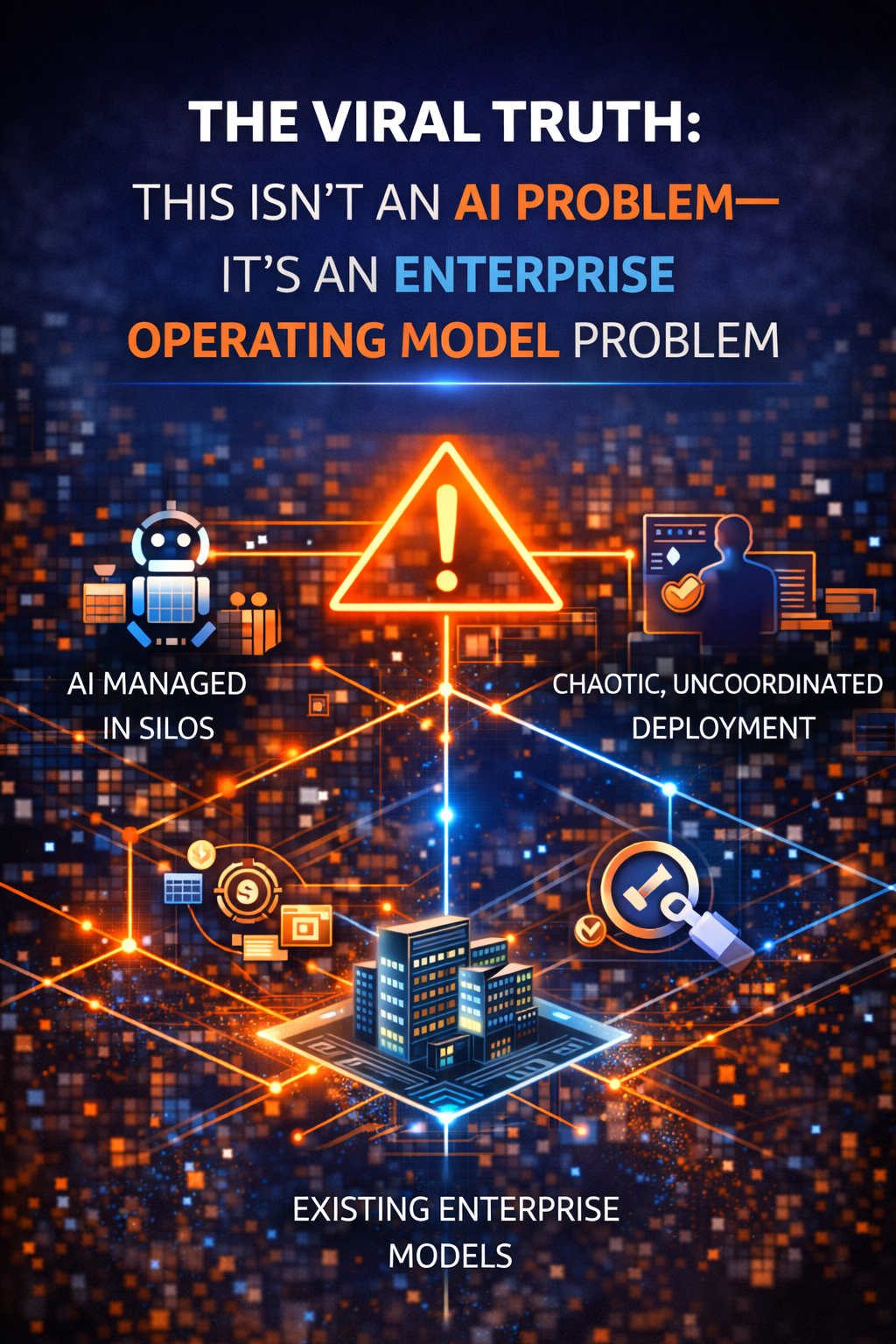
The viral truth: this isn’t an AI problem—it’s an enterprise operating model problem
Most large enterprises already have AI talent. Many have AI platforms. Most have strong security teams.
Yet they still lose visibility.
Why?
Because AI is not one system. It is an estate—and estates require:
- standardization
- lifecycle controls
- observability
- change management
- vendor interoperability
- cost governance
And when markets hype “agents” faster than enterprises can govern them, failure rates rise—exactly the pattern Gartner and Reuters have warned about. (Gartner)
“The next wave of enterprise AI failures won’t come from bad models.
It will come from enterprises that no longer know what AI is running.”
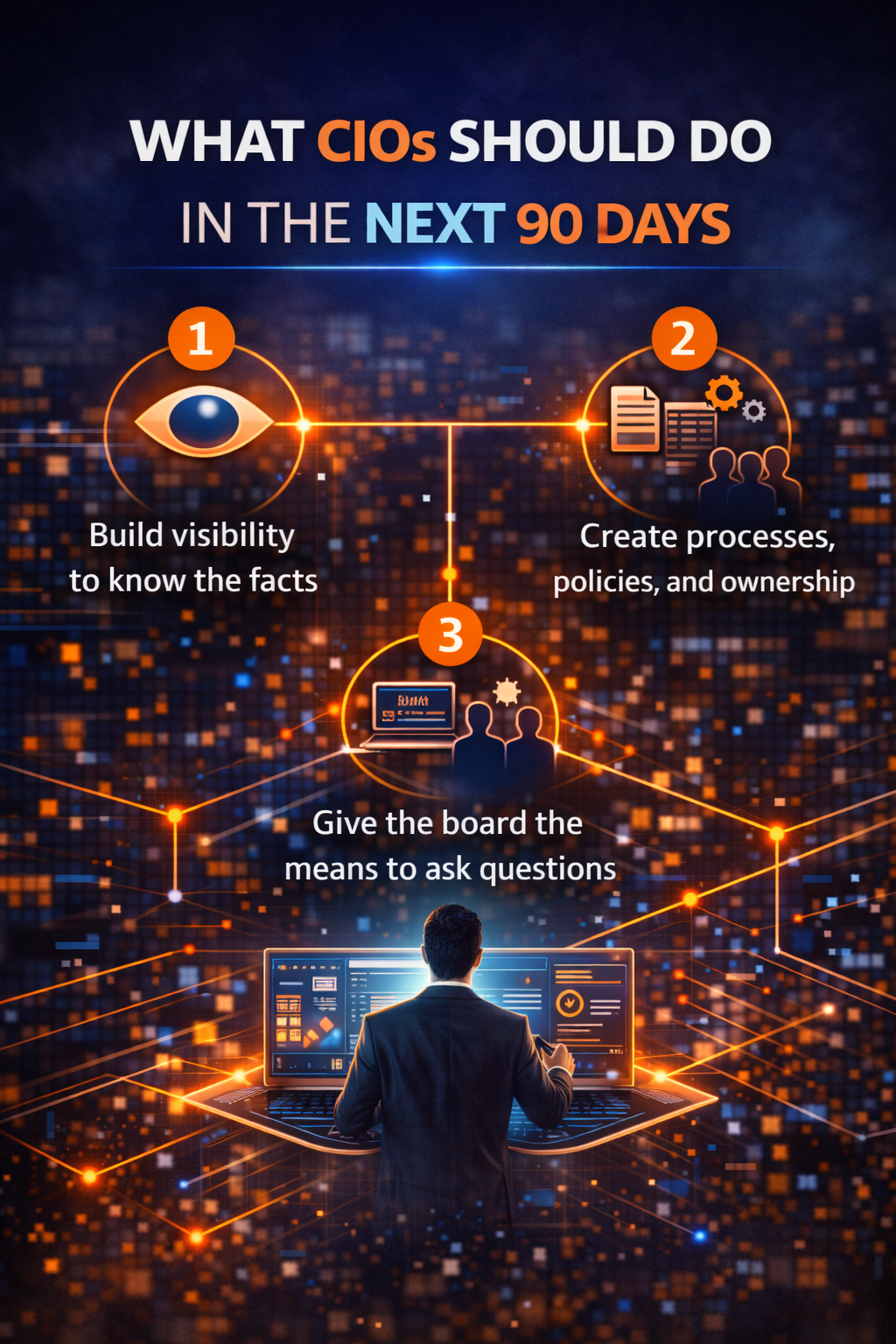
What CIOs should do in the next 90 days (simple, actionable)
1) Declare the AI Estate formally
If you don’t name it, you can’t manage it.
2) Start with discovery, not redesign
Find what exists: tools, agents, model calls, SaaS AI features, shadow usage.
3) Create a tiering model for AI risk
- Suggestion-only systems (lower risk)
- Action-taking systems (higher risk)
- High-impact / regulated decisions (highest risk)
4) Standardize guardrails for anything that acts
Identity, permissions, logging, rollback, monitoring.
5) Make ownership visible
Every AI capability needs a named owner.
6) Prepare board language
Boards don’t want architecture diagrams. They want:
- what exists
- what can act
- what could cause incidents
- what controls are in place
- how risk is trending down over time
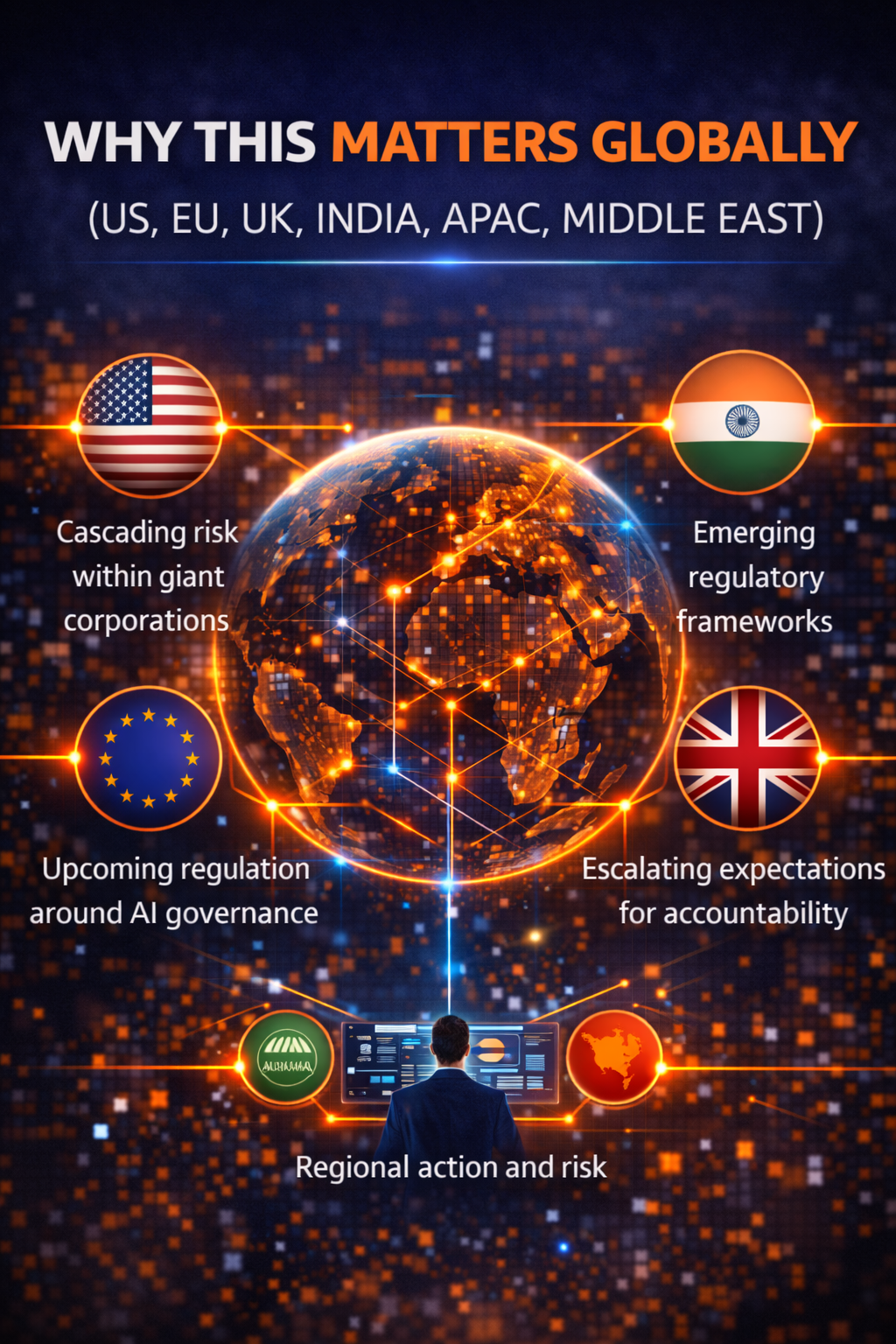
Why this matters globally (US, EU, UK, India, APAC, Middle East)
The AI estate crisis is global because the drivers are global:
- SaaS vendors are embedding AI everywhere
- agentic automation is mainstreaming
- regulators are formalizing deployer obligations (EU AI Act is a directional signal) (Artificial Intelligence Act)
- boards are asking for accountability, not demos
Whether you’re in regulated industries or not, the core executive question is converging:
“Do we know what AI is running in our enterprise—and can we prove it’s under control?”
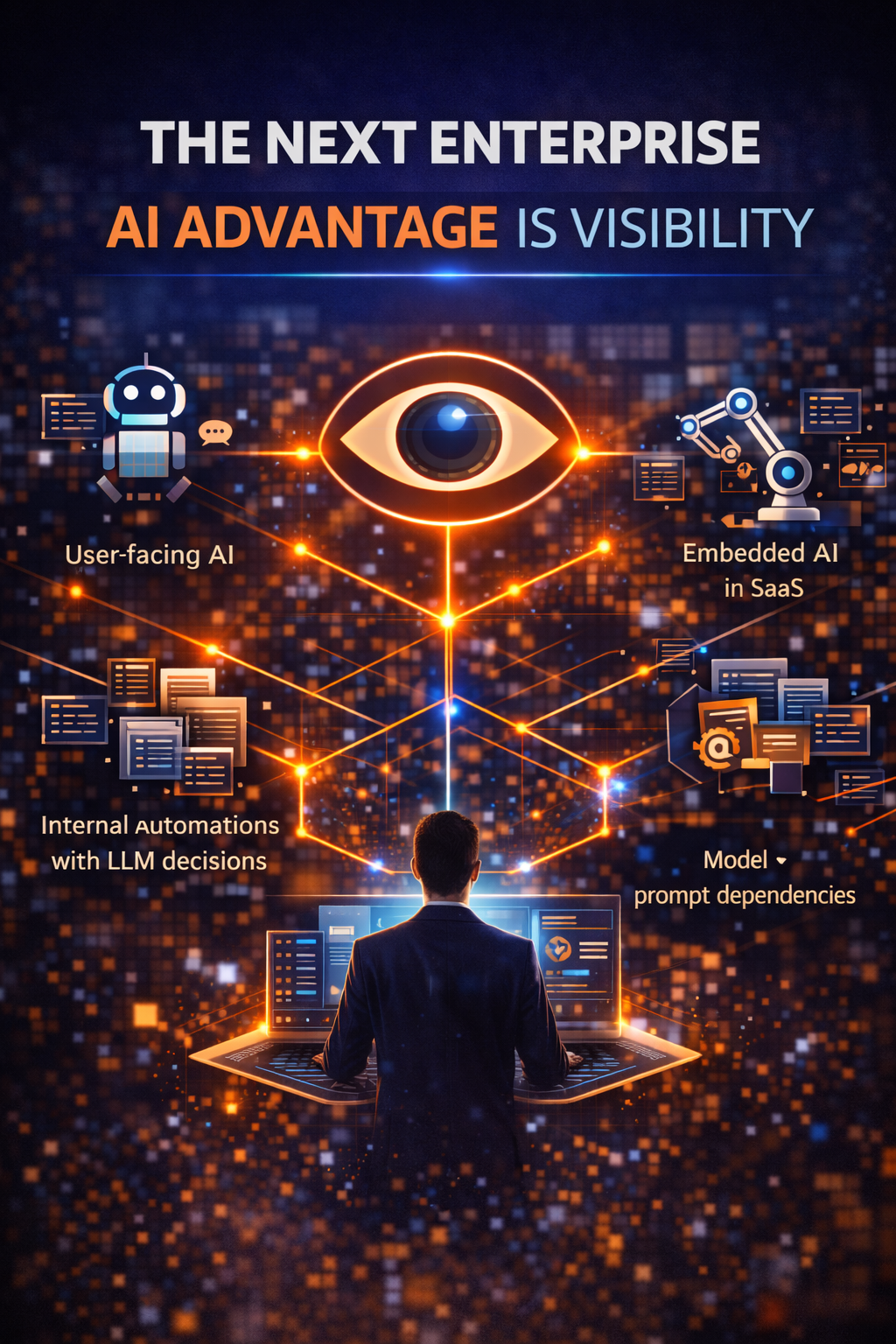
Conclusion: The next enterprise AI advantage is visibility
The next wave of enterprise AI failures won’t come from “bad models.”
It will come from something more basic:
Enterprises losing visibility into their AI estate.
Once AI systems can act, visibility becomes governance. Governance becomes risk. Risk becomes board-level.
So the new CIO mandate is not:
- “Deploy more AI.”
It is:
Make AI legible. Make AI auditable. Make AI operable.
Because the enterprise that can see its AI estate is the enterprise that can safely—and sustainably—scale it.
Glossary
- Enterprise AI Estate: The total footprint of AI capabilities across an organization—tools, agents, models, prompts, integrations, and AI embedded in SaaS.
- Shadow AI: Unapproved or unmanaged AI usage—often entire workflows—operating outside formal governance. (CIO)
- Deployer (EU AI Act): The organization using an AI system in operations (as opposed to the provider). (Artificial Intelligence Act)
- High-risk AI system: A category under EU AI Act and other regulatory thinking where additional obligations apply (logging, oversight, monitoring). (AI Act Service Desk)
- Human oversight: Operational controls ensuring humans can supervise, intervene, and prevent harm in high-risk AI usage contexts. (Artificial Intelligence Act)
- AI Inventory: A living catalog of AI systems and dependencies, including where they run, what they access, and who owns them. (Ankura.com)
- Operability: The ability to run AI safely in production with monitoring, rollback, incident response, and accountability.
-
Enterprise AI Estate
The complete set of AI systems operating within an organization, including user-facing AI, embedded SaaS AI, internal automations, model dependencies, prompts, agents, and data pathways.
Shadow AI
AI tools or capabilities used by employees or teams without formal approval, visibility, or governance by IT or risk teams.
Agentic AI
AI systems capable of taking actions—triggering workflows, changing records, executing tasks—rather than only generating recommendations or text.
AI Operability
The ability to monitor, control, audit, roll back, and govern AI systems in production environments.
Board-Level AI Risk
Risks arising from AI systems that can materially affect financial outcomes, compliance posture, security, or reputation.
FAQ
1) What is an “Enterprise AI Estate”?
It’s the full set of AI capabilities running across your organization—including copilots, agents, model APIs, prompt libraries, embedded SaaS AI, automations, and data pathways.
2) Why are CIOs losing track of what AI is running?
Because AI is entering through many channels at once: business-led tooling, vendor updates, embedded SaaS features, and team-level agents that evolve from “assist” to “act.”
3) What is shadow AI, and why is it dangerous?
Shadow AI is unmanaged AI usage outside governance. It becomes dangerous when it touches sensitive data, makes decisions, or takes actions without visibility or accountability. (CIO)
4) Why is this now a board-level risk?
Because action-taking AI can create incidents—financial, compliance, security, and reputational—and boards increasingly expect provable governance and accountability.
5) What do regulators expect enterprises to do?
Regulatory direction (e.g., EU AI Act) emphasizes oversight, monitoring, and record-keeping for high-risk contexts. (Artificial Intelligence Act)
6) What’s the fastest first step for a CIO?
Declare “AI estate management” as a program, run discovery across business + IT + vendors, and build a living inventory with ownership, permissions, and logging standards. (Ankura.com)
Why is the Enterprise AI Estate becoming a risk now?
Because AI systems are increasingly autonomous and embedded across tools, workflows, and SaaS platforms—often without centralized visibility or approval.
What is the difference between AI governance and AI estate management?
Governance defines rules and policies. Estate management ensures visibility, ownership, monitoring, and operational control across all AI systems.
Is this only a problem for regulated industries?
No. Any enterprise where AI can take actions—financial, operational, or customer-facing—faces similar risks, regardless of sector.
How does the EU AI Act affect global enterprises?
It signals a global shift: deployers must know what AI they run, how it behaves, and how decisions can be audited—even outside the EU.
What should CIOs prioritize first?
Visibility. You cannot govern, secure, or optimize AI systems you cannot see.
References and further reading
- CIO.com — Shadow AI coverage and governance risk framing (CIO)
- Gartner press release — prediction on agentic AI project cancellations (Gartner)
- Reuters — summary of Gartner’s “agent washing” and cancellation risk (Reuters)
- EU AI Act — deployer obligations and human oversight references (Artificial Intelligence Act)
- EU AI Act Service Desk — record-keeping guidance for high-risk AI (AI Act Service Desk)
- NIST — AI Risk Management Framework (AI RMF) (NIST)
- Ankura — AI RMF GOVERN 1.6 inventory mechanism interpretation (Ankura.com)
- The Human–Agent Ratio: The New Productivity Metric CIOs Will Manage—and the Enterprise Stack Required to Make It Safe – Raktim Singh
- What Is Enterprise AI? Why “AI in the Enterprise” Is Not Enterprise AI—and Why This Distinction Will Define the Next Decade – Raktim Singh
- Why Enterprises Are Quietly Replacing AI Platforms with an Intelligence Supply Chain – Raktim Singh
- Continuous Recomposition: Why Change Velocity—Not Intelligence—Is the New Enterprise AI Advantage – Raktim Singh
- The AI Platform War Is Over: Why Enterprises Must Build an AI Fabric—Not an Agent Zoo – Raktim Singh
- Why Enterprise AI Is Becoming a Fabric: From AI Agents to Services-as-Software | by RAKTIM SINGH | Dec, 2025 | Medium
- The Human–Agent Ratio: The New Productivity Metric CIOs Will Manage — and the Enterprise Stack Required to Make It Safe | by RAKTIM SINGH | Dec, 2025 | Medium
- The Enterprise Model Portfolio: Why Model Selection Is the Wrong Question for 2026: By Raktim Singh
- The Human–Agent Ratio: The New Productivity Metric CIOs Will Manage—and the Required Stack for it: By Raktim Singh



Raktim Singh is an AI and deep-tech strategist, TEDx speaker, and author focused on helping enterprises navigate the next era of intelligent systems. With experience spanning AI, fintech, quantum computing, and digital transformation, he simplifies complex technology for leaders and builds frameworks that drive responsible, scalable adoption.