

Boards are right to ask for clarity:
- Where will AI create real value first?
- What gains are realistic—without betting the enterprise?
- How do we steer toward durable advantage, not scattered pilots?
This article is a board-level answer.
Not with hype. Not with fear. With a practical idea: the AI dividend.
The future will not reward companies for using AI. It will reward those that convert AI into structural decision advantage.
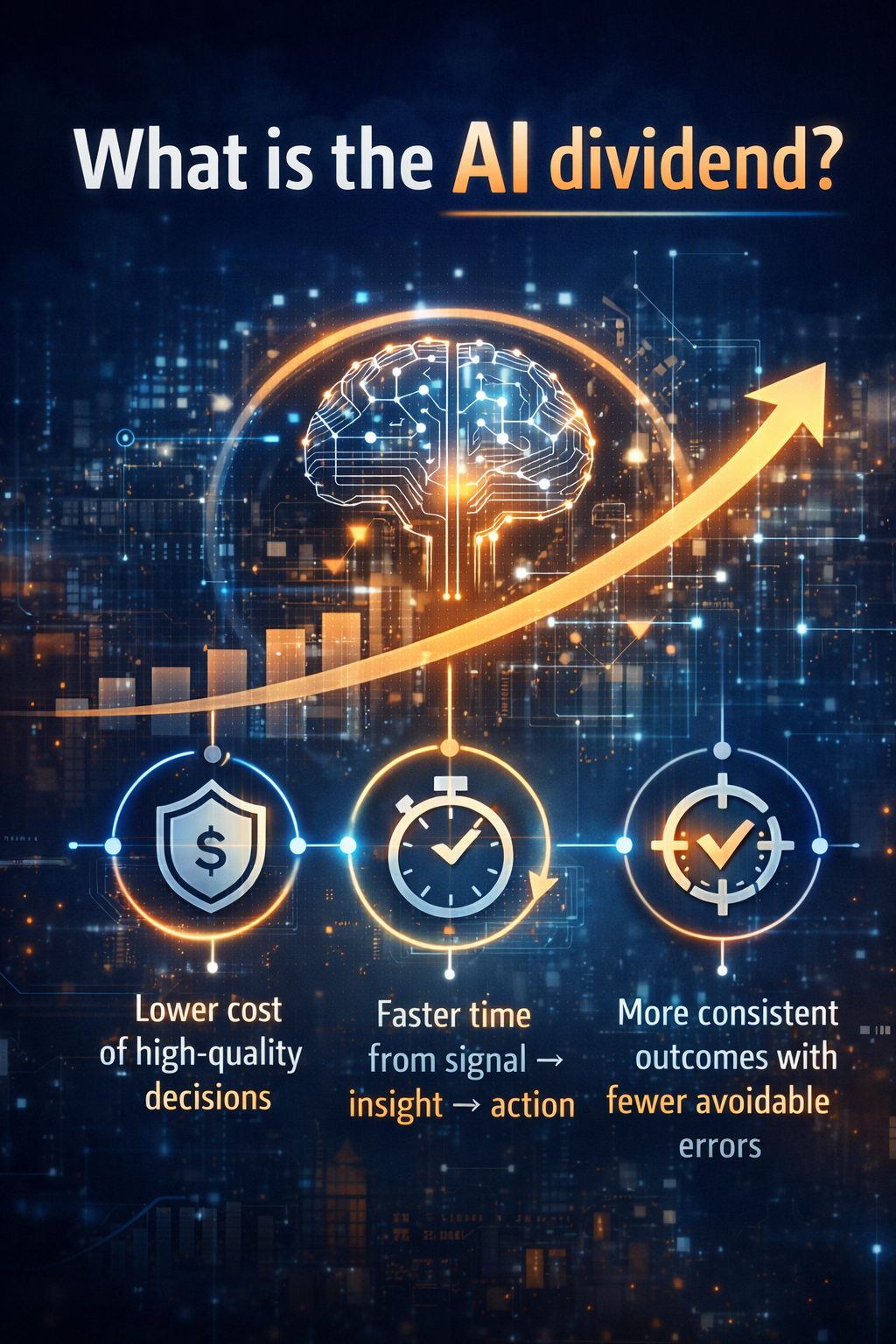
What is the AI dividend?
The AI dividend is the first set of structural gains an organization unlocks when AI changes the economics of decisions:
- Lower cost of a high-quality decision
- Faster time from signal → insight → action
- More consistent outcomes, with fewer avoidable errors
This is not “AI as automation.”
This is AI as decision leverage—and it tends to show up first in the places that already drive the economics of the business.
A useful global signal here: McKinsey’s research on value capture repeatedly highlights that impact increases when companies redesign workflows and put senior leaders in roles like AI governance, rather than simply deploying tools. (McKinsey & Company)
So the board’s job is to steer AI toward structural economics, not shiny demos.
If decision quality became your primary competitive metric, how different would your board dashboard look?
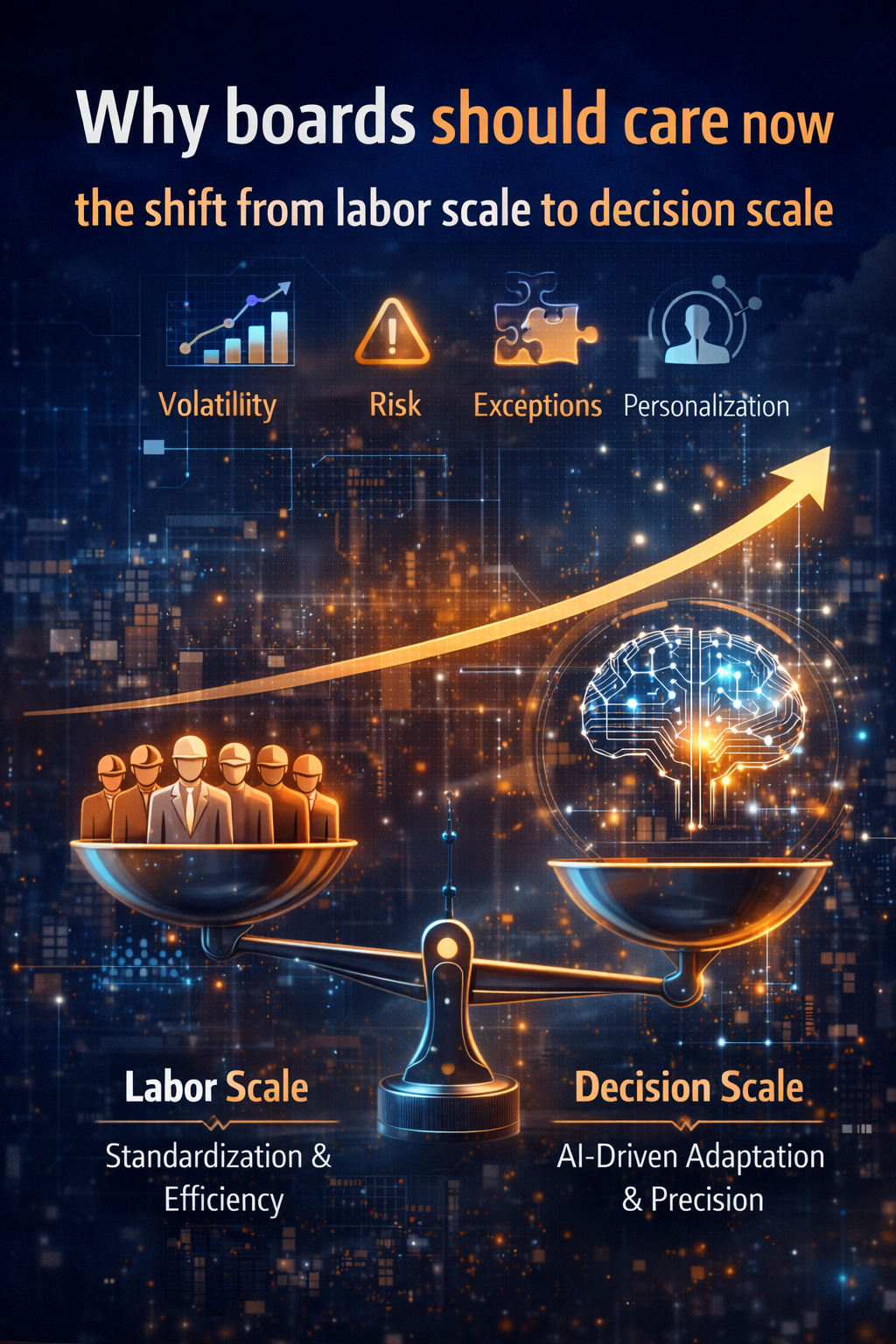
Why boards should care now: the shift from labor scale to decision scale
For decades, advantage came from scaling labor and standardizing processes. That worked when the environment was stable.
Today, most industries operate under constant variance:
- demand volatility
- supply uncertainty
- exception-heavy operations
- fast-changing risk conditions
- rising expectations for personalization and responsiveness
In variance-heavy environments, being efficient is not enough. You can be efficient—and wrong.
AI changes the equation by making it cheaper to:
- sense changes earlier
- predict outcomes better
- recommend actions contextually
- monitor execution continuously
In plain language: AI makes it economical to handle complexity.
That’s why the AI dividend shows up first where variance creates real cost, cash drag, leakage, or missed opportunities.
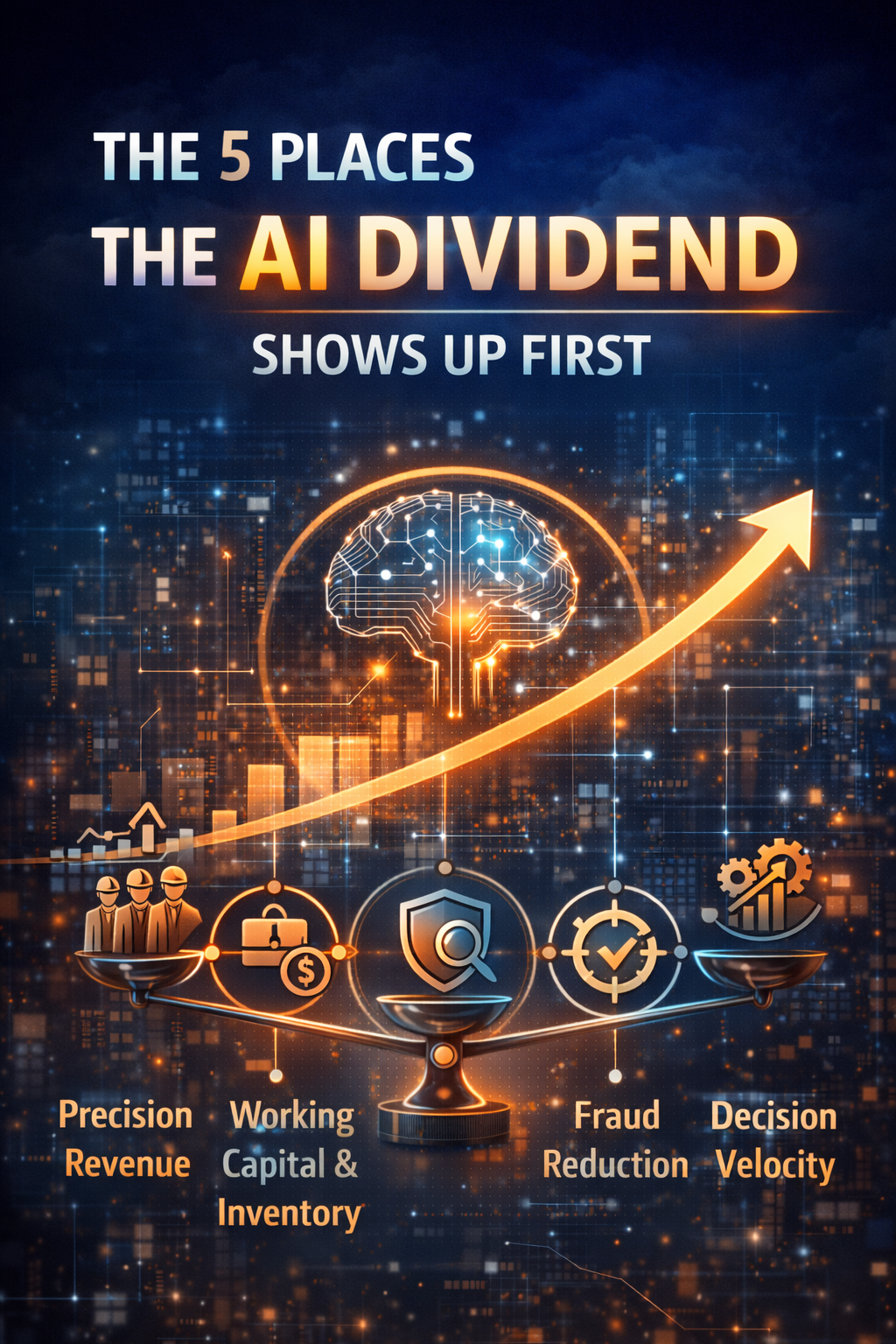
The 5 places the AI dividend shows up first
Boards often ask: “What are the top AI use cases?”
A better board question is:
Where does decision quality create measurable economic outcomes—fast?
Across sectors, the earliest dividend typically comes from five arenas.
1) Precision revenue: pricing, offers, and retention
The simplest way to understand AI-led growth is this:
Most organizations still sell using averages.
Averages are comfortable—but expensive.
A simple example: pricing that learns
Imagine a company that sets prices once a quarter using historical performance and committee judgment.
But in reality:
- demand changes weekly
- competitor moves happen daily
- supply constraints shift margins
- willingness-to-pay varies by context
AI doesn’t just “predict demand.”
It helps the organization make better pricing decisions more often.
Early structural gains typically appear when AI improves:
- discount discipline (fewer unnecessary discounts)
- churn prevention (intervene before attrition happens)
- next-best action (which offer, which channel, which timing)
This is the start of precision growth—growth that does not require proportional increases in spend.
Board takeaway: AI ROI is strongest when it improves revenue decisions at scale, not when it creates prettier dashboards.
2) Working capital and inventory: the hidden balance-sheet dividend
Many boards underestimate how much cash is trapped in “uncertainty buffers.”
Inventory is often the physical form of institutional doubt.
A simple example: why inventory piles up
One function forecasts optimistically.
Another buffers “just in case.”
Another wants operational stability.
Another worries about service levels.
The result is compromise through excess stock.
AI helps—but only if it changes the decision loop, not just the dashboard.
The first dividend here is not “better forecasts” in isolation. It is:
- faster updates to demand signals
- smarter replenishment decisions
- early warnings for slow-moving items
- clearer thresholds for overrides and exceptions
McKinsey’s work in banking, for example, describes AI’s potential to boost revenues through personalization and lower costs via automation and reduced errors—value that becomes real when organizations operationalize AI in core loops. (McKinsey & Company)
Board takeaway: Inventory is not only an operational problem. It is a decision architecture problem.
3) Fraud, loss prevention, and anomaly detection: stopping leakage early
In many businesses, leakage hides in exceptions:
- suspicious transactions
- duplicate payouts
- abnormal claims
- policy violations
- slow drift in controls
AI’s early dividend is not just catching fraud. It’s reducing the cost of oversight:
- flag fewer false positives
- prioritize high-risk cases
- learn from investigator outcomes
- detect new patterns earlier
This is not about replacing investigators. It’s giving them a better “targeting system,” so the same team prevents more loss.
Board takeaway: AI reduces loss by compressing detection time and improving triage quality.
4) Decision velocity: compressing the signal-to-action chain
Boards rarely measure “decision velocity,” but it increasingly determines competitiveness.
A simple example: the slow approval chain
A frontline team sees an issue.
It gets reported.
It moves through tools.
Then meetings.
Then approvals.
Then action.
By the time the organization responds, the cost has already occurred.
AI’s structural dividend appears when organizations reduce:
- time to detect (faster sensing)
- time to interpret (contextual summarization, retrieval, reasoning support)
- time to decide (recommendations, escalation thresholds)
- time to execute (workflow integration)
This is where AI becomes a strategic speed advantage—not productivity theater.
Board takeaway: AI’s compounding payoff often comes from faster cycles of learning and execution.
5) Productivity that changes capacity, not just busywork
Many organizations start with “productivity” use cases:
- summarizing documents
- drafting content
- automating tickets
- answering internal queries
These can be useful, but the board should ask one question:
Does this create real capacity—or just produce more text?
AI’s first meaningful productivity dividend appears when it:
- reduces cycle time for key workflows
- removes rework and reconciliation
- improves first-pass quality
- shortens onboarding and training time
In other words, productivity becomes structural when it changes throughput and quality, not just output volume.
Deloitte’s board guidance emphasizes that boards should pursue AI for strategic advantage while ensuring responsible oversight—exactly the mindset needed to separate capacity gains from content noise. (Deloitte)
Board takeaway: Treat productivity as workflow throughput + quality improvement, not content generation.
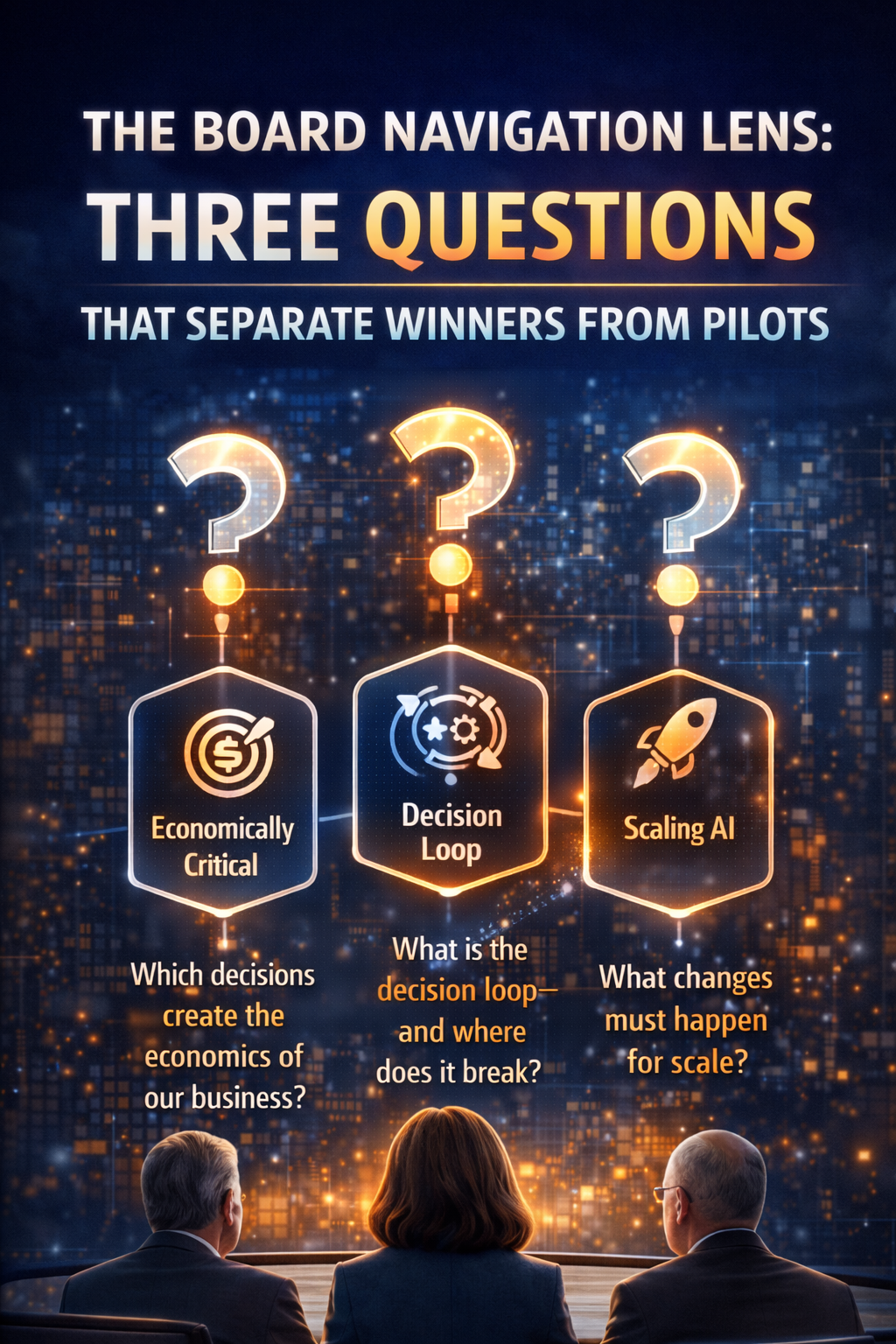
The board navigation lens: three questions that separate winners from pilots
Most AI efforts fail for a simple reason:
They treat AI as a feature, not as a new operating capability.
Boards can keep it simple with three steering questions.
Question 1: Which decisions create the economics of our business?
Instead of asking “top AI use cases,” ask:
- Which decisions most affect revenue?
- Which decisions most affect cost and capital?
- Which decisions most affect risk and trust?
Then prioritize AI around those decisions.
This aligns with the discipline of decision intelligence—which Gartner defines as advancing decision-making by explicitly understanding and engineering how decisions are made, and improving outcomes through feedback. (Gartner)
Question 2: What is the decision loop—and where does it break?
Every decision loop has stages:
Signal → Interpretation → Decision → Execution → Feedback
AI creates value when it improves the loop—not when it generates artifacts.
Boards should ask leaders to name the breakpoints:
- Are signals delayed?
- Are definitions inconsistent?
- Are decision rights unclear?
- Are exceptions unmanaged?
- Are outcomes not measured?
Question 3: What must change for scale?
Scaling AI is rarely blocked by algorithms.
It’s blocked by:
- fragmented ownership
- unclear escalation rules
- missing feedback loops
- incentives that reward local optimization
- no economic accountability
McKinsey’s survey results point to “rewiring” moves—like workflow redesign and senior leadership roles in AI governance—as practices that correlate with value capture. (McKinsey & Company)
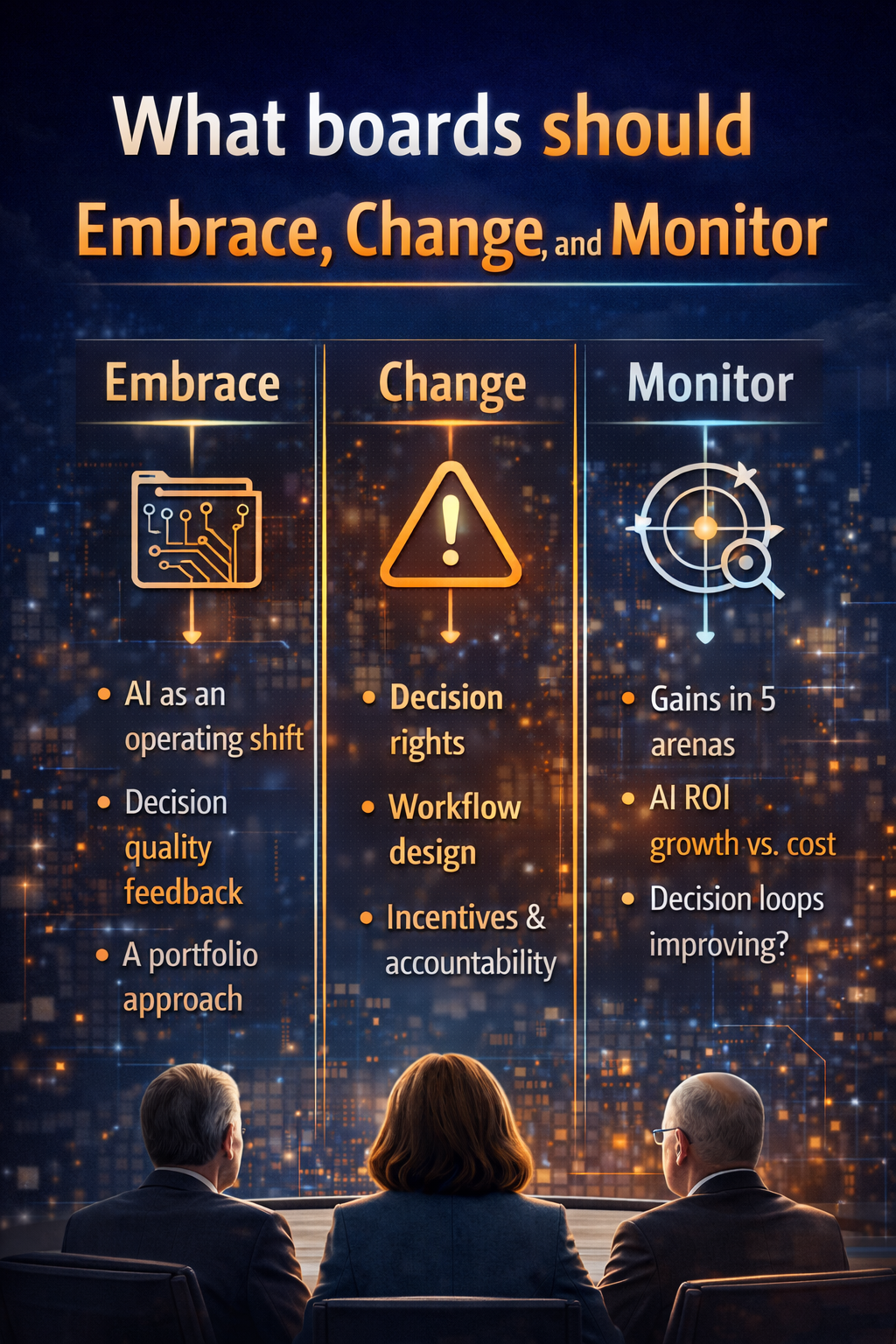
What boards should embrace, change, and monitor
This is where AI leadership becomes board-grade—and optimistic.
What to embrace
1) AI as an operating shift, not an IT program
AI becomes part of how decisions are made—continuously.
2) Decision quality as measurable and improvable
The AI dividend compounds when decision outcomes are measured and fed back.
3) A portfolio approach
Not “100 pilots.” A focused portfolio tied to economic decisions.
What to change
1) Decision rights and escalation logic
If it’s unclear who decides, AI will amplify confusion.
2) Workflow design, not just model deployment
If the workflow stays the same, AI becomes a report—not leverage.
3) Incentives and accountability
AI will optimize what gets rewarded. Boards must align incentives with outcomes.
What to monitor (without becoming risk-obsessed)
Boards don’t need to become technical. They need to become architectural.
Monitor:
- Are we seeing measurable gains in the five dividend arenas?
- Are AI costs rising faster than business value?
- Are decision loops becoming faster and more consistent?
- Are exceptions and overrides being tracked and learned from?
Deloitte’s boardroom AI guidance supports this posture: boards should increase AI literacy and governance attention to drive responsible oversight and strategic advantage. (Deloitte)
The executive-friendly truth: the AI dividend is earned, not installed
The biggest misconception in AI is:
“If we deploy AI, we get value.”
The reality is:
You earn the AI dividend by changing how the institution makes decisions.
AI amplifies the institution you already are.
- If the organization is aligned, AI scales alignment.
- If it’s fragmented, AI scales fragmentation.
That’s not a fear message. It’s a leadership opportunity—because it puts the steering wheel exactly where it belongs: with boards and executives.
Enterprise AI Operating Model
Enterprise AI scale requires four interlocking planes:
Read about Enterprise AI Operating Model The Enterprise AI Operating Model: How organizations design, govern, and scale intelligence safely — Raktim Singh
- Read about Enterprise Control Tower The Enterprise AI Control Tower: Why Services-as-Software Is the Only Way to Run Autonomous AI at Scale — Raktim Singh
- Read about Decision Clarity The Shortest Path to Scalable Enterprise AI Autonomy Is Decision Clarity — Raktim Singh
- Read about The Enterprise AI Runbook Crisis The Enterprise AI Runbook Crisis: Why Model Churn Is Breaking Production AI — and What CIOs Must Fix in the Next 12 Months — Raktim Singh
- Read about Enterprise AI Economics Enterprise AI Economics & Cost Governance: Why Every AI Estate Needs an Economic Control Plane — Raktim Singh
Read about Who Owns Enterprise AI Who Owns Enterprise AI? Roles, Accountability, and Decision Rights in 2026 — Raktim Singh
Read about The Intelligence Reuse Index The Intelligence Reuse Index: Why Enterprise AI Advantage Has Shifted from Models to Reuse — Raktim Singh
Read about Enterprise AI Agent Registry Enterprise AI Agent Registry: The Missing System of Record for Autonomous AI — Raktim Singh
Conclusion: The board question that unlocks the decade
Boards should not ask, “How do we adopt AI?”
They should ask:
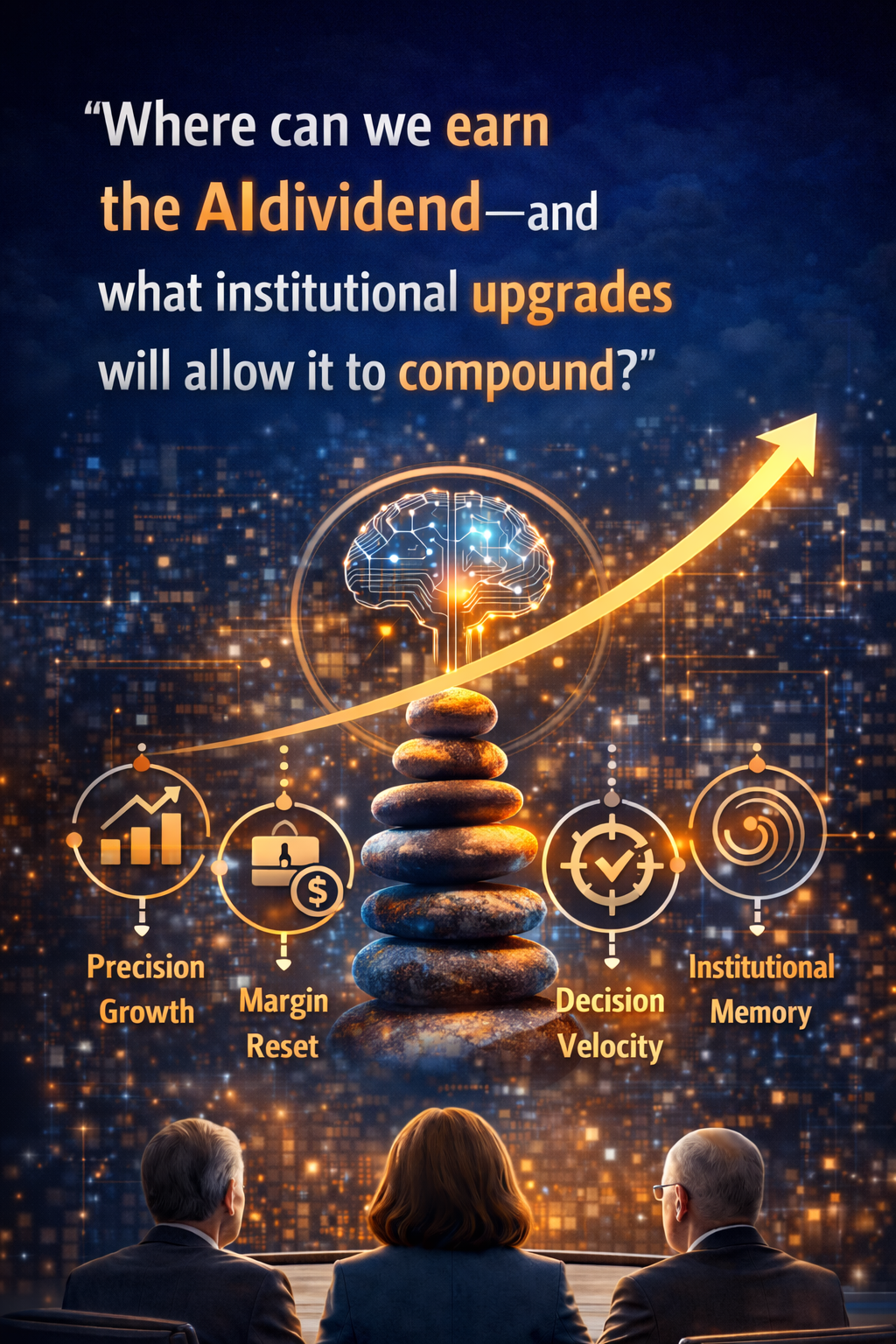
“Where can we earn the AI dividend—and what institutional upgrades will allow it to compound?”
Because the future will not reward organizations for “using AI.”
It will reward organizations that convert AI into structural decision advantage—with faster loops, lower error cost, and measurable economic impact.
And the boards that guide this shift early will not just modernize their companies.
They will reshape what their institutions can do.
Glossary
AI Dividend: The first structural gains from AI that change decision economics (cost, speed, quality).
Decision Loop: Signal → interpret → decide → execute → learn.
Decision Intelligence: A practical discipline that advances decision-making by understanding and engineering how decisions are made and improved via feedback. (Gartner)
Precision Growth: Growth driven by personalization and better micro-decisions, not volume expansion.
Decision Velocity: Speed at which an organization senses, decides, and executes.
FAQ
Q1) Is the AI dividend only for digital-first companies?
No. The dividend appears wherever decisions are frequent and economically material—especially in pricing, working capital, risk, and service workflows.
Q2) Which comes first: governance or value?
Value comes first when governance is “light but real”: clear ownership, escalation rules, and measurement. Heavy bureaucracy slows learning; zero governance creates chaos.
Q3) What’s the most common board mistake?
Treating AI as a collection of projects instead of an operating capability—and measuring activity (pilots, tools) instead of outcomes (economic gains, decision speed, decision quality).
Q4) What’s the fastest way to start?
Pick 2–3 economically critical decisions and redesign their decision loops end-to-end. Track outcomes, overrides, and learning signals.
What is the AI dividend?
The AI dividend is the first structural economic gain an organization earns when AI improves the cost, speed, and quality of economically critical decisions at scale.
What does “AI dividend” mean?
The AI dividend refers to measurable improvements in revenue precision, working capital efficiency, fraud reduction, decision velocity, and workflow throughput achieved through AI-enabled decision redesign.
Where does AI create value first?
AI typically creates early value in pricing optimization, inventory and working capital management, fraud detection, decision cycle compression, and capacity-enhancing productivity.
Why should boards care about AI now?
Because competitive advantage is shifting from scaling labor to scaling decision quality.
What is the board’s role in AI?
To govern decision architecture, align incentives, monitor economic impact, and ensure AI operates within defined escalation and accountability boundaries.
References and further reading
- McKinsey Global Survey on AI (workflow redesign and senior leaders in AI governance correlated with impact). (McKinsey & Company)
- Deloitte: AI in the boardroom—governance actions for responsible oversight and strategic advantage. (Deloitte)
- Gartner glossary: Decision Intelligence definition and feedback-driven improvement framing. (Gartner)
- McKinsey: Building the AI bank of the future (value pools including personalization and reduced errors/efficiency). (McKinsey & Company)
Raktim Singh writes on Enterprise AI operating models, governance architecture, and decision economics. His work focuses on how boards and C-suites can convert AI from experimentation into structural advantage.



Raktim Singh is an AI and deep-tech strategist, TEDx speaker, and author focused on helping enterprises navigate the next era of intelligent systems. With experience spanning AI, fintech, quantum computing, and digital transformation, he simplifies complex technology for leaders and builds frameworks that drive responsible, scalable adoption.