

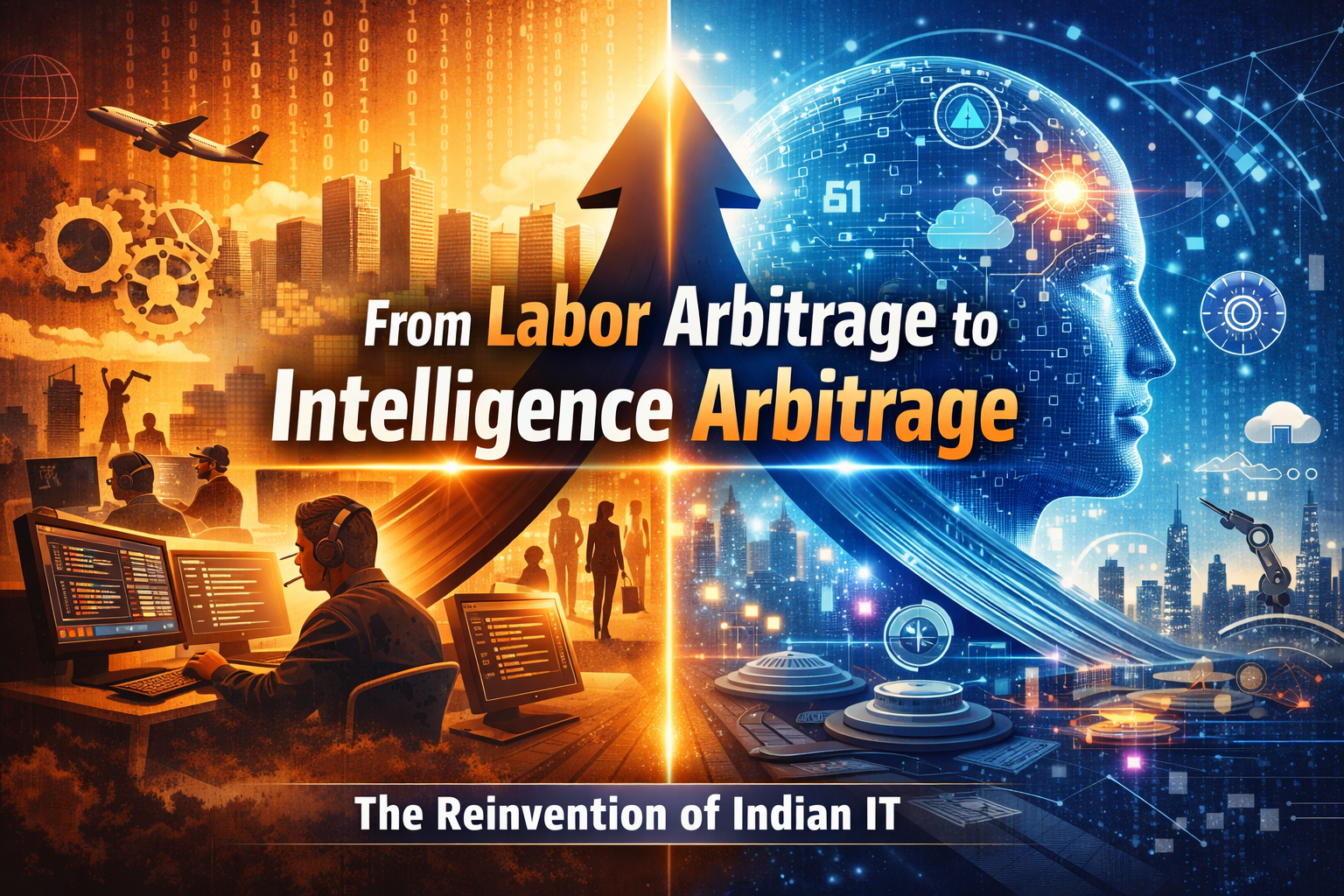
From Labor Arbitrage to Intelligence Arbitrage: The Reinvention of Indian IT in the AI Decade
For three decades, Indian IT mastered the art of scale—delivering talent, reliability, and cost advantage to enterprises across the globe.
That model reshaped global outsourcing and powered one of the most remarkable growth stories in modern business history. But the AI decade is rewriting the unit of value itself.
As automation compresses effort and generative systems accelerate execution, the old question—“How many people does this require?”—is giving way to a new one: “How intelligently can this enterprise operate?” The companies that recognize this shift early will not defend yesterday’s model.
They will design tomorrow’s advantage. This is not a story of decline. It is a story of promotion—from labor arbitrage to intelligence arbitrage, and from services scale to decision scale.
A board-level opportunity map for the AI decade
A noisy narrative is spreading: “AI will doom Indian IT.” Markets have reacted sharply to fast-moving agentic tooling and the possibility that enterprises will reduce traditional, labor-intensive outsourcing spend. (Reuters)
Boards should acknowledge the disruption—clearly, calmly, without denial. Generative AI is already improving developer productivity in measurable ways, and “agentic” capabilities are increasingly being embedded into enterprise applications. (McKinsey & Company)
But here is the board-level truth that gets lost in the panic:
AI compresses effort. It expands enterprise complexity.
And whenever enterprise complexity expands, a new value pool opens—often larger than the old one.
So the right framing is not “survival.” It is reinvention.
Indian IT’s first great advantage was labor arbitrage: delivering high-quality work at scale and cost. The next great advantage can be intelligence arbitrage: helping global enterprises operate, govern, and monetize intelligence—safely, economically, and at scale.
That is a different business. A higher business. And it is exactly the kind of shift boards exist to lead.
What changed: value is moving from building software to running intelligence
For decades, the services engine was powered by three assumptions:
- Work can be decomposed into tasks.
- Tasks are executed by people using tools.
- Value scales mainly through workforce size, process maturity, and delivery excellence.
AI challenges this—not because “software is dead,” but because the unit of value is shifting.
In the AI decade, enterprises will increasingly pay for:
- Decision quality: fewer wrong approvals, fewer wrong exceptions, fewer wrong escalations
- Decision speed: lower latency across operations, customer flows, supply chains, risk workflows
- Decision defensibility: evidence, audit trails, policy alignment, traceability
- Decision economics: cost-to-value visibility, predictable operating cost, ROI control
This is why the modern enterprise is not merely “using AI.” It is becoming AI-fied: redesigned so intelligence is embedded into operating rhythms—finance, risk, compliance, customer experience, operations, and engineering.
NASSCOM’s recent framing is consistent with this direction: the opportunity is large, but converting adoption into durable advantage requires coordinated capability building and institutional change. (nasscom.in)
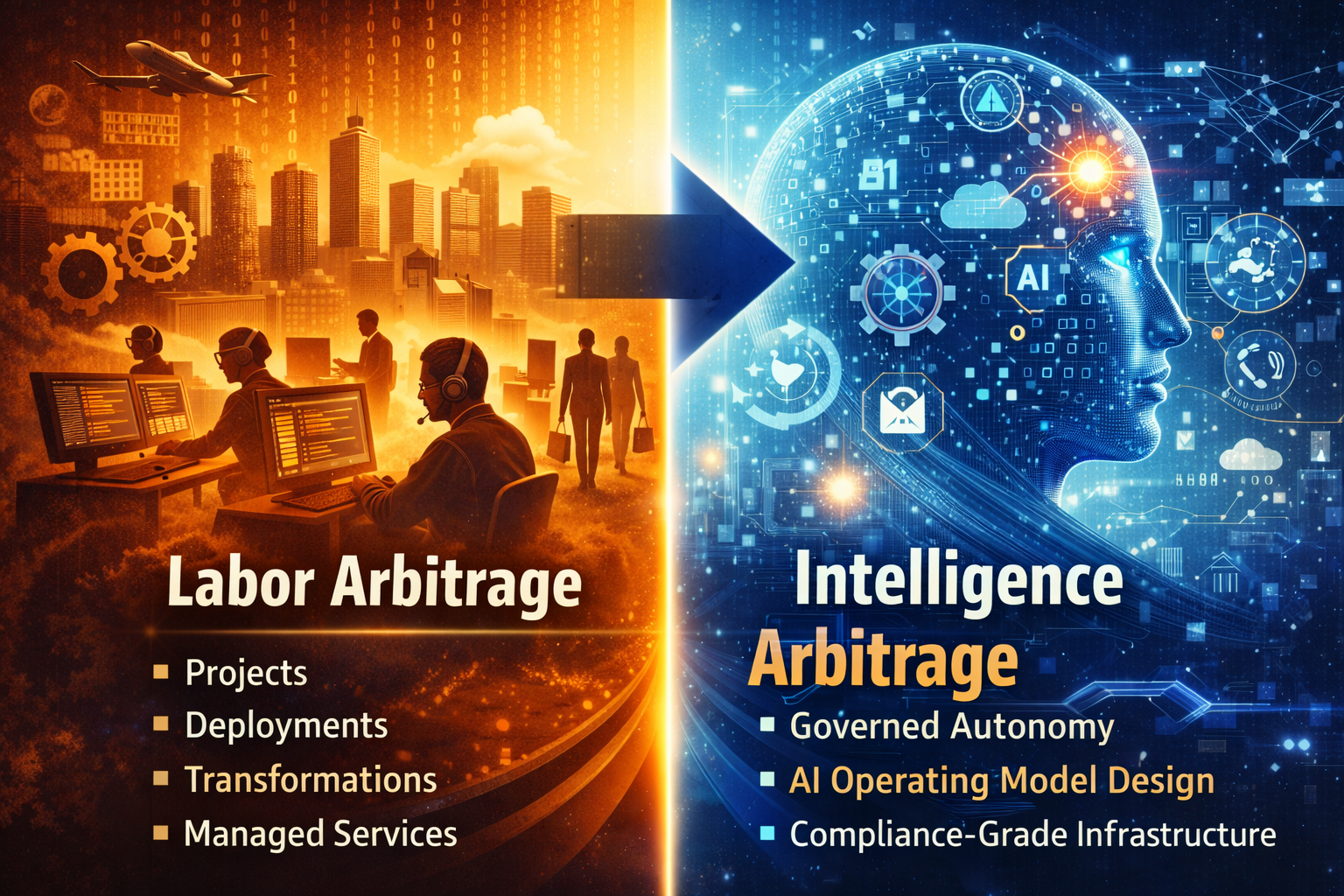
The core idea: labor arbitrage vs intelligence arbitrage
Labor arbitrage (the old engine)
You sell skilled effort efficiently:
- projects and implementations
- deployments and modernizations
- managed services (run systems)
- transformations (move from legacy to modern)
Core asset: a scalable delivery engine.
Intelligence arbitrage (the new engine)
You sell operated intelligence as an enterprise capability:
- governed autonomy (AI that acts safely inside real workflows)
- AI operating model design (ownership, decision rights, accountability)
- runtime reliability for agents (monitoring, incident response, drift management)
- cost governance for AI estates (FinOps for intelligence)
- compliance-grade decision infrastructure (auditability, traceability, reversibility)
- reusable “services-as-software” built on AI (catalogs, patterns, industry packs)
Core asset: repeatable operating capability—the ability to design, govern, and run intelligence across many clients and domains.
This isn’t hype. It’s a market pull created by a simple reality:
Enterprises will not just deploy AI. They will live with AI.
And living with AI requires operating disciplines most organizations do not yet have.
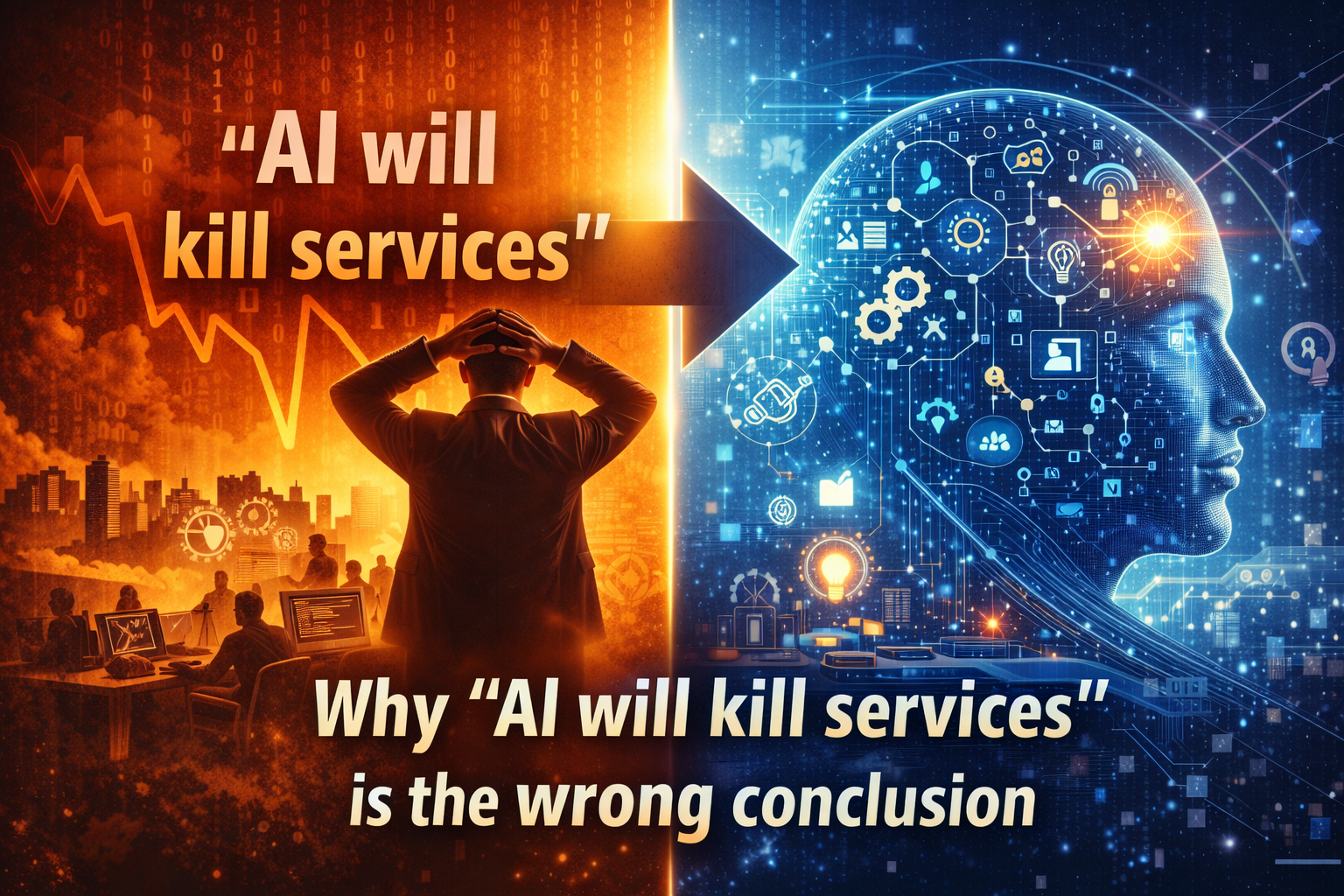
Why “AI will kill services” is the wrong conclusion
Yes, AI reduces effort in many activities. McKinsey’s research, for example, reported that developers can complete certain coding tasks significantly faster with generative AI. (McKinsey & Company)
But effort compression is only half the story. The other half is the expansion of complexity:
- More systems can be changed more often
- More workflows can be automated end-to-end
- More decisions can be delegated to machines
- More autonomy can be introduced into regulated processes
- More vendors, models, tools, prompts, and data flows appear in production
This creates a new operational requirement: someone must design and run the intelligence layer.
The adoption curve is moving from “chat assistants” to “agents in apps.” Gartner predicted that up to 40% of enterprise applications will include integrated task-specific agents by 2026 (up from <5% in 2025). (Gartner)
Agents increase leverage—but they also create governance, reliability, and cost obligations. Those obligations become the next services category.
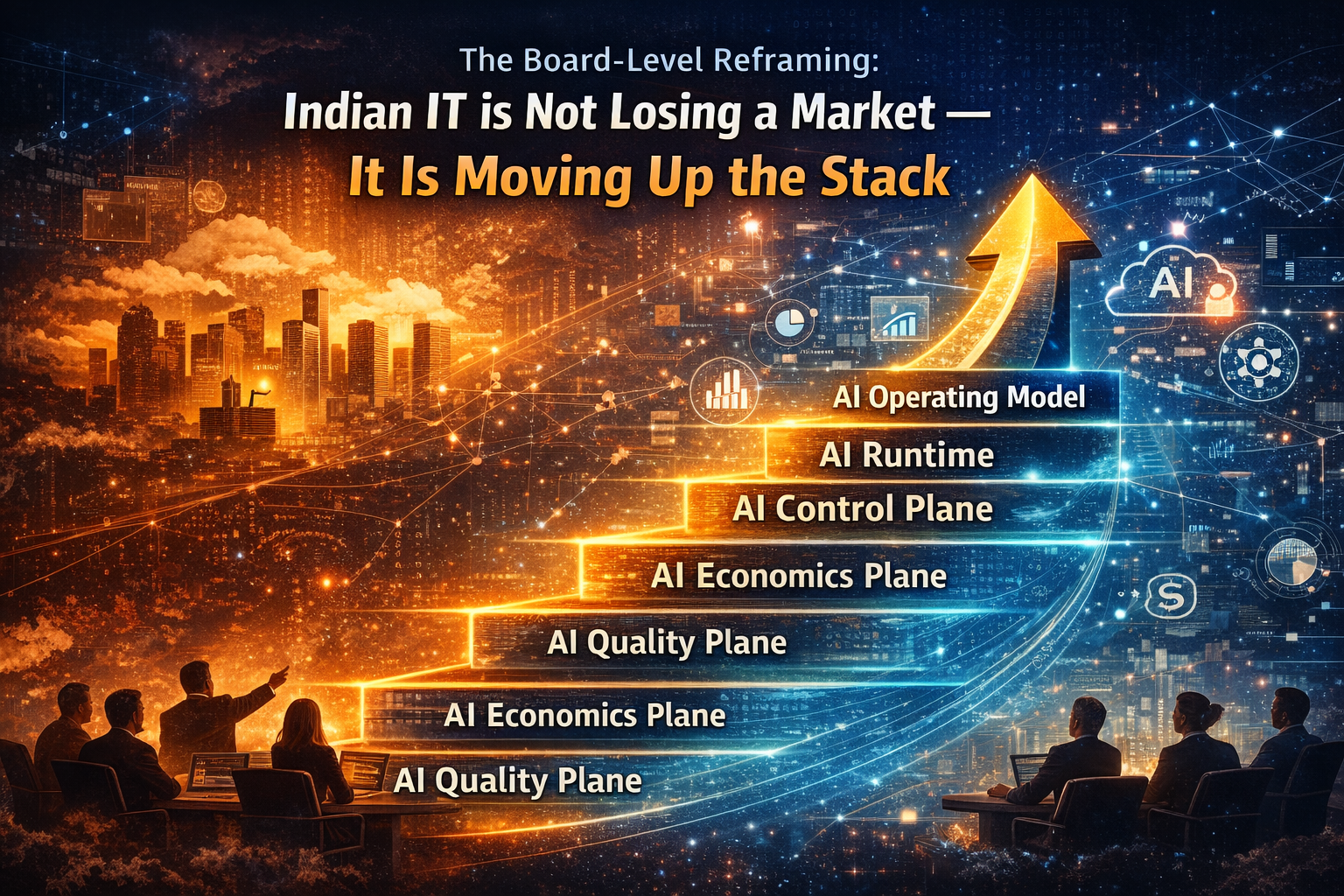
The board-level reframing: Indian IT is not losing a market—it is moving up the stack
Boards should stop asking:
“Will AI reduce billable hours?”
Start asking:
“What new enterprise spend category does AI create?”
That spend category looks like five “operating planes” that boards can understand immediately:
1) The AI operating model
Who owns AI outcomes? Who owns risk? Who owns reversibility? Who signs off on autonomy?
This is governance and accountability—not a tooling question.
2) The AI runtime
What is actually running in production? How does it change? How is it monitored?
AI in production is not static software. It evolves: models, prompts, retrieval, tools, policies.
3) The AI control plane
How do we ensure policy compliance, auditability, evidence, and defensibility—especially when systems act?
4) The AI economics plane
How do we prevent costs from exploding after “success”? How do we manage model/tool sprawl and compute variability?
5) The AI quality plane
How do we test and certify agentic workflows that act in real business systems?
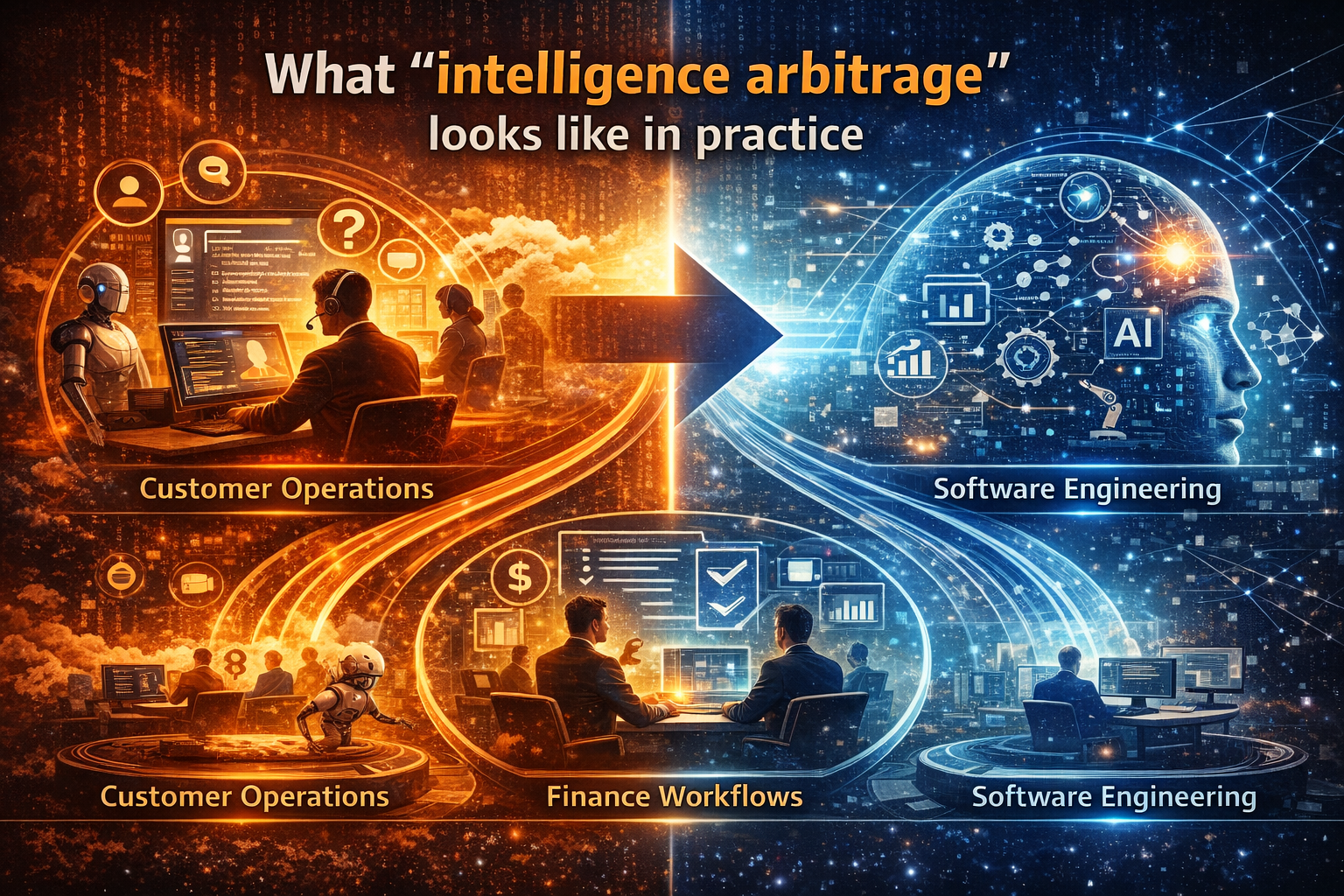
What “intelligence arbitrage” looks like in practice
No math. No buzzwords. Just reality.
Example A: Customer operations without the “handoff maze”
A global enterprise wants to reduce customer handling time. Traditionally, it invests in training, process redesign, and new tooling.
With AI-fication, the enterprise can introduce an agent that:
- reads the customer’s history
- identifies the likely issue
- proposes a resolution
- prepares a compliant response
- escalates only when needed
Effort reduces. But enterprise responsibility increases:
- Is the response compliant and brand-safe?
- Can we prove why the agent recommended this?
- What happens if the agent triggers an action?
- Who owns the decision if the outcome is wrong?
An Indian IT partner that can provide operated autonomy—with governance, auditability, and reliability—wins a larger scope than a “contact center automation project.”
Example B: Finance workflows where speed must remain defensible
Consider finance approvals (budget release, credit exceptions, vendor onboarding). AI can accelerate the process.
But boards will demand:
- traceability (“why this approval?”)
- evidence retention (“what inputs?”)
- policy alignment (“what rule?”)
- reversibility (“can we unwind?”)
That is a decision infrastructure problem, not a model demo problem.
Example C: Software engineering in the era of accelerated change
If developers produce code faster, enterprises can ship faster. Great.
But now:
- change velocity rises
- attack surface shifts
- testing burden changes
- maintenance models must adapt
McKinsey has also argued that AI can transform the software product development lifecycle—not merely coding speed. (McKinsey & Company)
Again: less effort per unit. More need for operating capability.
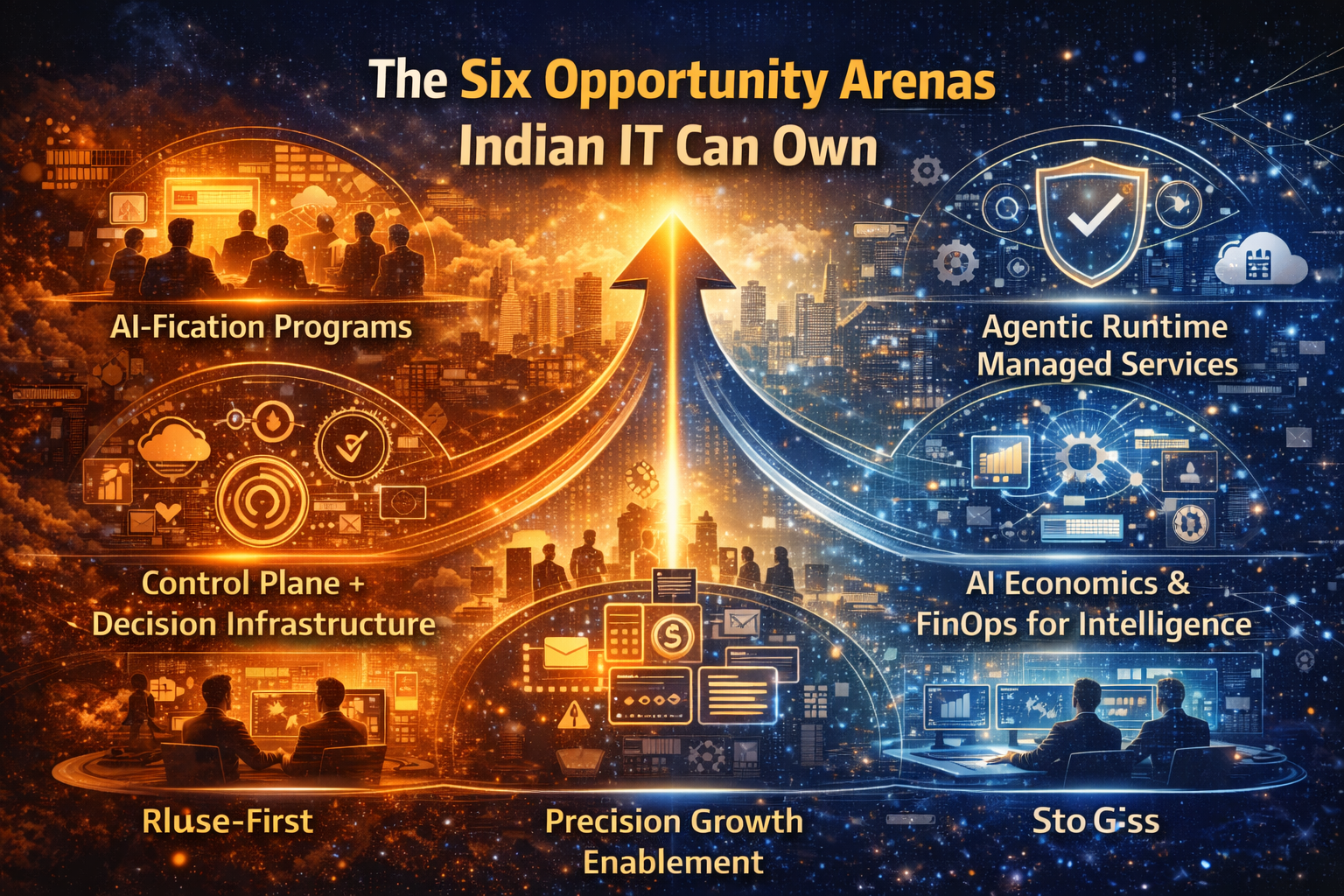
The six opportunity arenas Indian IT can own
This is the heart of the reinvention story: new revenue pools that are bigger than “AI tool rollout.”
1) AI-fication programs, not AI pilots
Enterprise conversations are shifting from exploration to execution—budgets, governance, and operating integration are becoming central. (The Economic Times)
Indian IT can lead AI-fication as a transformation category:
- redesign workflows around decision flow
- instrument decision points (evidence, observability)
- embed safety and policy gates
- re-architect data and integration for AI readiness
This is not “install AI.” This is rebuild operating capability.The Future Belongs to Decision-Intelligent Institutions – Raktim Singh
2) Agentic runtime managed services
As agentic capabilities spread across apps, runtime becomes the bottleneck: observability, incident response, drift monitoring, safety controls.
Enterprises will not want to run dozens (then hundreds) of agents alone. They will want a partner that runs agentic systems like mission-critical infrastructure.
3) Control plane + compliance-grade decision infrastructure
Boards and regulators will increasingly ask: “Show me how this system makes decisions.” In regulated industries, that becomes non-negotiable.
A partner that provides:
- audit-ready evidence trails
- policy enforcement and approvals
- role-based constraints
- red-team testing and certification
becomes essential.
4) AI economics and FinOps for intelligence
As AI embeds into operations, cost becomes strategic. Not just cloud cost—decision cost.
Partner value becomes:
- controlling model/tool sprawl
- routing workloads to cost-efficient options
- setting budgets and guardrails
- linking AI spend to measurable outcomes
5) Reuse-first “services-as-software”
The biggest margin expansion comes when Indian IT stops selling bespoke work and starts selling reusable intelligence services:
- an AI service catalog for common enterprise functions
- reusable governance templates
- reusable agent patterns
- domain-specific workflow packs
This is how services companies become operating capability providers.
6) Industry-grade “precision growth” enablement
Boards want growth, not demos. AI enables precision growth—moving from averages to targeted decisions at scale.
Gartner predicts that by 2028, 60% of brands will use agentic AI to deliver streamlined one-to-one interactions—implying major demand for governance, data discipline, and operating model change. (Gartner)
Indian IT can be the partner that makes precision growth operational—not just “personalization,” but safe, defensible personalization.The End of Averages: Why Precision Growth Will Define the Next Decade of Enterprise Strategy – Raktim Singh
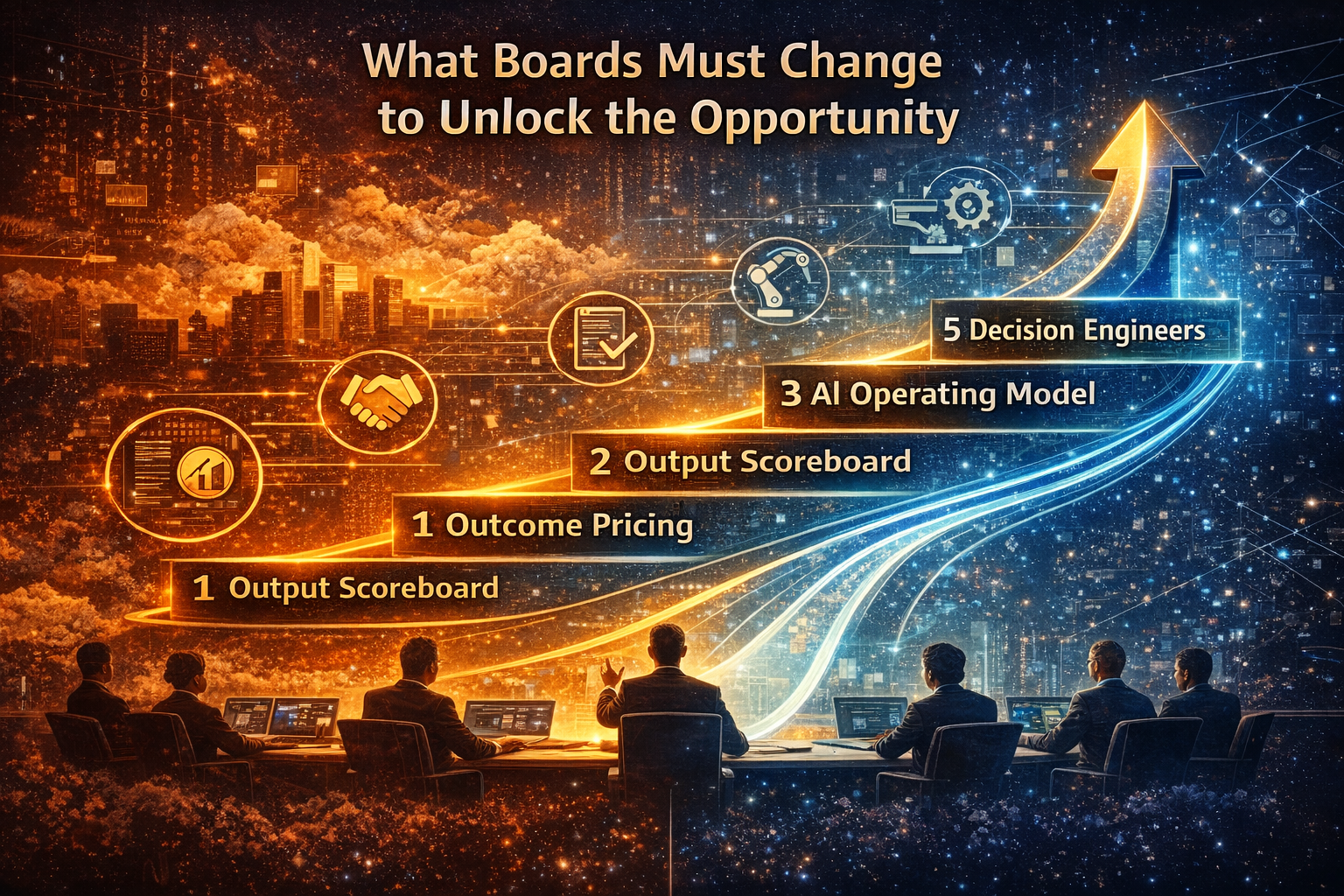
What boards must change to unlock the opportunity
The opportunity exists, but it is not automatic. Boards must guide a deliberate shift.
1) Change the commercial model: from effort pricing to outcome pricing
If AI compresses effort, selling effort becomes a race to the bottom.
Boards should push toward:
- outcome-based contracts
- managed capability subscriptions
- value-linked pricing
- shared gains (“AI dividend” What Is the AI Dividend? How Boards Capture Structural Gains from Enterprise AI – Raktim Singh) structures
2) Change what gets measured: adoption is not the scoreboard
Stop asking:
- “How many people are using AI?”
- “How many copilots did we roll out?”
Start asking:
- Where did decision latency drop?
- Where did error rates fall?
- Where did auditability improve?
- Where did operational friction reduce?
- Where is the AI dividend visible?
3) Build an enterprise AI operating model
The org design must evolve:
- clear ownership for AI decisions
- integrated risk and compliance
- runtime and platform accountability
- economic governance
4) Shift the delivery engine: from project factories to intelligence factories
AI-fication demands a new delivery system:
- reusable components
- governed workflows
- runtime instrumentation by default
- security and policy integrated into build
- continuous recomposition (because AI systems change)
5) Update talent strategy: from “more developers” to “more decision engineers”
This is not just AI training. It is role evolution:
- workflow designers who think in decisions
- engineers who build tool-using agents safely
- QA who test autonomy (not just outputs)
- FinOps teams who manage intelligence economics
- governance leaders who operationalize policy
NASSCOM has emphasized that workforce transformation is central as AI embeds across service lines and workflows. (nasscom.in)
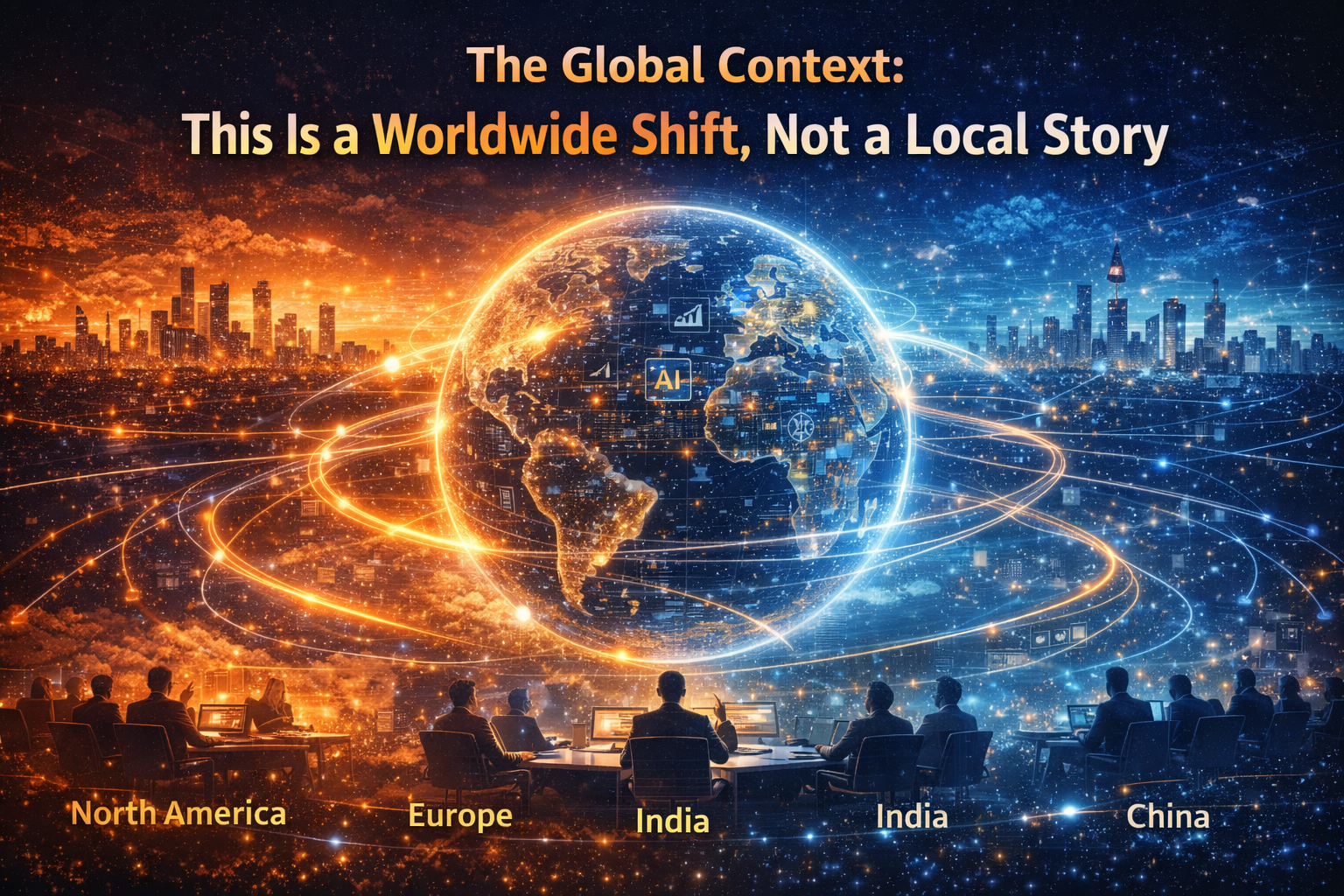
The global context: this is a worldwide shift, not a local story
This reinvention pattern will apply to consultancies, IT services, and integrators globally. But Indian IT has unusual strategic advantage:
- proximity to global enterprises through long-standing relationships
- deep exposure to real workflows and constraints
- proven capability running complex systems at scale
- talent density and execution maturity across India’s major tech hubs (Bengaluru, Hyderabad, Pune, Chennai, Gurugram)
The question is not capability. It is focus.
Boards must steer:
- from delivery scale to decision scale
- from project throughput to operating capability
- from services as people to services as intelligence infrastructure
Enterprise AI Operating Model
Enterprise AI scale requires four interlocking planes:
Read about Enterprise AI Operating Model The Enterprise AI Operating Model: How organizations design, govern, and scale intelligence safely — Raktim Singh
- Read about Enterprise Control Tower The Enterprise AI Control Tower: Why Services-as-Software Is the Only Way to Run Autonomous AI at Scale — Raktim Singh
- Read about Decision Clarity The Shortest Path to Scalable Enterprise AI Autonomy Is Decision Clarity — Raktim Singh
- Read about The Enterprise AI Runbook Crisis The Enterprise AI Runbook Crisis: Why Model Churn Is Breaking Production AI — and What CIOs Must Fix in the Next 12 Months — Raktim Singh
- Read about Enterprise AI Economics Enterprise AI Economics & Cost Governance: Why Every AI Estate Needs an Economic Control Plane — Raktim Singh
Read about Who Owns Enterprise AI Who Owns Enterprise AI? Roles, Accountability, and Decision Rights in 2026 — Raktim Singh
Read about The Intelligence Reuse Index The Intelligence Reuse Index: Why Enterprise AI Advantage Has Shifted from Models to Reuse — Raktim Singh
Read about Enterprise AI Agent Registry Enterprise AI Agent Registry: The Missing System of Record for Autonomous AI — Raktim Singh
Conclusion column: the board takeaway
Boards should treat AI as a category shift in enterprise value creation.
AI will compress effort. That is real.
But it will also expand complexity—because enterprises will run more autonomous workflows, faster change cycles, and higher expectations of accountability.
The winners will not be the firms that adopt AI the fastest.
They will be the firms that redesign themselves to run intelligence—with governance, economics, and reliability.
Indian IT can become the partner that makes this possible for global enterprises. Not by denying disruption, but by converting it into a higher-order service category: intelligence arbitrage.
Glossary
- AI-fication: Redesigning enterprise operations so intelligence becomes embedded into decision workflows, not bolted on as a tool.
- Intelligence arbitrage: Turning the complexity of enterprise AI (governance, runtime, economics, reliability) into a managed, reusable operating capability clients can buy.
- AI operating model: The governance structure that defines AI ownership, decision rights, accountability, and escalation paths.
- AI runtime: What is actually running in production—models, prompts, retrieval, tools, policies—and how it is monitored and managed.
- AI control plane: The layer that enforces policy, auditability, evidence, and defensibility for AI decisions and actions.
- Agentic AI: AI systems that can plan and act across steps (often using tools), not just generate text.
- AgentOps: Operational discipline for running agents safely in production (monitoring, drift control, incident response, testing).
- AI FinOps: Economic governance for AI estates—cost-to-value tracking, budget guardrails, and workload routing.
- Services-as-software: Reusable packaged services (catalogs, patterns, workflow packs) that scale beyond bespoke projects.
-
Labor Arbitrage
A services model based on cost and talent efficiency.Intelligence Arbitrage
A services model based on managing and governing enterprise AI complexity.AI-fication
Redesigning enterprise workflows so intelligence becomes embedded in operating systems.Decision Scale
The ability to improve decision quality and speed across thousands of workflows.AI Control Plane
The governance layer that ensures policy compliance, traceability, and auditability.Agentic Runtime
The production environment where AI agents operate and interact with enterprise systems.
FAQ
1) Is this saying Indian IT should stop services and become product companies?
No. This is saying the services category itself is moving up the stack—from effort delivery to operated intelligence infrastructure. Product companies will sell models and tools; enterprises will still need partners to make AI real inside messy, regulated, brownfield operations. (Reuters)
2) Why won’t enterprises just do this themselves?
Some will. But most will struggle to build all the required disciplines at once: governance, runtime reliability, cost control, testing of autonomy, integration into core systems. The complexity is operational, not theoretical.
3) What’s the single biggest shift boards should drive first?
Move from “AI adoption” to “AI operating capability.” Start by demanding an AI operating model (ownership + accountability) and an inventory of what’s running in production (runtime clarity). Then build control plane and economics.
4) Is agentic AI real or just hype?
Agent adoption is accelerating. Gartner has predicted broad embedding of task-specific agents into enterprise applications by 2026. (Gartner) That doesn’t mean every project succeeds—but it does mean the operating challenge is arriving quickly.
5) What makes this GEO-friendly for India without being India-only?
Because the argument is global (enterprise operating change), while examples and execution realities are grounded in India’s delivery ecosystem across Bengaluru, Hyderabad, Pune, Chennai, Gurugram, and Mumbai—where much of enterprise technology work already happens.
1. Will AI reduce demand for Indian IT services?
AI will reduce effort-based pricing but increase demand for AI governance, runtime management, and intelligence infrastructure.
2. What is intelligence arbitrage?
It is the capability to design, govern, and operate enterprise AI systems as a managed service.
3. How can Indian IT move up the value chain?
By shifting from project delivery to operating AI decision infrastructure at scale.
4. Why are boards critical in this transition?
Because this shift affects pricing models, risk governance, operating structure, and strategic positioning.
5. Is this shift unique to India?
No. It is global. But Indian IT has structural advantages in execution maturity and enterprise exposure.
References and further reading
- Reuters on AI-driven fears impacting Indian IT stocks and the debate around disruption vs integration reality. (Reuters)
- McKinsey on measurable developer productivity gains from generative AI. (McKinsey & Company)
- McKinsey on AI-enabled software product development lifecycle transformation. (McKinsey & Company)
- Gartner on the rapid embedding of task-specific AI agents into enterprise applications by 2026. (Gartner)
- Gartner on agentic AI enabling one-to-one interactions at scale by 2028 (marketing/experience implications). (Gartner)
- NASSCOM on India’s services sector and the AI opportunity (capability + institutional shift). (nasscom.in)
- Economic Times on the shift from experimentation to implementation and the need for collaboration frameworks. (The Economic Times)
Related Enterprise AI Reading
Many organizations are discovering that enterprise AI success depends on far more than model accuracy. Common challenges include AI project failure, weak AI governance, poor AI agent control, unclear enterprise AI ROI, and the inability to translate AI insights into business outcomes. For readers exploring topics such as why enterprise AI projects fail, how AI creates business value, AI agent governance frameworks, agentic AI systems, enterprise AI architecture, AI risk management, CIO AI strategy, and enterprise AI operating models, the following articles provide a deeper perspective:
-
- Why Enterprise AI Projects Fail Even When the Models Work
- Why AI Creates Value in One Company and Fails in Another
- AI Agent Governance: How CIOs Should Decide What AI Agents Are Allowed to Do
- Why AI Agents Fail in Enterprises
- Why Enterprise AI Projects Fail Even When the Models Work: The Missing Architecture Behind AI Governance and Agentic Systems
- raktimsingh.com/hy-enterprise-
ai-projects-fail-digital- anthropology-ai-governance/
Together, these articles examine the critical relationship between enterprise data, AI decision-making, AI governance, AI agents, execution systems, accountability mechanisms, and measurable business value, helping CIOs, CTOs, architects, and business leaders move from AI experimentation to enterprise-scale impact.



Raktim Singh is an AI and deep-tech strategist, TEDx speaker, and author focused on helping enterprises navigate the next era of intelligent systems. With experience spanning AI, fintech, quantum computing, and digital transformation, he simplifies complex technology for leaders and builds frameworks that drive responsible, scalable adoption.