

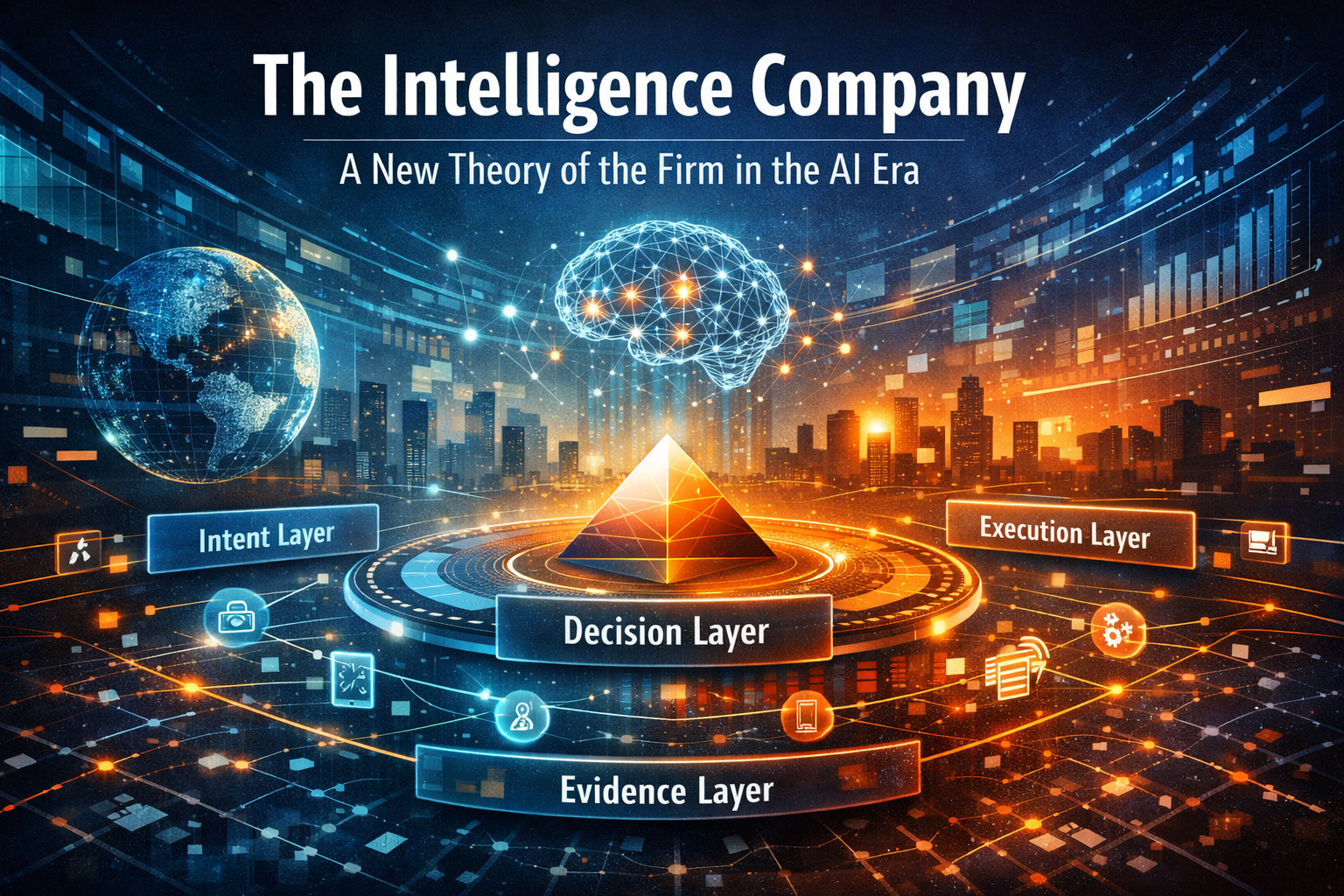
The Intelligence Company: A New Theory of the Firm in the AI Era
For nearly a century, we understood why firms existed: to reduce coordination costs and scale execution.
But that theory assumed one thing—that cognition was scarce and human. That assumption is now broken. When intelligence becomes programmable, actable, and continuously observable, the structure of the firm itself must change.
The next dominant corporate form will not be the software company. It will be the Intelligence Company—an organization designed to scale governed judgment, not just workflow.
Intelligence Company
Most leaders still talk about AI like it’s a powerful new tool—something you “deploy” into functions: customer service, marketing, finance, risk, or IT.
That framing is already outdated.
A tool can be adopted without changing the nature of the organization. Intelligence—especially intelligence that can act—changes the organization’s structure, boundaries, and economics.
In the industrial era, firms won by scaling production.
In the software era, firms won by scaling distribution and execution.
In the AI era, the next dominant form of organization will be the Intelligence Company: a firm designed to scale decision quality with governed autonomy.
This is not a technology story.
It is a new theory of the firm.
If you want the foundational operating-model view behind this shift, start with The Enterprise AI Operating Model (pillar): https://www.raktimsingh.com/enterprise-ai-operating-model/
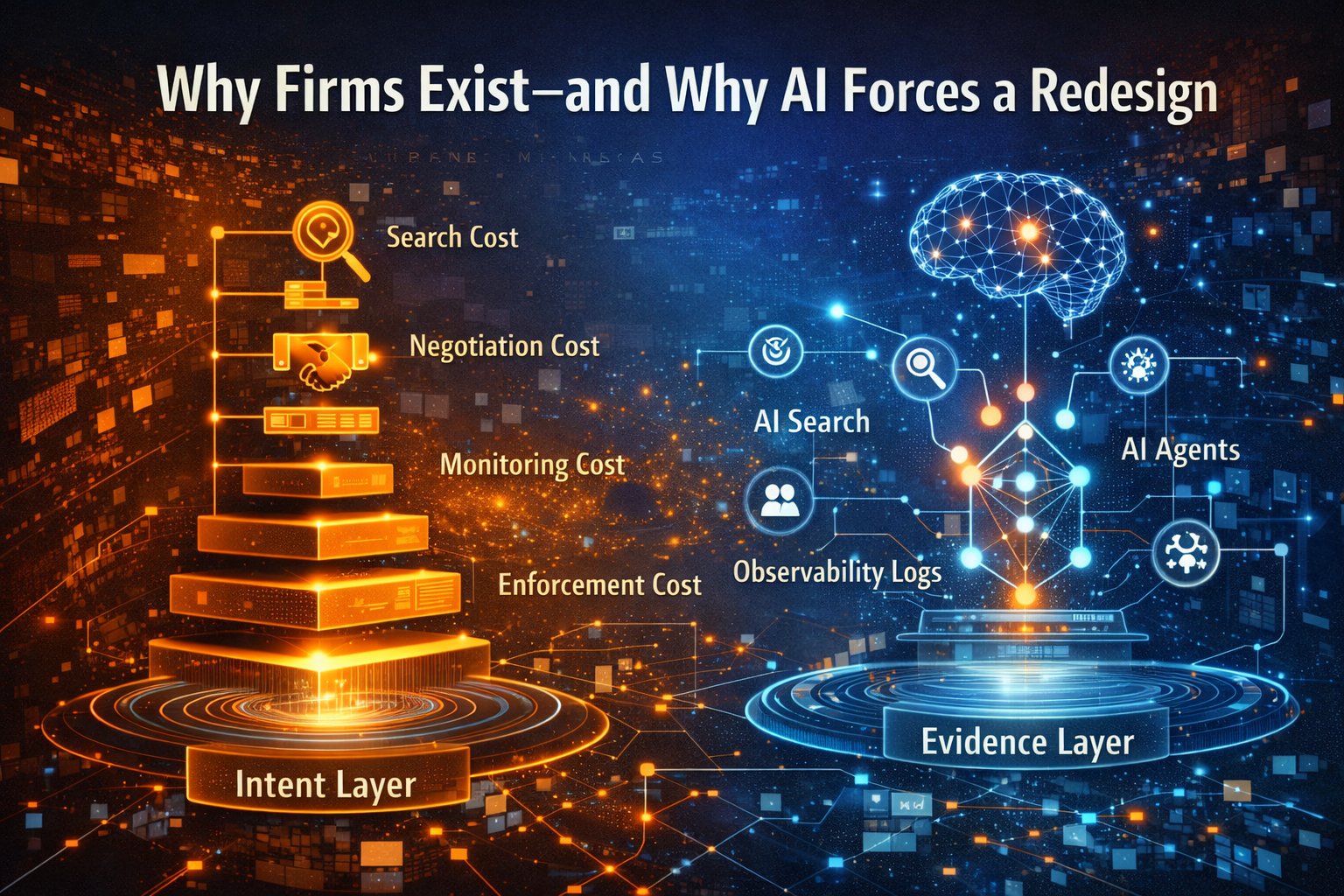
Why Firms Exist—and Why AI Forces a Redesign
A simple idea explains why firms exist at all: markets are not free to use. Even when buying and selling is technically possible, coordinating through the market involves friction—searching, negotiating, monitoring, enforcing, handling disputes, and managing uncertainty.
So firms emerged as a coordination engine. They replace repeated bargaining with hierarchy. Instead of negotiating every task, you can assign responsibility, define roles, and execute.
Now watch what happens when AI moves from “recommendation” to agency—from suggesting actions to taking them:
- Search costs collapse (AI can find options instantly)
- Negotiation costs drop (agents can propose, compare, iterate)
- Monitoring becomes continuous (observability, logs, live evaluation)
- Enforcement becomes programmable (policy constraints, guardrails, reversibility)
- Coordination becomes machine-speed (24/7, multi-step, multi-system)
Economists call many of these frictions transaction costs—and Coase’s classic explanation of the firm is rooted in the idea that firms exist to manage them. (Wiley Online Library)
When AI reduces these costs dramatically, the question changes.
The most important question is no longer:
“What can AI do?”
It becomes:
“What is the most efficient way to coordinate decisions and action—inside the firm vs. across the market—when cognition is cheap, continuous, and increasingly autonomous?”
That is exactly what the Intelligence Company answers.
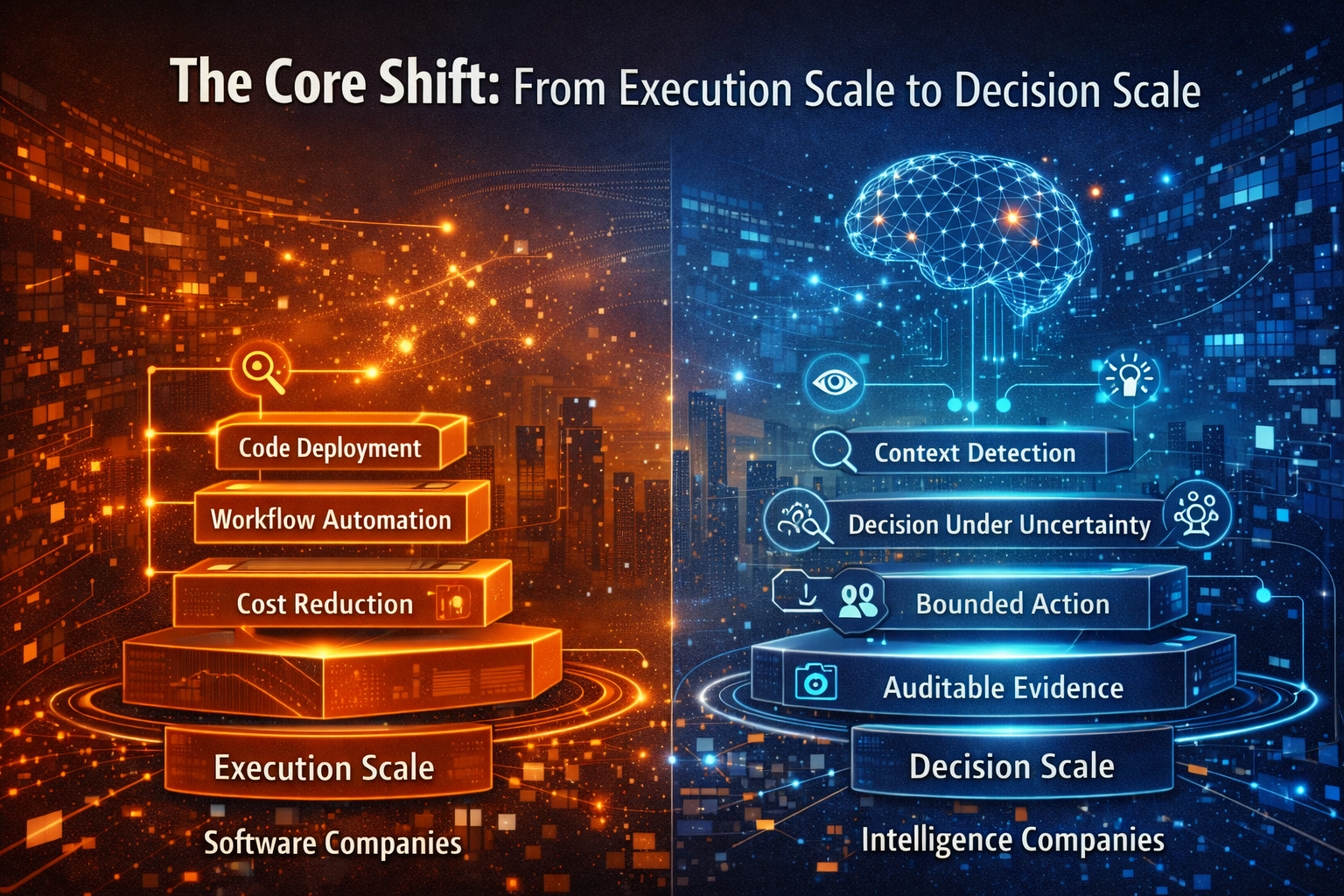
The Core Shift: From Execution Scale to Decision Scale
Software companies were built to scale execution:
- Write code once
- Deploy everywhere
- Automate workflows
- Reduce the marginal cost of delivery
But the Intelligence Company is built to scale judgment:
- Detect context continuously
- Decide under uncertainty repeatedly
- Act with bounded authority
- Learn from outcomes
- Produce evidence for trust, audit, and accountability
This is the deeper reason why Intelligence-Native Enterprise idea matters: it’s not a label. It’s a design principle.
Want the board-level framing of why advantage is moving here? See:
Decision Scale: Why Competitive Advantage Is Moving from Labor Scale to Decision Scale
https://www.raktimsingh.com/decision-scale-competitive-advantage-ai/
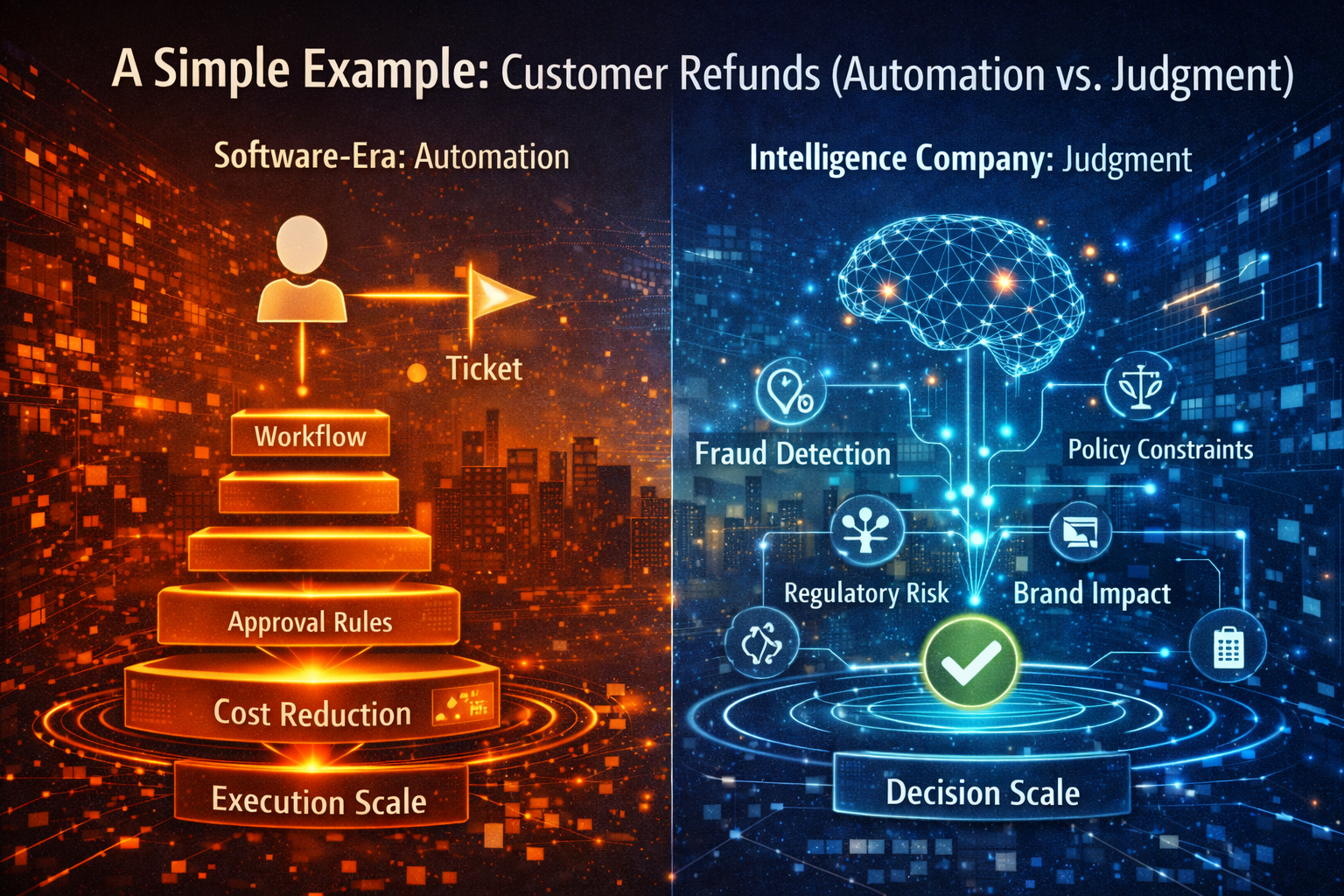
A Simple Example: Customer Refunds (Automation vs. Judgment)
Software-era approach: Build a workflow. Route tickets. Add approval rules.
Intelligence Company approach:
An AI system evaluates each refund request in context—customer history, product usage, fraud signals, policy constraints, regulatory risk, and brand impact.
It can approve instantly, escalate exceptions, propose alternatives, and log evidence. Over time, it reduces variance (fewer wrong approvals, fewer angry customers, lower fraud) and shortens resolution time.
That is not mere automation.
That is scalable judgment.
The Intelligence Company Defined
An Intelligence Company is a firm whose operating model is designed to produce, govern, and compound decision quality—at scale—using AI systems that can reason, act, and prove what they did and why.
Three implications follow immediately:
- Cognition becomes infrastructure (like finance or security)
- Authority becomes programmable (delegation is encoded and enforced)
- Evidence becomes a first-class output (trust is produced, not assumed)
This directly extends my “production reality” argument about AI systems that churn and degrade without operational discipline:
The Enterprise AI Runbook Crisis
https://www.raktimsingh.com/enterprise-ai-runbook-crisis-model-churn-production-ai/
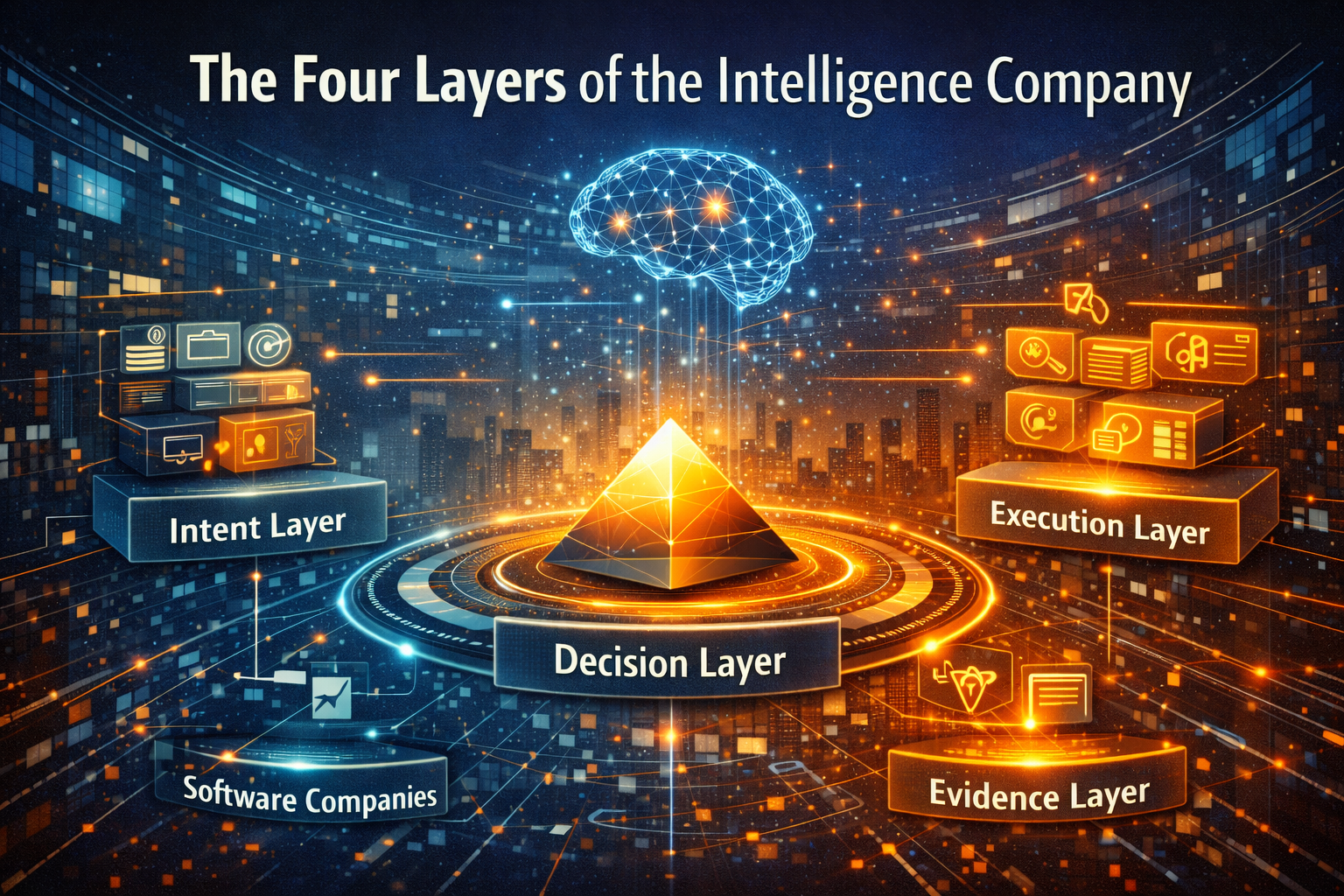
The Four Layers of the Intelligence Company
To make this practical, one need a mental model boards can remember and executives can implement.
1) Intent Layer (Goals + Constraints)
This is where leadership defines:
- What outcomes matter (growth, resilience, customer trust)
- What must never happen (policy violations, unsafe actions, reputational damage)
- What trade-offs are acceptable (speed vs. certainty, automation vs. oversight)
In a software company, intent is often implicit—buried in documents and meetings.
In an Intelligence Company, intent must be operational: expressed as constraints and decision principles.
Example: A bank defines “credit expansion” as a goal, but with constraints around affordability, fairness, fraud risk, and regulatory compliance across regions (US, EU, India), where rules differ.
2) Decision Layer (Reasoning Systems)
This is where models and agents:
- Interpret context
- Generate options
- Evaluate outcomes
- Choose actions
- Decide when to escalate
The Decision Layer is not “one model.” It’s a system: retrieval, reasoning, planning, policy evaluation, and self-checking.
Example: A telecom network uses decision systems to optimize capacity, detect anomalies, and reroute operations—without waiting for humans to interpret dashboards.
3) Execution Layer (Tools + Workflows)
This is where actions occur:
- APIs, enterprise apps, ticketing tools, payment rails, messaging systems
- Human handoffs for exceptions
- “Safe mode” operations when confidence is low
In an Intelligence Company, execution is not a separate world. It’s a controlled surface area. You explicitly decide what the AI can touch, how, and under what constraints.
Example: In healthcare, an AI system may draft discharge instructions, but medication changes route through clinical verification, with every step recorded.
4) Evidence Layer (Trace + Audit + Learning)
This is where trust is manufactured.
The Evidence Layer produces:
- Decision logs (what was decided)
- Rationale traces (why it was decided)
- Policy checks (which constraints were applied)
- Outcome tracking (what happened after)
- Incident response (what to do when it fails)
In a software firm, logs are mostly for debugging.
In an Intelligence Company, logs are governance artifacts.
This is the layer that makes autonomy scalable—especially as agents move into real-world operations (a concern now widely recognized in agent governance discussions). (World Economic Forum)
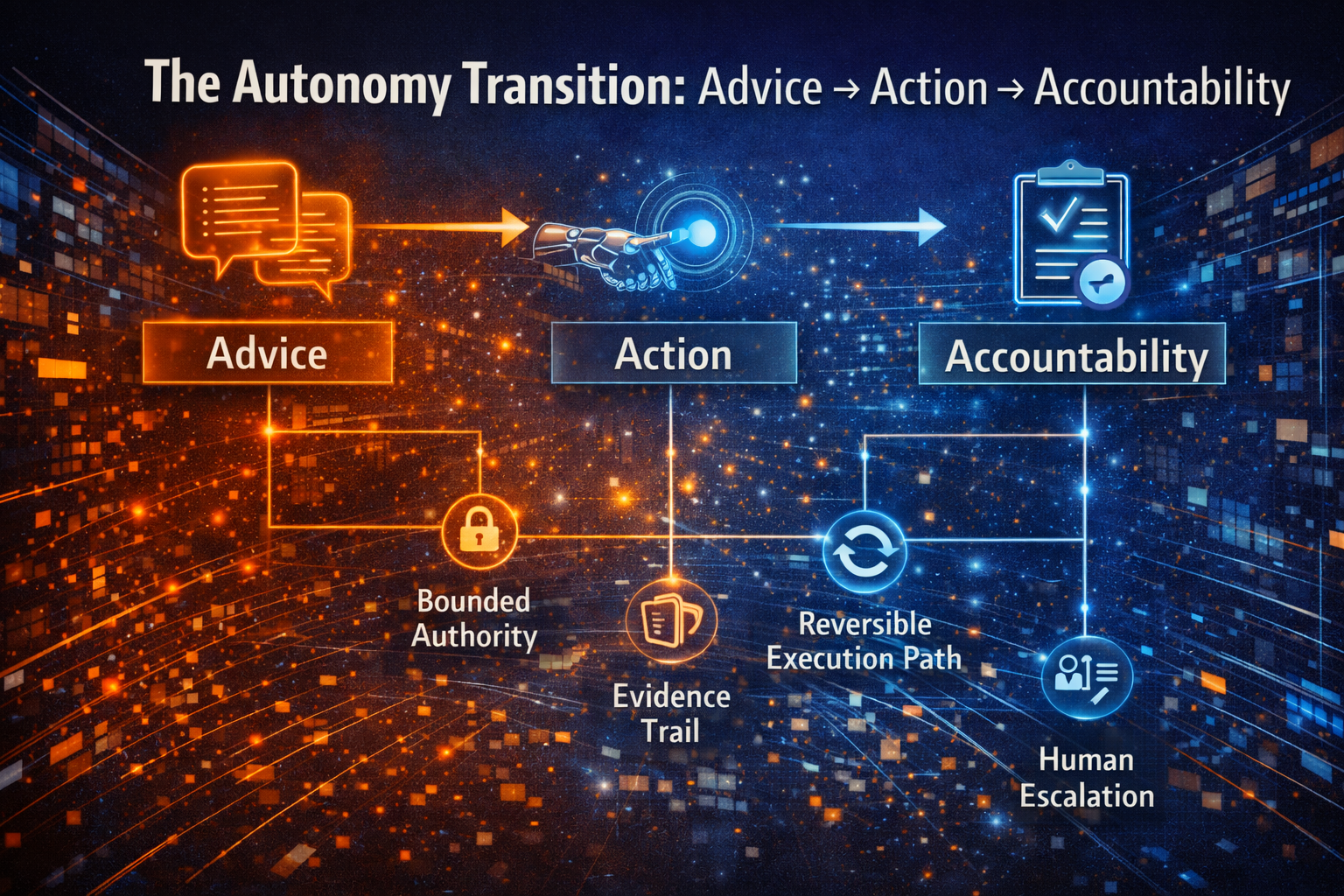
The Autonomy Transition: Advice → Action → Accountability
Most AI still lives in “advice mode”: summarize, suggest, predict.
The Intelligence Company emerges when AI enters action mode:
- sends communications
- approves exceptions
- changes configurations
- executes purchases
- negotiates schedules
- triggers workflows
That’s why “AI governance” alone is insufficient. Governance dictates what should happen; the Intelligence Company requires continuous proof of control.
Here’s the simplest board-level principle:
If AI can act, then every action must have:
- a bounded authority model (what it is allowed to do)
- a reversible execution path (how to undo or contain)
- an evidence trail (how to prove compliance and intent)
- a human escalation route (when it should stop)
This shift is also driving the emergence of “agent management” as a real operating need in organizations. (Harvard Business Review)
Why Firm Boundaries Will Shift
This is where the “new theory of the firm” becomes real.
As AI agents reduce coordination costs, firms will rethink what they keep inside vs. what they source from outside. Some functions will become easier to outsource because coordination is cheaper.
Other capabilities will become strategically important to keep inside because they encode proprietary judgment.
What will move outside (examples)
- Commodity content generation
- Routine support triage
- Standard document processing
- Basic procurement comparisons
What must move inside (examples)
- High-stakes risk decisions
- Pricing strategy and packaging
- Fraud, compliance, and trust systems
- “Decision memory” and institutional learning
- Customer experience policies that define brand identity
The boundary question becomes:
“Is this capability differentiating judgment—or commodity execution?”
Recent economics work explicitly explores how AI agents can reduce transaction costs and become market participants, shifting how markets and organizations function. (NBER)
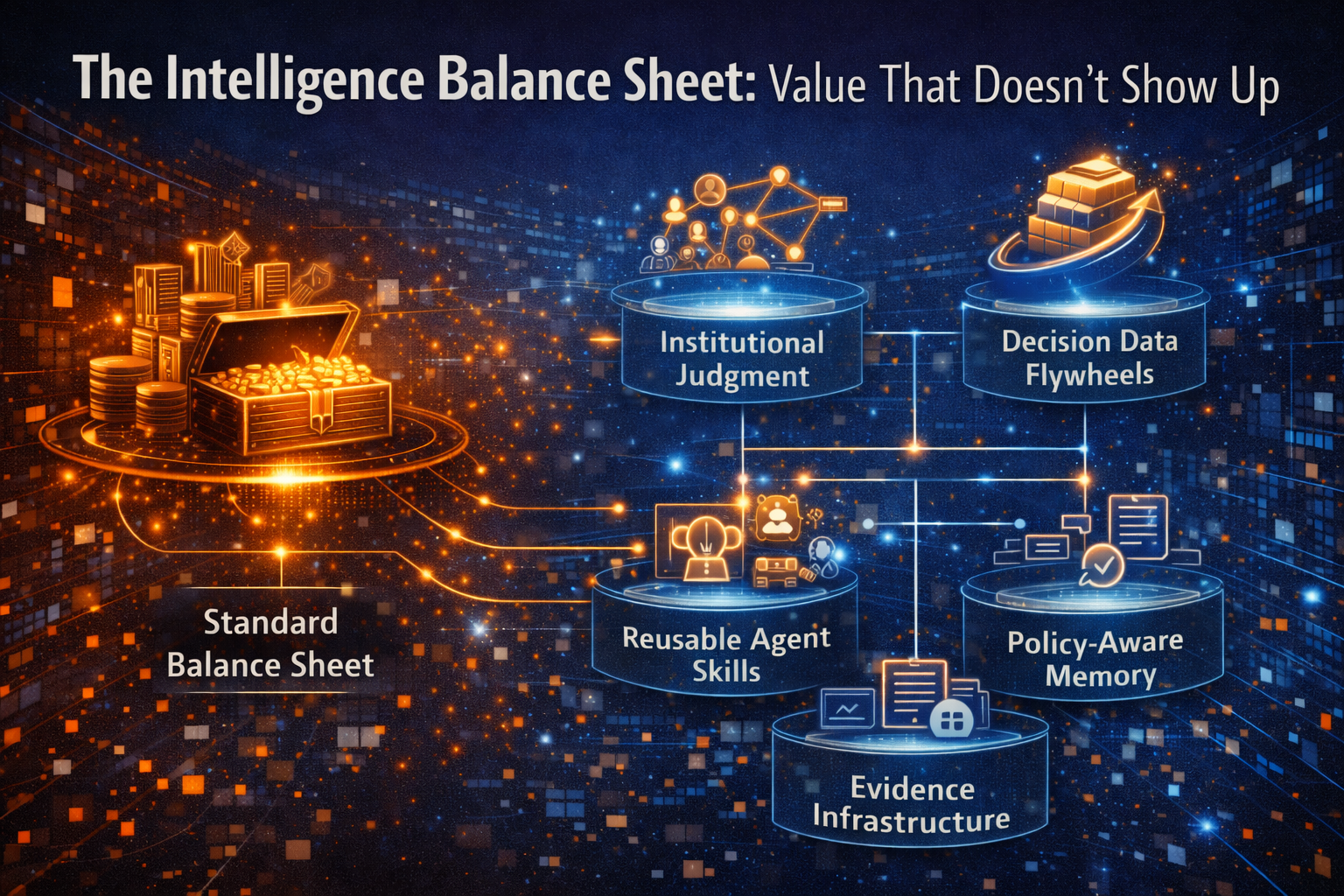
The Intelligence Balance Sheet: Value That Doesn’t Show Up
A major reason boards underestimate this shift is that intelligence assets don’t look like traditional assets.
Intelligence Companies accumulate:
- institutional judgment (encoded decision rules and playbooks)
- decision data flywheels (data that improves decisions over time)
- reusable agent skills (capabilities that can be redeployed)
- policy-aware memory (what the firm has learned and can defend)
- evidence infrastructure (trust at scale)
This is why the Intelligence Company is a capital allocation story, not an IT story.
Related canon you can read:
- The AI Dividend: https://www.raktimsingh.com/enterprise-ai-roi/
- The Future Belongs to Decision-Intelligent Institutions: https://www.raktimsingh.com/the-future-belongs-to-decision-intelligent-institutions/
- Who Owns Enterprise AI?: https://www.raktimsingh.com/who-owns-enterprise-ai-roles-accountability-decision-rights/
- The Intelligence Reuse Index: https://www.raktimsingh.com/intelligence-reuse-index-enterprise-ai-fabric/
The New Roles: Managing Machines That Decide
In the industrial era, managers supervised labor.
In the software era, managers supervised delivery and execution.
In the Intelligence Company, a new layer emerges: leaders who manage autonomous decision systems.
You will see:
- Agent managers (monitor performance, drift, escalation, safety)
- Decision product owners (own decision quality as a product)
- Policy engineers (translate governance into constraints)
- Evidence stewards (ensure auditability and defensibility)
- Autonomy reliability teams (safe degradation, reversibility, incident handling)
This is not bureaucracy. It is how decision quality becomes scalable.
What Boards Must Ask
Key questions leaders should ask in meetings.
Here are five:
- Are we building AI features—or becoming an Intelligence Company?
- Which decisions define our profit pool—and who owns their quality?
- Where is autonomy allowed, and where must humans remain the authority?
- Do we have an Evidence Layer that can prove what our AI did and why?
- Which capabilities are differentiating judgment—and must stay inside the firm boundary?
These questions force strategy, not experimentation.

A Global Lens: Why This Matters in the US, EU, India, and the Global South
The Intelligence Company will not look identical everywhere:
- In the EU, evidence and compliance expectations are higher; auditability becomes a competitive advantage.
- In the US, speed and market creation are dominant; autonomy will expand aggressively—then be forced to mature.
- In India and much of the Global South, scale and inclusion matter; Intelligence Companies will win by delivering high-quality decisions at low cost across massive populations and fragmented contexts.
The winners will be those who can adapt intent, evidence, and policy constraints across jurisdictions—without fragmenting the operating model.
Conclusion: The Next Corporate Form
The Intelligence Company is the next corporate form.
It emerges when:
- intelligence is cheap
- action is automated
- accountability must be provable
- and decision quality becomes the primary lever of value
The firms that understand this early will not just “adopt AI.”
They will redesign themselves—and help shape the Third-Order AI Economy, where new business models reorganize markets around scalable judgment.
If your board wants a durable advantage in the AI era, the mandate is simple:
Build the company that can scale judgment—safely, continuously, and defensibly.
Because the AI era won’t reward the company with the most models.
It will reward the company with the most governable judgment.
Glossary
Intelligence Company: A firm designed to scale governed decision quality using AI that can act and produce evidence.
Intelligence-Native Enterprise: An organization where intelligence is embedded into decision-making, governance, and execution—systemically.
Intent Layer: Goals, constraints, and decision principles leadership defines.
Decision Layer: The reasoning system (models/agents + policy checks) that produces decisions.
Execution Layer: Tools and workflows where actions occur, with controlled access.
Evidence Layer: The trace/audit/learning system that proves what AI did and why.
Programmable Authority: Delegation encoded as policies, constraints, escalation rules, and permissions.
Decision Quality: Consistency, correctness, speed, compliance, and resilience of decisions over time.
Decision Flywheel: Decisions generate data; data improves decisions; improved decisions generate more value.
Bounded Autonomy: AI can act within strict limits, with reversibility and escalation.
Third-Order AI Economy: An economy where scalable, accountable judgment becomes a primary engine of market formation and competitive advantage.
FAQs
1) Is the Intelligence Company only for tech companies?
No. Banks, telecom, manufacturing, healthcare, retail, logistics, and governments will all build intelligence operating layers because their value depends on high-frequency decisions under uncertainty.
2) Isn’t this just “digital transformation” again?
Digital transformation scaled execution. The Intelligence Company scales cognition: decisions, authority, accountability, and learning.
3) Won’t autonomy increase risk?
Yes—unless autonomy is bounded. That’s why evidence, reversibility, escalation, and accountability must be designed in, not added later. (World Economic Forum)
4) What’s the first practical step to become an Intelligence Company?
Pick 3–5 decisions that drive your profit pool (pricing, risk, retention, procurement, fraud). Build an evidence-backed decision system around them before expanding autonomy.
5) How do we measure progress without complicated models?
Track decision latency, error rates, escalation health, variance reduction, policy compliance, and outcome stability over time.
References and Further Reading
- Ronald Coase, The Nature of the Firm (1937) — the foundational transaction-cost framing of why firms exist. (Wiley Online Library)
- World Economic Forum, AI Agents in Action: Foundations for Evaluation and Governance — why agent oversight and governance maturity matter as agents move into execution. (World Economic Forum)
- Harvard Business Review, To Thrive in the AI Era, Companies Need Agent Managers — the emerging operating requirement to manage agent performance, safety, and alignment. (Harvard Business Review)
- NBER, The Coasean Singularity? Demand, Supply, and Market… — how AI agents can reduce transaction costs and reshape markets/participation. (NBER)
Enterprise AI Operating Model
Enterprise AI scale requires four interlocking planes:
Read about Enterprise AI Operating Model The Enterprise AI Operating Model: How organizations design, govern, and scale intelligence safely – Raktim Singh
- Read about Enterprise Control Tower The Enterprise AI Control Tower: Why Services-as-Software Is the Only Way to Run Autonomous AI at Scale – Raktim Singh
- Read about Decision Clarity The Shortest Path to Scalable Enterprise AI Autonomy Is Decision Clarity – Raktim Singh
- Read about The Enterprise AI Runbook Crisis The Enterprise AI Runbook Crisis: Why Model Churn Is Breaking Production AI—and What CIOs Must Fix in the Next 12 Months – Raktim Singh
- Read about Enterprise AI Economics Enterprise AI Economics & Cost Governance: Why Every AI Estate Needs an Economic Control Plane – Raktim Singh
Read about Who Owns Enterprise AI Who Owns Enterprise AI? Roles, Accountability, and Decision Rights in 2026 – Raktim Singh
Read about The Intelligence Reuse Index The Intelligence Reuse Index: Why Enterprise AI Advantage Has Shifted from Models to Reuse – Raktim Singh
Institutional Perspectives on Enterprise AI
Many of the structural ideas discussed here — intelligence-native operating models, control planes, decision integrity, and accountable autonomy — have also been explored in my institutional perspectives published via Infosys’ Emerging Technology Solutions platform.
For readers seeking deeper operational detail, I have written extensively on:
- What Makes an Enterprise Intelligence-Native? The Blueprint for Third-Order AI Advantage
https://blogs.infosys.com/emerging-technology-solutions/artificial-intelligence/what-is-enterprise-ai-the-operating-model-for-compounding-institutional-intelligence.html - Why “AI in the Enterprise” Is Not Enterprise AI: The Operating Model Difference Most Organizations Miss
https://blogs.infosys.com/emerging-technology-solutions/artificial-intelligence/why-ai-in-the-enterprise-is-not-enterprise-ai-the-operating-model-difference-that-most-organizations-miss.html - The Enterprise AI Control Plane: Governing Autonomy at Scale
https://blogs.infosys.com/emerging-technology-solutions/artificial-intelligence/the-enterprise-ai-control-plane-governing-autonomy-at-scale.html - Enterprise AI Ownership Framework: Who Is Accountable, Who Decides, and Who Stops AI in Production
https://blogs.infosys.com/emerging-technology-solutions/artificial-intelligence/enterprise-ai-ownership-framework-who-is-accountable-who-decides-and-who-stops-ai-in-production.html - Decision Integrity: Why Model Accuracy Is Not Enough in Enterprise AI
https://blogs.infosys.com/emerging-technology-solutions/artificial-intelligence/decision-integrity-why-model-accuracy-is-not-enough-in-enterprise-ai.html - Agent Incident Response Playbook: Operating Autonomous AI Systems Safely at Enterprise Scale
https://blogs.infosys.com/emerging-technology-solutions/artificial-intelligence/agent-incident-response-playbook-operating-autonomous-ai-systems-safely-at-enterprise-scale.html - The Economics of Enterprise AI: Designing Cost, Control, and Value as One System
https://blogs.infosys.com/emerging-technology-solutions/artificial-intelligence/the-economics-of-enterprise-ai-designing-cost-control-and-value-as-one-system.html
Together, these perspectives outline a unified view: Enterprise AI is not a collection of tools. It is a governed operating system for institutional intelligence — where economics, accountability, control, and decision integrity function as a coherent architecture.
Related Enterprise AI Reading
Many organizations are discovering that enterprise AI success depends on far more than model accuracy. Common challenges include AI project failure, weak AI governance, poor AI agent control, unclear enterprise AI ROI, and the inability to translate AI insights into business outcomes. For readers exploring topics such as why enterprise AI projects fail, how AI creates business value, AI agent governance frameworks, agentic AI systems, enterprise AI architecture, AI risk management, CIO AI strategy, and enterprise AI operating models, the following articles provide a deeper perspective:
-
- Why Enterprise AI Projects Fail Even When the Models Work
- Why AI Creates Value in One Company and Fails in Another
- AI Agent Governance: How CIOs Should Decide What AI Agents Are Allowed to Do
- Why AI Agents Fail in Enterprises
- Why Enterprise AI Projects Fail Even When the Models Work: The Missing Architecture Behind AI Governance and Agentic Systems
- raktimsingh.com/hy-enterprise-
ai-projects-fail-digital- anthropology-ai-governance/
Together, these articles examine the critical relationship between enterprise data, AI decision-making, AI governance, AI agents, execution systems, accountability mechanisms, and measurable business value, helping CIOs, CTOs, architects, and business leaders move from AI experimentation to enterprise-scale impact.



Raktim Singh is an AI and deep-tech strategist, TEDx speaker, and author focused on helping enterprises navigate the next era of intelligent systems. With experience spanning AI, fintech, quantum computing, and digital transformation, he simplifies complex technology for leaders and builds frameworks that drive responsible, scalable adoption.