

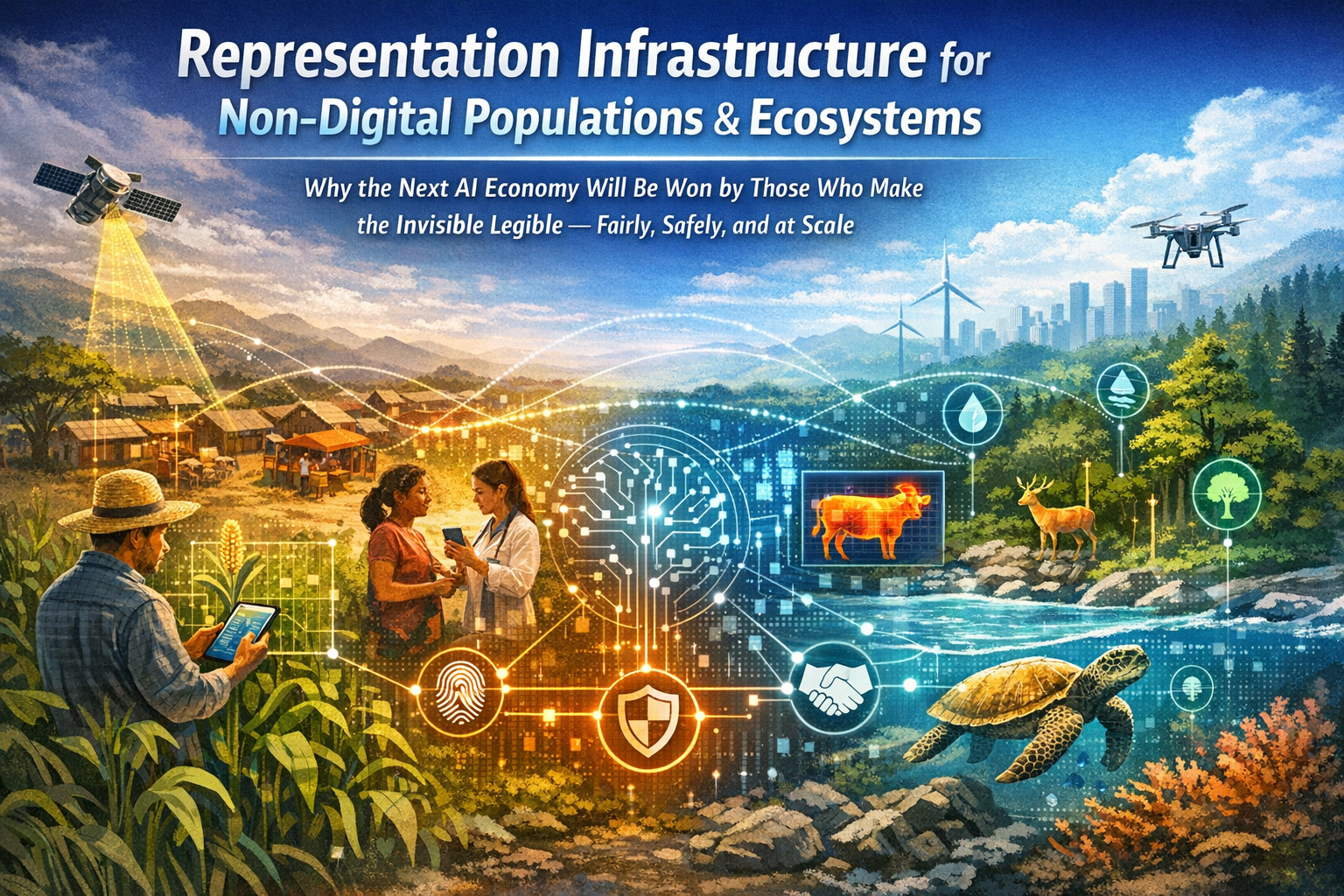
Representation Infrastructure
Artificial intelligence is often described as a revolution in intelligence. But intelligence alone does not change systems. What matters is what intelligence can see, measure, and act upon.
Today’s AI systems operate almost entirely on digitally legible reality—structured data, digital transactions, online behaviors, and machine-generated signals. Yet the majority of the world’s economic activity, environmental systems, and human livelihoods still operate outside this digital visibility.
Farmers managing soil health, informal workers navigating local markets, small producers operating in fragmented supply chains, and ecosystems evolving beyond sensor coverage all exist in what we might call the non-digital world.
For artificial intelligence, this world is largely invisible.
And what AI cannot see, it cannot serve.
This is why the next frontier of the AI economy is not simply building better models. It is building representation infrastructure: the systems that translate real-world signals into machine-legible forms so intelligent systems can understand, support, and govern the full complexity of human and ecological activity.
In the coming decade, the institutions that build this infrastructure will shape not only the future of artificial intelligence—but the future of economic inclusion, environmental stewardship, and digital governance itself.
The Core Constraint of Artificial Intelligence
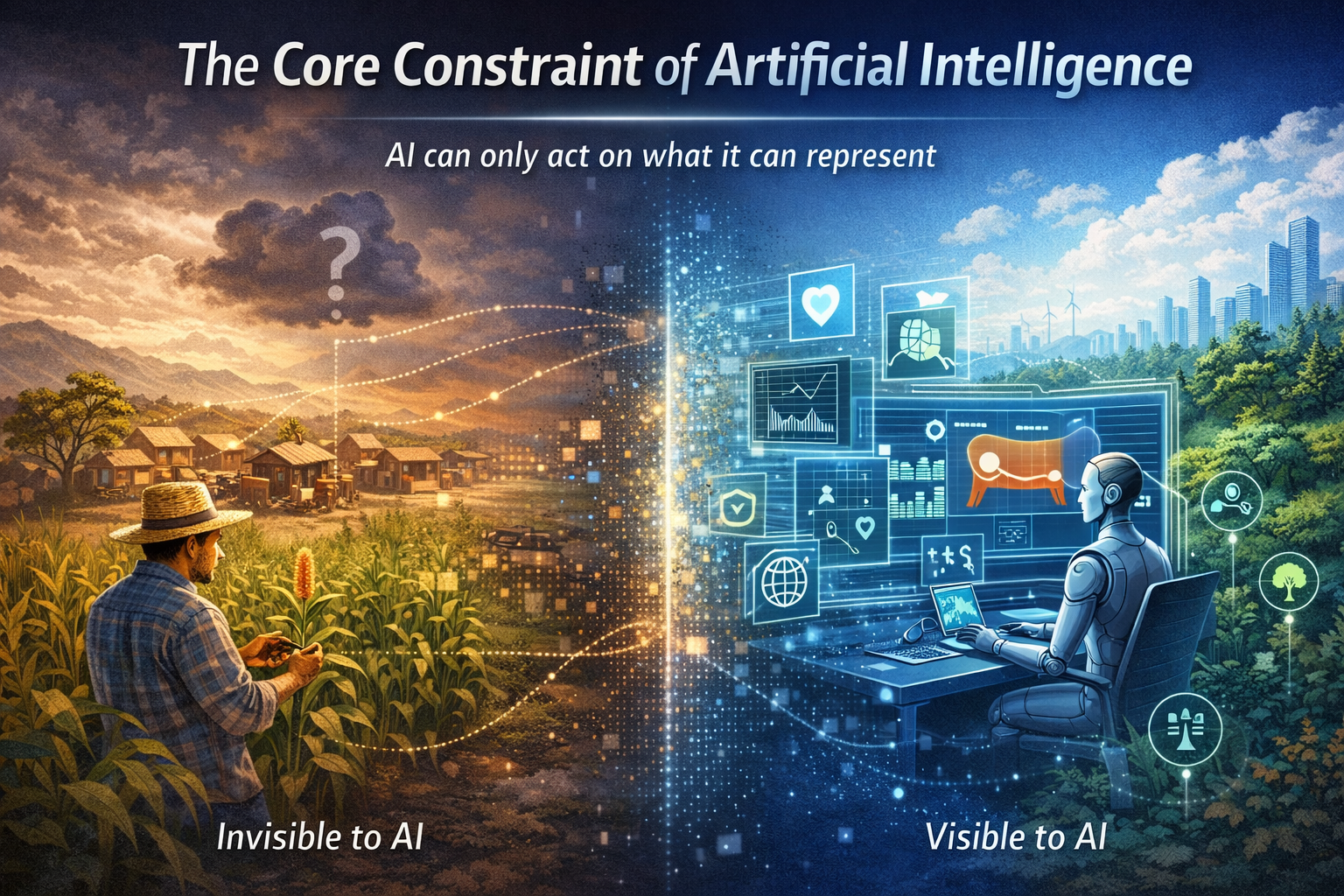
Artificial intelligence can only act on what it can represent.
Every AI system—from credit-risk models to climate simulations—depends on structured signals. If a need, risk, or activity does not produce machine-readable signals, it remains invisible to decision systems.
And in an AI-driven economy, invisibility has consequences.
Invisible systems tend to be:
- under-served
- under-financed
- under-protected
- or simply ignored
This is not a philosophical claim. It is an engineering reality.
AI systems optimize within the boundaries of the data they can see. When signals are missing, decisions default to approximations, averages, or exclusion.
This is why the defining infrastructure of the AI decade will not simply be better models.
It will be better representation.
The institutions that succeed in the next wave of AI will be those that build the infrastructure capable of converting real-world activity—people, operations, ecosystems—into trusted, consented, machine-readable signals.
Definition: Representation Infrastructure
Representation Infrastructure refers to the technological, institutional, and governance systems that convert real-world human, economic, and ecological activity into machine-readable signals so artificial intelligence systems can observe, understand, and act on them.
It enables AI systems to include:
-
non-digital populations
-
informal economies
-
physical ecosystems
-
unstructured real-world activity
Without representation infrastructure, large portions of the world remain invisible to intelligent systems.
Why Representation Is the Real Bottleneck of the AI Economy
In many discussions about artificial intelligence, the focus remains on:
- model size
- training data scale
- compute power
- prompt engineering
But as AI capabilities mature, a deeper constraint becomes visible.
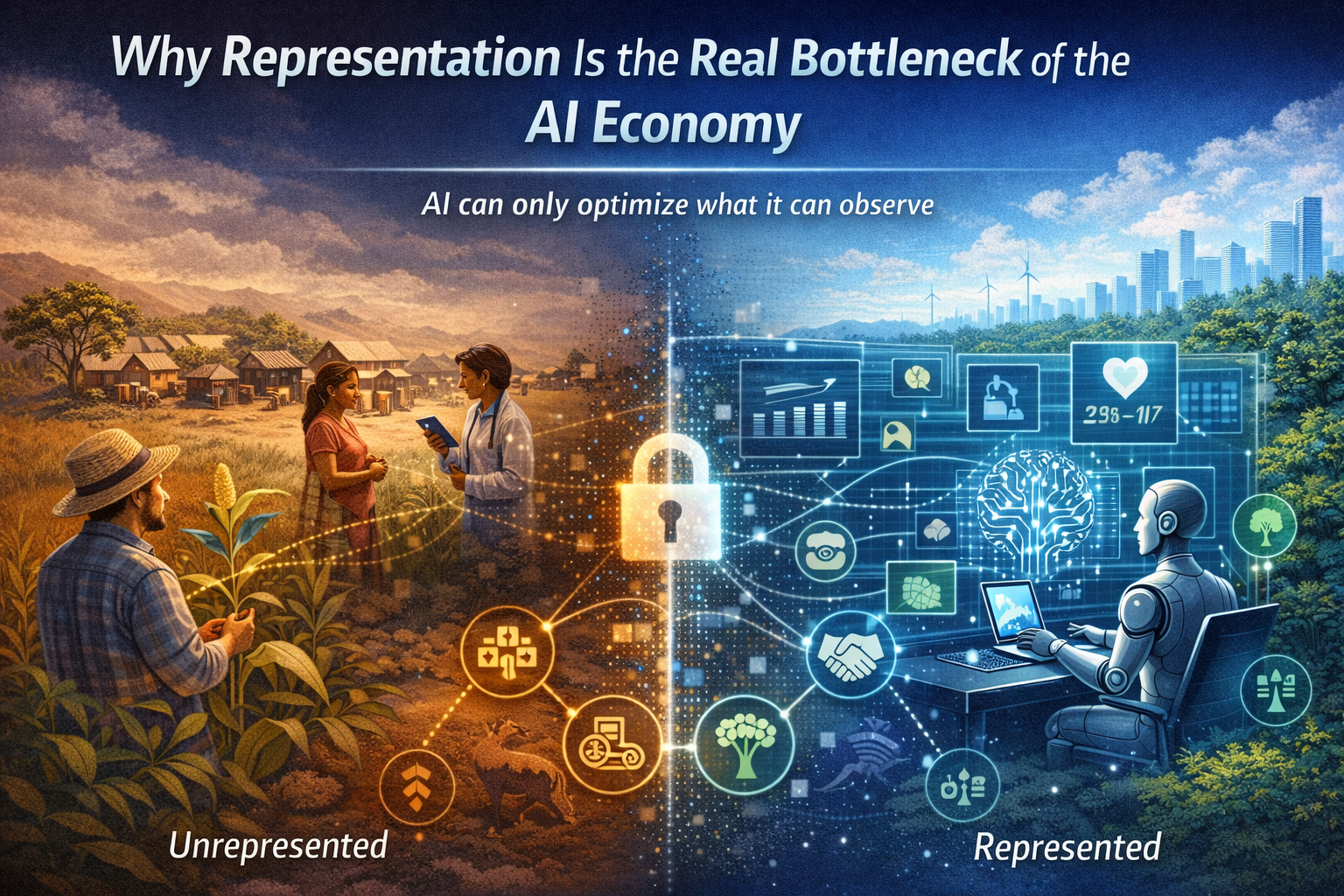
AI systems cannot optimize what they cannot observe.
This creates a structural problem for vast segments of the global economy.
Consider the scale of systems that remain poorly represented in machine-readable form:
- small farmers
- informal businesses
- local supply chains
- physical infrastructure
- biodiversity systems
- oceans and water systems
- livestock health
- soil ecosystems
These systems generate signals constantly. But those signals rarely exist in formats decision systems can reliably interpret.
In other words, they are economically active but computationally silent.
This idea connects closely to what I previously described as the Silent Systems Doctrine, where large portions of real-world value remain outside the decision space of intelligent systems.
Representation infrastructure is the mechanism that brings those silent systems into view.
Representation Infrastructure Is Not Digitization
Many initiatives frame the problem as “digitization.”
That framing is incomplete.
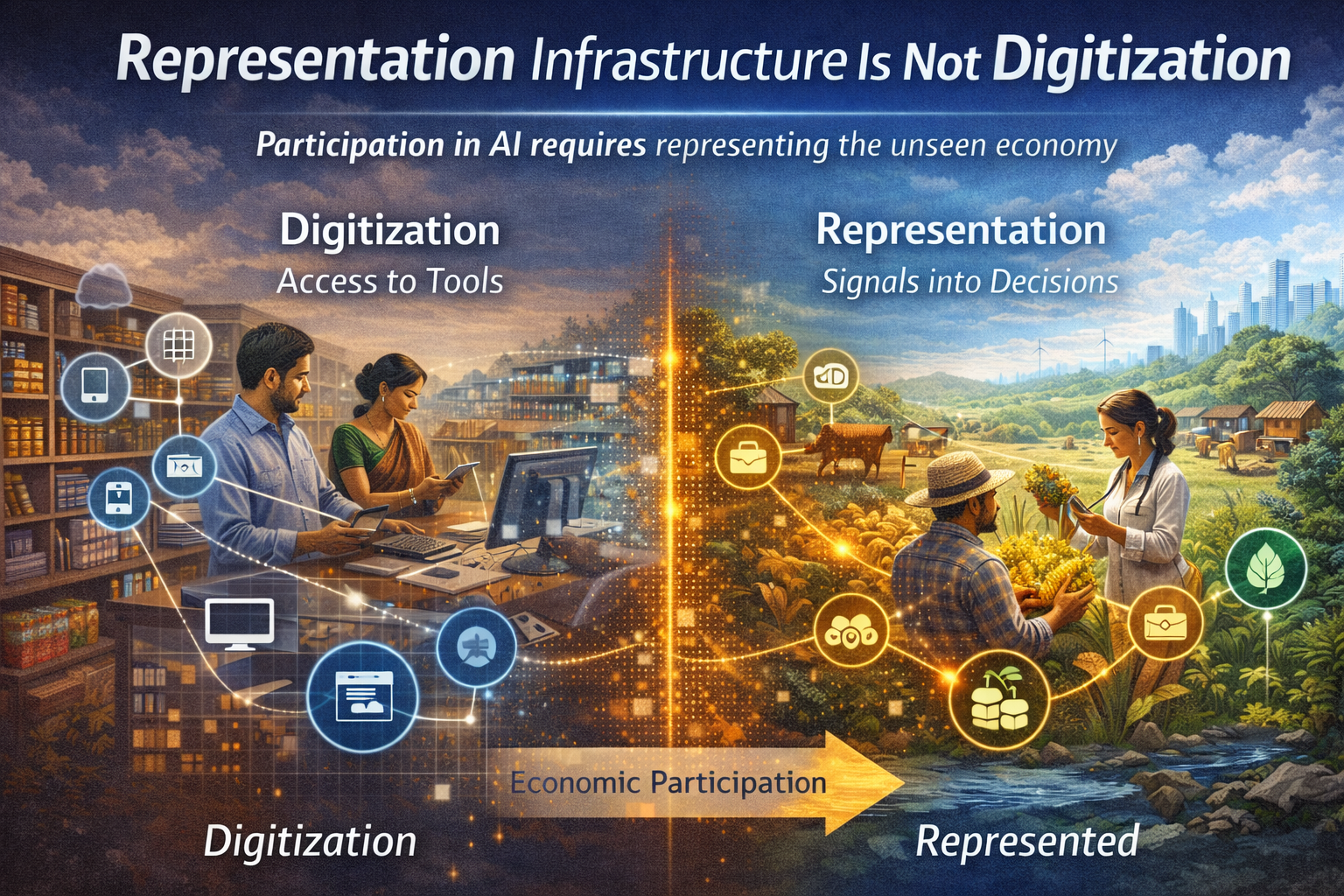
Digitization is about collecting data.
Representation infrastructure is about economic participation in the AI era.
To understand the difference, consider how participation evolved across technological eras.
Industrial Era
Participation required access to labor markets and capital.
Internet Era
Participation required digital identity, payments, and connectivity.
AI Era
Participation increasingly requires representation inside decision systems.
If individuals, organizations, or ecosystems cannot be represented inside AI-driven systems, they cannot fully participate in the economic opportunities those systems create.
This is why representation infrastructure is not a technical project.
It is an economic architecture question.
And increasingly, a board-level strategic issue.
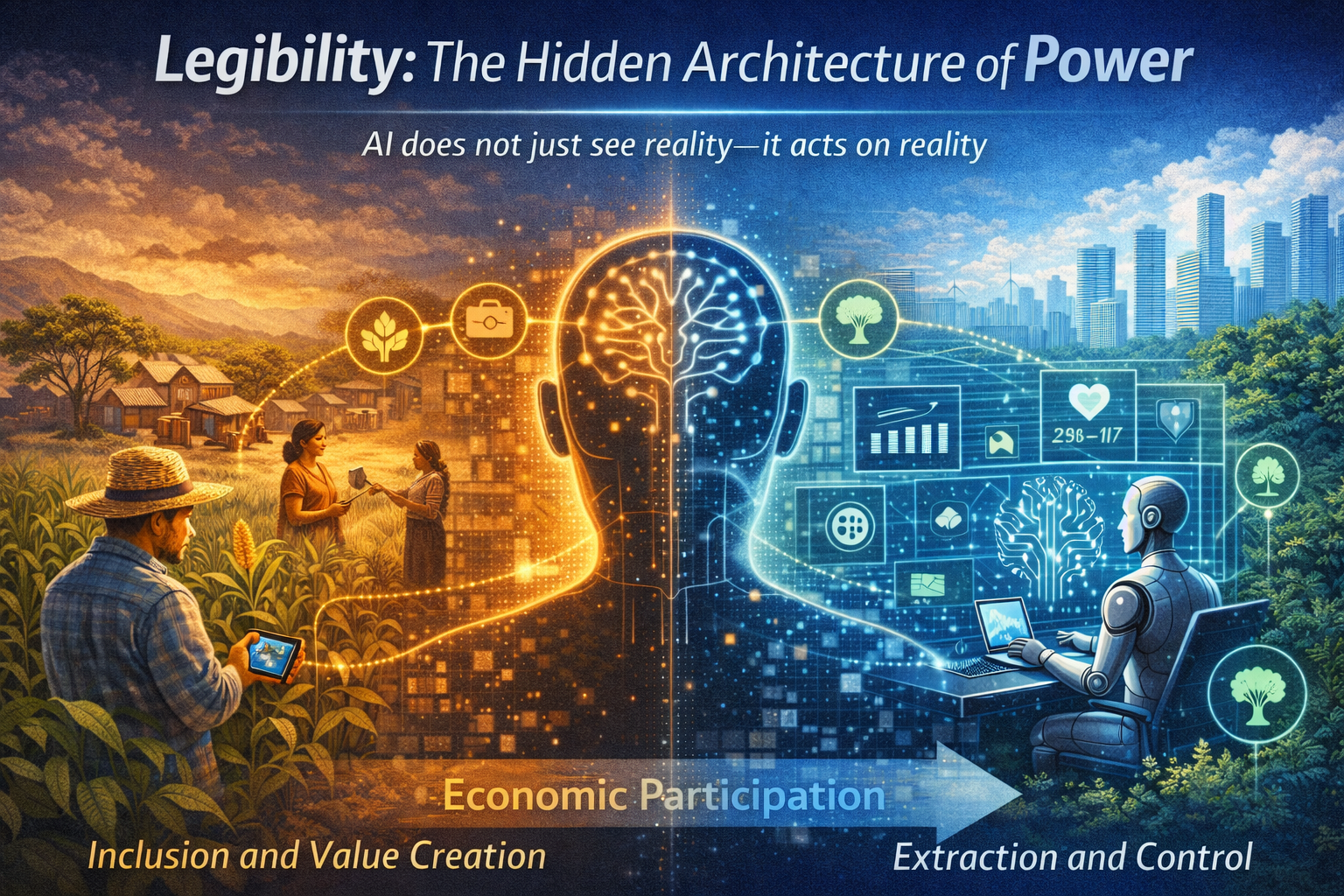
Legibility: The Hidden Architecture of Power
Political economist James C. Scott introduced the concept of legibility to describe how institutions simplify complex realities into measurable forms that can be governed.
Maps, census records, land registries, and standardized metrics are all tools of legibility.
Artificial intelligence dramatically intensifies this process.
AI systems do not merely observe reality.
They act upon it.
They determine:
- who receives credit
- how insurance is priced
- which risks are prioritized
- where resources are deployed
- which markets receive attention
In an AI-mediated economy, legibility becomes power.
But legibility has two faces.
Inclusion and Value Creation
When signals become legible, underserved populations can gain access to financial services, markets, and decision support.
Extraction and Control
When representation is designed poorly, the same signals can enable surveillance, exploitation, or asymmetric power.
Responsible representation infrastructure must address both realities simultaneously.
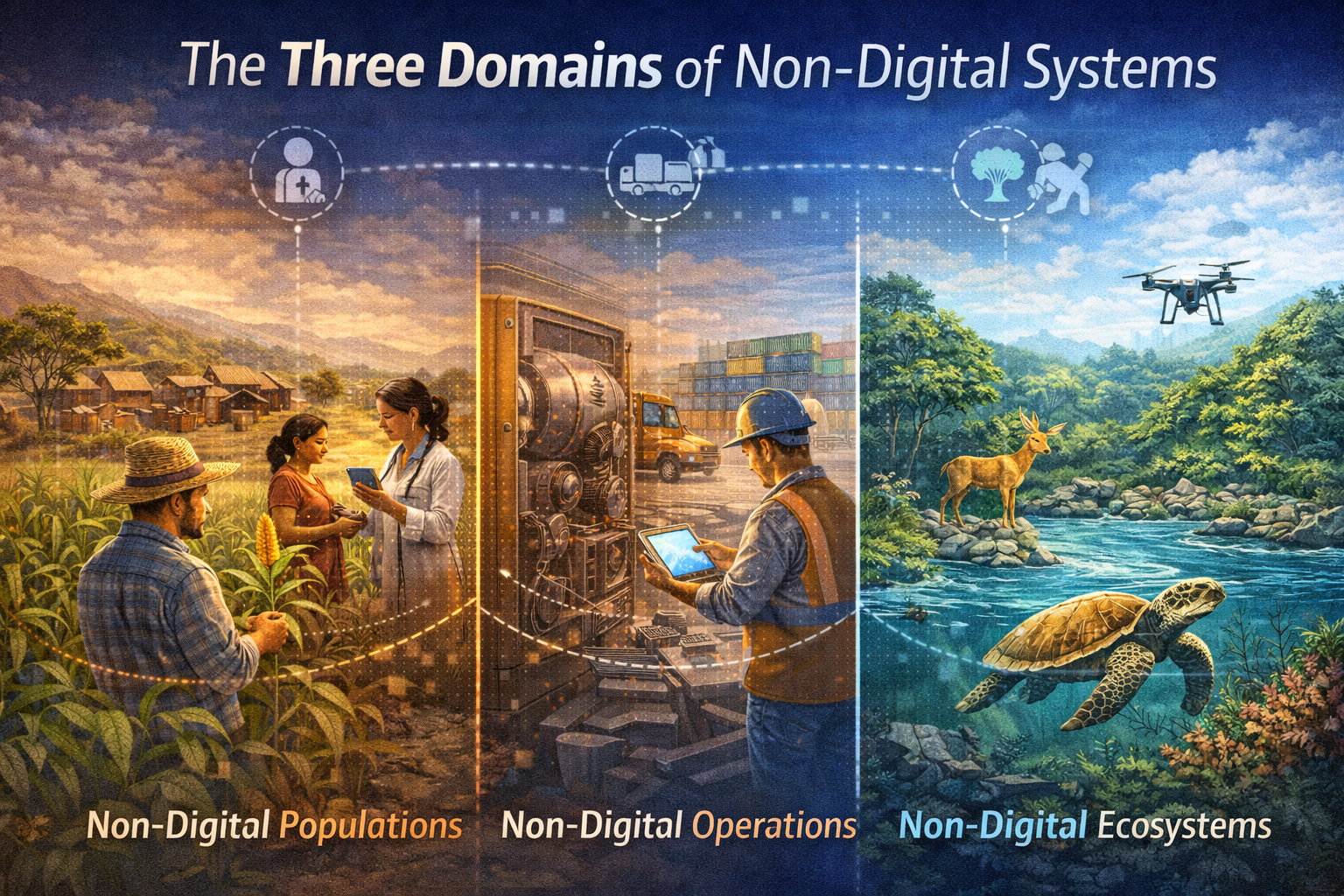
The Three Domains of Non-Digital Systems
The phrase “non-digital” often suggests people without access to technology.
But the challenge is broader and more structural.
A system can be technologically connected yet still be poorly represented.
Three major domains illustrate this gap.
-
Non-Digital Populations
These include individuals and communities operating in low-instrumentation environments.
Examples include:
- small farmers
- micro-entrepreneurs
- informal workers
- rural households
- local service providers
These populations produce valuable economic signals—purchases, harvest patterns, seasonal activity—but the signals are often fragmented or informal.
Without structured representation, these actors remain outside many modern financial and decision systems.
-
Non-Digital Operations
Within organizations, large portions of the physical economy remain partially observed.
These include:
- field service operations
- logistics networks
- manufacturing equipment
- retail inventory flows
- maintenance processes
Despite decades of digitization, real-world operations still generate incomplete and noisy data streams.
Representation infrastructure helps convert those signals into actionable intelligence.
-
Non-Digital Ecosystems
Perhaps the most overlooked domain is the natural world.
Animals, forests, rivers, soils, and marine ecosystems constantly generate signals about environmental health.
Yet these signals rarely appear in economic decision systems.
Emerging technologies—remote sensing, sensor networks, and AI-driven monitoring—are beginning to change this.
When ecosystems become representable, they can become:
- measurable
- monitorable
- protectable
But they can also become commodified.
This makes governance essential.
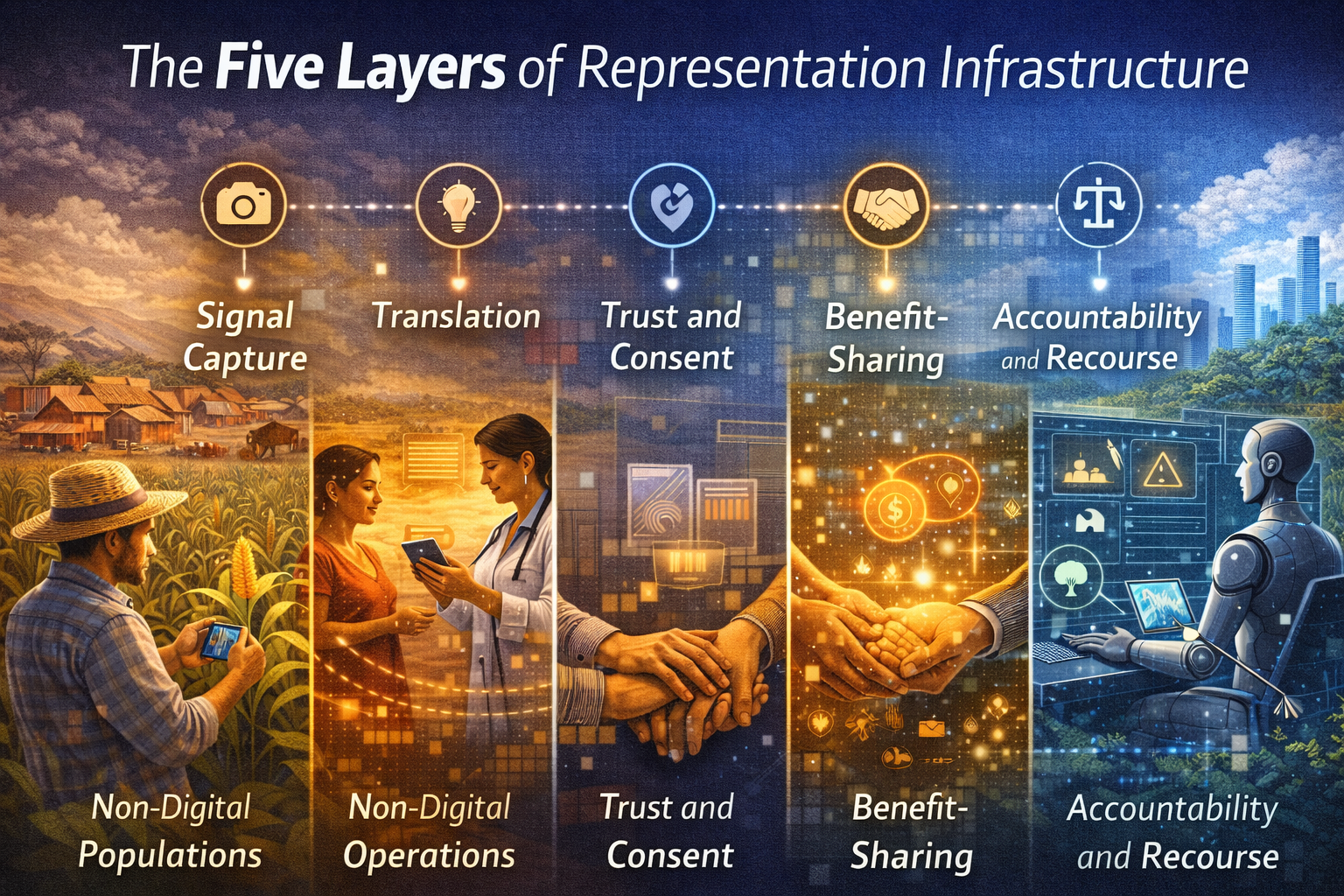
The Five Layers of Representation Infrastructure
Representation infrastructure is not a single technology.
It is a stack composed of multiple layers.
Layer 1 — Signal Capture
The first step is converting real-world activity into data signals.
Examples include:
- crop imagery captured via smartphones
- satellite data on vegetation health
- sales transactions in small retail stores
- motion sensors in logistics networks
- thermal imaging for livestock health
The goal is not perfect measurement.
The goal is consistent signal coverage.
Layer 2 — Translation
Raw data rarely produces useful decisions on its own.
Signals must be translated into meaningful insights.
Translation includes:
- language localization
- domain interpretation
- workflow integration
For example, a farmer does not need a spectral vegetation index.
They need a recommendation:
“Inspect the western field tomorrow morning.”
Layer 3 — Trust and Consent
Many representation systems fail because they ignore governance.
Participants must understand:
- what data is collected
- how it will be used
- who controls access
- what protections exist
Data stewardship models such as data trusts have emerged to address this issue by creating independent governance structures for shared data.
Without trust, representation infrastructure cannot scale sustainably.
Layer 4 — Benefit Sharing
Representation should not become extraction.
If populations or ecosystems generate signals that power AI systems, they must share in the resulting value.
Benefit sharing can take many forms:
- improved credit access
- lower insurance costs
- better productivity insights
- fairer market pricing
- verified sustainability premiums
When value flows back to the represented population, adoption becomes voluntary and durable.
Layer 5 — Accountability and Recourse
AI-driven decisions can affect livelihoods and ecosystems.
People need mechanisms to challenge or appeal those decisions.
Representation infrastructure must therefore include:
- explanation mechanisms
- dispute resolution
- rollback pathways
- human escalation channels
This layer creates legitimacy.
Without it, AI systems risk losing public trust.
Representation Infrastructure in Practice
Several real-world examples illustrate how these layers interact.
Agriculture: When Crops Become Legible
Fields cannot speak.
But satellite imagery, weather data, and smartphone photos can reveal early signs of crop stress.
When these signals are combined with AI analysis, farmers can receive:
- early disease detection
- fertilizer optimization advice
- climate risk alerts
At scale, these signals can also support crop insurance and agricultural financing.
Remote sensing technologies are already transforming agricultural monitoring worldwide.
Small Retail: The Invisible Economy
Millions of small shops generate valuable signals through daily transactions.
Yet those signals often remain trapped in notebooks or fragmented systems.
When structured properly, sales data can enable:
- inventory optimization
- dynamic supply chain replenishment
- small-ticket credit evaluation
The shop does not need to “learn AI.”
It simply needs to become representable.
Livestock Health Monitoring
Livestock health monitoring systems increasingly use computer vision and sensor networks to detect abnormal behavior patterns.
Early detection can:
- improve animal welfare
- reduce disease outbreaks
- improve farm productivity
But these systems also raise governance questions:
Who owns the monitoring data?
How is it used?
Representation must always be accompanied by stewardship.
Ecosystem Monitoring
Marine ecosystems generate signals through temperature changes, biodiversity patterns, and ocean chemistry.
Sensor networks and AI systems are beginning to monitor these signals at scale.
This enables improved climate resilience strategies.
However, it also introduces new economic incentives around ecosystem valuation.
Representation must therefore balance conservation and commercialization.
The Risk of Surveillance Legibility
The most powerful critique of representation infrastructure is that it could enable surveillance.
History shows that systems designed to measure populations can also control them.
Responsible representation infrastructure must therefore incorporate safeguards.
Key principles include:
- purpose limitation
- minimum necessary data
- independent stewardship
- transparent governance
- dispute mechanisms
Without these safeguards, representation becomes a tool of control rather than empowerment.
Authenticity Infrastructure: The New Requirement
As generative AI expands, the authenticity of signals becomes critical.
AI systems must be able to distinguish genuine signals from manipulated ones.
This is where authenticity infrastructure enters the picture.
Emerging standards such as C2PA (Content Authenticity Initiative) provide mechanisms to trace the origin and modification history of digital media.
Representation without authenticity introduces a new vulnerability.
Authenticity must therefore become part of the representation stack.
The Strategic Consequence
The first wave of AI advantage came from model capabilities.
The next wave will come from representation capabilities.
Organizations that build strong representation infrastructure gain several advantages:
- unique signal coverage
- continuous learning loops
- trusted decision workflows
- durable ecosystem relationships
In effect, representation infrastructure becomes a new form of platform advantage.
A Practical Blueprint for Building Representation Infrastructure
For organizations seeking to implement these ideas, a structured approach is essential.
Step 1 — Identify a Silent System
Start with one population, operational process, or ecosystem that currently lacks reliable representation.
Step 2 — Define the Decision
Choose one high-value decision the system will improve.
Step 3 — Design the Signal Set
Identify signals that are:
- affordable to capture
- reliable
- non-intrusive
Step 4 — Build the Translation Layer
Ensure outputs translate into clear, actionable recommendations.
Step 5 — Establish Governance
Implement consent mechanisms and stewardship structures.
Step 6 — Create Benefit Sharing
Define how value flows back to the represented population.
Step 7 — Monitor and Adapt
Representation systems must evolve as conditions change.
The Viral Insight
AI does not primarily reward intelligence.
It rewards legibility.
And the next frontier of legibility lies in the non-digital world—people, operations, and ecosystems that already generate value but cannot yet speak in machine-readable form.
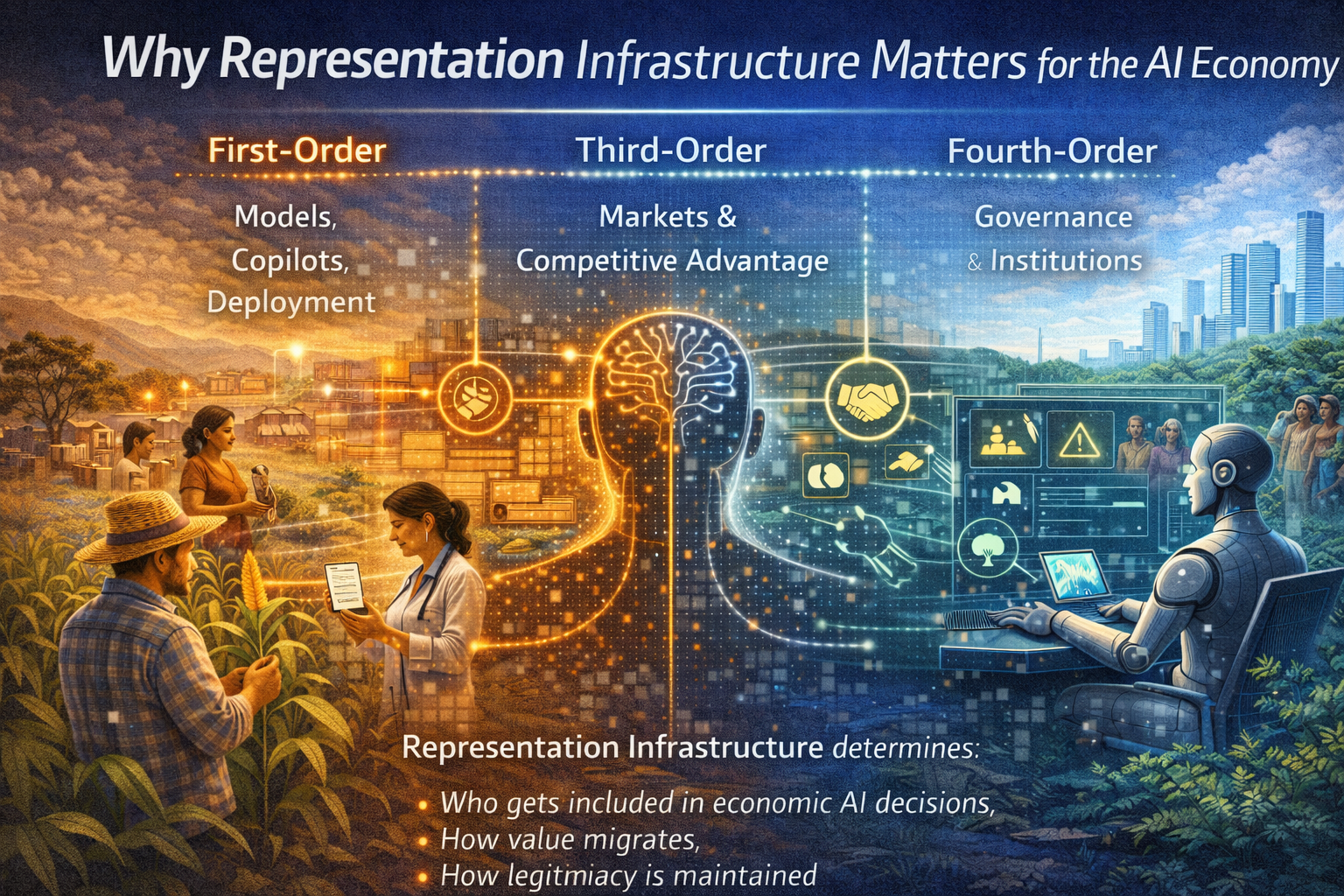
Why Representation Infrastructure Matters for the AI Economy
This concept connects directly with broader transformations in the AI landscape.
In the Third-Order AI Economy, AI reshapes markets and competitive advantage.
Representation infrastructure determines who gets included in those markets.
In the Fourth-Order AI Economy, institutions evolve to govern these systems responsibly.
Representation infrastructure becomes the bridge between enterprise AI systems and broader societal participation.
Conclusion: The Next Platform Advantage
The first wave of artificial intelligence made cognition abundant.
The next wave will determine who benefits from that abundance.
The decisive factor will not be model size.
It will be representation.
Organizations that build trusted, ethical representation infrastructure will unlock the next layer of AI value creation.
Those that ignore this challenge risk building intelligence systems that optimize only a narrow slice of reality.
In the AI economy, invisibility has a cost.
The next great task of enterprise and institutional AI is therefore not simply intelligence.
It is voice.
And voice, in the machine age, begins with representation.
Glossary
Representation Infrastructure
Systems that convert real-world signals into trusted, machine-readable inputs for AI decision systems.
Silent Systems
Populations, operations, or ecosystems that generate signals but cannot directly participate in machine-readable decision systems.
Legibility
The process of making complex reality measurable and administratively visible.
Data Trust
A governance structure that manages data on behalf of a group of beneficiaries.
Authenticity Infrastructure
Technologies that verify the origin and integrity of digital signals.
Recourse
The ability to challenge or reverse automated decisions.
Frequently Asked Questions (FAQ)
What is representation infrastructure in AI?
Representation infrastructure is the combination of technologies and governance mechanisms that convert real-world signals into trusted inputs for AI systems.
Why is representation important?
AI systems can only act on what they can observe. Without reliable signals, decision systems cannot optimize outcomes.
How is representation different from digitization?
Digitization collects data. Representation infrastructure enables meaningful participation in AI-driven decision systems.
What is the biggest risk of representation systems?
The risk is that representation becomes surveillance or extraction if governance safeguards are absent.
How can organizations build ethical representation systems?
By implementing trust, consent, stewardship, benefit sharing, and recourse mechanisms alongside technical signal capture.
References and Further Reading
The Intelligence-Native Enterprise Doctrine
This article is part of a larger strategic body of work that defines how AI is transforming the structure of markets, institutions, and competitive advantage. To explore the full doctrine, read the following foundational essays:
- The AI Decade Will Reward Synchronization, Not Adoption
Why enterprise AI strategy must shift from tools to operating models.
https://www.raktimsingh.com/the-ai-decade-will-reward-synchronization-not-adoption-why-enterprise-ai-strategy-must-shift-from-tools-to-operating-models/ - The Third-Order AI Economy
The category map boards must use to see the next Uber moment.
https://www.raktimsingh.com/third-order-ai-economy/ - The Intelligence Company
A new theory of the firm in the AI era — where decision quality becomes the scalable asset.
https://www.raktimsingh.com/intelligence-company-new-theory-firm-ai/ - The Judgment Economy
How AI is redefining industry structure — not just productivity.
https://www.raktimsingh.com/judgment-economy-ai-industry-structure/ - Digital Transformation 3.0
The rise of the intelligence-native enterprise.
https://www.raktimsingh.com/designing-intelligence-native-enterprise/ - Industry Structure in the AI Era
Why judgment economies will redefine competitive advantage.
https://www.raktimsingh.com/industry-structure-in-the-ai-era-why-judgment-economies-will-redefine-competitive-advantage/



Raktim Singh is an AI and deep-tech strategist, TEDx speaker, and author focused on helping enterprises navigate the next era of intelligent systems. With experience spanning AI, fintech, quantum computing, and digital transformation, he simplifies complex technology for leaders and builds frameworks that drive responsible, scalable adoption.