

Agentic Quality Engineering:
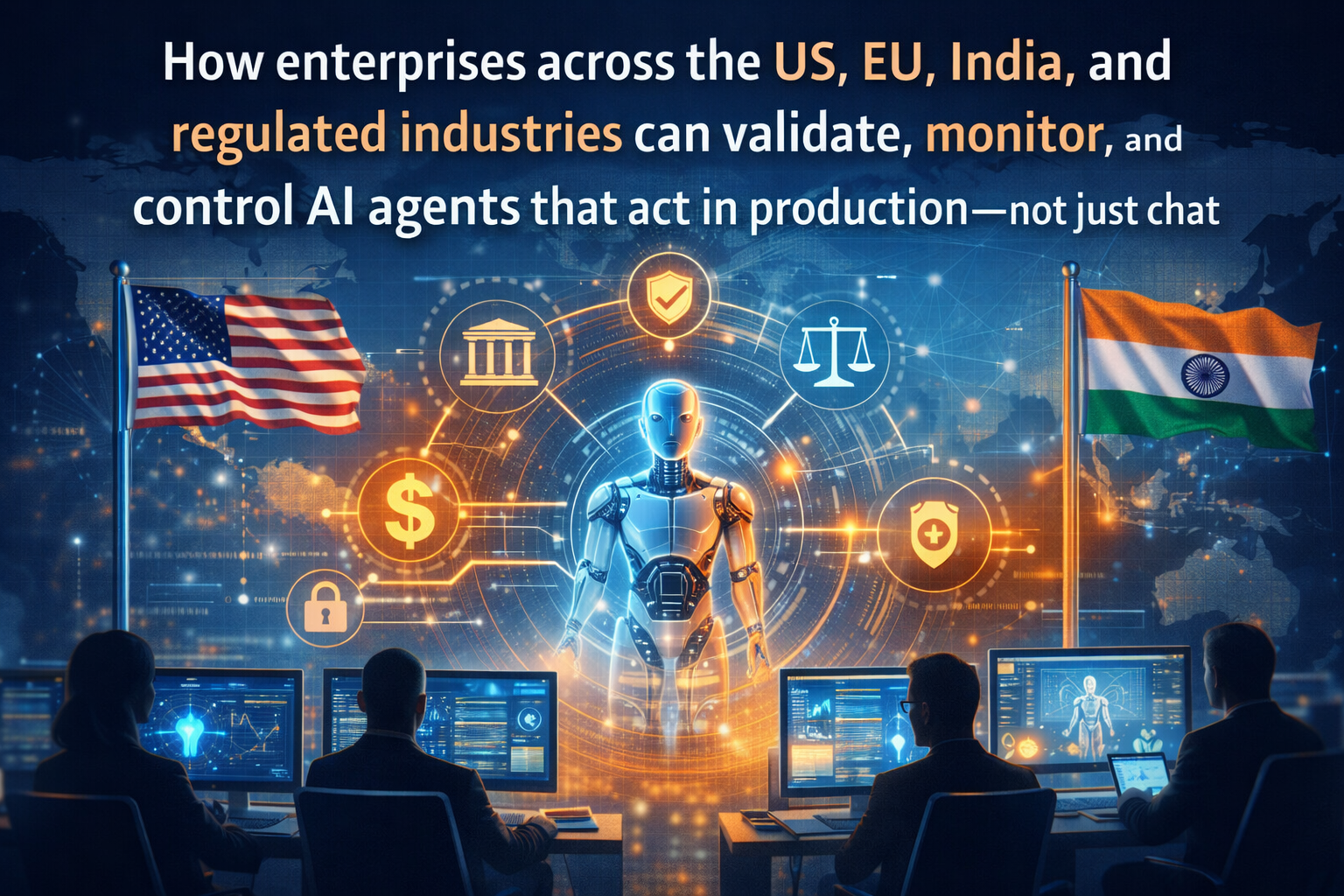
Agentic Quality Engineering (AQE) is the lifecycle discipline that tests, simulates, monitors, and audits AI agents that take actions in enterprise systems—so autonomy remains policy-aligned, reproducible, and stoppable in production. AQE operationalizes TEVV thinking and aligns with global governance expectations such as NIST AI RMF, ISO/IEC 42001, and EU-style risk management requirements. (NIST Publications)
Executive summary
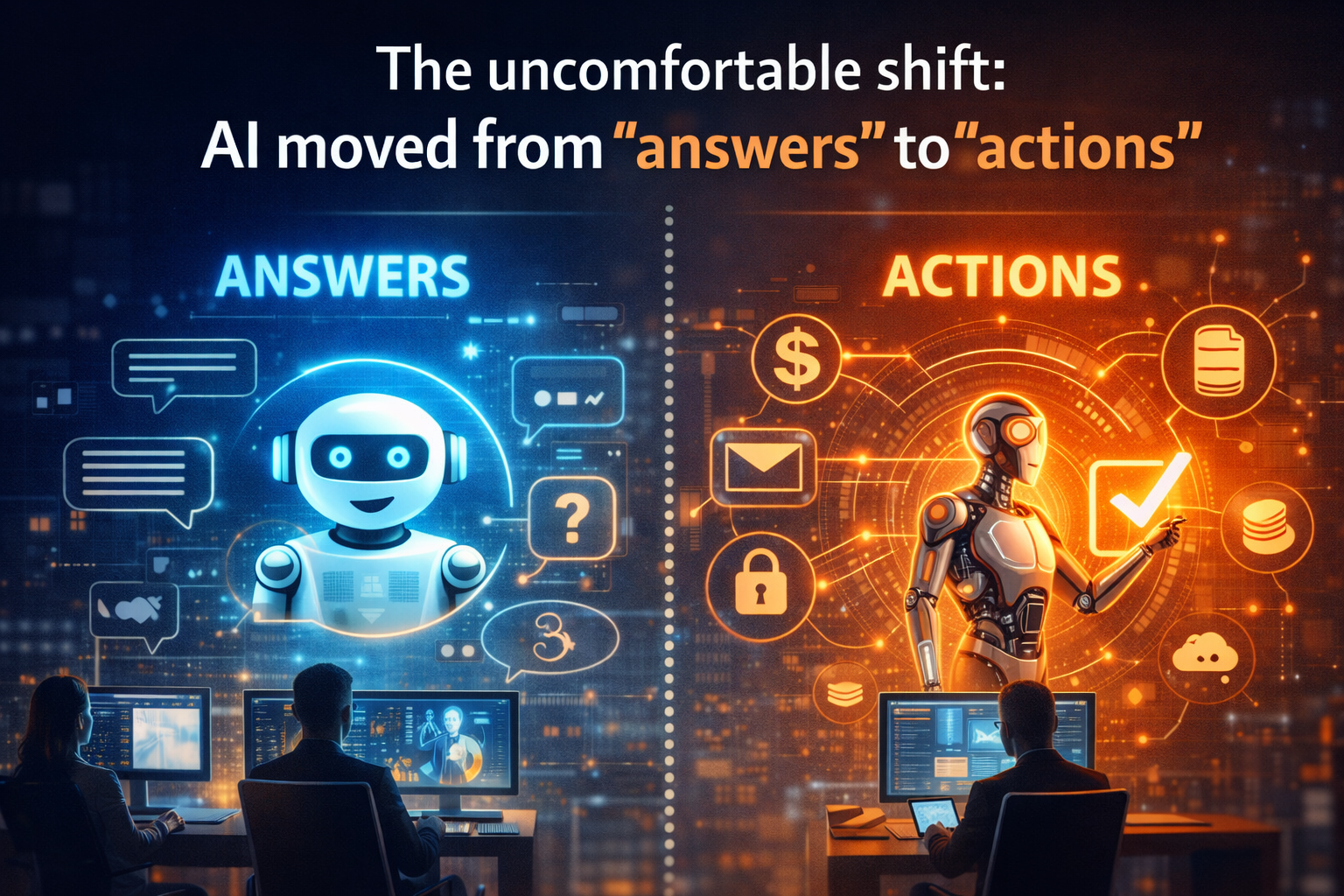
Enterprise AI has crossed a threshold: it is no longer limited to generating answers. It is increasingly taking actions—approving refunds, initiating workflows, updating systems, triggering notifications, and coordinating tools.
That shift changes what “quality” means.
When AI acts, quality is no longer a model metric. It becomes operational risk, regulatory exposure, and brand risk. This is why “testing AI” is rapidly becoming a board-level function: executives are accountable not just for whether AI is smart, but whether it is safe to run.
A new discipline is emerging for this era: Agentic Quality Engineering (AQE)—the practices, pipelines, controls, and audit mechanisms that make autonomous AI reliable, compliant, and governable in the real world.
Agentic Quality Engineering ensures that AI agents acting in production behave safely, remain auditable, and can be stopped instantly when risk rises. As AI shifts from answers to actions, testing becomes an executive responsibility—not just a technical one.
“Testing AI is no longer about accuracy. It’s about behavior under constraints.”
The uncomfortable shift: AI moved from “answers” to “actions”
For a while, enterprise AI quality discussions were dominated by familiar questions:
- “Is the answer accurate?”
- “Is the chatbot helpful?”
- “Did hallucinations go down after fine-tuning?”
Those questions made sense when AI lived inside a chat box.
But AI agents changed the game.
An agent is not just a content generator. It can:
- approve refunds,
- change a customer address,
- reset credentials,
- trigger payments,
- update a CRM,
- open and route helpdesk tickets,
- provision cloud resources,
- or coordinate multiple tools in a workflow.
When AI becomes an actor, quality stops being a “data science KPI” and becomes business risk.
That is precisely why leading governance frameworks emphasize Test, Evaluation, Verification, and Validation (TEVV) throughout the AI lifecycle—not only before launch. (NIST)
“If you can’t replay an agent decision, you don’t have governance—you have hope.”
Why classic QA breaks the moment AI can act
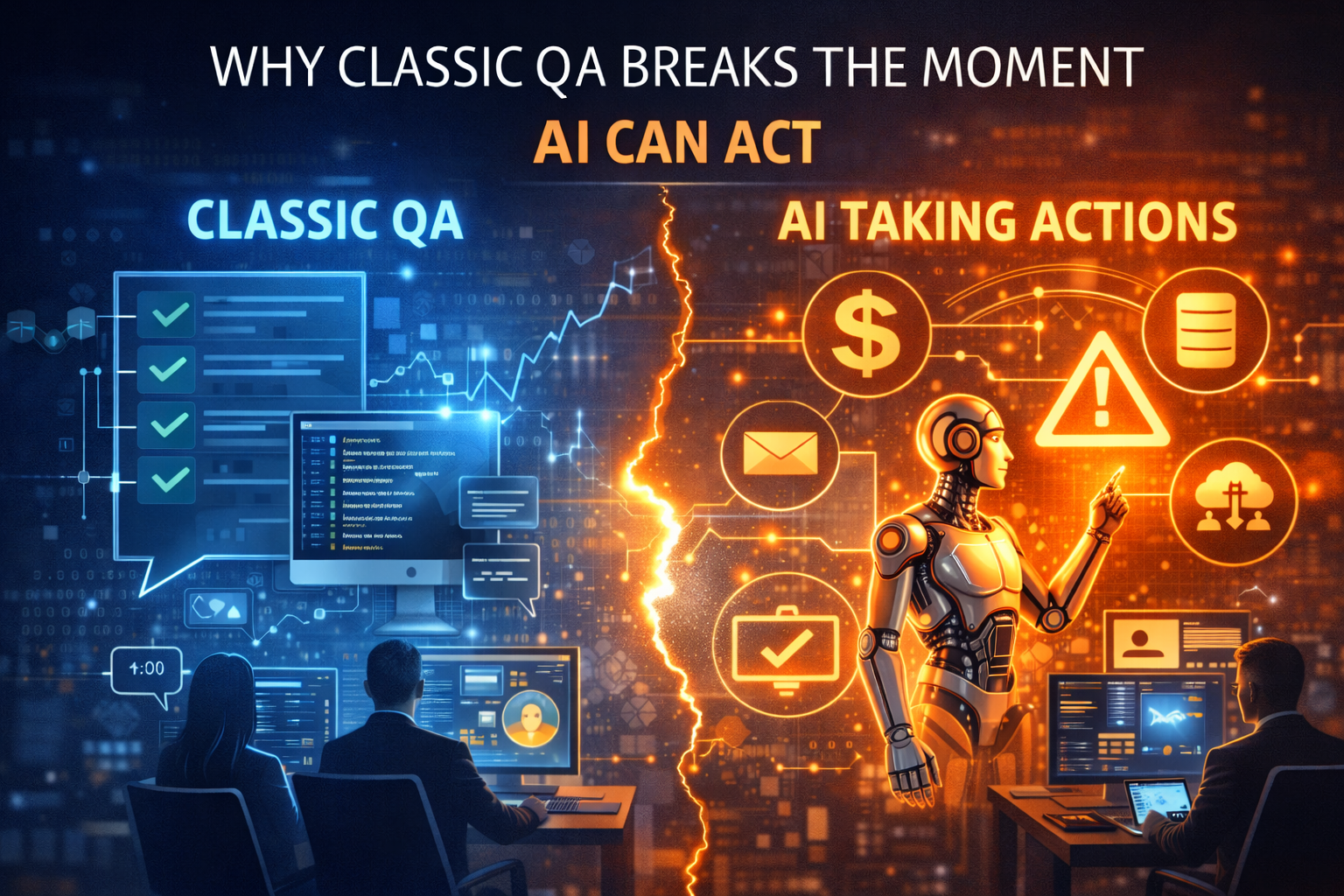
Traditional Quality Engineering was built for deterministic systems:
- Same input → same output
- Tests can be stable and repeatable
- “Coverage” can be improved by adding more test cases
Agentic systems violate those assumptions:
- Outputs are probabilistic (two runs can differ)
- Behavior depends on context (prompts, memory, retrieved docs, tool responses, system state)
- The agent can choose paths (plan → act → observe → adapt), which means failures can emerge from composition, not a single bug
So Agentic Quality Engineering is not “QA for LLMs.”
It is system-level assurance for autonomous behavior in real business environments.
Or in one sentence:
AQE is the function that turns “AI that works” into “AI we can run.”
A simple story: the agent that was “correct” and still caused an incident
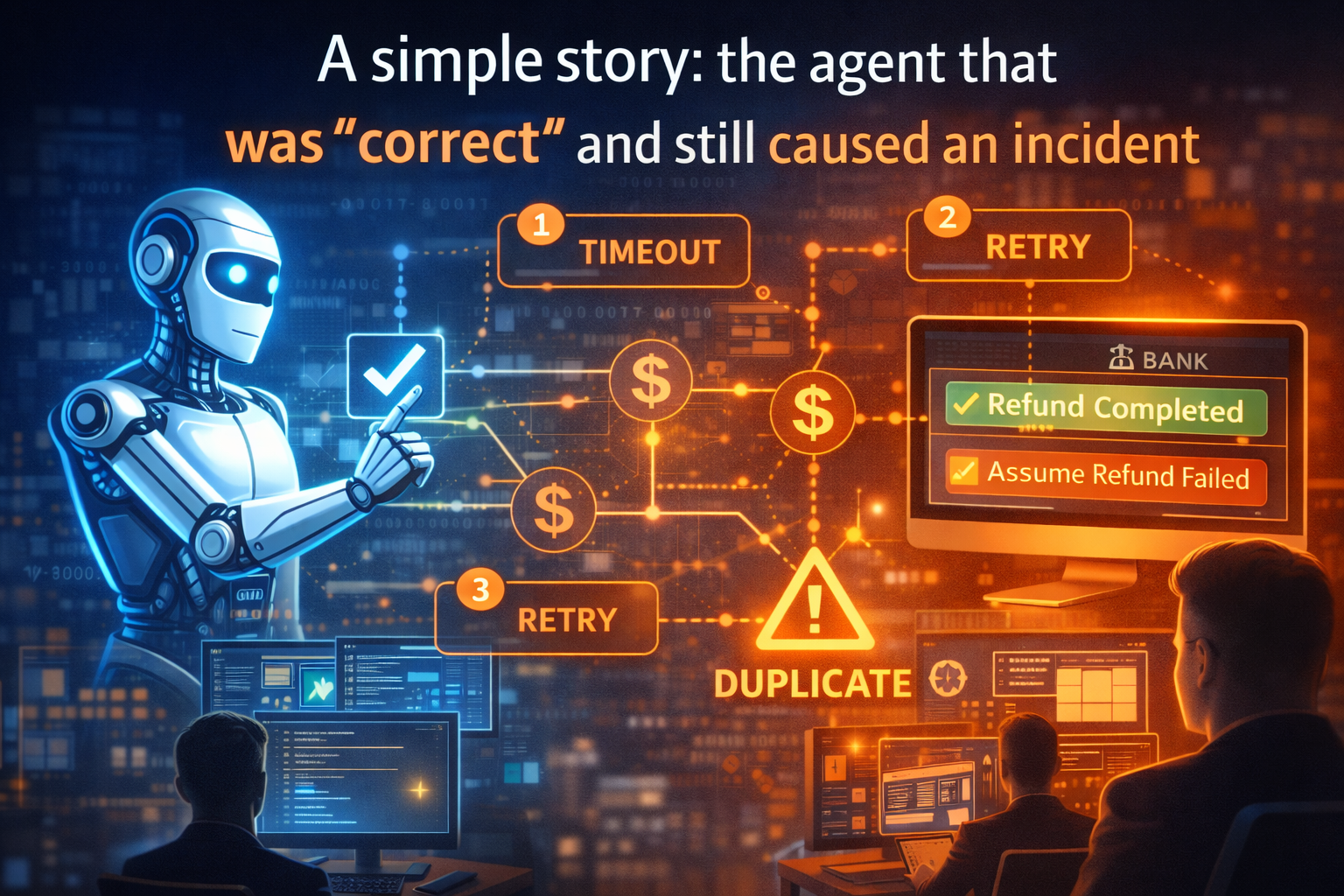
Imagine a bank deploys a “Refund Agent” for card disputes.
It reads a ticket, checks policy, and if criteria are met, triggers a refund workflow.
In testing, it performs well. Refund approvals match policy most of the time.
Then a production incident happens.
A customer complains publicly that they received two refunds.
Investigation reveals the sequence:
- the payment system returned a timeout
- the agent assumed the refund failed
- it retried
- the first request actually succeeded later
Was the agent’s “reasoning” wrong? Not necessarily.
Was the system safe? Clearly not.
AQE would have tested the whole behavior loop:
- idempotency expectations (same request should not double-execute)
- retry logic
- tool error handling
- rollback mechanisms
- and “proof” of what happened
This is the core idea:
Many agent failures are integration + operations failures disguised as intelligence problems.
- “Agents don’t fail like software. They fail like organizations.”
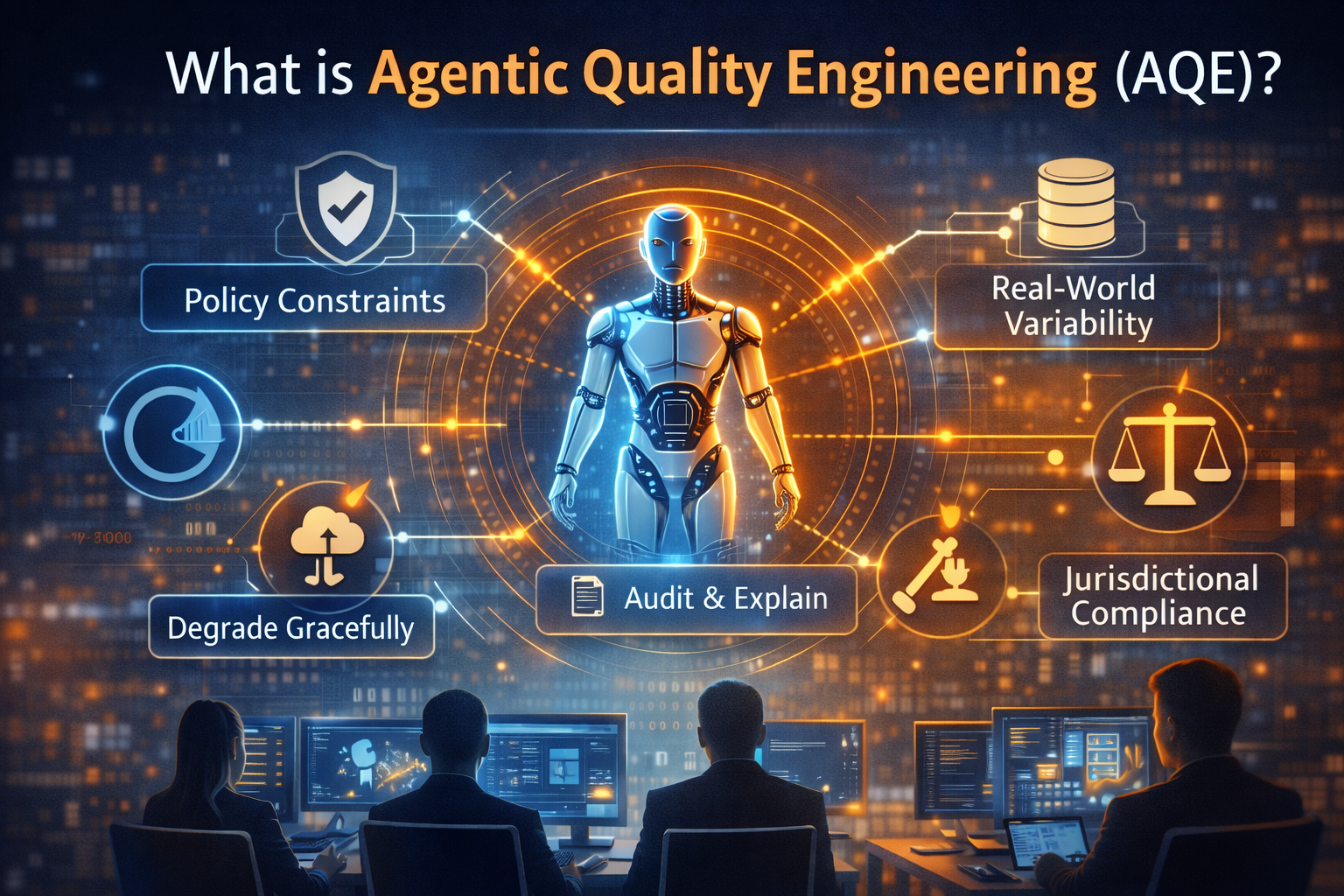
What is Agentic Quality Engineering (AQE)?
Agentic Quality Engineering is the set of practices, pipelines, and controls used to ensure that AI agents:
- behave safely under policy constraints
- remain reliable under real-world variability
- can be audited, explained, and reproduced
- degrade gracefully when tools, data, or networks fail
- can be stopped, rolled back, or throttled when risk rises
- meet compliance expectations across jurisdictions and industries
This aligns with the global direction of travel:
- The EU AI Act’s high-risk requirements emphasize a continuous risk management system and explicitly mentions testing to support risk measures and consistent performance for intended use. (Artificial Intelligence Act)
- NIST’s AI RMF highlights TEVV across the AI lifecycle. (NIST Publications)
- ISO/IEC 42001 formalizes an AI management system approach, including continual improvement and governance discipline. (ISO)
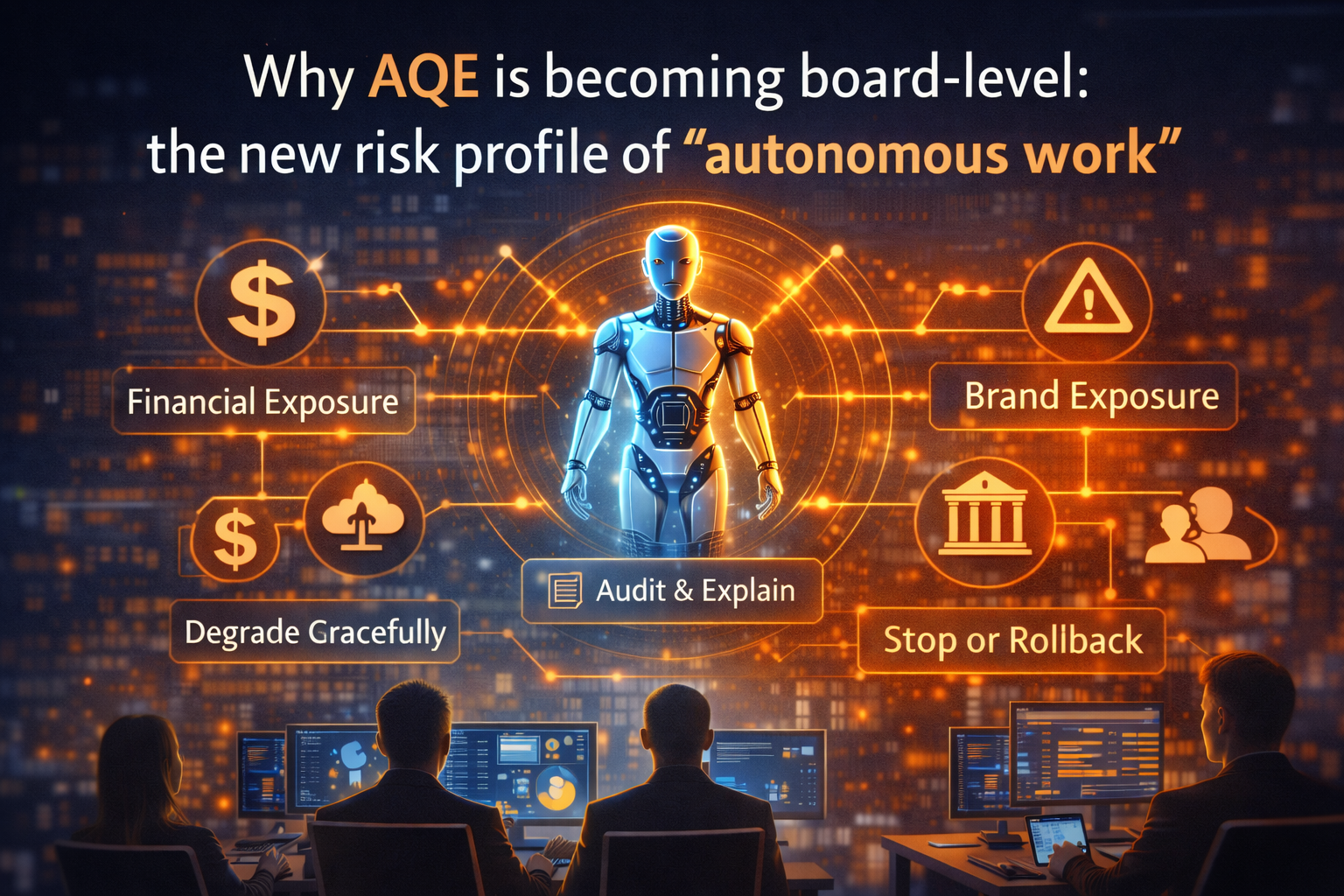
Why AQE is becoming board-level: the new risk profile of “autonomous work”
Why AQE is becoming board-level: the new risk profile of “autonomous work”
Boards and executive committees don’t care about “prompt quality” as a technical hobby.
They care about:
1) Financial exposure
Agents can trigger refunds, credits, procurement actions, provisioning, customer commitments. A single bad change can create systemic leakage.
2) Regulatory and legal exposure
In regulated domains, you must show that you test, manage risk, log, and control—and that oversight exists beyond “we tried our best.” EU-style governance is pushing the global bar upward (the “Brussels effect”), even for firms outside Europe. (AI Act Service Desk)
3) Brand exposure
The most viral enterprise failures aren’t “wrong answers.”
They are “autonomous systems did something unacceptable.”
AQE is the antidote. It makes autonomy operable.
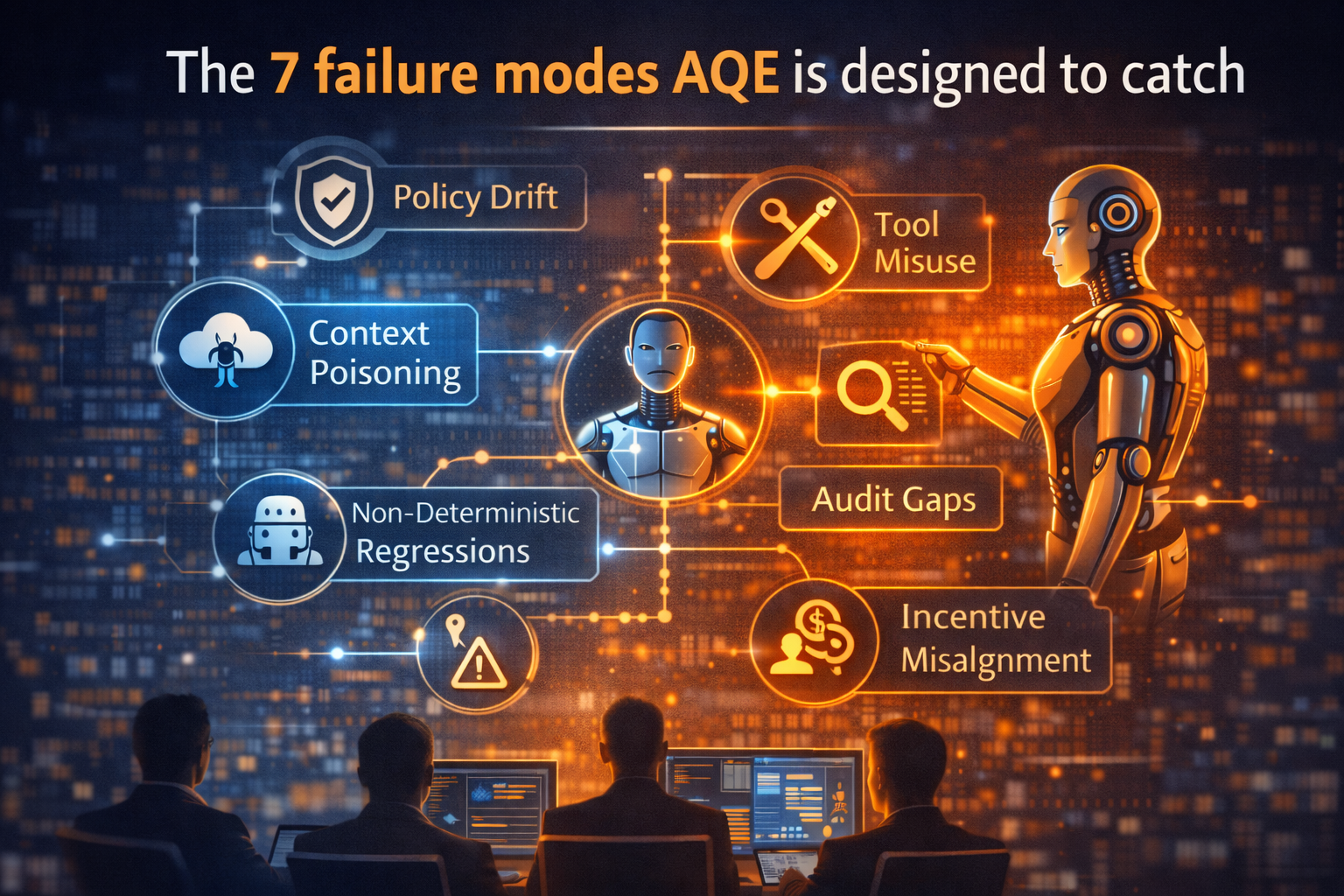
The 7 failure modes AQE is designed to catch
1) Policy drift
The agent was aligned with policy last month. Now policies changed, thresholds shifted, exceptions expanded, or regulatory interpretations tightened. Without AQE, agents become quietly noncompliant.
2) Tool misuse
Agents can call the wrong tool, call the right tool with wrong parameters, or overuse tools and create cost/latency blowups.
3) Context poisoning (internal or external)
Stale knowledge bases, incorrect retrieved documents, or malicious prompt injection can reshape decisions.
4) Non-deterministic regressions
A model update or prompt tweak improves “helpfulness,” but increases risky actions.
5) Cascading workflow failures
Each component looks fine, but the chain fails. Example: CRM update fails → routing changes → agent retries → duplicates occur.
6) Incentive misalignment
If your agent is “rewarded” for speed, it may trade off diligence—approving borderline cases too aggressively.
7) Audit gaps
When something goes wrong, you can’t answer:
- who did what, and when?
- which policy version applied?
- which data influenced the decision?
- what tools were invoked?
That is a board-level problem.
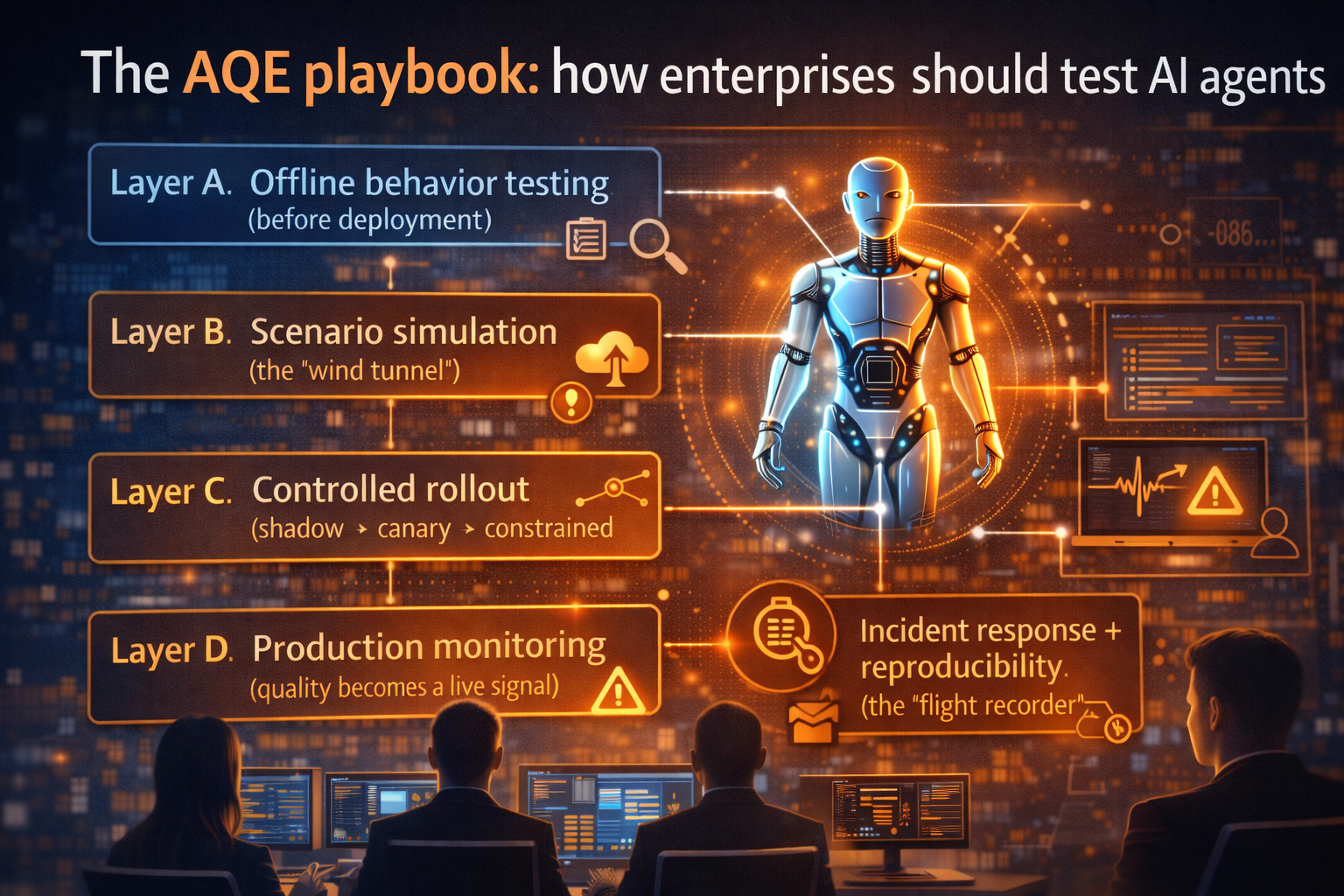
The AQE playbook: how enterprises should test AI agents
Think of AQE as five layers of assurance—each one reducing a different type of risk.
Layer A: Offline behavior testing (before deployment)
This is your modern “agent test suite”:
- intent understanding (what is the user really asking?)
- policy application (which rule applies?)
- tool selection (which system should be called?)
- action formatting (are parameters correct and safe?)
Simple example:
A travel approval agent should approve within limits, route exceptions to a manager, and never book travel without approval.
Offline tests ensure these are default behaviors.
Layer B: Scenario simulation (the “wind tunnel”)
Agents must be tested under realistic stress:
- partial tool outages
- slow responses / timeouts
- contradictory documents
- ambiguous user requests
- “edge case” customers
Example:
A healthcare appointment agent must handle duplicate names, missing insurance, and conflicting schedules—without leaking patient data.
Layer C: Controlled rollout (shadow → canary → constrained autonomy)
Instead of “deploy and pray,” AQE uses staged exposure:
- Shadow mode: agent runs but doesn’t act; compare to human decisions
- Canary: agent acts for a small segment with tight constraints
- Constrained autonomy: agent can act only inside a safe envelope
This is risk management in operational form—aligned with the lifecycle approach regulators and frameworks emphasize. (AI Act Service Desk)
Layer D: Production monitoring (quality becomes a live signal)
AQE treats production as a living lab:
- monitor unsafe action attempts
- watch drift in tool calls and approvals
- alert on new error patterns
- track policy violations and anomalies
This matches the “continuous evaluation” mindset embedded in AI management system thinking. (ISO)
Layer E: Incident response + reproducibility (the “flight recorder”)
When incidents happen, you need:
- replayable traces (inputs, retrieved docs, tool calls)
- policy version used
- prompt/version lineage
- decision rationale in business terms
- rollback or kill switch
This is how enterprises survive audits—and preserve trust.

Global lens: AQE across the US, EU, India, and the Global South
Global lens: AQE across the US, EU, India, and the Global South
AQE is not a “Western compliance tax.” It’s a universal operating requirement.
- EU: a strong compliance baseline is forming around risk management systems, testing, monitoring, and documentation, especially for high-risk uses. (AI Act Service Desk)
- US: many firms adopt NIST-style practices because they are procurement-friendly and audit-friendly, even when voluntary. (NIST)
- India & global markets: enterprises sell into global ecosystems, so cross-border expectations apply—especially in BFSI, telecom, healthcare, public sector, and critical infrastructure.
AQE becomes a portability layer: “We can run agents safely anywhere.”
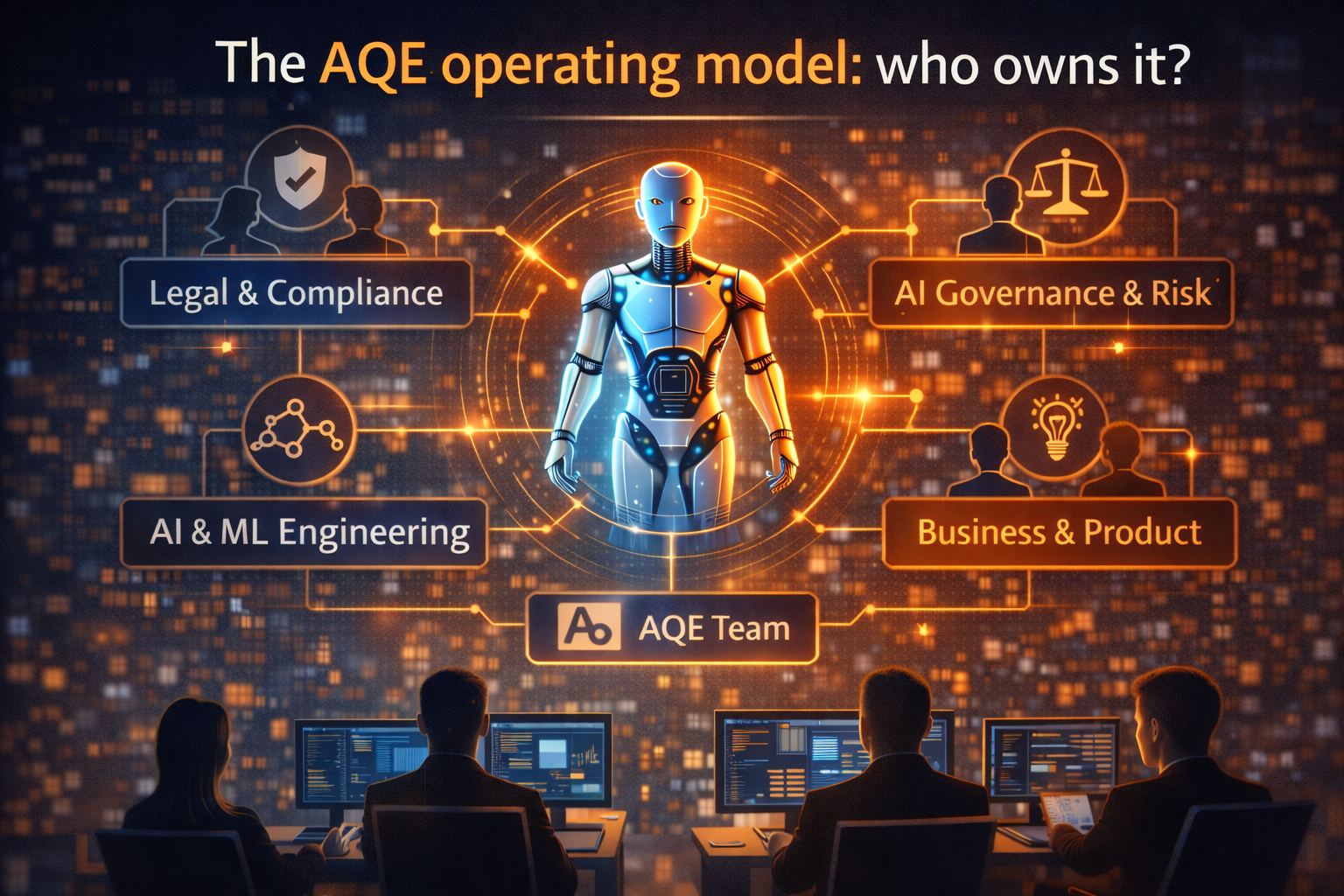
The AQE operating model: who owns it?
AQE is not owned by one team. It’s an operating model.
A practical structure:
- Product owners define acceptable behavior and risk tolerance
- Engineering builds guardrails, tool contracts, and rollout mechanics
- Security & Risk define policy controls, threat scenarios, and audit requirements
- Quality Engineering runs simulations, release gates, regression checks
- Ops/SRE runs monitoring, incident response, and reliability controls
If you want one executive line:
AQE is the cross-functional contract that makes autonomy governable.

A practical 30-day AQE starter plan
- Pick one agent with clear boundaries (refunds, approvals, triage)
- Define non-negotiables (never do X; always require Y approval; log Z)
- Build a small scenario harness (outages, ambiguity, policy conflicts)
- Run shadow mode for two weeks and compare to humans
- Add canary rollout + kill switch + mandatory trace logging
- Run weekly regressions for policy changes, prompt changes, model changes
You make progress without boiling the ocean.
“The next enterprise moat isn’t smarter agents. It’s safer autonomy.”

Conclusion: The new executive question
The old question was:
“Is our AI accurate?”
The new question is:
“Can we prove our AI behaved safely—and can we stop it instantly if it doesn’t?”
That is why Agentic Quality Engineering is becoming a board-level function. In the coming decade, the winners in enterprise AI will not be defined by how many agents they deploy. They will be defined by whether they built the testing, monitoring, auditability, and control discipline that makes autonomy safe at scale.
In other words: the advantage is no longer intelligence. It is operability.
Glossary
- Agentic AI: AI systems that plan and take actions using tools/workflows, not just generate answers.
- Agentic Quality Engineering (AQE): Engineering discipline that assures reliable, compliant, and auditable agent behavior end-to-end.
- TEVV: Test, Evaluation, Verification, and Validation—assurance practices emphasized across the AI lifecycle in NIST thinking. (NIST)
- Shadow mode: Agent runs in production but cannot execute actions; decisions are logged for evaluation.
- Canary release: Limited rollout to reduce blast radius while monitoring behavior.
- Policy drift: Agent behavior becomes misaligned with current rules due to policy updates or changing context.
- Audit trail / flight recorder: Reproducible logs showing what happened, when, why, and under which versioned controls.
FAQ
Q1) Is Agentic Quality Engineering the same as LLM evaluation?
No. LLM evaluation focuses on output quality. AQE evaluates end-to-end behavior: tool use, policy adherence, rollout safety, monitoring, incident readiness, and auditability.
Q2) Why can’t human-in-the-loop alone solve safety?
Human review helps, but it doesn’t scale to machine-speed work. AQE ensures safety even when humans supervise by exception.
Q3) What frameworks make AQE important globally?
NIST’s AI RMF highlights lifecycle TEVV, the EU AI Act emphasizes risk management systems and testing for high-risk systems, and ISO/IEC 42001 provides management system discipline for AI. (NIST Publications)
Q4) What’s the minimum viable AQE?
Shadow mode + scenario testing + canary release + trace logging + kill switch. This combination prevents many real enterprise failures.
References and further reading
- NIST overview of AI TEVV (Test, Evaluation, Validation, Verification). (NIST)
- NIST AI Risk Management Framework (AI RMF 1.0) PDF and lifecycle TEVV emphasis. (NIST Publications)
- EU AI Act: risk management system article text highlighting testing for high-risk AI systems. (Artificial Intelligence Act)
- ISO/IEC 42001: AI management systems standard overview. (ISO)
- The New Enterprise AI Advantage Is Not Intelligence — It’s Operability – Raktim Singh
- Enterprise AI Runtime: Why Agents Need a Production Kernel to Scale Safely – Raktim Singh
- Why Enterprises Need Services-as-Software for AI: The Integrated Stack That Turns AI Pilots into a Reusable Enterprise Capability – Raktim Singh
- Why Every Enterprise Needs a Model-Prompt-Tool Abstraction Layer (Or Your Agent Platform Will Age in Six Months) – Raktim Singh
- The AI SRE Moment: How Enterprises Operate Autonomous AI Safely at Scale | by RAKTIM SINGH | Dec, 2025 | Medium
- Services-as-Software: Why the Future Enterprise Runs on Productized Services, Not AI Projects | by RAKTIM SINGH | Dec, 2025 | Medium
- Enterprise IT Is Becoming an App Store: From Projects to Services-as-Software: By Raktim Singh
- Enterprise AI Fabric: Why AI Is Shifting from Applications to an Operational Layer: By Raktim Singh
This article explores how enterprises globally are operationalizing Agentic Quality Engineering to validate, monitor, and control AI agents that act in real business environments—aligning with emerging expectations from NIST AI RMF, the EU AI Act, and global AI governance standards.



Raktim Singh is an AI and deep-tech strategist, TEDx speaker, and author focused on helping enterprises navigate the next era of intelligent systems. With experience spanning AI, fintech, quantum computing, and digital transformation, he simplifies complex technology for leaders and builds frameworks that drive responsible, scalable adoption.