
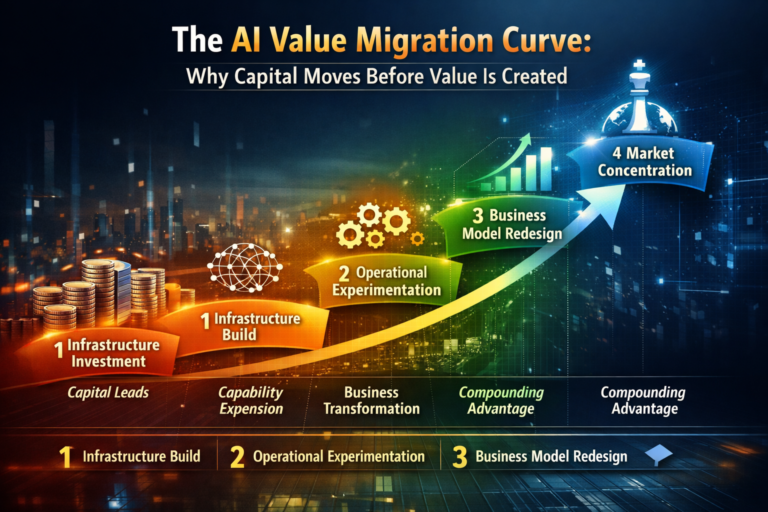
The AI Value Migration Curve: Why Capital Moves Before Value Is Created — And How Boards Can Win the Creation Phase
Artificial intelligence is triggering one of the largest capital reallocations in modern economic history. Yet many boards and executive teams still begin with a narrow question: “Where is the ROI?” That question, while reasonable, misunderstands how transformative technology waves unfold.
In every major disruption—from electricity to the internet—capital moved first, infrastructure scaled next, business models redesigned later, and durable value creation followed only after institutions adapted.
AI is following the same pattern. Understanding the AI Value Migration Curve is not about chasing hype; it is about recognizing where value is shifting, positioning before consolidation, and redesigning the enterprise to win in the value-creation decade ahead.
What is the AI Value Migration Curve?
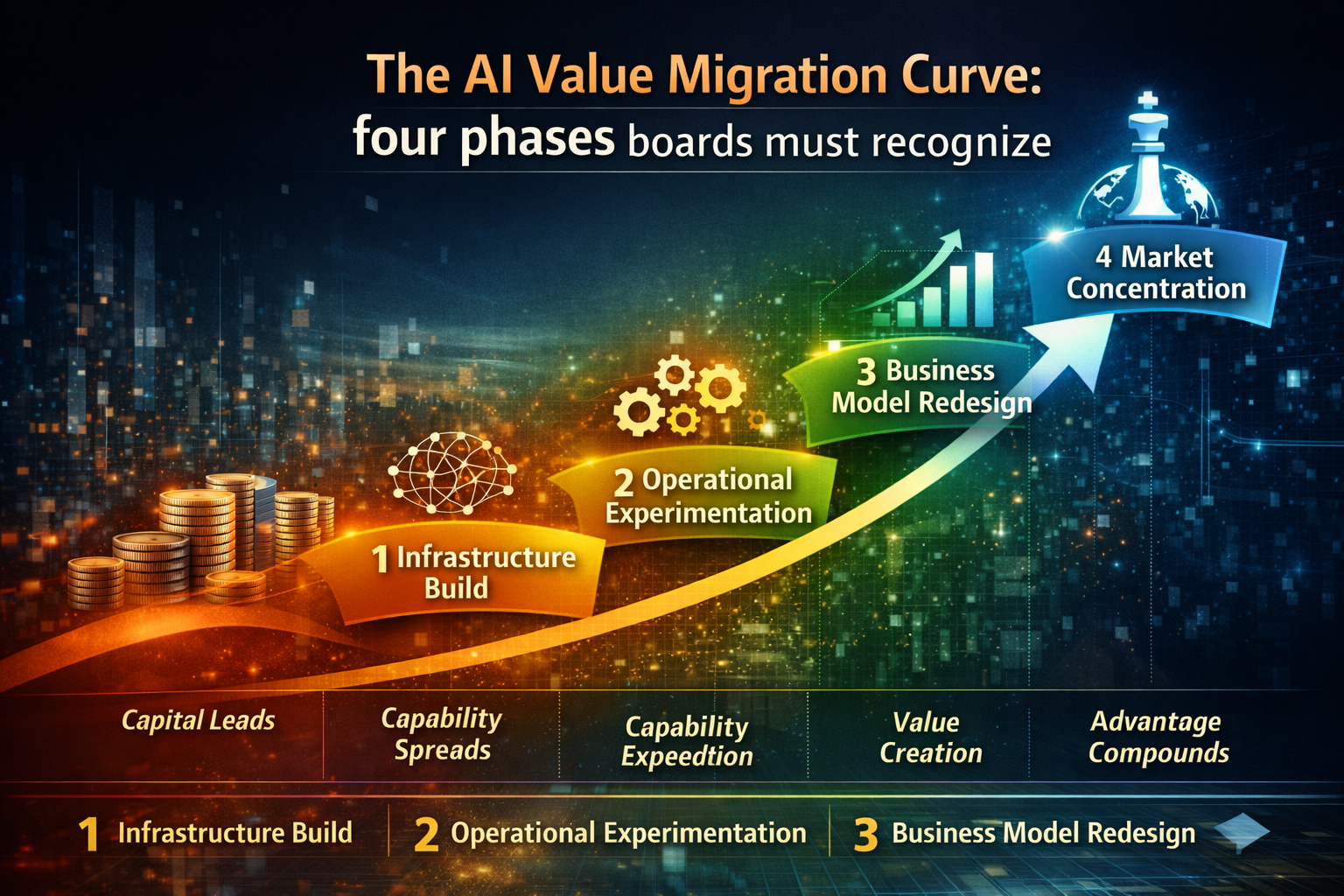
The AI Value Migration Curve describes how capital reallocates before visible business value appears. Infrastructure and capability investments lead first, experimentation follows, business model redesign drives value creation, and finally advantage concentrates among firms that learn fastest.
AI Value Migration Curve: How Boards Win with AI
Most boards ask the same question about AI:
“Where is the ROI?”
It’s a fair question. It’s also the wrong place to start.
Because when a technology wave is truly transformative, value doesn’t appear first.
Value moves first.
That movement—often invisible in quarterly dashboards—is what I call the AI Value Migration Curve:
- Capital reallocates (before value is visible)
- Capabilities spread (before business models stabilize)
- Value gets created (when institutions redesign how they operate)
- Advantage concentrates (when a few players compound learning faster than others)
If boards wait for “proven value” before acting, they often arrive after migration has already reshaped profit pools and competitive positions.
This is not about fear. It’s about timing.
AI is a disruption on the scale of earlier platform waves because it changes how decisions are made, how work is coordinated, and how revenue is produced. The winners won’t simply “use AI.” They will recognize the pattern: value migrates before it is created, and they will position their enterprise for the value-creation phase.
This essay is a board-level guide to:
- Why capital moves early (even when value is unclear)
- What “value migration” really means in practice
- The signals that show when migration is turning into value creation
- How boards can shape strategy for the value-creation decade
What “value migration” really means
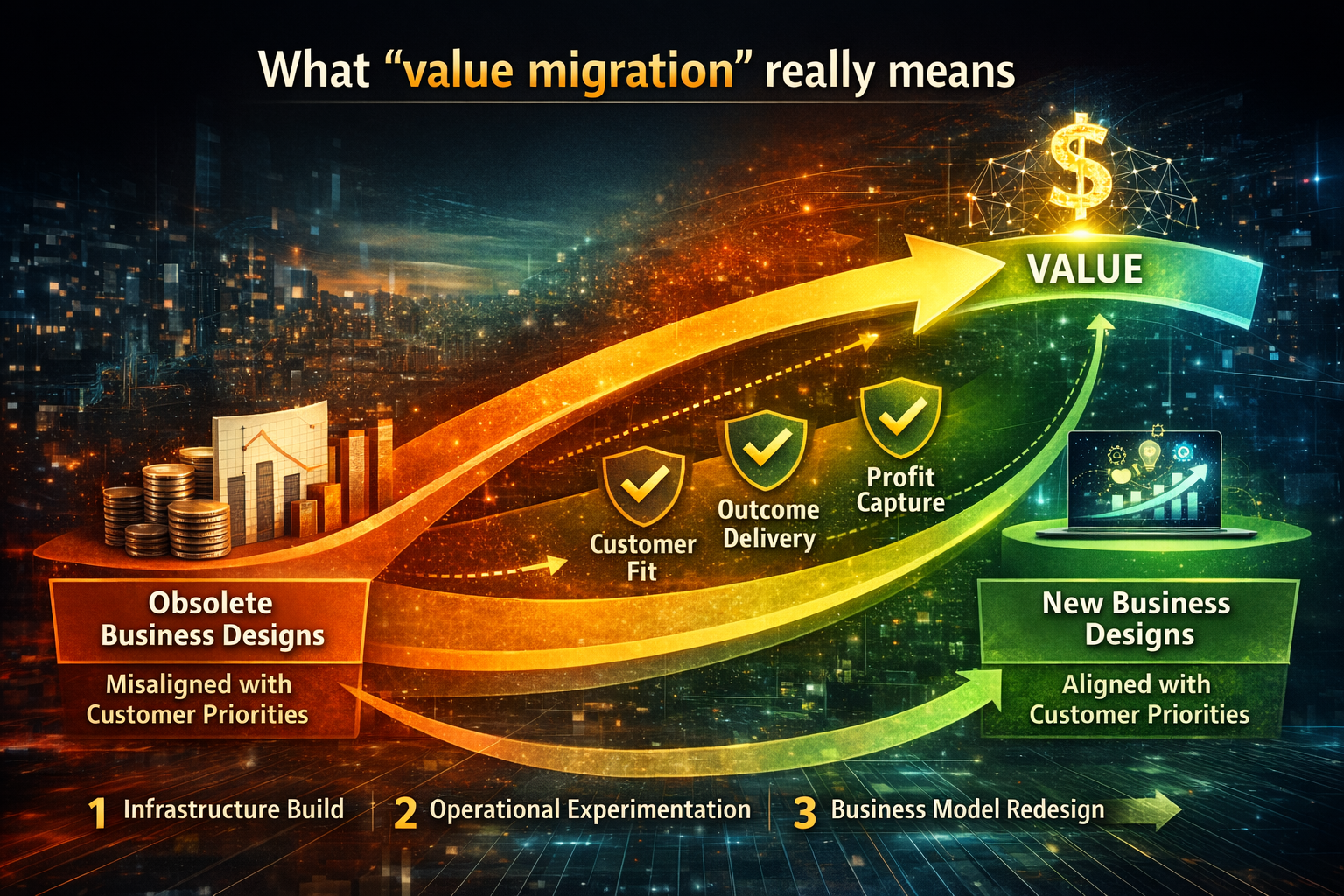
The phrase value migration is often used loosely. In strategy, it has a specific meaning: value flows away from obsolete business designs and toward new designs that better match customer priorities. Adrian Slywotzky popularized this idea by linking value shifts to “business design” choices—how a company chooses customers, differentiates, configures resources, goes to market, and captures value. (Google Books)
This matters because technologies don’t create value by themselves. They create value when they enable a better business design—a different way to deliver outcomes, structure costs, and capture profit.
Across major technology waves, a familiar sequence plays out:
- Early stage: capital rushes into infrastructure and enablers
- Middle stage: organizations experiment—some succeed, many stall
- Later stage: value creation accelerates as business models mature
- Then: advantage concentrates around those with compounding capability
This “capital first” pattern also shows up in techno-economic cycle research: early “installation” phases are often finance-led, while broad value creation typically comes later when institutions reorganize around the new paradigm. (carlotaperez.org)
Why capital moves before value is created
Boards often assume capital should follow proven value. In disruptive waves, it’s the reverse.
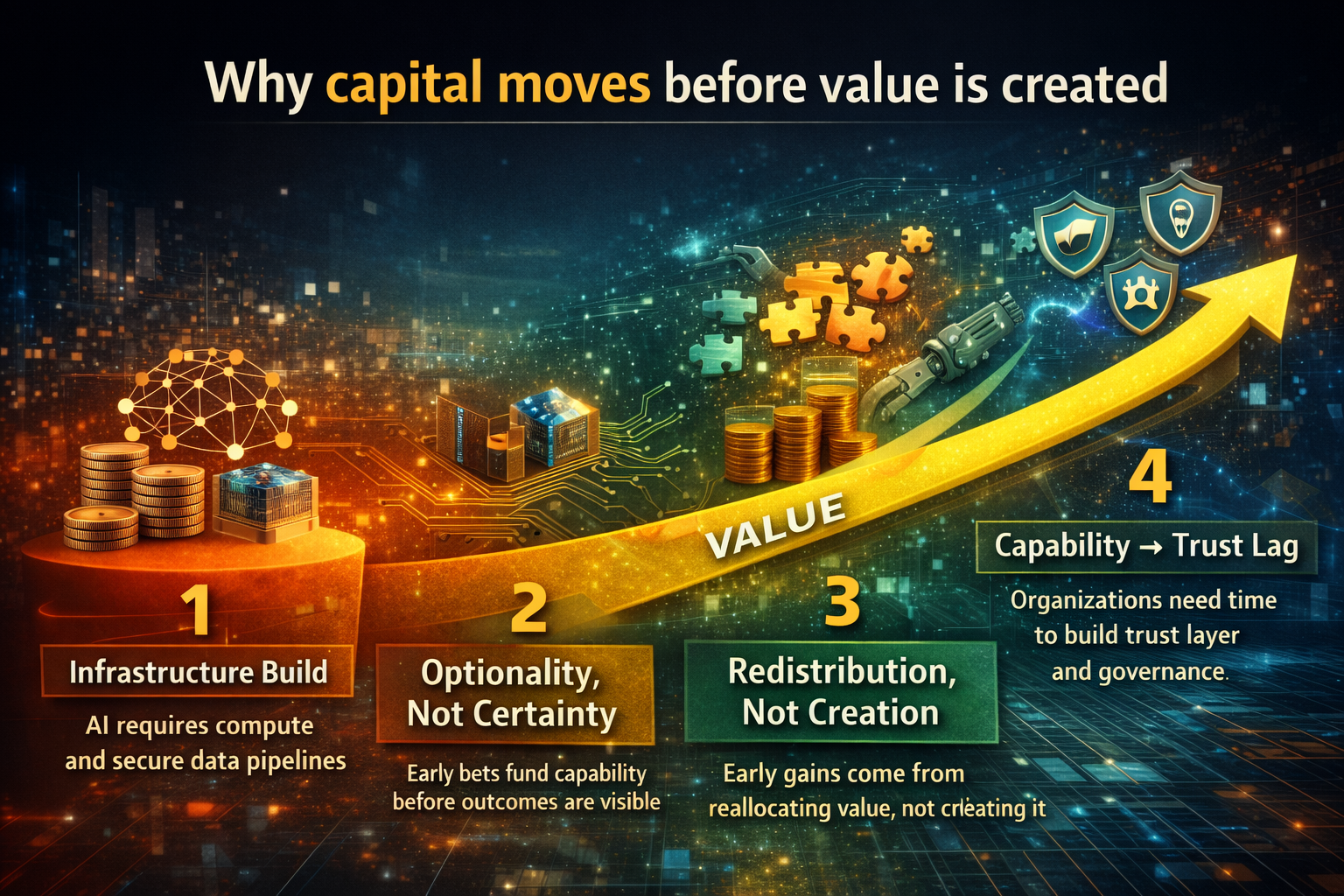
Capital moves early for five reasons.
1) Infrastructure must exist before outcomes can scale
AI value depends on compute, data pipelines, deployment tooling, and secure environments. Without infrastructure, you can’t scale learning into operations.
That’s why we’re seeing investment surges across the AI supply chain—data centers, chips, networking, power, and capacity build-outs—years before many enterprises can confidently attribute business value. (Reuters)
Simple example:
A board may not yet see AI increasing margins this quarter. But the industry is building the “electric grid” of AI—compute, networking, and platforms. That grid must be built before the real economic acceleration becomes visible.
2) Markets fund optionality before they fund certainty
Early capital often funds options: experiments, capabilities, and ecosystems. The logic is simple:
“If this wave becomes dominant, we want a seat at the table.”
That’s why capital concentrates in:
- foundational model ecosystems
- AI infrastructure
- enterprise integration layers
- developer tooling
…even when downstream outcomes are still forming.
3) The first returns come from redistribution, not creation
In the migration phase, value is frequently reallocated, not newly created.
- Some firms gain short-term productivity by automating tasks
- Some vendors capture spend by selling infrastructure
- Some functions improve, while others struggle to absorb change
This is not yet the “golden age” of value creation. It is the messy migration phase—where the economic center of gravity shifts. (carlotaperez.org)
4) Standards, trust, and governance lag capability
Capability often arrives before trust.
In enterprise AI, boards must fund not only models and tools, but also the system that makes outcomes reliable—privacy, security, compliance, change management, and organizational redesign.
This lag is not a failure. It’s normal: technology gets good faster than institutions get ready.
5) The biggest value arrives only after business models change
The largest value isn’t “using AI.” It is becoming AI-shaped:
- shifting products into decision services
- shifting workflows into learning systems
- shifting customer engagement into continuously optimized journeys
- shifting cost structures through automation + redesign
That is value creation. But it comes after migration forces industries to reorganize.
The AI Value Migration Curve: four phases boards must recognize
Phase 1: Infrastructure and capability build (capital leads)
This is the phase we are strongly in today.
Capital concentrates in:
- compute and data center expansion
- specialized networking
- model ecosystems and platforms
- enterprise AI tooling and integration
It’s noisy: many pilots, many announcements, many inflated expectations.
Boards should not ask, “Where is the full value?” yet.
Boards should ask:
“Are we building the capability to convert AI into value when the creation phase arrives?”
Phase 2: Operational experimentation (capability spreads)
Enterprises experiment across functions:
- customer service
- sales enablement
- software engineering
- operations and planning
- risk and compliance
- procurement and finance
Results are mixed. Some teams get real productivity. Others stall. Many deployments remain trapped in “demo value” rather than institutional value.
Phase 3: Business model redesign (value creation accelerates)
This is the real inflection.
Value creation becomes visible when companies redesign:
- how they price
- how they deliver outcomes
- how they manage risk
- how they coordinate work
- how they learn from feedback
This is when AI becomes a structural advantage, not a feature.
Phase 4: Compounding advantage and market concentration
Once value creation begins, advantage concentrates.
Why? Because AI rewards organizations that:
- learn fastest
- deploy improvements continuously
- close feedback loops in real workflows
- scale trust without slowing velocity
Market structure research on AI infrastructure highlights how economies of scale and supply chain dynamics can reinforce concentration. (OECD)
This is where “AI winners” emerge—not because they had the best models, but because they built the best learning systems.
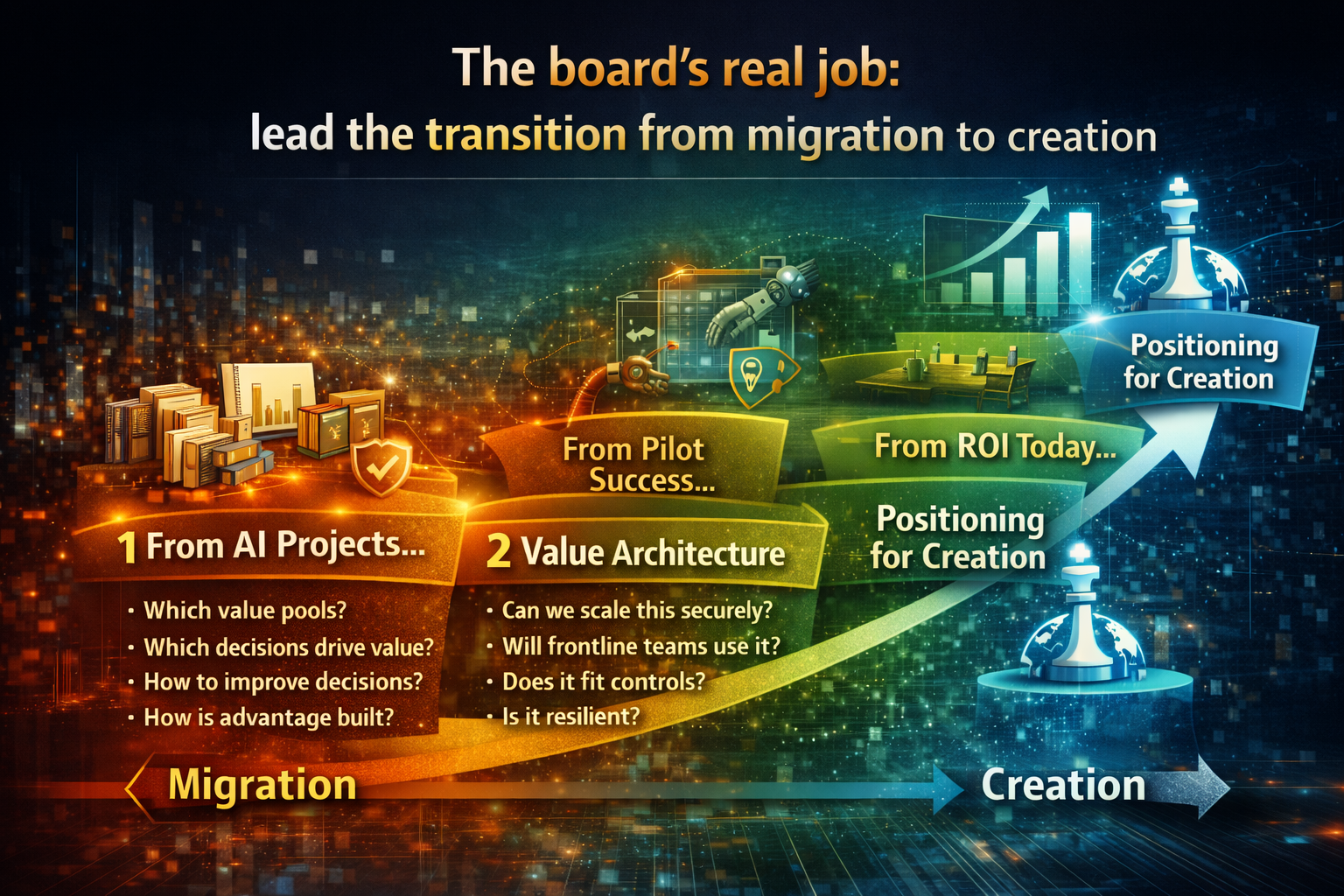
The board’s real job: lead the transition from migration to creation
Boards don’t need to become technologists. But they must become fluent in one transition problem:
How do we convert AI capability into durable business model advantage?
That requires three shifts in board oversight.
Shift 1: From “AI projects” to “value architecture”
In the migration phase, it’s tempting to sponsor a portfolio of AI projects.
In the creation phase, boards must ask for a value architecture:
- Which value pools are we targeting?
- Which decisions define those value pools?
- How will we improve those decisions continuously?
- How will improvements translate into durable advantage?
Shift 2: From “pilot success” to “institutional absorbability”
Many organizations can build a strong AI pilot.
Fewer can absorb it into the enterprise in a way that changes revenue, cost, risk, and customer experience sustainably.
Boards should ask:
- Can we adopt this at scale without breaking trust?
- Will frontline teams actually use it?
- Does it fit accountability and controls?
- Is it resilient when the world changes?
Shift 3: From “ROI today” to “positioning for creation”
Boards must balance two time horizons:
- Near-term value: productivity, faster cycle times, reduced waste
- Mid-term advantage: pricing power, new services, new operating leverage
The mistake is optimizing only for near-term gains, then missing the strategic reconfiguration.
Simple examples: value migration vs value creation
Example 1: Customer service
Migration: AI reduces response time and cost per contact.
Creation: AI becomes a proactive retention engine—detecting risk signals early, recommending interventions, and learning from outcomes continuously.
The difference is not the model.
The difference is the business design.
Example 2: Pricing and revenue
Migration: AI generates pricing suggestions.
Creation: AI enables dynamic, context-aware pricing and contract personalization—turning pricing into a continuously optimized strategic lever.
This is where pricing power emerges—one of the most board-relevant outcomes.
Example 3: Operations and planning
Migration: AI improves forecasts.
Creation: AI turns planning into a self-correcting system—detecting disruptions early, simulating options, and adjusting inventory, capacity, and logistics with minimal delay.
Value creation appears when AI reduces the “decision lag” that causes waste.
Example 4: Product to prediction
Migration: AI improves recommendations.
Creation: The company sells outcomes—prediction, prevention, optimization, assurance.
This is how “products” become decision services.
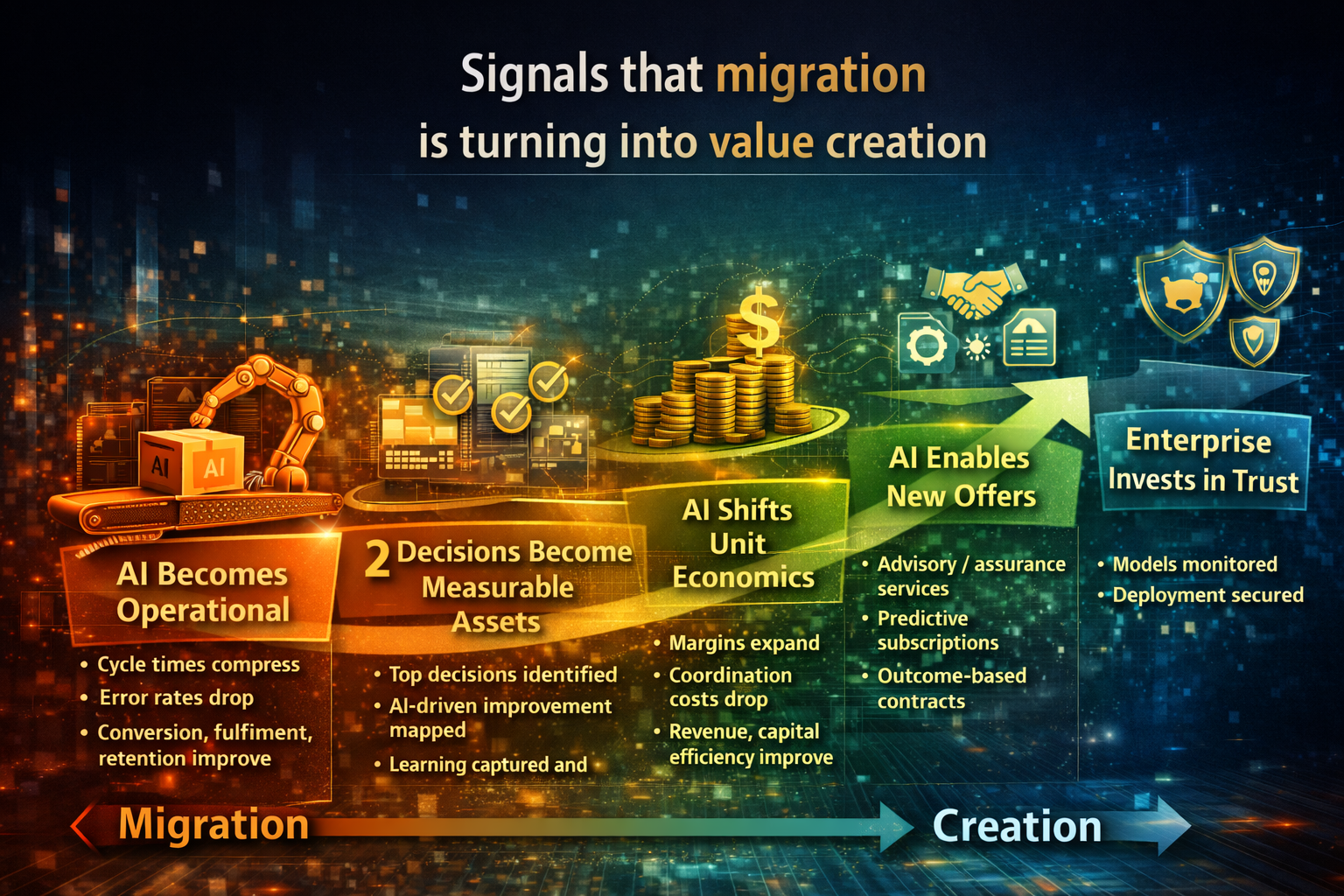
Signals that migration is turning into value creation
Boards need early indicators that the enterprise is moving into the creation phase. Here are practical signals—no math required:
1) AI shifts from assistive to operational
Not “helpful summaries,” but operational outcomes:
- cycle times compress
- error rates drop
- conversion improves
- retention rises
- risk incidents decline
- fulfillment improves
2) Decisions become measurable assets
The enterprise can clearly name:
- the decisions that drive value
- who owns them
- how AI improves them
- how learning is captured and applied
3) AI starts changing unit economics
AI improvements show up in:
- margin expansion
- reduced coordination cost
- higher revenue per employee
- improved capital efficiency
Not through hype. Through repeatable performance.
4) AI enables new offers, not just better execution
A strong signal is when AI creates monetizable capabilities:
- advisory services
- assurance services
- predictive subscriptions
- outcome-based contracts
- embedded decision support inside client workflows
5) The enterprise invests in the trust layer
Leadership funds:
- secure deployment patterns
- monitoring and incident response
- content integrity and provenance
- policy alignment
These investments look like “cost” early—but they are what allow value creation to scale without breaking trust.
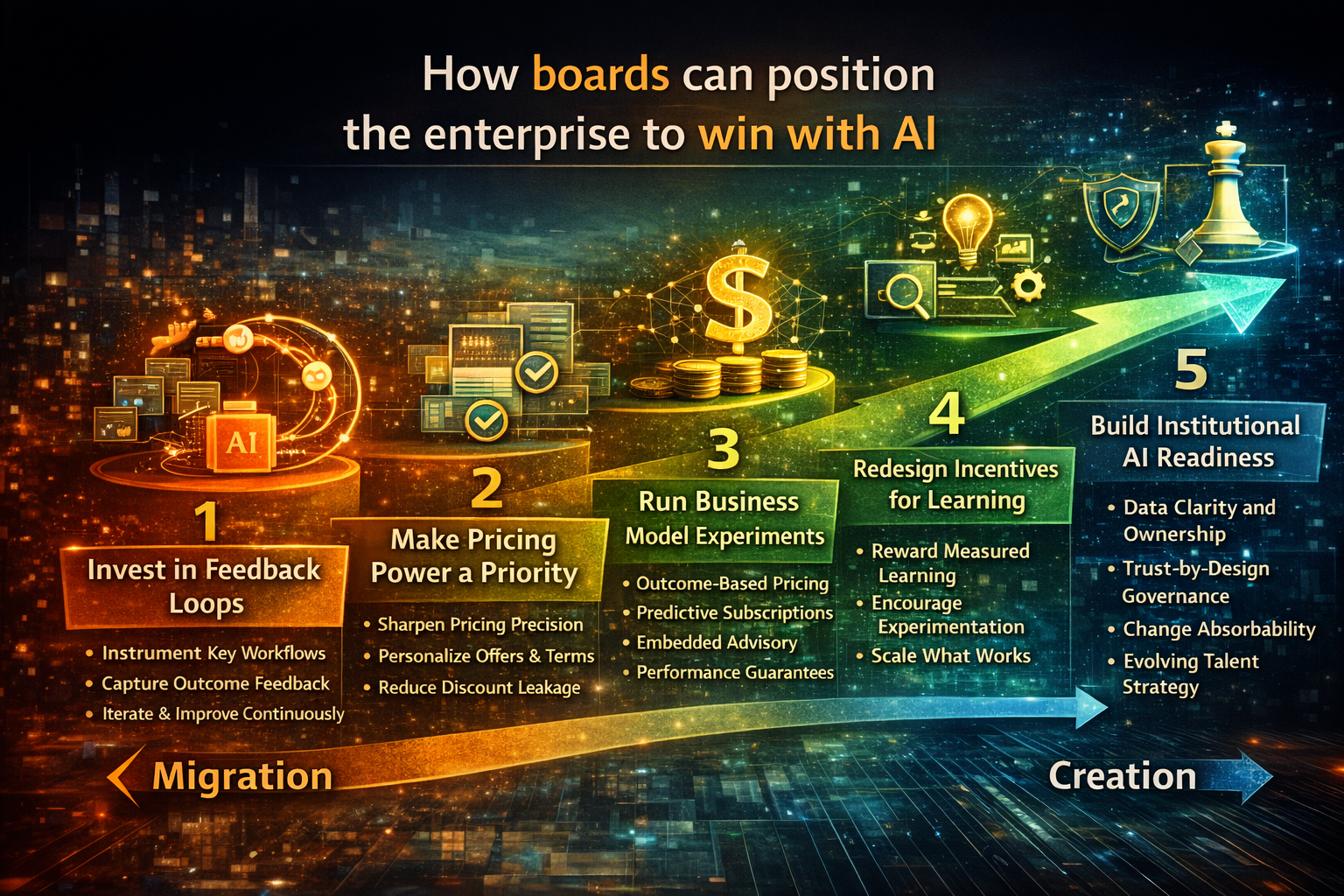
How boards can position the enterprise to win with AI
This is the heart of the article: what boards can do now.
1) Allocate capital to feedback loops, not only tools
Tools are easy to buy. Feedback loops are harder to build.
Boards should prioritize investments that make learning continuous:
- instrumentation of key workflows
- capturing outcome feedback
- closing the loop into decisions
- improving models and processes iteratively
2) Make pricing power a first-class AI objective
Many companies underuse AI by treating it as productivity tech.
Boards should ask:
- Where can AI improve pricing precision?
- Where can AI personalize offers and terms?
- Where can AI reduce discount leakage?
- Where can AI turn negotiation into a smarter system?
This is value creation.
3) Sponsor business model experiments with clear boundaries
AI will enable new revenue designs. Boards should sponsor controlled experiments:
- outcome-based pricing
- predictive subscriptions
- embedded advisory
- performance guarantees supported by AI monitoring
4) Redesign incentives so learning is rewarded
AI value creation requires learning velocity.
If incentives reward only short-term delivery and quarterly cost cuts, the enterprise may never enter the creation phase.
Boards should reward:
- measured learning
- controlled experimentation
- scaling what works
- institutionalizing proven patterns
5) Treat AI readiness as an institutional capability
Readiness is not a checklist. It is an operating posture:
- data clarity
- decision ownership
- change absorption
- trust-by-design
- talent evolution
Boards should treat readiness as a strategic asset—because the creation phase rewards the ready.
Conclusion: the optimistic thesis boards should internalize
AI will not reward those who merely adopt it.
AI will reward those who re-architect how their enterprise learns, decides, prices, and delivers outcomes.
That is why capital moves before value is visible.
Capital is flowing toward the organizations and infrastructures that will dominate the value-creation phase—because once creation begins, advantage compounds quickly. (Reuters)
Boards that understand the AI Value Migration Curve have one job:
Position the enterprise for value creation—before value creation becomes obvious.
That is how you win with AI.
Glossary
AI Value Migration Curve: A four-phase pattern where capital reallocates before outcomes are visible, then capability spreads, value is created through redesign, and advantage concentrates.
Value Migration: The flow of economic value from obsolete business designs to new designs that better match customer priorities. (Google Books)
Value Creation: The phase where new business models and operating designs generate new profit pools and sustainable growth.
Market Concentration: The tendency for advantage to cluster among a few winners, often driven by scale economies and infrastructure dynamics. (OECD ONE)
Pricing Power: The ability to defend or expand margins through better pricing, segmentation, and contract design.
Decision Services: Offerings where customers pay for outcomes enabled by prediction, optimization, or assurance.
Feedback Loop: A system where outcomes are measured and used to improve future decisions continuously.
FAQ
1) Why does AI investment rise before companies see clear ROI?
Because disruptive waves require infrastructure and capability first; broad value arrives later when business models and institutions reorganize around the new paradigm. (carlotaperez.org)
2) What should boards measure during the AI migration phase?
Operational adoption, decision ownership, feedback-loop closure, unit-economics movement, and emergence of AI-enabled new offers.
3) How do we know when we’ve moved from pilots to AI value creation?
When AI changes unit economics, reshapes pricing/contracting, creates new monetizable services, and becomes embedded in real workflows—not just demos.
4) Will AI lead to consolidation in many industries?
Often yes. Infrastructure scale economies and supply chain dynamics can favor large players, reinforcing concentration. (OECD ONE)
5) What is the fastest way to win with AI without reckless risk?
Invest in feedback loops, prioritize pricing power and decision outcomes, run bounded business model experiments, and scale trust-by-design alongside capability.
The Enterprise AI Doctrine: From Decision Scale to Institutional Redesign
Over the past few months, I’ve been building a structured doctrine around Enterprise AI — not as a technology trend, but as an institutional redesign agenda.
It unfolds in layers:
🔹 1️⃣ Decision Economics
- Decision Scale: Why Competitive Advantage Is Moving from Labor Scale to Decision Scale
https://www.raktimsingh.com/decision-scale-competitive-advantage-ai/
→ Establishes the core thesis: advantage is shifting from scaling labor to scaling decision quality.
🔹 2️⃣ Institutional Transformation
- The Future Belongs to Decision-Intelligent Institutions
https://www.raktimsingh.com/the-future-belongs-to-decision-intelligent-institutions/
→ Argues that AI leadership is not about tooling — it is about institutional architecture.
🔹 3️⃣ Sector-Level Redesign
- The Institutional Redesign of Indian IT: From Services Firms to Intelligence Institutions
https://www.raktimsingh.com/institutional-redesign-indian-it-intelligence-institutions/ - From Labor Arbitrage to Intelligence Arbitrage: Why Indian IT’s AI Reinvention Will Define the Next Decade
https://www.raktimsingh.com/from-labor-arbitrage-to-intelligence-arbitrage-why-indian-its-ai-reinvention-will-define-the-next-decade/
→ Examines how this shift reshapes industry structure, economics, and competitive positioning.
🔹 4️⃣ Economic Consequences
- The End of Averages: Why Precision Growth Will Define the Next Decade of Enterprise Strategy
https://www.raktimsingh.com/precision-growth-end-of-averages-enterprise-ai/ - What Is the AI Dividend? How Boards Capture Structural Gains from Enterprise AI
https://www.raktimsingh.com/ai-dividend-boards-structural-gains/
→ Explores how decision intelligence translates into measurable structural gains.
🔹 The Unifying Thesis
Together, these articles form a coherent framework:
- Competitive advantage is moving from labor scale to decision scale
- Institutions must evolve from services firms to intelligence institutions
- AI must shift from isolated pilots to structurally governed, economically accountable enterprise systems
This is not AI adoption.
It is enterprise redesign.
Reference and Further Reading
1️⃣ Carlota Perez — Technological Revolutions Framework
2️⃣ OECD — AI Market Concentration & Infrastructure
https://www.oecd.org/digital/artificial-intelligence/
3️⃣ McKinsey — AI Value & Productivity Research
AI in the workplace: A report for 2025 | McKinsey
4️⃣ MIT Sloan Management Review — AI & Business Model Innovation
5️⃣ World Economic Forum — AI Governance & Board Readiness
Artificial Intelligence | World Economic Forum



Raktim Singh is an AI and deep-tech strategist, TEDx speaker, and author focused on helping enterprises navigate the next era of intelligent systems. With experience spanning AI, fintech, quantum computing, and digital transformation, he simplifies complex technology for leaders and builds frameworks that drive responsible, scalable adoption.