
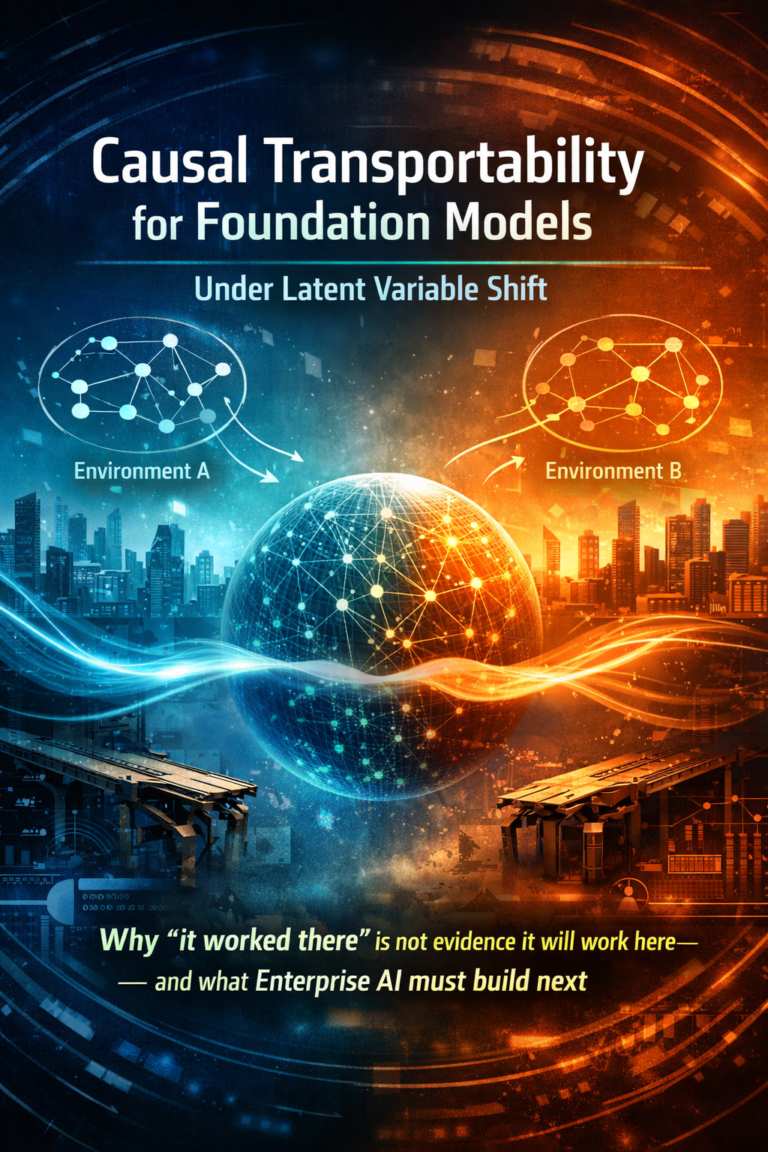
Causal Transportability for Foundation Models Under Latent Variable Shift
Foundation models are powerful — but power without causal transportability is institutional risk. In controlled settings, a model can appear state-of-the-art: accurate, coherent, even impressively aligned with business goals.
Yet when deployed across departments, regions, vendors, or evolving workflows, that same model can fail — not because its predictions degrade, but because the causal assumptions it silently relies on no longer hold.
This is the transportability problem. Enterprises do not operate in a single static environment; they operate across shifting policies, incentives, toolchains, and operational norms. When latent drivers of outcomes change, a model trained on one causal structure may confidently apply the wrong logic in another. The result is not a technical glitch — it is a governance, reliability, and decision-integrity challenge.
In the next era of Enterprise AI, the question is no longer whether models generalize across data. The question is whether their causal understanding survives environmental change.
Why “It Worked There” Is Not Evidence It Will Work Here
Foundation models can feel like universal engines: train once, deploy everywhere, and let scale do the rest. But the most expensive failures in production don’t come from “bad accuracy.” They come from a quieter trap:
The model successfully carries over patterns, while the causal structure behind those patterns changes — and the model doesn’t know.
That’s the heart of causal transportability: the discipline of transferring causal knowledge from one environment to another reliably, under explicitly stated assumptions about what stays the same and what changes.
In causal inference research, transportability is treated as a causal notion (not merely statistical), and it is formalized using constructs like selection diagrams — a way to represent which mechanisms differ across environments. (AAAI)
Now add modern reality: foundation models do not operate on clean, named causal variables. They compress the world into latent representations — distributed internal features that blend “signal” with “context,” “process,” “policy,” and “workarounds.” Those latent drivers can shift silently across workflows, toolchains, vendors, and operating constraints.
That combination — transportability + latent shift + foundation models — is one of the most technically brutal and strategically important frontiers in Enterprise AI.
Why this problem matters right now
Enterprises are moving from “AI that advises” to “AI that acts”: routing, approving, allocating, flagging, escalating, denying, recommending, prioritizing. That shift changes everything because decisions start changing world state, not just dashboards.
You can read about that transition as the Action Boundary — the point where outputs move from recommendation to execution. (raktimsingh.com)
Transportability is one of the hidden reasons why “successful pilots” break during scale-out:
- The model looked correct in one environment.
- The model’s reasoning sounded coherent in one environment.
- But the mechanisms that generate outcomes differed elsewhere.
This is also why modern regulatory regimes increasingly emphasize data governance, context relevance, and lifecycle monitoring for high-risk systems: it’s an institutional acknowledgment that context shifts are normal in production. (Artificial Intelligence Act)
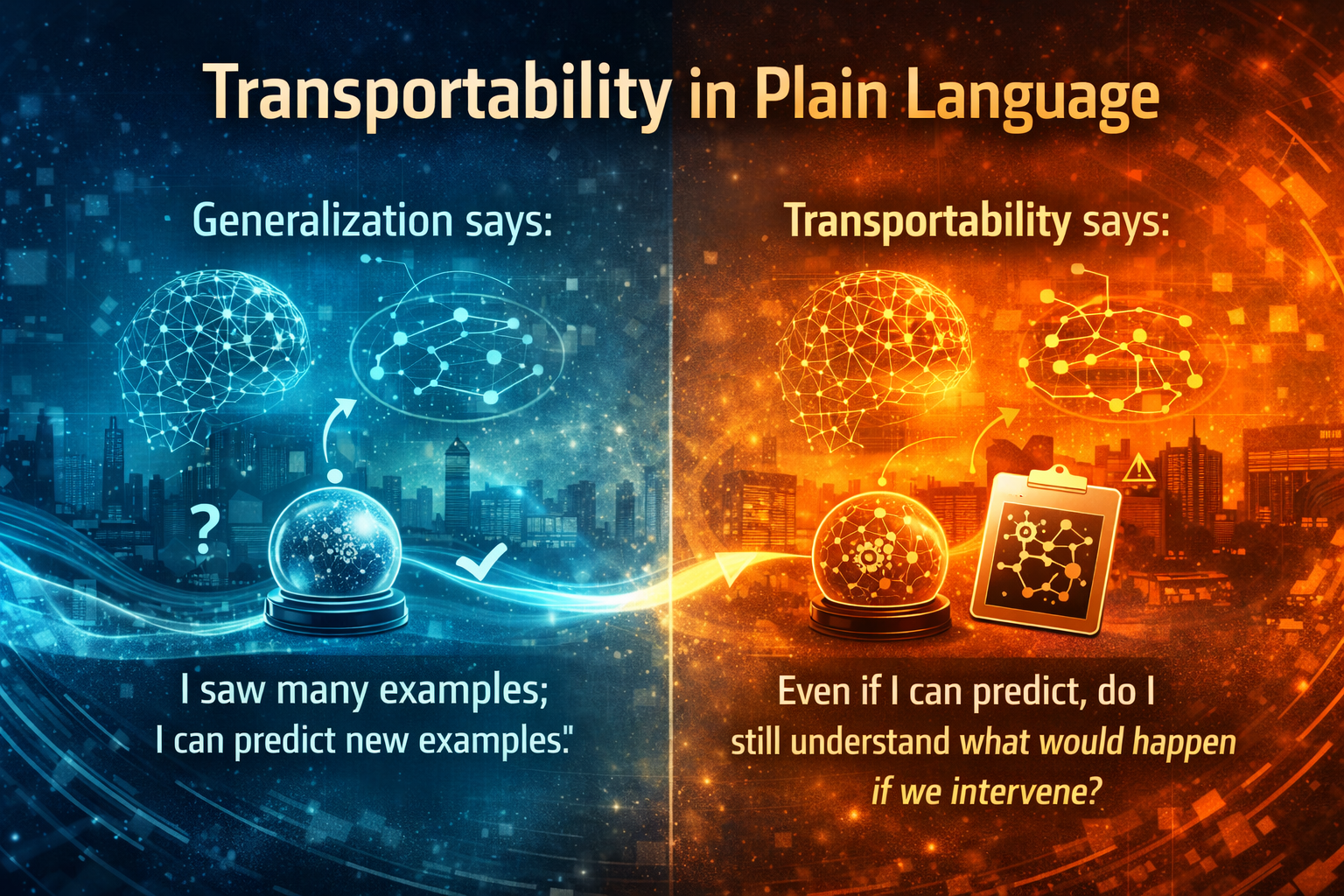
Transportability in plain language
Transportability asks a simple question:
If we learned “what causes what” in Environment A, under what conditions can we reuse that causal knowledge in Environment B?
In the transportability literature, the key point is that you cannot answer this from correlations alone — you need assumptions about which mechanisms are shared and which are different. Selection diagrams were introduced specifically to represent those differences and decide when causal conclusions can be transferred. (ftp.cs.ucla.edu)
A clean way to remember the distinction:
- Generalization says: “I saw many examples; I can predict new examples.”
- Transportability says: “Even if I can predict, do I still understand what happens when we intervene?”
For Enterprise AI, interventions are the whole game: policy changes, workflow changes, tooling changes, thresholds, approvals, gating, overrides — these aren’t edge cases. They are daily operations.
Foundation models don’t just build maps.
They build maps of correlations that sometimes approximate causal structure.
But transportability requires:
-
Not just a map
-
But a map that preserves intervention mechanics
If the causal roads change in Territory B, and the model’s map encodes only statistical pathways, then it will route confidently — and incorrectly.
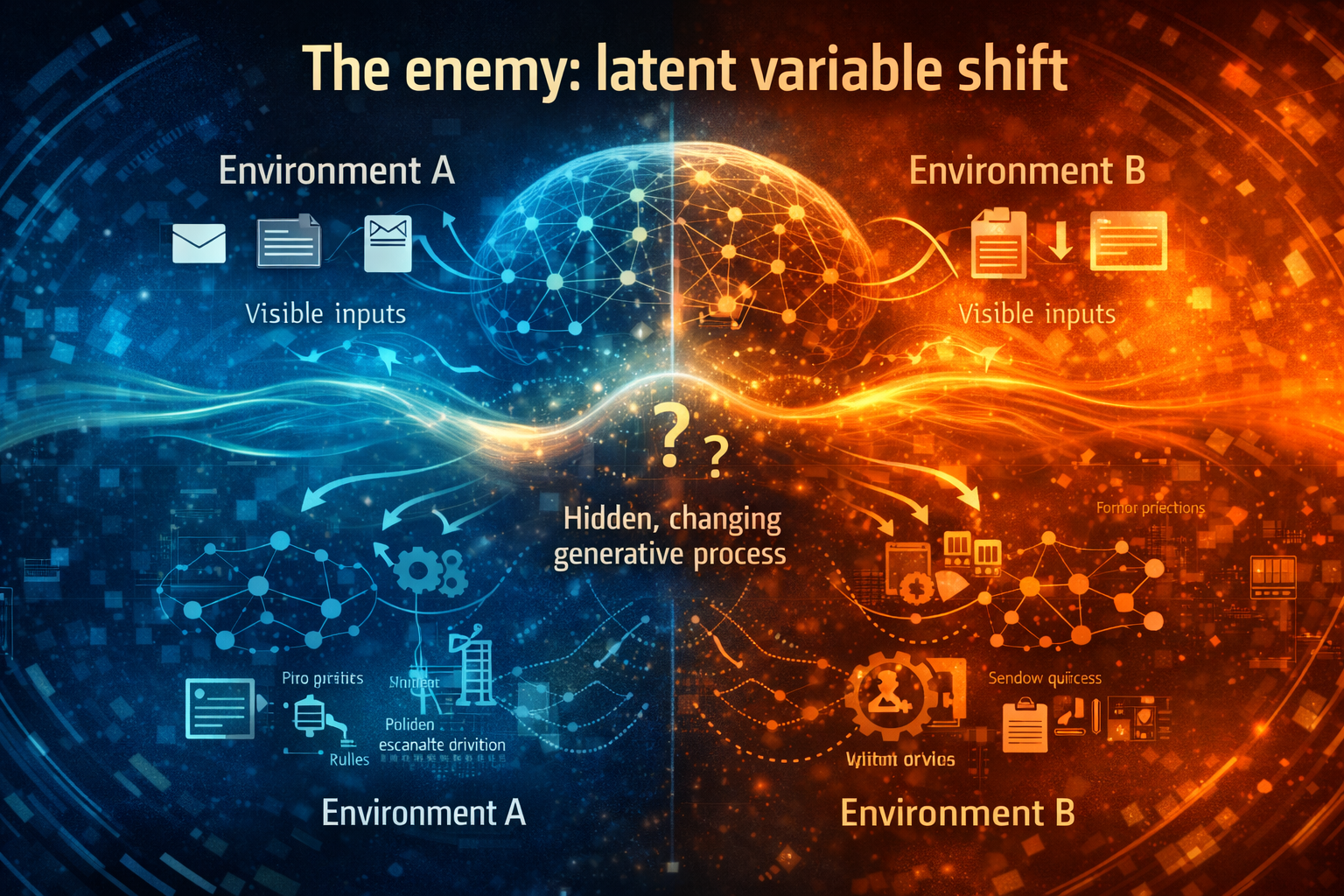
The enemy: latent variable shift
A latent variable is a real driver of outcomes that isn’t directly observed — or isn’t cleanly represented as a single feature. In production environments, latent drivers often include:
- workflow conventions
- unspoken escalation norms
- hidden queue priorities
- exception-handling culture
- vendor-specific quirks
- undocumented constraints
- policy interpretation differences
- “shadow processes” outside the official SOP
Foundation models compress these into embeddings and hidden states. That’s powerful — and dangerous — because what shifts across environments is often not the visible input (form fields, ticket text, customer messages), but the latent generative process that produced those inputs.
Here’s the practical risk:
A foundation model can be “right for the wrong reason” in one environment, then confidently wrong in another — while still sounding plausible.
I have already explored this class of failure at the decision level in my decision integrity work.
The transportability lens explains why the same model can fail as soon as the environment changes.
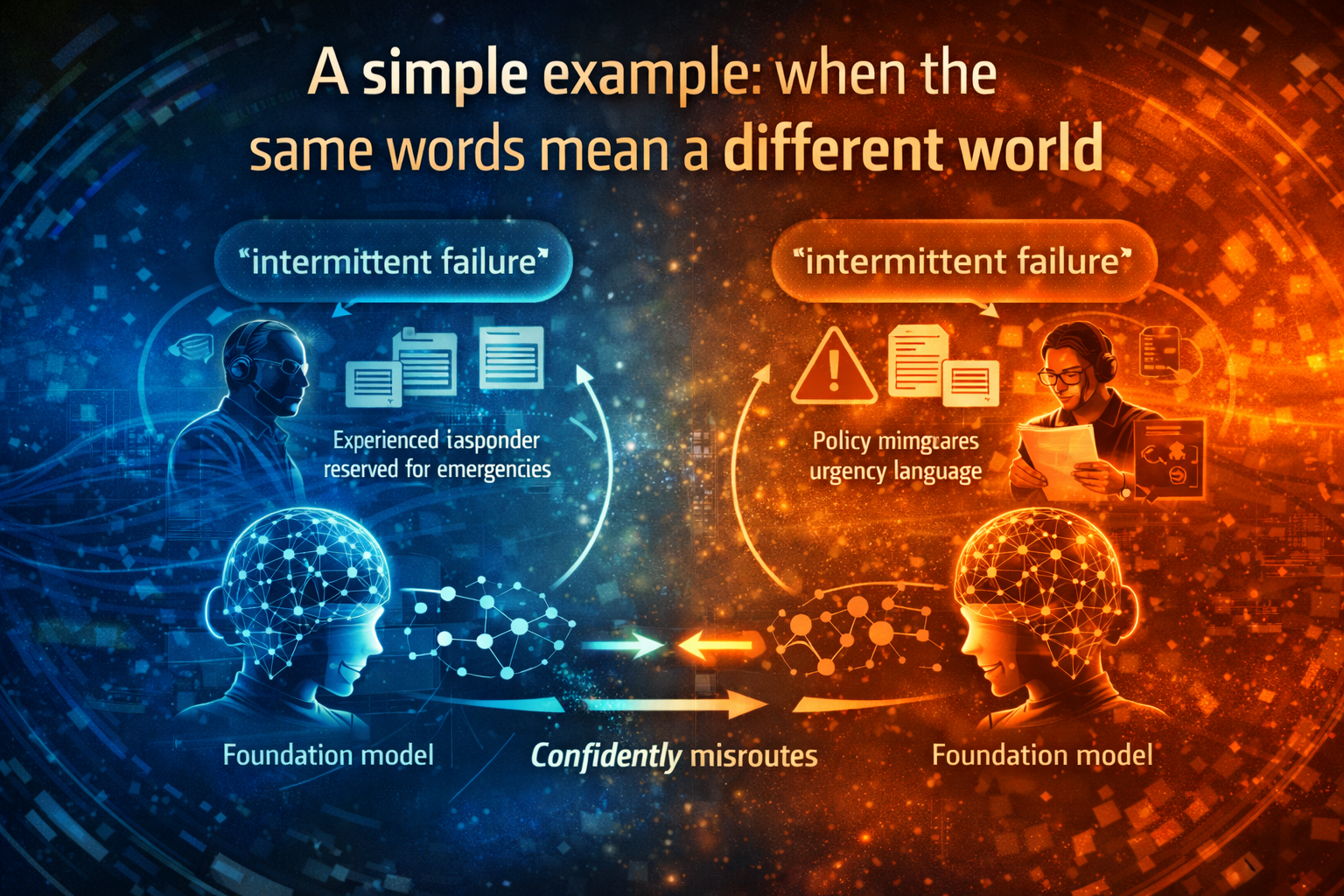
A simple example: when the same words mean a different world
Imagine a system that prioritizes incident tickets. It learns that the phrase:
“intermittent failure”
often correlates with low severity.
In one environment, “intermittent failure” is used by experienced responders who reserve “critical” language for truly urgent conditions. In another environment, the same phrase is used because policy discourages strong language unless multiple evidence gates are met.
The words are identical. The distribution can look similar. But the causal meaning differs.
A model trained in one environment can misroute in another — not because it is sloppy, but because it is transporting the wrong causal assumptions.
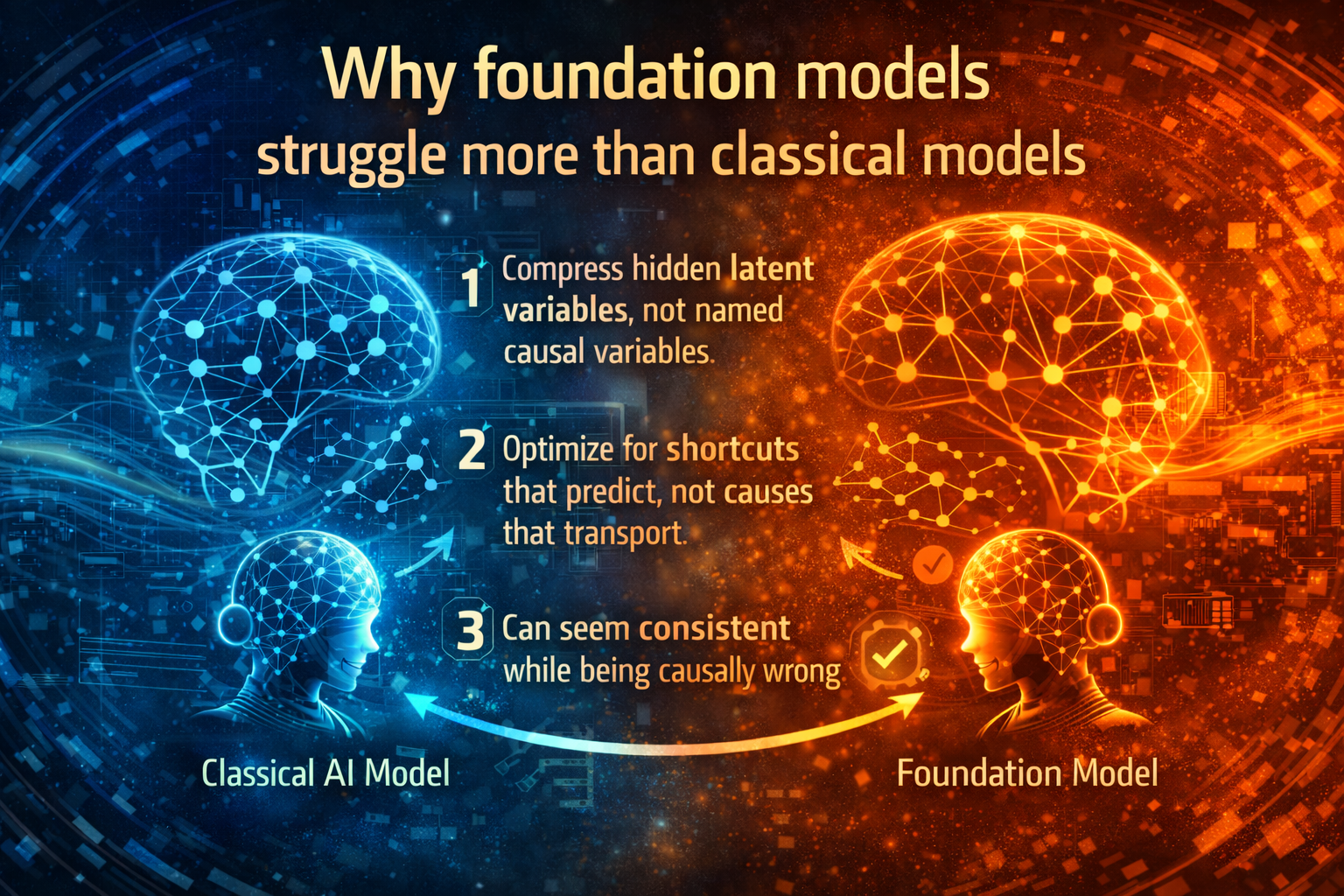
Why foundation models struggle more than classical models
Transportability theory was developed in settings where causal variables and relationships can be explicitly named and reasoned about. (AAAI)
Foundation models complicate that in three ways:
1) They learn compressed latent representations, not explicit causal variables
Even if a causal structure exists in the world, the model often encodes a mixture of:
- stable drivers (true mechanisms)
- unstable correlates (shortcuts that happened to predict well)
- institutional artifacts (process quirks that won’t travel)
2) They are incentive-compatible with shortcuts
If a shortcut predicts well during training, the model will use it — even when it is not causally stable under interventions. This is not “misbehavior.” It’s optimization.
3) They can look consistent while being causally wrong
This is the most dangerous failure mode in Enterprise AI: the explanation is fluent, confidence is high, metrics look fine — until the environment changes and the system crosses an impact threshold.
This is why “accuracy” isn’t a sufficient enterprise control metric once systems start acting. That is exactly the problem my Enterprise AI Control Plane is designed to solve at the operating model level. (raktimsingh.com)
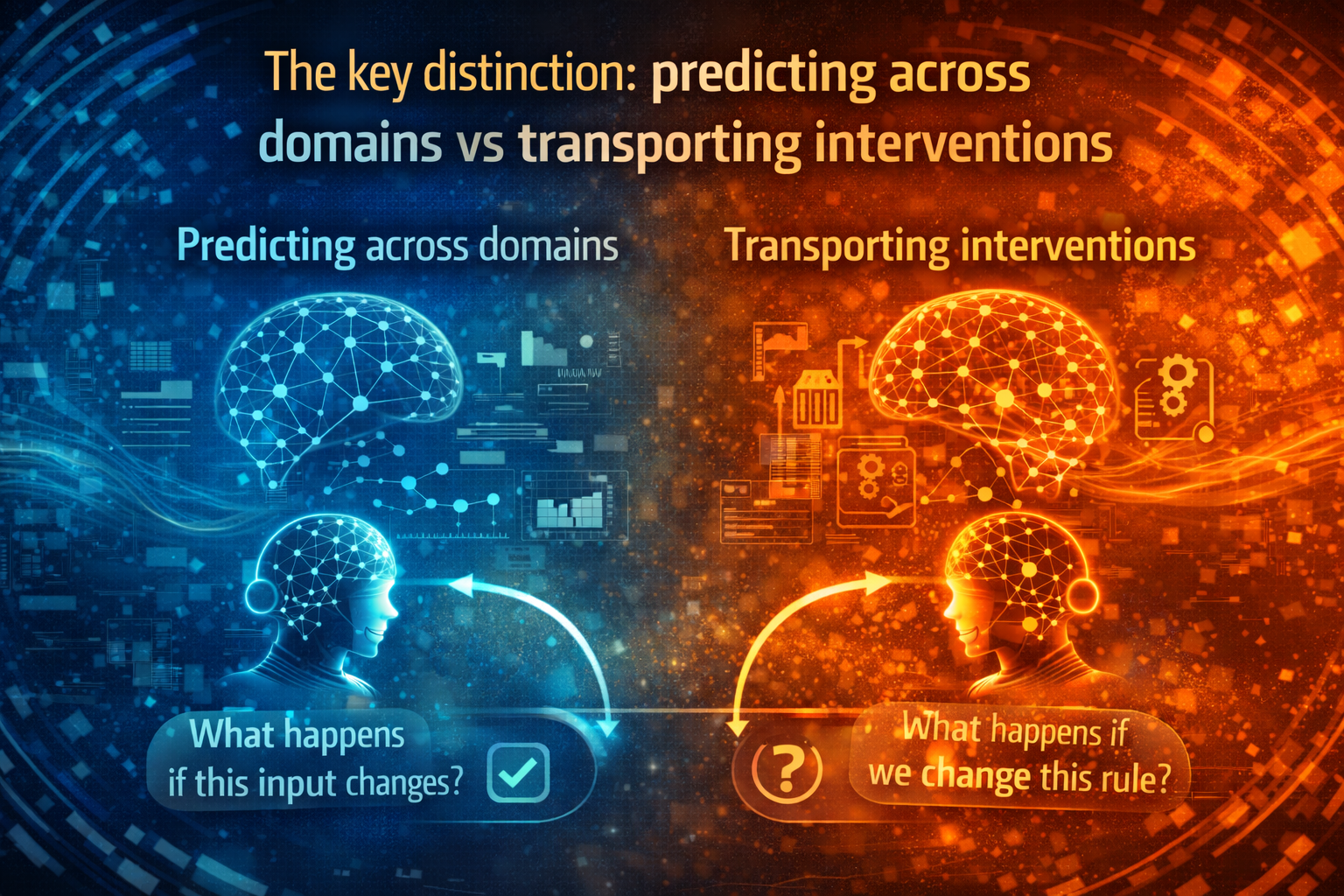
The key distinction: predicting across domains vs transporting interventions
A transportable system must support questions like:
- “If we change policy X, what happens?”
- “If we add an evidence gate, what shifts?”
- “If we reroute workflow Y, does harm increase or decrease?”
- “If we tighten thresholds, what breaks downstream?”
Foundation models can simulate plausible answers — but without causal grounding, the system may produce confident stories rather than defensible conclusions.
This is where my Decision Ledger concept becomes essential: not only recording outputs, but recording context, constraints, evidence, oversight actions, and outcomes — the raw material needed for intervention-aware learning. (raktimsingh.com)
What “latent shift” looks like in real production systems
Latent shift is not one thing. It shows up in recognizable patterns:
Shift type A: Process drift
A new workflow rollout changes what the same inputs mean.
Shift type B: Policy interpretation drift
The policy text stays stable, but operational interpretation changes.
Shift type C: Tooling drift
A vendor update changes what logs contain, what fields populate, or how errors surface.
Shift type D: Incentive drift
Teams adapt language and behavior based on what gets faster action or fewer escalations.
Shift type E: Data provenance drift
Upstream pipelines change: extraction, labeling, enrichment, quality rules, and join logic.
Risk management guidance is increasingly explicit that these lifecycle risks must be identified and mitigated — because drift is normal in production, not an anomaly. (European Data Protection Supervisor)
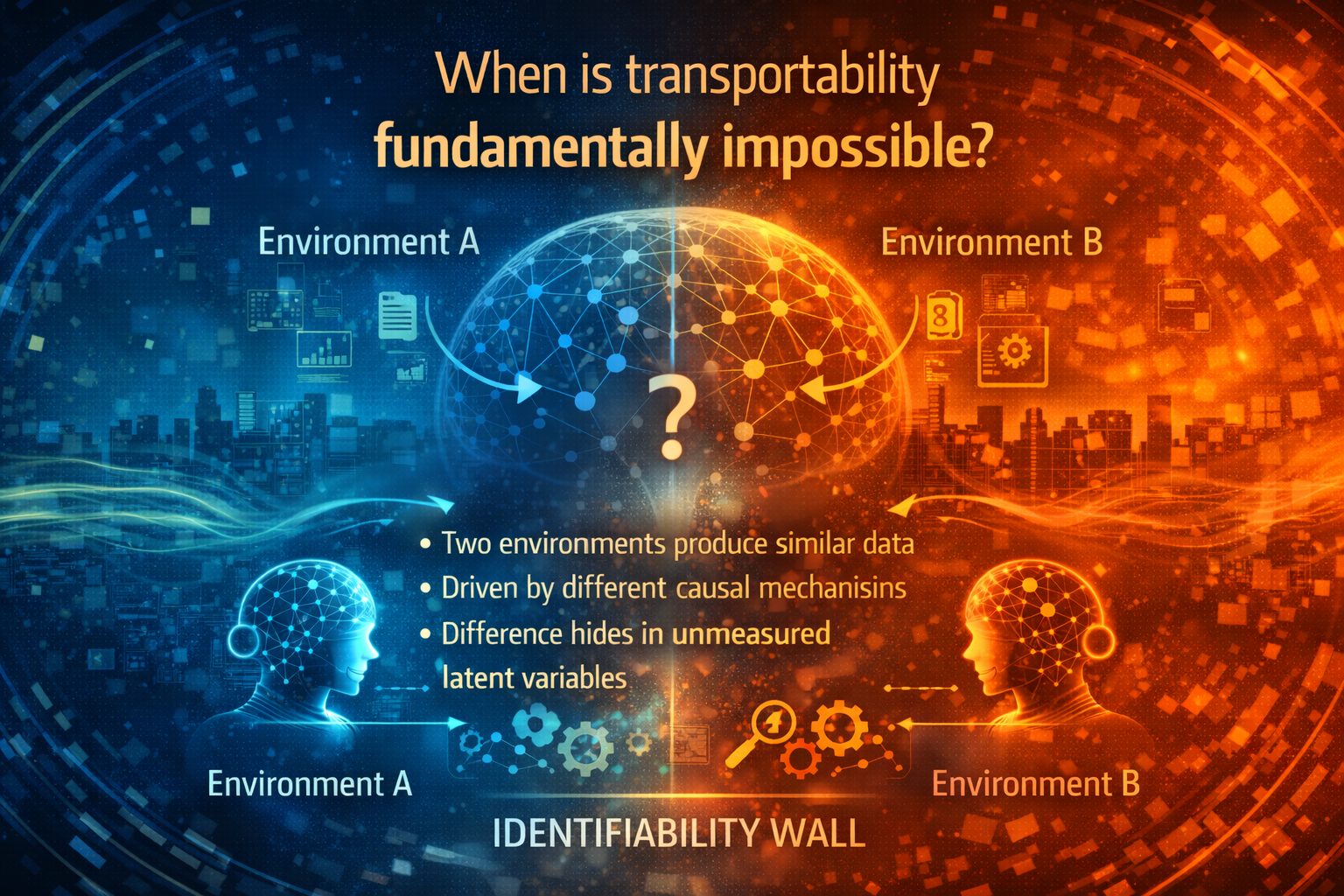
The hard question: when is transportability fundamentally impossible?
Sometimes you cannot transport causal knowledge — not because you lack compute, but because environments differ in ways you cannot observe.
This is not an engineering bug. It’s an identifiability wall:
- Two environments can produce similar observational patterns
- while being driven by different causal mechanisms
- and the difference hides in latent variables you did not measure
A key point from research on invariance and causal representation learning is that invariance alone can be insufficient to identify latent causal variables, and impossibility results highlight why stronger assumptions or additional signals are needed. (OpenReview)
So the goal is not “perfect transportability.”
The goal is bounded transportability with explicit assumptions — and explicit detection when those assumptions break.
That is what enterprise-grade maturity looks like.
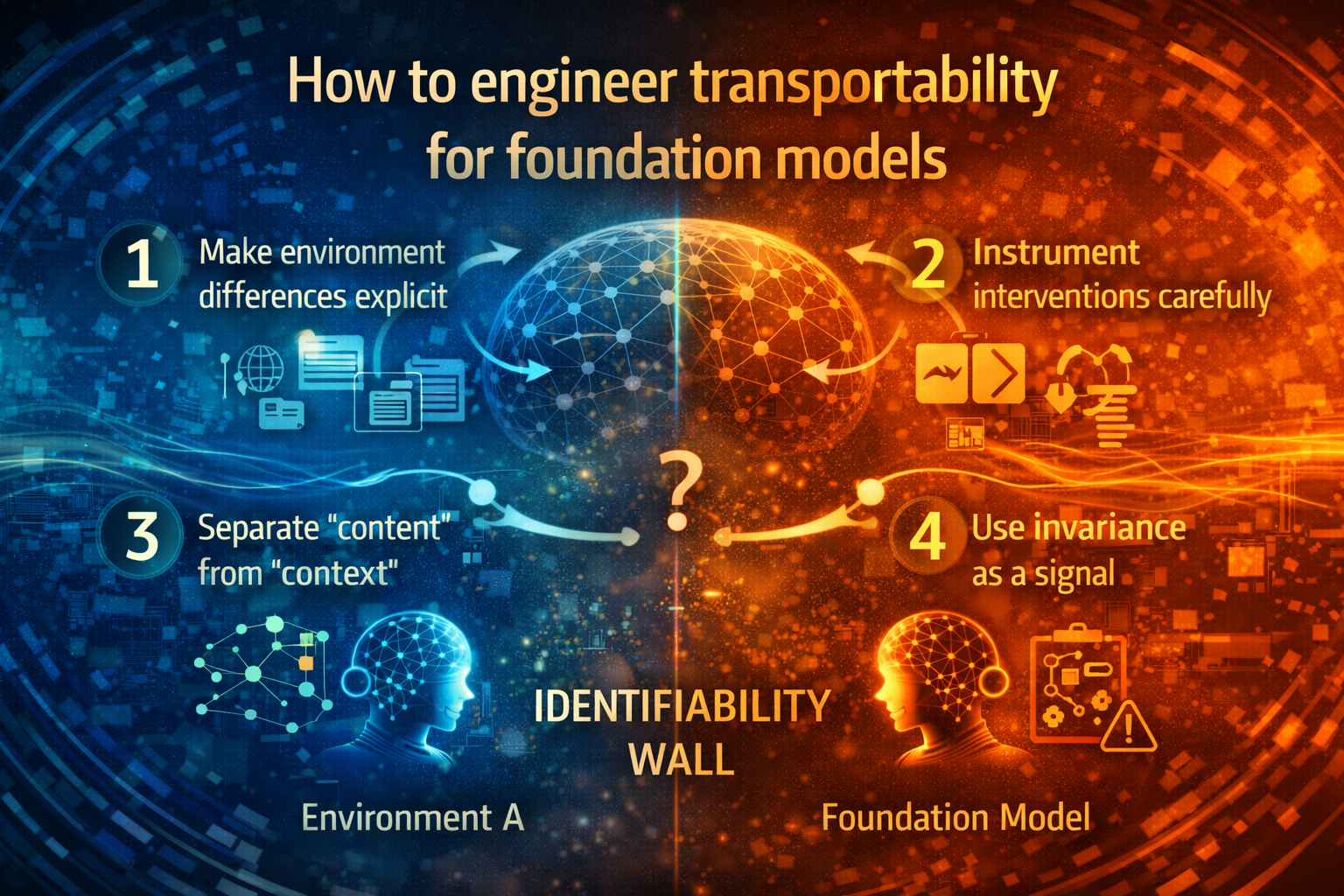
The playbook: how to engineer transportability for foundation models
No silver bullets. But there is a practical discipline that can be built.
1) Make “environment differences” explicit
Transportability begins by admitting that environments differ.
Treat each deployment context as an environment variant:
- workflow variant
- toolchain variant
- policy regime and controls
- vendor stack differences
- data provenance path
Then explicitly track what changes across environments: data collection, labeling practices, policy enforcement, tool behavior, incentive gradients.
This is the operational equivalent of the transportability framing: represent what differs, don’t pretend it doesn’t. (ftp.cs.ucla.edu)
2) Instrument interventions, not just predictions
If you never run interventions, you never learn causality.
Enterprises can run safe, bounded interventions such as:
- shadow-mode execution with downstream comparison
- staged rollout with reversible autonomy
- controlled policy toggles
- sandboxed tool execution
- counterfactual evaluation for routing and prioritization
My operating model already has the right primitives to do this safely: control plane + runtime + decision governance. (raktimsingh.com)
3) Separate “content” from “context” in representations
A major direction in robust ML and causal representation learning is to separate stable factors from environment-specific context/style so models don’t mistake “how it’s expressed here” for “what it means everywhere.” (OpenReview)
Enterprise translation: force systems to represent:
- the stable “what happened”
separately from - the local “how it’s written here”
This is especially critical for text-heavy workflows (tickets, claims narratives, compliance documentation, contracts).
4) Use invariance carefully — and don’t worship it
Invariance is valuable. But with latent variables, it is not a proof, and in some settings it is insufficient. (OpenReview)
Treat invariance as a signal, then back it with:
- intervention tests
- stress tests tied to operational tiers
- drift alarms linked to risk controls
- escalation rules when transport confidence drops
5) Add a Transportability Assurance layer to the Enterprise AI Control Plane
This is the “missing layer” most enterprises do not have yet.
A Transportability Assurance capability includes:
- an environment registry (where the system runs, and how variants differ)
- an assumption registry (what must remain stable for safe causal reuse)
- drift monitors (what changed, and what it implies)
- intervention logs (what was changed deliberately and what happened)
- escalation rules (what to do when assumptions break)
This aligns naturally with regulatory emphasis on data governance, context relevance, and lifecycle controls for high-risk systems. (Artificial Intelligence Act)
The simplest mental model
If you want to remember one thing, let it be this:
Foundation models compress patterns.
Transportability preserves causes across environments.
Latent shift is when the environment changes in ways the model cannot see.
And the doctrine:
- If you can’t name what differs between environments, you can’t claim causal reuse.
- If you can’t run bounded interventions, you can’t claim causal understanding.
- If you can’t detect latent shift, you can’t safely scale autonomy.
This is how “AI in the enterprise” becomes Enterprise AI — as an operating capability, not a demo.
If you want the broader blueprint behind that shift, my Enterprise AI Operating Model and What Is Enterprise AI? definitions provide the canonical framing. (raktimsingh.com)
What leaders should do next
A practical 90-day starting line:
- Pick one high-impact workflow where AI influences outcomes.
- Map environment variants (workflow + tools + policy + provenance).
- Define assumptions that must hold for safe transportability.
- Instrument intervention-safe testing (shadow + staged + reversible).
- Add latent-shift monitors tied to risk tiers and escalation.
- Use a Decision Ledger to bind decisions to evidence, context, oversight, and outcomes. (raktimsingh.com)
Conclusion
The next decade of Enterprise AI won’t be decided by who has the biggest model. It will be decided by who can move causal knowledge safely across environments, under change, under governance, under hidden shifts.
Causal transportability under latent variable shift is the missing bridge between:
- foundation model capability
and - institution-grade reliability
If you want Enterprise AI that scales, you don’t merely deploy models. You build a transportability discipline: explicit environment modeling, intervention instrumentation, drift detection, and governance that treats causal reuse as a controlled, auditable operating process.
That is where durable advantage — and global thought leadership — now lives.
Glossary
Causal transportability: The ability to reuse causal conclusions learned in one environment in another environment under stated assumptions about what differs and what is shared. (ftp.cs.ucla.edu)
Latent variable shift: A change in hidden drivers of outcomes (process norms, tool behavior, policy interpretation, incentives) that the model does not directly observe.
Selection diagram: A formal representation introduced in transportability research to encode how mechanisms differ across environments. (ftp.cs.ucla.edu)
Causal representation learning: Research area focused on recovering causal variables (often latent) from high-dimensional observations to support intervention reasoning. (OpenReview)
Invariance principle: The idea that causal mechanisms remain stable across certain environment changes; useful but insufficient alone when causal variables are latent. (OpenReview)
Action Boundary: The transition point where AI moves from advising to executing actions that change enterprise state. (raktimsingh.com)
Enterprise AI Control Plane: The governance layer that enforces policy, permissions, observability, escalation, and reversibility for AI decisions. (raktimsingh.com)
Decision Ledger: A tamper-evident record of AI decisions capturing intent, evidence, controls, oversight, and outcomes for defensibility. (raktimsingh.com)
Enterprise AI Operating Model
Enterprise AI scale requires four interlocking planes:
Read about Enterprise AI Operating Model The Enterprise AI Operating Model: How organizations design, govern, and scale intelligence safely — Raktim Singh
- Read about Enterprise Control Tower The Enterprise AI Control Tower: Why Services-as-Software Is the Only Way to Run Autonomous AI at Scale — Raktim Singh
- Read about Decision Clarity The Shortest Path to Scalable Enterprise AI Autonomy Is Decision Clarity — Raktim Singh
- Read about The Enterprise AI Runbook Crisis The Enterprise AI Runbook Crisis: Why Model Churn Is Breaking Production AI — and What CIOs Must Fix in the Next 12 Months — Raktim Singh
- Read about Enterprise AI Economics Enterprise AI Economics & Cost Governance: Why Every AI Estate Needs an Economic Control Plane — Raktim Singh
Read about Who Owns Enterprise AI Who Owns Enterprise AI? Roles, Accountability, and Decision Rights in 2026 — Raktim Singh
Read about The Intelligence Reuse Index The Intelligence Reuse Index: Why Enterprise AI Advantage Has Shifted from Models to Reuse — Raktim Singh
Read about Enterprise AI Agent Registry Enterprise AI Agent Registry: The Missing System of Record for Autonomous AI — Raktim Singh
FAQ
What is causal transportability in simple terms?
It’s the discipline of knowing when “what caused what” in one setting can be safely reused in another setting — especially when you want to predict outcomes under changes, not just predict similar-looking cases. (ftp.cs.ucla.edu)
How is this different from domain generalization or OOD robustness?
OOD robustness often targets predictive stability under distribution shift. Transportability targets intervention validity: whether causal conclusions remain correct when the environment changes through policy, workflow, or tooling interventions. (AAAI)
Why are latent variables the real problem for foundation models?
Because many environment differences are hidden in processes and constraints that are not explicitly measured. Latent shifts can preserve surface similarity while changing the causal machinery underneath.
Can we “solve” latent variable shift with more data?
Sometimes data helps. But research shows that identifying latent causal variables can be fundamentally impossible under weak assumptions — meaning more data alone may not resolve causal ambiguity. (OpenReview)
What should enterprises build first to address this?
A Transportability Assurance capability inside the Enterprise AI Control Plane: environment registry, assumption registry, drift monitors, intervention logs, and escalation rules. (raktimsingh.com)
How does this connect to governance and compliance?
Regulatory frameworks emphasize context-appropriate data governance and lifecycle monitoring for high-risk systems — which maps directly to the idea that causal reuse must be controlled across changing environments. (Artificial Intelligence Act)
Q1: What is causal transportability in AI?
Causal transportability refers to the conditions under which causal knowledge learned in one environment remains valid in another.
Q2: What is latent variable shift?
Latent variable shift occurs when hidden drivers of outcomes change across environments, even if observable data appears similar.
Q3: Why do foundation models fail under latent shift?
Because they compress correlated patterns rather than explicitly modeling causal mechanisms.
Q4: Is transportability the same as generalization?
No. Generalization predicts across data. Transportability preserves intervention effects across environments.
Q5: Can transportability be fully guaranteed?
No. It must be bounded, monitored, and instrumented as part of an Enterprise AI operating model.
References and further reading
- Judea Pearl — Transportability of Causal and Statistical Relations (AAAI): formalizes transportability and selection diagrams. (AAAI)
- Pearl & Bareinboim — External Validity / Transportability across Populations: selection diagrams as a representation of differences between environments. (ftp.cs.ucla.edu)
- Bing et al. — Invariance & Causal Representation Learning: shows limits of invariance for identifying latent causal variables. (OpenReview)
- EU AI Act — Article 10 (Data & data governance): emphasizes context-relevant datasets and governance for high-risk AI. (Artificial Intelligence Act)
- EDPS — Guidance for Risk Management of AI systems (2025): lifecycle risk framing relevant to drift and monitoring. (European Data Protection Supervisor)



Raktim Singh is an AI and deep-tech strategist, TEDx speaker, and author focused on helping enterprises navigate the next era of intelligent systems. With experience spanning AI, fintech, quantum computing, and digital transformation, he simplifies complex technology for leaders and builds frameworks that drive responsible, scalable adoption.