
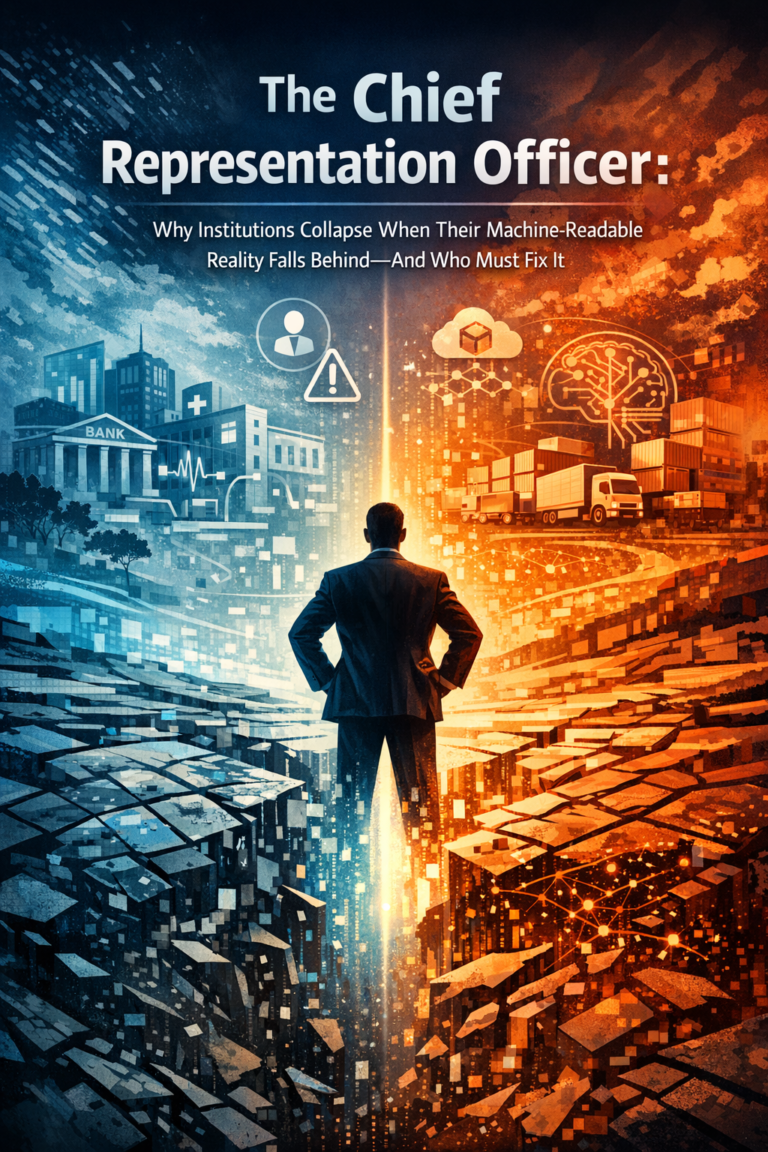
The Chief Representation Officer: Executive summary
Most enterprises still think AI failure begins with the model. They are wrong.
The deeper failure begins earlier — when the institution’s machine-readable view of customers, assets, suppliers, risks, operations, and contexts no longer matches reality.
This article introduces representation collapse as a new theory of institutional failure and argues that large enterprises will increasingly need a Chief Representation Officer: an executive accountable for the integrity of machine-readable reality across the organization. As AI moves from assistance to action, this role may become as important as the CIO, CFO, or CRO in safeguarding resilience, trust, and growth.
Executive Definition
Chief Representation Officer (CReO) is an emerging executive role responsible for ensuring that an organization’s machine-readable view of reality—its data, identities, states, and decision context—remains accurate, current, and governable, enabling AI systems to act safely and effectively.
AI systems do not fail only because they are unintelligent.
They fail because they act on an outdated or incomplete representation of reality.
Why this matters now
The AI conversation is still dominated by model size, copilots, agents, prompts, and automation. Yet the real strategic question is much more foundational:
What happens when an institution becomes increasingly intelligent, but increasingly wrong about the world it is acting on?
That is the hidden failure pattern of the next decade.
Banks will not break only because their models are weak. They will break because the customer reality inside their systems is fragmented. Hospitals will not struggle only because AI is immature. They will struggle because patient state is incomplete, delayed, or disconnected. Governments will not fail at digital delivery only because adoption is low. They will fail because identity, eligibility, grievance, and entitlement realities do not travel together in machine-readable form.
This is not a narrow data issue. It is not just an AI governance issue. It is not just a systems integration issue.
It is a deeper institutional problem: the collapse of representational fidelity.
And in the Representation Economy, that problem becomes central.
What is a Chief Representation Officer?
A Chief Representation Officer is a senior executive responsible for ensuring that an organization’s machine-readable representation of reality—across data, identities, states, and systems—remains accurate, connected, and governable, so that AI-driven decisions are reliable and trustworthy.
The failure begins before the model begins
Most institutions still treat AI as an intelligence layer added on top of existing systems. They ask whether a model is accurate enough, fast enough, explainable enough, or inexpensive enough. So they invest in better models, better prompts, better agents, better interfaces, and better dashboards.
But that is increasingly the wrong place to begin.
Institutions do not collapse in the AI era because they lack intelligence. They collapse because the reality inside their systems stops matching the reality outside them.
A bank may have a sophisticated AI underwriting model, yet still misread a customer’s financial condition because identity, obligations, transaction behavior, and life events live across disconnected systems.
A hospital may deploy AI-assisted triage, yet still make unsafe decisions because medications, allergies, diagnostic updates, and prior history are not synchronized. A supply chain may run predictive AI at scale, yet still fail because inventory state, supplier reliability, weather signals, customs delays, and warehouse constraints are poorly linked.
In each case, the institution is not failing because AI cannot reason. It is failing because the institution no longer knows — in machine-readable form — what is actually true.
That is the hidden crisis of the AI age: representation collapse. Your draft already identified this core idea, and that remains the article’s most original contribution.
What is representation collapse?
Representation collapse is what happens when an institution’s internal, machine-readable view of the world becomes misaligned with the real world it is trying to govern, serve, predict, optimize, or act upon.
This misalignment usually appears long before a visible crisis.
It starts quietly.
A customer has changed jobs, moved cities, shifted repayment behavior, or adopted a different risk pattern, but internal systems still see an older version of that person. A supplier’s reliability has degraded, but procurement systems continue to rank that supplier as stable. A patient’s condition evolves across visits, devices, labs, and notes, but the AI-enabled workflow sees only a partial picture. A citizen appears in multiple fragmented systems, but service delivery logic cannot reliably recognize them as the same person.
Over time, the institution continues to act on a frozen, partial, delayed, or distorted version of reality. Once AI is added, that distortion does not disappear. It scales.
This matters because trustworthy AI depends on far more than model performance. NIST’s AI Risk Management Framework emphasizes that AI risk management must account for context, data and inputs, evaluation, and governance across the AI lifecycle, not just the model itself. Its Generative AI Profile likewise highlights the need to assess the accuracy, representativeness, relevance, and suitability of data and inputs used by AI systems. (NIST)
That is an important clue. It suggests that the hidden weakness in many AI programs is not only algorithmic performance. It is whether the institution’s inputs and representations remain faithful enough to the world the organization is acting upon.
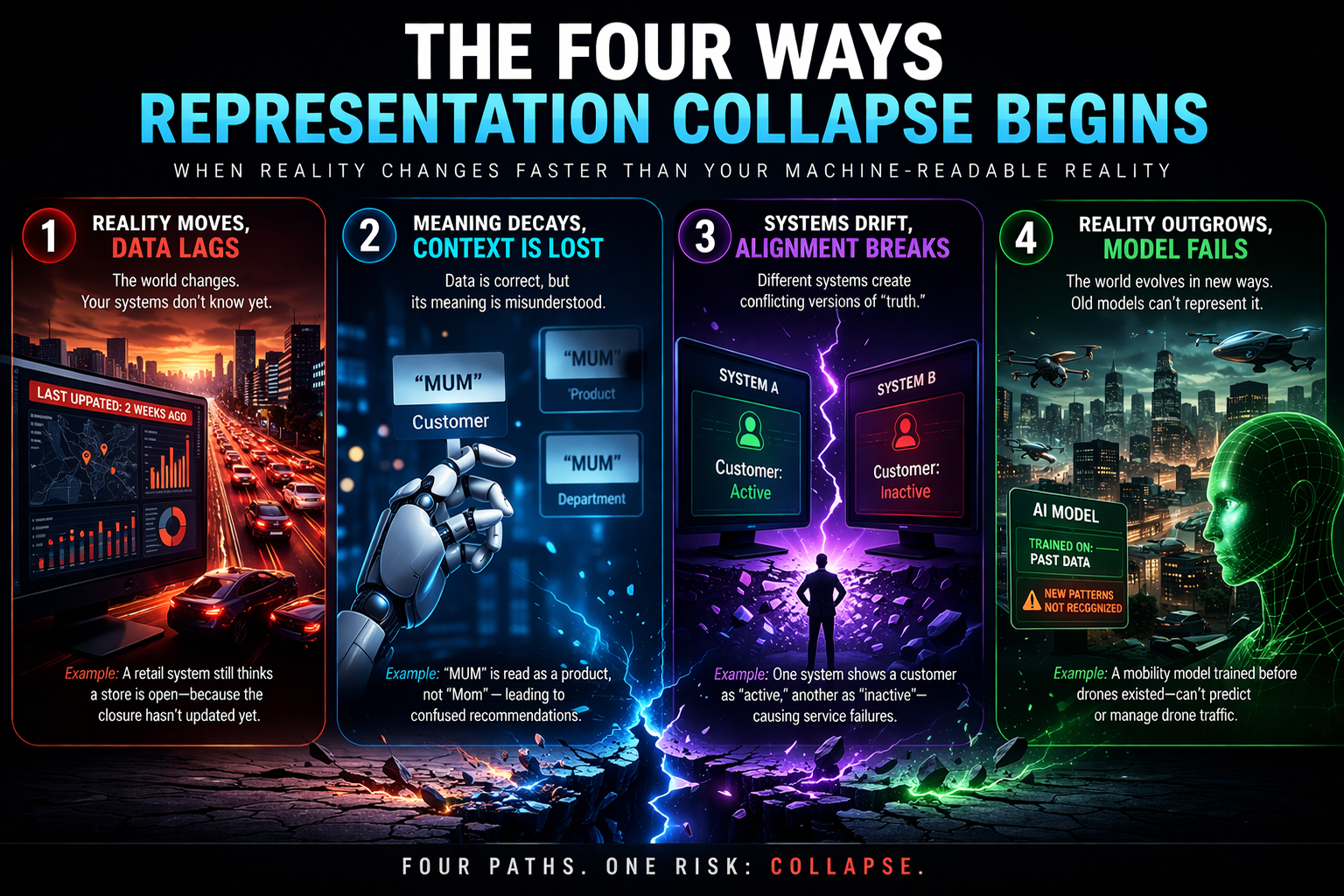
The four ways representation collapse begins
Representation collapse rarely arrives all at once. It usually grows through four distinct but connected failures.
-
Signal decay
Institutions run on signals: transactions, clicks, documents, approvals, sensor readings, incident logs, conversations, exceptions, behavioral traces, lab results, and environmental events.
Signals decay in value when they are late, missing, noisy, manipulated, or collected from the wrong place.
A fraud system trained on clean historical patterns may perform well in testing, then degrade in production because attacker behavior evolves faster than signal capture. A customer service AI may sound impressive while acting on stale service records. A predictive maintenance model may appear accurate, but only because it is not seeing the signals that would reveal newly emerging faults.
The problem is not that the institution is blind.
The problem is that it is seeing old light.
-
Entity distortion
Before an institution can reason, it must know who or what it is reasoning about.
Is this the same customer across channels? Is this vendor the same legal entity under a different identifier? Is this patient record correctly linked? Is this shipment, machine, contract, location, or policy object represented consistently across systems?
This is where identity becomes strategic infrastructure.
The World Bank’s ID4D initiative notes that many people globally still lack official identification or usable digital identity for secure transactions and access to services. In the AI era, that matters even more, because institutions cannot act responsibly on realities they cannot reliably identify. (OECD)
In the Representation Economy, identity is not administrative plumbing.
It is the admission ticket into machine-legible systems.
-
State lag
Reality changes continuously. Many institutions do not.
A customer who was low-risk six months ago may now be overextended. A shipment that was on schedule this morning may be delayed by evening. A machine that was healthy last week may now be approaching failure. A treatment plan that was valid yesterday may now require urgent revision.
If systems update too slowly, machine-readable state becomes an outdated portrait. The institution looks intelligent, but acts from an old snapshot.
-
Evolution blindness
The hardest problem is not representing a point-in-time state. It is understanding how that state evolves.
That requires tracking trajectories, not just fields. Movement, drift, context shifts, new dependencies, behavioral changes, emerging patterns, and environmental conditions all matter. Many enterprises record what something is. Far fewer continuously model what it is becoming.
This is where many AI systems break. They are deployed into a moving world with static assumptions.
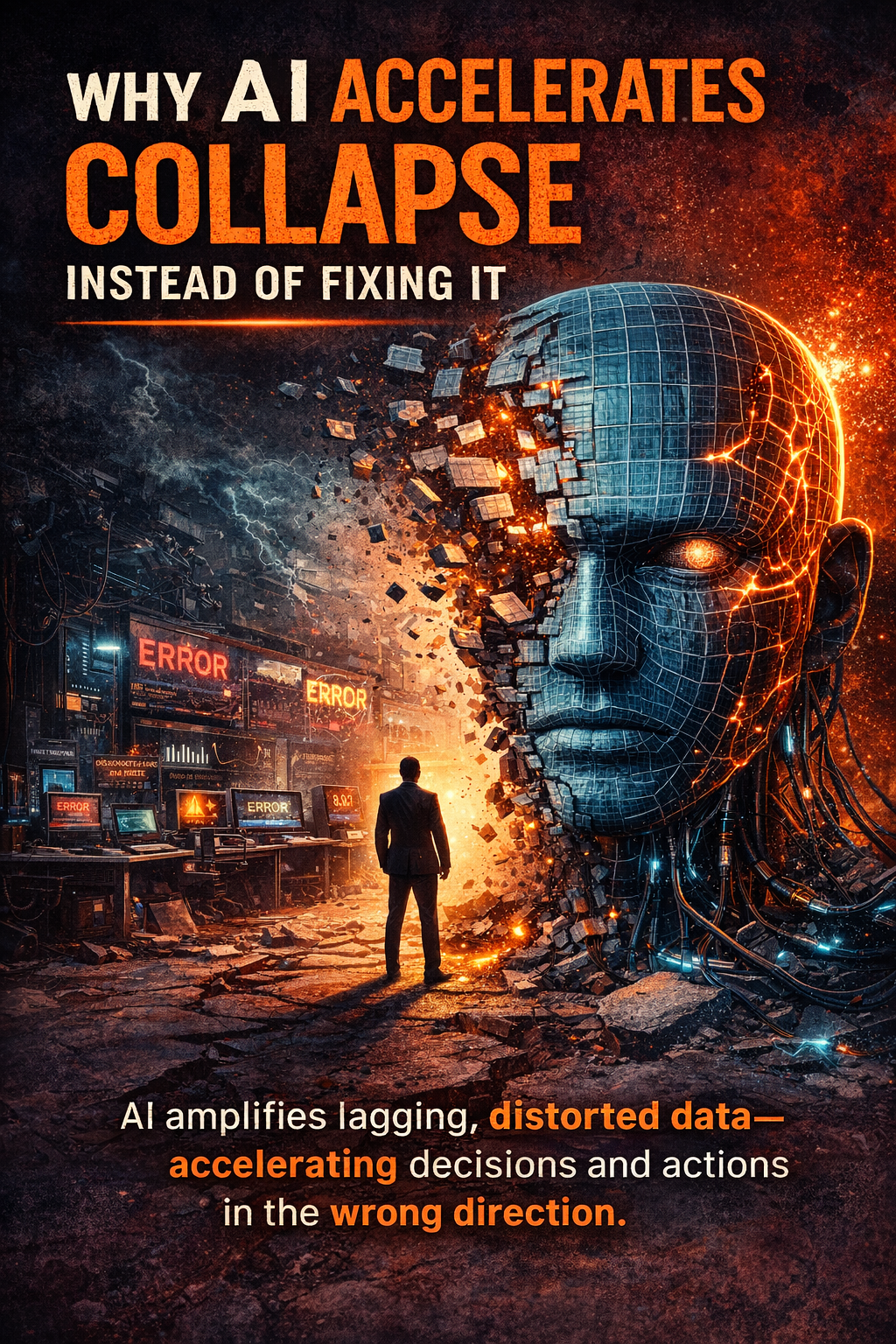
Why AI accelerates collapse instead of fixing it
There is still a common assumption that AI will somehow clean up institutional messiness. That once a smarter model is added, broken data, fragmented systems, and incomplete reality will become manageable.
Sometimes AI can compensate for weak systems.
But at scale, the opposite is often true.
AI does not automatically solve representation problems. It amplifies them.
It amplifies them because it increases speed, confidence, reach, and automation. A flawed human judgment may affect one customer. A flawed AI-mediated judgment can affect millions. A poor manual classification may remain local. A poor machine-readable representation can propagate across workflows, recommendations, approvals, audits, escalations, and downstream systems.
The OECD AI Principles emphasize that AI should be innovative and trustworthy, respect human rights and democratic values, and support robustness, transparency, accountability, and the capacity for people to understand and challenge outcomes. Those goals become far harder to achieve when the underlying representation of reality is already distorted. (OECD)
This is the deeper strategic point:
AI turns slow institutional drift into fast institutional failure.
Before AI, representation weaknesses could remain hidden behind human judgment, delay, improvisation, and exception handling. Humans often sensed that something was off. They paused. They called someone. They used context that never entered the system.
AI reduces that friction. It operationalizes assumptions. It industrializes action. It makes representation quality a first-order strategic issue.
Representation collapse is already a board-level risk
Representation collapse is not a narrow technical problem. It is a compound governance issue that affects risk, trust, compliance, resilience, service quality, fairness, and growth.
The EU AI Act established the first broad legal framework for AI in the EU and entered into force on August 1, 2024. It is built around a risk-based approach and increases expectations around oversight, transparency, accountability, and lifecycle controls for higher-risk AI uses. (Digital Strategy)
But regulation only captures part of the problem.
An institution can be technically compliant and still fail operationally if the reality inside its systems is outdated, fragmented, or falsely simplified.
Consider a few simple examples:
A retail bank denies a creditworthy customer because income, obligations, and identity signals are spread across disconnected systems. The model may be statistically competent. The representation is not.
A hospital deploys AI-assisted triage, but allergy history, medication data, and recent test updates are not synchronized. The model is not the only risk. The patient representation is.
A logistics enterprise optimizes routes using AI, but supplier status, weather, customs delays, and warehouse constraints are poorly linked. The algorithm may not be broken. The institution’s machine-readable world is incomplete.
A government digitizes public service delivery, but citizens cannot be reliably recognized across identity, eligibility, payment, and grievance systems. The issue is not merely digitization. It is representational continuity.
This is why digital public infrastructure has become strategically important. The World Bank describes DPI as foundational digital building blocks such as digital identity, digital payments, and trusted data sharing that can improve service delivery across sectors. That matters for AI because intelligence cannot work reliably where representation infrastructure is weak. (OECD)
Boards already audit financial statements because capital depends on trustworthy representation of economic reality.
In the AI era, boards will increasingly need to audit something else as well:
How reality itself is being represented inside decision systems.
Why existing executives cannot fully own this problem
One reason representation collapse remains under-managed is that it sits awkwardly across current executive roles.
The CIO owns systems, integration, enterprise platforms, and operating reliability.
The CTO owns architecture, engineering direction, and innovation.
The Chief Data Officer owns data assets, lineage, governance, and analytics.
The Chief Risk Officer owns enterprise risk.
The Chief Compliance Officer owns policy interpretation and regulatory controls.
The Chief AI Officer, where it exists, often owns AI strategy, adoption, and deployment.
All of these roles matter.
None of them fully owns the integrity of machine-readable reality across the institution.
That is a different problem.
Representation is not just data quality. It is whether the institution’s decision systems carry a truthful, current, connected, and governable view of entities, states, relationships, permissions, histories, and changes over time.
That responsibility is too important to remain scattered.

Enter the Chief Representation Officer
The Chief Representation Officer is the executive accountable for the institutional integrity of machine-readable reality.
This is not a cosmetic rebranding of data governance. It is broader, more strategic, and more consequential.
The Chief Representation Officer exists to ensure that the institution can be seen accurately enough by its own systems for intelligence to act responsibly.
That means asking questions many enterprises are not yet organized to ask:
Which signals matter most, and which are missing?
Which entities are duplicated, poorly linked, or invisible?
Where does state representation lag reality?
Which decisions are being made from stale or partial world models?
Where are human appeals, corrections, and exceptions feeding back into the system?
What should AI be allowed to act on, and where should it only advise?
How do we detect representation drift before it becomes business failure?
This is where your SENSE–CORE–DRIVER framework becomes especially powerful.
- SENSE determines whether reality becomes machine-legible at all.
- CORE determines how the system interprets, reasons, and decides.
- DRIVER determines whether action is authorized, bounded, verifiable, and correctable.
Most organizations are overinvesting in CORE — models, agents, copilots, orchestration, and reasoning layers — while underinvesting in SENSE and under-designing DRIVER.
The Chief Representation Officer is, in effect, the steward of the bridge between these layers.
Not because one person will control everything.
But because one role must ensure that these layers remain institutionally coherent.
What the Chief Representation Officer would actually own
To make the role practical, it needs a clear mandate.
- Signal integrity
The role would identify which real-world signals matter for high-stakes decisions, where signal gaps exist, and where weak or delayed inputs are degrading downstream intelligence.
- Entity integrity
This includes identity resolution, canonical records, relationship modeling, and reducing the fragmentation that causes institutions to misrecognize customers, suppliers, employees, assets, and citizens.
- State representation
The role would ensure that operational states are current enough, granular enough, and accessible enough for systems to act safely and effectively.
- Evolution monitoring
The role would own how the institution tracks drift, behavioral change, environmental shifts, and changing dependencies over time.
- Representation governance
This includes standards for what the institution claims to know, how it knows it, how confidence is measured, and when uncertainty is too high for automated action.
- Delegation boundaries
Not every machine-readable representation should trigger autonomous action. Some should only inform people. Some should route cases. Some should be blocked from execution altogether.
- Verification and recourse
People must be able to challenge, correct, and appeal machine-mediated outcomes. That aligns strongly with the direction of trustworthy AI governance emphasized by NIST, OECD, and the EU’s AI framework. (NIST)
That final point matters deeply.
A system that cannot be corrected is not merely brittle.
It is institutionally dangerous.

Why this role becomes urgent in the next phase of AI
Three forces make the Chief Representation Officer increasingly necessary.
First, AI is moving from advice to action
Once AI systems begin routing work, approving decisions, triggering workflows, interacting with customers, and operating across enterprise systems, the cost of representational error rises sharply.
Second, governance is moving toward lifecycle accountability
Official frameworks increasingly focus not just on model outputs, but on design, monitoring, oversight, challenge mechanisms, and operational controls across the lifecycle. (NIST)
Third, competitive advantage is shifting
In a same-model world, durable advantage will not come only from access to intelligence. It will come from better representation of reality: cleaner identities, richer states, faster updates, stronger verification, and more trustworthy delegation.
That is why the Chief Representation Officer should not be framed as a defensive role alone.
It is also a growth role.
Institutions that represent reality better will underwrite more accurately, personalize more responsibly, detect risk sooner, coordinate operations more effectively, recover faster from errors, and earn more trust from customers, regulators, and partners.
In the Representation Economy, what an institution can reliably represent becomes a source of strategic advantage.
Why this idea should matter to boards and CEOs
Boards and CEOs are being told to move faster on AI.
That is correct.
But speed without representational integrity creates a dangerous illusion of progress.
You can automate faster and still misunderstand reality.
You can deploy more agents and still degrade trust.
You can improve model accuracy and still make worse institutional decisions.
This is why the next frontier of AI leadership is not simply intelligence.
It is institutional legibility.
The institutions that win will not just be those that think more. They will be those that see better, update faster, represent more truthfully, and correct themselves more responsibly.
That is a much harder standard.
It is also a much more durable one.
Conclusion: the institutions that win will not think more. They will see better.
For years, digital transformation was about digitizing workflows.
Then AI shifted the conversation toward automating cognition.
The next phase is larger than both.
It is about whether institutions can maintain a truthful, governable, machine-readable relationship with the reality they serve.
That is the real frontier.
Some institutions will continue investing in intelligence while neglecting representation. They will look modern from the outside and become brittle on the inside. They will deploy impressive systems on top of decaying reality models. They will scale decisions, but not understanding. They will accelerate action, but not truth.
And then they will wonder why trust collapses, why compliance costs rise, why customers feel misread, why operations become unstable, and why AI never delivers its promised value.
The answer will often be the same:
The institution fell behind reality.
That is why the Chief Representation Officer matters.
Not as another executive title.
As the steward of machine-readable truth inside the enterprise.
As the role that prevents representational drift from becoming institutional failure.
As the executive who understands that in the AI era, what matters is not only how well a system reasons, but how faithfully it represents the world it reasons about.
The institutions that win will not simply have better AI.
They will have stronger SENSE, wiser CORE, and more legitimate DRIVER.
They will know that intelligence without representation is confident misunderstanding.
They will know that the failure begins before the model begins.
And they will build leadership around that truth.
FAQ
What is a Chief Representation Officer?
A Chief Representation Officer is a proposed executive role responsible for the integrity of an institution’s machine-readable view of reality — including signals, identities, states, changes over time, and the governance of how AI systems act on those representations.
What is representation collapse in AI?
Representation collapse occurs when an institution’s internal representation of customers, assets, risks, operations, or contexts becomes misaligned with the real world, causing AI systems and decision processes to act on stale, fragmented, or distorted realities.
How is this different from data governance?
Data governance focuses on quality, lineage, access, and compliance around data assets. Representation governance is broader: it concerns whether the institution’s systems collectively carry a truthful, timely, usable, and governable view of reality for decision-making and action.
Why is this important for boards?
Because AI risk increasingly depends not only on models but on whether institutions are making decisions from accurate and current representations of the world. This affects resilience, fairness, compliance, trust, and strategic advantage.
Why can’t the CIO or Chief Data Officer own this?
They own crucial parts of the problem, but not the full institutional question of whether machine-readable reality is sufficiently truthful, connected, current, and safe to drive automated or AI-mediated action.
How does this connect to the SENSE–CORE–DRIVER framework?
SENSE makes reality legible, CORE reasons over that reality, and DRIVER governs how actions are authorized, verified, executed, and corrected. The Chief Representation Officer helps ensure these layers remain aligned.
Glossary
Chief Representation Officer
A proposed executive role responsible for the integrity of machine-readable reality across the enterprise.
Representation collapse
A failure condition in which internal digital representations of the world fall behind or diverge from reality.
Machine-readable reality
The version of customers, assets, suppliers, events, risks, and states that an institution’s systems can identify, process, reason over, and act upon.
Entity integrity
The ability to reliably identify, link, and distinguish people, organizations, assets, and other actors across systems.
State representation
The system’s current understanding of the condition of an entity, asset, process, or environment at a given moment.
Evolution monitoring
The capability to track how states, behaviors, risks, and relationships change over time.
Representation governance
The policies, controls, standards, and review mechanisms that govern what a system claims to know and how that knowledge may be used.
Delegation boundaries
The rules defining where AI may autonomously act, where it may advise, and where human review remains mandatory.
Recourse
The pathways through which people can challenge, correct, appeal, or reverse machine-mediated decisions.
Representation Economy
A broader framework arguing that AI-era value creation depends not just on intelligence, but on the ability of institutions to represent reality accurately and act on it responsibly.
References and further reading
For credibility, discovery, and GEO strength, I recommend ending the article with a short “References and Further Reading” section like this:
- NIST AI Risk Management Framework (AI RMF 1.0) — foundational guidance on managing AI risks across context, data, design, deployment, and governance. (NIST)
- NIST Generative AI Profile — companion guidance for generative AI risk management, including attention to the quality and suitability of inputs and data. (NIST)
- OECD AI Principles — global principles for trustworthy AI, including transparency, robustness, accountability, and human-centered governance. (OECD)
- EU AI Act — the EU’s risk-based legal framework for AI, now in force, shaping oversight expectations for AI systems. (Digital Strategy)
- Emerging Technology Solutions | Infosys Topaz Fabric: How AI Is Quietly Changing the Way Enterprise Services Are Delivered
- Emerging Technology Solutions | What Is Infosys Topaz Fabric? The Missing Layer for Scalable Enterprise AI
- Emerging Technology Solutions | Infosys Topaz Fabric: Enterprise AI Infrastructure for Scalable, Governed, and Cost-Aware AI Exec
-
Explore the Architecture of the AI Economy
This article is part of a broader research series exploring how institutions are being redesigned for the age of artificial intelligence. Together, these essays examine the structural foundations of the emerging AI economy — from signal infrastructure and representation systems to decision architectures and enterprise operating models.
If you want to explore the deeper framework behind these ideas, the following essays provide additional perspectives:
-
- • Why Most AI Projects Fail Before Intelligence Even Begins
- The Representation Economy: Why AI Institutions Must Run on SENSE, CORE, and DRIVER – Raktim Singh
- The Representation Economy: Why Intelligent Institutions Will Run on the SENSE–CORE–DRIVER Architecture – Raktim Singh
- Representation Failure: Why AI Systems Break When Institutions Misread Reality – Raktim Singh
- The Representation Premium: Why Institutions That Are Easier for AI to See, Trust, and Coordinate With Will Win the Next Economy – Raktim Singh
- The Firm of the AI Era Will Be Built Around Representation: Why Institutions Must Redesign Themselves for the SENSE–CORE–DRIVER Economy – Raktim Singh
- The Representation Stack: The New Architecture of Intelligent Institutions in the AI Economy – Raktim Singh
- Representation Economics: The New Law of Value Creation in the AI Era – Raktim Singh
- Representation Insurance: Why Machine-Readable Trust Will Power the AI Economy – Raktim Singh
- Representation Alpha: Why Competitive Advantage Will Come from Better Representation, Not Better Models – Raktim Singh
- Representation Fiduciaries: The Missing Institution the AI Economy Cannot Scale Without – Raktim Singh
- Representation Fragility and Exclusion: The Hidden Fault Line That Will Break the AI Economy – Raktim Singh
- Representation Drift & Labor: Why AI Systems Fail When Reality Moves Faster Than Machines – Raktim Singh
- Representation Monopolies: Why the AI Economy Will Be Controlled by Those Who Define Reality – Raktim Singh
- Representation Forensics: The Missing Layer of AI—Why the Future Will Be Decided by What Systems Thought Reality Was – Raktim Singh
- What Is the Representation Economy? (raktimsingh.com)
- The Representation Economy: Why AI Institutions Must Run on SENSE, CORE, and DRIVER (raktimsingh.com)
- Decision Scale: Why Competitive Advantage Is Moving from Labor Scale to Decision Scale (raktimsingh.com)
- Firms Won’t Be Defined by Employees. They Will Be Defined by Delegation – Raktim Singh
- The New Company Stack: The 7 Business Categories That Will Emerge in the Representation Economy – Raktim Singh
- The Representation Attack Surface: Why AI’s Biggest Threat Is Reality Hacking, Not Model Hacking – Raktim Singh
- The Representation Cold Start: Why Entire Industries Cannot Use AI Until Reality Becomes Machine-Ready – Raktim Singh
- The Representation Attack Surface: Why AI’s Biggest Threat Is Reality Hacking, Not Model Hacking – Raktim Singh
Together, these essays outline a central thesis:
The future will belong to institutions that can sense reality, represent it clearly, reason about it intelligently, and act through governed machine systems.
This is why the architecture of the AI era can be understood through three foundational layers:
SENSE → CORE → DRIVER
Where:
- SENSE makes reality legible
- CORE transforms signals into reasoning
- DRIVER ensures that machine action remains accountable, governed, and institutionally legitimate
Signal infrastructure forms the first and most foundational layer of that architecture.
AI Economy Research Series — by Raktim Sing
-



Raktim Singh is an AI and deep-tech strategist, TEDx speaker, and author focused on helping enterprises navigate the next era of intelligent systems. With experience spanning AI, fintech, quantum computing, and digital transformation, he simplifies complex technology for leaders and builds frameworks that drive responsible, scalable adoption.