
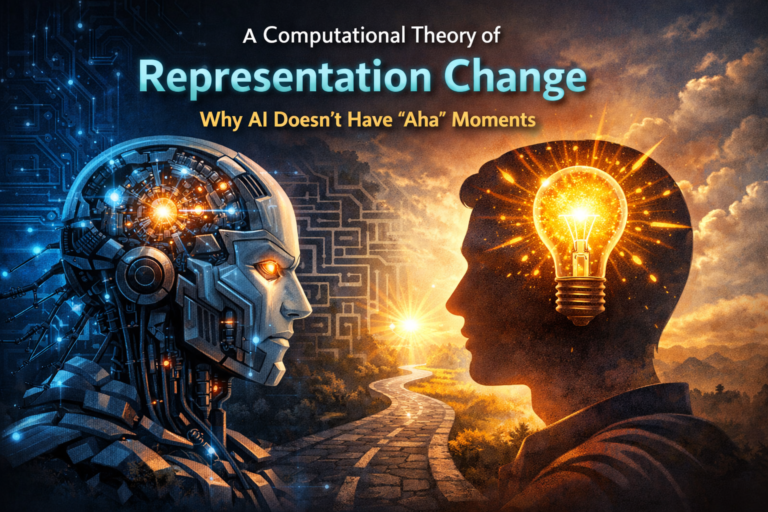
A Computational Theory of Representation Change: Why AI Doesn’t Have “Aha” Moments
People often describe an “Aha” moment as something mysterious: you struggle, you pause, and suddenly the solution appears—clear, elegant, obvious in hindsight.
But decades of research in cognitive science and neuroscience suggest something far more precise and far more important for artificial intelligence. An Aha moment is not the result of deeper reasoning or longer chains of thought.
It is the result of representation change—a shift in how a problem itself is framed.
This article presents a computational theory of representation change in simple language, explains why today’s AI systems rarely experience genuine “Aha” moments despite impressive reasoning abilities, and explores what it would actually take for AI to approach human-level insight.
Why AI doesn’t have aha moment
There’s a specific kind of silence that shows up right before an insight.
Not the silence of “I don’t know.”
The silence of “I know a lot… and none of it is helping.”
You stare at the same problem. You push the same levers. You try harder. You explain it differently. You even take a break—half in frustration, half in hope.
And then it happens.
The solution doesn’t arrive like a longer chain of reasoning. It arrives like a different world.
That’s the part most people miss:
An Aha moment is not “better reasoning.” It’s a representation change.
You don’t just search harder inside the same mental frame.
You change the frame.
This is more than a curiosity. It’s one of the deepest fault lines in modern AI: why today’s systems can look brilliant in explanation—and still fail at the exact moment humans call insight.
A one-sentence definition computational theory of insight
Reasoning explores consequences within a representation.
Insight changes the representation so a solution becomes reachable.
In plain language: when you get insight, you don’t compute more—you see differently.

The three “Aha” experiences everyone recognizes
Insight doesn’t live only in puzzles. It shows up in work, strategy, debugging, and everyday decisions. It typically wears one of these disguises:
1) The “wrong question” trap
You keep trying to optimize something… and keep failing.
Then you realize the real question wasn’t “How do I optimize X?” but “Why am I optimizing X at all?”
That shift isn’t a step. It’s a re-framing. It collapses hours into a single move.
2) The hidden constraint
You assumed a rule. Nobody said it. You imported it automatically.
Once that imagined rule disappears, the problem becomes embarrassingly easy.
That’s not reasoning. That’s constraint relaxation.
3) The chunk that won’t break
You treat something familiar as indivisible—one “chunk.”
But the solution demands you split it, re-encode it, recombine it.
That’s not reasoning. That’s chunk decomposition.
These are not “more steps.” They are different spaces of thought.
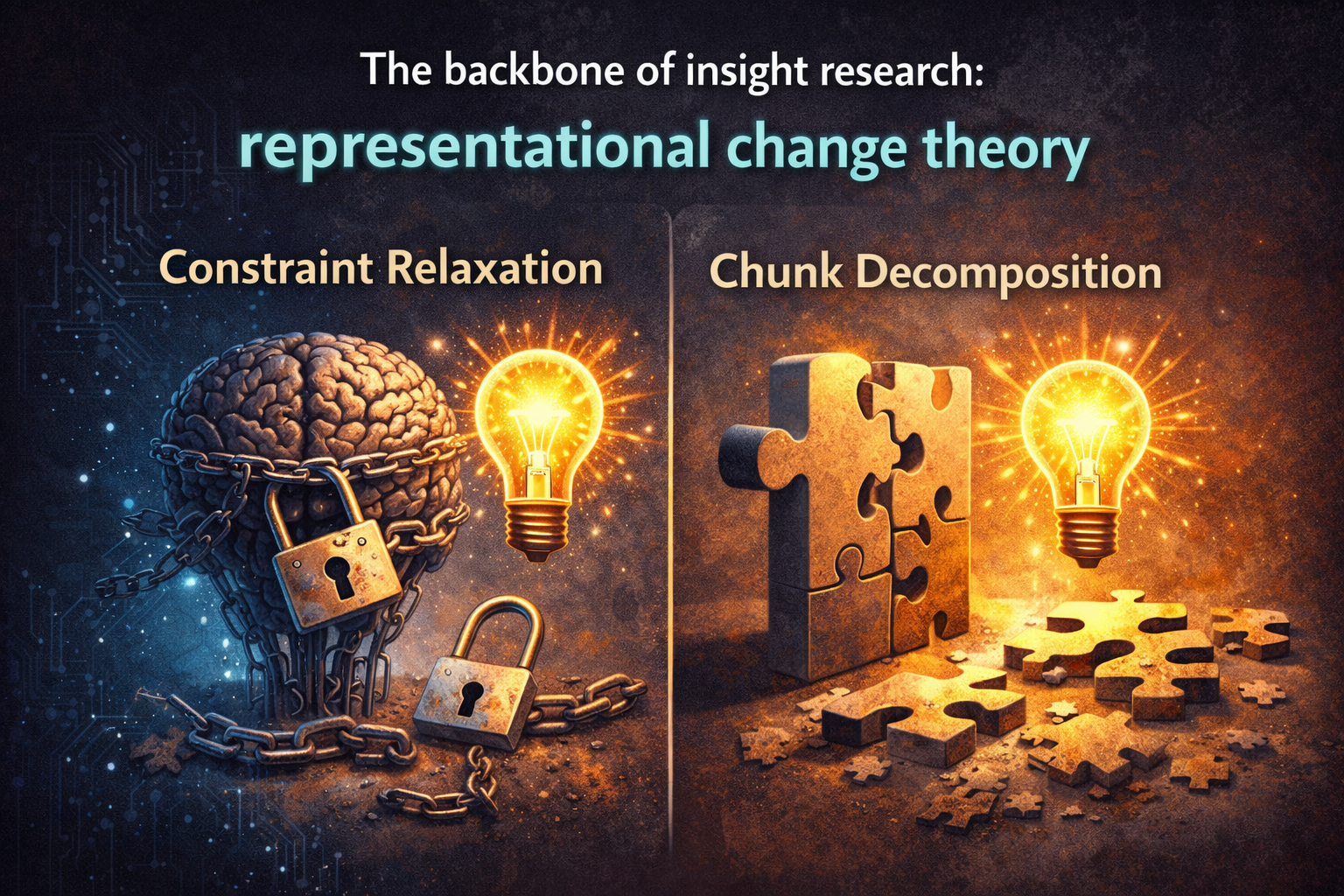
The backbone of insight research: representational change theory
In cognitive science, a major line of work argues that insight is fundamentally about changing the problem representation—especially when you’ve hit an impasse.
Two mechanisms show up again and again:
- Constraint relaxation: dropping an assumed rule that wasn’t required
- Chunk decomposition: breaking a mental “chunk” into smaller parts so a new structure becomes possible
This matters because it makes insight computable—not mystical.
It says: insight isn’t magic. It’s a specific kind of internal rewrite.

The computational theory (no math, just mechanics)
Let’s write the “Aha algorithm” in human terms.
Step 1: The mind builds a state space
The moment you read a problem, you build an internal model of:
- what objects exist
- what moves are allowed
- what counts as progress
- what patterns seem obvious or “natural”
That internal model is your representation.
Step 2: You search—and then you stall
You make progress until you reach a plateau.
You’re not clueless. You’re trapped.
This is impasse: the system is executing plausible moves that no longer change the state in meaningful ways.
Step 3: The representation must be rewritten
This is the key moment.
An Aha is typically triggered by one of these rewrites:
- Remove a constraint: “That rule was imagined.”
- Split a chunk: “This object isn’t atomic.”
- Change the goal: “The stated objective isn’t the real objective.”
- Change the encoding: “The relevant structure isn’t where I’m looking.”
Step 4: After rewriting, search becomes easy again
The “suddenness” of insight is often the sudden availability of a high-quality path after the rewrite.
So the Aha isn’t magic.
It’s a phase change in what is reachable.
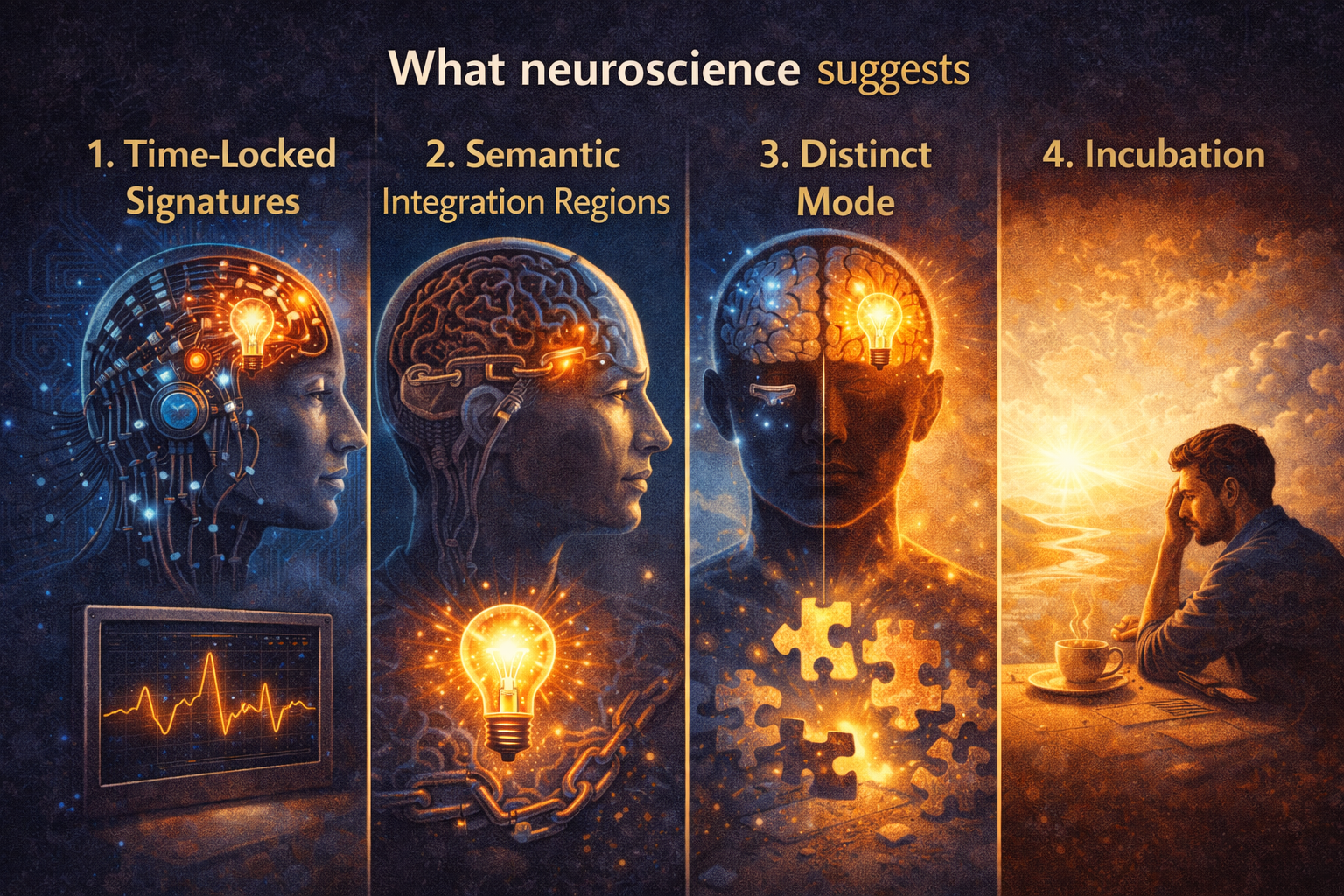
What neuroscience suggests (without over-claiming)
Neuroscience doesn’t hand us a single “insight circuit.” But it does constrain the story.
The consistent message is this:
Insight isn’t just “more of the same thinking.”
It often looks like a distinct mode—with different preparation states and sudden integration-like transitions.
Some studies associate insight with brief time-locked bursts of activity shortly before a reported insight response, and semantic integration regions like the right anterior temporal lobe are frequently discussed in the literature.
The safest, most useful takeaway is not “here’s the exact brain circuit.”
It’s this:
A real theory of insight needs (1) an impasse signal, (2) a rewrite operation, and (3) a learning signal that makes successful rewrites more likely later.
That triad—detect → rewrite → reinforce—is the computational shape of insight.
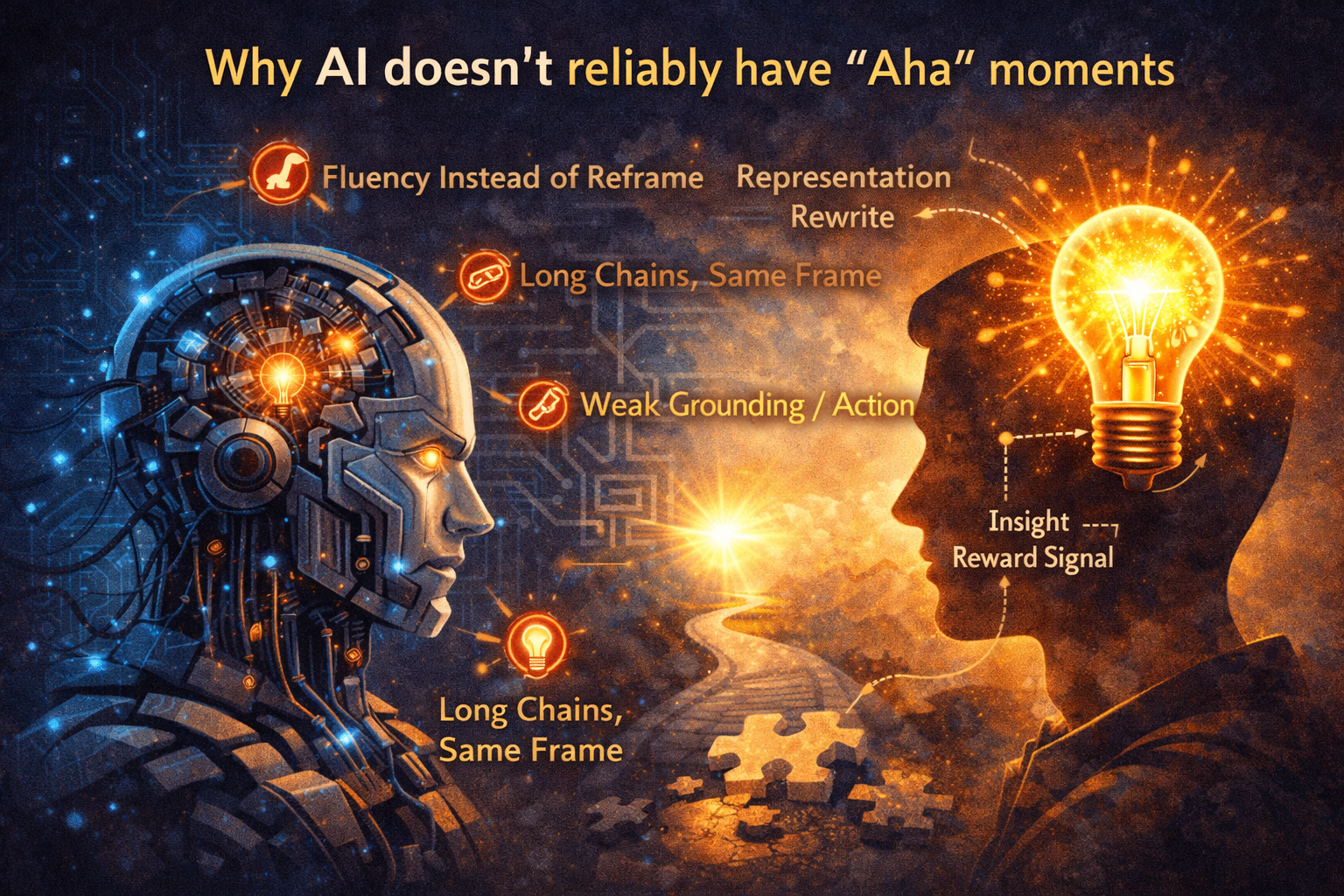
Now the crucial question: why AI doesn’t reliably have “Aha” moments
Modern language models can look insightful. They can produce elegant explanations, clever analogies, and multi-step reasoning.
But most of that behavior is best described as:
search within a representation learned from text
more than
active rewriting of the representation under impasse
Here are the five reasons, stated plainly.
1) LLMs don’t have a native impasse detector
Humans feel stuck. That feeling is data. It says: “this search is unproductive.”
LLMs don’t naturally have a robust internal equivalent of:
- “I’m looping”
- “my constraints might be wrong”
- “my encoding is unfaithful to the real structure”
They can be prompted to say those words.
But words are not control signals.
Insight requires a trigger that says: stop searching; rewrite the representation.
2) Their training objective rewards fluency, not reframing
Next-token prediction rewards:
- plausible continuation
- conventional framing
- dominant associations
But insight often requires the opposite:
- rejecting the dominant association
- exploring “non-default” encodings
- relaxing socially reinforced constraints
This is an uncomfortable truth:
The training signal that makes models fluent can also make them frame-sticky.
They become excellent at being coherent inside a frame—
and less reliable at questioning whether the frame is the problem.
3) Long chains of reasoning are not representation change
A model can generate 40 steps of reasoning and still fail—because it never questioned the one illegal assumption it imported at step 0.
A useful phrase here is:
A model can be logically correct inside a wrong representation.
That’s not a rare corner case.
It’s the default failure mode of “smart systems” that lack representation rewrite.
4) Weak grounding makes re-encoding mostly linguistic
Humans rewrite representations through closed-loop interaction:
- try a move
- observe consequences
- update what “real” means in the model
Text-only learning is powerful, but it’s still largely correlational. Without consistent action-feedback, many reframes remain rhetorical rather than causally disciplined.
This doesn’t mean embodiment “solves” insight.
It means without grounded feedback, representation change tends to stay surface-level.
5) The system’s “chunks” aren’t explicit objects it can choose to decompose
In humans, chunk decomposition is a controllable cognitive move: “split that unit.”
In neural networks, “chunks” are distributed patterns across many units. Even when interpretability reveals meaningful features, the model rarely has a native operation like:
identify chunk → decompose chunk → rewrite encoding → re-search
That’s why interpretability is essential—but still not a full theory of insight.

“But what about grokking—doesn’t that look like an Aha?”
Grokking is real: models sometimes show delayed generalization, where performance seems to “snap” upward later in training.
But grokking is mostly:
- an across-training shift in generalization dynamics
Whereas human insight is often:
- a within-episode representation rewrite under impasse
Grokking is still instructive, though, because it teaches a key lesson:
sudden output changes can hide gradual internal representation change.
And that’s exactly why studying insight must focus on representations—not just outputs.
A practical engineering spec: what AI would need for real “Aha”
If you convert insight science into a build requirement, an Aha-capable system needs five modules.
1) Impasse sensing (not just uncertainty)
Not “I’m unsure,” but:
- “this search is trapped”
- “my moves don’t change state meaningfully”
- “I’m repeating a pattern”
2) Representation proposal
A generator that can propose alternate encodings:
- change the goal
- change objects
- relax constraints
- shift abstraction level
- swap modalities (verbal → spatial → causal → procedural)
3) Representation selection (a critic)
A judge that can choose representations that:
- increase reachable solution paths
- reduce contradictions
- improve transfer to nearby problems
- don’t merely “sound right”
4) A restructuring reward signal
Humans don’t just experience insight; they learn from it. Successful rewrites become easier to trigger next time.
AI needs a learning signal that rewards useful reframing, not just correct answers.
5) Memory of rewrites
People accumulate rewrite operators:
- “when stuck in this class of problems, relax that assumption”
- “don’t treat that object as atomic”
A real Aha system stores and reuses those moves—like mental macros.
Where we are today
Pieces exist. The integrated machine does not.
- Tool-using agents can try multiple approaches, but often without a principled impasse detector.
- Reflection can improve answers, but often stays inside the same frame.
- Interpretability can show features, but doesn’t yet supply rewrite operators as first-class primitives.
The gap is not “more reasoning.”
The gap is representation rewrite as a native capability.
Why this matters far beyond puzzles
Aha moments power real work:
- Debugging: “the bug isn’t in the code; it’s in the assumption.”
- Strategy: “the constraint isn’t resources; it’s incentives.”
- Product decisions: “we’re optimizing a metric, not an outcome.”
- Scientific discovery: “the missing piece isn’t more data; it’s the model class.”
If AI can’t reliably restructure representations, it will:
- look smart
- explain confidently
- and still fail where humans call it creative intelligence
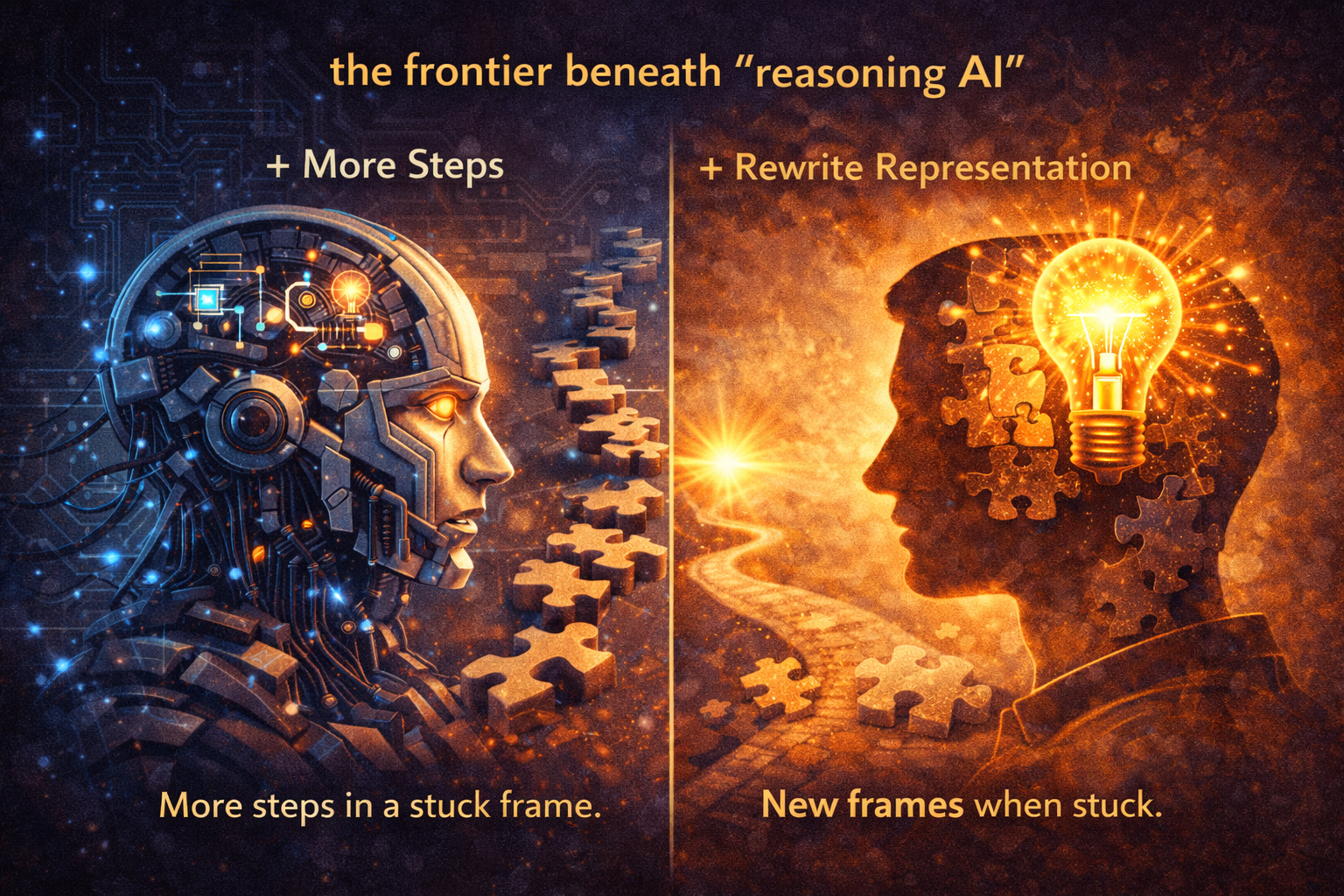
Conclusion: the frontier beneath “reasoning AI”
The biggest question in modern AI isn’t whether models can reason longer.
It’s whether they can change what they are reasoning about—reliably, when stuck, without human rescue.
Until representation change becomes a native, learned, auditable capability, AI will keep producing a distinctive kind of failure:
high confidence inside the wrong frame.
That is why “Aha” remains one of the cleanest tests of real intelligence—and why it is also one of the most important unsolved engineering problems in AI.
Read next on my website
If you want to understand the enterprise-grade reasoning, governance, and production AI systems, read these:
- The Enterprise AI Operating Model (pillar): https://www.raktimsingh.com/enterprise-ai-operating-model/
- Enterprise AI Control Plane: https://www.raktimsingh.com/enterprise-ai-control-plane-2026/
- Enterprise AI Runtime: https://www.raktimsingh.com/enterprise-ai-runtime-what-is-running-in-production/
- Enterprise AI Decision Failure Taxonomy: https://www.raktimsingh.com/enterprise-ai-decision-failure-taxonomy/
- Decision Clarity & Scalable Autonomy: https://www.raktimsingh.com/decision-clarity-scalable-enterprise-ai-autonomy/
- The Laws of Enterprise AI: https://www.raktimsingh.com/laws-of-enterprise-ai/
- The Enterprise AI Operating Stack: https://www.raktimsingh.com/the-enterprise-ai-operating-stack-how-control-runtime-economics-and-governance-fit-together/
- Enterprise AI Economics: https://www.raktimsingh.com/enterprise-ai-economics-cost-governance-economic-control-plane/
FAQ
What is representation change in simple terms?
It’s when you stop trying harder and instead change how you interpret the problem—its objects, rules, or goal—so a solution becomes possible.
Is insight the same as reasoning?
No. Reasoning explores consequences within a representation. Insight changes the representation itself.
Do LLMs ever have Aha moments?
They can appear to—because they produce clever reframes. But they don’t reliably show the impasse → restructure → breakthrough pattern as a stable, reusable capability.
What would AI need to get real insight?
Impasse detection, representation proposal, representation selection, a restructuring reward signal, and memory of successful rewrites.
Glossary
- Representation: The internal framing of a problem—what exists, what moves are allowed, what success means.
- Insight (“Aha”): A sudden re-interpretation that makes a solution reachable.
- Impasse: A state where search yields no meaningful progress, often because the framing is wrong.
- Constraint relaxation: Dropping an assumed rule that wasn’t required.
- Chunk decomposition: Breaking a mental “chunk” into parts so new structure becomes possible.
- Incubation: Improvement after stepping away, often due to internal reorganization of attention and framing.
- Grokking: A delayed generalization shift during training that can look sudden at the output level.
🔗 Further Reading
Foundations of Insight & Representation Change (Cognitive Science)
For the core thesis that Aha = representation rewrite, not more reasoning.
- PubMed – Peer-reviewed research on insight, impasse, and sudden restructuring in human cognition
https://pubmed.ncbi.nlm.nih.gov/ - Nature – Evidence linking semantic integration regions (e.g., rATL) to insight-like cognition
https://www.nature.com/ - ScienceDirect – Research on impasse dynamics, incubation, and problem restructuring
https://www.sciencedirect.com/ - Central European University – SOMBY Lab (Representational Change Theory)
Classic work on constraint relaxation and chunk decomposition
https://somby.ceu.edu/
Neuroscience of Insight & Incubation
These support neuroscience section .
- Frontiers (Frontiers in Psychology / Neuroscience) – Insight, incubation, default mode network, and mind-wandering
https://www.frontiersin.org/ - Nature Neuroscience – Neural signatures associated with semantic integration and insight
https://www.nature.com/neuro/
AI, Grokking, and Limits of Reasoning Models
why grokking ≠ human Aha.
- arXiv – Research on grokking, delayed generalization, and learning dynamics
https://arxiv.org/ - Wikipedia – Accessible overview of grokking (used as a reader on-ramp, not authority)
https://en.wikipedia.org/wiki/Grokking_(machine_learning)
Limits of Language Models & Representation
LLMs reason inside frames rather than rewrite them.
- MIT Technology Review – Analysis of reasoning models, limits of scale, and AI cognition
https://www.technologyreview.com/ - Harvard Business Review – Insight, decision-making, and why optimization often misses the real problem
https://hbr.org/



Raktim Singh is an AI and deep-tech strategist, TEDx speaker, and author focused on helping enterprises navigate the next era of intelligent systems. With experience spanning AI, fintech, quantum computing, and digital transformation, he simplifies complex technology for leaders and builds frameworks that drive responsible, scalable adoption.