

The real strategic question is no longer who uses AI, but who extracts advantage from it.
In a Same-Model World, differentiation shifts from tools to context — from computation to institutional memory, governance architecture, and decision velocity.
This is where Context Capital emerges as the defining asset of the Third-Order Economy.
When intelligence becomes abundant, context becomes scarce.
And in the AI decade, scarcity—not capability—defines advantage.
Differentiation in a Same-Model World
Artificial intelligence is collapsing the cost of cognition. Research is instant. Pattern recognition is automated. Simulation is continuous. Language barriers are dissolving. Optimization is becoming ubiquitous.
That sounds like universal advantage. It isn’t.
When cognition becomes abundant, it stops being a moat.
The next scarcity is not intelligence.
It is context.
The institutions that capture, govern, permission, and compound context will define the next era of economic advantage.
We are entering the age of Context Capital Markets.
When cognition becomes abundant, context becomes scarce.
What This Article Gives Boards and C-Suite Leaders
This is not a “how to implement AI” guide. It is a market-structure lens—written for board members and senior executives who want to win in the AI decade without being trapped in tool-chasing.
You will learn:
- Why the collapse of cognitive scarcity commoditizes intelligence
- What Context Capital really is (and why it’s not “data”)
- How Context Capital Markets emerge as a new institutional layer
- The C³ framework (Capture, Curate, Compound) for building context advantage
- How C³ connects to C.O.R.E. (Capture, Orchestrate, Regulate, Evolve)
- The new third-order business models that monetize context
- What boards should fund, govern, and measure—starting now
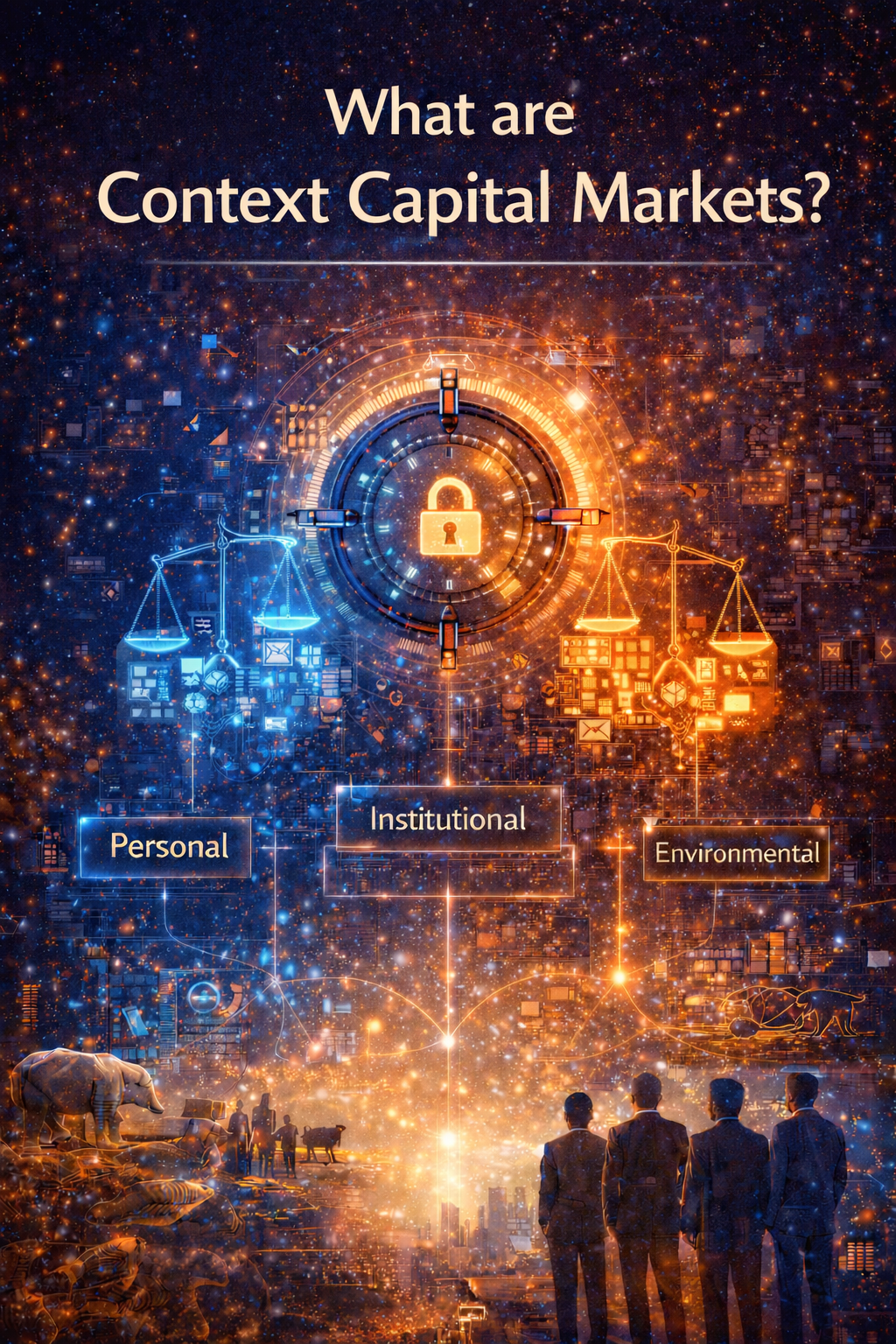
What are Context Capital Markets?
Context Capital Markets are the emerging economic and institutional systems that enable organizations to capture, govern, exchange, and compound permissioned context—so AI can make better decisions, act safely, and create new value at scale.
The Collapse of Cognitive Scarcity
For most of economic history, cognition was scarce.
- Analysis required teams
- Forecasting required expertise
- Strategy required hierarchy
- Coordination required meetings
AI is dissolving those constraints.
When the marginal cost of cognition approaches zero:
- Every firm can generate insights
- Every competitor can simulate scenarios
- Every executive can access global knowledge
- Every startup can deploy powerful models
Intelligence commoditizes.
This is the first-order shock of AI.
But markets do not reorganize at the first order.
They reorganize when scarcity shifts.
In a same-model world, context—not intelligence—becomes the moat.

Scarcity Shift: From Intelligence to Context
If everyone has similar models, what differentiates?
Not model access.
Not inference speed.
Not prompt sophistication.
The differentiator becomes:
- Longitudinal understanding
- Permissioned memory
- Situational awareness
- Identity-bound constraints
- Real-world signals
- Institutional history
In one word: context.
This is the point most executives miss.
The future will not be won by those who “have AI.”
It will be won by those who have legitimate, permissioned, compounding context.
What Is Context Capital?
Context Capital is not raw data.
It is not datasets.
It is not embeddings.
It is not dashboards.
Context Capital is permissioned, longitudinal, identity-bound understanding that compounds across decisions.
It includes:
- Behavioral patterns
- Institutional memory
- Risk tolerance
- Historical interactions
- Regulatory constraints
- Ethical boundaries
- Environmental conditions
- Silent signals from non-digital systems
Context is meaning attached to signals.
Capital is an asset that compounds.
When context compounds, advantage compounds.
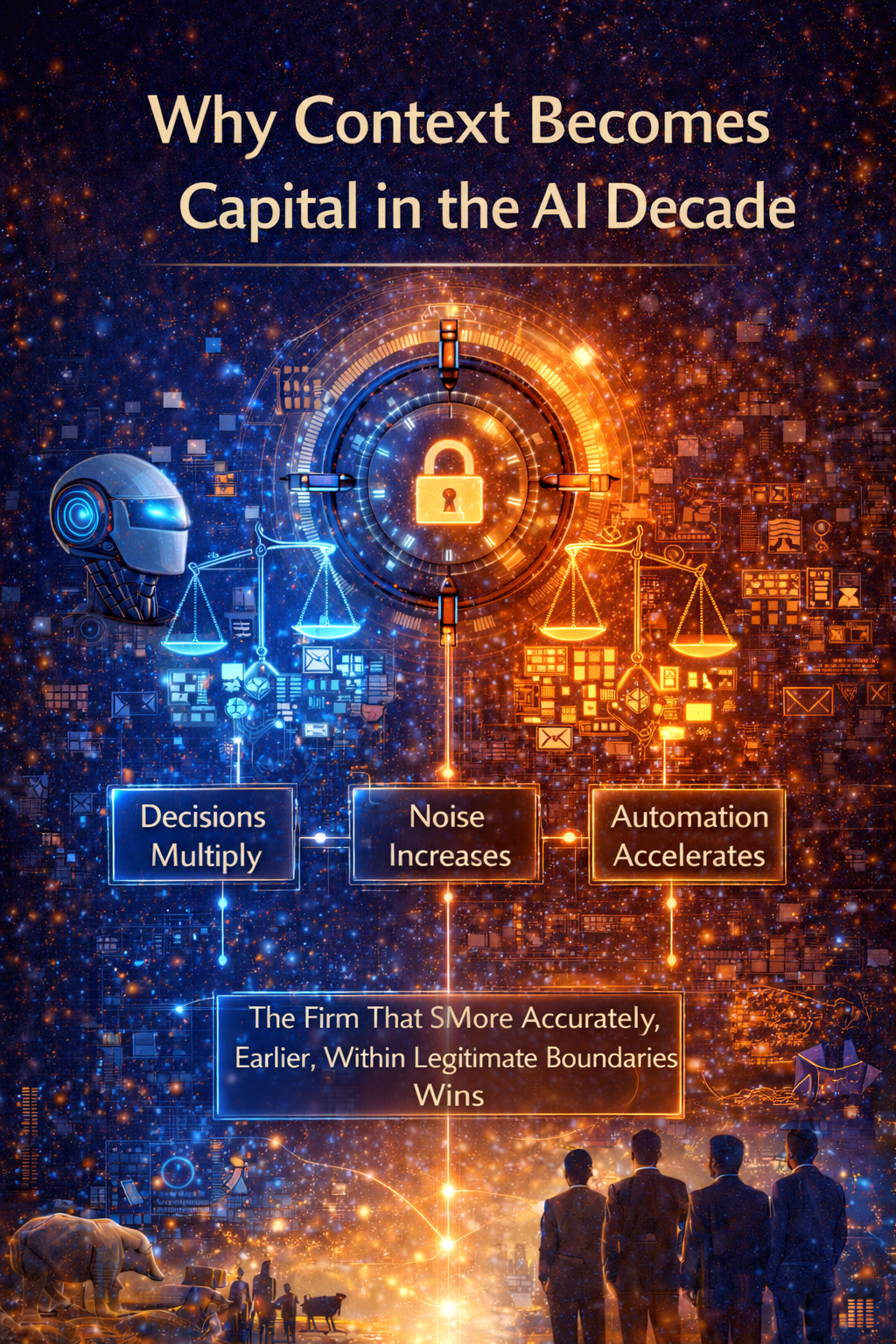
Why Context Becomes Capital in the AI Decade
When intelligence is cheap:
- Decisions multiply
- Options proliferate
- Noise increases
- Automation accelerates
In such an environment, the winners are not those who generate the most answers.
The winners are those who see:
- more accurately
- earlier
- and within legitimate boundaries
Context determines:
- what matters
- what to ignore
- when to act
- when to escalate
- when to refrain
Context determines judgment quality.
Judgment determines trust.
Trust determines execution authority.
Context is upstream of advantage.
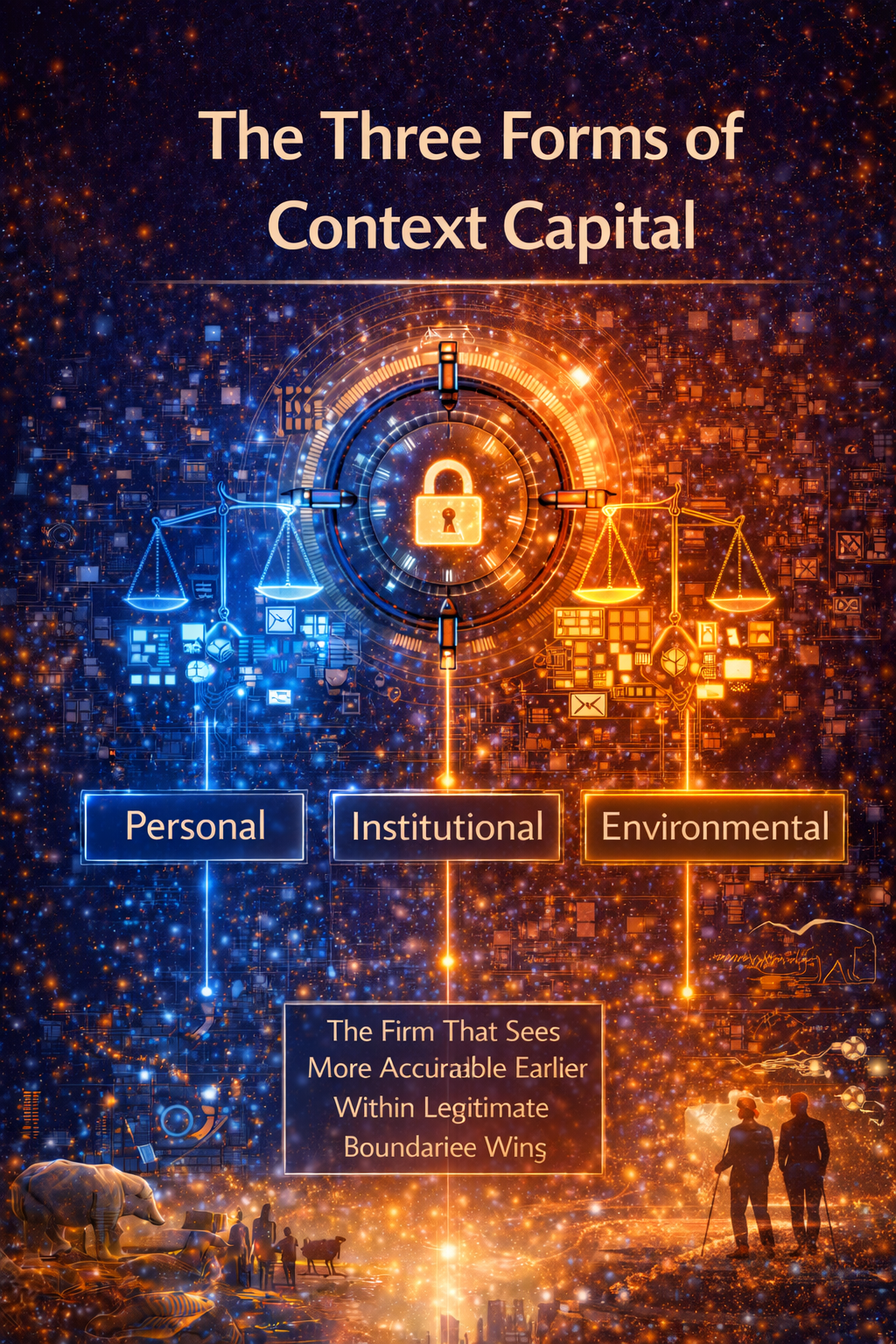
The Three Forms of Context Capital
To understand Context Capital Markets, we must separate three distinct forms of context capital. Each creates different opportunities—and different governance obligations.
1) Personal Context Capital
Identity-bound understanding:
- Preferences
- History
- Constraints
- Behavioral signals
- Risk appetite
This layer powers hyper-personalization.
But hyper-personalization without permission becomes exploitation.
So the real strategic asset is not personalization—it is consent architecture that makes personalization legitimate.
In the same-model world, trust is not a brand promise. It is a systems property.
2) Institutional Context Capital
Organizational memory:
- Prior decisions
- Policy precedents
- Compliance history
- Market exposure
- Vendor behavior
- Operational friction
Most enterprises possess enormous institutional context—but cannot operationalize it. It sits in emails, approvals, tickets, tribal knowledge, and “how things really work.”
AI makes this usable—if the organization designs governance that prevents misuse and ensures traceability.
3) Environmental Context Capital
Signals from systems that cannot self-advocate:
- Ecological data
- Infrastructure stress
- Animal health
- Rural activity patterns
- Supply chain fragility
- Elderly population signals
- Non-digital communities
This is the largest untapped frontier.
And it is where third-order value creation concentrates: turning silent signals into actionable, permissioned context.
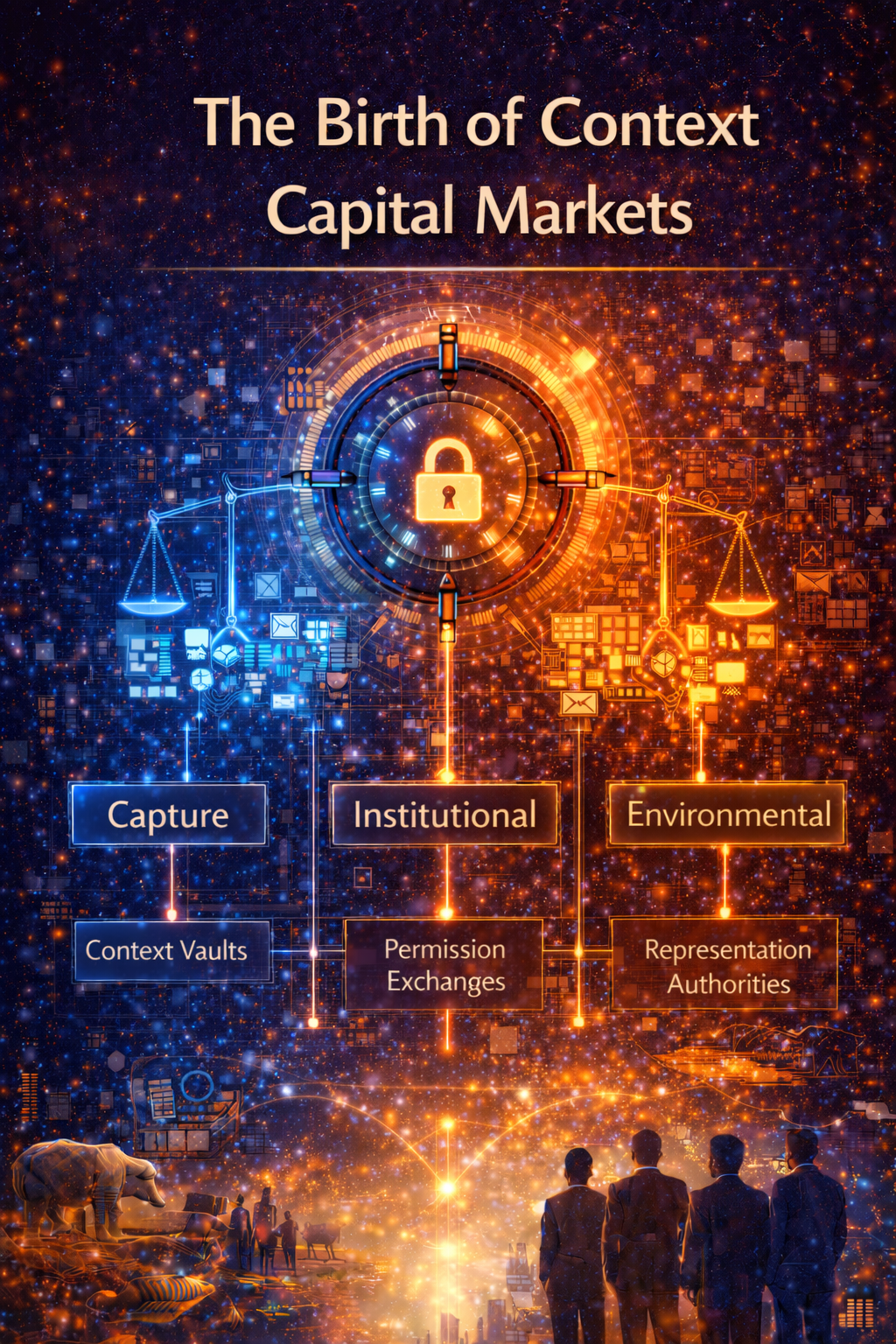
The Birth of Context Capital Markets
Once context becomes capital, markets emerge around:
- Capture
- Governance
- Validation
- Exchange
- Auditing
- Protection
- Insurance
- Reversibility
Just as financial capital required:
- Banks
- Exchanges
- Clearinghouses
- Custodians
- Regulators
Context Capital will require new institutional roles:
- Context Vaults (permissioned context custody)
- Permission Exchanges (who may access what, when, and why)
- Consent Ledgers (auditable consent and revocation)
- Representation Authorities (legitimacy and accountability in representation)
- Delegation Contracts (bounded authority to act)
- Audit Mechanisms (proof and traceability)
This is not metaphor.
This is market infrastructure.
“The AI decade won’t reward faster answers. It will reward permissioned understanding.”
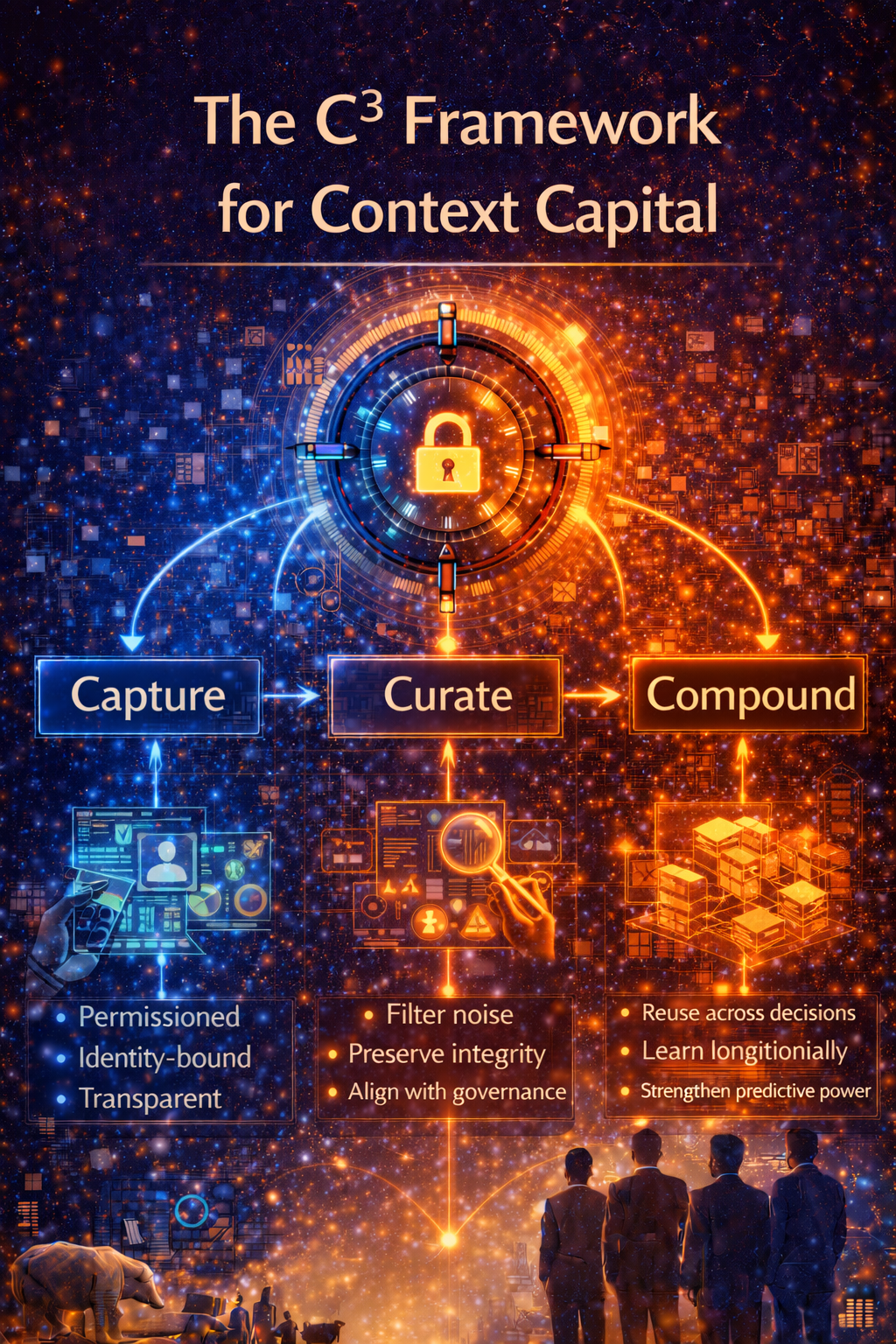
The C³ Framework for Context Capital
To operationalize context, institutions need discipline.
C³ = Capture, Curate, Compound
Capture
Collect signals legitimately:
- permissioned
- identity-bound
- transparent
Curate
Filter noise and preserve integrity:
- quality controls
- provenance
- governance alignment
- bias detection
Compound
Reuse across decisions:
- longitudinal learning
- improved prediction and routing
- institutional memory that becomes reliable over time
Context that is captured but not curated becomes liability.
Context that is curated but not compounded becomes cost.
Context that compounds become capital.
How C³ Connects to C.O.R.E.
C.O.R.E. operates downstream.
Context Capital is upstream.
- C — Capture Context (foundation of C³)
- O — Orchestrate Decisions (context-guided routing: act / ask / escalate)
- R — Regulate Action (policy bounded by context and permission)
- E — Evolve with Evidence (audit trails + learning loops that compound trust)
Without Context Capital, C.O.R.E. operates blindly.
Without C.O.R.E., Context Capital cannot execute safely.
Together, they form the operating engine of what you have defined as the Representation Economy—where value flows through legitimate representation and trusted delegation.
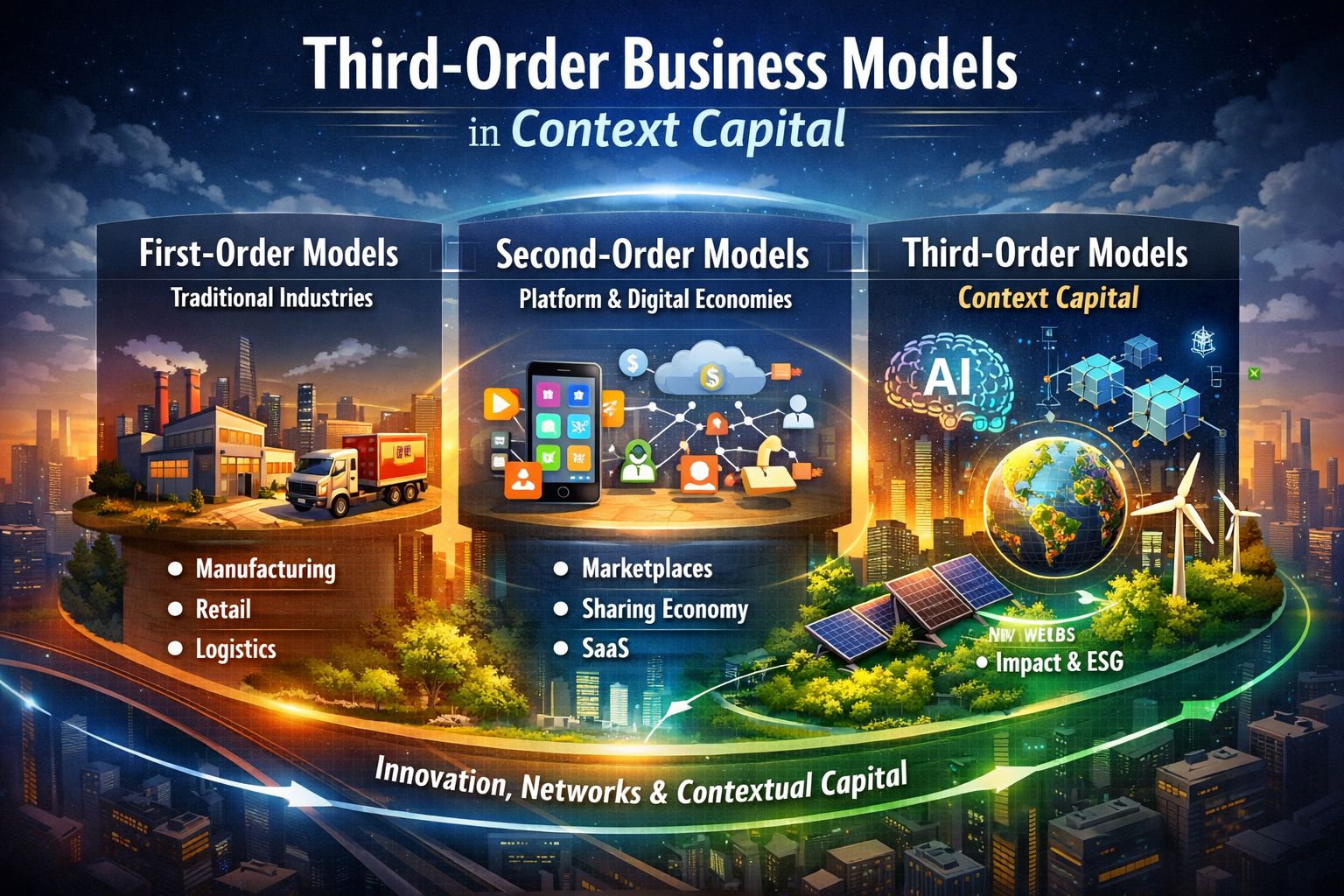
Third-Order Business Models in Context Capital
The “Uber moment” of AI will not be better chatbots.
It will be businesses that monetize context—safely, legitimately, and at scale.
Expect new categories:
Context Custodians
Trusted entities holding permissioned, identity-bound context.
Context Brokers
Securely matching context to execution providers (under strict constraints).
Context Auditors
Verifying integrity, provenance, and misuse boundaries.
Delegation Insurers
Underwriting actions taken using context-driven automation.
Context Sovereignty Providers
Nation-aligned context rails for sensitive sectors and regulated domains.
These are not SaaS tools.
They are institutional roles—built around a new scarcity.
The Non-Digital Majority Opportunity
Most of the world cannot articulate optimization requests.
They do not know what can be improved.
They do not know what is measurable.
They do not know what is representable.
That is the largest Context Capital opportunity.
Turning:
- silent health signals
- rural production patterns
- elderly care needs
- ecological stress markers
- informal economy flows
into structured, permissioned context unlocks new markets.
Representation becomes value creation.
Context becomes economic power.
Governance Is the Gating Constraint
Context without governance becomes surveillance.
Context without consent becomes exploitation.
Context without recourse becomes systemic risk.
Therefore, Context Capital Markets require:
- Representation Rights
- Bounded delegation
- Transparent liability
- Reversibility mechanisms
- Independent audit
Trust is not a feature.
Trust is infrastructure.
The Board-Level Imperative
Boards should ask six questions—now:
- What context assets do we own?
- Are they permissioned and legitimate?
- Are we compounding context across decisions—or recreating context every time?
- Where are we blind?
- Are we building context moats—or model dependencies?
- Do we control the execution rails tied to our context?
Capital allocation must shift from:
Model acquisition → context architecture.
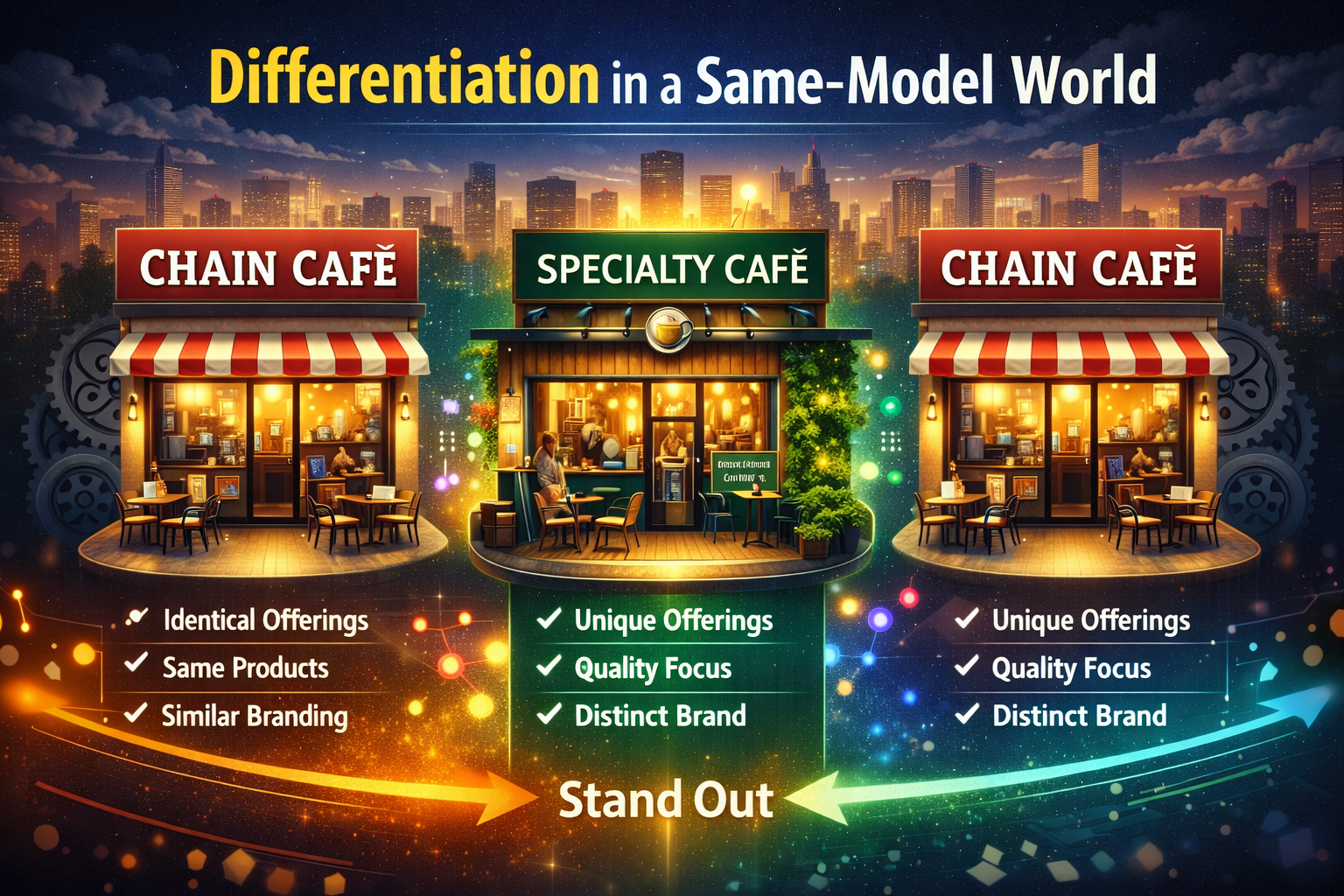
Differentiation in a Same-Model World
When every competitor uses similar AI models:
- Intelligence becomes table stakes
- Automation becomes baseline
- Productivity gains converge
Differentiation shifts to:
- context continuity
- institutional memory
- ethical boundary-setting
- bounded delegation design
- execution reliability
The firm that governs context best wins.
Trust is not a feature. Trust is infrastructure.
Fourth-Order Implications
At the fourth order, context becomes:
- a balance-sheet category
- a regulated asset
- a cross-border sovereignty concern
- a geopolitical lever
Nations will compete on context integrity.
Firms aligned with sovereign context rails gain embedded advantage.
AI becomes economic architecture.
The New Value Migration
First, value migrates:
Human-only cognition → AI-augmented cognition.
Second, value migrates:
Intelligence → context governance.
Third, value creates:
New institutional roles that did not previously exist.
Context Capital Markets are that third wave.
Strategic Summary for Executives
AI reduces the cost of cognition.
Cognition commoditizes.
Scarcity shifts to context.
Context becomes capital.
Capital demands governance.
Governance enables delegation.
Delegation unlocks execution.
Execution creates new markets.
That is the economic stack of the AI decade.
Conclusion: Winning the Context Century
The internet rewarded those who controlled distribution.
The AI decade will reward those who control representation.
But representation rests on context.
And context—when legitimate and compounded—becomes capital.
Boards that recognize Context Capital early will:
- allocate differently
- govern differently
- design differently
- compete differently
The future of AI is not faster answers.
It is deeper understanding—permissioned, structured, auditable, and compounded.
Context is the new currency.
And Context Capital Markets will define the next economic order.
In a Same-Model World, models are rented. Context is built.
And the enterprises that build context win.
Further Reading on raktimsingh.com
To expand the doctrine behind this pillar, explore:
- The Enterprise AI Operating Model: https://www.raktimsingh.com/enterprise-ai-operating-model/
- The Intelligence Reuse Index: https://www.raktimsingh.com/intelligence-reuse-index-enterprise-ai-fabric/
- The Enterprise AI Runbook Crisis: https://www.raktimsingh.com/enterprise-ai-runbook-crisis-model-churn-production-ai/
- Who Owns Enterprise AI?: https://www.raktimsingh.com/who-owns-enterprise-ai-roles-accountability-decision-rights/
- The Future Belongs to Decision-Intelligent Institutions: https://www.raktimsingh.com/the-future-belongs-to-decision-intelligent-institutions/
Glossary
Context Capital: Permissioned, longitudinal, identity-bound understanding that compounds across decisions.
Context Capital Markets: Institutions and mechanisms for capturing, governing, validating, exchanging, and compounding context.
Cost of Cognition: Marginal cost of producing decision-useful intelligence (research, synthesis, forecasting, simulation).
C³ Framework: Capture, Curate, Compound—operational discipline for context advantage.
C.O.R.E.: Capture Context, Orchestrate Decisions, Regulate Action, Evolve with Evidence—architecture for trusted delegation and execution.
Representation Economy: Economic layer where value flows through legitimate representation and trusted action.
Bounded Delegation: Controlled authority for AI to act, with limits, escalation rules, and reversibility.
Context Vault: A permissioned store of identity-bound context with governance, audit, and revocation controls.
FAQ
What are Context Capital Markets?
They are the emerging systems that enable organizations to capture, govern, and compound permissioned context—so AI can make better decisions and act safely at scale.
How is Context Capital different from data?
Data is raw signals. Context capital is meaning + constraints + history + permission—organized so it compounds across decisions.
Why does context matter more when AI models are widely available?
Because model capability converges. The differentiator becomes who has legitimate longitudinal context, and who can govern and reuse it reliably.
What should boards fund first: models or context architecture?
Context architecture. Models can be rented. Permissioned context and governance create compounding advantage and execution reliability.
How does Context Capital connect to trusted delegation?
Context determines judgment quality. Judgment influences trust. Trust determines what can be safely delegated for autonomous execution.
The Intelligence-Native Enterprise Doctrine
This article is part of a larger strategic body of work that defines how AI is transforming the structure of markets, institutions, and competitive advantage. To explore the full doctrine, read the following foundational essays:
- The AI Decade Will Reward Synchronization, Not Adoption
Why enterprise AI strategy must shift from tools to operating models.
https://www.raktimsingh.com/the-ai-decade-will-reward-synchronization-not-adoption-why-enterprise-ai-strategy-must-shift-from-tools-to-operating-models/ - The Third-Order AI Economy
The category map boards must use to see the next Uber moment.
https://www.raktimsingh.com/third-order-ai-economy/ - The Intelligence Company
A new theory of the firm in the AI era — where decision quality becomes the scalable asset.
https://www.raktimsingh.com/intelligence-company-new-theory-firm-ai/ - The Judgment Economy
How AI is redefining industry structure — not just productivity.
https://www.raktimsingh.com/judgment-economy-ai-industry-structure/ - Digital Transformation 3.0
The rise of the intelligence-native enterprise.
https://www.raktimsingh.com/digital-transformation-3-0-the-rise-of-the-intelligence-native-enterprise/ - Industry Structure in the AI Era
Why judgment economies will redefine competitive advantage.
https://www.raktimsingh.com/industry-structure-in-the-ai-era-why-judgment-economies-will-redefine-competitive-advantage/
Institutional Perspectives on Enterprise AI
Many of the structural ideas discussed here — intelligence-native operating models, control planes, decision integrity, and accountable autonomy — have also been explored in my institutional perspectives published via Infosys’ Emerging Technology Solutions platform.
For readers seeking deeper operational detail, I have written extensively on:
- What Makes an Enterprise Intelligence-Native? The Blueprint for Third-Order AI Advantage
https://blogs.infosys.com/emerging-technology-solutions/artificial-intelligence/what-is-enterprise-ai-the-operating-model-for-compounding-institutional-intelligence.html - Why “AI in the Enterprise” Is Not Enterprise AI: The Operating Model Difference Most Organizations Miss
https://blogs.infosys.com/emerging-technology-solutions/artificial-intelligence/why-ai-in-the-enterprise-is-not-enterprise-ai-the-operating-model-difference-that-most-organizations-miss.html - The Enterprise AI Control Plane: Governing Autonomy at Scale
https://blogs.infosys.com/emerging-technology-solutions/artificial-intelligence/the-enterprise-ai-control-plane-governing-autonomy-at-scale.html - Enterprise AI Ownership Framework: Who Is Accountable, Who Decides, and Who Stops AI in Production
https://blogs.infosys.com/emerging-technology-solutions/artificial-intelligence/enterprise-ai-ownership-framework-who-is-accountable-who-decides-and-who-stops-ai-in-production.html - Decision Integrity: Why Model Accuracy Is Not Enough in Enterprise AI
https://blogs.infosys.com/emerging-technology-solutions/artificial-intelligence/decision-integrity-why-model-accuracy-is-not-enough-in-enterprise-ai.html - Agent Incident Response Playbook: Operating Autonomous AI Systems Safely at Enterprise Scale
https://blogs.infosys.com/emerging-technology-solutions/artificial-intelligence/agent-incident-response-playbook-operating-autonomous-ai-systems-safely-at-enterprise-scale.html - The Economics of Enterprise AI: Designing Cost, Control, and Value as One System
https://blogs.infosys.com/emerging-technology-solutions/artificial-intelligence/the-economics-of-enterprise-ai-designing-cost-control-and-value-as-one-system.html
Together, these perspectives outline a unified view: Enterprise AI is not a collection of tools. It is a governed operating system for institutional intelligence — where economics, accountability, control, and decision integrity function as a coherent architecture.



Raktim Singh is an AI and deep-tech strategist, TEDx speaker, and author focused on helping enterprises navigate the next era of intelligent systems. With experience spanning AI, fintech, quantum computing, and digital transformation, he simplifies complex technology for leaders and builds frameworks that drive responsible, scalable adoption.