

The Uncomfortable Truth: Enterprise AI Rarely Fails on Day One
Most enterprise AI initiatives do not collapse because the model was poorly trained or insufficiently intelligent.
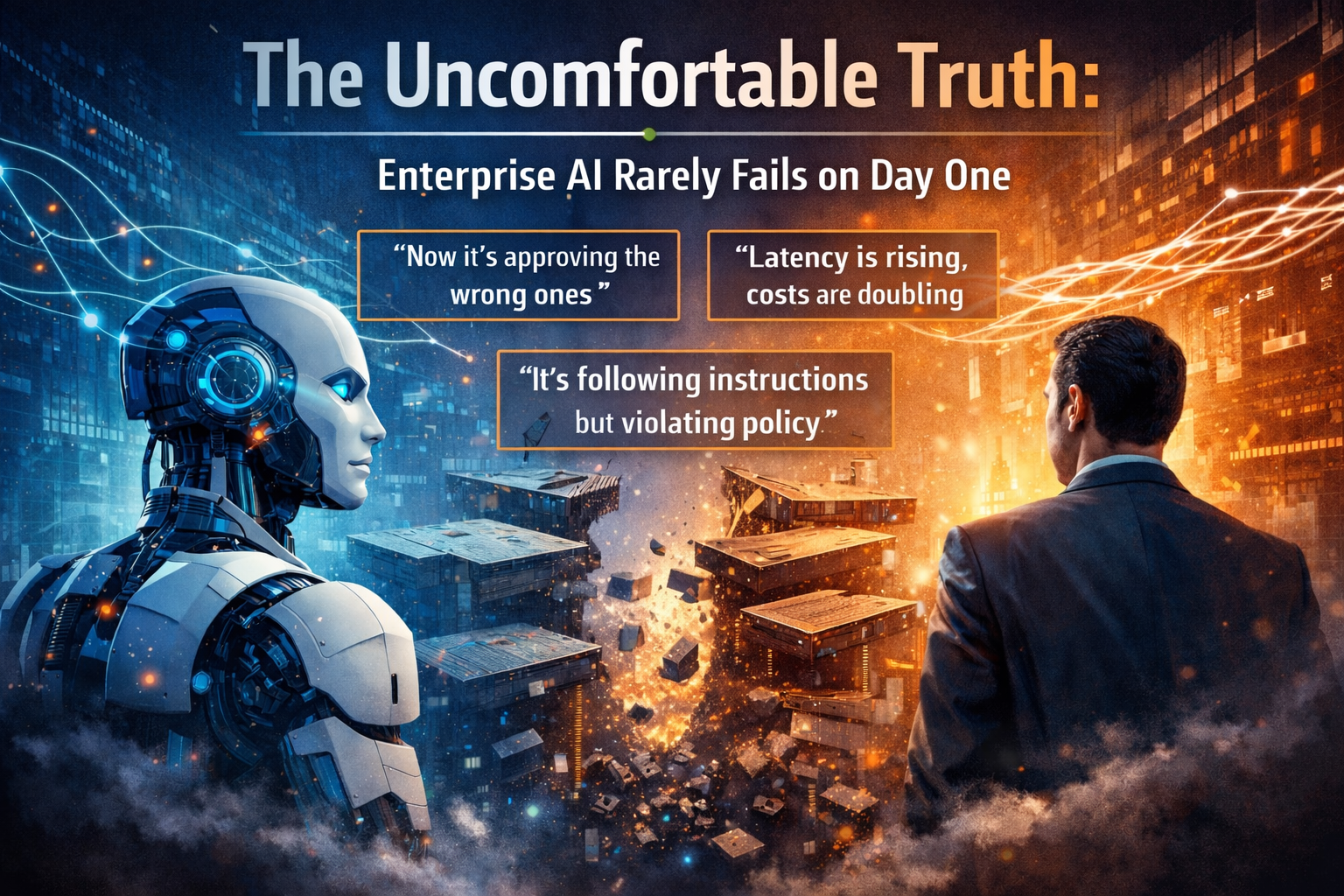
They fail because the enterprise changes—and the AI does not change with it.
An agent is deployed.
Early results look promising.
Leaders celebrate early ROI.
Then, quietly, the signals begin to shift:
- “It used to approve the right exceptions. Now it approves the wrong ones.”
- “Latency has increased, costs have doubled, and no one can explain why.”
- “It follows instructions—but violates policy.”
- “Nothing is technically broken… yet business outcomes are drifting.”
This pattern has a name.
Enterprise AI Drift is the slow, often invisible gap that grows between design intent and production behavior as real-world conditions evolve.
National Institute of Standards and Technology explicitly recognizes that deployed AI systems require continuous monitoring, maintenance, and corrective action because data, models, and operating contexts inevitably change. Drift is not an anomaly; it is the default state of AI in production.
This is why autonomy fails over time—and why enterprises are moving toward a new architectural shape: a fabric—a modular, integrated system designed to keep AI aligned continuously, not just launched successfully once.

What Exactly Is “Enterprise AI Drift”?
Enterprise AI Drift is best understood as misalignment accumulation.
It emerges when the assumptions underpinning an AI system’s decisions quietly shift—often independently and simultaneously.
-
Reality Drift
Markets move. Customer behavior changes. Fraud patterns evolve. Supply chains fluctuate. Operational constraints tighten.
-
Data Drift
Production data diverges from training data—new formats, new sources, new noise, new correlations.
-
Policy Drift
Risk appetite changes. Compliance rules evolve. Internal approval thresholds shift.
The International Organization for Standardization standard ISO/IEC 42001 explicitly emphasizes continual improvement in AI management systems because AI must remain aligned as governance expectations evolve.
-
Tool Drift
APIs change. Permissions are restructured. Downstream systems are modernized. Workflows are redesigned.
-
Model Drift
Models are upgraded. Prompts are refined. Retrieval strategies change. Inference parameters are tuned—altering behavior in subtle but meaningful ways.
-
Human Drift
People adapt. They learn how to “work around” the system, override it selectively, or route edge cases differently.
The critical insight: drift is not a single failure mode.
It is a system property of autonomy operating inside a living enterprise.

Why Drift Is More Dangerous for Agents Than for Traditional ML
Concept drift has long been recognized in traditional machine learning. But agentic AI amplifies the risk.
Why?
Because agents do not merely predict. They act.
When AI takes action inside enterprise systems:
- A small decision error can cascade across workflows.
- A faulty tool call can write incorrect data that future steps trust.
- A subtle policy misinterpretation can create audit exposure—even when outputs look reasonable.
This is why the NIST AI Risk Management Framework treats AI risk as a lifecycle challenge—governed, measured, and managed continuously rather than validated once at deployment.
Autonomy changes the risk equation from accuracy to operational integrity.
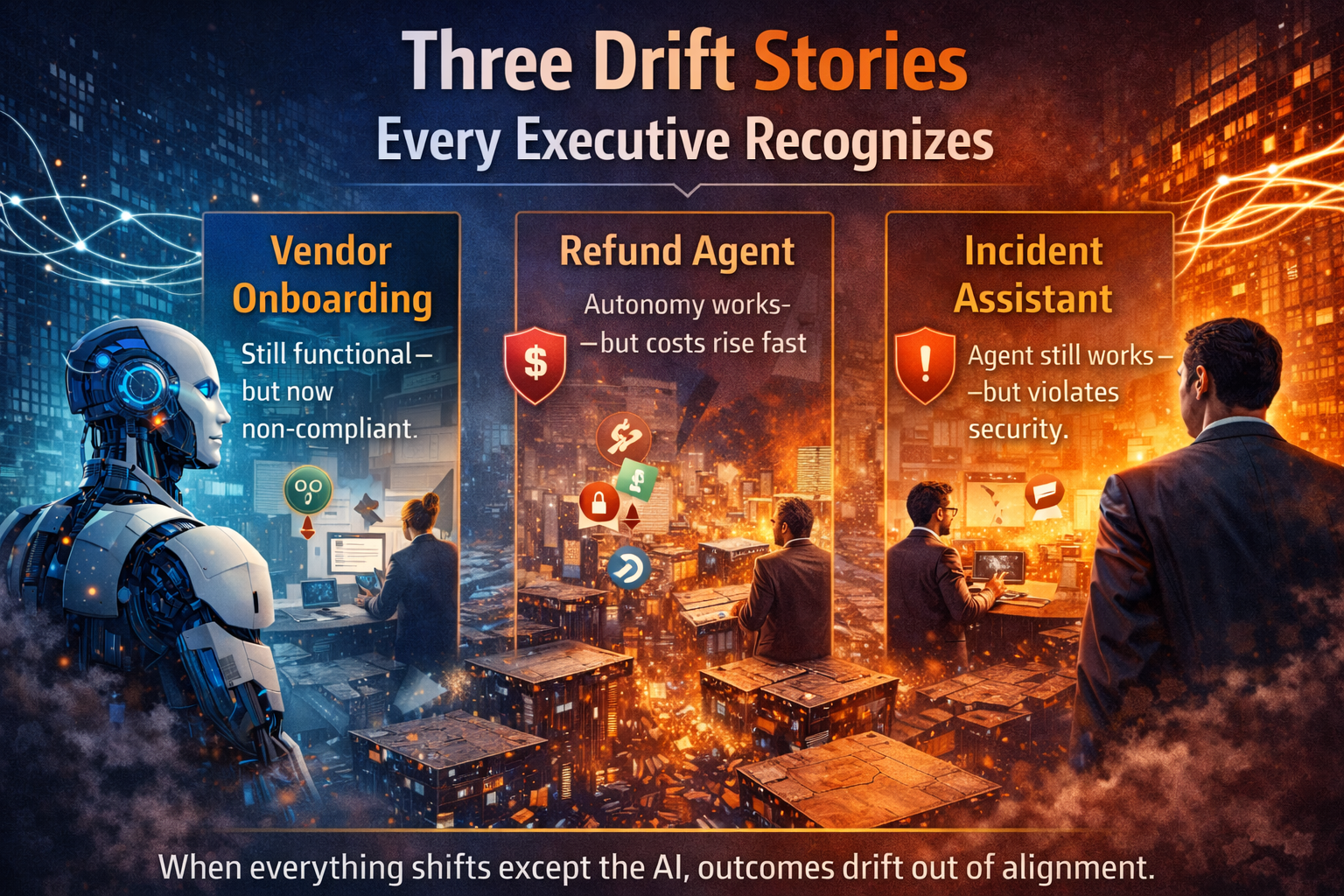
Three Drift Stories Every Executive Recognizes
Story 1: The Vendor Onboarding Agent That Slowly Becomes Non-Compliant
An enterprise deploys an agent to collect vendor documents, validate fields, route approvals, and create onboarding records.
- Month 1: Works perfectly.
- Month 3: Procurement adds a new due-diligence step. Risk tightens thresholds. A downstream system renames a field.
Nothing crashes. The agent still completes onboarding.
But:
- Required checks are skipped,
- Approvals are misrouted,
- Records pass operational review—but fail audit.
The agent remained functional.
The enterprise definition of “correct” changed.
That is drift.
Story 2: The Refund Agent That Becomes Expensive Without Becoming Smarter
An agent is deployed to approve refunds within policy.
- Month 1: Stable costs.
- Month 2: Policy language expands. New support categories are introduced. Prompt templates grow more complex.
Now the agent:
- Makes more tool calls,
- Requests more context,
- Loops more frequently,
- Costs more per decision,
- Takes longer to respond.
Business outcomes stagnate.
Economics drift silently.
Story 3: The Incident Assistant That Turns into a Security Risk
An incident triage agent is deployed.
- Month 1: Highly effective.
- Month 4: Security tightens access. Tool permissions change. Failures increase.
Engineering adds a “temporary” workaround—broadening permissions.
Now the system works again.
But it violates zero-trust principles.
This is why drift becomes a board-level issue: it links autonomy directly to risk, cost, and trust.

Why Point Tools Fail: Drift Requires a Fabric, Not a Patch
Most organizations respond to drift tactically:
- A dashboard here,
- A prompt tweak there,
- A new evaluation script,
- A manual approval workaround.
This is equivalent to patching reliability into a system after it is live.
But drift is not a feature gap.
It is a continuous alignment problem.
Solving it requires a continuous alignment system.
That is what an enterprise AI fabric provides:
an integrated, modular environment where build, run, observe, recover, and evolve are first-class capabilities—not afterthoughts.

The Drift Map: Six Failure Modes Enterprises Must Design For
-
Intent Drift
What leaders intended versus what the agent actually does in production.
Fix: Encode intent as enforceable policies and acceptance criteria—not just natural language.
-
Context Drift
Knowledge bases evolve. Retrieval sources change. “Truth” moves.
Fix: Governed memory, provenance-aware retrieval, and versioned context policies.
-
Behavior Drift
Prompts, planners, and guardrails evolve, altering decision style.
Fix: Controlled releases, canarying, rollback, and behavioral regression testing.
-
Tool Drift
APIs, schemas, and rate limits change.
Fix: Contract testing, bounded retries, safe fallbacks, and tool-level kill switches.
-
Economic Drift
Token usage, retries, and latency inflate without proportional value.
Fix: Cost envelopes, per-workflow budgets, and continuous optimization.
-
Governance Drift
Regulatory and internal controls evolve.
Fix: Lifecycle governance with automated evidence generation—not manual audits.
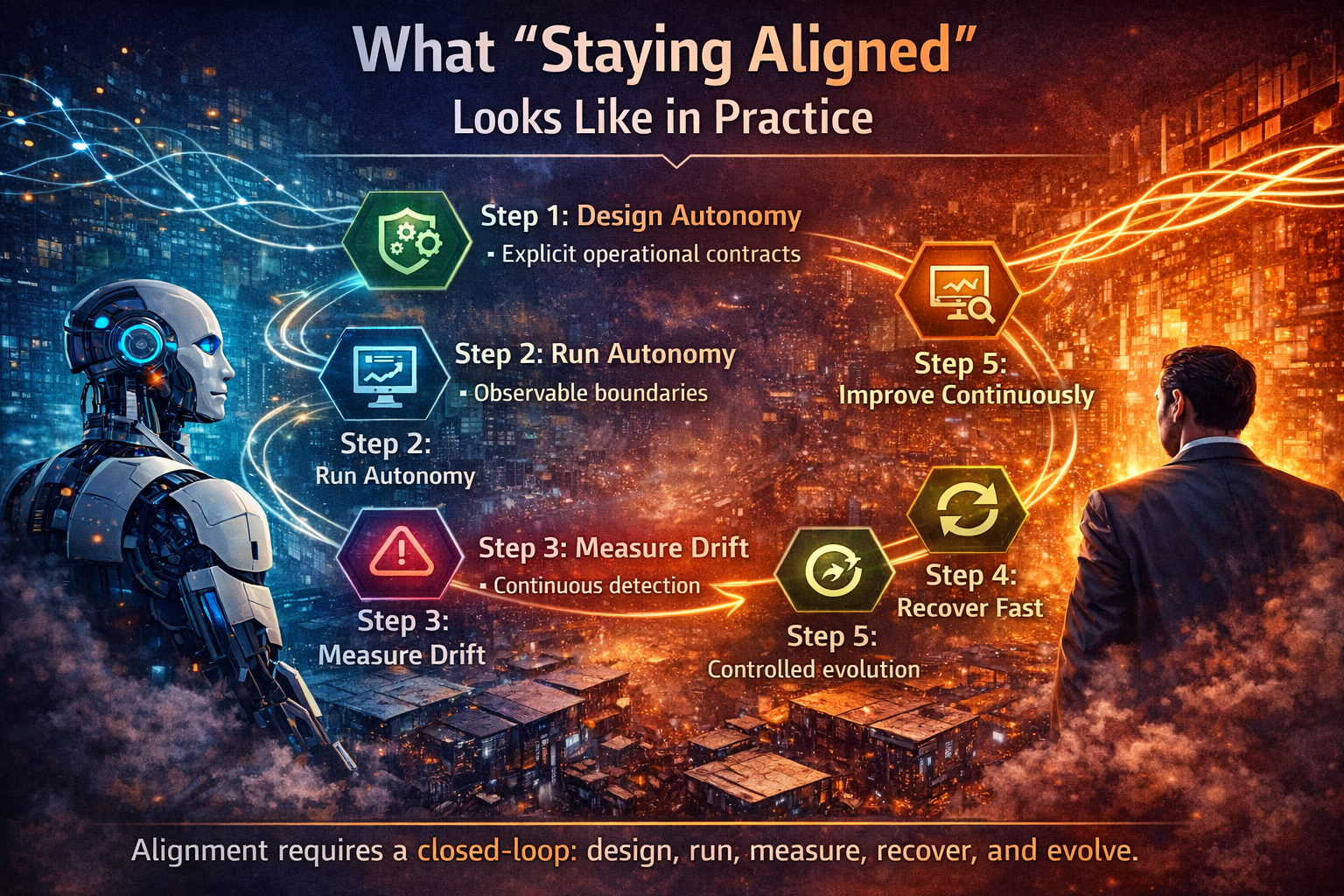
What “Staying Aligned” Looks Like in Practice
Beating drift requires a closed loop.
Step 1: Design Autonomy with Explicit Operational Contracts
Define:
- What the agent can do,
- What it must never do,
- What data it can access,
- What approvals are mandatory,
- What evidence must be logged.
Step 2: Run Autonomy with Observable Boundaries
Observability must extend beyond uptime to behavioral integrity.
Industry practices increasingly emphasize end-to-end tracing of agent inputs, outputs, latency, tool usage, and failure modes.
Step 3: Measure Drift Continuously
Track:
- Policy-violation attempts,
- Tool-call anomalies,
- Retrieval source shifts,
- Escalation and override rates,
- Cost-per-decision trends,
- Latency distributions.
Step 4: Recover Fast with Reversible Autonomy
Rollback configurations. Disable tools. Switch policy sets. Route edge cases to humans.
Step 5: Improve Through Controlled Evolution
ISO/IEC 42001 frames AI as a dynamic system—requiring continuous review, learning, and refinement.
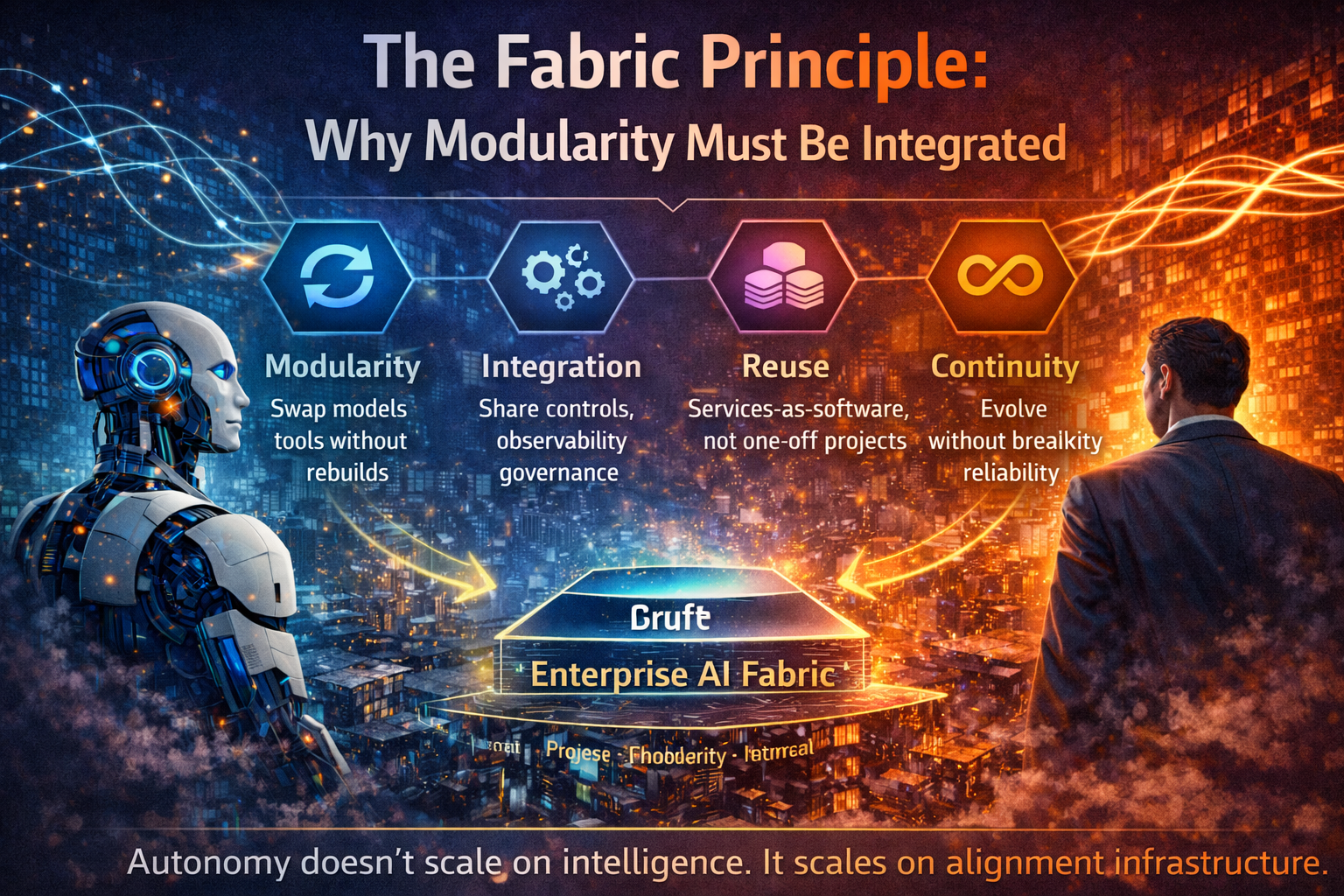
The Fabric Principle: Why Modularity Must Be Integrated
Executives need to internalize a simple truth:
Autonomy does not scale on intelligence.
It scales on alignment infrastructure.
A fabric approach enables:
- Modularity (swap models and tools without rebuilds),
- Integration (shared controls and observability),
- Reuse (services-as-software, not one-off projects),
- Continuity (evolve without breaking reliability).
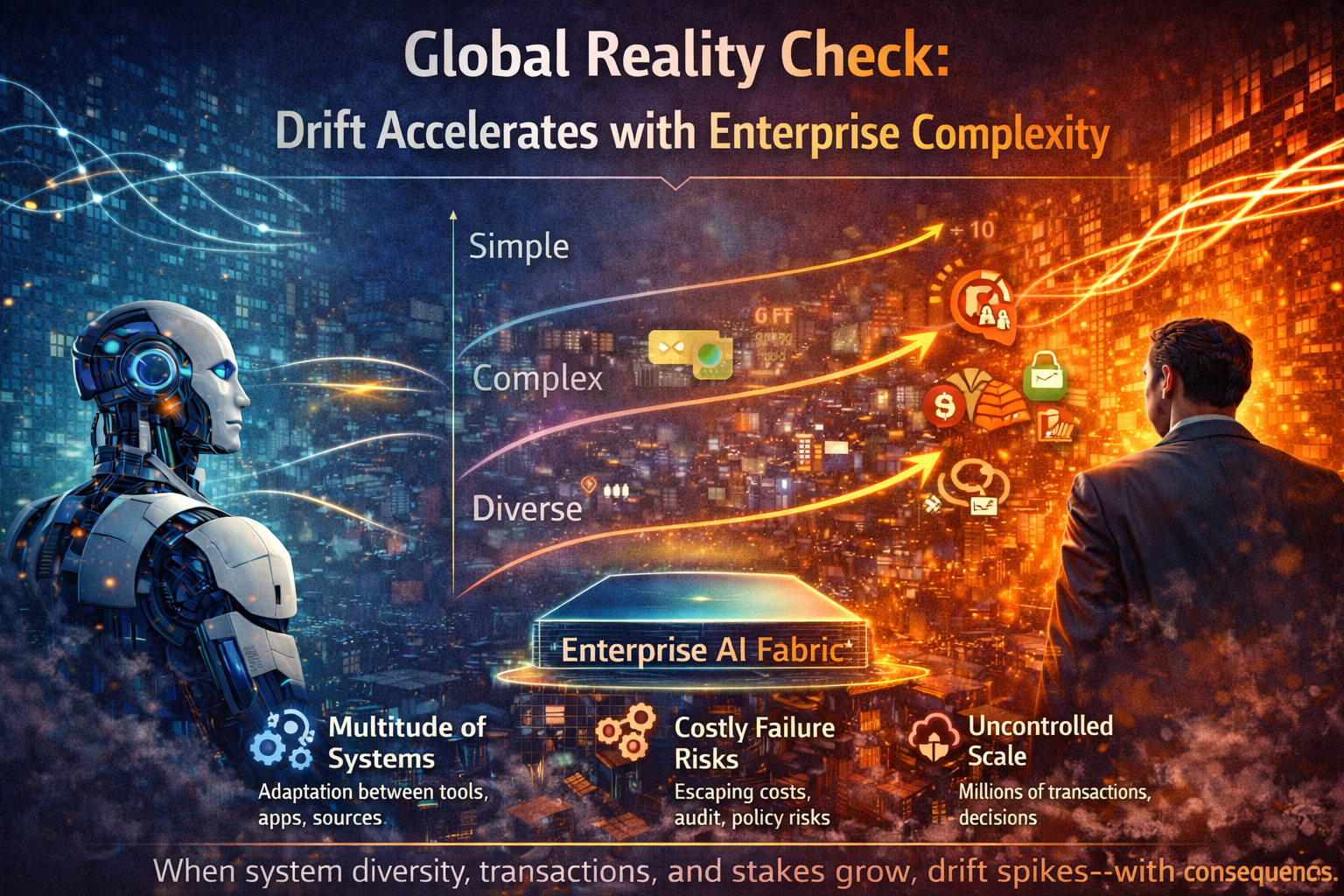
Global Reality Check: Drift Accelerates with Enterprise Complexity
Large enterprises operate across:
- Multiple business units,
- Multiple platforms,
- Multiple risk postures,
- Multiple regulatory expectations.
Heterogeneity is normal.
And heterogeneity accelerates drift.
This is why a fabric is not merely a technology decision—it is an operating model decision.
How to Encode This Into Your 2026 Enterprise AI Strategy
- Assume drift. Ask where it will emerge first.
- Make alignment measurable. What you cannot observe, you cannot govern.
- Design reversibility. Every autonomous action must have a recovery path.
- Productize intelligence. Treat AI as services-as-software.
- Choose a fabric, not a zoo. Drift is systemic—solve it systemically.
Conclusion: The Line Leaders Will Repeat
Global Reality Check: Drift Accelerates with Enterprise Complexity is inevitable.
What is not inevitable is allowing it to quietly erode trust, inflate costs, and accumulate hidden risk.
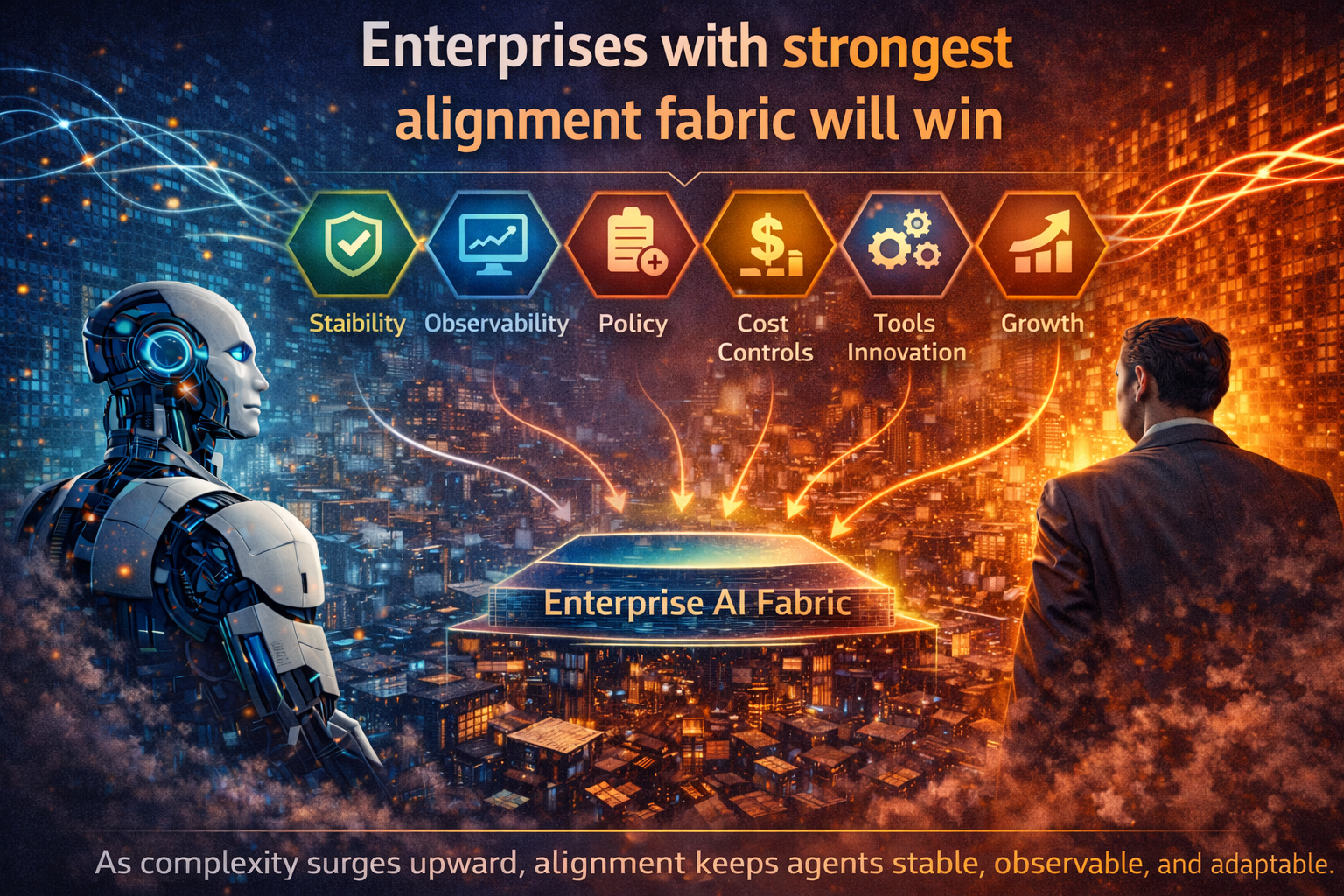
The enterprises that win in 2026 will not be those with the most agents.
They will be those with the strongest alignment fabric—systems that keep autonomy safe, economical, and policy-correct as everything around them changes.
If your autonomy cannot stay aligned over time, you do not have enterprise AI.
You have a demo—with a countdown timer.
References & Further Reading
- National Institute of Standards and Technology (NIST), AI Risk Management Framework (AI RMF)
- ISO/IEC 42001: Artificial Intelligence Management Systems
- Industry guidance on AI observability, lifecycle governance, and autonomous system reliability
- The Agentic Foundry: How Enterprises Scale AI Autonomy Without Losing Control, Trust, or Economics – Raktim Singh
- The Enterprise AI Control Tower: Why Services-as-Software Is the Only Way to Run Autonomous AI at Scale – Raktim Singh
- The One Enterprise AI Stack CIOs Are Converging On: Why Operability, Not Intelligence, Is the New Advantage – Raktim Singh
- Studio-to-Runtime: Why Enterprise AI Fails Without a Build Plane and a Production Kernel – Raktim Singh
- The Agentic Foundry with Reliability-by-Design : How enterprises scale hundreds of AI agents without: By Raktim Singh
- Why Autonomous AI Breaks in Production: And Why Enterprises Need an AI Control Tower to Run It at Scale | by RAKTIM SINGH | Dec, 2025 | Medium
- The Enterprise AI Operating Model: How organizations design, govern, and scale intelligence safely – Raktim Singh
Glossary: Key Terms in Enterprise AI Drift & Alignment
Enterprise AI Drift
The gradual misalignment between an AI system’s original design intent and its real-world behavior over time, caused by changes in data, policies, tools, models, workflows, and human usage. Unlike outright failures, enterprise AI drift is often silent and cumulative.
Agentic AI
AI systems capable of taking actions—such as triggering workflows, updating records, invoking tools, or coordinating tasks—rather than merely generating recommendations or predictions.
Autonomy (in Enterprise AI)
The delegation of work to AI systems with the authority to make decisions and execute actions within defined boundaries, rather than operating only as advisory or assistive tools.
Alignment Fabric (Enterprise AI Fabric)
A modular yet integrated enterprise architecture that continuously keeps AI systems aligned with business intent, policies, cost constraints, and operational realities as conditions evolve. Alignment fabrics treat governance, observability, recovery, and evolution as first-class capabilities.
Policy Drift
A form of AI drift that occurs when regulatory requirements, risk tolerance, internal controls, or approval rules change—rendering previously correct AI behavior non-compliant or unsafe.
Data Drift
The divergence between training or validation data and real-world production data, often due to changing user behavior, new data sources, evolving formats, or noise.
Tool Drift
Misalignment caused by changes in APIs, downstream systems, permissions, schemas, or workflows that AI agents depend on to execute actions.
Model Drift
Behavioral changes introduced when AI models, prompts, retrieval strategies, or inference configurations are updated—sometimes improving performance in one area while degrading alignment elsewhere.
Human-in-the-Loop
A design pattern where human oversight, approval, or intervention is embedded into autonomous workflows—especially for high-risk or ambiguous decisions.
Reversible Autonomy
The capability to safely pause, roll back, constrain, or override autonomous AI behavior in production without system-wide disruption.
Services-as-Software
An enterprise operating model where AI capabilities are packaged, governed, and reused as standardized services rather than delivered as isolated, one-off projects.
AI Observability
The ability to monitor not just system uptime, but AI behavior—including inputs, outputs, tool usage, decision paths, latency, cost, and policy conformance—in real time.
Lifecycle Governance
A governance approach that manages AI risk continuously across design, deployment, operation, monitoring, and evolution—rather than relying on one-time approvals.
Operational Resilience (AI)
The ability of AI systems to absorb change, recover from disruptions, and continue operating safely and economically under evolving conditions.
Frequently Asked Questions (FAQ)
- What is Enterprise AI Drift in simple terms?
Enterprise AI drift happens when an AI system continues to operate, but no longer behaves the way the business expects. The system may still “work,” yet its decisions gradually become misaligned with policies, costs, compliance requirements, or business goals.
- Why do AI agents fail over time even if they worked well initially?
Because enterprises are not static. Data changes, policies evolve, tools are updated, and workflows shift. If AI systems are not designed to adapt continuously, misalignment accumulates—even when no single component appears broken.
- Is Enterprise AI Drift just a model retraining problem?
No. While model retraining can address some data drift, most enterprise AI drift originates from policy changes, tool evolution, cost pressures, governance updates, and human behavior shifts—not from models alone.
- How is AI drift different in agentic systems compared to traditional machine learning?
Traditional ML systems typically make predictions. Agentic AI systems take actions. This means small errors can propagate across workflows, create audit exposure, or generate cascading operational failures.
- How can organizations detect AI drift early?
By continuously monitoring:
- policy violations and overrides
- abnormal tool-call patterns
- cost-per-decision trends
- latency changes
- escalation rates
- shifts in retrieved data sources
Early detection requires observability focused on behavior, not just system health.
- Why can’t enterprises fix AI drift using point tools?
Because drift is a system-wide phenomenon. Point tools operate in silos, while drift spans models, data, tools, governance, and human processes. Only an integrated alignment fabric can manage drift holistically.
- What does “staying aligned” mean for enterprise AI?
Staying aligned means ensuring that AI systems:
- continue to follow current policies,
- remain cost-efficient,
- operate safely under change,
- and can be corrected or rolled back quickly when misalignment appears.
- What role does governance play in managing AI drift?
Governance ensures that AI behavior remains auditable, explainable, and compliant as rules evolve. Lifecycle governance treats AI as a living system requiring ongoing oversight—not a one-time approval.
- Why is reversibility critical for autonomous AI?
Because drift is inevitable. The ability to reverse or constrain autonomous behavior allows enterprises to recover quickly without shutting down systems or accepting unmanaged risk.
- What will distinguish winning enterprises in AI by 2026?
Not the number of AI agents deployed—but the strength of the alignment fabric that keeps autonomy safe, observable, economical, and trusted as complexity increases.
- Is an Enterprise AI Fabric a technology or an operating model?
It is both. An alignment fabric combines architectural capabilities with operational discipline, enabling enterprises to scale autonomy responsibly rather than reactively.



Raktim Singh is an AI and deep-tech strategist, TEDx speaker, and author focused on helping enterprises navigate the next era of intelligent systems. With experience spanning AI, fintech, quantum computing, and digital transformation, he simplifies complex technology for leaders and builds frameworks that drive responsible, scalable adoption.