

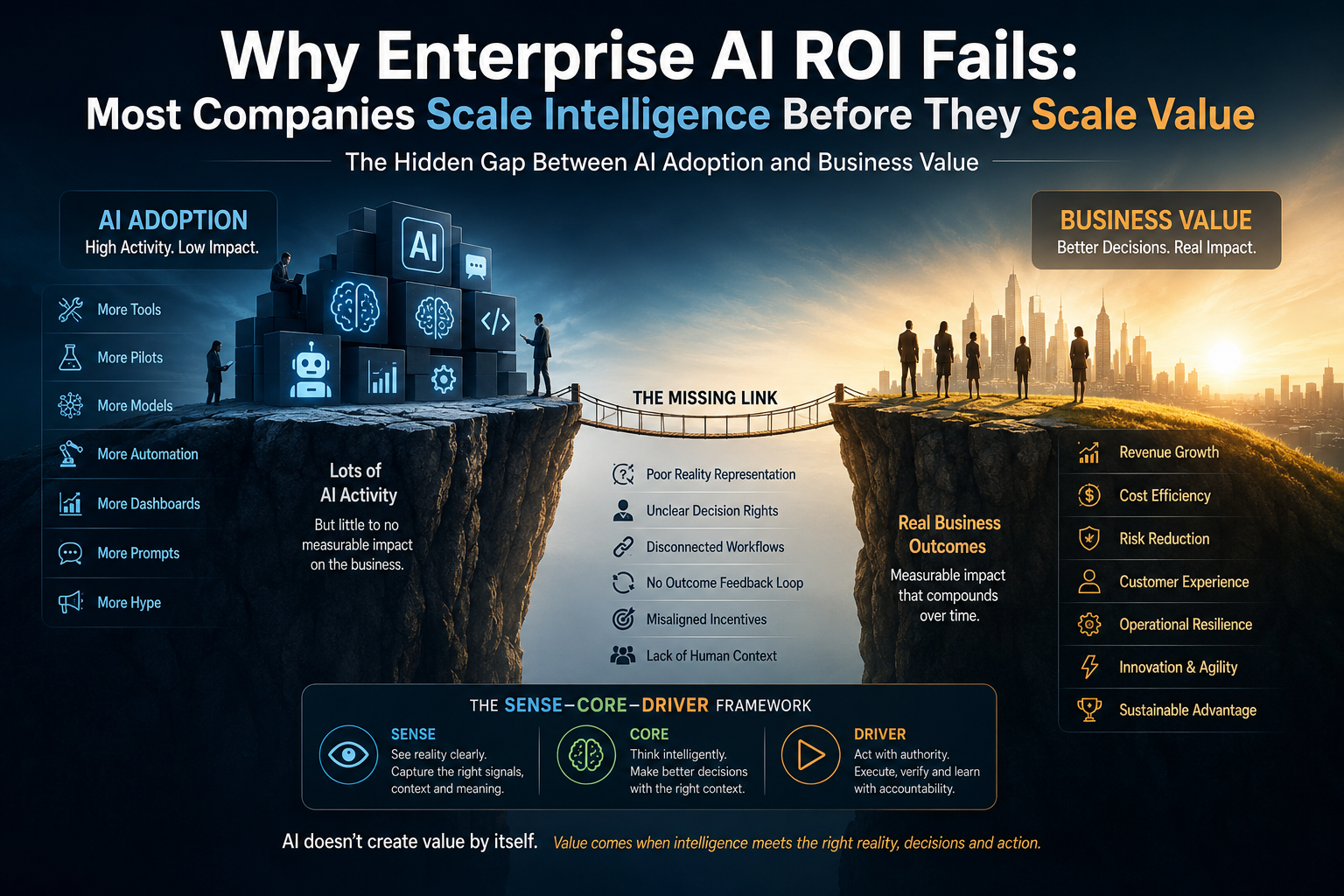
Enterprise AI ROI:
For the past several years, the AI conversation has been dominated by one question: which model is faster, cheaper, or scores higher on a benchmark. That question still matters. But it is no longer the most important one. The deeper question is: why do some organizations become easier for AI systems to understand, trust, and work with than others?
Most Enterprise AI projects fail to deliver expected ROI not because the models are inaccurate, but because organizations struggle to connect AI outputs to real business decisions and operational workflows.
The Hidden Gap Between AI Adoption and Business Value
Most enterprises are not failing because they lack AI tools, models, copilots, or agents. They are failing because they are scaling AI activity before they have built the institutional capacity to convert intelligence into measurable value.
Introduction: The Boardroom Question Nobody Can Avoid
Every boardroom now has some version of the same question.
Where is the ROI from AI?
The company has invested in copilots. Developers are using coding assistants. Customer service has tested AI agents. Business teams are summarizing documents faster. Employees are experimenting with generative AI. A few demos looked impressive. Some pilots may even have won internal awards.
And yet, when the CFO asks a simple question — what changed in revenue, cost, risk, speed, customer experience, resilience, or decision quality — the answer is often unclear.
That is the uncomfortable truth about enterprise AI today.
Many organizations have increased AI usage without increasing institutional value. They have more prompts, more pilots, more dashboards, more agents, more automation experiments, and more AI presentations. But they do not yet have a clear line between AI activity and business outcomes.
That gap is the real reason enterprise AI ROI fails.
The problem is not that AI is weak. In many cases, the technology is already powerful enough to produce meaningful value. The problem is that most enterprises are scaling intelligence before they scale value.
They scale tools before redesigning work.
They scale pilots before redesigning operating models.
They scale models before fixing representation.
They scale automation before clarifying decision rights.
They scale agents before defining authority.
They scale intelligence before understanding the reality that intelligence is supposed to improve.
This is why enterprise AI ROI is not simply a technology issue. It is an institutional design issue.
And the companies that understand this early will have a very different advantage from those merely buying the next AI platform.
Twenty years of digital transformation gave enterprises machine-readable records — transactions, tickets, workflows, dashboards. But records are not reality. A CRM may show an account as active. It will not show that the customer called last week to cancel and was talked out of it, or that the relationship depends on one person who is about to retire. A warehouse system may show inventory levels. It will not show which items are physically accessible, which are earmarked by informal agreement, or which supplier just flagged a six-week delay.
Digital transformation made the enterprise machine-readable. AI transformation has to make it machine-understandable. That distinction explains most of the ROI gap.
The Enterprise AI Paradox
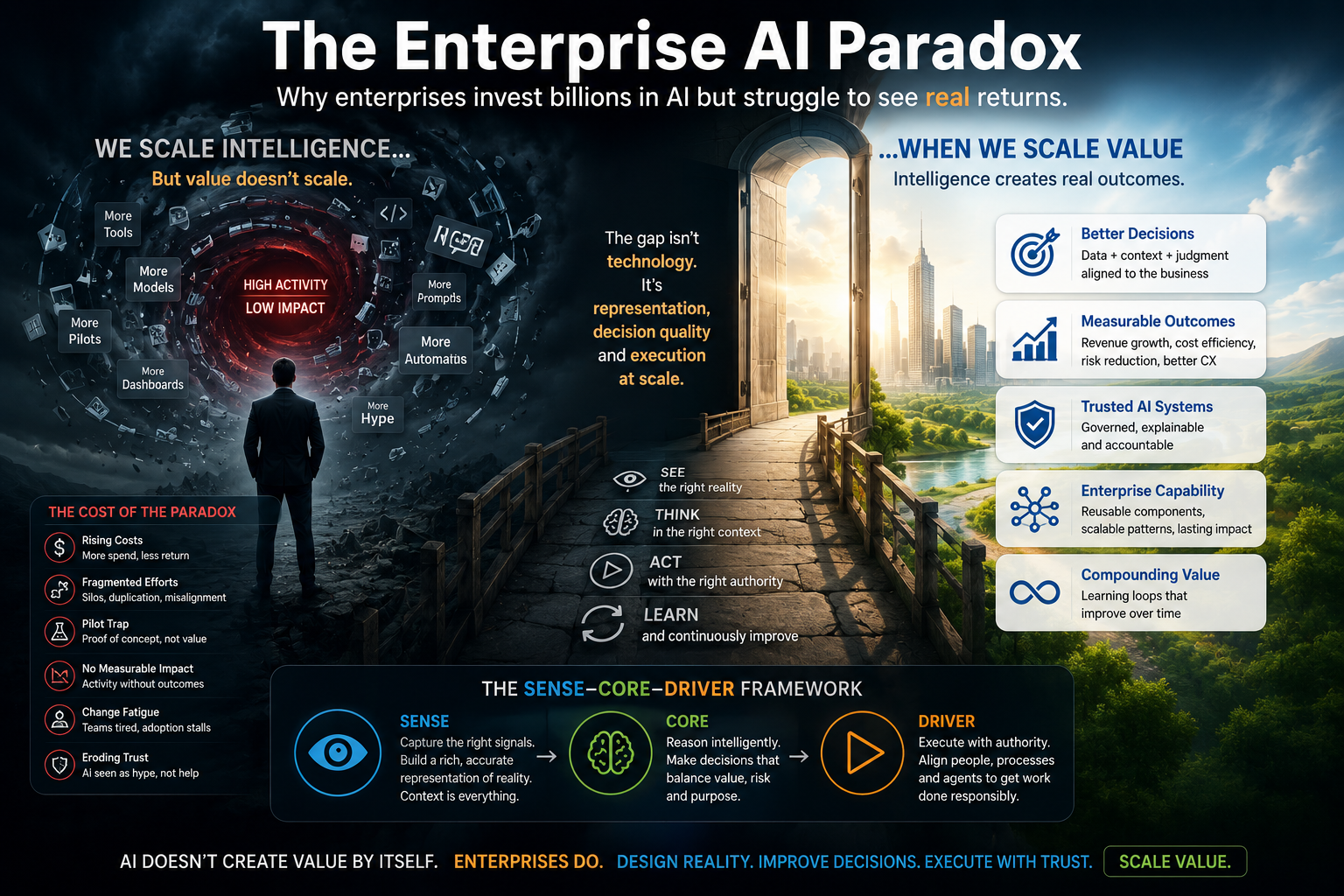
The paradox of enterprise AI is simple.
The more powerful AI becomes, the more expensive weak representation becomes.
When AI was only recommending, the cost of misunderstanding was limited. When AI begins summarizing, deciding, routing, approving, escalating, negotiating, coding, or acting across systems, misunderstanding becomes operational.
A weak report may mislead one manager.
A weak AI agent may misdirect an entire workflow.
A poor dashboard may create confusion.
A poor representation layer may cause AI to optimize the wrong reality at scale.
A human may notice when a process does not match the ground reality.
An AI system may confidently act on the process as documented.
That is the paradox. Better intelligence does not automatically create better outcomes. It can amplify whatever version of reality the enterprise gives it.
If the enterprise gives AI fragmented data, it will reason over fragments.
If it gives AI outdated process maps, it will optimize outdated work.
If it gives AI shallow customer records, it will personalize without understanding.
If it gives AI unclear authority boundaries, it will act faster than the organization can govern.
This is why many AI ROI conversations are incomplete. They focus on model capability, productivity, and adoption, but they underplay a deeper question:
Can the enterprise represent its own reality accurately enough for AI to create value?
That question sits at the heart of the Representation Economy.
AI Adoption Is Not AI Value
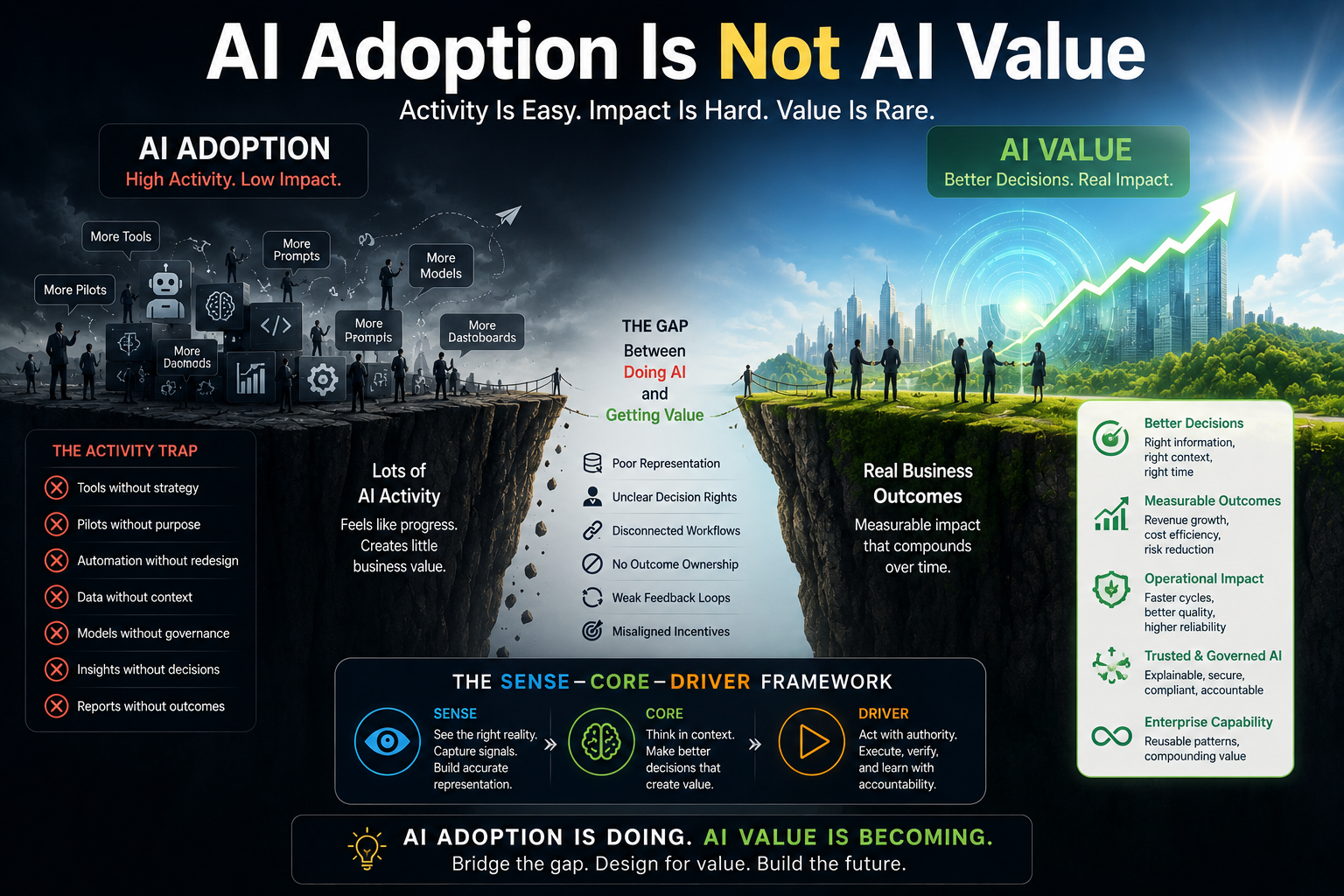
Enterprise leaders often measure AI progress through adoption.
How many employees are using AI?
How many copilots have been deployed?
How many use cases are in the pipeline?
How many agents are live?
How many teams have received AI training?
How many hours have been saved?
These numbers are useful, but they are not ROI.
AI adoption tells us whether people are using AI.
AI value tells us whether the organization is becoming better because of AI.
The difference is enormous.
A sales team may use AI to generate more emails. But if those emails do not improve conversion quality, shorten deal cycles, deepen customer understanding, or improve account prioritization, the organization has created activity, not value.
A software team may use AI to generate more code. But if the code increases technical debt, creates hidden security risk, or accelerates the wrong backlog, the enterprise has created output, not value.
A support team may use AI to summarize customer complaints. But if the summaries do not help the company fix root causes, reduce repeat tickets, or improve product design, the firm has created faster documentation, not better service.
A finance team may use AI to explain variances faster. But if business leaders do not make better investment, pricing, cost, or capacity decisions, the organization has created faster analysis, not better economics.
AI activity becomes valuable only when it changes the quality of decisions, actions, and outcomes.
This sounds obvious. In practice, most AI programs skip this step.
They ask, “Where can we use AI?”
They do not ask, “Where does value actually break today?”
That is where ROI starts failing.
The Hidden Value Chain of Enterprise AI
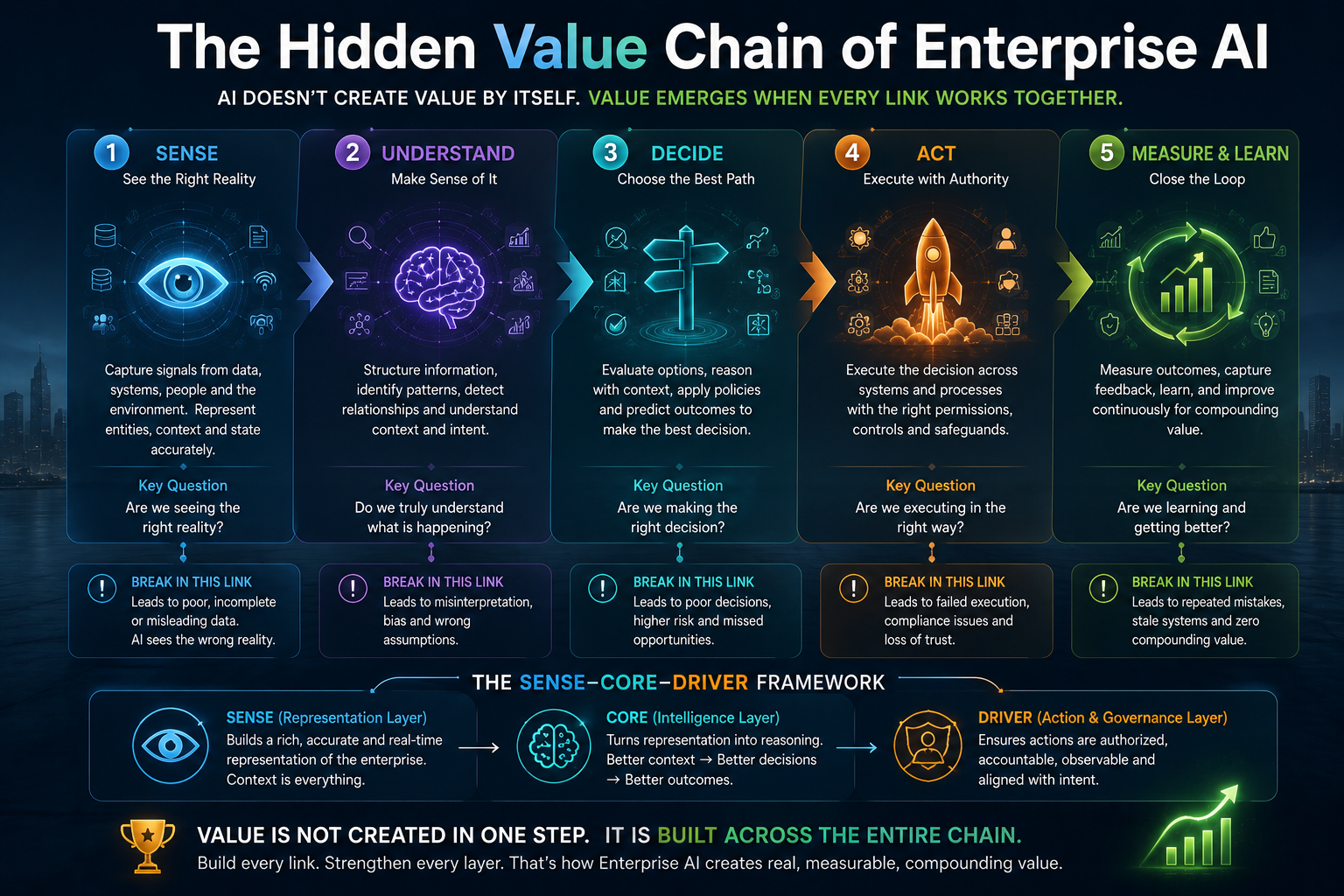
For AI to create ROI, something very specific must happen.
A real-world situation must be understood correctly.
A decision must be improved.
An action must be executed responsibly.
The result must be measured.
The system must learn from the outcome.
If any part of this chain breaks, ROI becomes weak.
This is why many AI pilots look successful but fail at scale. In a pilot, the context is narrow. The data is curated. The users are motivated. The risks are controlled. Exceptions are handled manually. The success criteria are often soft.
At enterprise scale, reality returns.
Data is messy.
Processes vary across regions.
Policies conflict.
Customers behave unpredictably.
Employees use workarounds.
Legacy systems disagree with each other.
Approvals are unclear.
Exceptions multiply.
Risk teams ask difficult questions.
The business wants accountability.
A pilot can survive without deep institutional architecture. A production AI system cannot.
This is why ROI often disappoints after the excitement phase. The organization moves from “Can AI do this task?” to “Can the enterprise trust this system to change real work?”
Those are very different questions.
A pilot tests capability.
An enterprise rollout tests institutional readiness.
Why AI ROI Is Really a Representation Problem
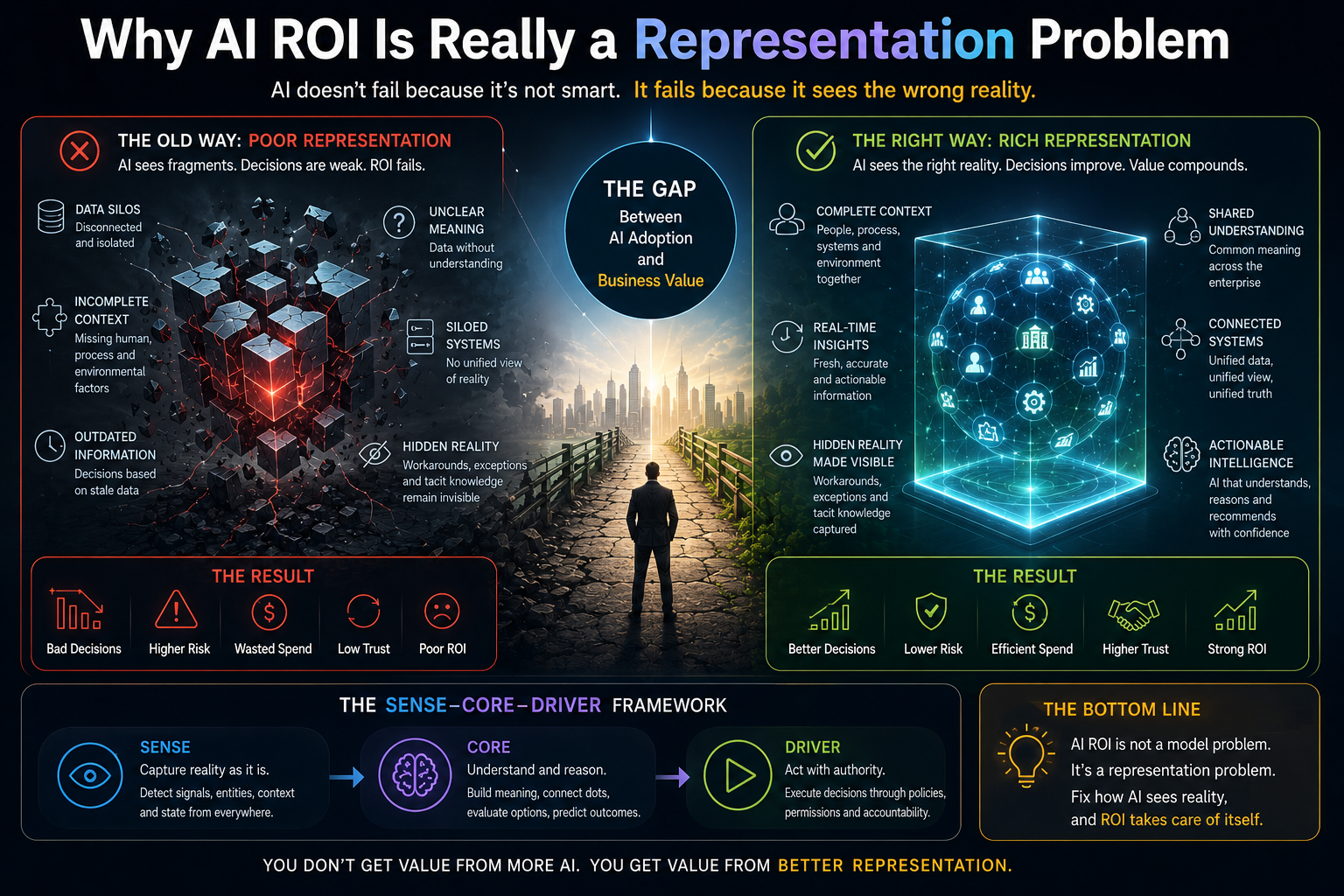
AI does not act on reality directly. It acts on representations of reality.
It acts on data, documents, logs, tickets, process maps, knowledge bases, CRM records, ERP entries, sensor feeds, policies, workflows, permissions, and human instructions.
If those representations are weak, AI will reason on a weak version of the enterprise.
This is a critical point for CIOs, CTOs, enterprise architects, and board members.
An enterprise may have data and still not have representation.
Data says: “A customer called five times.”
Representation asks: “What was the customer trying to solve, which promises failed, which internal handoffs broke, and what is the current state of the customer relationship?”
Data says: “A ticket was closed.”
Representation asks: “Was the problem actually solved, or was the workflow merely completed?”
Data says: “The employee approved the request.”
Representation asks: “Did the employee understand the AI recommendation, have authority to approve it, and retain real accountability?”
Data says: “The machine was repaired.”
Representation asks: “What failure pattern is emerging across assets, locations, suppliers, technicians, and operating conditions?”
Most enterprises have enormous data stores but poor representation of reality.
That is why AI ROI fails.
The AI system may be technically strong, but the reality it sees may be incomplete, outdated, fragmented, or misleading.
In the Representation Economy, value moves toward organizations that can represent reality better, reason over it responsibly, and act with legitimacy.
That is a much deeper source of advantage than simply deploying more AI tools.
The SENSE–CORE–DRIVER View of AI ROI
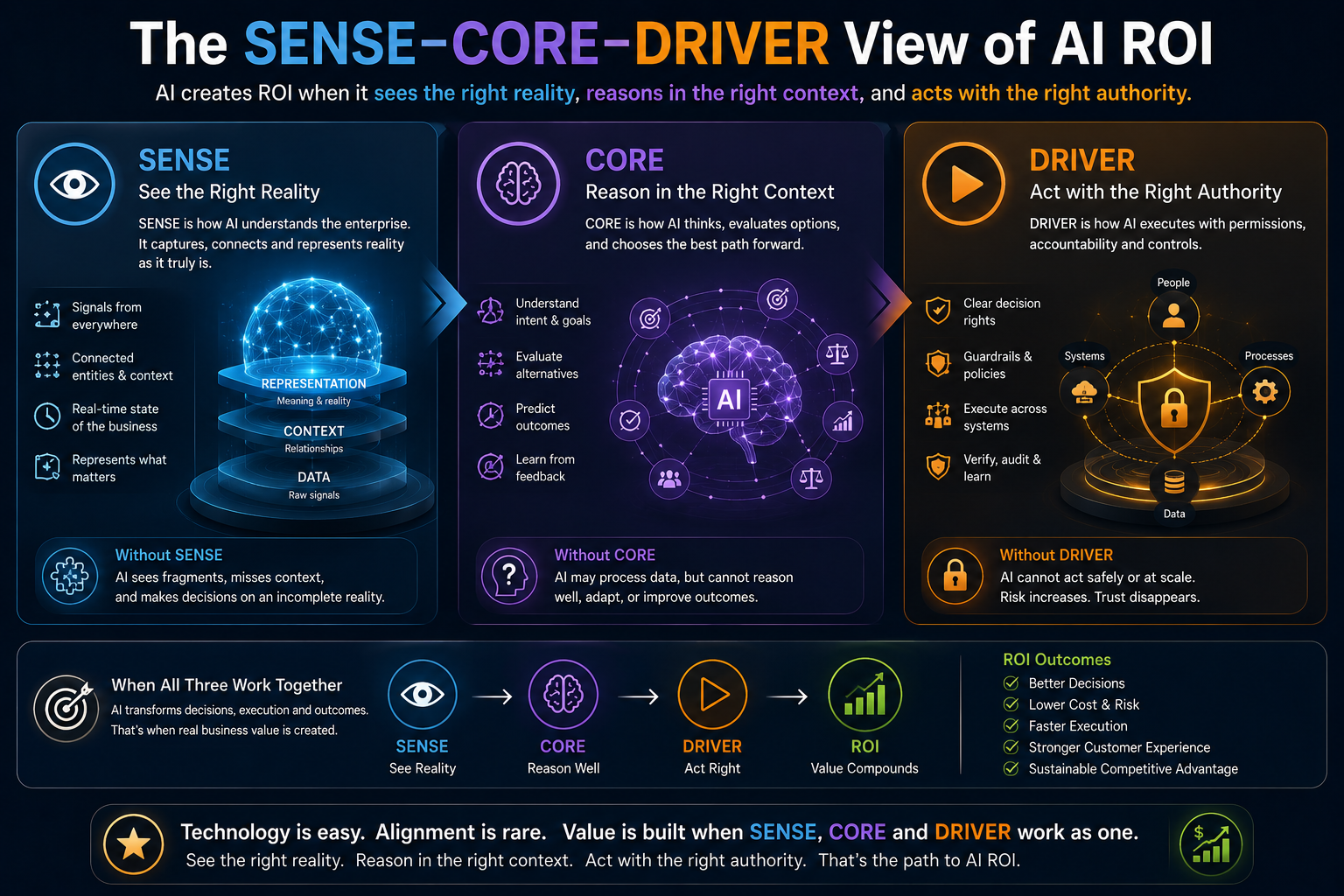
Enterprise AI ROI depends on three layers working together.
SENSE is the layer that makes reality machine-readable. It detects signals, connects them to entities, represents their state, and updates that state as reality changes.
CORE is the reasoning layer. It interprets context, compares options, optimizes decisions, and learns from feedback.
DRIVER is the execution and legitimacy layer. It defines who authorized action, what boundaries exist, how decisions are verified, how actions are executed, and how errors can be corrected.
Most AI programs overinvest in CORE.
They buy models.
They tune prompts.
They benchmark outputs.
They compare model performance.
They debate open versus closed models.
They build agent frameworks.
These things matter. But they are not enough.
If SENSE is weak, AI cannot see the enterprise correctly.
If DRIVER is weak, AI cannot act legitimately.
If CORE is strong but SENSE and DRIVER are weak, the organization gets confident intelligence acting on poor reality with unclear authority.
That is not ROI.
That is institutional risk disguised as productivity.
The practical lesson is simple:
AI must see the right reality.
AI must reason in the right context.
AI must act within the right authority.
When these three conditions are missing, enterprise AI does not scale value. It scales confusion.
Why AI ROI Fails Even When the Model Works
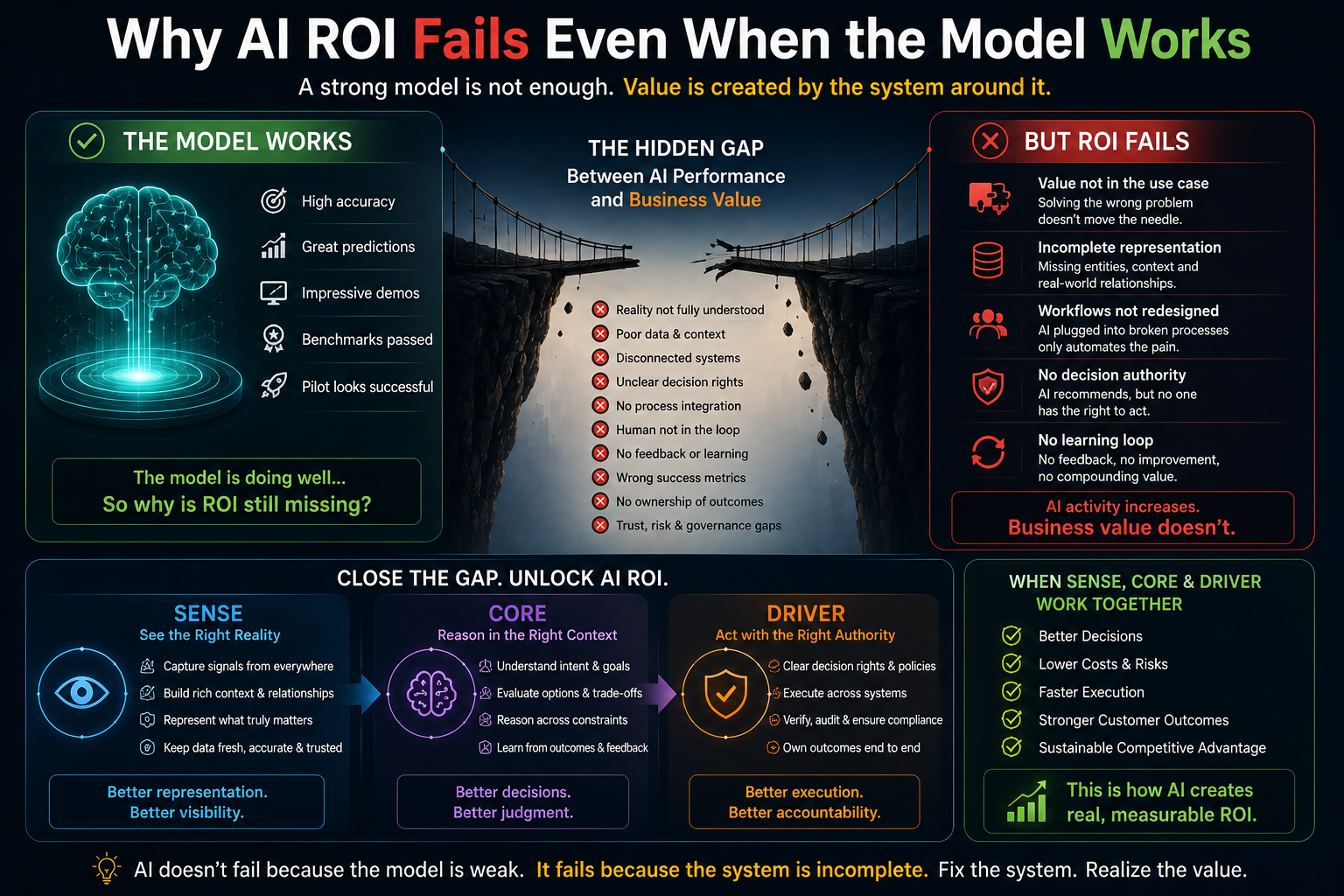
One of the most misleading statements in enterprise AI is this:
“The model works.”
A model can work and the enterprise system can still fail.
The model may summarize correctly, but the workflow may remain broken.
The model may predict accurately, but the organization may not know what action to take.
The model may classify the case correctly, but the approval boundary may be unclear.
The model may generate code quickly, but the architecture may become harder to maintain.
The model may answer customer queries, but the root cause of customer frustration may remain untouched.
Model performance is not enterprise performance.
This is where many AI ROI programs lose discipline. They move from technical validation to business claims too quickly.
A model benchmark can tell you whether the AI is capable. It cannot tell you whether the enterprise is ready to absorb that capability responsibly.
Enterprise ROI requires more than model accuracy. It requires context, workflow redesign, governance, integration, adoption, authority, measurement, and learning loops.
That is why “the model works” is only the beginning of the ROI conversation.
Why Scaling AI Before Scaling Value Creates Waste
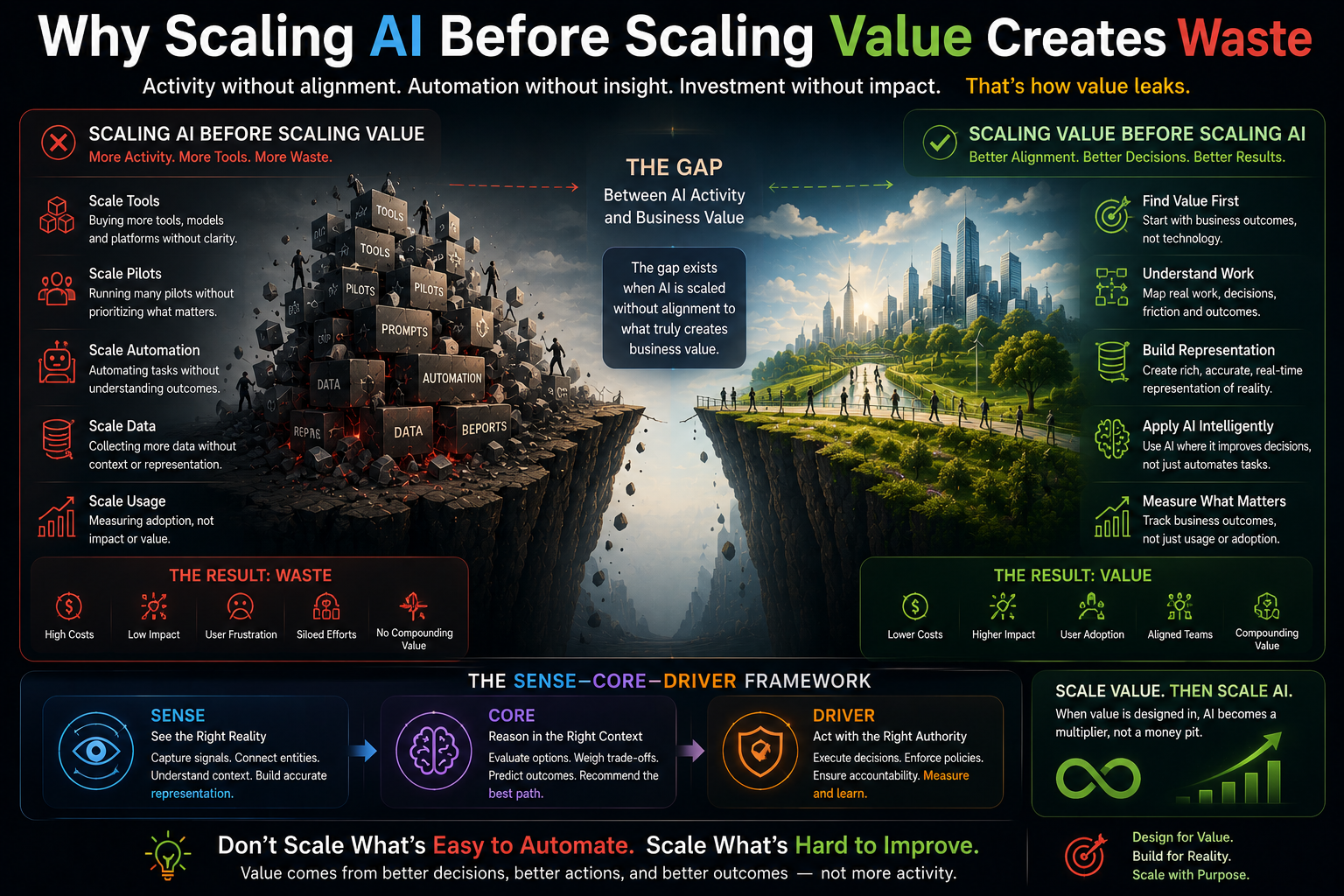
Many enterprises are now trying to scale AI horizontally.
One copilot for everyone.
One agent platform for every function.
One AI factory for all use cases.
One model strategy for the enterprise.
One automation target across departments.
This looks efficient. It often creates waste.
Why?
Because value is not evenly distributed across the enterprise.
Some tasks are frequent but low-value.
Some tasks are expensive but rare.
Some tasks are easy to automate but risky to delegate.
Some tasks look manual but actually contain judgment.
Some workflows appear inefficient because they are protecting the organization from bad decisions.
Some delays are not process failures; they are governance signals.
When companies scale AI without understanding these differences, they automate the surface of work instead of improving the economics of work.
A bank may automate document review but fail to reduce credit risk.
A retailer may personalize offers but fail to improve margin quality.
A manufacturer may use AI for predictive maintenance but still miss why technicians override alerts.
An insurer may automate claims triage but create customer anger when legitimate exceptions are treated as standard cases.
A telecom company may deploy AI assistants but fail to reduce the root causes of service complaints.
In each case, AI is present.
But value is not flowing.
The mistake is not using AI. The mistake is scaling AI before mapping where value is created, blocked, distorted, or destroyed.
When Governance Looks Right but Isn’t: The Human–AI Reality Gap
Enterprise AI has a governance problem that governance frameworks often miss. Most AI governance programs define policies, classify risks, create review workflows, and keep humans in the loop. All of this is necessary. But governance often fails to ask two deeper questions: Has the enterprise represented the right reality for AI to reason over? And does the human still behave the way the governance framework assumes?
These two questions explain a failure pattern that is quietly breaking AI ROI across industries.
Consider a bank using AI to assist loan officers. The AI recommends whether to approve, reject, or escalate a loan. The governance design looks responsible — the AI gives a recommendation, the loan officer reviews it, the officer makes the final decision. The workflow says human-in-the-loop.
At first, the officer reads the AI output carefully, checks the explanation, and compares the recommendation against personal judgment. But after six months, the AI appears reliable. Review time falls. Routine cases are approved quickly. After a year, the officer often clicks approve because the AI has usually been right. The governance document still says: AI recommendation followed by human review. But the real behavior has changed. The human is still in the loop — but human judgment has weakened.
This is not only automation bias. It is an institutional representation problem. The enterprise believes it has represented oversight. In reality, oversight has become symbolic.
The same pattern appears in healthcare (clinicians stop challenging AI-generated interpretations, expertise erodes), software engineering (engineers stop reading architecture and security implications, technical debt rises), and customer service (support teams stop noticing emotional signals, customer trust declines). ROI looks positive in the short term while the long-term system quietly becomes weaker.
The Human–AI Reality Gap has two sides. The first is a SENSE problem: the enterprise fails to represent human, behavioral, and institutional reality properly before AI enters the workflow. The second is a DRIVER problem: the enterprise assumes human oversight remains meaningful even after repeated interaction with AI changes how people actually behave.
Closing this gap requires a Human–AI Reality Audit before scaling AI into any decision-critical workflow: What reality is the AI expected to represent? Which human behaviors does the governance framework assume? How does human behavior change after six months of production use? Is oversight real or has it become routine clicking? These are not soft questions — they determine what SENSE must capture, what CORE can reason over, and what DRIVER must govern.
When Oversight Becomes Symbolic
AI ROI often fails quietly, because organizations measure automation instead of measuring behavioral change.
Consider a loan officer reviewing AI-generated recommendations. In month one, she checks every output carefully. By month twelve, the AI has usually been right, so she clicks approve. The human is still technically “in the loop.” But the judgment behind that loop has eroded. The institution believes it has preserved oversight. In reality, oversight has become symbolic.
A bank may report that AI improved loan processing time — and treat that as the ROI story. But if officers have quietly stopped applying judgment, the institution may be increasing hidden risk at the same time it reports an efficiency win. The same pattern shows up in hospitals where clinicians stop challenging AI-generated interpretations, and in any workflow where a “human in the loop” becomes a human rubber-stamping the loop.
Before scaling further, CIOs and CTOs should run a Human–AI Reality Audit: examine what reality the AI system is actually representing, how humans are genuinely expected to validate its outputs, how behavior has changed over time, and whether governance remains meaningful in production — or just on paper.
Example 1: The Customer Service Copilot That Saves Time but Does Not Improve Service
Imagine a company deploys a customer service copilot.
The pilot looks excellent. Agents respond faster. Summaries are better. Average handling time improves. Employees like the tool. Leadership calls it a success.
But three months later, customer satisfaction has not improved. Repeat calls remain high. Escalations continue. Complaints increase in certain segments.
What happened?
The AI improved the interaction but did not improve the system.
The copilot helped agents answer faster, but it did not identify that customers were calling repeatedly because billing rules were confusing, product information was inconsistent, and internal teams were closing tickets without resolving root causes.
The company scaled AI activity. It did not scale value.
From a SENSE–CORE–DRIVER perspective, the failure is clear.
SENSE was too narrow. It represented calls, not customer state.
CORE optimized response generation, not root-cause resolution.
DRIVER executed faster service actions without changing accountability across product, billing, and operations.
The result was faster handling of unresolved reality.
This is common in enterprise AI.
AI makes the visible task faster while the invisible system remains broken.
Example 2: The Coding Assistant That Increases Output but Weakens Engineering Economics
Now consider software development.
A company deploys AI coding assistants across engineering teams. Developers produce code faster. Managers see productivity gains. The program reports time savings.
But after a few months, architecture review slows down. Defects increase in integration environments. Security teams find inconsistent patterns. Maintenance becomes harder because more code was generated than properly understood.
Again, AI activity increased. Enterprise value did not.
The issue is not that coding assistants are bad. They can be powerful. The issue is that code generation is not the same as engineering value.
Engineering value depends on maintainability, security, architecture fit, testability, reuse, performance, and long-term change cost.
If AI accelerates code creation without strengthening design discipline, review quality, dependency understanding, and ownership, the enterprise may simply produce technical debt faster.
SENSE failed to represent the real engineering system: dependencies, design intent, risk areas, and maintenance burden.
CORE generated plausible code.
DRIVER did not enforce architectural accountability before action moved into the codebase.
The enterprise scaled code before scaling engineering judgment.
That is why ROI becomes questionable.
Example 3: The Procurement Agent That Automates Transactions but Misses Trust
Procurement seems like a natural candidate for AI agents.
An agent can compare vendors, summarize contracts, check policy, draft purchase recommendations, and route approvals. The efficiency case looks strong.
But procurement is not only a transaction process. It is also a trust system.
A vendor may be cheaper but strategically risky.
A contract may be compliant but operationally weak.
A supplier may meet policy but have delivery reliability concerns.
A faster approval may weaken negotiation leverage.
A local exception may exist because of an earlier business incident that never became formal policy.
If an AI agent sees only structured procurement data, it may optimize price while weakening resilience.
Here again, ROI fails because value was defined too narrowly.
The organization thought procurement value meant faster buying. In reality, procurement value may mean lower risk, better supplier performance, stronger negotiation, greater continuity, and responsible spending.
AI scaled the transaction. It did not scale the institution’s judgment.
Why “Time Saved” Is a Dangerous AI ROI Metric
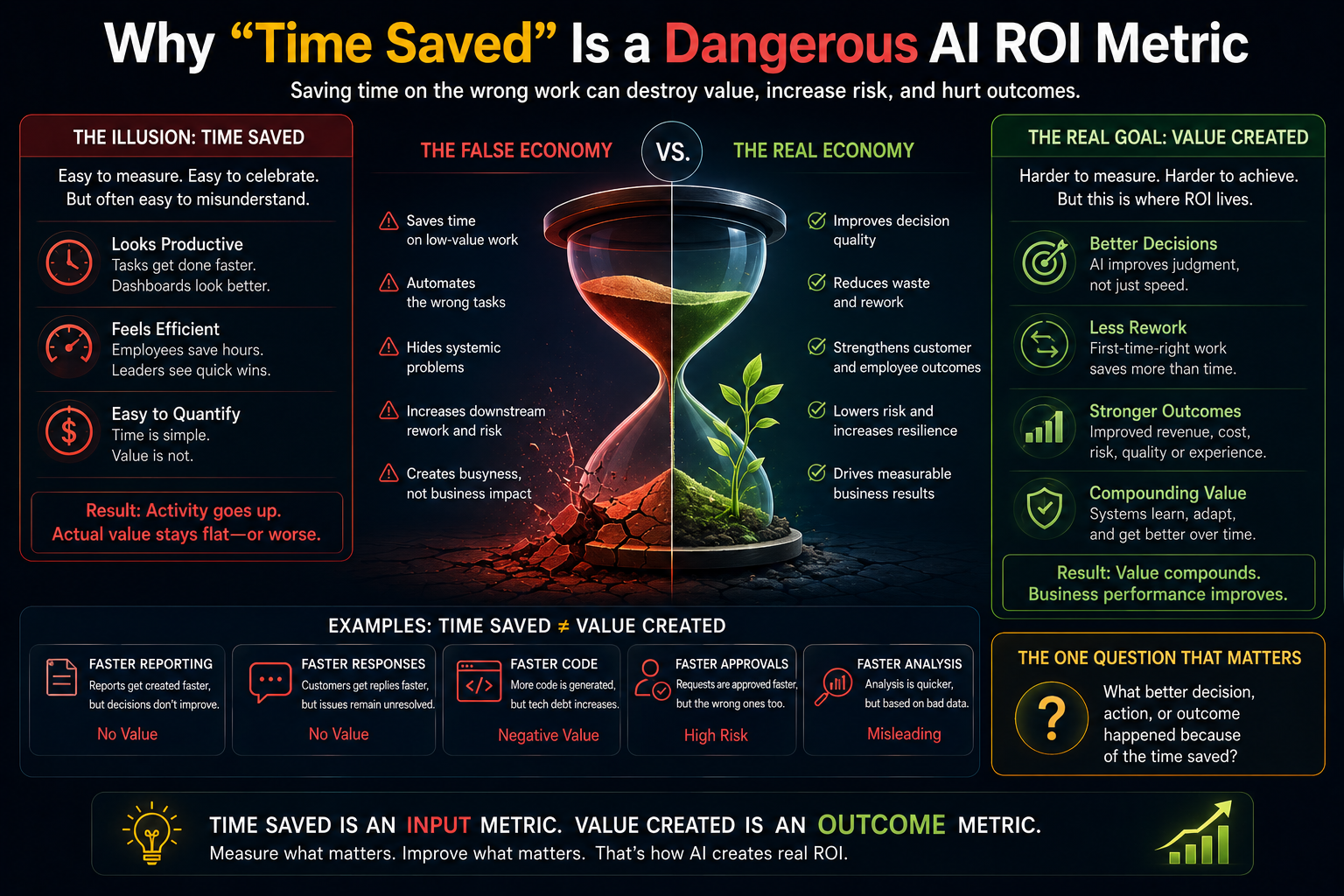
Many AI business cases begin with time savings.
This is understandable. Time is easy to measure. If AI reduces a task from thirty minutes to five minutes, the value appears obvious.
But time saved is not always value created.
If the saved time is not redeployed to higher-value work, it becomes theoretical value.
If faster work increases downstream rework, it becomes negative value.
If AI compresses a task that should have triggered human judgment, it becomes risk.
If the process itself should have been redesigned, task-level savings become a distraction.
A legal team may summarize contracts faster, but if negotiation quality does not improve, value is limited.
A marketing team may generate content faster, but if brand trust declines, value is destroyed.
A finance team may automate variance explanations, but if business leaders do not make better decisions, value is weak.
A project team may create status reports faster, but if delivery risk remains hidden, the organization is only accelerating reporting theatre.
Time saved is an input metric.
Enterprise value is an outcome metric.
The most mature AI organizations will not ask only, “How much time did we save?”
They will ask, “What decision improved, what risk reduced, what revenue increased, what cost disappeared, what experience changed, or what capability compounded?”
Digital Anthropology: The Missing Discipline in AI ROI
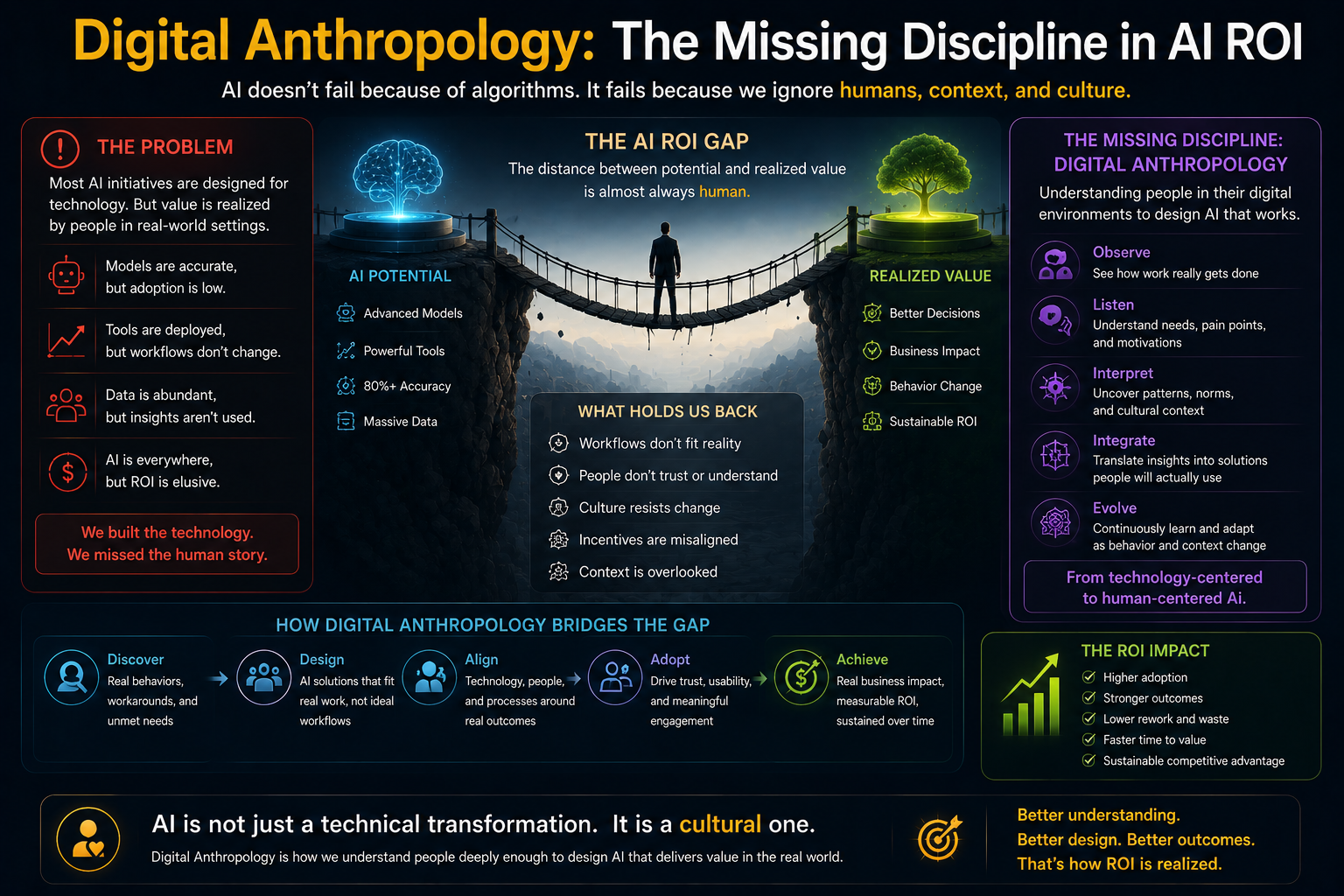
Most AI programs study processes. Few study work.
A process is what the system says happens.
Work is what people actually do to make the system function.
The difference matters.
A process map may show five steps. Real work may involve twenty informal decisions, three workarounds, two personal relationships, and one experienced employee who knows when the official rule does not fit the situation.
AI systems trained only on formal process maps miss this reality.
This is why digital anthropology should become part of enterprise AI architecture.
Before scaling AI, organizations need to understand how work is actually performed, where judgment sits, where trust is created, where exceptions occur, where employees compensate for system weaknesses, and where customers experience friction that internal metrics do not capture.
Without this, AI automates the documented enterprise, not the real enterprise.
And the documented enterprise is often a simplified fiction.
For enterprise AI ROI, this is not a soft topic. It is an economic topic.
Because if AI misunderstands real work, it cannot reliably improve value.
What Digital Anthropology Reveals That Dashboards Cannot
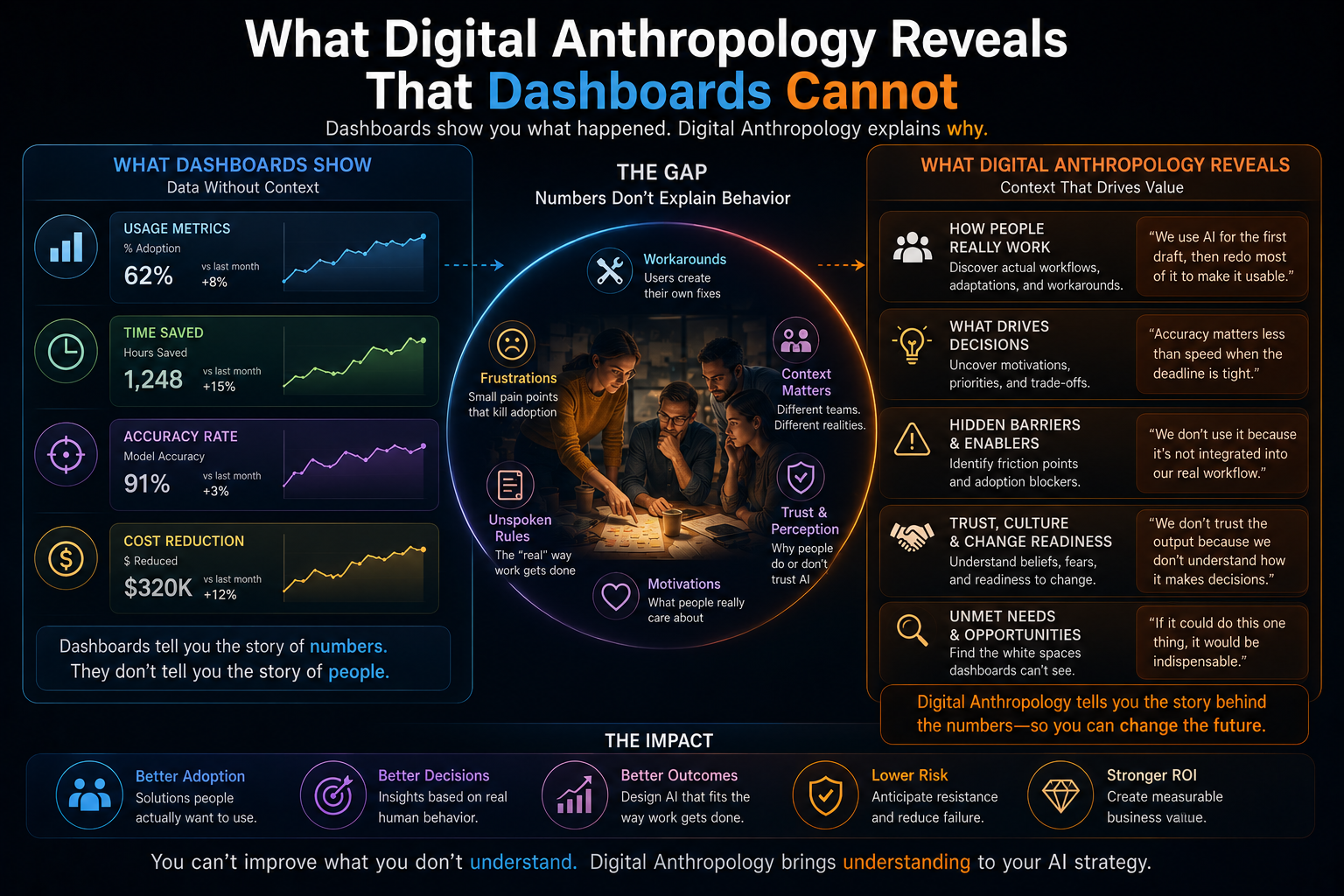
Dashboards are useful, but they usually show what the enterprise has decided to measure.
Digital anthropology helps reveal what the enterprise has not yet learned to see.
It can expose shadow workflows, informal approvals, hidden expertise, trust networks, exception handling, workarounds, local adaptations, and silent failure points.
These are not minor details. They often explain why AI pilots fail during enterprise rollout.
An AI system may assume that the workflow is linear. Employees know it is not.
An AI agent may assume that an approval means consent. Managers know some approvals are symbolic.
A dashboard may show that tickets are closed. Customers know their problems remain unresolved.
A process map may show a clean handoff. Employees know the handoff works only because two people have built personal trust over years.
A governance document may say that human oversight exists. In practice, the human may be approving what the AI has already shaped.
This is why digital anthropology is powerful. It gives AI programs a way to understand the lived reality of work before automating it.
It helps leaders ask:
Why do employees override the system?
Which approvals are meaningful and which are ceremonial?
Where do customers struggle even when dashboards look green?
Which informal practices protect quality?
Which delays are actually risk controls?
Which exceptions reveal broken representation?
Where does AI change human behavior in ways the dashboard does not measure?
These questions improve AI ROI because they improve the enterprise’s understanding of itself.
The ROI Failure Pattern: Pilot Success, Enterprise Disappointment
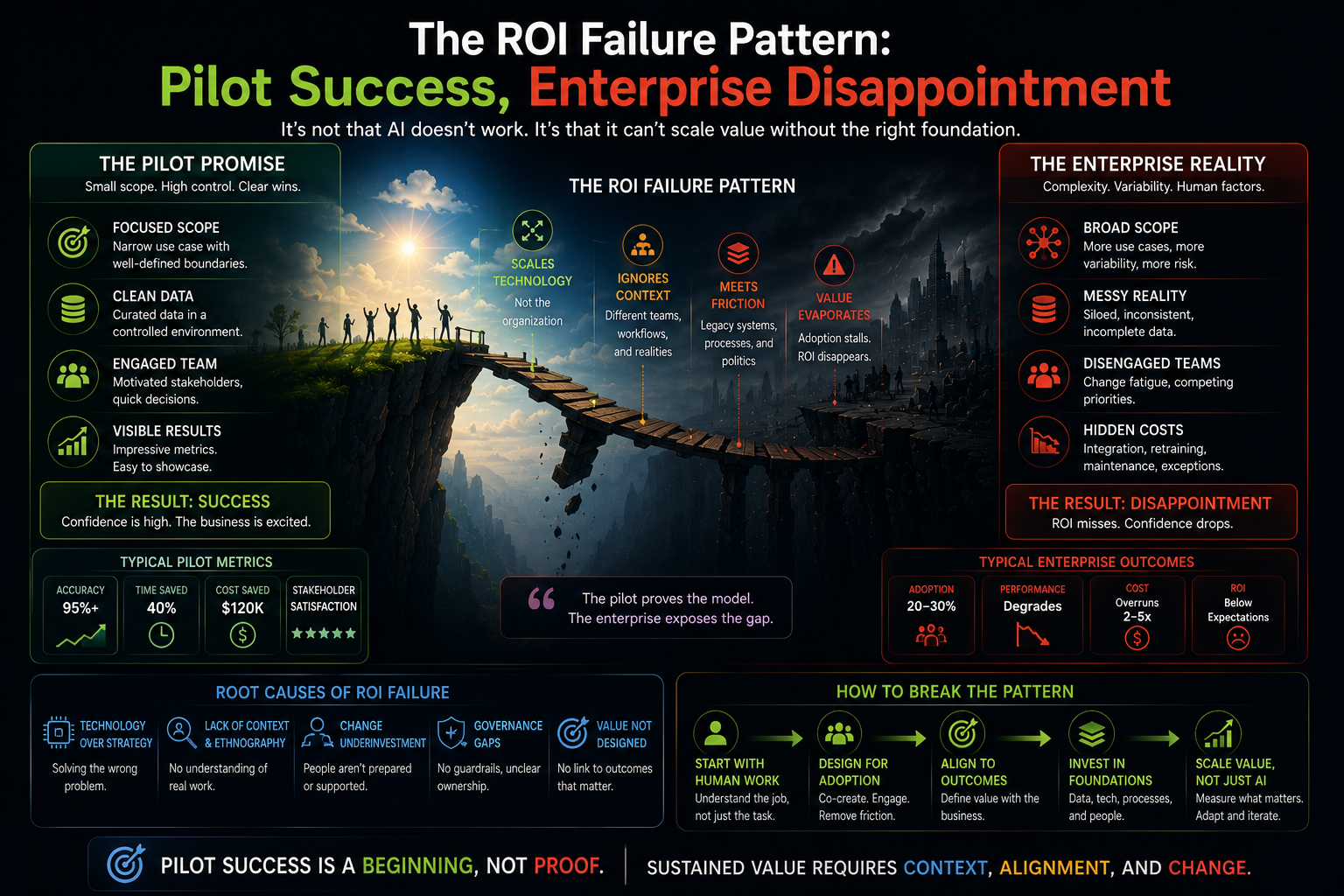
Many AI programs follow the same path.
A business unit identifies a use case.
A pilot is launched.
The pilot shows promise.
A presentation is created.
Leadership approves scaling.
The solution is rolled out more widely.
Complexity increases.
Exceptions appear.
Adoption varies.
Risk teams intervene.
Users create workarounds.
Costs rise.
Benefits become harder to prove.
The program is quietly slowed, renamed, or absorbed into another initiative.
This is not failure because AI cannot work. It is failure because the pilot tested capability, not institutional readiness.
A pilot asks: Can AI perform the task?
The enterprise asks: Can AI improve the operating system of the business?
Those are different tests.
A pilot can succeed with a clever model. Enterprise ROI requires value architecture.
What Value Architecture Means
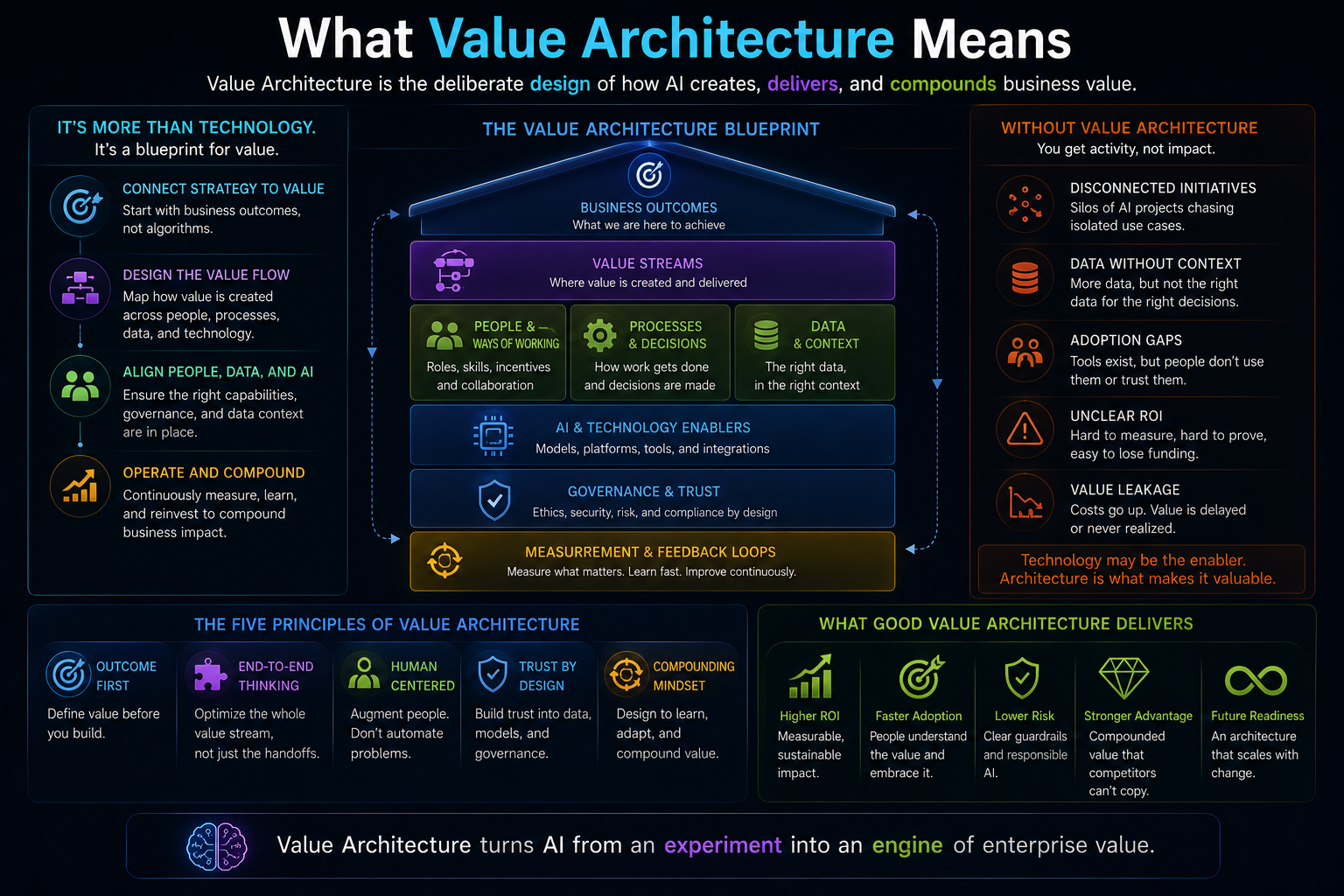
Value architecture is the design discipline that connects AI capability to measurable enterprise outcomes.
It asks:
What reality must AI understand?
Which entities must be represented accurately?
Which decisions must improve?
Which actions can be delegated?
Which humans remain accountable?
Which systems must be integrated?
Which risks must be bounded?
Which feedback loops must update the system?
Which outcomes prove value?
Which forms of value matter beyond immediate cost reduction?
This is where enterprise AI becomes different from ordinary automation.
Traditional automation executes known rules. Enterprise AI interprets context and influences decisions. Agentic AI may act across systems.
The more AI moves from suggestion to action, the more value architecture matters.
Without it, organizations scale tools. With it, they scale capability.
The Board-Level Mistake: Treating AI as a Portfolio of Use Cases
Many enterprises organize AI as a use-case portfolio.
This is useful in the early stage. It creates visibility. It helps prioritize investment. It gives leaders a way to track experimentation.
But over time, the use-case mindset becomes limiting.
A portfolio of use cases does not automatically become an enterprise capability.
Ten copilots do not make an AI-ready enterprise.
Twenty pilots do not create an operating model.
Fifty agents do not create governance.
Hundreds of prompts do not create institutional intelligence.
Enterprise AI value compounds only when use cases share common foundations.
Shared identity.
Shared context.
Shared policies.
Shared observability.
Shared decision logs.
Shared evaluation standards.
Shared representation structures.
Shared governance patterns.
Shared feedback loops.
Without these foundations, every use case becomes a separate island. The organization keeps paying the cost of rediscovery.
This is why many companies feel busy but not transformed.
They have AI projects, but they do not have AI capability.
Why Most Companies Scale the Wrong Layer
There are three layers companies can scale.
They can scale AI access.
They can scale AI use cases.
They can scale AI value systems.
Most organizations start with access. They give people tools.
Then they move to use cases. They ask teams to find applications.
But the real advantage comes from scaling value systems: the institutional foundations that allow AI to improve decisions and execution repeatedly across the enterprise.
This includes representation of real work, decision rights, data-context alignment, human accountability, agent permissions, feedback loops, risk boundaries, economic measurement, operational redesign, and runtime governance.
These are less glamorous than demos. But they are where ROI lives.
How CIOs and CTOs Should Rethink AI ROI
CIOs and CTOs should stop asking only how many AI tools are deployed.
They should ask stronger questions.
Where is AI improving decision quality?
Where is AI reducing avoidable rework?
Where is AI exposing hidden friction?
Where is AI improving customer outcomes?
Where is AI reducing risk, not just labor?
Where is AI creating reusable intelligence?
Where is AI strengthening the operating model?
Where is AI helping the enterprise learn faster?
Where is AI changing the economics of a workflow, not merely speeding up a task?
These questions move AI from experimentation to value creation.
They also change how AI programs are funded.
Instead of funding “AI use cases,” organizations should fund value pathways.
A value pathway starts with a business outcome, maps the reality required to improve it, identifies the decisions that matter, defines the actions that can be delegated, and creates the measurement system to prove improvement.
That is a different way to run enterprise AI.
Practical Example: Improving Collections in Financial Services
Consider collections in financial services.
A narrow AI approach might use a model to predict which customers are likely to default or which message may improve repayment.
That may help, but it is incomplete.
A value-led approach asks deeper questions.
What is the customer’s current financial state?
What signals indicate stress before default?
What repayment options are legitimate and fair?
Which interventions help both the institution and the customer?
Which actions require human judgment?
Which communications improve trust rather than create fear?
How do we measure recovery, customer dignity, compliance, and long-term relationship value?
Here, SENSE must represent the customer’s state more accurately. CORE must reason about options beyond simple collection probability. DRIVER must ensure that action is authorized, fair, explainable, and reversible where needed.
That is how AI moves from prediction to institutional value.
The ROI is not only higher collection efficiency. It may also include lower complaints, better retention, improved regulatory confidence, and stronger trust.
Practical Example: Reducing Supply Chain Disruption
In supply chain, AI is often used for forecasting, demand planning, inventory optimization, and supplier risk.
But ROI fails when the system sees data without context.
A supplier may appear reliable based on historical delivery metrics. But local disruption, climate events, port congestion, quality drift, workforce instability, or dependency concentration may tell a different story.
If AI sees only past transactions, it may optimize the wrong plan.
A better approach represents the supply chain as a living system of entities, states, dependencies, and evolving risks.
Which supplier is connected to which product line?
Which part has no substitute?
Which delay affects which customer promise?
Which warehouse decision creates downstream cost?
Which risk is temporary and which is structural?
This is SENSE.
Then CORE can reason across alternatives.
Should the company reroute, substitute, delay, renegotiate, redesign, or hold inventory?
Then DRIVER defines who can act, which decisions require approval, and how exceptions are documented.
This is how AI ROI becomes operational resilience, not just forecast accuracy.
Practical Example: AI in Healthcare Workflow
Healthcare is another area where AI ROI can be misunderstood.
An AI system may summarize patient records, assist with scheduling, support triage, or detect patterns in clinical notes. These are useful capabilities.
But healthcare value does not come only from faster documentation or faster routing. It comes from better care coordination, lower clinical risk, fewer missed signals, reduced administrative burden, and improved patient trust.
If AI sees only the formal record, it may miss the real care journey.
A patient’s condition may be shaped by history, medication adherence, caregiver support, appointment access, previous interactions, and small signals that are scattered across systems.
The model may work. The representation may not.
A value-led healthcare AI system must ask:
What is the patient’s current state?
Which signals are missing or unreliable?
Which decisions require clinical judgment?
Which actions are safe to automate?
How is accountability preserved?
How can errors be corrected quickly?
This is where SENSE, CORE, and DRIVER become practical.
AI must see enough reality, reason with care, and act only within legitimate boundaries.
Practical Example: Citizen Services and Public Systems
Public-sector AI is often justified through efficiency.
Faster processing.
Lower backlog.
Better query handling.
More automated classification.
But citizen services are not only administrative workflows. They are trust relationships between institutions and people.
A public system may process a case faster but still fail if it cannot represent the citizen’s real situation. A citizen may not fit a standard category. A document may be missing for a valid reason. A local condition may explain an exception. A rigid automated process may create exclusion instead of efficiency.
Here, ROI cannot be measured only in speed.
It must include access, fairness, transparency, appeal, correction, and institutional trust.
This is where the Representation Economy becomes especially relevant. When institutions cannot represent people accurately, those people become invisible to the system.
AI can then make exclusion faster.
For public systems, the right question is not only “Can AI process more cases?”
The better question is: “Can AI help the institution understand people more accurately and act more responsibly?”
Why AI Governance Alone Does Not Solve ROI
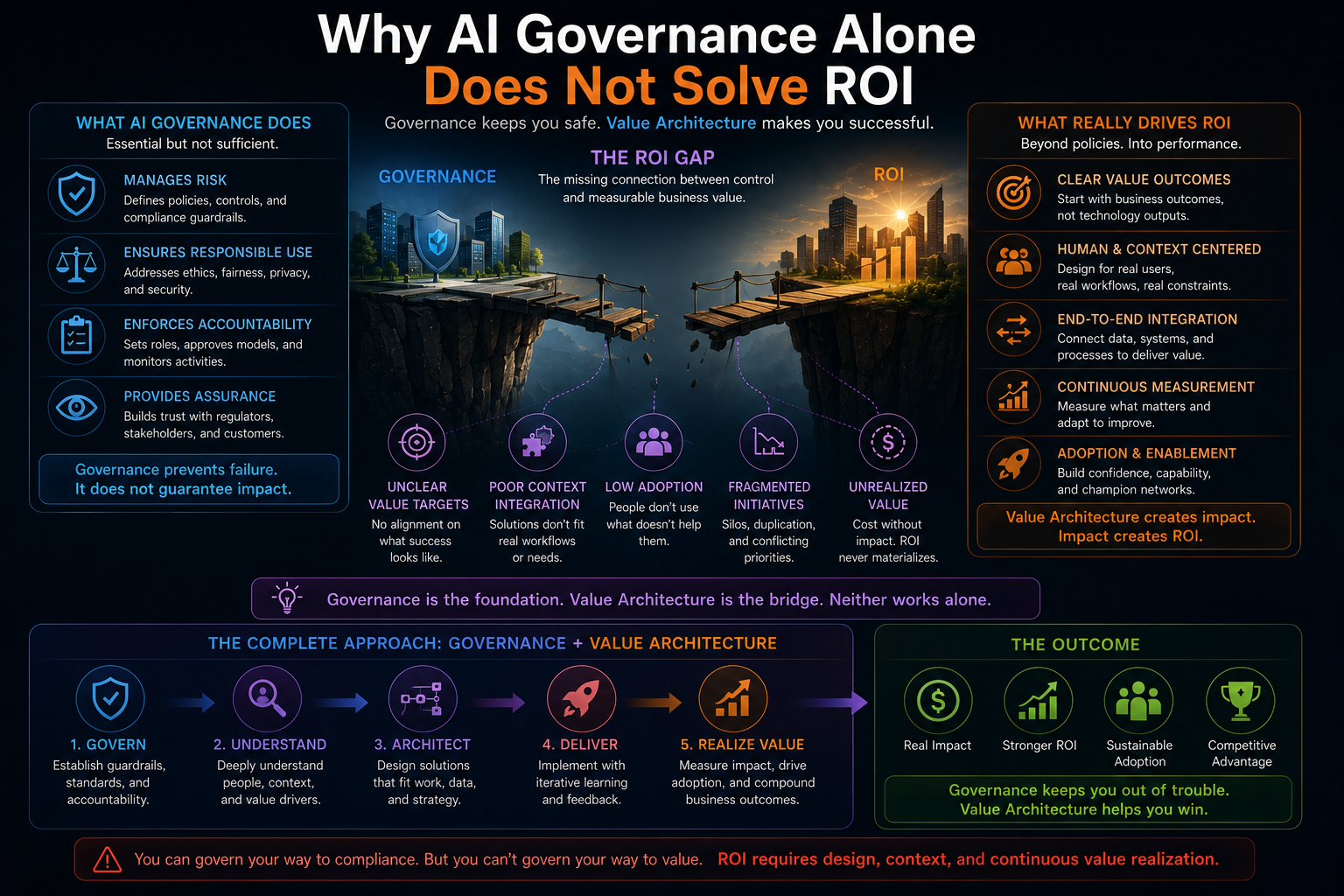
Governance is necessary, but governance alone does not create ROI.
Many organizations respond to AI risk by creating policies, committees, controls, and approval workflows. This is important. But if governance is detached from value creation, it becomes a brake rather than an operating system.
The goal is not to slow AI down.
The goal is to make AI valuable, safe, accountable, and scalable.
Governance must move closer to runtime.
It must answer practical questions.
What is this AI system allowed to see?
What is it allowed to infer?
What is it allowed to recommend?
What is it allowed to execute?
Who approved that boundary?
How is the action verified?
What happens if the decision is wrong?
Can the action be reversed?
Who owns the outcome?
This is why the DRIVER layer matters.
Without DRIVER, AI governance remains abstract. With DRIVER, governance becomes operational.
Why Enterprise Architects Should Care
Enterprise architects are central to AI ROI because the problem is not only model performance. It is system design.
AI value depends on how intelligence connects to data, identity, workflow, policy, observability, security, integration, and business outcomes.
Enterprise architects should ask:
Where does context come from?
How is entity identity resolved?
How are decisions logged?
How are agent permissions managed?
How are policies enforced at runtime?
How does the system know when to escalate?
How is feedback captured?
How do we prevent model, prompt, tool, and workflow sprawl?
How does AI fit into the broader enterprise operating model?
These are architectural questions. They are also ROI questions.
Because every weak connection creates leakage.
Context leakage.
Decision leakage.
Accountability leakage.
Cost leakage.
Trust leakage.
Value leakage.
The enterprise that fixes these leakages will get more value from AI than the enterprise that simply buys more models.
The Shift from Model Advantage to Operating Advantage
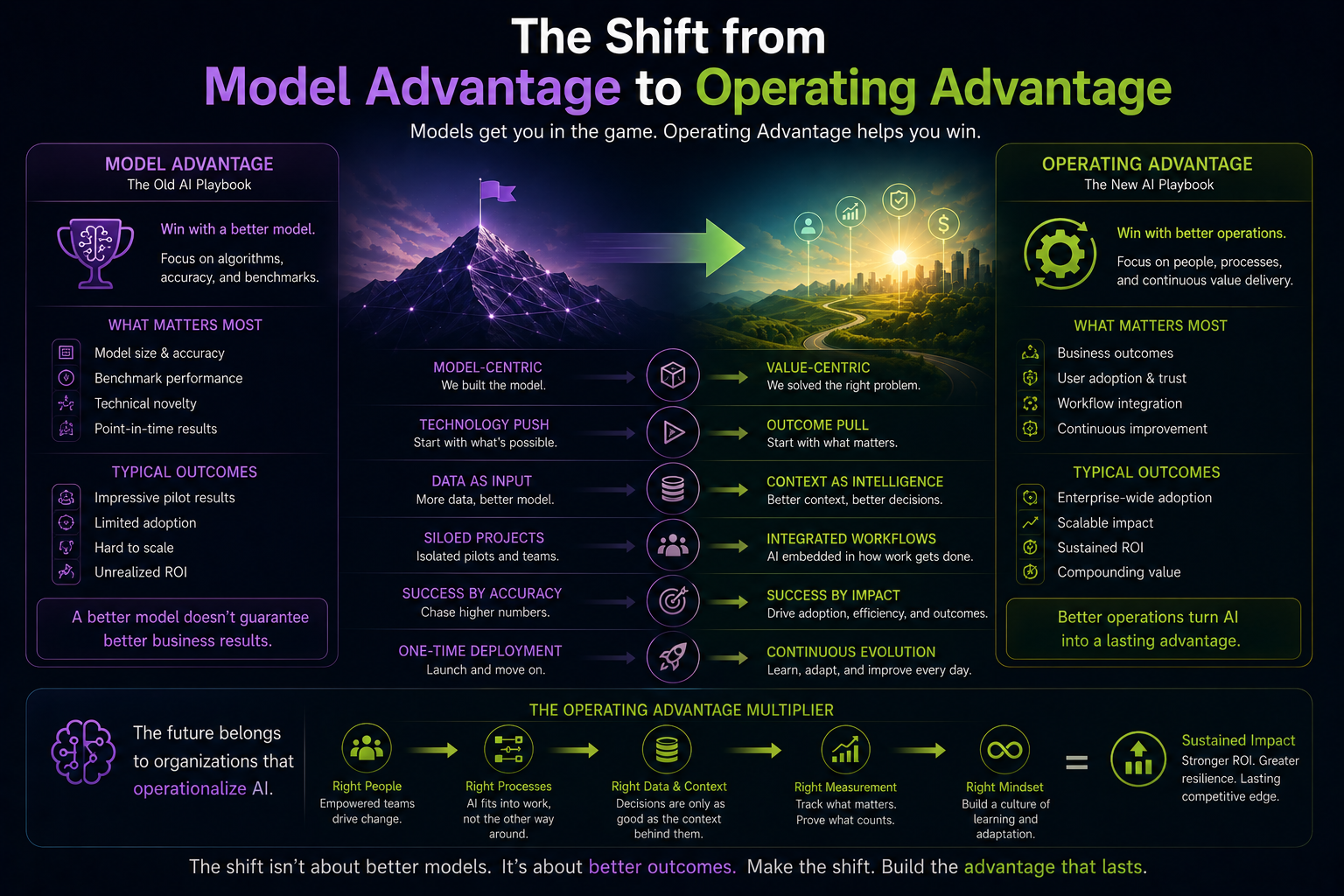
For the first phase of generative AI, companies were fascinated by model capability.
Which model is better?
Which benchmark is higher?
Which context window is larger?
Which tool is cheaper?
Which vendor is ahead?
These questions still matter. But they are becoming less decisive.
As models become more widely available, competitive advantage shifts from access to intelligence toward the ability to operationalize intelligence.
The winning enterprise will not necessarily be the one with the best model. It will be the one with the best representation of its business, the clearest decision architecture, the strongest governance of action, and the fastest learning loop from outcome back to system improvement.
This is the deeper meaning of the Representation Economy.
Value will move toward organizations that can represent reality better, reason over it responsibly, and act with legitimacy.
Why “Scale AI” Is the Wrong Strategic Phrase
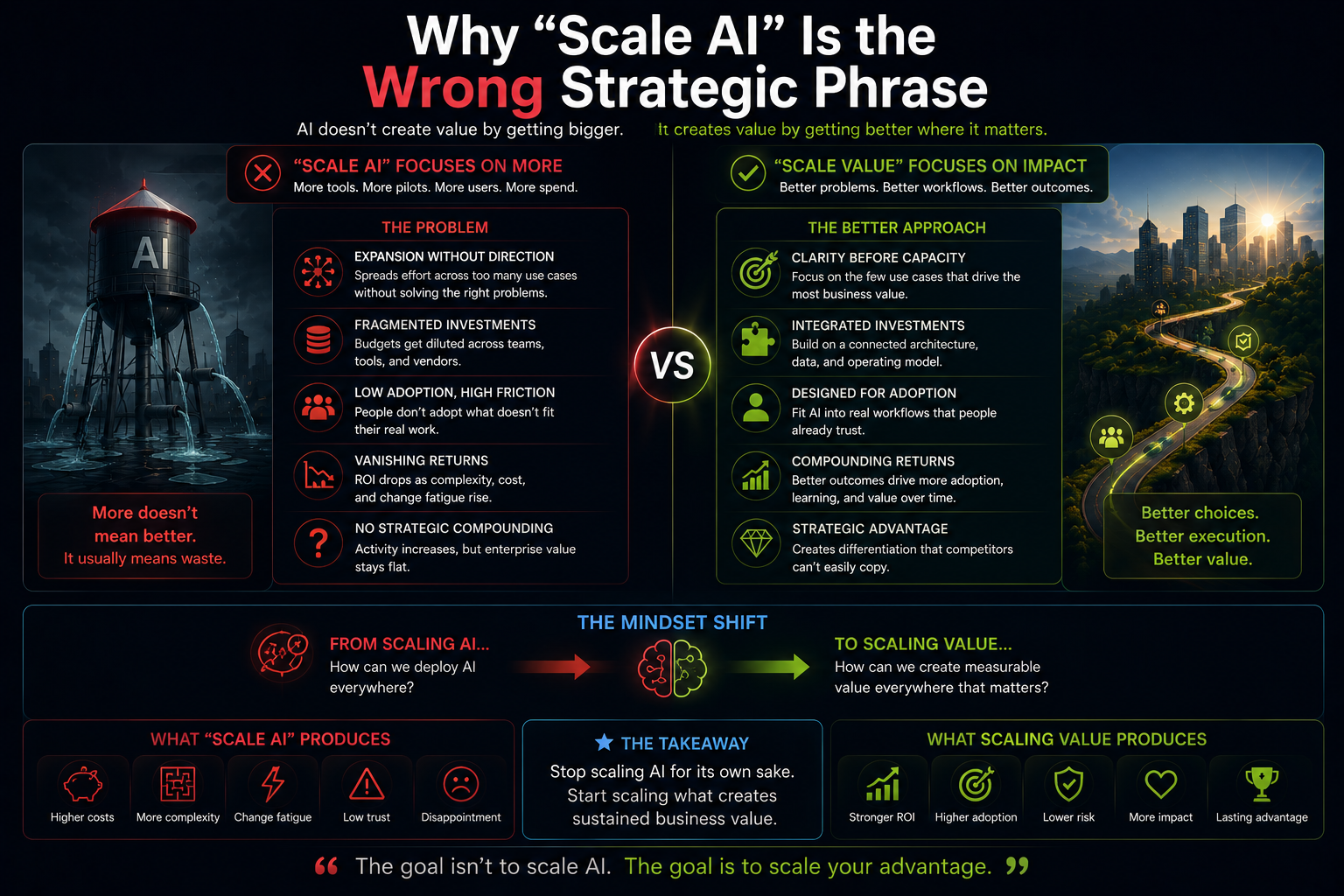
Leaders often say they want to scale AI.
But this phrase can mislead.
The real goal is not to scale AI.
The real goal is to scale better outcomes using AI.
That distinction changes everything.
If the goal is to scale AI, the organization counts deployments.
If the goal is to scale value, the organization redesigns work.
If the goal is to scale AI, the company asks for more use cases.
If the goal is to scale value, it asks which decisions matter most.
If the goal is to scale AI, success is adoption.
If the goal is to scale value, success is measurable change in business performance, risk, trust, resilience, and capability.
This is why many AI ROI programs fail before they begin.
They start with the wrong verb.
What Boards Should Ask Before Approving Large AI Investments
Boards do not need to become AI engineers. But they must become better at asking value questions.
Before approving large AI investments, boards should ask:
Which business value pool is this investment targeting?
What decision or workflow will change?
What reality must the system represent accurately?
What human judgment must remain?
What authority is being delegated to AI?
What risks increase when the system succeeds?
How will value be measured beyond usage?
What will we stop doing if AI works?
What new capability will compound over time?
What is our right to recover when AI is wrong?
These questions separate AI theatre from AI strategy.
They also reveal whether the organization has a real operating model or only a technology roadmap.
The New AI ROI Maturity Model
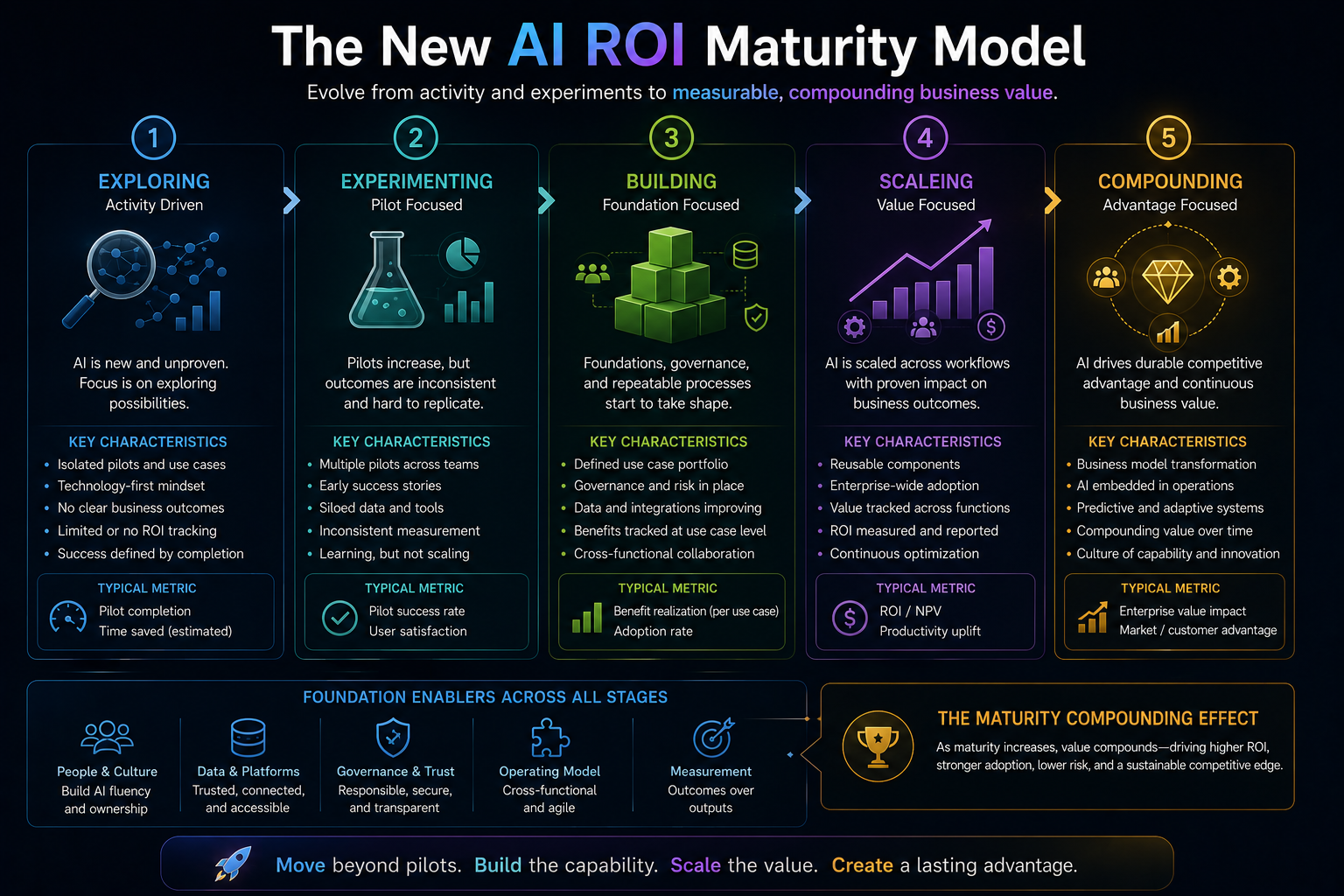
Enterprise AI maturity is not about how many AI tools a company has.
A more useful maturity path looks like this.
At the first level, AI is used for personal productivity. Individuals summarize, draft, search, code, and analyze faster.
At the second level, AI improves team workflows. Departments use AI for support, reporting, analysis, development, marketing, or operations.
At the third level, AI improves business decisions. The organization connects AI to specific decisions that affect revenue, cost, risk, quality, or customer outcomes.
At the fourth level, AI becomes part of governed execution. AI recommendations and agent actions are connected to authority, auditability, verification, and recourse.
At the fifth level, AI becomes institutional capability. The organization continuously improves how it represents reality, reasons over complexity, acts responsibly, and learns from outcomes.
Most companies are stuck between the first and second levels while speaking as if they are at the fourth.
That gap explains much of the ROI disappointment.
The Real Reason AI ROI Fails
Enterprise AI ROI fails because companies scale visible AI before fixing invisible value systems.
They scale copilots before clarifying decision quality.
They scale agents before defining authority.
They scale automation before understanding human work.
They scale models before improving representation.
They scale pilots before building operating capability.
They scale productivity claims before proving business outcomes.
The solution is not to slow down AI.
The solution is to scale the right things first.
Scale representation.
Scale decision clarity.
Scale human understanding.
Scale governance at runtime.
Scale feedback loops.
Scale value measurement.
Scale the ability to recover from error.
Then scale AI.
How Enterprise AI ROI Actually Fails
ROI dashboards track model accuracy, token cost, usage, and pilot count. None of these answer the question that actually matters: is AI improving the decisions and outcomes that drive the business? Based on observed failure patterns across enterprise AI programs, ROI disappears along five distinct dimensions.
Representation failure. The AI system acts on records, not reality — workflow status rather than actual progress, documented process rather than real behavior, structured data that omits the context driving the decision.
Decision failure. The AI optimizes the wrong outcome — reducing handling time while increasing repeat contacts, generating code faster while accumulating technical debt, cutting costs while degrading supply chain resilience.
Adoption failure. Users don’t trust the system because it doesn’t match their lived reality. They feed it poor inputs, override its recommendations, or route around it through informal workarounds — entirely rational behavior given that the system doesn’t understand the context they work in.
Execution failure. AI produces intelligence that cannot reach action. Recommendations sit in dashboards. Insights accumulate in reports. The enterprise has better analysis but the same operating rhythm, because no one built the bridge from AI output to governed action.
Legitimacy failure. AI acts without clear authority. An agent updates records, triggers payments, or changes customer communications, and when something goes wrong, no one can explain who approved the action, under what criteria, or how to reverse it. This failure becomes more consequential as agentic AI becomes mainstream.
The Value That’s Already There
Not all AI ROI has to be created from scratch. Some of it is already inside the organization, just not being captured — trapped behind decisions that are too slow, judgment that’s inconsistent across teams, or signals that never connect to each other.
This is a different kind of return than the one most AI strategy decks chase. It doesn’t require a new product or a new revenue line. It requires removing the friction that’s already costing money. Prevented loss is invisible profit — and unlike a one-time efficiency gain, it compounds over time.
How to Measure It
Most organizations measure AI ROI the wrong way: they track adoption, not value. AI adoption measures usage. AI value measures business impact — and an organization can have high adoption and still generate little measurable value.
Boards and CIOs should anchor ROI measurement in outcome metrics, not activity metrics: revenue velocity, margin recovery rate, working capital released, exception rate (how often a decision still escalates to a human), decision accuracy over time, and reuse — how often the same decision logic gets applied across units rather than rebuilt from scratch. Time saved is an input metric. These are outcome metrics. The gap between the two is usually where the ROI story falls apart.
Where the Ceiling on ROI Actually Sits
Three examples make this concrete. In customer service, sustained ROI doesn’t come from the most capable chatbot — it comes from understanding resolution journeys: why customers call back, which issues require human judgment, and what “resolution” actually means for different customer segments. A system built on chat logs alone optimizes for response speed while quietly degrading trust.
In procurement, the gap between AI that saves money and AI that creates fragility comes down to what reality the system can see. Price and order history are well represented in most procurement systems; delivery reliability under stress, supplier relationship dynamics, and contract clauses buried in unstructured documents are not. An AI that can only see price will optimize cost while destroying resilience — and the damage won’t show up on the ROI dashboard until a supply chain failure occurs.
In software engineering, AI coding assistants deliver ROI only within a well-represented development context — architecture constraints, security rules, existing defect patterns, and deployment requirements. Without that context, they generate code that passes style checks while introducing complexity, accelerating activity while slowing the system down.
In each case, representation quality determines the ceiling of possible ROI. Better reasoning and tighter governance can only improve what the system is able to see in the first place.
The Practical Starting Point: A Work Reality Audit
Before launching the next AI use case, examine not just the process documentation but how work actually happens: where exceptions occur, which decisions rely on tacit knowledge no system captures, and which data fields look complete but don’t represent the state they claim to measure. This audit is the fastest way to find out whether you’re about to automate a misunderstood reality — which is the single most common source of wasted AI investment.
Key Takeaways
- AI adoption is not the same as AI value.
- Time saved is often a misleading AI ROI metric.
- Enterprise AI ROI depends on representation quality, decision quality, and execution quality.
- Most AI pilots succeed because they operate in controlled environments.
- Most enterprise AI programs disappoint because they encounter organizational reality.
- Digital Anthropology helps organizations understand real work rather than documented workflows.
- SENSE–CORE–DRIVER provides a framework for understanding how AI creates enterprise value.
- The future competitive advantage lies in operating advantage, not model advantage.
- Companies that scale value before they scale AI achieve stronger long-term outcomes.
Summary
Enterprise AI ROI fails when organizations confuse AI adoption with business value. Many companies deploy copilots, agents, models, and automation tools without first understanding where value is created, blocked, distorted, or destroyed. The deeper problem is representation: AI does not act on reality directly; it acts on the enterprise’s representation of reality through data, workflows, policies, systems, permissions, and human instructions. If this representation is incomplete or misleading, AI may scale activity without improving outcomes.
The SENSE–CORE–DRIVER framework explains enterprise AI ROI through three layers. SENSE makes reality machine-readable. CORE reasons over that reality. DRIVER governs action, authority, verification, and recourse. AI ROI improves when these layers work together. It fails when enterprises overinvest in models and agents while underinvesting in representation, decision clarity, digital anthropology, governance, feedback loops, and value measurement.
Conclusion: The Companies That Win Will Scale Value Before They Scale AI
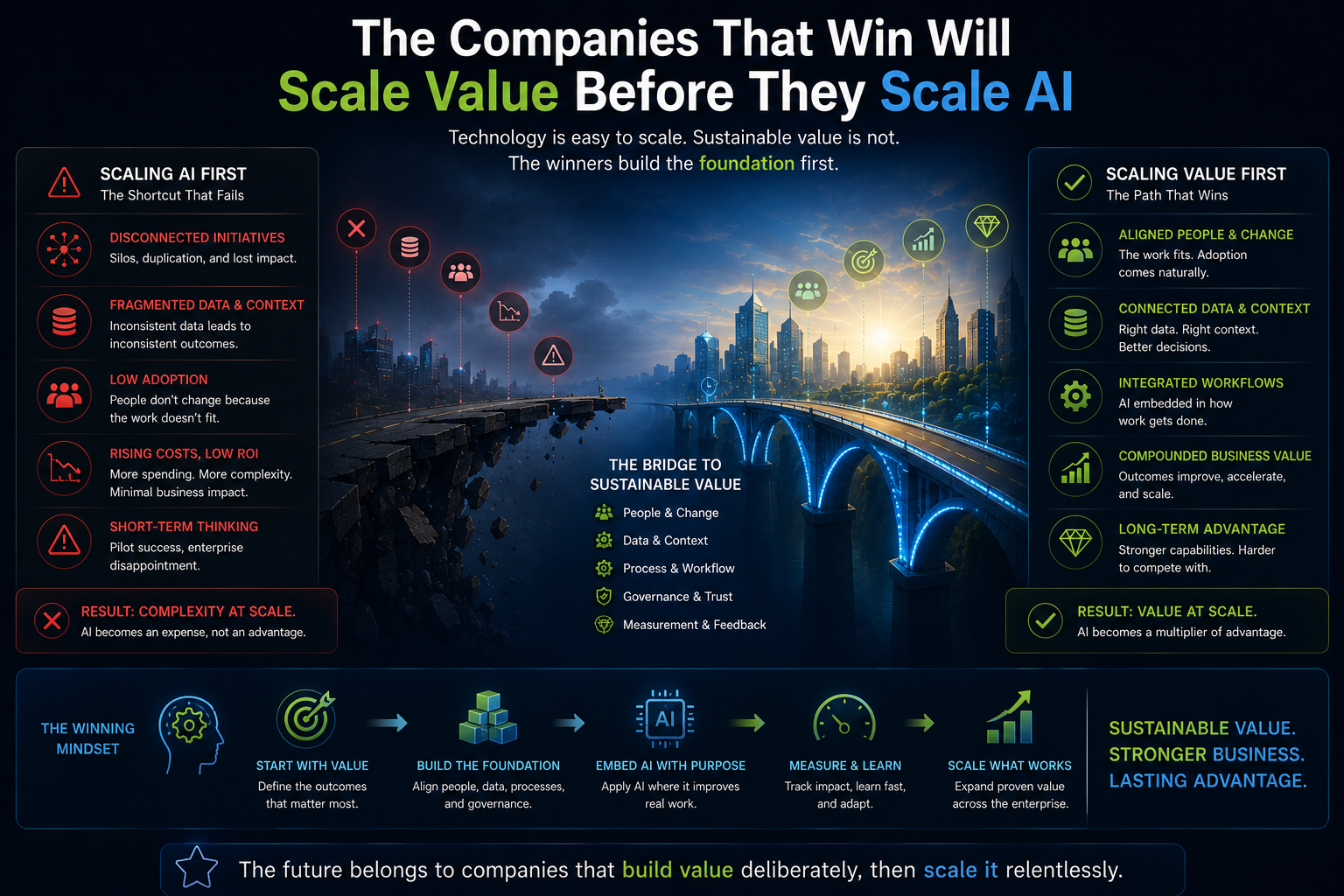
The next phase of enterprise AI will be more demanding than the first.
The easy phase was experimentation.
The hard phase is value.
In the easy phase, companies asked what AI could do.
In the hard phase, they must ask what the enterprise should become.
That is why AI ROI is not only a finance question. It is a strategy question, an architecture question, a governance question, and a human systems question.
Most companies do not need more AI activity. They need a better connection between reality, decisions, and action.
This is the promise of the SENSE–CORE–DRIVER framework.
SENSE asks whether the enterprise can represent reality accurately.
CORE asks whether it can reason over that reality intelligently.
DRIVER asks whether it can act with authority, verification, accountability, and recourse.
When these layers work together, AI can move beyond pilots, demos, and productivity theatre. It can become a real source of enterprise value.
But when these layers are missing, companies will continue to scale AI before they scale value.
The first wave of enterprise AI was about generating intelligence.
The second wave will be about governing intelligence.
The third wave will be about representing reality accurately enough for intelligence to create value.
The organizations that win will not be those that deploy the most AI.
They will be the organizations that understand reality best.
Glossary
Enterprise AI ROI — The measurable business value generated by enterprise AI investments, including revenue growth, cost reduction, risk reduction, faster decisions, improved quality, and stronger operating capability.
AI Adoption — The extent to which employees and teams use AI tools. Distinct from AI value: adoption measures usage, value measures business impact.
AI Value — The business outcomes produced by AI systems.
Representation — The digital model of reality used by AI systems to reason and act.
Representation Economy — The idea that future AI value depends on how accurately institutions represent reality, reason over that representation, and act with legitimacy.
Digital Anthropology — The study of how people actually work, collaborate, make decisions, and create workarounds inside digital systems, revealing the gap between formal process maps and real work.
SENSE — The representation layer: how reality becomes machine-legible.
CORE — The reasoning layer: how AI reasons and makes decisions.
DRIVER — The execution and governance layer: how decisions become governed, accountable action.
Operating Advantage — Competitive advantage created through superior workflows, governance, decision systems, and execution — distinct from model advantage, which comes from better AI technology alone.
Value Architecture — The design discipline that connects AI capability to measurable enterprise outcomes.
AI Governance — Policies, controls, guardrails, and accountability mechanisms governing AI use.
Agentic AI — AI systems that can plan, decide, act, and use tools with some degree of autonomy.
FAQ
Why does enterprise AI ROI fail? ROI fails when organizations scale AI tools, copilots, agents, and models without connecting them to measurable business outcomes, decision quality, workflow redesign, governance, and real-world execution.
What is the difference between AI adoption and AI value? Adoption means people are using AI. Value means the organization is becoming better because of it. An organization can have high adoption and still generate little measurable value.
Why is “time saved” a weak AI ROI metric? Time saved is an input metric, not an outcome metric. It only matters if it improves decisions, reduces risk, increases revenue, or improves customer outcomes.
Why do AI pilots succeed but enterprise rollouts fail? Pilots succeed in narrow, controlled environments. Rollouts fail when real-world complexity appears: messy data, exceptions, unclear authority, human workarounds, and weak governance.
How does the Representation Economy explain AI ROI? AI creates value only when institutions can accurately represent reality, reason over it, and act responsibly. Poor representation leads to poor outcomes regardless of model quality.
Why does Digital Anthropology matter for AI ROI? It reveals how work actually happens — shadow workflows, informal trust networks, exceptions, and tacit judgment that dashboards don’t capture — so AI systems can be designed around real behavior rather than idealized process maps.
What is the difference between model advantage and operating advantage? Model advantage comes from better AI technology. Operating advantage comes from integrating AI into workflows, governance, and decision-making. As models commoditize, operating advantage becomes the stronger differentiator.
What should CIOs focus on to improve AI ROI? Understanding real work, improving representation quality, connecting AI to business outcomes, building governance into runtime systems, and measuring value rather than activity.
What is the biggest mistake enterprises make with AI? Scaling AI before scaling value — deploying more models, agents, and copilots without understanding how value is actually created inside the enterprise.
Who created these frameworks? Raktim Singh developed the Representation Economy, SENSE–CORE–DRIVER, and Digital Anthropology for Enterprise AI as a connected body of work: Digital Anthropology improves understanding of real work, SENSE–CORE–DRIVER provides the architecture for acting on that understanding, and the Representation Economy explains the resulting economic stakes.
Why do most enterprise AI projects fail?
They remain disconnected from business processes, decision rights, governance structures, and execution systems. The model may work; the organization lacks the architecture to convert intelligence into value.
Why does the same AI model create value in one company but not another?
Because companies differ in representation quality, workflow integration, governance, decision rights, and execution readiness. Value depends on institutional architecture, not model capability.
What’s the missing layer between data, decisions, and execution?
The enterprise architecture that converts raw data into trusted representation, representation into better decisions, and decisions into authorized, governed action.
References
Gartner: GenAI project abandonment due to poor data quality, risk controls, costs, and unclear business value. NIST AI Risk Management Framework. OECD AI Principles.
Where can I learn more?
Website: https://www.raktimsingh.com
GitHub: https://github.com/raktims2210-dev/representation-economy
ORCID: https://orcid.org/0009-0002-6207-602X
Zenodo DOI: 10.5281/zenodo.20368910 · Figshare DOI: 10.6084/m9.figshare.32393949
ResearchGate: https://www.researchgate.net/publication/405094400 · OSF: https://osf.io/xt2qc/
Related Enterprise AI Reading
This article is part of a broader body of work exploring Enterprise AI, AI Governance, Digital Anthropology, and the emerging challenges of machine-legible reality. Readers interested in the underlying concepts and frameworks may find the following resources useful. For an introduction to the economic and organizational implications of machine-readable representations, see What Is the Representation Economy?. For a deeper examination of the architectural foundations of Enterprise AI systems, see The SENSE–CORE–DRIVER Framework. Readers seeking a practical definition of Enterprise AI and why many initiatives fail to scale can refer to What Is Enterprise AI?.
For governance-focused perspectives, see Enterprise AI Governance, which examines why governance failures often originate in representation and accountability gaps rather than compliance processes alone. For organizations deploying autonomous systems, What Is an Enterprise AI Agent Registry? explores how enterprises can maintain visibility, control, and governance over AI agents operating at scale. Finally, Digital Anthropology for Enterprise AI examines how human work practices, informal processes, and organizational reality influence AI adoption and why many AI transformations fail when systems misrepresent how work actually gets done.
About the Author
Raktim Singh is an enterprise AI strategist, technology researcher, author, and TEDx speaker. He is the creator of the Representation Economy framework, the SENSE–CORE–DRIVER architecture, and Digital Anthropology for Enterprise AI — a connected body of work on how intelligent institutions represent reality, reason over it, and govern action at scale. Published at raktimsingh.com.
Website: https://www.raktimsingh.com · LinkedIn: https://www.linkedin.com/in/raktimsingh · ORCID: https://orcid.org/0009-0002-6207-602X



Raktim Singh is an AI and deep-tech strategist, TEDx speaker, and author focused on helping enterprises navigate the next era of intelligent systems. With experience spanning AI, fintech, quantum computing, and digital transformation, he simplifies complex technology for leaders and builds frameworks that drive responsible, scalable adoption.