

Enterprise AI Strategy
Enterprise AI strategy has entered a new phase. As AI systems move from insight to execution—approving actions, triggering workflows, and coordinating operations—AI is no longer a technology bet. It is an operating capability boards must actively govern.
Executive summary
Enterprise AI has crossed a threshold. AI is no longer limited to advice—it is increasingly taking actions inside workflows. That shift changes everything: failure is no longer “a wrong answer,” but “a wrong outcome.” As a result, Enterprise AI strategy is no longer a technology bet; it becomes an operating capability boards must own—like cybersecurity, financial controls, or operational resilience.
Frameworks and standards are converging on this idea: governance and oversight sit with actors who carry management and fiduciary responsibility (NIST AI RMF), while regulatory regimes increasingly emphasize human oversight, deployer obligations, and auditable control systems (EU AI Act), and management standards require an AI management system with continual improvement (ISO/IEC 42001). (NIST Publications)

The quiet shift: AI moved from “insight” to “execution”
For years, leaders treated AI like a technology wager:
- Pick a platform
- Hire a data science team
- Run pilots
- Scale what works
That playbook made sense when AI mostly advised—predictions, recommendations, dashboards, copilots that helped people decide.
But in 2026, Enterprise AI is becoming something else. AI is beginning to act inside real workflows:
- Drafting and sending customer communications
- Approving or rejecting requests
- Triggering operational workflows
- Enriching records and updating systems
- Coordinating tasks across teams and tools
When AI starts acting, the unit of failure changes. It is no longer “a wrong answer.” It is a wrong outcome—an action that can create financial loss, compliance exposure, operational disruption, or reputational harm.
That is why Enterprise AI is no longer a technology bet. It becomes an operating capability—something you run, govern, measure, and continuously improve. The same way you run cybersecurity, financial controls, or uptime.
And once it becomes an operating capability, it becomes a board-level concern.
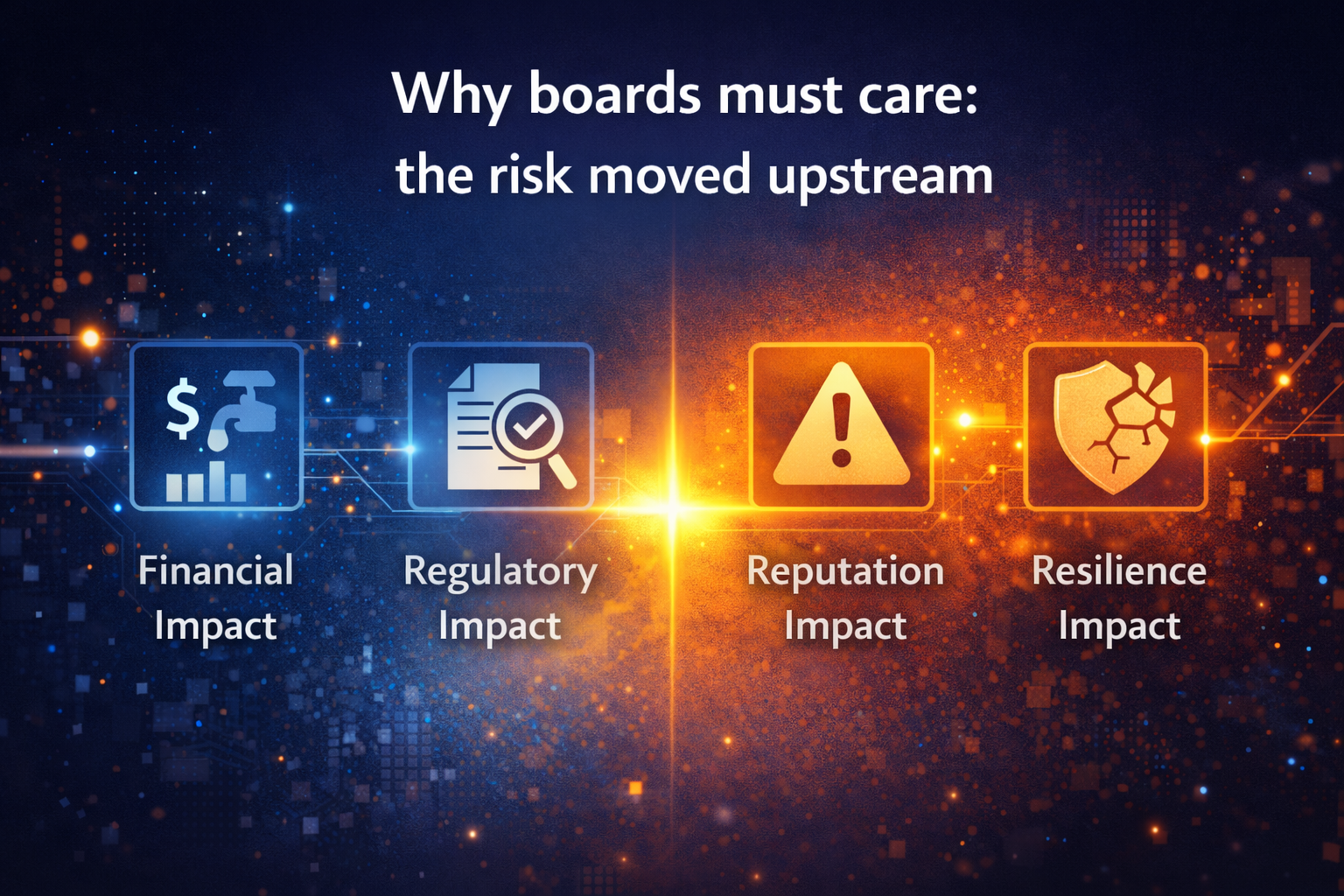
Why boards must care: the risk moved upstream
Boards don’t govern technology because it is interesting. Boards govern capabilities because they create material impact:
- Financial impact: leakage, fraud, operational loss, runaway compute bills
- Regulatory impact: audit findings, compliance breaches, reporting obligations
- Reputation impact: customer harm, trust erosion, brand damage
- Resilience impact: outages, cascading failures, inability to recover quickly
The moment AI begins executing actions, boards inherit a new question:
Do we have the controls to run intelligence safely—at scale—over time?
This is not theoretical. Global frameworks and standards increasingly describe AI governance as a management responsibility—not a research activity:
- NIST AI RMF 1.0 explicitly states that “Governance and Oversight” tasks are assumed by AI actors with management, fiduciary, and legal authority. (NIST Publications)
- The EU AI Act emphasizes human oversight requirements and deployer obligations for high-risk AI systems. (AI Act Service Desk)
- ISO/IEC 42001 specifies requirements for establishing and continually improving an AI management system, turning AI governance into auditable operational practice. (ISO)
This is the strategic shift: AI is becoming governable infrastructure.

“AI strategy” vs “Enterprise AI strategy”
Most companies already have an AI strategy. It usually looks like:
- Adopt GenAI tools
- Upskill teams
- Create a use-case pipeline
- Launch pilots
- Partner with vendors
That is not Enterprise AI strategy. That is AI adoption strategy.
Enterprise AI strategy answers different questions
Enterprise AI strategy is not “Which model should we use?” It is:
- Where is AI allowed to act—and where must it only advise?
- What outcomes are we optimizing—speed, quality, cost, compliance, experience?
- What safety and control boundaries are non-negotiable?
- Who is accountable when AI causes real-world impact?
- How do we observe, audit, and reverse AI behavior in production?
- How do we prevent reinvention and scale reuse responsibly?
- How do we keep the AI estate change-ready as models, policies, and regulations evolve?
If your AI strategy does not answer these questions, you do not yet have an Enterprise AI strategy.
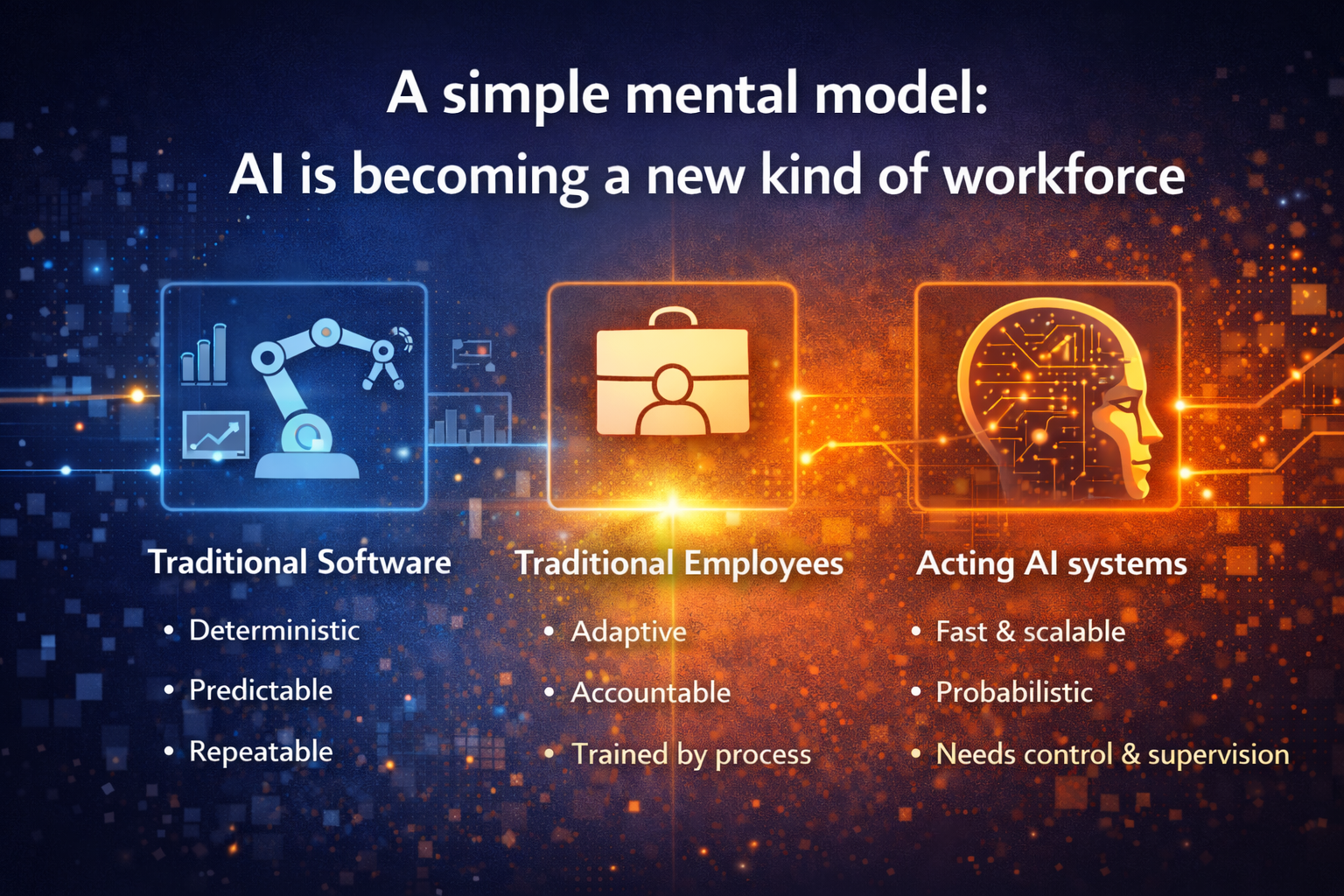
A simple mental model: AI is becoming a new kind of workforce
Here is the simplest way to explain Enterprise AI to non-technical stakeholders:
- Traditional software behaves like machines: deterministic, predictable, repeatable.
- Employees behave like humans: adaptive, accountable, trained through process.
- Acting AI systems resemble a new kind of workforce: fast, scalable, capable—but probabilistic.
When you introduce a new workforce at enterprise scale, you do not “buy tools” and move on. You define:
- Roles and boundaries (what they can do)
- Operating procedures (how they should act)
- Oversight (who reviews and when)
- Incident response (what to do when something breaks)
- Training and audits (how to improve over time)
- Cost controls and performance metrics (how to govern economics)
Enterprise AI strategy is the board-level decision to treat AI as an operating workforce—not a lab experiment.
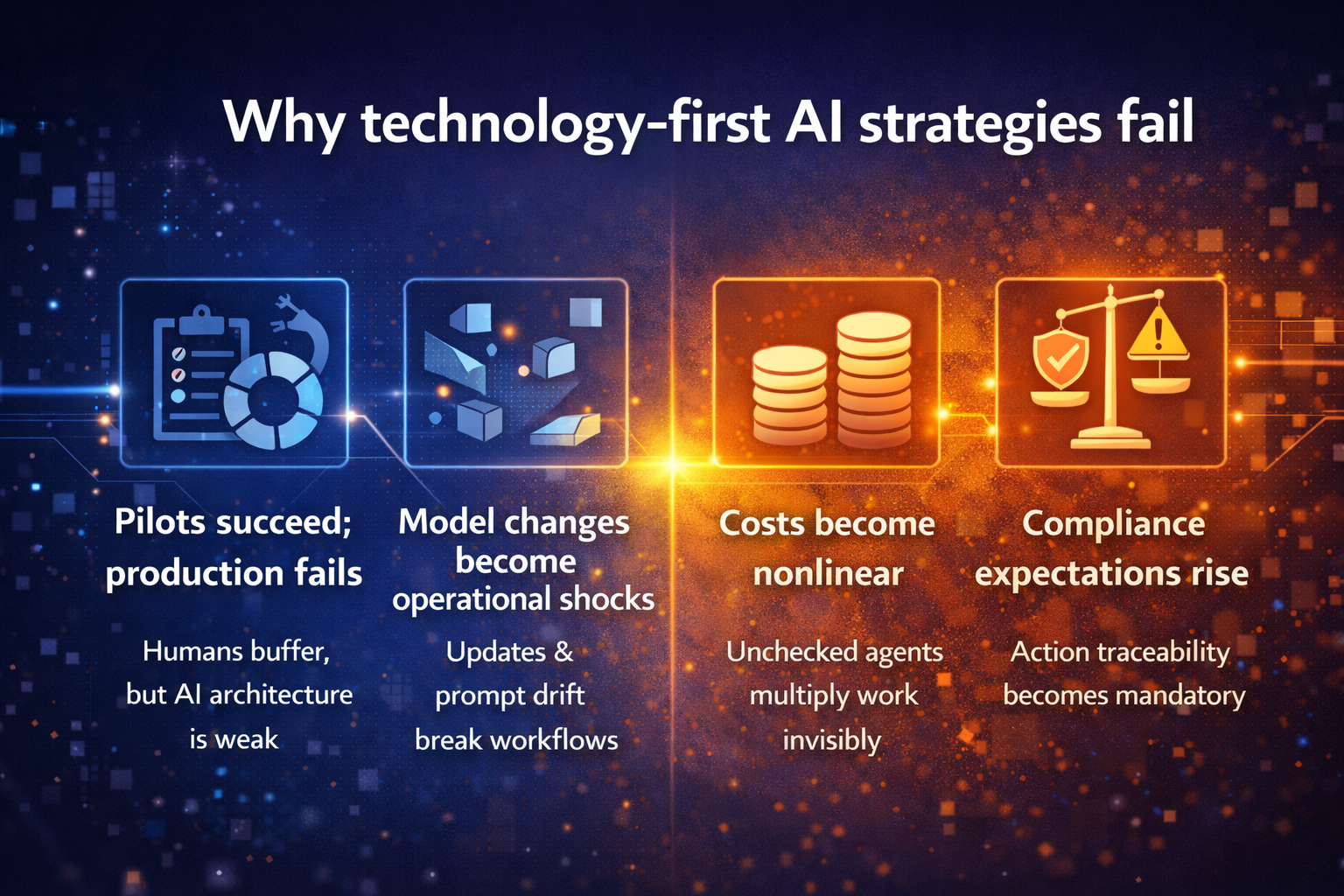
Why technology-first AI strategies fail (with simple examples)
1) Pilots succeed; production fails
In pilots, humans compensate for AI weaknesses. In production, the AI meets edge cases at volume.
Example:
A support assistant writes excellent responses most of the time. In a pilot, a supervisor catches the few risky replies. In production, “rare” failures become hundreds of customer interactions per week—turning minor defects into reputational debt.
Lesson: pilots hide operational reality because humans absorb the risk.
2) Model changes become operational shocks
Models are updated. Prompts drift. Policies change. Upstream systems evolve. If AI is embedded in workflows, every change can alter outcomes.
Boards should not ask, “Which model is best?”
They must ask: Do we have change control over AI behavior?
If you can’t answer that, you don’t have a strategy—you have a gamble.
3) Costs become nonlinear
An agent that searches, retries, calls tools, escalates, and reasons can multiply compute and downstream workload.
Example:
A “helpful” procurement agent that calls three systems, retries on failures, and pulls policy documents for every request may look efficient in a demo—then create an invisible cost surge at scale (compute + API calls + human escalations).
Lesson: productivity without cost governance becomes a silent tax.
4) Compliance expectations rise
Once AI touches regulated or sensitive workflows, you need traceability: what data was used, what instructions applied, what action was taken, and who approved it.
In the EU AI Act context, deployers of high-risk systems must assign human oversight to competent persons with authority and support, reinforcing that this is operational responsibility—not vendor responsibility alone. (artificialintelligenceact.eu)
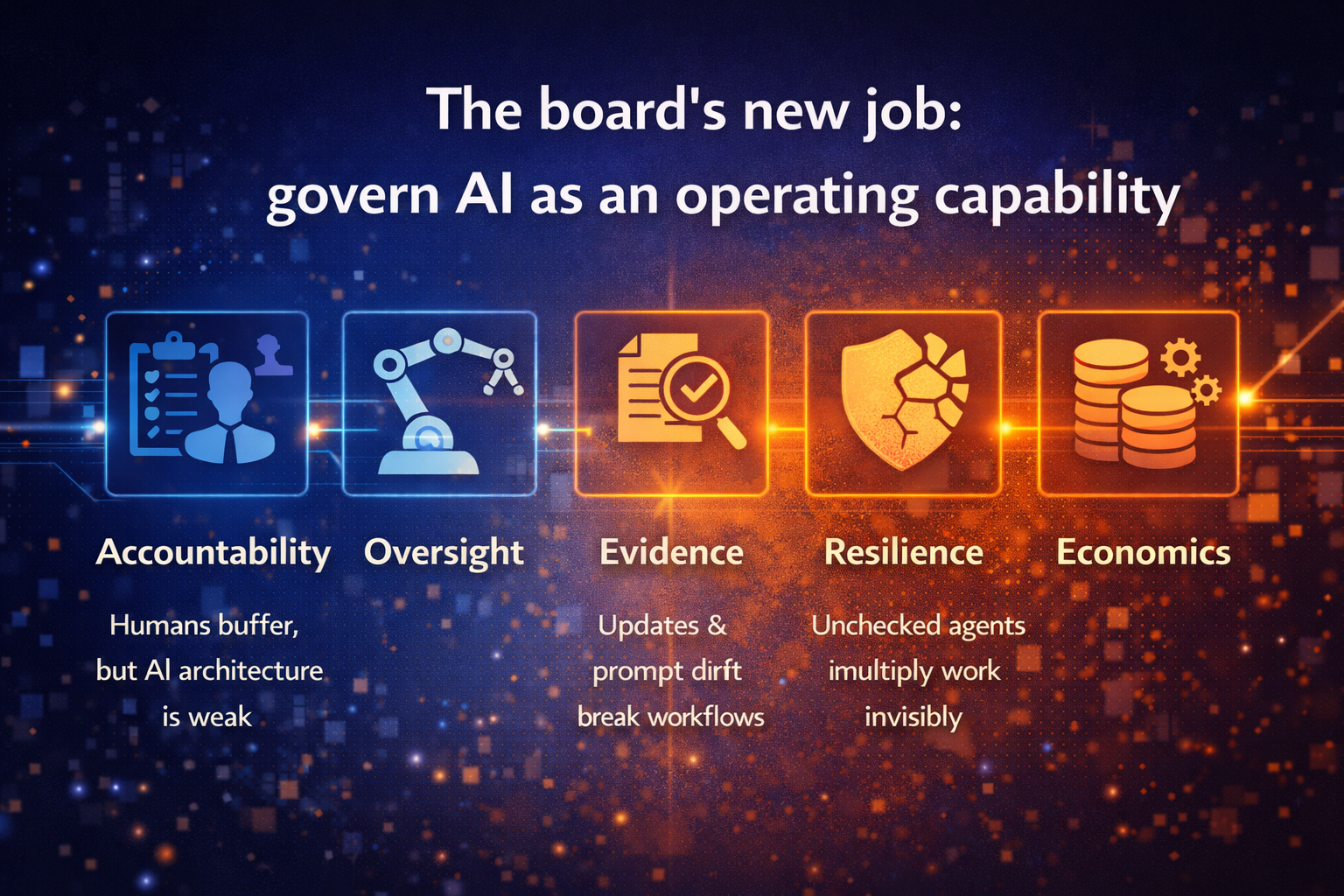
The board’s new job: govern AI as an operating capability
Board ownership does not mean the board designs architectures. It means the board ensures the enterprise can answer five governance realities.
1) Accountability is explicit
Who is accountable for:
- what AI is allowed to do
- what systems it can touch
- what failure looks like
- how quickly it can be stopped or reversed
NIST AI RMF makes the governance point directly: “Governance and Oversight” tasks sit with actors who have management and fiduciary authority. (NIST Publications)
2) Oversight is built-in, not promised
“Human-in-the-loop” cannot be a slogan. It must be designed into workflows and scaled.
EU guidance on human oversight emphasizes monitoring, interpreting, and being able to override high-risk systems—while reducing over-reliance. (AI Act Service Desk)
3) Evidence exists for audit
When asked, can you show:
- what the AI saw
- what it decided
- what it did
- under which policy/instructions
- with what approvals and logs
If you cannot produce this evidence, you cannot claim governance—you can only claim intent.
4) Resilience exists for failure
When AI behaves unexpectedly:
- Can you detect it quickly?
- Can you contain it?
- Can you roll back behavior?
- Can you prove what happened?
This is operational resilience applied to intelligence.
5) Economics are governed
Boards govern capital allocation. Enterprise AI introduces ongoing spend: model usage, tooling, compute, data, compliance, and the operational staff required to run it.
If economics are unmanaged, Enterprise AI will not scale sustainably—no matter how impressive the demos look.
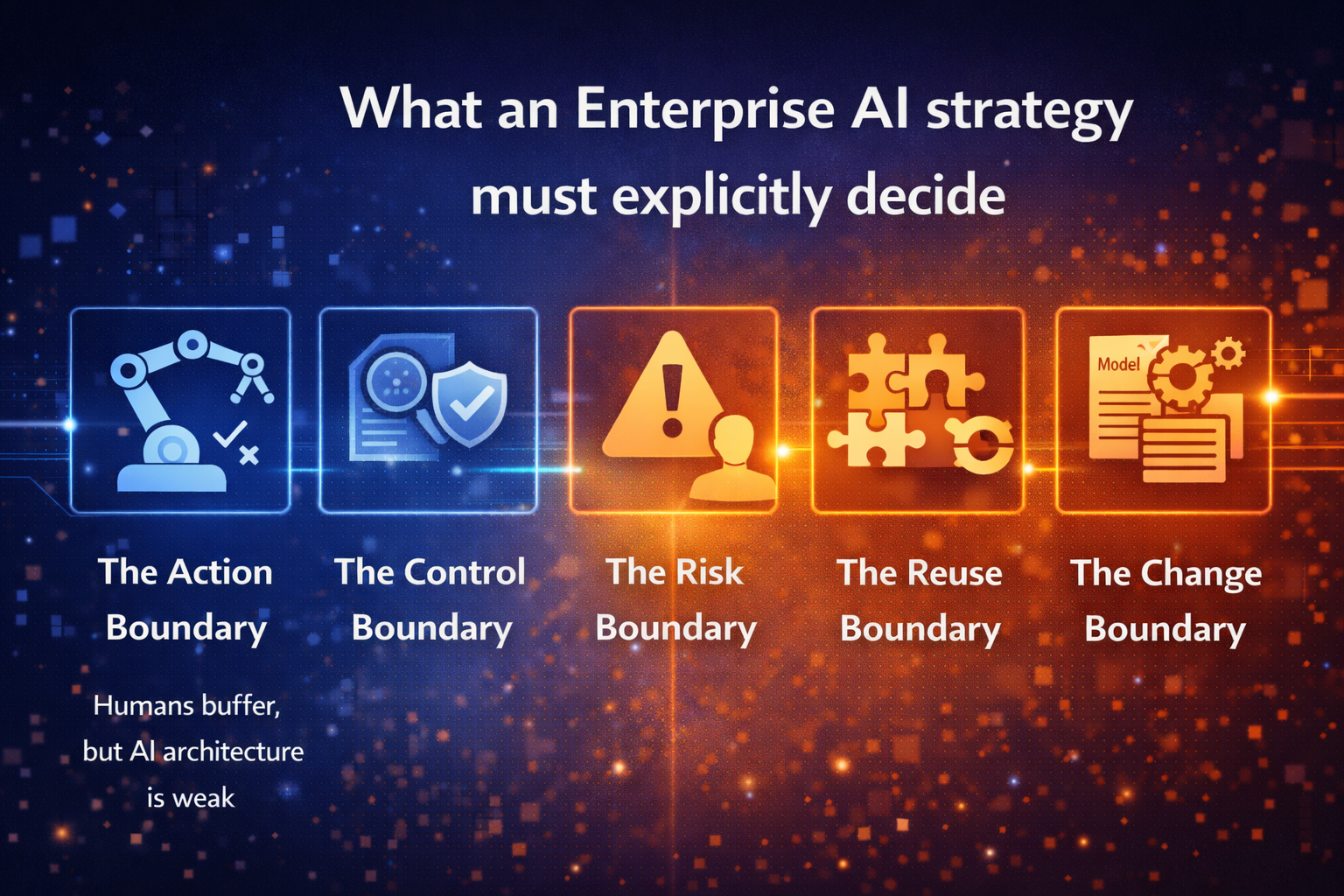
What an Enterprise AI strategy must explicitly decide
Here are five decisions that separate strategy from enthusiasm.
Decision 1: The Action Boundary
Define the line where AI shifts from:
- advisory → execution
- suggestion → transaction
- text output → system action
The strategy must specify:
- what classes of actions AI can take
- what requires human approval
- what is forbidden by policy
Decision 2: The Control Boundary
Define minimum controls before AI is allowed to operate:
- observability (logs, traces, monitoring)
- auditing (evidence trail)
- reversibility (stop/rollback)
- security (identity, access control, tool permissions)
If you cannot enforce controls, you do not have a scalable operating capability.
Decision 3: The Risk Boundary
Define what “high-risk AI” means in your context:
- customer impact
- financial impact
- legal/compliance exposure
- operational safety impact
This boundary determines oversight, documentation, and deployment discipline—especially in regions with risk-based AI rules. (AI Act Service Desk)
Decision 4: The Reuse Boundary
Decide whether the organization optimizes for:
- many local pilots, or
- reusable, governed intelligence components
Without reuse, AI scales as chaos—every team builds its own prompts, tools, workflows, and policies.
Decision 5: The Change Boundary
Enterprise AI is not a one-time deployment. It evolves continuously:
- model changes
- policy changes
- data changes
- workflow changes
Strategy must specify who approves changes, how changes are tested, and how production behavior is protected.
This is precisely why ISO/IEC 42001 frames AI governance as an ongoing management system with continual improvement. (ISO)
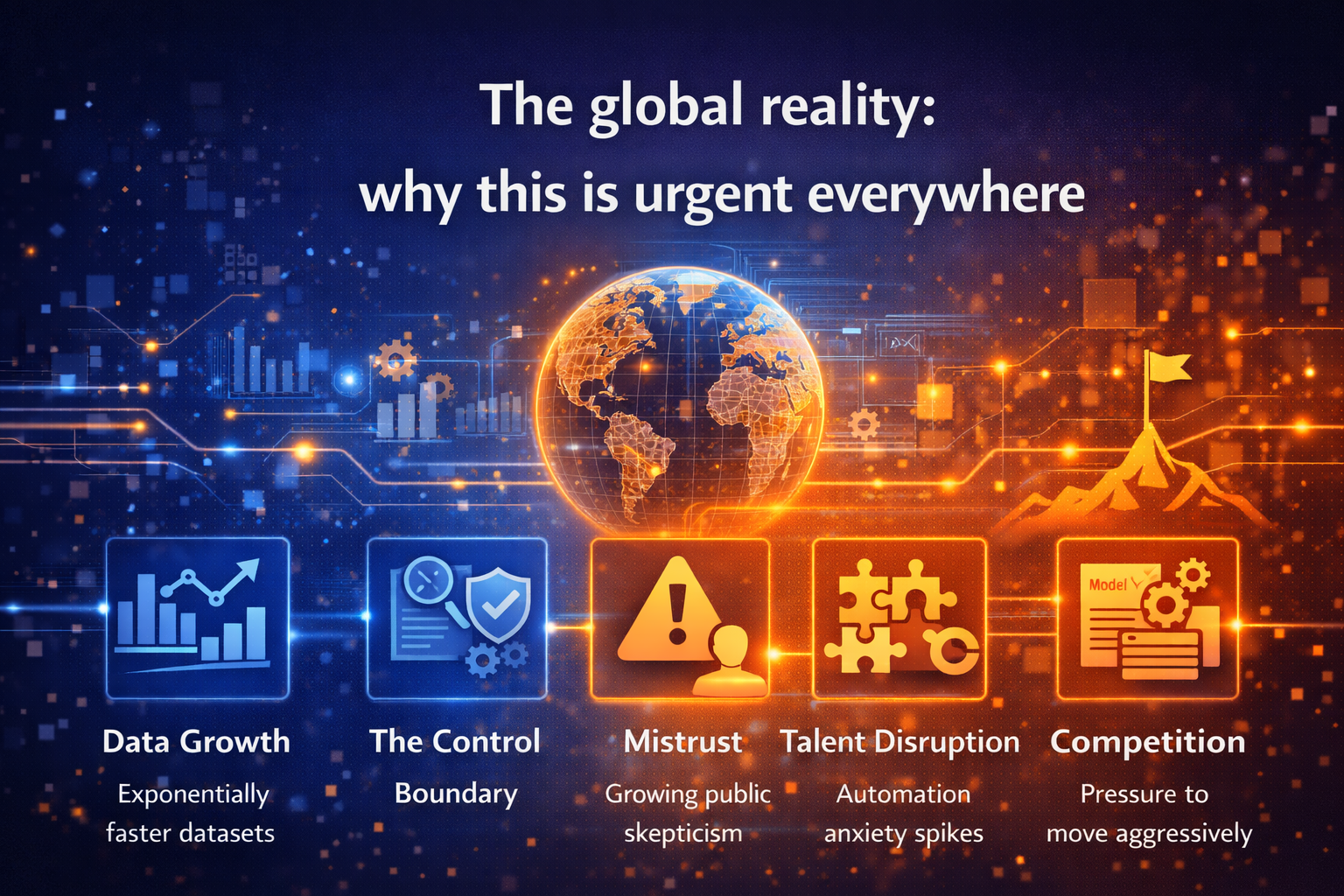
The global reality: why this is urgent everywhere
Enterprise AI is global because enterprises operate across different regulatory and trust regimes:
- The EU is advancing risk-based obligations and oversight expectations for high-risk AI. (AI Act Service Desk)
- The UK uses a principles-based approach anchored in safety, transparency, fairness, accountability/governance, and contestability/redress—pushing organizations toward clearer operational responsibility. (GOV.UK)
- The US and many global enterprises use NIST AI RMF as a common governance language across procurement, oversight, and risk management. (NIST)
- International standards like ISO/IEC 42001 provide auditable scaffolding to prove governance is real, not cosmetic. (ISO)
This means Enterprise AI strategy must be designed as a capability that travels across jurisdictions, audit cultures, and operating environments.
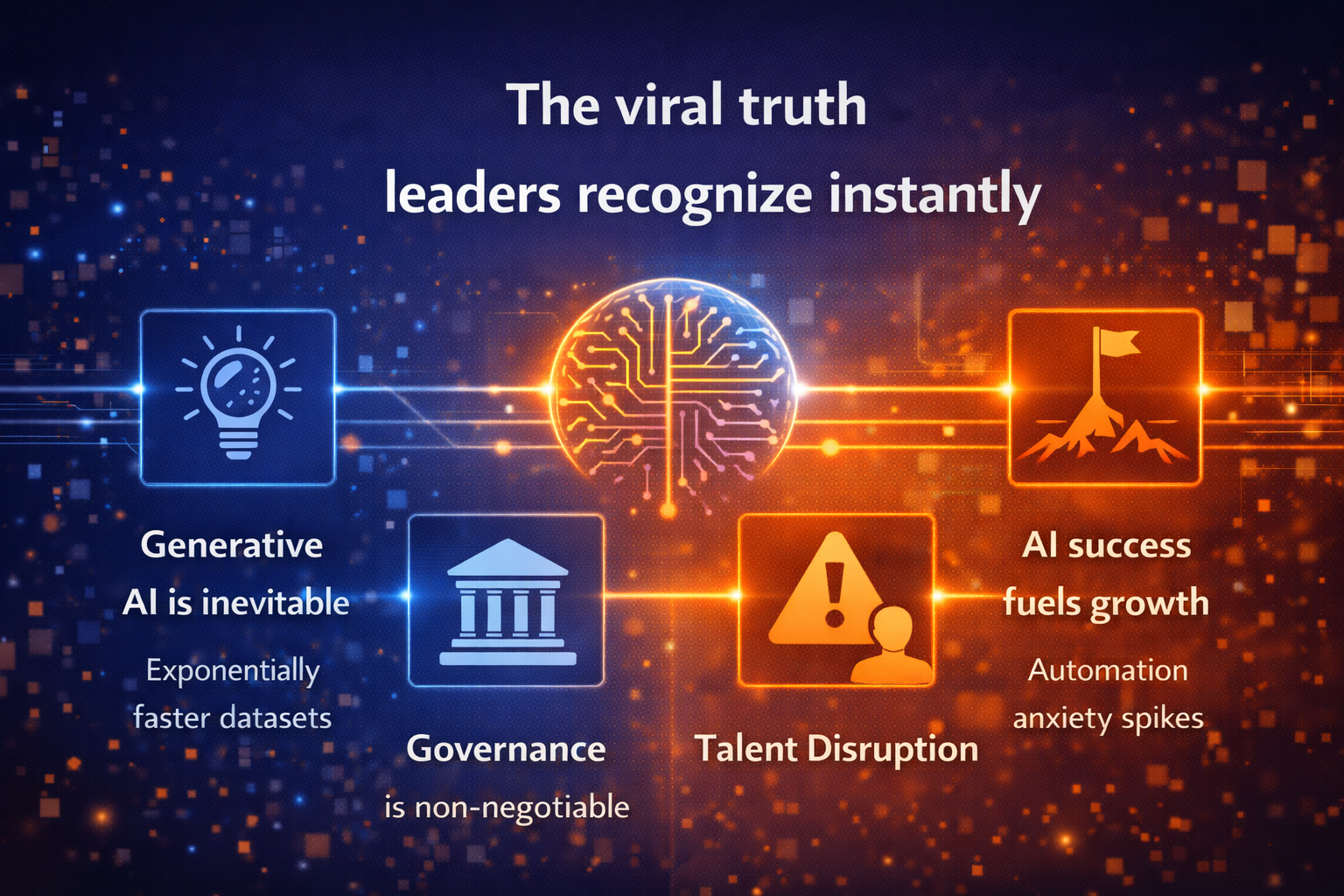
The viral truth leaders recognize instantly
If you want one line that will travel on social media because it feels obvious once stated, use this:
Enterprise AI doesn’t fail because models are weak. It fails because enterprises can’t run intelligence as an operational system.
Leaders recognize the pattern:
- pilots that look impressive
- production issues that are hard to diagnose
- governance that exists on slides, not in systems
- costs that creep up quietly
- teams reinventing the same intelligence
A strong Enterprise AI strategy names this reality—and gives a practical way forward.
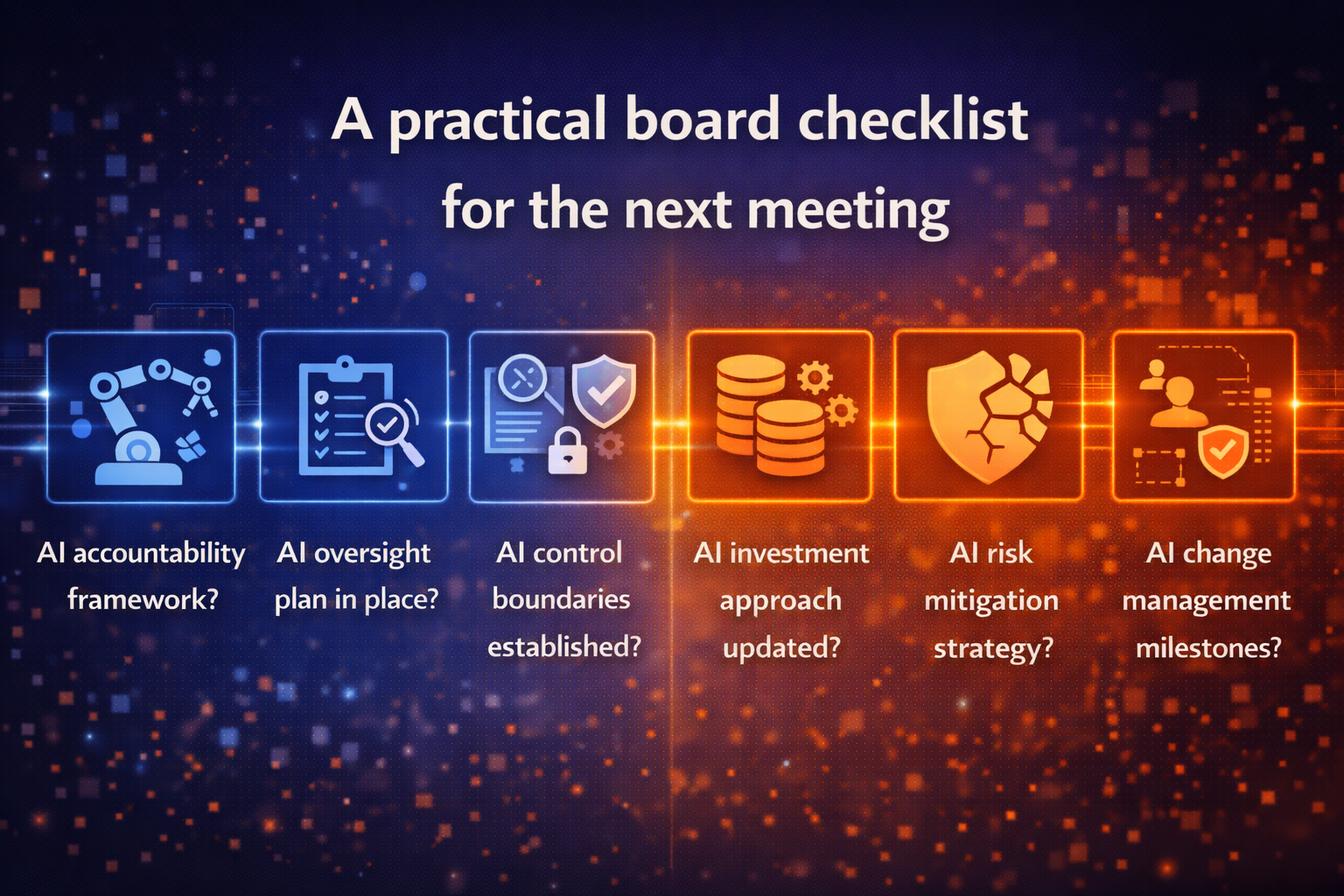
A practical board checklist for the next meeting
Without making this bureaucratic, boards can ask five questions that cut through hype:
- Where is AI allowed to act today—and where will it act next quarter?
- What evidence will we have when something goes wrong?
- How quickly can we stop or reverse AI behavior in production?
- How do we prevent every team from reinventing intelligence?
- What is our ongoing cost envelope—and who owns it?
If the enterprise can answer these, it is moving from “AI adoption” to Enterprise AI strategy.
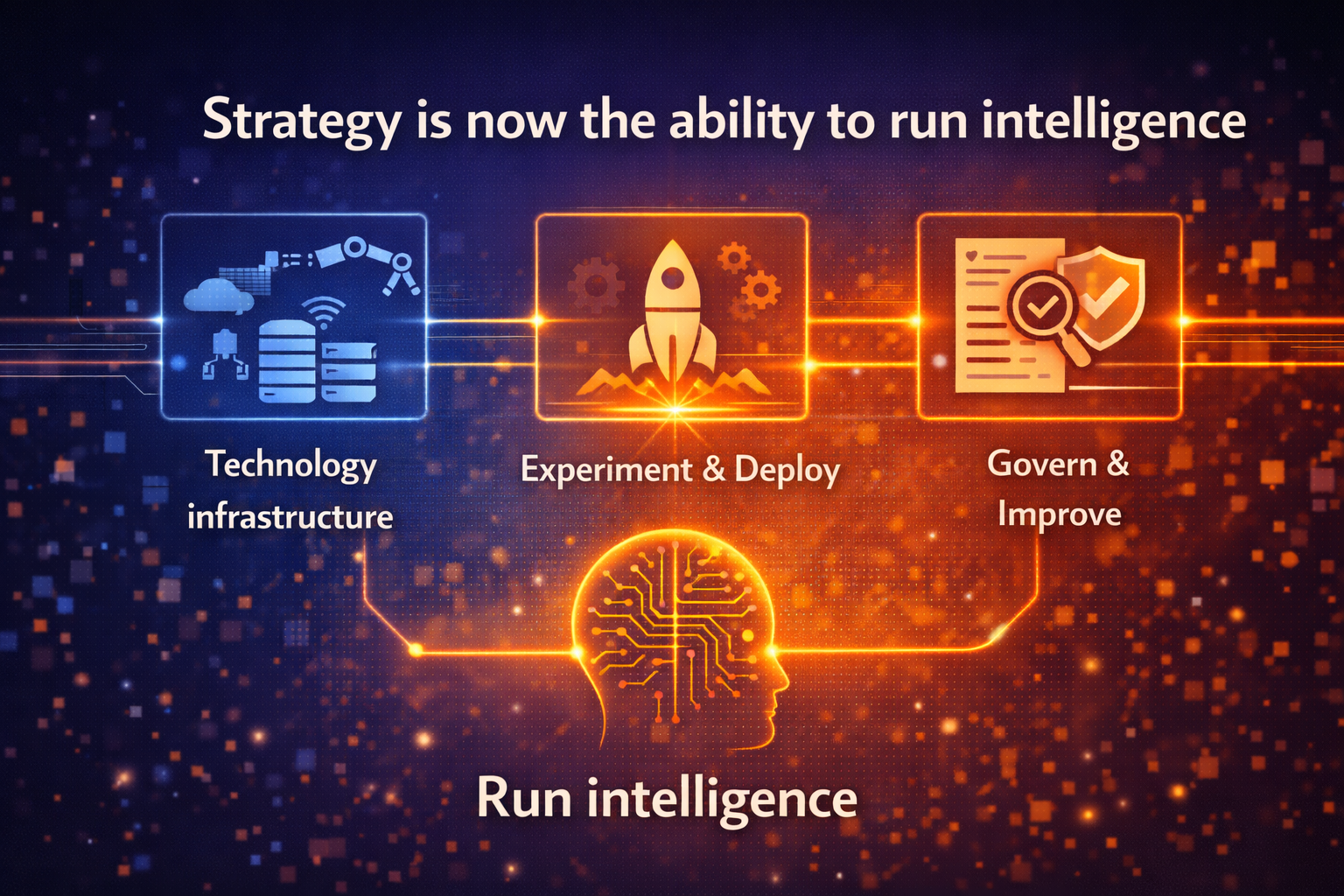
Conclusion: Strategy is now the ability to run intelligence
Enterprise AI strategy is not about betting on the right model. It is about building the organizational ability to run intelligence—safely, visibly, economically, and continuously—once AI starts acting inside workflows.
Boards don’t need to become AI experts.
They need to ensure the enterprise can answer one question with confidence:
If intelligence is now executing in our workflows, can we govern it like we govern money, risk, and uptime?
If the answer is not yet “yes,” the organization doesn’t need more pilots.
It needs an Enterprise AI strategy.
Next step: If you want the architecture-level blueprint for how to run Enterprise AI safely once it crosses into execution, read the pillar:
Enterprise AI Operating Model: https://www.raktimsingh.com/enterprise-ai-operating-model/
This article is part of a broader Enterprise AI knowledge base exploring how organizations design, govern, and operate intelligence safely at scale. These are covered at
Institutional Perspectives on Enterprise AI
Many of the structural ideas discussed here — intelligence-native operating models, control planes, decision integrity, and accountable autonomy — have also been explored in my institutional perspectives published via Infosys’ Emerging Technology Solutions platform.
For readers seeking deeper operational detail, I have written extensively on:
- What Makes an Enterprise Intelligence-Native? The Blueprint for Third-Order AI Advantage
https://blogs.infosys.com/emerging-technology-solutions/artificial-intelligence/what-is-enterprise-ai-the-operating-model-for-compounding-institutional-intelligence.html - Why “AI in the Enterprise” Is Not Enterprise AI: The Operating Model Difference Most Organizations Miss
https://blogs.infosys.com/emerging-technology-solutions/artificial-intelligence/why-ai-in-the-enterprise-is-not-enterprise-ai-the-operating-model-difference-that-most-organizations-miss.html - The Enterprise AI Control Plane: Governing Autonomy at Scale
https://blogs.infosys.com/emerging-technology-solutions/artificial-intelligence/the-enterprise-ai-control-plane-governing-autonomy-at-scale.html - Enterprise AI Ownership Framework: Who Is Accountable, Who Decides, and Who Stops AI in Production
https://blogs.infosys.com/emerging-technology-solutions/artificial-intelligence/enterprise-ai-ownership-framework-who-is-accountable-who-decides-and-who-stops-ai-in-production.html - Decision Integrity: Why Model Accuracy Is Not Enough in Enterprise AI
https://blogs.infosys.com/emerging-technology-solutions/artificial-intelligence/decision-integrity-why-model-accuracy-is-not-enough-in-enterprise-ai.html - Agent Incident Response Playbook: Operating Autonomous AI Systems Safely at Enterprise Scale
https://blogs.infosys.com/emerging-technology-solutions/artificial-intelligence/agent-incident-response-playbook-operating-autonomous-ai-systems-safely-at-enterprise-scale.html - The Economics of Enterprise AI: Designing Cost, Control, and Value as One System
https://blogs.infosys.com/emerging-technology-solutions/artificial-intelligence/the-economics-of-enterprise-ai-designing-cost-control-and-value-as-one-system.html
Together, these perspectives outline a unified view: Enterprise AI is not a collection of tools. It is a governed operating system for institutional intelligence — where economics, accountability, control, and decision integrity function as a coherent architecture.
Glossary
- Enterprise AI strategy: A board-level approach to operating AI safely and economically once it influences or executes actions in real workflows.
- Human oversight: Measures that ensure AI systems are supervised and can be overridden appropriately during operation. (AI Act Service Desk)
- Deployer: The organization using an AI system in real operations (not just the vendor building it). (artificialintelligenceact.eu)
- AI management system (AIMS): A management system for establishing, implementing, maintaining, and continually improving how AI is governed. (ISO)
- AI risk management: A lifecycle approach to governing, mapping, measuring, and managing AI risks. (NIST)
FAQs
1) Isn’t this just “Responsible AI”?
Responsible AI is necessary, but Enterprise AI strategy goes further: it turns principles into operating decisions—accountability, oversight, resilience, and economics.
2) Why must boards own this? Can’t IT handle it?
IT can implement controls, but boards must ensure the enterprise has governance over AI-driven outcomes—especially when actions can create material risk.
3) Does this apply if we only use copilots?
Yes. Copilots often become “shadow executors.” Over time they move from drafting to triggering actions. Strategy must define boundaries before drift occurs.
4) What’s the first step to create an Enterprise AI strategy?
Define the Action Boundary: where AI can act, where it must be supervised, and what it must never do. Then align controls, evidence, resilience, and economics.
5) How do regulations affect Enterprise AI strategy?
Risk-based rules and governance frameworks emphasize oversight and accountability—making “strategy as operating capability” unavoidable across geographies. (AI Act Service Desk)
References
- NIST, Artificial Intelligence Risk Management Framework (AI RMF 1.0) — governance/oversight responsibility framing. (NIST Publications)
- NIST, AI Risk Management Framework overview page. (NIST)
- European Commission AI Act Service Desk, Article 14: Human oversight (high-risk AI). (AI Act Service Desk)
- EU AI Act (deployer obligations), Article 26 (human oversight assignment, competence/authority/support). (artificialintelligenceact.eu)
- ISO, ISO/IEC 42001:2023 — AI management systems. (ISO)
- UK Government (guidance PDF), Implementing the UK’s AI Regulatory Principles (initial guidance for regulators). (GOV.UK)
- GOV.UK, A pro-innovation approach to AI regulation (White Paper). (GOV.UK)
Further reading
Add these as internal links at the end of your website version:
What Is Enterprise AI? Why “AI in the Enterprise” Is Not Enterprise AI—and Why This Distinction Will Define the Next Decade – Raktim Singh : how organizations design, govern, and scale intelligence safely
- The Intelligence Reuse Index: Why Enterprise AI Advantage Has Shifted from Models to Reuse – Raktim Singh: why advantage shifted from models to reuse
- The Enterprise AI Execution Contract: The Missing Layer Between Design Intent and Production Autonomy – Raktim Singh: the missing layer between design intent and production autonomy
- The Enterprise AI Estate Crisis: Why CIOs No Longer Know What AI Is Running — And Why That Is Now a Board-Level Risk – Raktim Singh: why CIOs no longer know what AI is running
- The Enterprise AI Runbook Crisis: Why Model Churn Is Breaking Production AI—and What CIOs Must Fix in the Next 12 Months – Raktim Singh: why model churn breaks production AI
- The AI Platform War Is Over: Why Enterprises Must Build an AI Fabric—Not an Agent Zoo – Raktim Singh : The AI Platform is Over:Why Enterprises Must Build an AI Fabric-Not an Agent Zoo



Raktim Singh is an AI and deep-tech strategist, TEDx speaker, and author focused on helping enterprises navigate the next era of intelligent systems. With experience spanning AI, fintech, quantum computing, and digital transformation, he simplifies complex technology for leaders and builds frameworks that drive responsible, scalable adoption.