
AI breaks that stability.
When cognition becomes cheap—when search, analysis, synthesis, negotiation drafts, compliance checks, and operational decisions can be produced at machine speed—the firm stops behaving like a static container of coordination. It becomes something more dynamic: a cognition orchestrator that continuously redraws what it owns, what it partners for, and what it routes through markets.
This is not just a story about automation or productivity. It is a story about economic structure: why firms exist, what makes them grow, what makes them shrink—and why, in the AI decade, the smartest organizations will learn to make boundaries fluid by design.
In 1937, Ronald Coase explained firms as an answer to the “cost of using the market”—what we now call transaction costs: the search, bargaining, monitoring, and enforcement burdens that make market exchange expensive in practice. (rochelleterman.com)
AI is now attacking those costs directly—sometimes collapsing them, sometimes shifting them, and sometimes moving them into new places.
That is why the boundary of the AI-era firm is becoming fluid.
What Is the Boundary of the Firm in the AI Era?
In classical economics, the boundary of the firm defines which activities are performed internally versus coordinated through markets.
In the AI era, that boundary becomes fluid because artificial intelligence dramatically lowers coordination and cognition costs.
As a result, firms shrink in some areas and expand in others — depending on where intelligence, data, control, and strategic advantage reside.

What “the boundary of the firm” actually means
The boundary is a practical line:
- Inside the firm: coordination happens through roles, managers, governance, workflows, budgets, and internal systems.
- Outside the firm: coordination happens through vendors, contracts, alliances, marketplaces, pricing, and external service levels.
Coase’s core idea is simple: firms exist because coordinating through markets isn’t free—you spend real time and money finding partners, negotiating terms, protecting information, monitoring delivery, and enforcing agreements. (Wikipedia)
As a result, a firm tends to expand until the cost of organizing “one more thing” internally equals the cost of buying it externally. (Wikipedia)
Now picture what happens when AI compresses the cost of search, drafting, monitoring, and enforcement.
That line starts moving.
Why AI makes firm boundaries fluid: it collapses coordination costs
Transaction costs show up in everyday executive friction:
- “Can we find the right supplier fast enough?”
- “Can Legal negotiate this contract without a six-week cycle?”
- “Can we verify compliance continuously—not just at audit time?”
- “Can we monitor vendor delivery without building a large oversight team?”
- “Can we coordinate across 10 internal teams without endless meetings?”
AI—especially when embedded in workflows—reduces these costs by making coordination continuous, cheap, and scalable, not only inside the firm but increasingly across firm boundaries as well.
A useful mental model:
Before AI
Coordination = meetings + email + manual checks + slow negotiation + human monitoring
With AI
Coordination = real-time sensing + automated synthesis + draft negotiation + compliance monitoring + workflow execution
When coordination becomes cheaper, the economic reason for a fixed boundary weakens. That is the direct implication of Coase’s argument. (rochelleterman.com)
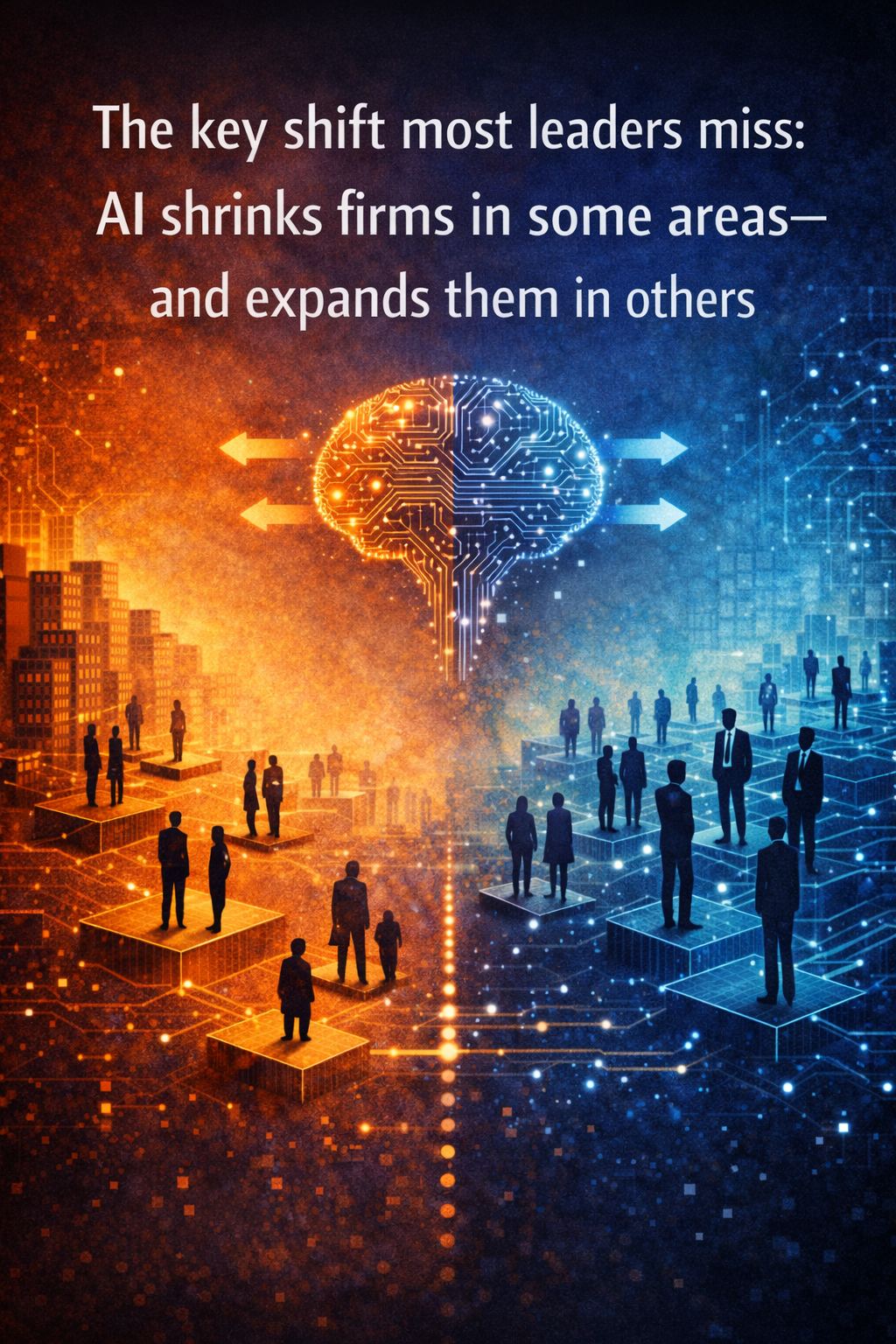
The key shift most leaders miss: AI shrinks firms in some areas—and expands them in others
A common mistake is to assume AI will simply “shrink the firm” by making outsourcing easier.
That is only half true.
AI drives simultaneous outsourcing and insourcing, depending on the nature of work and the nature of risk.
A simple rule that executives can actually use:
- If work is modular, well-specified, and measurable → AI makes it easier to buy externally.
- If work has tight coupling, deep institutional context, or high consequence → firms often bring it inside and govern it tightly.
In other words: the boundary becomes fluid, not uniformly smaller.
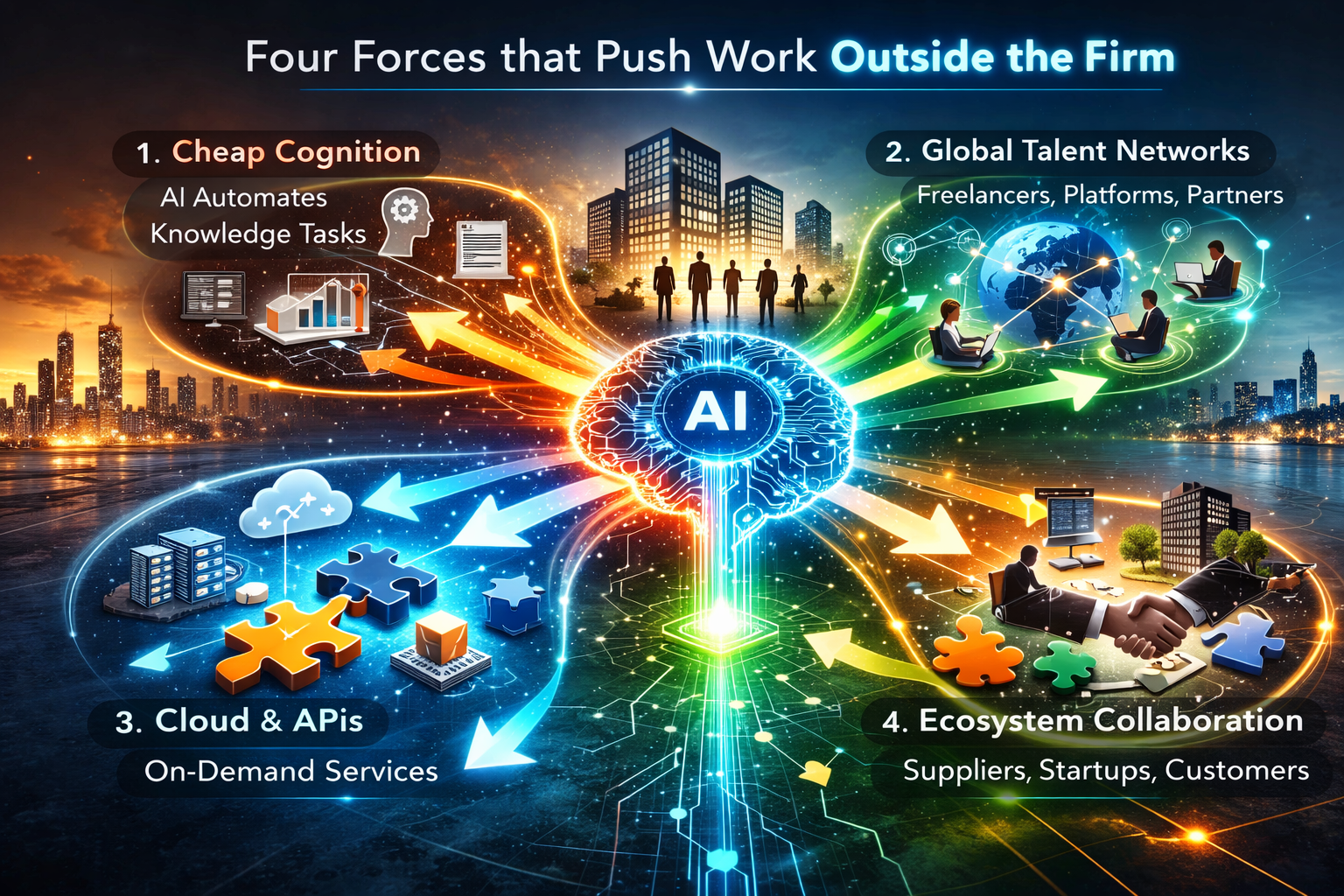
Four forces that push work outside the firm
1) Search friction collapses
Procurement used to be slow because discovering, qualifying, and comparing suppliers took time. AI can now draft requirements, shortlist vendors, evaluate proposals, summarize risks, and standardize specifications faster—shrinking the “search and information” component of transaction costs. (Corporate Finance Institute)
Simple example:
A mid-sized manufacturer needs a niche analytics module for predictive maintenance. Previously: weeks of vendor discovery and RFP cycles. Now: an AI-assisted procurement workflow drafts the RFP, scores responses, flags missing clauses, and produces a shortlist in days.
Result: more “buy” decisions—because the market becomes easier to use.
2) Contracting becomes faster and more standardized
Generative AI is increasingly reshaping contract lifecycle management—drafting, redlining, summarizing deviations, and extracting obligations—reducing bargaining overhead and cycle time. (Financial Times)
This does not eliminate lawyers. It eliminates unnecessary friction—the kind that forced firms to keep work internal simply to avoid the cost of contracting.
Result: more modular services delivered externally.
3) Monitoring becomes continuous
Outsourcing historically created fear: “How will we ensure quality?”
AI enables ongoing monitoring—SLAs, logs, anomalies, compliance drift—without building a massive oversight function.
Result: enforcement costs fall, and external delivery becomes more reliable.
4) Marketplaces become coordination engines
As coordination becomes software-native, markets become more usable. Platforms can package capability with governance, observability, and measurable outcomes.
Result: firms increasingly plug into external capability networks without losing control.
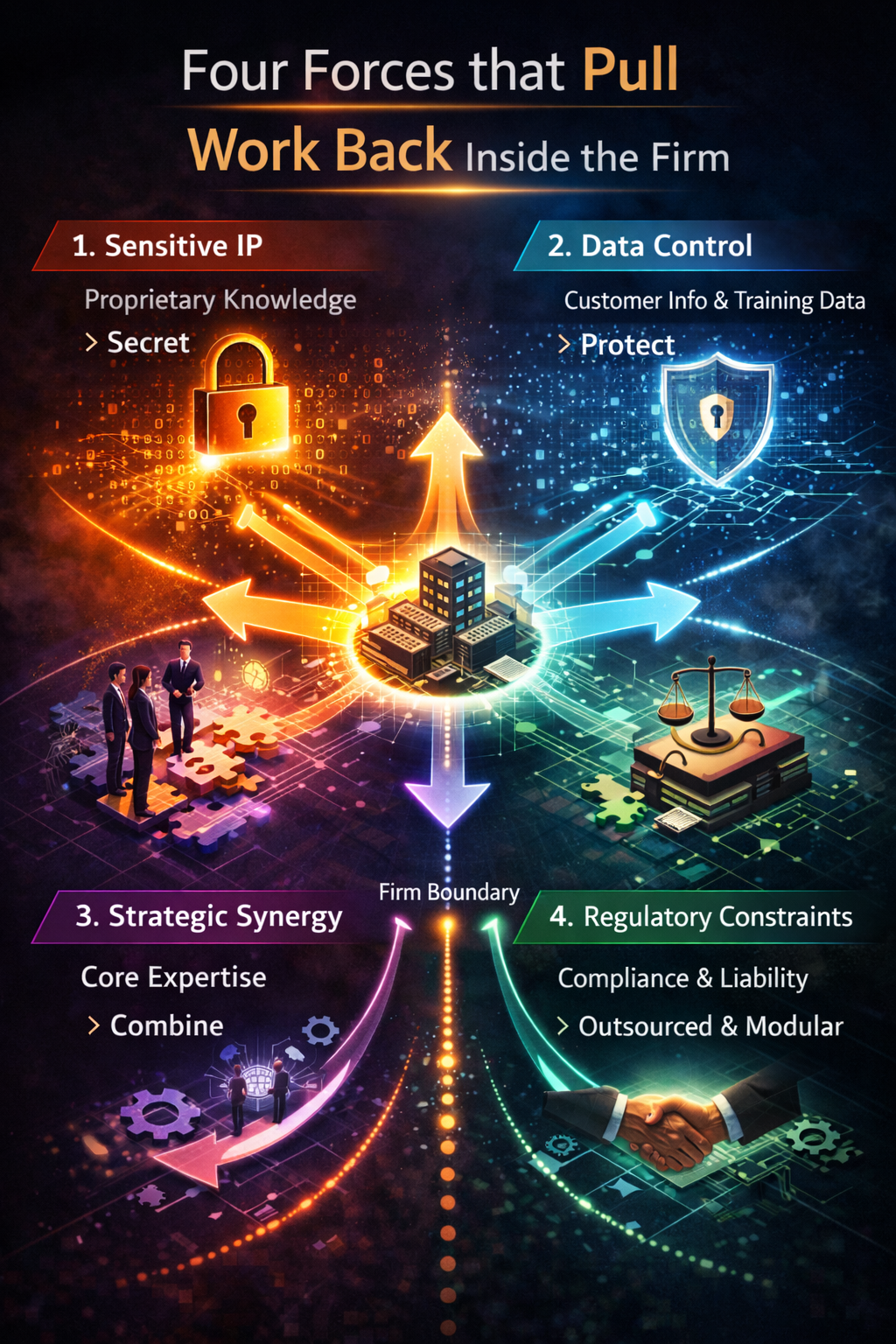
Four forces that pull work back inside the firm
1) Regulated risk and accountability
In regulated industries—banking, insurance, healthcare, telecom—outsourcing is not just about cost. It is about auditability, data residency, explainability, and liability.
As AI systems begin to act (not just advise), organizations often internalize the most sensitive decision loops to preserve defensibility and control.
2) Deep context and institutional memory
Some work cannot be cleanly specified because it relies on unwritten rules, edge cases, legacy constraints, and cross-team dependencies.
AI can amplify institutional memory—but only if the enterprise builds it as a governed asset, not a scattered set of prompts. When that memory becomes strategic, firms pull critical workflows inward.
3) Capability compounding through reuse
If a capability improves through repeated use—across products, markets, and teams—firms internalize it because it becomes institutional capital.
This is where the AI decade diverges sharply from the digital decade: durable advantage is less about adopting tools and more about building compounding decision infrastructure.
4) Differentiation and strategic uniqueness
AI increases the speed of imitation for commodity capabilities. So firms protect the loops that create differentiation: pricing strategy, risk policy, fraud posture, supply resilience, customer trust systems.
Result: the “inside boundary” becomes the home of compounding advantage.
Updating Coase for the AI era: from transaction cost economics to cognition orchestration
Coase gave us the foundational idea: firms arise to reduce the cost of market coordination. (rochelleterman.com)
The AI-era update is this:
The firm is no longer primarily a production function.
It is an orchestration function—of cognition, decision rights, and governed action.
In plain language:
- Markets are becoming smarter.
- Vendors are becoming more agentic.
- Contracts are becoming more dynamic.
- Monitoring is becoming automated.
- Decision loops are accelerating.
So the firm must answer a new strategic question:
What should we orchestrate as a core cognition system—and what can we route through external intelligence markets?
That is the new boundary problem.
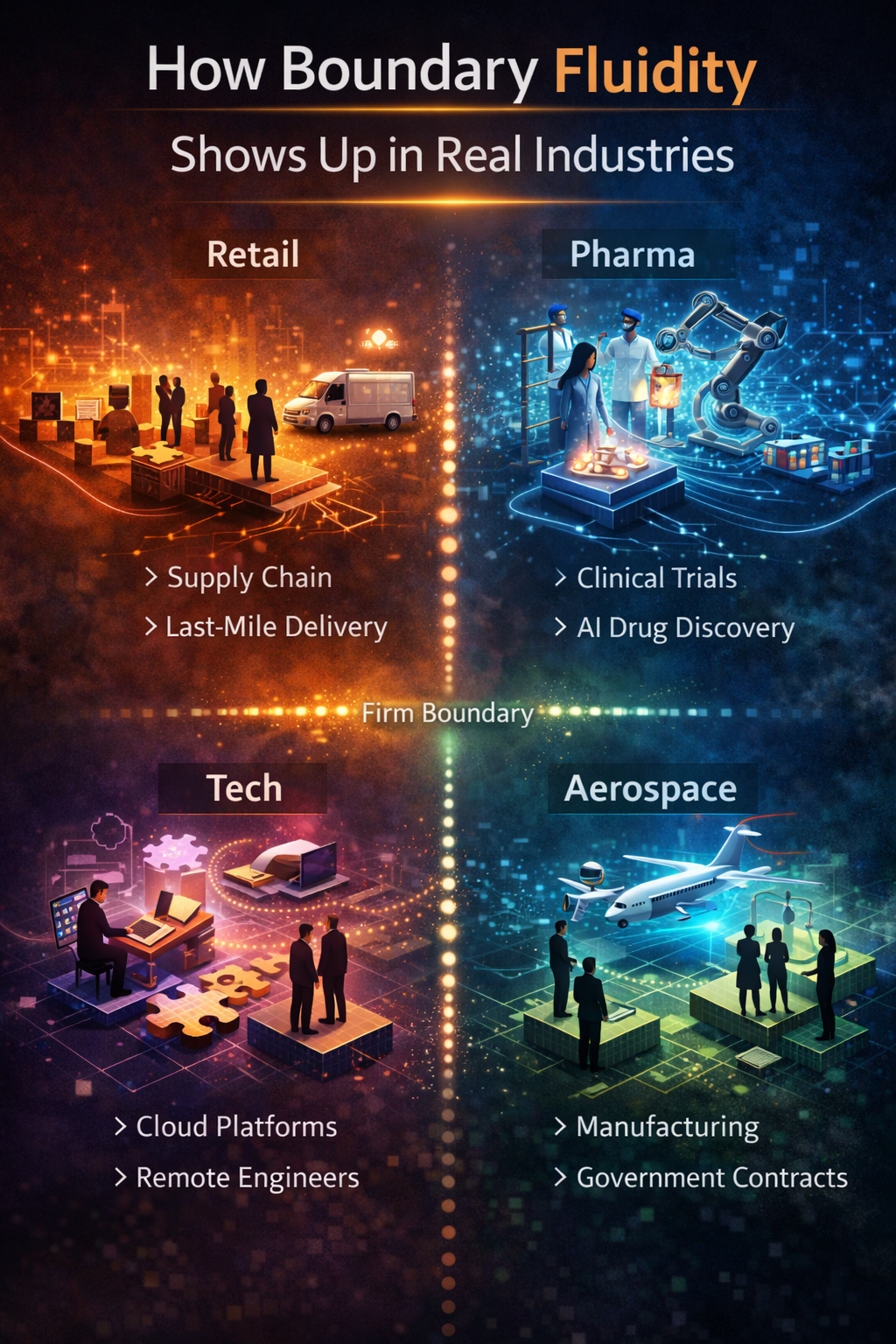
Global examples: how boundary fluidity shows up in real industries
Banking: fraud versus service
A bank can outsource parts of customer service and document processing. But fraud detection and risk decisioning often move inward because accountability and reputational risk are existential.
AI increases automation in both areas—but the boundary differs because the cost of being wrong differs.
Retail: analytics bought, pricing owned
Retailers can buy external demand signals and optimization tools. But many internalize pricing strategy and inventory logic because it shapes margin and competitiveness.
AI enables “continuous pricing,” but who owns the loop determines who owns the advantage.
Software companies: modular development, internal coherence
Testing, documentation, and routine code review are increasingly modular. But architecture, security posture, identity, and platform direction are pulled inward because they represent strategic coherence.
Manufacturing: vendor intelligence, internal quality loops
AI can help outsource maintenance analytics, but factories often internalize quality loops because quality failures cascade into recalls, compliance penalties, and brand damage.
Why boards must care: boundaries are now a strategic instrument
In the AI decade, boundaries are not a static org chart decision. They are a strategic lever.
Boards should treat boundary design as part of enterprise AI strategy:
- Which decision loops must remain internal for accountability?
- Which loops can be externalized for speed and flexibility?
- Where does intelligence reuse create compounding advantage?
- Where does vendor dependence create strategic fragility?
This is where “Enterprise AI” stops being a technology initiative and becomes institutional capital formation—a compounding asset that improves the enterprise’s ability to sense, decide, act, and learn safely at scale.
A board-grade framework: decide what stays inside vs outside in the AI era
Use four filters. Keep the language simple. Keep the logic rigorous.
1) Consequence filter
If failure creates regulatory, safety, or reputational damage → keep the loop internal or tightly governed.
2) Differentiation filter
If it drives durable competitive advantage → internalize and compound it.
3) Coupling filter
If it requires deep integration, shared context, and cross-team coordination → internalize.
4) Commodity filter
If it is modular, measurable, and widely available → externalize via vendors/markets.
The “fluid boundary” strategy is not about minimizing headcount.
It is about maximizing decision quality, decision speed, safety, and compounding learning.
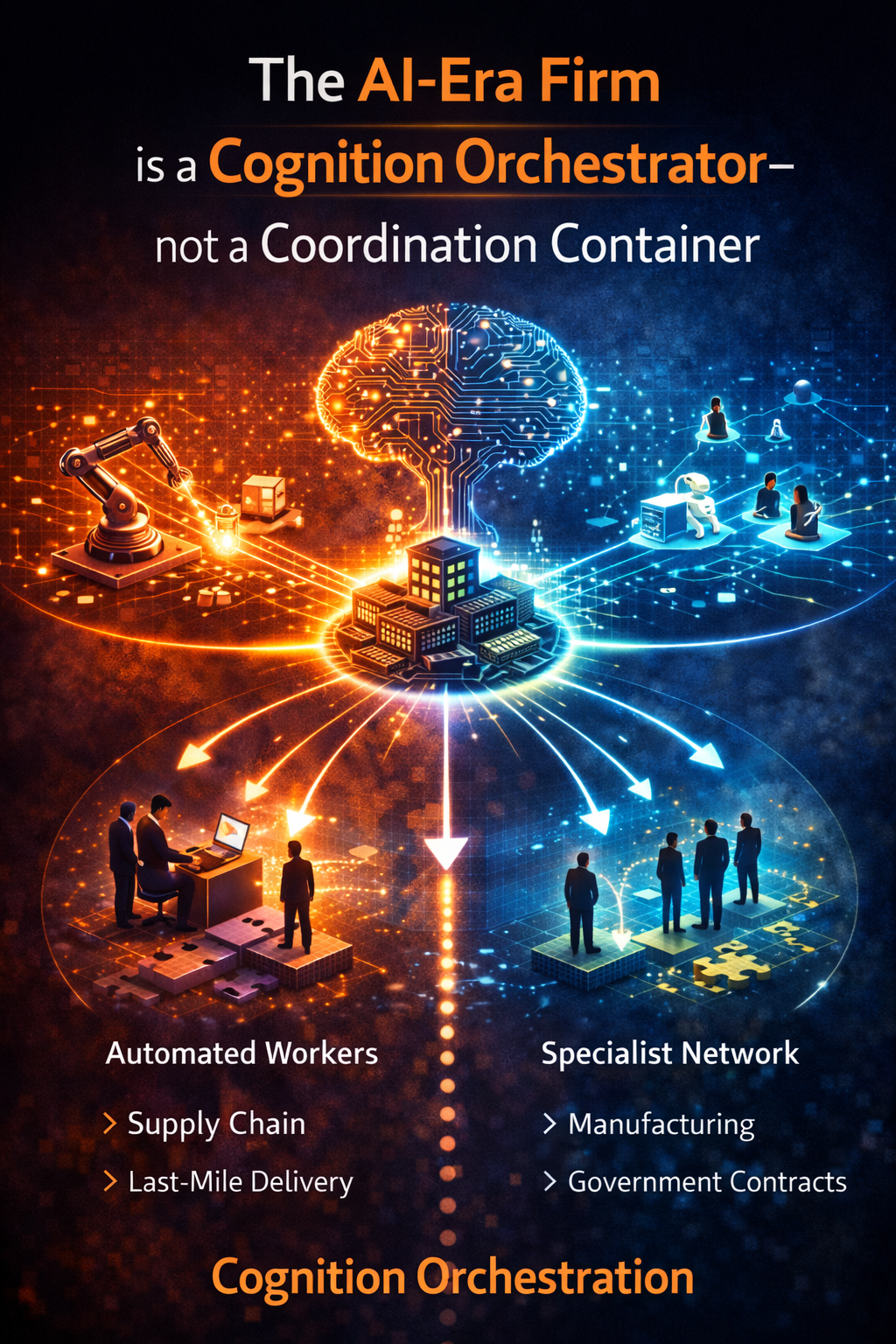
Conclusion: the AI-era firm is a cognition orchestrator—not a coordination container
The most important shift underway is not that companies are “adopting AI.”
It is that AI is rewriting the economics of coordination.
That is why firms are being unbundled and rebundled at the same time:
- Some will become thin coordinators that assemble capability from markets.
- Others will become thick cognition engines that internalize high-consequence decision loops.
- The winners will do both—selectively—based on consequence, differentiation, coupling, and governance.
This is the real AI transformation:
Not digitization.
Not copilots.
Not pilot counts.
Institutional redesign.
Enterprise AI Operating Model
Enterprise AI scale requires four interlocking planes:
Read about Enterprise AI Operating Model The Enterprise AI Operating Model: How organizations design, govern, and scale intelligence safely – Raktim Singh
- Read about Enterprise Control Tower The Enterprise AI Control Tower: Why Services-as-Software Is the Only Way to Run Autonomous AI at Scale – Raktim Singh
- Read about Decision Clarity The Shortest Path to Scalable Enterprise AI Autonomy Is Decision Clarity – Raktim Singh
- Read about The Enterprise AI Runbook Crisis The Enterprise AI Runbook Crisis: Why Model Churn Is Breaking Production AI—and What CIOs Must Fix in the Next 12 Months – Raktim Singh
- Read about Enterprise AI Economics Enterprise AI Economics & Cost Governance: Why Every AI Estate Needs an Economic Control Plane – Raktim Singh
Read about Who Owns Enterprise AI Who Owns Enterprise AI? Roles, Accountability, and Decision Rights in 2026 – Raktim Singh
Read about The Intelligence Reuse Index The Intelligence Reuse Index: Why Enterprise AI Advantage Has Shifted from Models to Reuse – Raktim Singh
The Intelligence-Native Enterprise Doctrine
This article is part of a larger strategic body of work that defines how AI is transforming the structure of markets, institutions, and competitive advantage. To explore the full doctrine, read the following foundational essays:
-
The AI Decade Will Reward Synchronization, Not Adoption
Why enterprise AI strategy must shift from tools to operating models.
https://www.raktimsingh.com/the-ai-decade-will-reward-synchronization-not-adoption-why-enterprise-ai-strategy-must-shift-from-tools-to-operating-models/ -
The Third-Order AI Economy
The category map boards must use to see the next Uber moment.
https://www.raktimsingh.com/third-order-ai-economy/ -
The Intelligence Company
A new theory of the firm in the AI era — where decision quality becomes the scalable asset.
https://www.raktimsingh.com/intelligence-company-new-theory-firm-ai/ -
The Judgment Economy
How AI is redefining industry structure — not just productivity.
https://www.raktimsingh.com/judgment-economy-ai-industry-structure/ -
Digital Transformation 3.0
The rise of the intelligence-native enterprise.
https://www.raktimsingh.com/digital-transformation-3-0-the-rise-of-the-intelligence-native-enterprise/ -
Industry Structure in the AI Era
Why judgment economies will redefine competitive advantage.
https://www.raktimsingh.com/industry-structure-in-the-ai-era-why-judgment-economies-will-redefine-competitive-advantage/
Institutional Perspectives on Enterprise AI
Many of the structural ideas discussed here — intelligence-native operating models, control planes, decision integrity, and accountable autonomy — have also been explored in my institutional perspectives published via Infosys’ Emerging Technology Solutions platform.
For readers seeking deeper operational detail, I have written extensively on:
-
What Makes an Enterprise Intelligence-Native? The Blueprint for Third-Order AI Advantage
-
Why “AI in the Enterprise” Is Not Enterprise AI: The Operating Model Difference Most Organizations Miss
-
The Enterprise AI Control Plane: Governing Autonomy at Scale
-
Enterprise AI Ownership Framework: Who Is Accountable, Who Decides, and Who Stops AI in Production
-
Decision Integrity: Why Model Accuracy Is Not Enough in Enterprise AI
-
Agent Incident Response Playbook: Operating Autonomous AI Systems Safely at Enterprise Scale
-
The Economics of Enterprise AI: Designing Cost, Control, and Value as One System
Together, these perspectives outline a unified view: Enterprise AI is not a collection of tools. It is a governed operating system for institutional intelligence — where economics, accountability, control, and decision integrity function as a coherent architecture.
FAQ
What is the “fluid boundary” of the firm?
It means the line between what a company does internally and what it buys externally is shifting faster—and more frequently—because AI lowers coordination and transaction costs.
Does AI always push outsourcing?
No. AI reduces friction for outsourcing, but it also increases the incentive to internalize high-consequence, highly coupled, and differentiating decision loops.
How is this different from digital transformation?
Digital transformation modernized processes. AI changes the economics of coordination, making the boundary of the firm dynamic and strategic—not just operational. (Wikipedia)
What should boards focus on first?
Decision rights, governance enforcement, institutional memory, and which intelligence loops must remain internal to be defensible and compounding.
Q1. What is the “boundary of the firm” in economics?
It refers to the line between activities performed internally by a company and those coordinated through markets or external partners.
Q2. How does AI affect the boundary of the firm?
AI reduces coordination and cognition costs, making it easier to move certain activities outside the firm while centralizing others that rely on proprietary data, governance, or strategic control.
Q3. Why does AI shrink firms in some areas?
Automation, APIs, global talent platforms, and AI agents reduce the need for large internal teams for standardized work.
Q4. Why does AI expand firms in other areas?
Data control, regulatory exposure, intellectual property, and strategic differentiation pull certain capabilities back inside.
Q5. What is a cognition orchestrator firm?
A cognition orchestrator firm designs, governs, and synchronizes intelligence flows across internal and external systems rather than merely coordinating labor
Glossary
Boundary of the firm
The line between activities coordinated inside the organization vs through external markets and contracts.
Transaction costs
Costs of using markets: search and information costs, bargaining costs, monitoring, policing, and enforcement. (Wikipedia)
Cognitive cost collapse
The rapid decline in the cost of producing analysis, reasoning, and decision support using AI.
Decision rights
Who has authority to decide—and under what constraints and accountability.
Institutional memory
Governed knowledge of policies, exceptions, operational history, and context that improves decisions over time.
References and further reading
- Coase, R. H. (1937). The Nature of the Firm. (rochelleterman.com)
- Overview of transaction costs (search, bargaining, enforcement). (Wikipedia)
- Generative AI and contract management (industry impact). (Financial Times)
- AI in procurement and source-to-pay transformation (practical lens). (artofprocurement.com)



Raktim Singh is an AI and deep-tech strategist, TEDx speaker, and author focused on helping enterprises navigate the next era of intelligent systems. With experience spanning AI, fintech, quantum computing, and digital transformation, he simplifies complex technology for leaders and builds frameworks that drive responsible, scalable adoption.