
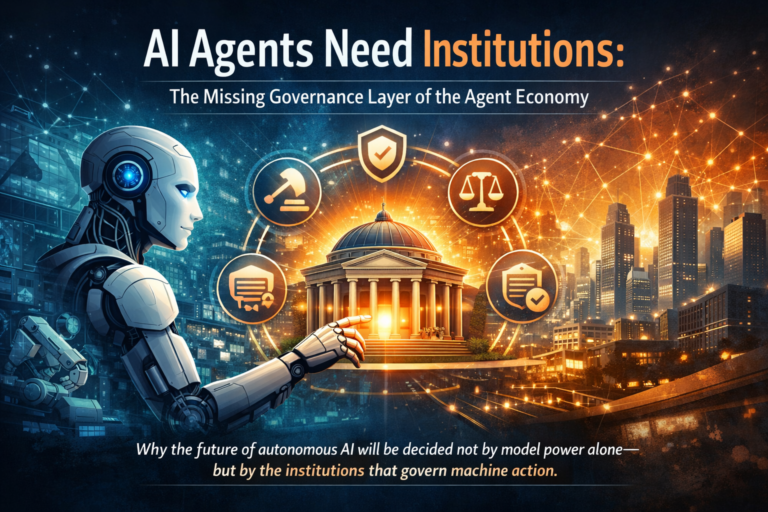
For the past decade, most discussions about AI focused on what models could know.
Could they summarize documents?
Could they answer questions?
Could they generate code?
Could they produce images or marketing content?
Those capabilities mattered because they demonstrated that machines could interpret and generate information.
But a much bigger transformation is now underway.
AI systems are no longer just generating outputs.
They are beginning to take actions.
AI agents can search enterprise systems, trigger workflows, update records, negotiate schedules, approve exceptions, recommend financial actions, interact with customers, and even coordinate with other agents.
In some cases, they can complete entire workflows with minimal human intervention.
This marks the beginning of what many analysts are calling the Agent Economy.
Yet this shift introduces a much deeper question than model capability.
What happens when machine intelligence begins acting inside real institutions?
At that point, the central issue is no longer intelligence alone.
It is governance.
Not governance as a compliance checklist.
Governance as institutional architecture.
Because when AI systems move from generating insights to executing decisions, the most important question becomes:
Can the institution surrounding the AI govern its behavior safely, responsibly, and economically?
This is why AI agents need institutions.
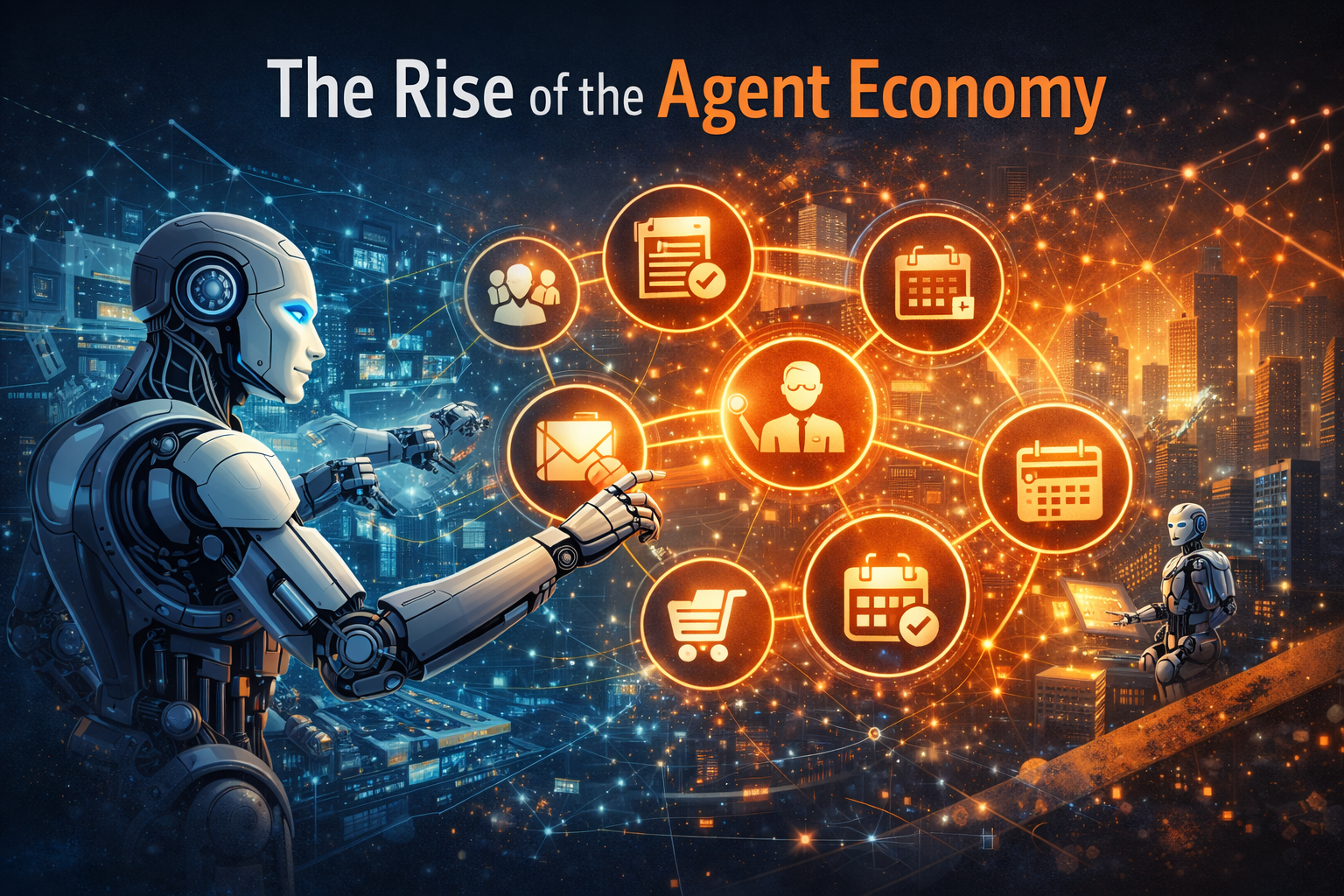
The Rise of the Agent Economy
Traditional enterprise software works through explicit instruction.
A human clicks a button.
A workflow runs.
A rule executes.
A record changes.
This structure kept authority clear: humans decided, software executed.
AI agents fundamentally change this model.
Instead of executing predefined instructions, agents can receive goals.
From that goal they can:
- break tasks into subtasks
- search knowledge bases
- call tools and APIs
- interpret policies
- revise plans dynamically
- coordinate with other systems
In other words, AI agents can observe, reason, decide, and act.
That sounds like a technical improvement.
But institutionally, it represents something much bigger.
It means machines are beginning to participate inside operational decision loops.
And once machines participate in decision loops, governance becomes essential.
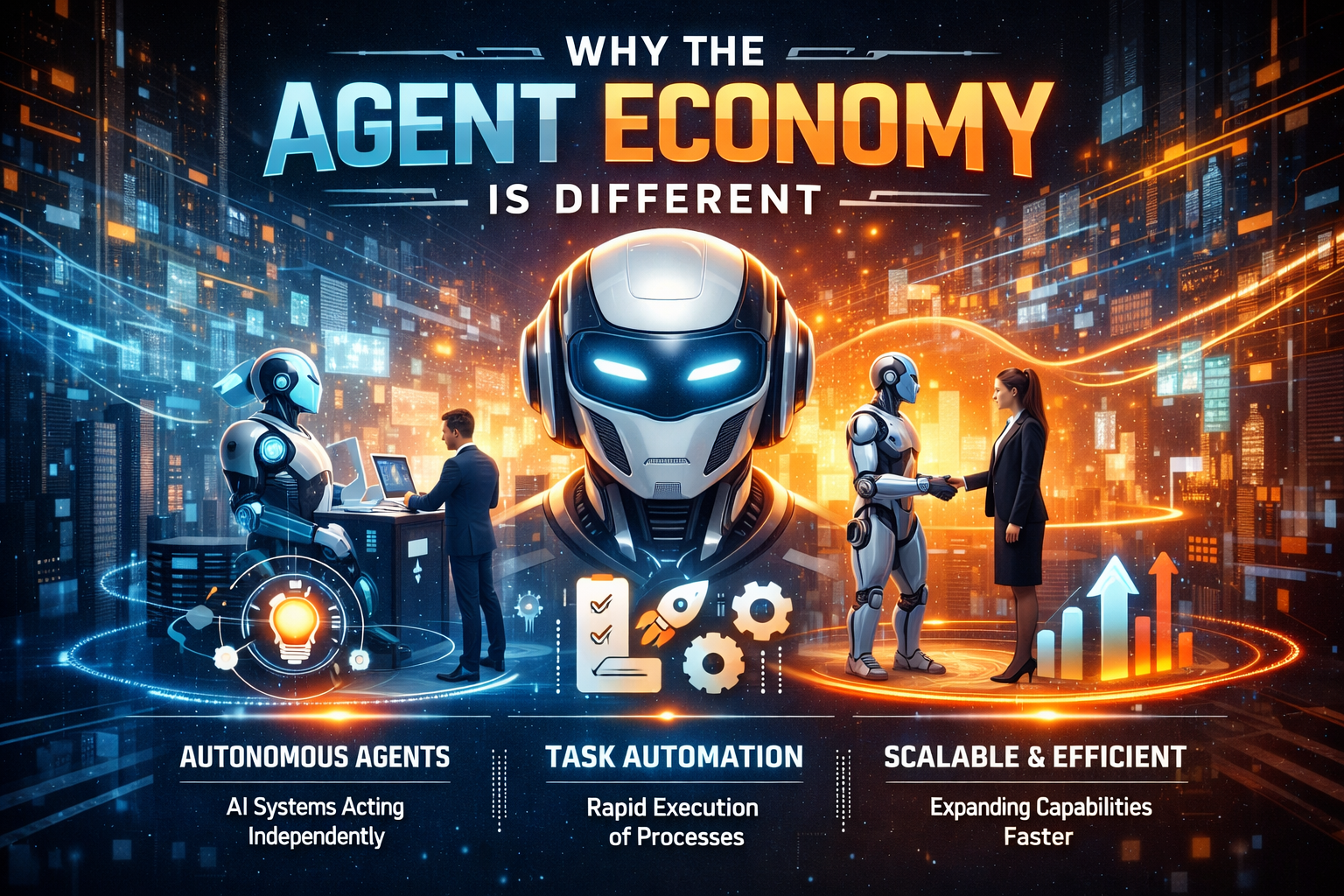
Why the Agent Economy Is Different
Imagine a telecommunications company handling customer complaints.
In the traditional system:
A human support representative reads the complaint.
The system suggests possible responses.
The human chooses an action.
In the agent-driven model:
An AI agent may:
- read the complaint
- analyze customer history
- verify policy rules
- offer a retention discount
- update billing
- schedule technical service
- send a follow-up message
All without human intervention.
At first glance, this appears to be automation.
But institutionally, it is something far more significant.
Now the organization must answer questions such as:
Who authorized the agent to issue discounts?
Which policy version was used?
What happens if the agent misinterprets context?
Can the decision be audited?
Can a supervisor intervene?
Can the organization stop the agent instantly?
What happens when multiple agents interact in unpredictable ways?
These are institutional questions, not technical questions.
Yet most organizations are still deploying AI systems into governance structures designed for human-only workflows.
The result is predictable:
Intelligence is arriving faster than governance.
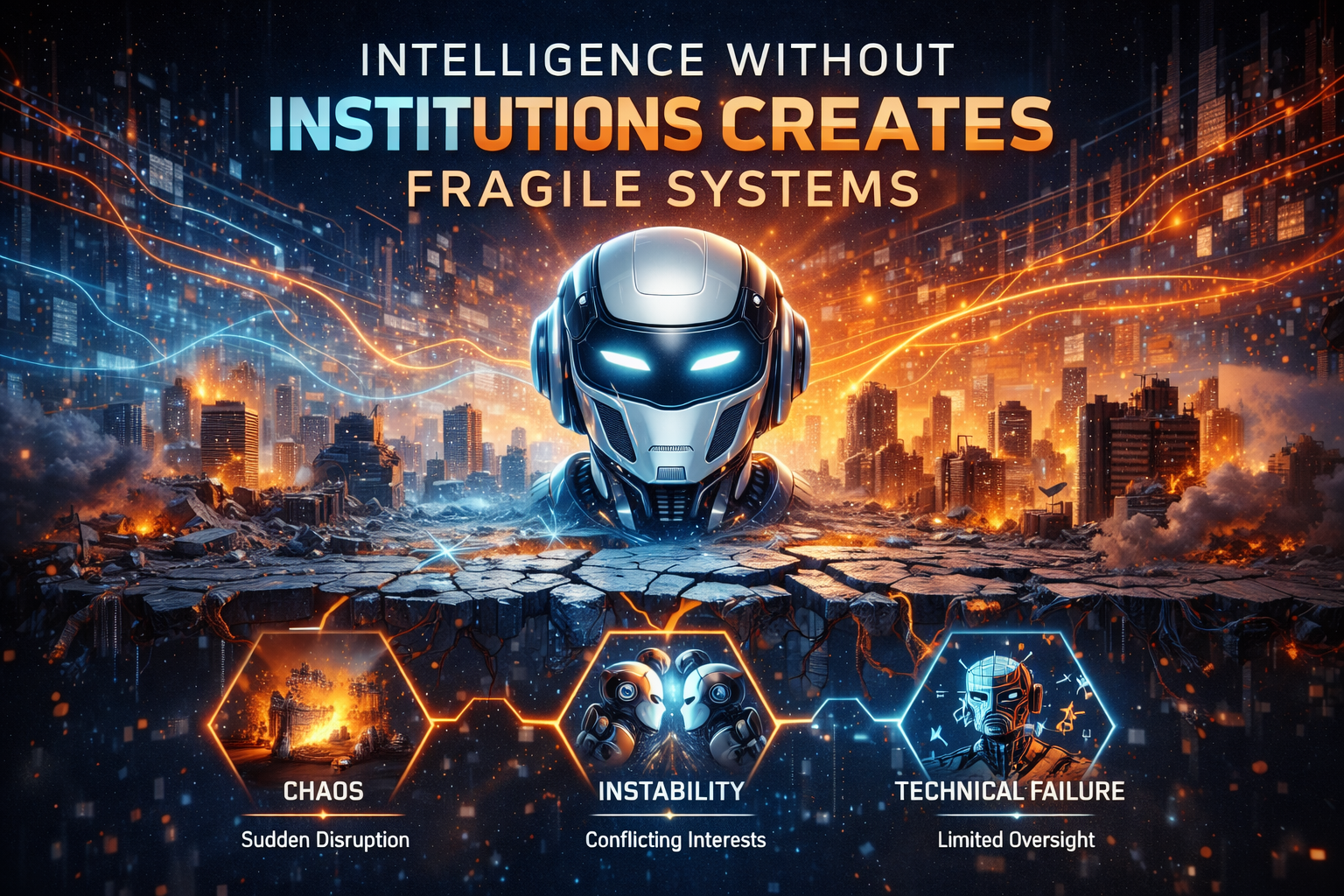
Intelligence Without Institutions Creates Fragile Systems
History repeatedly shows that technological power arrives before institutions mature enough to govern it.
Industrial machinery emerged before labor protections.
Financial innovation expanded faster than risk management frameworks.
The internet scaled globally before societies established durable rules around identity, privacy, and platform accountability.
Artificial intelligence is following the same pattern—only much faster.
This matters because AI agents fail differently from traditional software.
A typical software bug creates technical errors.
An AI agent failure can create organizational consequences.
For example:
A procurement agent might reorder inventory aggressively because it misinterpreted temporary demand patterns.
A financial agent might optimize short-term collections while damaging long-term customer relationships.
A fraud detection agent might escalate legitimate users due to biased signals in training data.
A scheduling agent might maximize efficiency in ways that unfairly disadvantage certain employees.
In each case, the problem is not simply that the model made an error.
The deeper issue is that the institution allowed a machine to act without the proper governance architecture.
That architecture requires clear representation, accountability, and authority boundaries.
This is where the SENSE–CORE–DRIVER framework becomes essential.
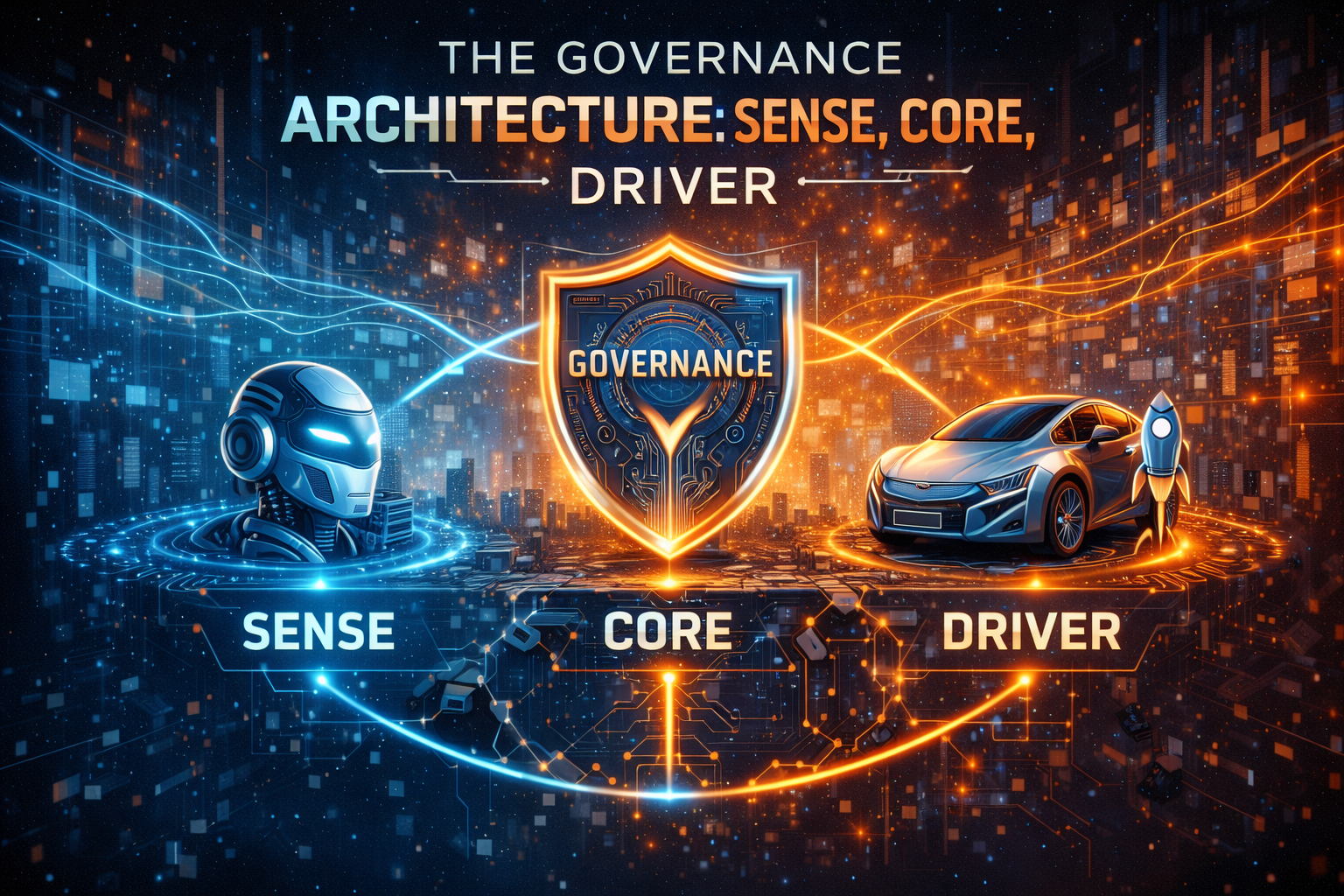
The Governance Architecture: SENSE, CORE, DRIVER
A practical way to understand institutional governance for AI agents is to think in three layers.
These layers define how organizations translate machine intelligence into controlled institutional behavior.
SENSE: Can the Institution See Reality Clearly?
Every AI agent begins with perception.
Before reasoning can begin, the system must understand:
- which entity it is dealing with
- what the relevant context is
- what policies apply
- what permissions exist
- what the current state of the system is
If the sensing layer is weak, the agent starts from distorted reality.
Consider a lending support system assisting relationship managers.
If customer identity is fragmented across systems, income records are incomplete, policy exceptions are hidden in emails, and transaction histories are inconsistent, the AI agent will not reason incorrectly—it will reason on incorrect reality.
This is why governance begins before the model starts thinking.
Institutions must first make reality legible.
This includes:
- identity resolution systems
- event logging
- policy retrieval infrastructure
- workflow visibility
- permission mapping
- context freshness monitoring
Without these capabilities, organizations do not have AI governance.
They have AI guesswork.
This idea connects closely with the concept explored in:
The Representation Stack: How Reality Becomes Identifiable, Legible, and Actionable in the AI Economy
and
Identity Infrastructure: The Missing Layer Between Signals and Representation in the AI Economy
Both show why institutions must first make reality machine-readable before intelligent action becomes possible.
CORE: Can the Agent Reason Within Institutional Logic?
Once an agent perceives reality, it must interpret it.
This reasoning layer includes:
- planning and task decomposition
- retrieval of knowledge and policies
- contextual reasoning
- exception handling
- decision confidence estimation
- escalation logic
Many organizations focus heavily on this layer.
They compare models, prompts, orchestration frameworks, and reasoning architectures.
But CORE alone does not create governance.
A highly intelligent system can still cause institutional harm if it reasons outside the organization’s authority structure.
Consider insurance claims processing.
An AI system might detect suspicious patterns with high accuracy.
But if the system cannot distinguish between:
“recommend investigation”
and
“deny claim”
then the system has crossed an institutional boundary.
Institutions must clearly define:
Which decisions agents can recommend
Which decisions they can approve
Which decisions require human oversight
Which decisions must never be automated
The true governance challenge is not simply:
Can the agent think?
The real question is:
Can the agent think within institutional authority boundaries?
This connects to the broader concept explored in:
Decision Integrity: Why Model Accuracy Is Not Enough in Enterprise AI
DRIVER: Can the Institution Control Real-World Action?
The DRIVER layer is where reasoning becomes action.
It includes the execution environment where agents interact with real systems.
Examples include:
- API calls
- workflow execution
- financial transactions
- notifications
- database updates
- account modifications
Many AI failures occur not because models misunderstand language but because execution authority is poorly controlled.
For example:
A refund agent without spending limits can create financial leakage.
A procurement agent without supplier restrictions can create contractual risk.
A customer service agent without escalation rules can create legal liability.
Driver governance must answer questions such as:
Which tools can the agent access?
Which actions are reversible?
What spending authority exists?
What approval thresholds are required?
What alerts trigger human intervention?
Where is the emergency kill switch?
Governance becomes real when institutions establish:
permissions, logging, monitoring, escalation paths, and safe shutdown mechanisms.
These capabilities are increasingly emphasized by global governance frameworks such as:
- OECD AI Principles
- NIST AI Risk Management Framework
- EU AI Act
- Singapore Model AI Governance Framework for Agentic AI
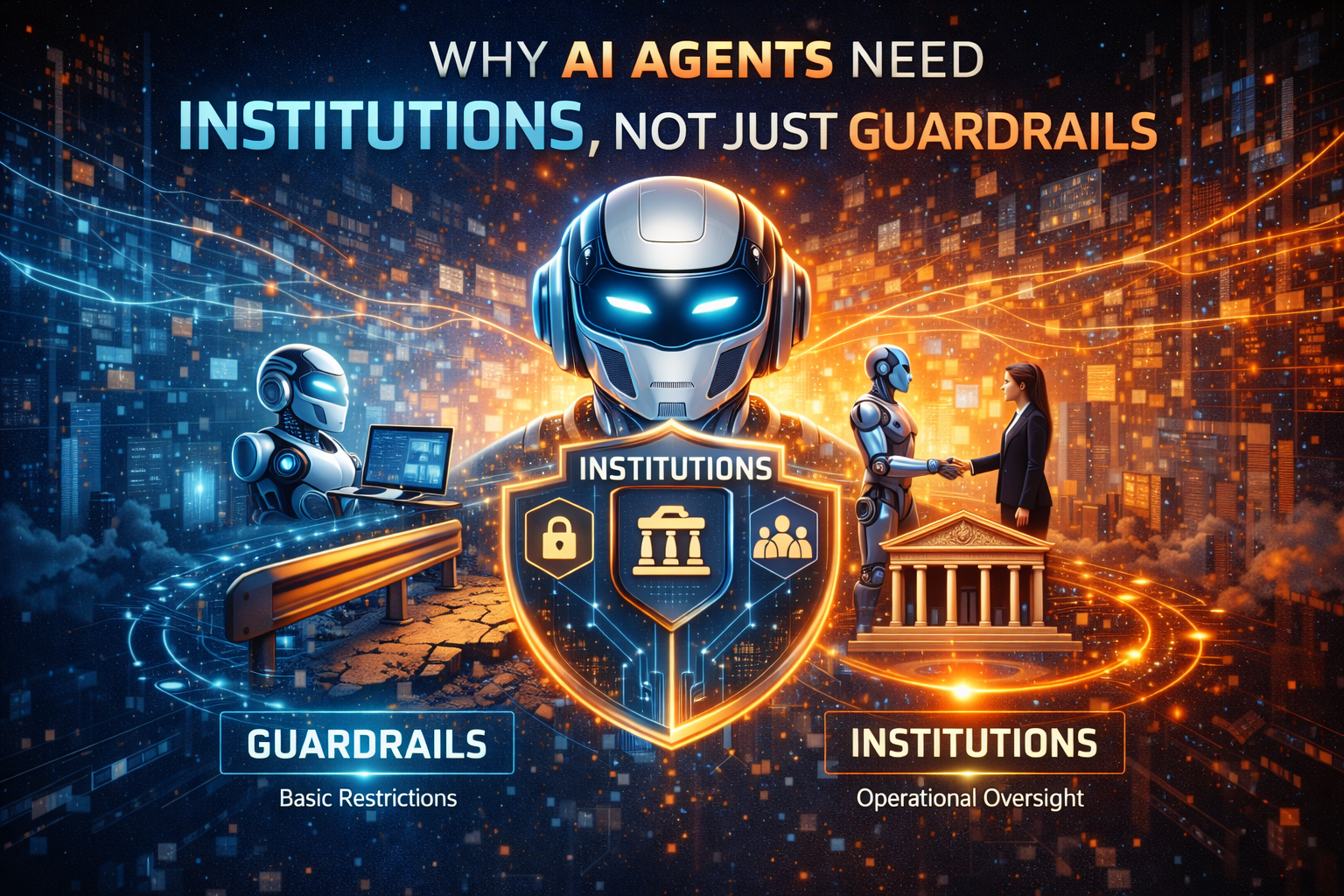
Why AI Agents Need Institutions, Not Just Guardrails
Many current discussions describe AI safety in terms of guardrails.
The concept is useful, but incomplete.
Guardrails imply a thin layer of control around a model.
Institutions are much deeper.
Institutions define:
- authority
- accountability
- evidence
- auditability
- escalation mechanisms
- dispute resolution
- legitimacy of decisions
Human organizations rely on institutions for governance.
The same will increasingly apply to machine actors.
This is why the future of the agent economy will not be determined by the most powerful standalone model.
It will be determined by the strength of the institutions governing those models.
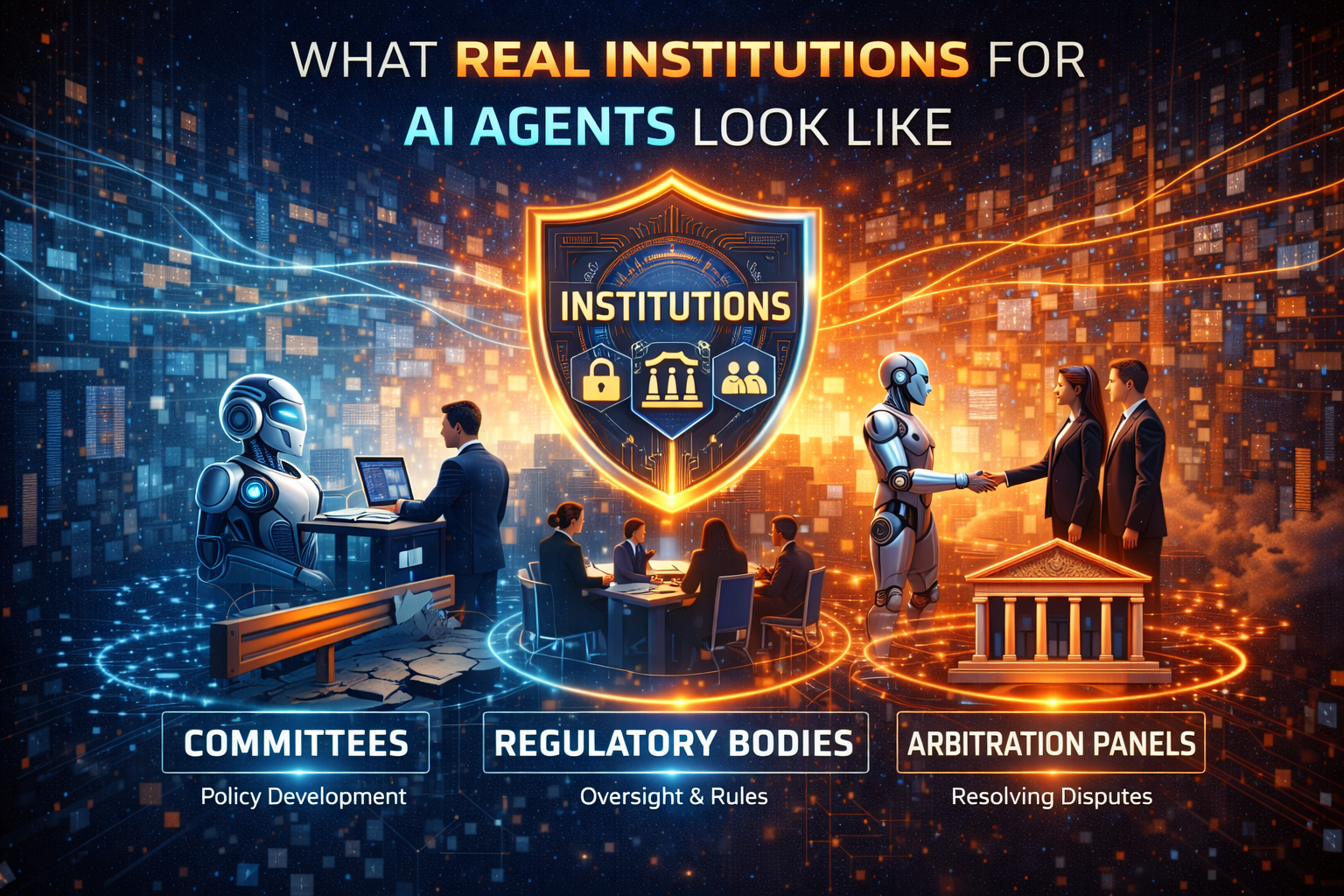
What Real Institutions for AI Agents Look Like
Organizations that successfully govern AI agents typically exhibit several characteristics.
Every agent has a clear identity.
The organization knows what the agent is, what systems it can access, and who owns it.
Authority boundaries are explicit.
The institution distinguishes between advisory, recommendation, approval, and execution.
Every action leaves evidence.
Agents produce logs showing decision context, policy references, and tool usage.
Accountability structures exist.
Each agent has business owners, engineering owners, and risk oversight.
Human supervision remains possible.
Humans can inspect decisions, intervene when necessary, and stop the system if needed.
Economic discipline is embedded.
Agents operate within cost limits, efficiency thresholds, and budget constraints.
Failure modes are designed in advance.
Agents narrow scope, escalate to humans, or halt when uncertainty exceeds defined thresholds.
These elements create institutional governance for autonomous systems.
The Global Governance Shift Has Already Begun
This topic is no longer theoretical.
Around the world, policymakers and institutions are beginning to address it.
The OECD is clarifying definitions of agentic AI and emphasizing accountability.
NIST’s AI Risk Management Framework treats governance as an organizational discipline rather than a technical feature.
The European Union’s AI Act introduces a risk-based regulatory framework for AI systems.
Singapore has launched governance guidance specifically addressing agentic AI systems capable of autonomous actions.
The direction is clear.
The question is no longer:
Should we govern AI?
The real question is:
What institutions must exist to govern machines that can act?
The Strategic Lesson for Leaders
Many organizations still believe they are purchasing AI capability.
In reality, they are entering a new phase of institutional design.
When AI agents act inside enterprises, organizations must decide:
How authority is delegated
How accountability is enforced
How evidence is recorded
How policy is interpreted
How economic value is measured
In other words, the challenge is no longer software adoption.
It is institutional architecture.
This shift aligns closely with the broader transformation described in:
Decision Scale: Why Competitive Advantage Is Moving from Labor Scale to Decision Scale
and
The Future Belongs to Decision-Intelligent Institutions
Both explore how AI changes the fundamental structure of organizations.
Conclusion: The Institutions That Govern Intelligence Will Define the AI Economy
Artificial intelligence is no longer simply a tool.
It is becoming a participant in operational systems.
And whenever new actors enter complex systems, institutions must evolve.
The next decade will not be won by organizations that deploy AI the fastest.
It will be won by organizations that design the strongest governance architecture around machine intelligence.
Institutions that can:
sense reality clearly,
reason within policy boundaries,
and drive action safely.
This is the foundation of the agent economy.
SENSE.
CORE.
DRIVER.
Not just as a technical stack.
But as the governance architecture of intelligent institutions.
In the emerging AI economy, intelligence without institutions does not scale into advantage.
It scales into fragility.
The true leaders of the next decade will recognize that the missing governance layer is not a peripheral issue.
It is the system itself.
FAQ
What is an AI agent?
An AI agent is a system capable of perceiving its environment, reasoning about goals, and taking actions through tools or software systems.
Why do AI agents require governance?
AI agents can make operational decisions. Governance ensures those decisions align with organizational policies, authority boundaries, and accountability standards.
Why do AI agents need institutions?
AI agents need institutions because guardrails alone cannot manage complex decision-making environments. Institutions provide governance, accountability, dispute resolution, and operational oversight.
What is agentic AI?
Agentic AI refers to systems that exhibit autonomy, goal-directed behavior, and the ability to interact with tools and environments to accomplish tasks.
What is the Agent Economy?
The Agent Economy refers to an emerging economic system where AI agents perform tasks, make decisions, and execute workflows autonomously across digital and physical systems.
What are AI guardrails?
AI guardrails are safety mechanisms that restrict harmful outputs. However, they are limited because they do not provide full institutional governance.
What is the governance architecture for AI systems?
A governance architecture defines how AI systems observe reality, represent institutional knowledge, and execute actions safely. One model is the SENSE–CORE–DRIVER framework.
What is SENSE–CORE–DRIVER in AI governance?
It is a governance framework describing how institutions manage AI systems:
SENSE — perception and data visibility
CORE — reasoning and decision logic
DRIVER — execution and operational control
What are institutions in AI systems?
Institutions in AI refer to structured governance systems such as:
-
policy frameworks
-
decision authority layers
-
oversight bodies
-
dispute resolution mechanisms
-
accountability infrastructure
Glossary
Agent Economy
An economic environment where autonomous AI agents participate in workflows, decisions, and transactions.
Agentic AI
AI systems capable of autonomous planning and action.
AI Governance
Institutional structures that control how AI systems operate and make decisions.
Decision Integrity
Ensuring AI decisions remain aligned with organizational policy and accountability.
Institutional AI Architecture
Organizational structures that govern AI behavior across systems.
The Intelligence-Native Enterprise Doctrine
This article is part of a larger strategic body of work that defines how AI is transforming the structure of markets, institutions, and competitive advantage. To explore the full doctrine, read the following foundational essays:
- The AI Decade Will Reward Synchronization, Not Adoption
Why enterprise AI strategy must shift from tools to operating models.
https://www.raktimsingh.com/the-ai-decade-will-reward-synchronization-not-adoption-why-enterprise-ai-strategy-must-shift-from-tools-to-operating-models/ - The Third-Order AI Economy
The category map boards must use to see the next Uber moment.
https://www.raktimsingh.com/third-order-ai-economy/ - The Intelligence Company
A new theory of the firm in the AI era — where decision quality becomes the scalable asset.
https://www.raktimsingh.com/intelligence-company-new-theory-firm-ai/ - The Judgment Economy
How AI is redefining industry structure — not just productivity.
https://www.raktimsingh.com/judgment-economy-ai-industry-structure/ - Digital Transformation 3.0
The rise of the intelligence-native enterprise.
https://www.raktimsingh.com/digital-transformation-3-0-the-rise-of-the-intelligence-native-enterprise/ - Industry Structure in the AI Era
Why judgment economies will redefine competitive advantage.
https://www.raktimsingh.com/industry-structure-in-the-ai-era-why-judgment-economies-will-redefine-competitive-advantage/ - Why Most AI Projects Fail Before Intelligence Even Begins – Raktim Singh
- Identity Infrastructure: The Missing Layer Between Signals and Representation in the AI Economy – Raktim Singh
- The Representation Stack: How Reality Becomes Identifiable, Legible, and Actionable in the AI Economy – Raktim Singh
- The Hardest Problem in AI: Representing What Cannot Speak – Raktim Singh
Institutional Perspectives on Enterprise AI
Many of the structural ideas discussed here — intelligence-native operating models, control planes, decision integrity, and accountable autonomy — have also been explored in my institutional perspectives published via Infosys’ Emerging Technology Solutions platform.
For readers seeking deeper operational detail, I have written extensively on:
- What Makes an Enterprise Intelligence-Native? The Blueprint for Third-Order AI Advantage
https://blogs.infosys.com/emerging-technology-solutions/artificial-intelligence/what-is-enterprise-ai-the-operating-model-for-compounding-institutional-intelligence.html - Why “AI in the Enterprise” Is Not Enterprise AI: The Operating Model Difference Most Organizations Miss
https://blogs.infosys.com/emerging-technology-solutions/artificial-intelligence/why-ai-in-the-enterprise-is-not-enterprise-ai-the-operating-model-difference-that-most-organizations-miss.html - The Enterprise AI Control Plane: Governing Autonomy at Scale
https://blogs.infosys.com/emerging-technology-solutions/artificial-intelligence/the-enterprise-ai-control-plane-governing-autonomy-at-scale.html - Enterprise AI Ownership Framework: Who Is Accountable, Who Decides, and Who Stops AI in Production
https://blogs.infosys.com/emerging-technology-solutions/artificial-intelligence/enterprise-ai-ownership-framework-who-is-accountable-who-decides-and-who-stops-ai-in-production.html - Decision Integrity: Why Model Accuracy Is Not Enough in Enterprise AI
https://blogs.infosys.com/emerging-technology-solutions/artificial-intelligence/decision-integrity-why-model-accuracy-is-not-enough-in-enterprise-ai.html - Agent Incident Response Playbook: Operating Autonomous AI Systems Safely at Enterprise Scale
https://blogs.infosys.com/emerging-technology-solutions/artificial-intelligence/agent-incident-response-playbook-operating-autonomous-ai-systems-safely-at-enterprise-scale.html - The Economics of Enterprise AI: Designing Cost, Control, and Value as One System
https://blogs.infosys.com/emerging-technology-solutions/artificial-intelligence/the-economics-of-enterprise-ai-designing-cost-control-and-value-as-one-system.html
Together, these perspectives outline a unified view: Enterprise AI is not a collection of tools. It is a governed operating system for institutional intelligence — where economics, accountability, control, and decision integrity function as a coherent architecture.
References & Further Reading
NIST AI Risk Management Framework
EU Artificial Intelligence Act
World Economic Forum
Governance of AI Agents Report



Raktim Singh is an AI and deep-tech strategist, TEDx speaker, and author focused on helping enterprises navigate the next era of intelligent systems. With experience spanning AI, fintech, quantum computing, and digital transformation, he simplifies complex technology for leaders and builds frameworks that drive responsible, scalable adoption.