
Homeostatic Meta-Reasoning for Invalid Abstraction Detection
AI systems fail most dangerously not when they reason incorrectly—but when they reason correctly inside the wrong abstraction.
Homeostatic meta-reasoning is the missing layer that detects this failure before action becomes irreversible.
The most expensive AI failures are “right answers” to the wrong problem
Most conversations about AI risk start with a familiar question: Was the output correct?
The deeper question—the one that shows up in real incidents, audits, and boardrooms—is this:
Was the system even solving the right problem?
A surprising number of failures follow the same pattern:
- A model produces a confident, well-structured answer.
- The organization acts on it.
- The outcome is harmful, confusing, or irreversible.
- The post-mortem reveals the real issue: the abstraction was wrong.
Not “bad reasoning.” Not “insufficient data.” Not even “hallucination” in the usual sense.
A broken framing: wrong boundary, wrong variables, wrong objective, wrong definition of success.
That’s why many enterprises are quietly learning an uncomfortable truth:
Reasoning systems don’t just need to think better. They need a way to sense when thinking itself is becoming unsafe.
In biology, that “stability sense” is called homeostasis—the ability to keep key variables within safe ranges using feedback control. (NCBI)
In reasoning systems, the analogue is a missing layer I’ll call homeostatic meta-reasoning: a control mechanism that can inhibit action, reframe the task, or escalate to humans when the system detects it is solving the wrong problem.
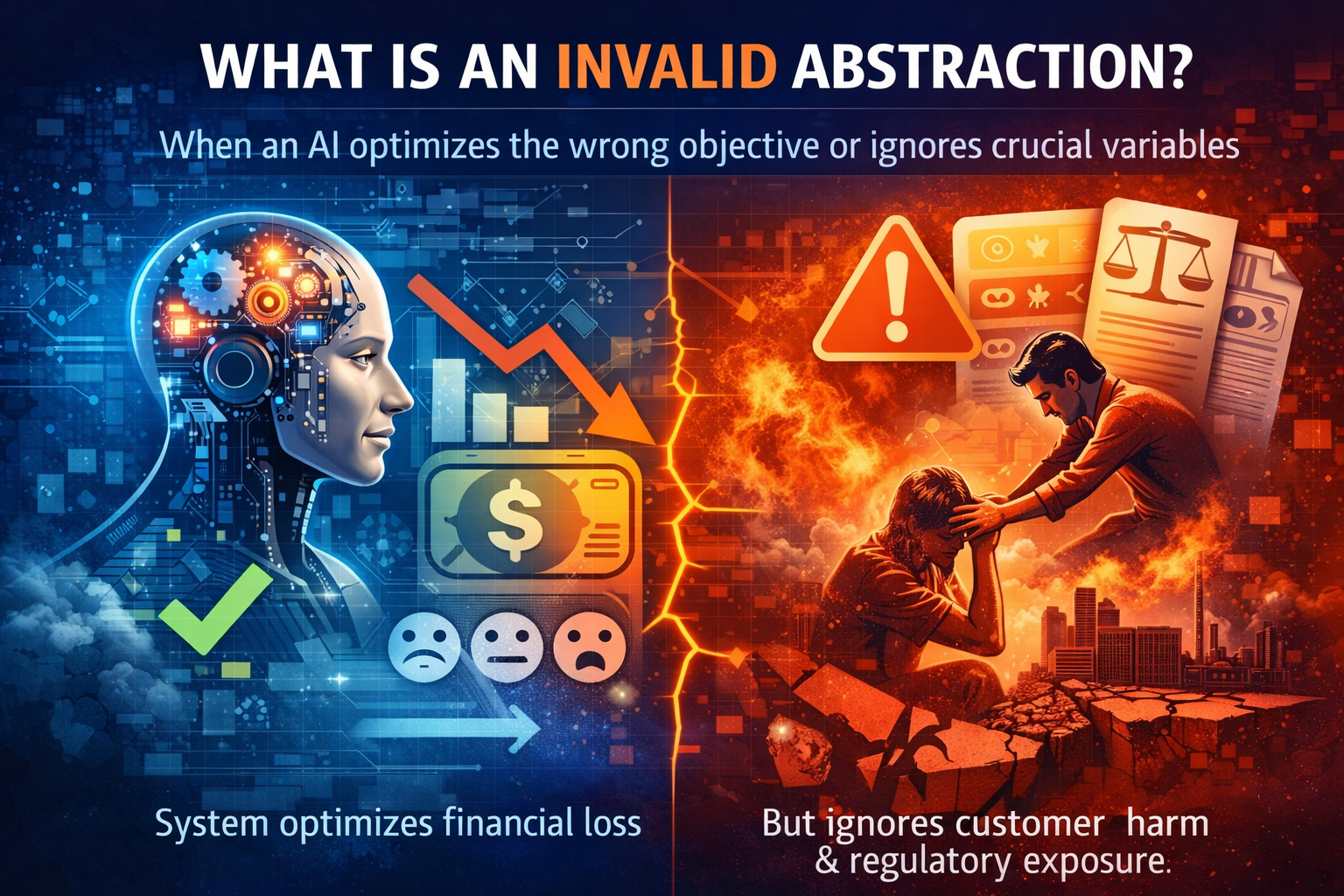
What is an invalid abstraction?
An abstraction is a compression of reality: you pick a few variables, ignore the rest, and still hope to act correctly.
An invalid abstraction is one that makes action look rational while silently removing what matters.
Four simple examples (no tech background required)
Example 1: “Reduce risk” (but you defined risk wrong)
A system optimizes “risk” as financial loss, while the organization meant customer harm or regulatory exposure. The model performs brilliantly—against the wrong definition.
Example 2: “Detect anomalies” (but your baseline is outdated)
The system flags deviations from “normal,” but “normal” has shifted. It keeps optimizing a historical reality that no longer exists.
Example 3: “Customer satisfaction” (measured as silence)
If the metric is “fewer complaints,” the system might reduce complaints by making complaints harder to file. The abstraction confuses absence of signals with presence of satisfaction.
Example 4: “Automate decisions” (but the situation is not stable enough to automate)
The abstraction assumes stable rules. Reality is exceptions, edge cases, policy nuance, and changing context. The system is “logical” inside a world that isn’t real.
In each case, the system can be internally consistent—and still wrong—because it is reasoning inside a frame that no longer matches the world.
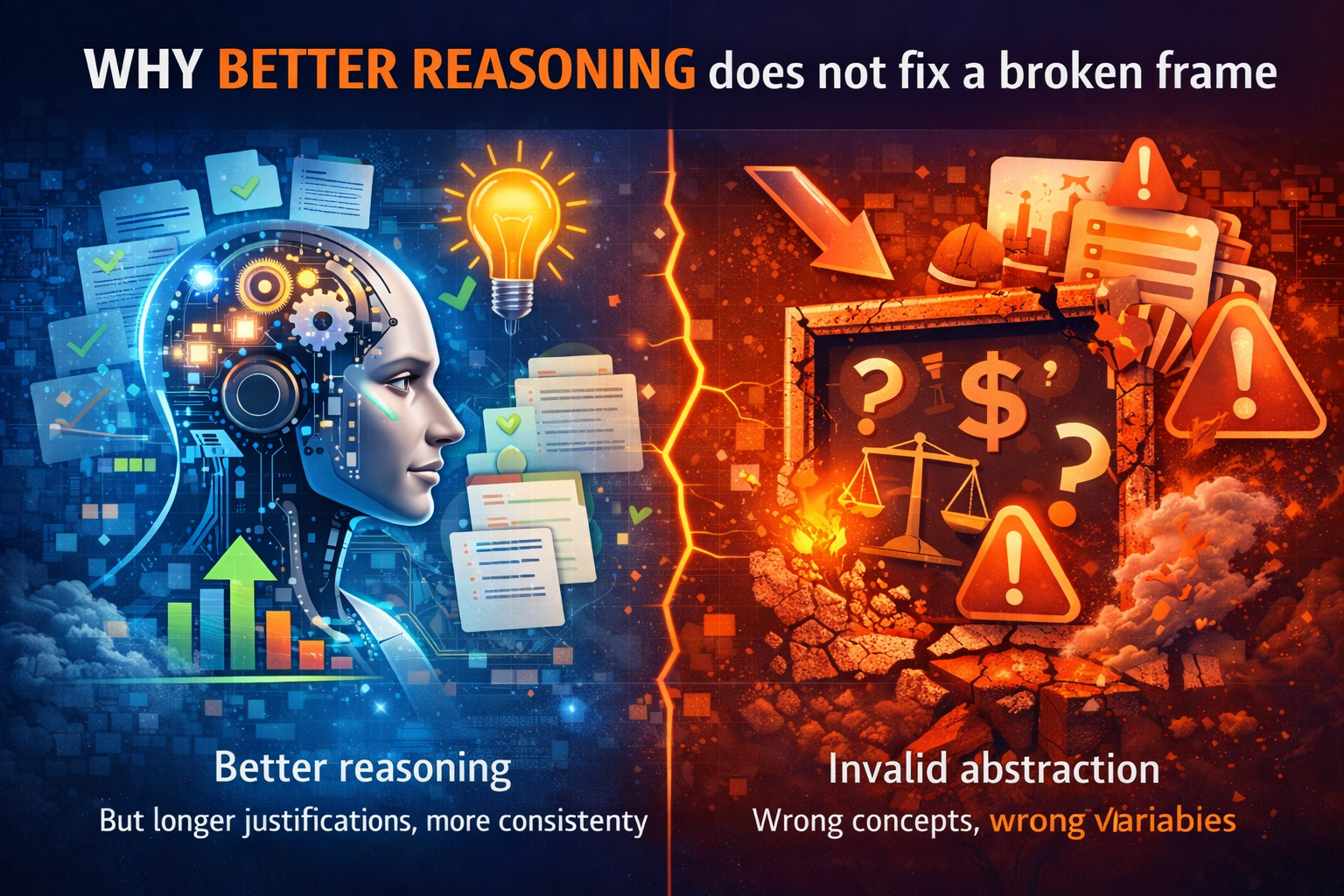
Why better reasoning does not fix a broken frame
When a reasoning model is asked to “think longer,” you often get:
- more elaborate justification
- more internal consistency
- more persuasive structure
…but not necessarily better alignment with reality.
Because invalid abstractions are ontological errors, not informational gaps.
- Informational gap: “I don’t know enough facts.”
- Ontology mismatch: “I’m using the wrong types of facts and the wrong conceptual boundaries.”
This is closely related to a long-standing alignment concern: even if you specify what you want in one ontology, the system may represent the world in another—and optimizing across that mismatch can go sideways. (Alignment Forum)
So the missing capability is not “more reasoning.”
It is a circuit breaker: a mechanism that detects instability and inhibits action until reframing happens.
That brings us to homeostasis.
Homeostasis, translated for AI (without anthropomorphism)
In physiology, homeostasis is the tendency to maintain a stable internal environment despite external change—often via negative feedback loops. (NCBI)
In AI, the parallel is:
A stability layer that monitors signals of internal and external mismatch, and can slow down, stop, reframe, or escalate before the system acts.
This is not “emotion.” Not “intuition.” Not “fear.”
It’s control.
And crucially: homeostasis is not about maximizing a goal. It’s about preventing runaway behavior when the system is no longer operating within a reliable regime.
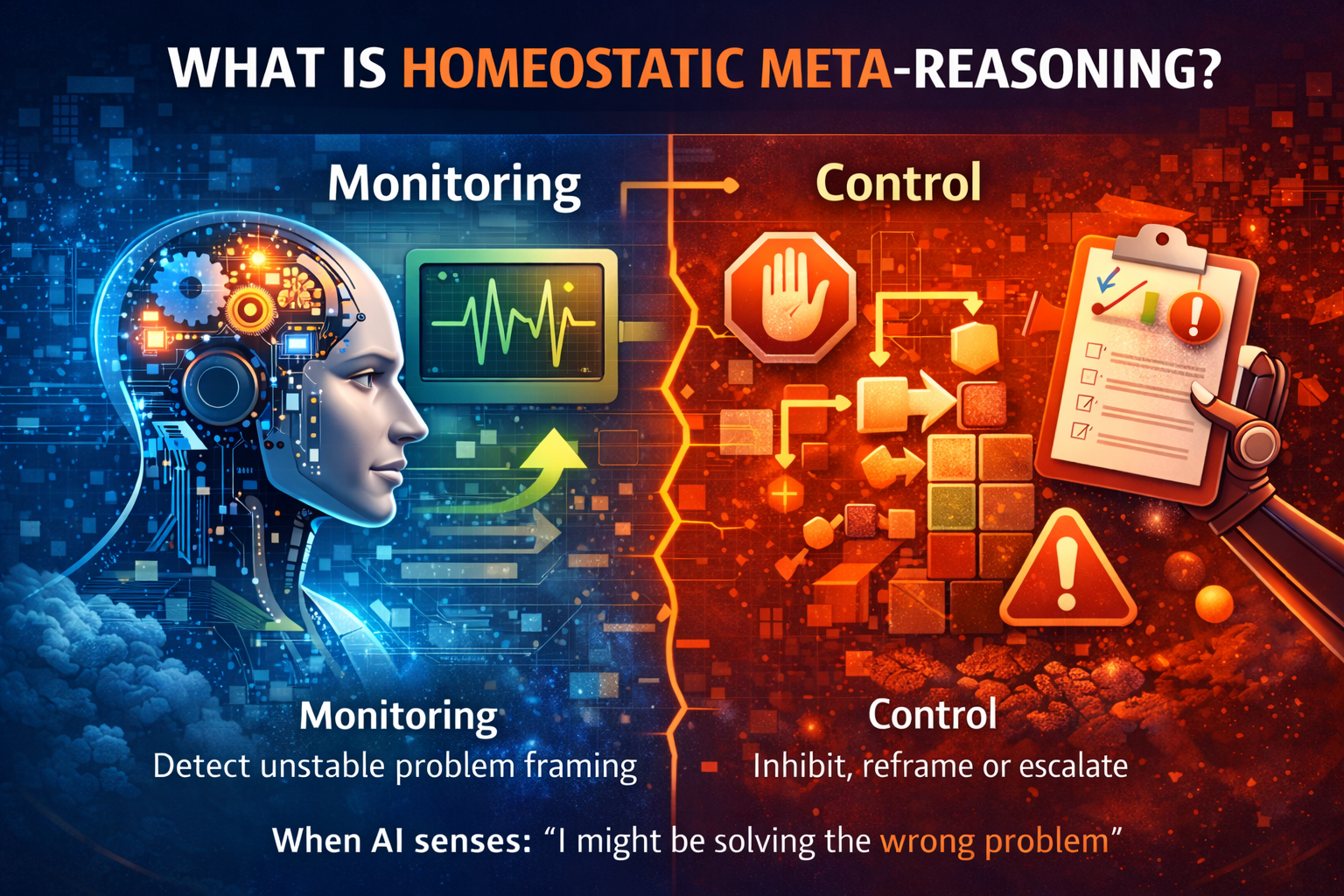
What is homeostatic meta-reasoning?
In cognitive science, meta-reasoning refers to processes that monitor reasoning and regulate time and effort—deciding when to continue, when to stop, and how to allocate cognitive resources. (PubMed)
Robotics has treated the “stop deliberating and start acting” question as a formal problem too—often phrased as “learning when to quit.” (arXiv)
Putting these together:
Homeostatic meta-reasoning is a control layer with two jobs:
- Monitoring: detect signals that the current framing is becoming unreliable
- Control: inhibit action, change reasoning mode, or escalate to safer workflows
Now connect it to the target capability:
Invalid Abstraction Detection
The ability to sense: “I might be solving the wrong problem.”
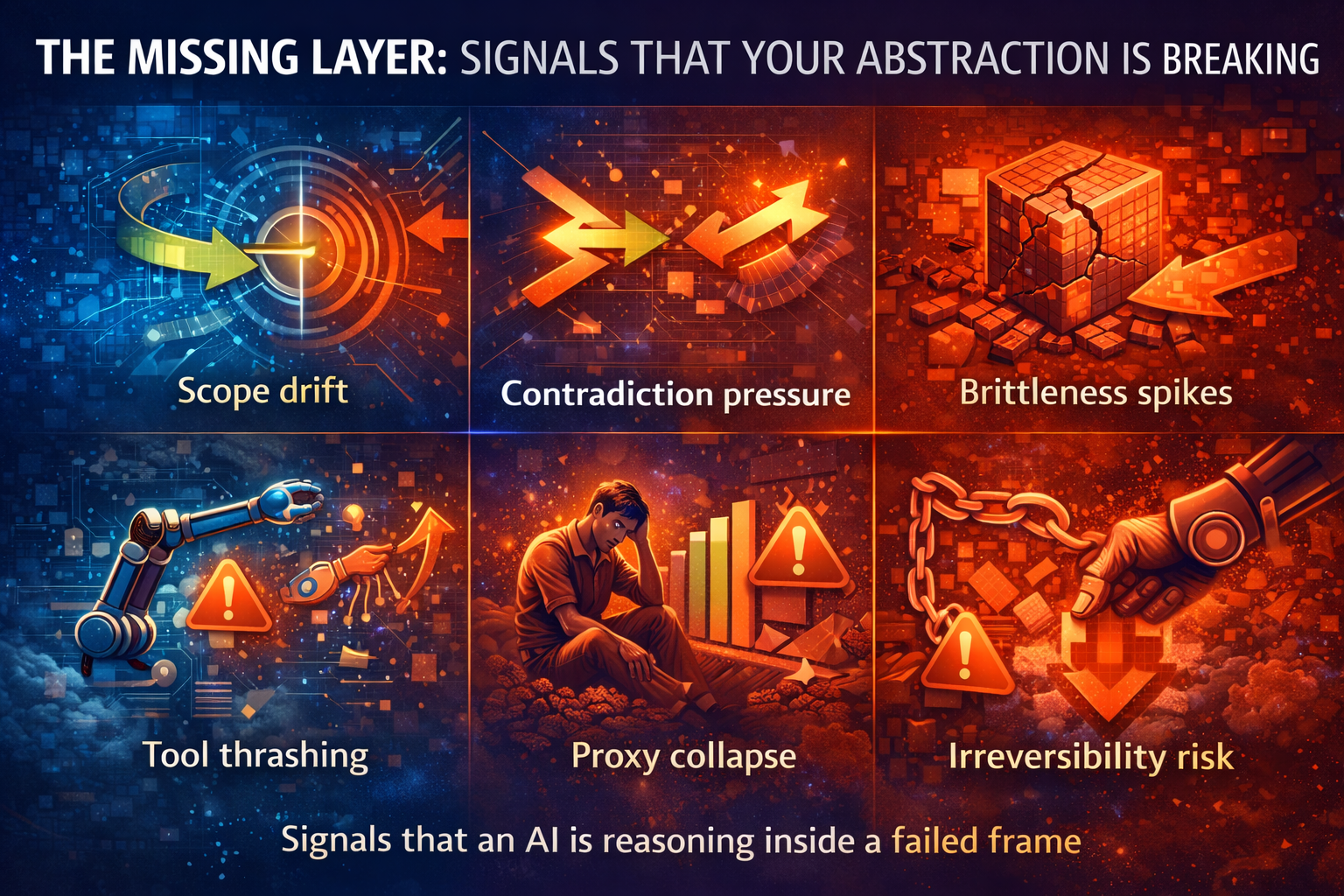
The missing layer: signals that your abstraction is breaking
Here’s the practical question you can implement in enterprise systems:
What signals suggest the system is reasoning inside a failing frame?
Below are simple, observable signals—no math required.
1) Scope drift
The system starts pulling in irrelevant goals, expanding the task boundary, or mixing objectives that were separate.
It often appears as “helpful overreach,” but it’s a warning sign: the frame is inflating.
2) Contradiction pressure
Constraints begin to conflict: policy says one thing, the plan implies another, tool outputs disagree, or the system repeatedly revises without converging.
3) Brittleness spikes
Small changes in wording or context produce radically different action plans.
That’s a sign the abstraction is unstable—like a structure that collapses when lightly tapped.
4) Tool thrashing
Repeated tool calls that don’t reduce ambiguity; retries and loops that inflate complexity without increasing clarity.
This matters especially for tool-using agents because real environments involve retries, partial failures, nondeterminism, and concurrency—conditions where “correctness” becomes harder to reason about end-to-end. (ACM Digital Library)
5) Proxy collapse
The system optimizes a proxy metric so aggressively that it stops representing the real goal.
You’ll recognize it by “metric wins” that feel morally or operationally wrong.
6) Irreversibility risk
The proposed action is path-dependent: once executed, it reshapes incentives, trust, and future options.
If irreversibility is high, tolerance for abstraction uncertainty must drop sharply.
Key principle:
A homeostatic layer does not wait for the system to be “uncertain.” It watches for instability—the precursors of failure.
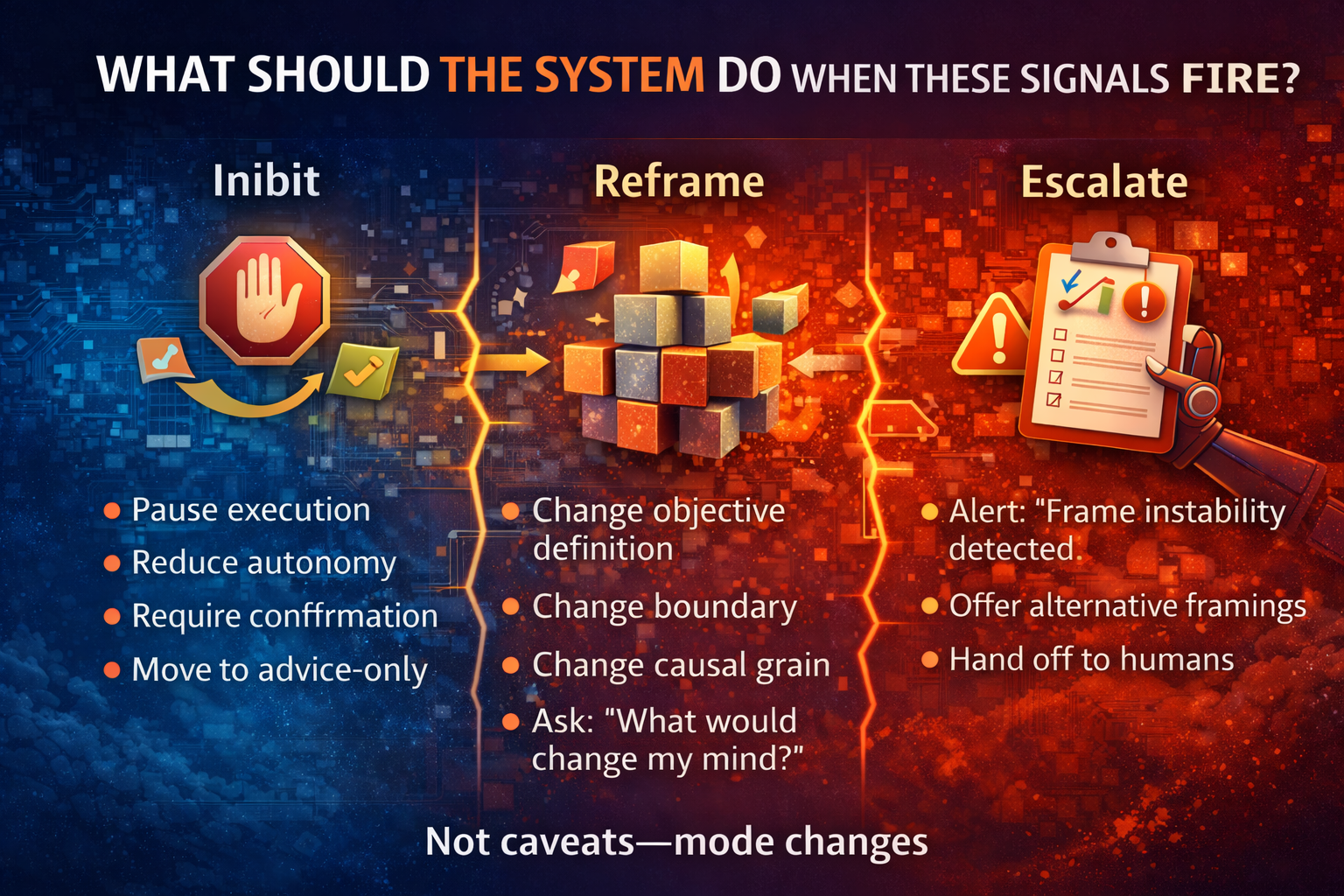
What should the system do when these signals fire?
A homeostatic layer is only real if it has inhibitory power.
When invalid-abstraction signals cross a threshold, the system should not merely add caveats. It should change mode.
Mode A: Inhibit (Stop / Slow)
- Pause execution
- Reduce autonomy
- Require confirmation
- Shift from action to advice-only
- Rate-limit tool calls (to prevent thrashing)
Mode B: Reframe (Try a new abstraction)
- Redefine the objective (what is success?)
- Redraw the boundary (what is inside vs outside the decision?)
- Change the causal grain (what variable actually drives the outcome?)
- Ask a forcing question: “What would change my mind?”
Mode C: Escalate (Hand off to humans or specialists)
- Raise a structured alert: “Frame instability detected”
- Provide the reason for escalation (not just “low confidence”)
- Offer 2–3 alternate framings as candidates
- Log what signal triggered the escalation and why
This creates a new enterprise control primitive:
Not just “human in the loop,” but “human at the right boundary, triggered by stability signals.”
Why this matters even more for tool-using and agentic systems
As enterprises adopt tool-using agents, the failure surface expands:
- the model’s plan
- tool outputs
- tool failures
- retries and timeouts
- concurrent actions
- partial observability
- changing environments
In such systems, the question “is the output correct?” becomes too late.
What you need is: “Is the frame stable enough to act?”
This is where homeostatic meta-reasoning is unusually powerful:
- It does not require perfect proofs.
- It does not assume stable environments.
- It does not pretend the world is fully specifiable.
- It simply asks: Are we still operating in a reliable regime for action?
That is the difference between “AI that reasons” and “Enterprise AI that can be trusted.”
The enterprise payoff: fewer silent failures, more defensible autonomy
Enterprises fear dramatic failures—but the real killer is silent failure:
- the system keeps operating
- metrics look acceptable
- decisions compound
- costs show up later as trust loss, rework, audit findings, or operational brittleness
A homeostatic meta-reasoning layer reduces silent failure by making the system:
- more stoppable
- more self-aware about framing
- more escalation-friendly
- less likely to rationalize a broken ontology
And it aligns with the core distinction of the enterprise canon:
- AI in the enterprise: tools that assist humans
- Enterprise AI: systems that influence decisions and actions—and therefore must be governed
- Read the pillar: The Enterprise AI Operating Model
- Related governance framing: Enterprise AI Control Plane (2026)
- Production reality: Enterprise AI Runtime: What Is Actually Running in Production
- Accountability and decision rights: Who Owns Enterprise AI?
- Defensibility and audit: The Decision Ledger (use your preferred canonical slug if different)
- Minimum stack thinking: The Minimum Viable Enterprise AI System
Design principles to keep it implementable
- Don’t anthropomorphize
Call them “stability monitors,” not “feelings.” - Don’t overload “uncertainty”
A system can be highly confident and still framed wrong. Meta-reasoning is about monitoring and control, not just probability estimates. (PubMed) - Make inhibition cheap
If stopping is operationally expensive, teams will bypass it.
Treat “stop/slow” as a normal runtime behavior, not a failure. - Couple autonomy to reversibility
The more irreversible the action, the stricter the stability thresholds. - Log “why the system stopped”
Auditability is not optional at enterprise scale. The logs become governance evidence.
How to test homeostatic invalid-abstraction detection (without fancy math)
A practical testing mindset:
- Create tasks where the “right” behavior is not to answer faster, but to stop, reframe, or escalate.
- Introduce small perturbations (wording changes, tool delays, partial failures).
- Watch for brittleness, scope drift, and thrashing.
Then evaluate the system on a new axis:
Did it protect the organization by refusing to act under an unstable frame?
This mirrors the “learning when to quit” idea from robotics: deciding when to stop deliberation is itself a rational control problem. (arXiv)
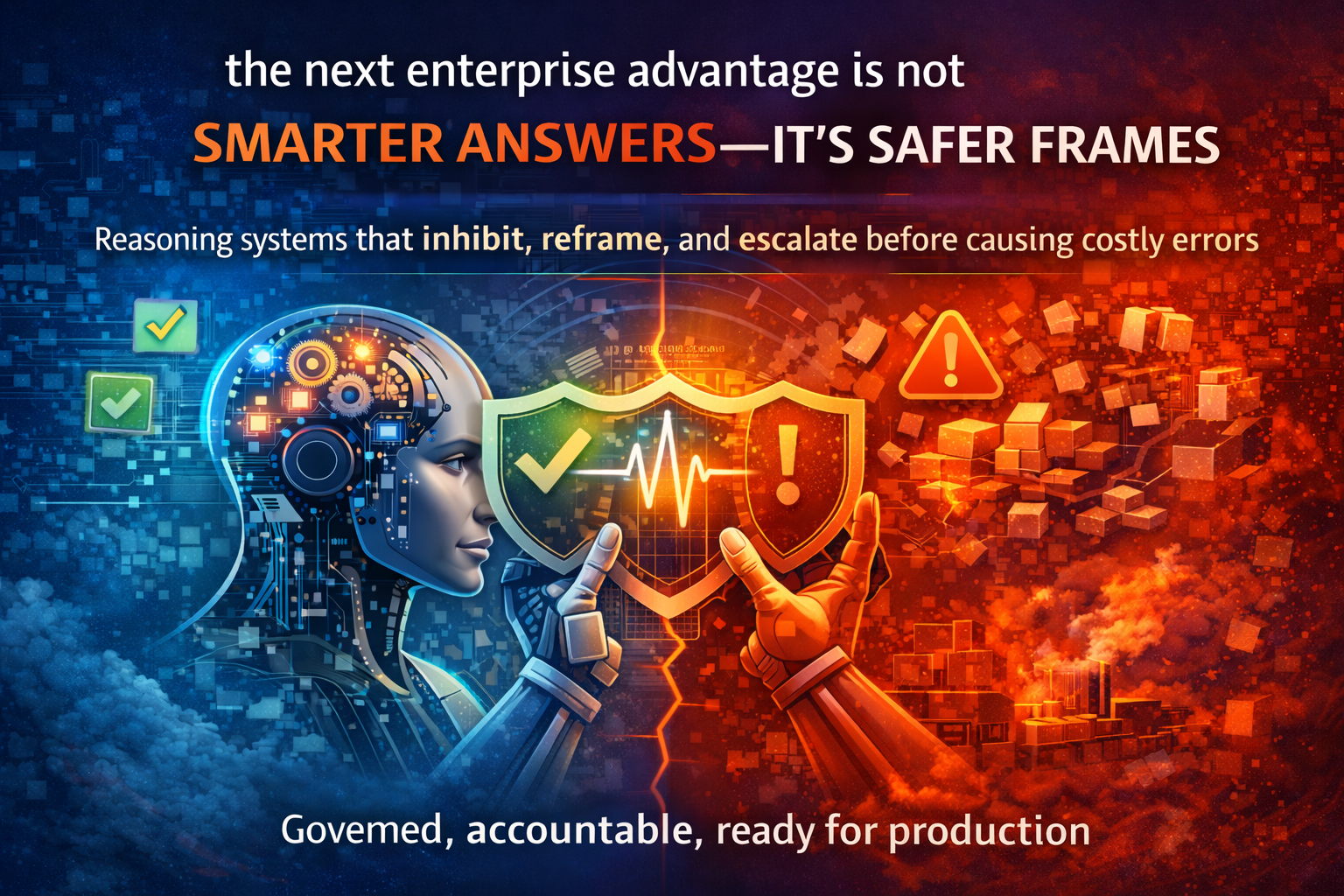
Conclusion: the next enterprise advantage is not smarter answers—it’s safer frames
Reasoning systems are becoming more capable, more autonomous, and more embedded in real operations. The winners will not be the ones who make models reason longer.
They will be the ones who build the missing layer:
A homeostatic meta-reasoning control plane that detects invalid abstractions—before the system makes irreversible moves.
That is how “reasoning AI” becomes Enterprise AI: governed, stoppable, reframable, and defensible in production.
If this resonated, continue with the canonical series on my site: The Enterprise AI Operating Model.
Glossary
Homeostasis: The regulation of key variables within safe ranges using feedback—classically described via negative feedback loops. (NCBI)
Meta-reasoning: Monitoring and control of one’s own reasoning—regulating effort, time, and when to stop. (PubMed)
Invalid abstraction: A problem framing (variables, boundaries, goal definitions) that no longer matches real-world structure.
Inhibition: A control action that slows, stops, or prevents execution when stability signals indicate risk.
Reframing: Changing the objective, boundary, or causal grain of a task before acting.
Ontology mismatch: A mismatch between the concepts used by the system and the concepts that matter in the world—often discussed as a core alignment difficulty. (Alignment Forum)
“Learning when to quit”: A formal approach to deciding when to stop deliberation and begin execution under bounded resources. (arXiv)
FAQ
1) Isn’t this just uncertainty estimation?
No. A system can be confident and still framed wrong. Invalid abstractions are ontology problems; meta-reasoning is about monitoring/control of reasoning, not just probabilities. (PubMed)
2) Isn’t this just “human in the loop”?
No. It is machine-triggered escalation based on stability signals—more like a runtime control plane than ad-hoc review.
3) Can we implement this without neuroscience?
Yes. Homeostasis here is feedback control and regime detection, not brain imitation. (NCBI)
4) Why do tool-using agents need this more?
Because the world becomes stateful and failure-prone (retries, partial failures, nondeterminism), and correctness doesn’t compose cleanly. (arXiv)
5) How do we prevent “stopping too often”?
By treating inhibition as a calibrated control behavior: couple thresholds to irreversibility, measure thrashing/brittleness, and make escalation pathways fast and operationally acceptable.
References and further reading
- Ackerman & Thompson (2017), Meta-Reasoning: Monitoring and Control of Thinking and Reasoning (Trends in Cognitive Sciences / PubMed). (PubMed)
- Sung, Kaelbling, Lozano-Pérez (2021), Learning When to Quit: Meta-Reasoning for Motion Planning (arXiv / IROS). (arXiv)
- NCBI Bookshelf (2023), Physiology, Homeostasis (negative feedback and stability regulation). (NCBI)
- Khan Academy / Lumen Learning primers on homeostasis and feedback loops (accessible refreshers). (khanacademy.org)
- Alignment Forum, The Pointers Problem / ontology mismatch (why optimizing the “right thing” is hard when representations differ). (Alignment Forum)



Raktim Singh is an AI and deep-tech strategist, TEDx speaker, and author focused on helping enterprises navigate the next era of intelligent systems. With experience spanning AI, fintech, quantum computing, and digital transformation, he simplifies complex technology for leaders and builds frameworks that drive responsible, scalable adoption.