
The New Executive Mandate: Designing Human + AI Advantage
Artificial intelligence is no longer a technology upgrade. It is a leadership inflection point.
Across boardrooms in the United States, Europe, India, the Middle East, and Southeast Asia, executives are confronting the same reality: AI does not simply make work faster—it reshapes how decisions are made, who makes them, and how institutions create durable advantage.
The organizations that will lead the intelligence era are not those that adopt the most tools, but those that redesign leadership itself—where AI scales cognition and human leaders scale judgment, coherence, and trust.
This is the new executive mandate: to design Human + AI advantage as a structural capability, not an experiment.
This article is written for board members, CEOs, CFOs, CIOs, CHROs, and strategy leaders across the United States, Europe, India, the Middle East, Southeast Asia, and global enterprises navigating AI transformation.
It synthesizes insights from governance standards, regulatory momentum, global workforce research, and enterprise AI operating models to provide an actionable executive framework.
The Quiet Inflection Point in Leadership
Every era rewrites leadership without announcing it.
The industrial era rewarded scale.
The digital era rewarded speed.
The intelligence era rewards decision quality at scale.
For decades, executive advantage followed a predictable formula:
Set direction. Allocate capital. Manage performance. Reduce risk. Scale what works.
Artificial intelligence does not invalidate this formula.
It changes the physics behind it.
For the first time in corporate history, a technology does not merely automate tasks — it generates options, recommends actions, simulates scenarios, and increasingly executes inside workflows.
The result is not “more productivity.”
It is a new operating condition:
Leaders can now scale cognition — but must redesign how judgment works.
And when cognition scales, scarcity shifts.
The new scarcity is not information. It is:
- Attention
- Coherence
- Decision integrity
- Institutional trust
Recent workplace research has shown that AI, when poorly integrated, can intensify work rather than reduce it — expanding task scope and accelerating pace without improving clarity. The lesson is clear:
AI deployed as a tool increases activity.
AI designed as a system increases advantage.
The executive mandate is no longer “adopt AI.”
It is to design Human + AI advantage.
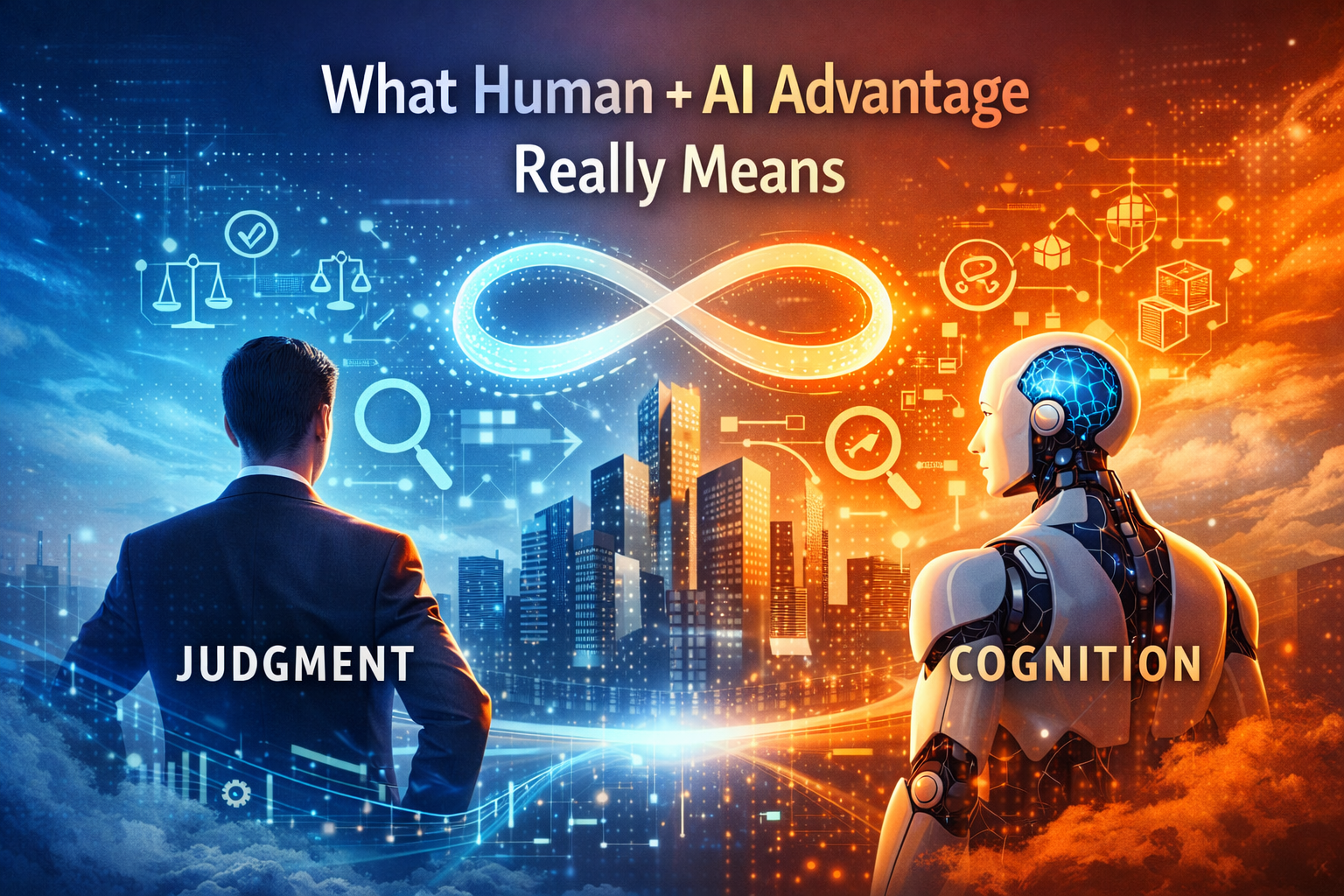
What Human + AI Advantage Really Means
Human + AI advantage is not collaboration theatre.
It is an operating philosophy.
AI scales cognition.
Humans scale judgment.
The institution must scale the pairing.
AI excels at:
- Synthesizing vast information
- Generating alternatives
- Identifying patterns across fragmented data
- Simulating potential futures
- Compressing decision preparation time
Humans remain uniquely strong at:
- Framing the right question
- Defining value and trade-offs
- Interpreting ambiguity
- Exercising moral and strategic judgment
- Sustaining trust across stakeholders
The competitive enterprise designs an operating model where these capabilities reinforce — rather than undermine — each other.
That is the structural shift.
It moves the organization from task execution to decision orchestration.
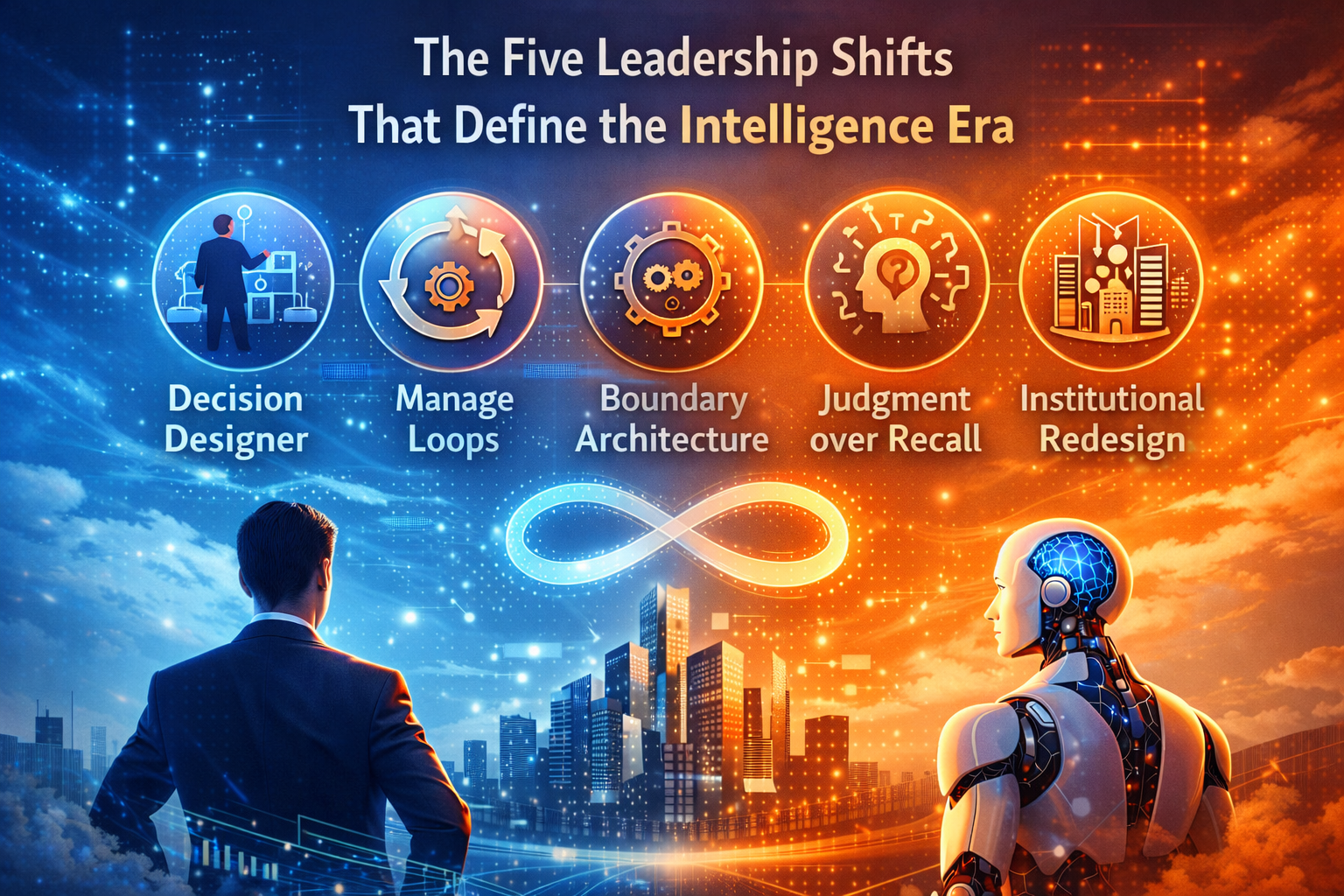
The Five Leadership Shifts That Define the Intelligence Era
-
From Decision-Maker to Decision-Designer
Historically, leaders were bottlenecks because information was scarce and expensive.
In the AI era, information is abundant and inexpensive.
The advantage now lies in designing the decision environment.
Executives must determine:
- What inputs shape the system?
- What policy constraints govern outcomes?
- What decisions are reversible?
- Where must humans remain accountable?
- How are exceptions escalated?
Example:
A procurement AI can generate vendor shortlists in seconds.
A traditional leader approves each list.
A redesigned leader defines spend thresholds, compliance constraints, and escalation logic — allowing compliant decisions to flow automatically while reserving human attention for anomalies.
This is how decision velocity increases without sacrificing control.
-
From Managing Performance to Managing Feedback Loops
AI systems evolve continuously.
Models change.
Policies update.
Data drifts.
Regulations shift.
Leadership must become fluent in feedback systems.
Global governance frameworks — including the NIST AI Risk Management Framework and ISO/IEC 42001 — emphasize lifecycle management over one-time deployment.
The executive question is no longer:
“Did we deploy AI?”
It is:
“Is our AI learning safely and staying aligned?”
Example:
A customer service AI reduces response times.
Six months later, refund policies change.
If feedback loops are weak, the AI provides outdated guidance.
Competitive advantage belongs to organizations that build continuous validation, monitoring, and adjustment into their operating cadence.
-
From Control to Boundary Architecture
Traditional control relies on approvals and gates.
AI collapses that model — speed outpaces committees.
The modern solution is boundary design:
- Define what AI may do.
- Define what it must never do.
- Define what requires human confirmation.
- Log and audit critical decisions.
Standards like ISO/IEC 42001 and emerging regulatory regimes (such as the EU AI Act) signal that governance must be structural, not reactive.
Boundary architecture allows scale without chaos.
-
From Expertise as Recall to Expertise as Judgment
AI retrieves information faster than any executive can.
This reduces the value of memorized knowledge.
It increases the value of:
- Asking better counterfactuals
- Interpreting uncertainty
- Understanding second-order effects
- Recognizing when a model is confidently wrong
The World Economic Forum consistently highlights analytical thinking, adaptability, and leadership judgment as future-critical skills.
In the intelligence era, executive expertise shifts from “knowing” to deciding under uncertainty with clarity.
-
From AI Adoption to Institutional Redesign
Many organizations track AI success by tool usage.
Usage is not advantage.
Advantage is measurable in:
- Shorter decision cycles
- Reduced economic error
- Margin expansion
- Risk compression
- Precision customer engagement
Boards increasingly recognize that AI must become an operating capability, not a technology experiment.
My foundational work on the Enterprise AI Operating Model articulates this clearly:
👉 https://www.raktimsingh.com/enterprise-ai-operating-model/
Adoption is activity.
Redesign is advantage.

The Upside Boards Should Be Excited About
This is not a defensive story.
It is a structural opportunity.
-
Precision at Scale
From mass decisions to tailored micro-decisions across pricing, risk, supply chains, and service.
-
Strategic Learning Acceleration
When idea generation and simulation are inexpensive, hypothesis testing accelerates.
-
Decision Velocity as Competitive Leverage
Signal → Insight → Action compression becomes a market differentiator.
As argued in Decision Scale, competitive advantage is moving from labor scale to decision scale:
👉 https://www.raktimsingh.com/decision-scale-competitive-advantage-ai/
-
Reusable Institutional Intelligence
Organizations can build a library of governed, reusable AI capabilities — not isolated pilots.
My Intelligence Reuse Index directly connects here:
👉 https://www.raktimsingh.com/intelligence-reuse-index-enterprise-ai-fabric/
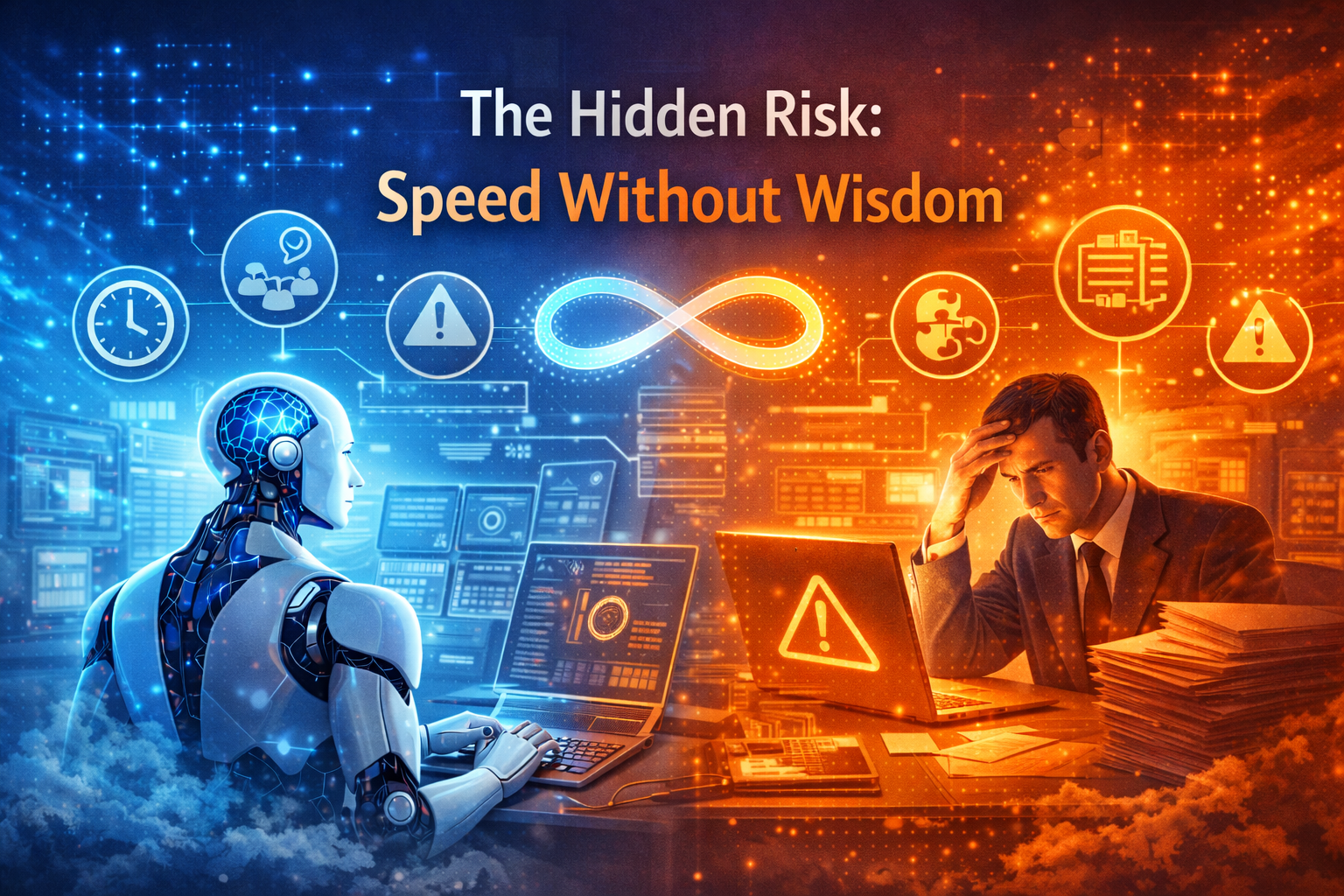
The Hidden Risk: Speed Without Wisdom
If institutions do not redesign leadership, AI produces:
- Work intensification
- Tool fragmentation
- Cost explosion after success
- Regulatory exposure
- Trust erosion
This is why my previously warned about the Enterprise AI Runbook Crisis:
👉 https://www.raktimsingh.com/enterprise-ai-runbook-crisis-model-churn-production-ai/
Speed without institutional clarity creates fragility.
Human + AI advantage requires structural alignment.
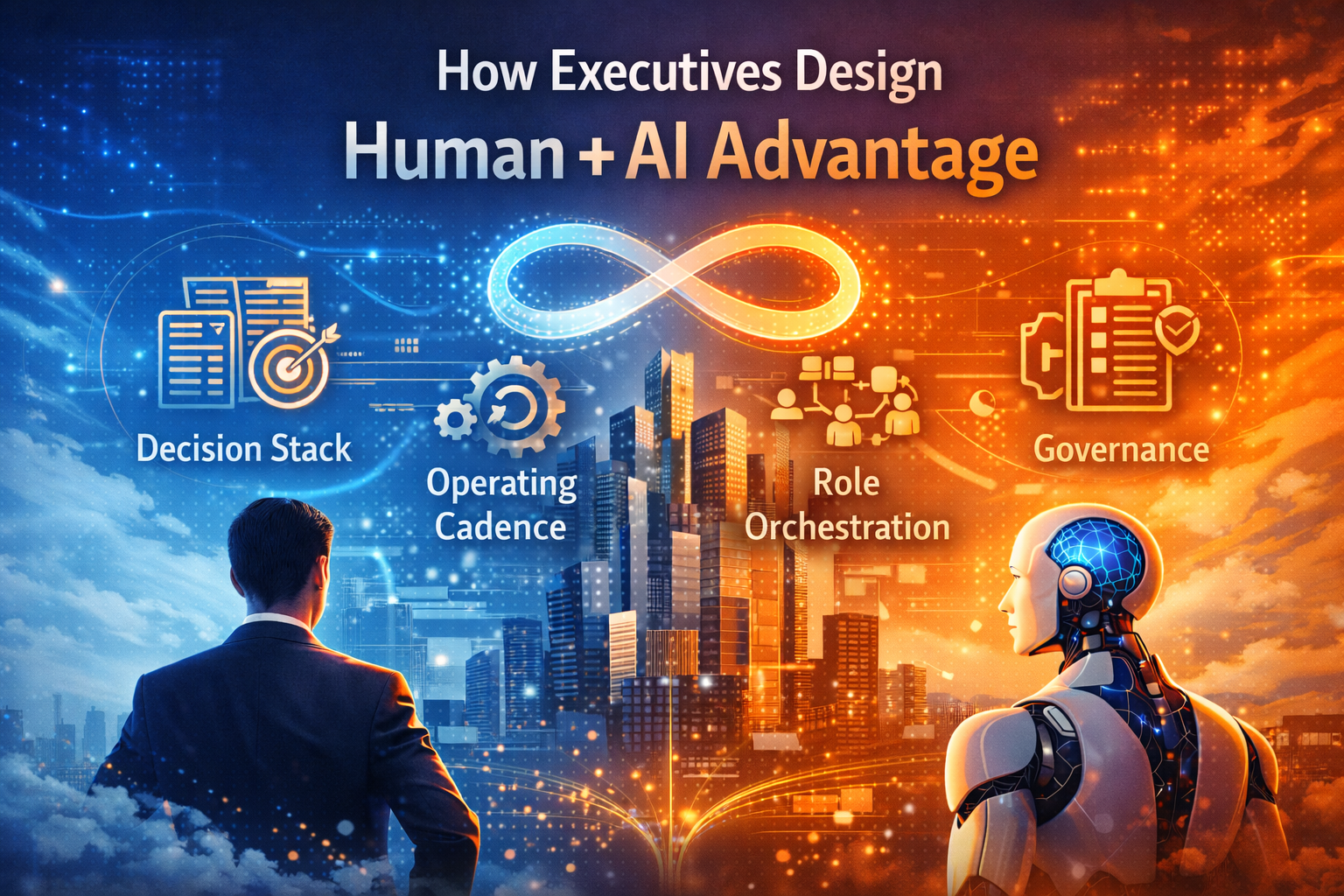
How Executives Design Human + AI Advantage
-
Design the Decision Stack
Identify your highest-leverage decisions:
- Pricing
- Risk approvals
- Supply chain allocation
- Customer exception handling
- Fraud detection
Then define:
- Ownership
- Inputs
- Constraints
- Monitoring
- Reversibility
AI becomes a decision infrastructure, not a productivity assistant.
-
Establish an AI Operating Cadence at Board Level
Boards should regularly ask:
- Where is AI influencing decisions?
- What changed since last quarter?
- Are costs drifting?
- Where are override rates increasing?
- What incidents occurred?
- Which decisions improved outcomes measurably?
This transforms AI from IT discussion to strategic oversight.
-
Redesign Roles Around Orchestration
Emerging role archetypes:
- AI-augmented producers
- AI supervisors
- Decision designers
- Trust stewards
Leadership evolves toward system orchestration.
-
Treat Governance as an Enabler of Scale
Responsible AI frameworks (NIST AI RMF, OECD AI Principles, ISO/IEC 42001) are not barriers to innovation.
They are prerequisites for compounding advantage.
Institutional redesign ensures that AI becomes safe to scale — not risky to expand.
The Executive Playbook
Embrace
- AI as decision infrastructure
- Decision velocity as KPI
- Reusable AI capabilities
- Continuous learning loops
Change
- Clarify decision rights
- Align incentives to decision quality
- Integrate build-run-govern lifecycle
- Shift from approval culture to boundary design
Watch
- Cognitive overload
- Cost expansion after scale
- Tool and model sprawl
- Regulatory divergence across regions
- Erosion of trust
Why This Is the Enterprise AI Era
The next decade will not reward the company with the most pilots.
It will reward the institution that integrates:
- Governance
- Economics
- Runtime discipline
- Decision clarity
My broader canon — including:
- The AI Dividend
👉 https://www.raktimsingh.com/ai-dividend-boards-structural-gains/ - Enterprise AI Economics
👉 https://www.raktimsingh.com/enterprise-ai-economics-cost-governance-economic-control-plane/ - Who Owns Enterprise AI?
👉 https://www.raktimsingh.com/who-owns-enterprise-ai-roles-accountability-decision-rights/
— builds toward this leadership mandate.
Human + AI advantage is the synthesis layer.
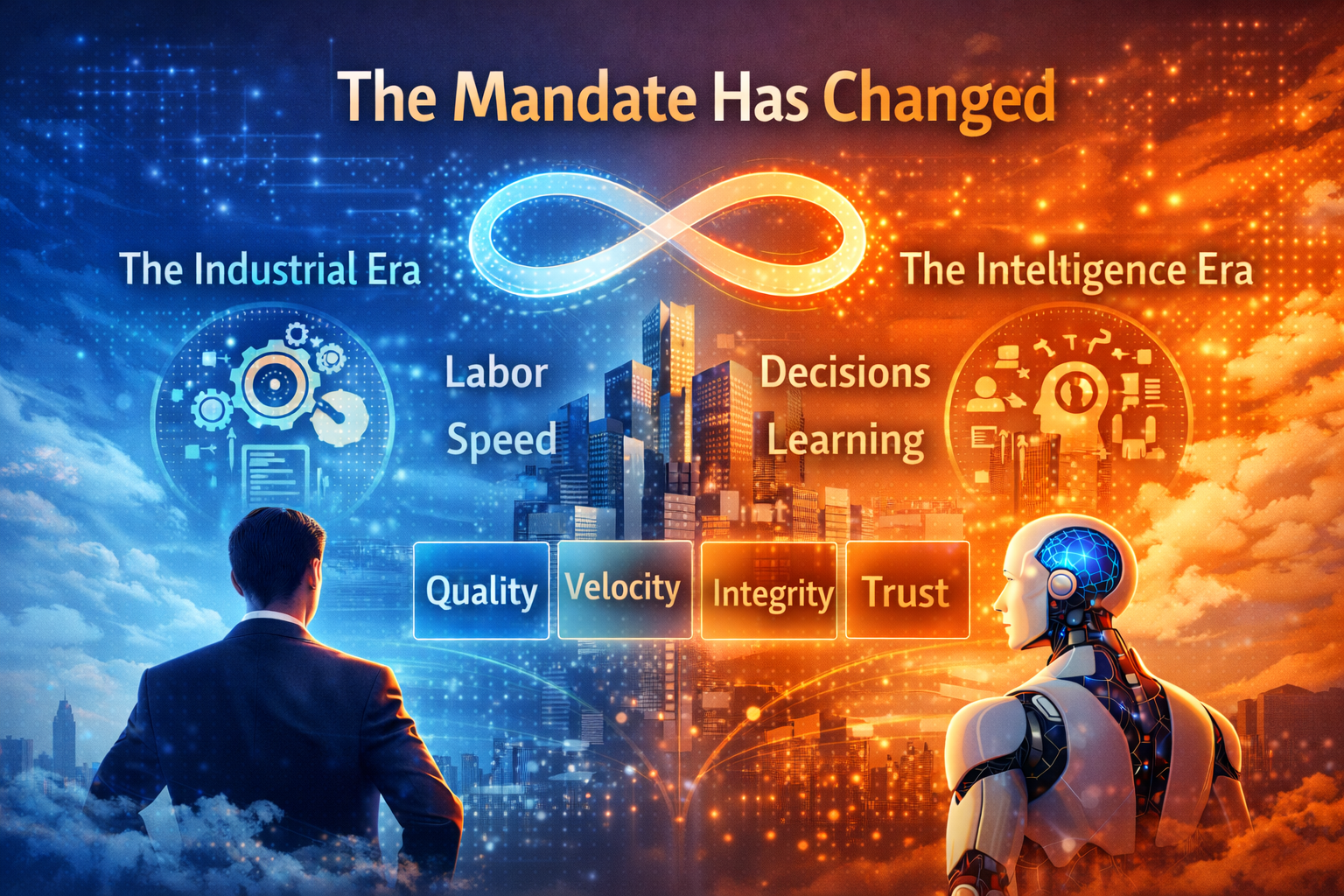
Conclusion: The Mandate Has Changed
The industrial era scaled labor.
The digital era scaled information.
The intelligence era scales decisions.
The executive mandate is no longer simply to manage performance.
It is to design the conditions under which humans and AI generate:
- Higher decision quality
- Faster strategic response
- Institutional resilience
- Durable trust
Executives who understand this will not merely deploy AI.
They will redesign their enterprises to compound with intelligence.
And those who redesign early will define the standards others must follow.
FAQ
What is Human + AI advantage?
A structural enterprise capability where AI scales cognition and leaders scale judgment within governed systems.
Why is leadership redesign necessary in AI transformation?
Because AI affects decisions, not just tasks. Decision architecture must evolve.
How should boards oversee AI strategy?
By focusing on decision quality, risk alignment, operating cadence, and institutional economics.
What is the biggest mistake executives make with AI?
Measuring usage instead of structural advantage.
Further Reading on Enterprise AI Strategy
For deeper structural frameworks on enterprise AI transformation:
-
The Enterprise AI Operating Model
https://www.raktimsingh.com/enterprise-ai-operating-model/ -
Decision Scale: Why Competitive Advantage Is Moving from Labor Scale to Decision Scale
https://www.raktimsingh.com/decision-scale-competitive-advantage-ai/ -
The AI Dividend: How Boards Capture Structural Gains
https://www.raktimsingh.com/ai-dividend-boards-structural-gains/ -
The Intelligence Reuse Index
https://www.raktimsingh.com/intelligence-reuse-index-enterprise-ai-fabric/ -
Who Owns Enterprise AI? Roles and Accountability
https://www.raktimsingh.com/who-owns-enterprise-ai-roles-accountability-decision-rights/
Further Reading & References
1️⃣ AI Governance & Risk Frameworks
NIST AI Risk Management Framework (US)
https://www.nist.gov/itl/ai-risk-management-framework
ISO/IEC 42001 – AI Management System Standard
https://www.iso.org/standard/42001.html
OECD AI Principles (Global policy benchmark)
https://oecd.ai/en/ai-principles
EU AI Act Overview (Regulatory momentum)
https://digital-strategy.ec.europa.eu/en/policies/regulatory-framework-ai
2️⃣ Board-Level AI Oversight
Harvard Business Review – AI and Leadership
https://hbr.org/topic/artificial-intelligence
EY – Board Oversight of AI
https://www.ey.com/en_gl/board-matters
McKinsey – The State of AI
https://www.mckinsey.com/capabilities/quantumblack/our-insights/the-state-of-ai
Article Type:
Article → Business / Technology / Executive Strategy
Author: Raktim Singh
Organization: Independent Enterprise AI Thought Leader
Audience: Executives, Board Members, Global Enterprises
Primary Topic: AI leadership redesign



Raktim Singh is an AI and deep-tech strategist, TEDx speaker, and author focused on helping enterprises navigate the next era of intelligent systems. With experience spanning AI, fintech, quantum computing, and digital transformation, he simplifies complex technology for leaders and builds frameworks that drive responsible, scalable adoption.