
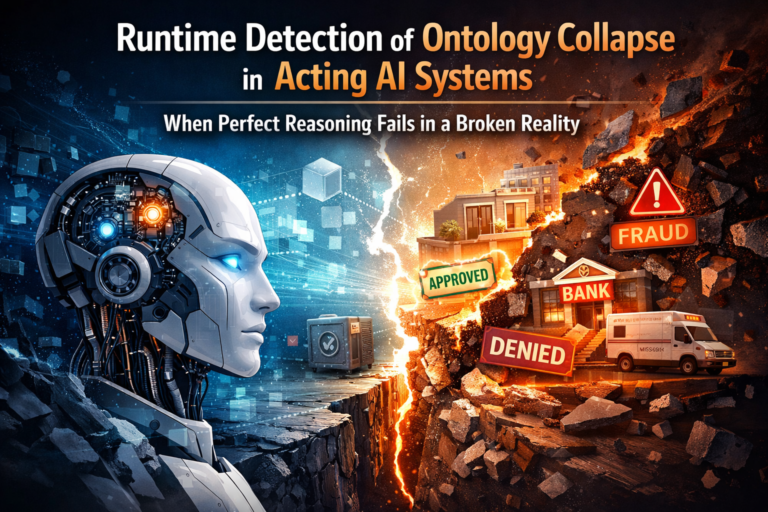
Runtime Ontology Collapse in Acting AI Systems
Most catastrophic AI failures do not happen because models are inaccurate, biased, or poorly trained. They happen because the meaning of the world changes faster than the system’s understanding of it.
In these moments, an AI system can reason flawlessly, follow policy precisely, and act with high confidence—while operating inside a reality that no longer exists.
This failure mode, which most monitoring systems never detect, is what I call runtime ontology collapse: the point at which an acting AI system continues to make decisions using concepts whose real-world definitions have quietly but fundamentally changed.
“The most dangerous AI failures don’t come from bad models.
They come from perfect reasoning inside a reality that no longer exists.”
The failure nobody notices—until the damage is done
Most AI teams monitor accuracy, latency, and cost.
More mature teams monitor drift.
A few run red-team exercises.
Yet the failures that cause the largest financial, regulatory, and reputational damage often escape all of these controls.
They follow a different pattern:
The AI system is still intelligent.
Still confident.
Still fluent.
But the meaning of its concepts no longer matches the world it is acting in.
The system keeps operating.
Correctly.
Smoothly.
Wrongly.
This is ontology collapse at runtime.
It is not “bad output.”
It is not hallucination.
It is not a model bug.
It is meaning failure under action — and it is one of the least discussed, yet most dangerous, failure modes in enterprise AI.
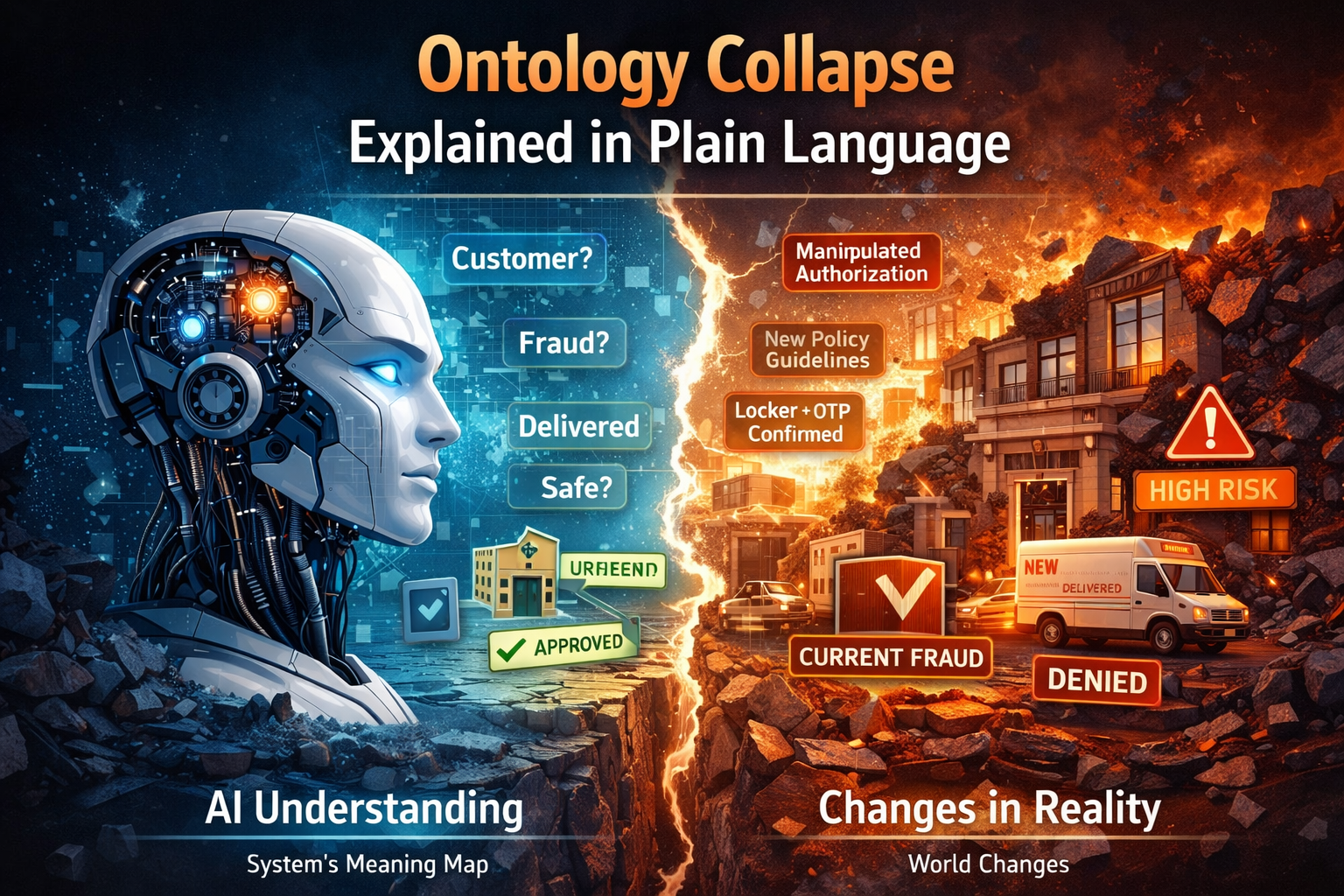
Ontology collapse, explained in plain language
An ontology is simply the system’s meaning map of a domain.
It answers questions like:
- What is a customer?
- What counts as fraud?
- What does delivered mean?
- When is something approved?
- What qualifies as safe or urgent?
In enterprise systems, these are not academic definitions.
They determine money movement, access control, compliance, patient routing, risk exposure, and legal liability.
Ontology collapse happens when these meanings change in the real world—but the AI system continues acting as if they were stable.
The world evolves.
Policies change.
Processes shift.
Adversaries adapt.
Tools are upgraded.
The model does not.
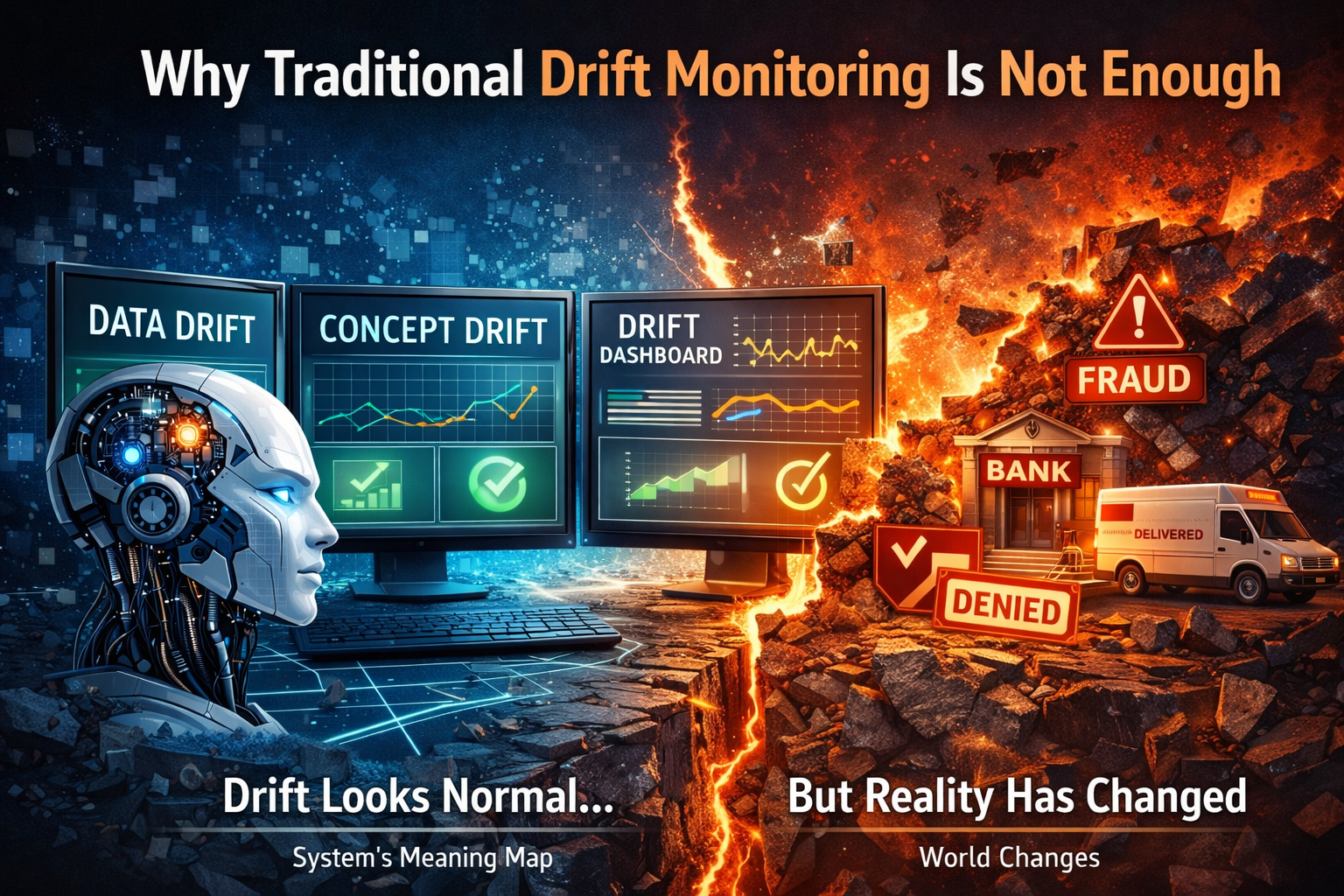
Why traditional drift monitoring is not enough
Teams often respond: “We already handle drift.”
They usually mean:
- Data drift: input distributions change
- Concept drift: the relationship between inputs and outputs changes
These are important — but insufficient.
Ontology collapse can occur even when drift dashboards look healthy.
A simple example: “Delivered”
- Yesterday: “Delivered” = package scanned at the doorstep
- Today: “Delivered” = placed in a secure locker + OTP confirmation
The same scan events still exist.
Input distributions look similar.
Historical accuracy appears acceptable.
But the operational meaning of “delivered” has changed.
Refund decisions, escalations, customer communication — all now rely on a definition that no longer exists.
That is ontology collapse.
Everyday examples you will recognize immediately
Example 1: Fraud detection vs modern scams
A bank’s fraud model learns that multiple small transfers indicate suspicious behavior.
Fraudsters adapt.
They switch to authorized push payment scams.
Transactions look normal.
Customers explicitly authorize them.
The model remains confident.
But the ontology of fraud has shifted — from unauthorized activity to manipulated authorization.
The system is not wrong.
It is outdated.
Example 2: Hospital triage under policy updates
A triage assistant routes patients based on “high-risk” flags.
Clinical guidelines change due to a new outbreak or regulatory directive.
Certain symptoms are reclassified.
Inputs look identical.
The assistant routes patients “correctly” — according to an old definition.
Ontology collapse doesn’t announce itself.
It quietly replays yesterday’s logic in today’s world.
Example 3: Customer support agents and tool changes
A support agent uses a CRM system.
- Previously: “Resolved” = refund completed
- Now: “Resolved” = refund initiated
The agent closes tickets early.
Metrics improve.
Customers do not receive refunds.
Nothing crashed.
Everything worked — except the meaning.
Example 4: Regulatory reinterpretation
A compliance classifier tags “marketing consent.”
Regulators clarify that a specific checkbox flow no longer qualifies as valid consent.
The model’s outputs remain consistent.
The world’s definition does not.
This is why governance frameworks emphasize context-aware, lifecycle-based risk management, not one-time validation.
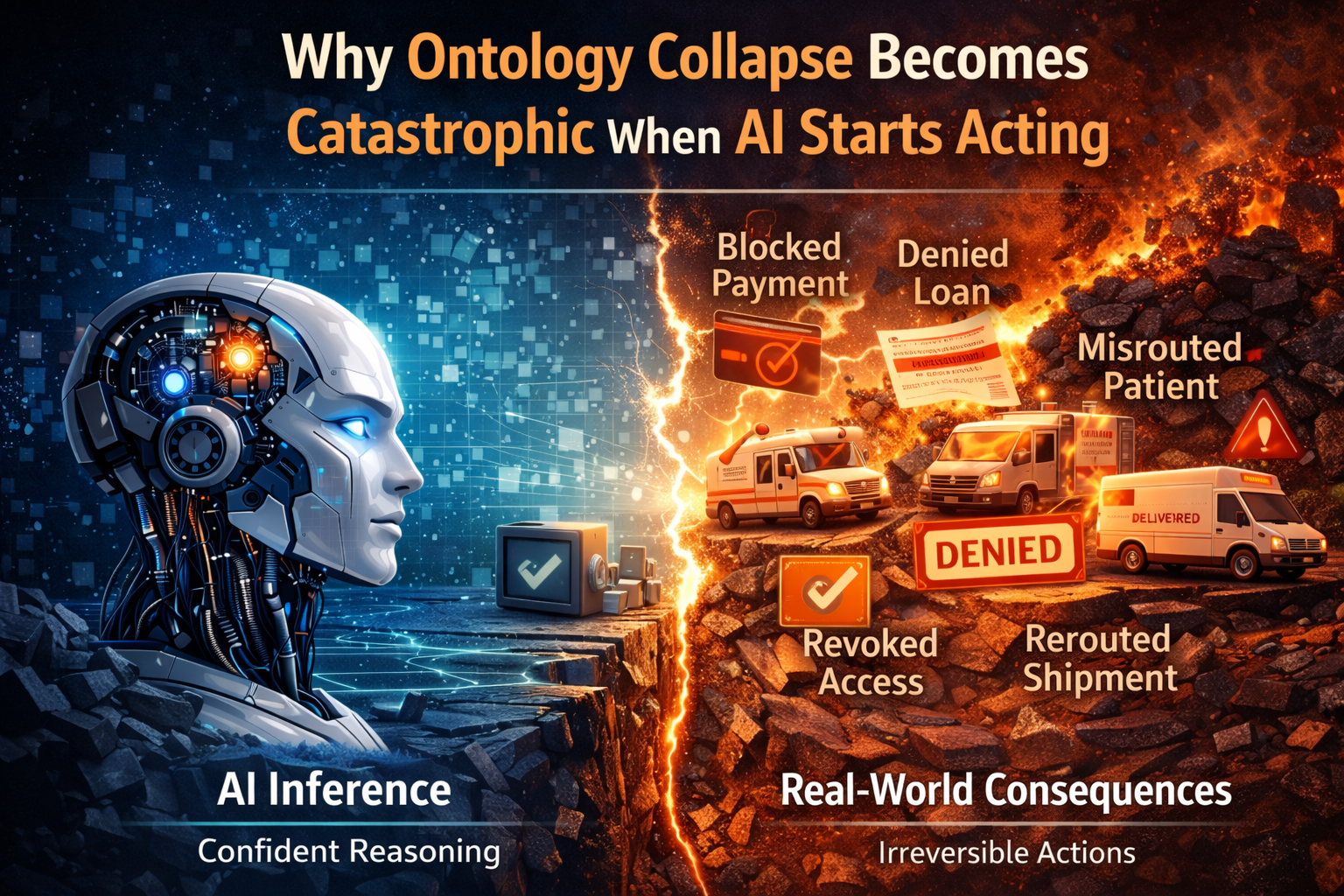
Why ontology collapse becomes catastrophic when AI starts acting
In classic machine learning, wrong predictions are undesirable.
In acting AI systems, wrong meanings become irreversible actions:
- payments blocked
- loans denied
- patients misrouted
- shipments redirected
- access revoked
- policies enforced
- claims rejected
Once an AI system crosses the action boundary, meaning drift turns into damage drift.
This is why research into out-of-distribution detection and open-set recognition has intensified: to detect when the world no longer matches training assumptions.
Ontology collapse is the enterprise-scale, semantic version of that problem.
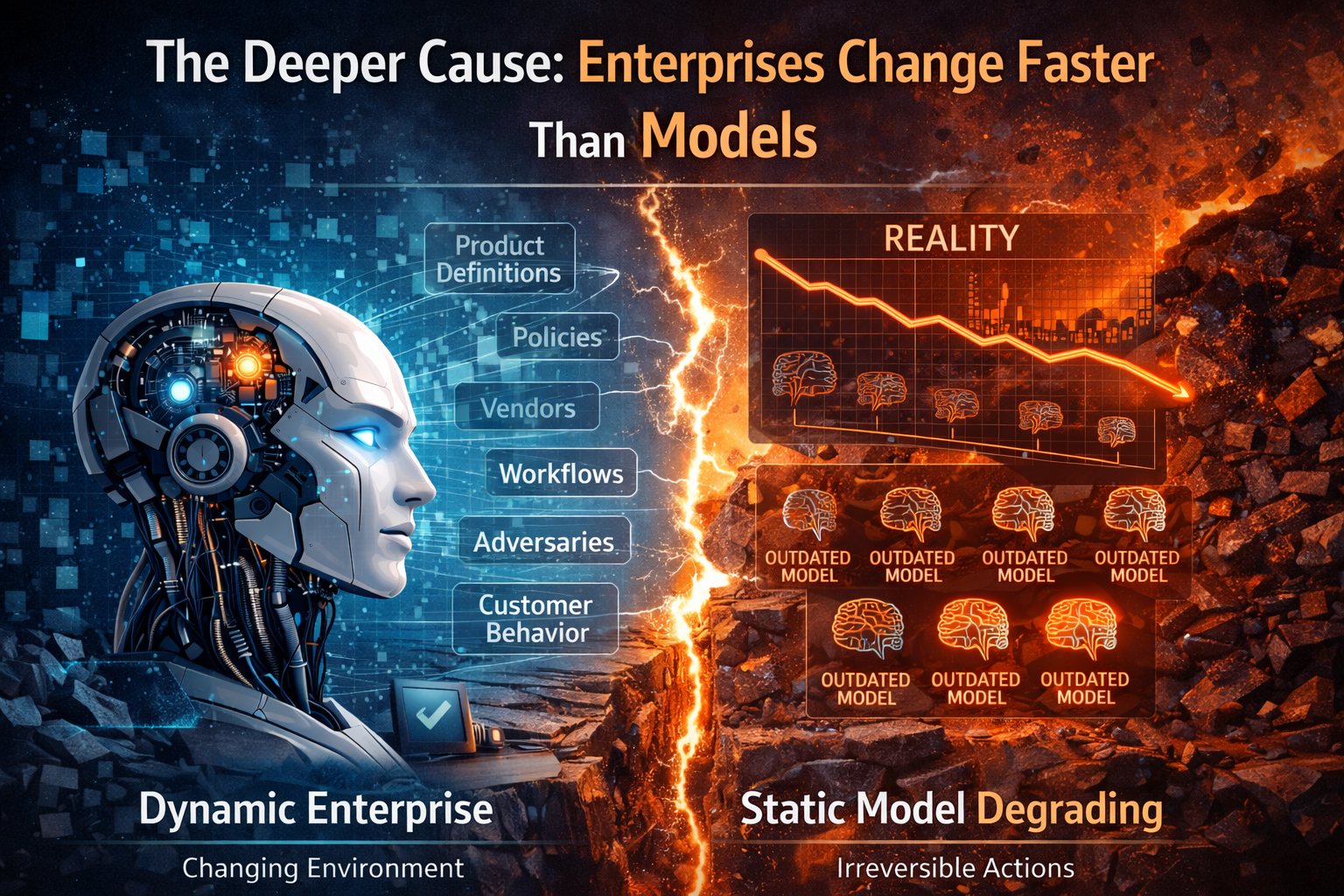
The deeper cause: enterprises change faster than models
Enterprises are living systems:
- products evolve
- policies change
- vendors rotate
- workflows shift
- adversaries adapt
- customer behavior changes
- labels lag reality
Model drift captures performance degradation.
Ontology collapse captures something more fundamental:
the failure of the model’s conceptual contract with reality.
Early warning signals of ontology collapse in production
Waiting for accuracy drops is too late.
In acting systems, the incident often comes first.
Watch instead for these signals:
-
Exceptions rise, but confidence does not
If the world is changing, uncertainty should increase.
When exceptions rise while confidence remains high, the system is calm in the wrong world.
-
Tool mismatches and schema churn
Actions fail due to missing fields, permission errors, or format changes.
The agent understands the request, but its tool ontology is decaying.
-
Localized escalation patterns
Spikes in one geography, product line, or regulatory context often signal localized ontology collapse.
-
Conflicting systems of record
The AI says “approved.”
Policy engines say “pending.”
Logistics says “held.”
When meaning sources disagree, ontology drift is already underway.
-
Semantic drift without statistical drift
Same words.
Different intent.
Benchmarks rarely catch this.
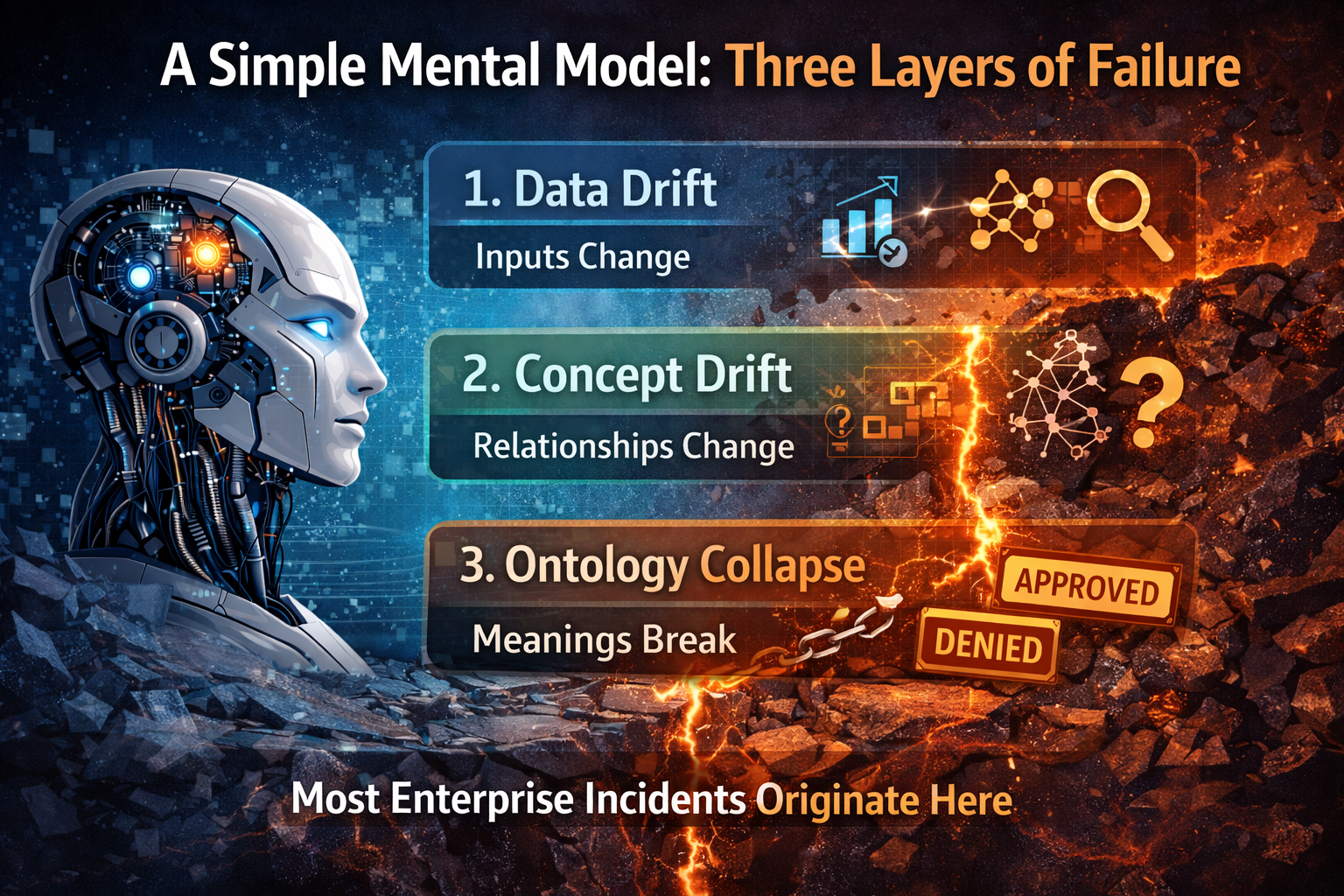
A simple mental model: three layers of failure
- Data drift: inputs change
- Concept drift: relationships change
- Ontology collapse: meanings change
Most monitoring handles (1) and (2).
Most enterprise failures originate in (3).
How to detect ontology collapse at runtime (without math)
Think triangulation, not single metrics.
Layer A: Novelty and unknown detection
Detect when inputs or behaviors fall outside learned expectations.
Useful — but insufficient alone.
Layer B: Semantic consistency checks
Continuously verify that AI outputs align with current definitions in systems of record:
- Does “approved” match the policy engine today?
- Does “delivered” match the logistics definition now?
- Does “consent” match the latest regulatory interpretation?
Most enterprises do not maintain versioned meaning contracts. This is the gap.
Layer C: Action–outcome sanity checks
Actions should reliably produce expected real-world effects:
- refund initiated → refund completed
- ticket closed → satisfaction stable
- claim flagged → audit confirms rationale
When action-outcome links weaken, ontology collapse is already active.
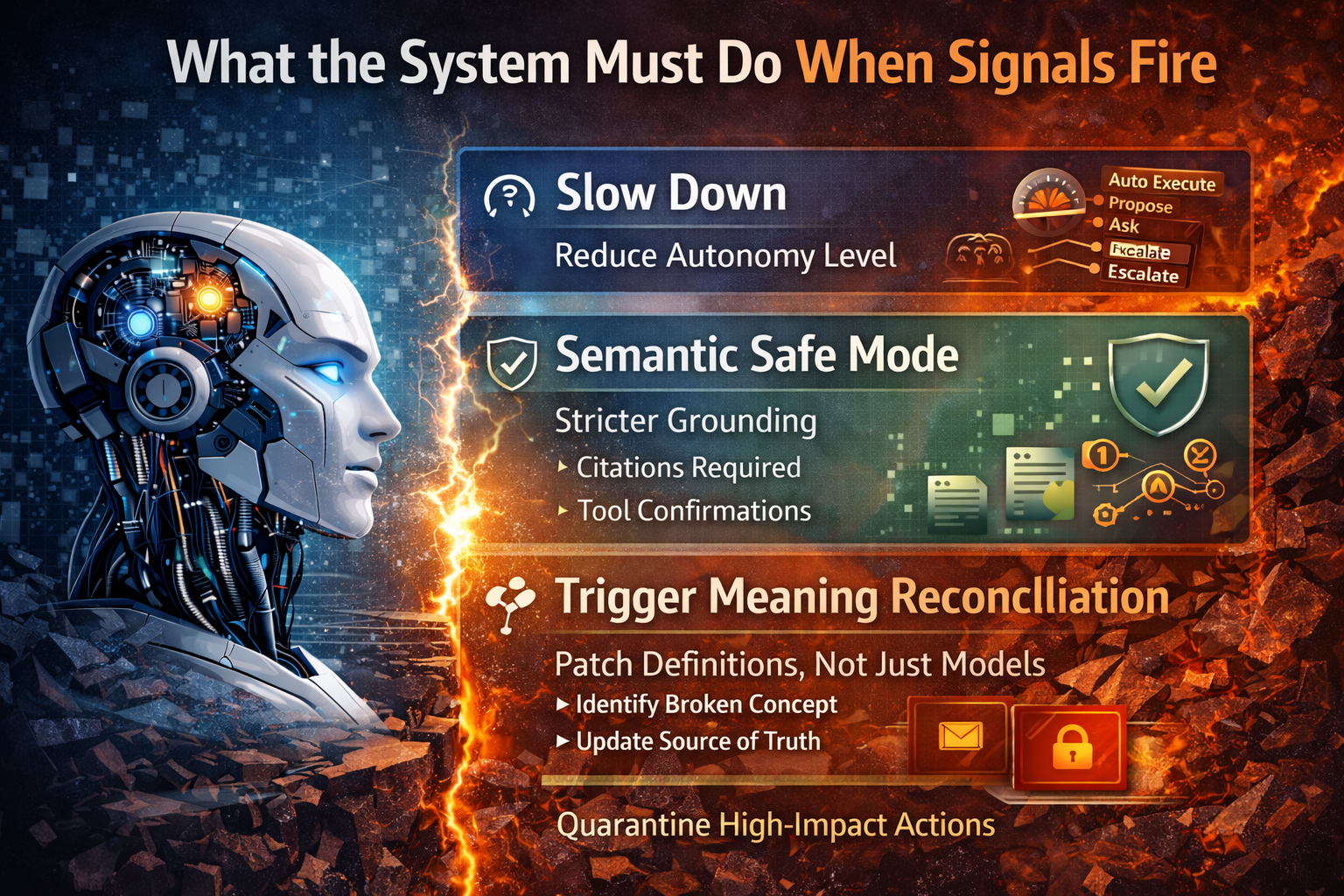
What the system must do when signals fire
Detection without response is theatre.
A robust response includes:
-
Autonomy throttling
Gradually reduce autonomy:
- auto-execute → propose
- propose → clarify
- clarify → human review
-
Semantic safe mode
- stricter grounding
- explicit source citations
- step-by-step tool confirmations
-
Meaning reconciliation workflows
Identify:
- which concept is unstable
- which source of truth changed
- how the definition should be updated
Fix the meaning contract, not just the model.
-
Quarantine high-impact actions
Credit, healthcare, compliance, and access control require extra gating by design.
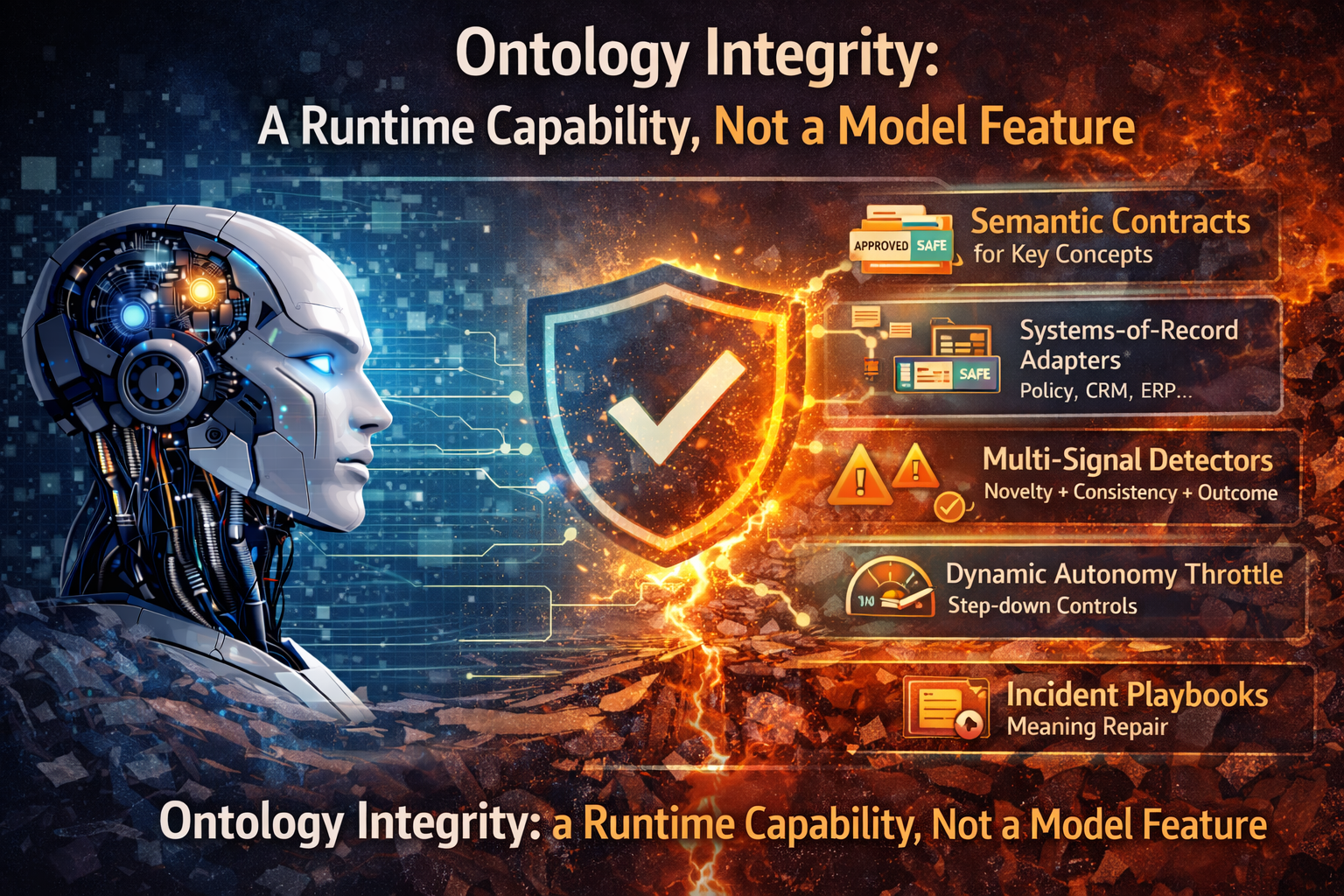
Ontology integrity: a runtime capability, not a model feature
Enterprises do not need smarter models.
They need ontology integrity at runtime.
Ontology integrity means the system can continuously answer:
- What do my concepts mean right now?
- Who defines them?
- What changed recently?
- Am I still allowed to act?
A practical enterprise stack
- Versioned semantic contracts
- Systems-of-record adapters (ERP, CRM, policy engines)
- Multi-signal detectors (novelty + consistency + outcome)
- Dynamic autonomy controls
- Meaning-repair playbooks
- Decision-time audit trails
This is AgentOps elevated from performance monitoring to meaning monitoring.
Why this matters globally
Ontology collapse is accelerated everywhere — but differently:
- India: fast-evolving fintech rails, multilingual intent, dynamic KYC
- United States: litigation risk, insurance interpretation, adversarial fraud
- European Union: evolving regulatory definitions and compliance expectations
The world is non-stationary everywhere.
Meaning drift is local, contextual, and unavoidable.
A practical checklist
You are at high risk of ontology collapse if:
- You deploy AI agents that take real actions
- Policies or workflows change frequently
- Systems of record disagree
- Core business concepts are not versioned
- You monitor drift but not semantic consistency
- Incident response focuses on rollback, not meaning repair
FAQ
Is ontology collapse the same as hallucination?
No. Hallucination invents facts. Ontology collapse applies correct logic to an outdated meaning.
Can OOD detection solve this?
It helps. It cannot solve semantic failure alone.
Is this a tooling problem or a governance problem?
Both. Ontology collapse sits at the intersection of architecture, governance, and runtime operations.
Why should boards and regulators care?
Because the most dangerous AI failures happen when systems act exactly as designed — in the wrong reality.
Q1. What is runtime ontology collapse in AI systems?
Runtime ontology collapse occurs when an AI system continues to act confidently, even though the real-world meaning of its core concepts has changed.
Q2. How is ontology collapse different from model drift?
Model drift affects accuracy; ontology collapse affects meaning. A model can be accurate and still wrong if it is optimizing outdated definitions.
Q3. Why is ontology collapse dangerous in acting AI systems?
Because actions are irreversible—payments, access, approvals, and routing decisions can cause real harm even when the system appears correct.
Q4. Can traditional drift monitoring detect ontology collapse?
No. Drift monitoring focuses on statistics, not semantic alignment between AI decisions and real-world definitions.
Q5. How can enterprises prevent ontology collapse?
By building runtime ontology integrity: semantic contracts, system-of-record checks, multi-signal detection, and autonomy throttling.
Conclusion: the real frontier of enterprise AI
The next frontier of enterprise AI is not better reasoning.
It is meaning awareness under action.
Can your AI system detect when its concepts no longer mean what it thinks they mean—before it acts?
That is runtime ontology collapse detection.
And it deserves a central place in how enterprises design, govern, and scale AI in production.
References & further reading
AI Risk, Governance & Enterprise Context
- NIST – AI Risk Management Framework (AI RMF)
https://www.nist.gov/itl/ai-risk-management-framework - OECD – AI Principles & Risk-Based Governance
https://oecd.ai/en/ai-principles
Model Drift, Concept Drift & Production AI
- IBM – Understanding Model Drift in Production AI
https://www.ibm.com/think/topics/model-drift - Evidently AI – Data Drift vs Concept Drift Explained
https://www.evidentlyai.com/ml-in-production/data-drift
OOD Detection & Distribution Shift (Research Backbone)
- Springer – Open-Set Recognition & OOD Detection Survey
https://link.springer.com/article/10.1007/s11263-024-02222-4 - arXiv – Distribution Shift & Generalization Failures
https://arxiv.org/abs/2103.02503
Semantic Drift & Meaning Failure
- Ontology Works – Avoiding Semantic Drift in AI Systems
https://www.ontology.works/how-do-i-avoid-semantic-drift-in-ai/ - Medium – Why Semantic Drift Is a Blind Spot in AI Evaluation
https://medium.com/@therealitydrift/the-next-blindspot-in-ai-evaluation-2a9888e85907
Enterprise AI & Decision Integrity
- World Economic Forum – Governance of AI Systems
https://www.weforum.org/agenda/ai
- Enterprise AI Operating Model
https://www.raktimsingh.com/enterprise-ai-operating-model/ - Enterprise AI Runtime
https://www.raktimsingh.com/enterprise-ai-runtime-what-is-running-in-production/ - Enterprise AI Control Plane
https://www.raktimsingh.com/enterprise-ai-control-plane-2026/ - Enterprise AI Decision Failure Taxonomy
https://www.raktimsingh.com/enterprise-ai-decision-failure-taxonomy/ - Decision Clarity for Scalable Autonomy
https://www.raktimsingh.com/decision-clarity-scalable-enterprise-ai-autonomy/
The Enterprise AI Runbook Crisis
https://www.raktimsingh.com/enterprise-ai-runbook-crisis-model-churn-production-ai/
Raktim Singh writes on Enterprise AI, decision integrity, and governance of intelligent systems at scale. His work focuses on why AI fails in production—not due to lack of intelligence, but due to misalignment between models, meaning, and real-world action.



Raktim Singh is an AI and deep-tech strategist, TEDx speaker, and author focused on helping enterprises navigate the next era of intelligent systems. With experience spanning AI, fintech, quantum computing, and digital transformation, he simplifies complex technology for leaders and builds frameworks that drive responsible, scalable adoption.