
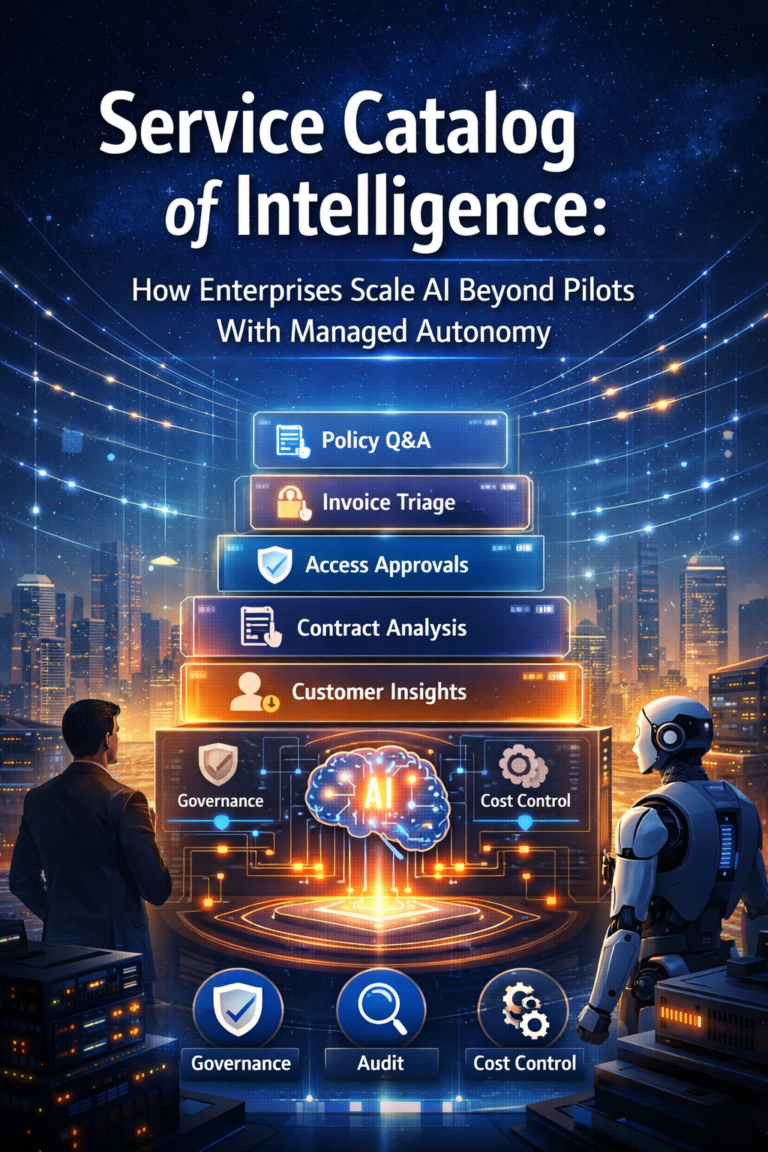
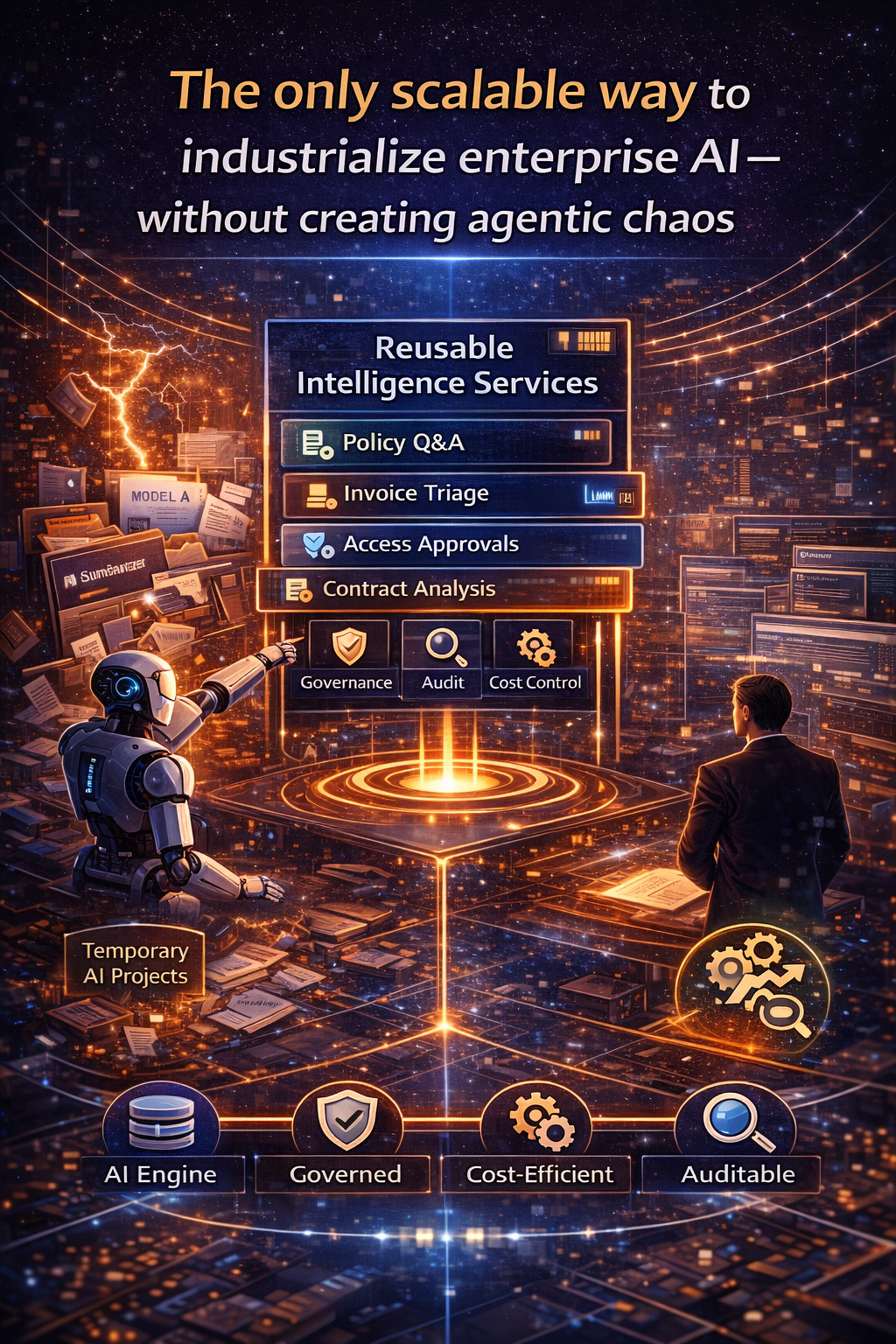
The only scalable way to industrialize enterprise AI—without creating agentic chaos
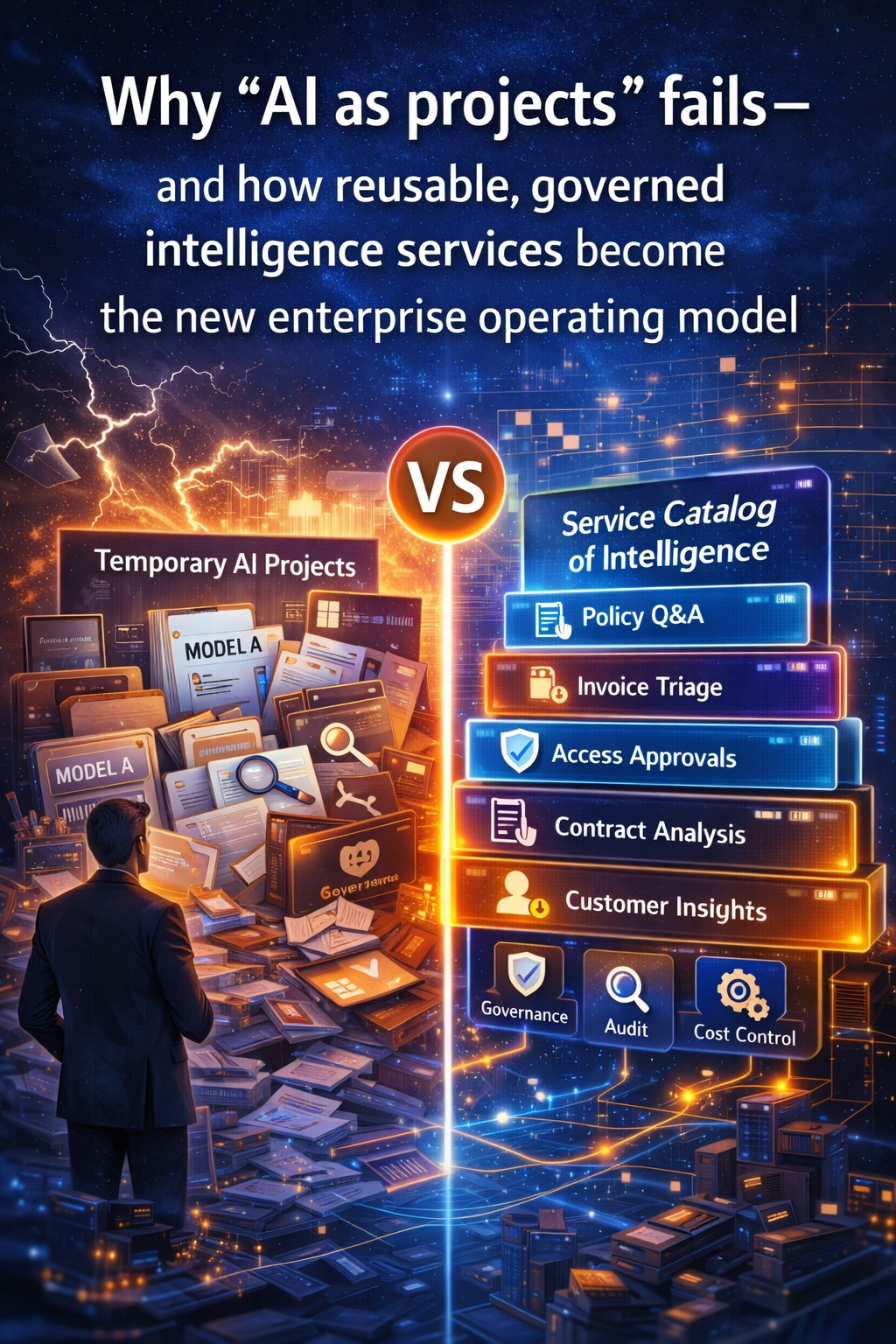
Most enterprise AI pilots fail to scale. Learn how a Service Catalog of Intelligence enables governed, reusable AI services with auditability, cost control, and managed autonomy.
Enterprise AI scales when intelligence becomes a catalog of reusable services—each with guardrails, audit trails, and cost envelopes—so teams can consume outcomes safely without rebuilding the plumbing.
Why this topic matters right now
Enterprise AI is no longer struggling because models are weak.
It is struggling because intelligence is being deployed without an operating model.
The early wave of enterprise AI was assistive: copilots, chatbots, summarizers. Helpful—but largely non-operational. The next wave is agentic: systems that approve requests, update records, trigger workflows, and coordinate across tools.
That shift is powerful.
It also fundamentally changes the enterprise risk equation.
Gartner has predicted that over 40% of agentic AI initiatives will be canceled by the end of 2027, not because the technology fails—but because costs escalate, value becomes unclear, and risk controls lag behind capability. Harvard Business Review has echoed the same pattern: agentic AI fails when governance, operating discipline, and accountability do not scale with autonomy.
Across enterprises, the pattern repeats:
- Teams launch many pilots
- A few pilots impress in demos
- In production, complexity explodes: duplicated effort, inconsistent policies, missing audit trails, unclear ownership, and runaway costs
Enterprises don’t need more pilots.
They need a repeatable way to ship AI as a governed, reusable service.
That is the Service Catalog of Intelligence.
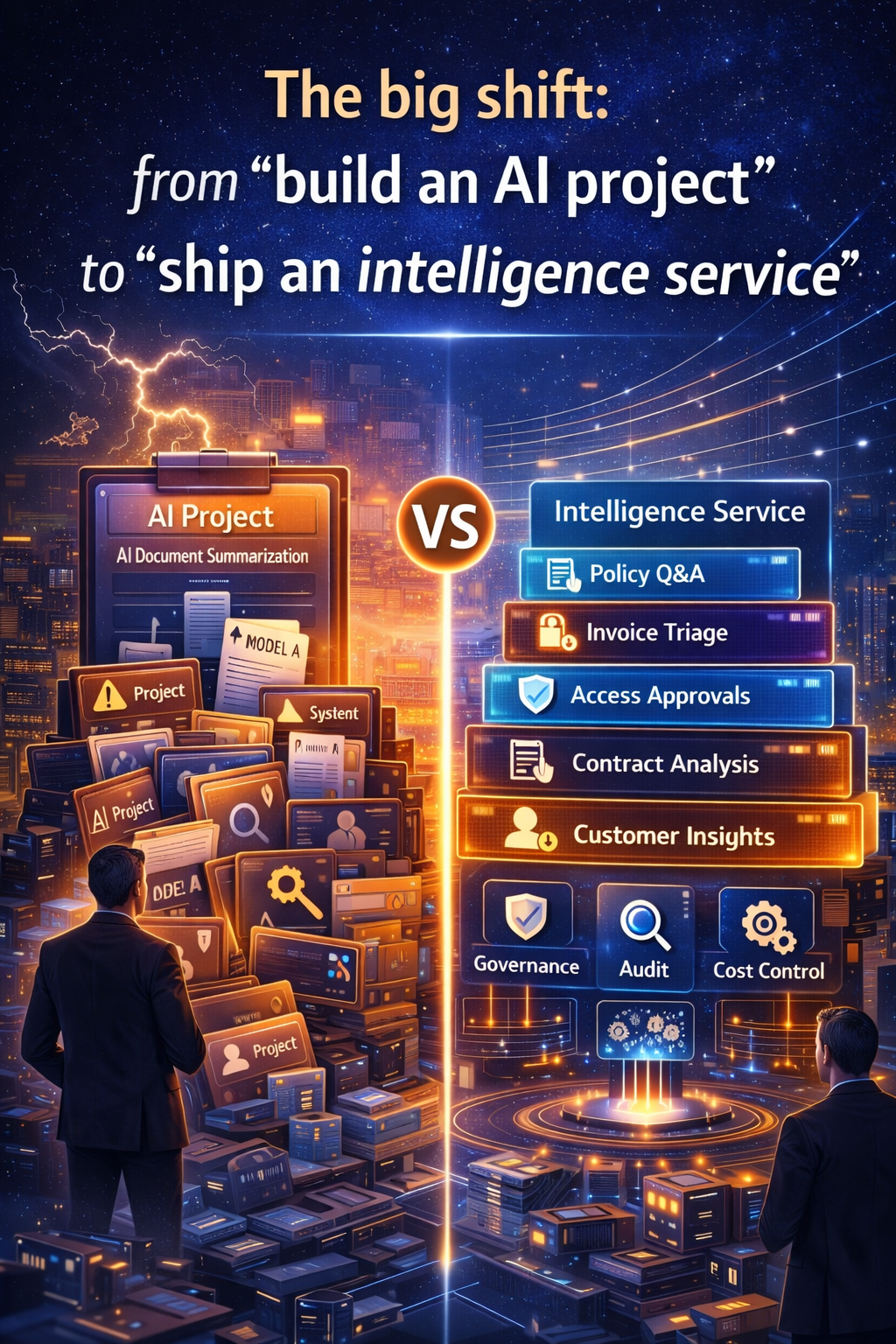
The big shift: from “build an AI project” to “ship an intelligence service”
Most enterprises still treat AI like a special project:
- A team builds a solution for one department
- It uses a specific model
- It integrates with a few systems
- It goes live
- Then another team builds a near-identical version elsewhere
This is how AI sprawl happens—and why scaling feels impossible.
A Service Catalog of Intelligence flips the mental model.
Instead of AI being something you build once, intelligence becomes a portfolio of reusable outcome services that teams can safely consume.
Think of it as an internal marketplace of intelligence products—each with:
- A clear outcome (“what problem does this solve?”)
- A defined interface (“how do I request it?”)
- Guardrails (“what is allowed, what is not?”)
- Reliability commitments (“what happens when confidence is low?”)
- Audit evidence (“how do we prove what happened?”)
- Cost boundaries (“what do we spend per request?”)
This is how enterprise platforms scale: not through heroics, but through repeatability.
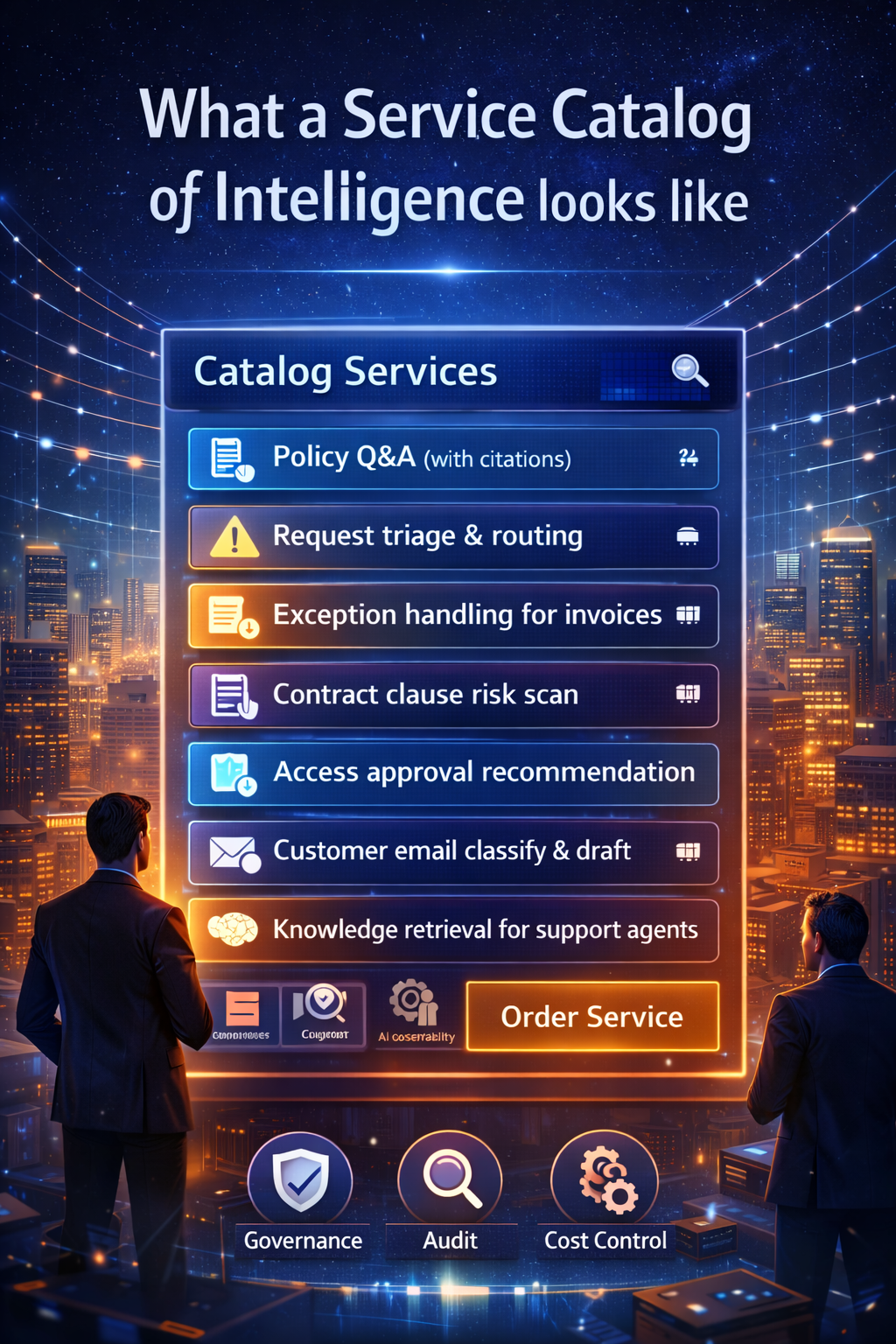
What a Service Catalog of Intelligence looks like
Imagine a business user opening an internal portal and seeing a list of intelligence services such as:
- Policy Q&A (with citations)
- Request triage and routing
- Invoice exception handling
- Contract clause risk scanning
- Access approval recommendations
- Customer email classification and draft responses
- Knowledge retrieval for support agents
They don’t need to know which model is used.
They don’t need to assemble prompts.
They don’t need to guess whether the output is safe to act on.
They simply request a service—much like ordering a cloud resource from an internal service catalog.
This mirrors how mature enterprises already deliver IT services: standardized offerings, consistent controls, and built-in accountability.
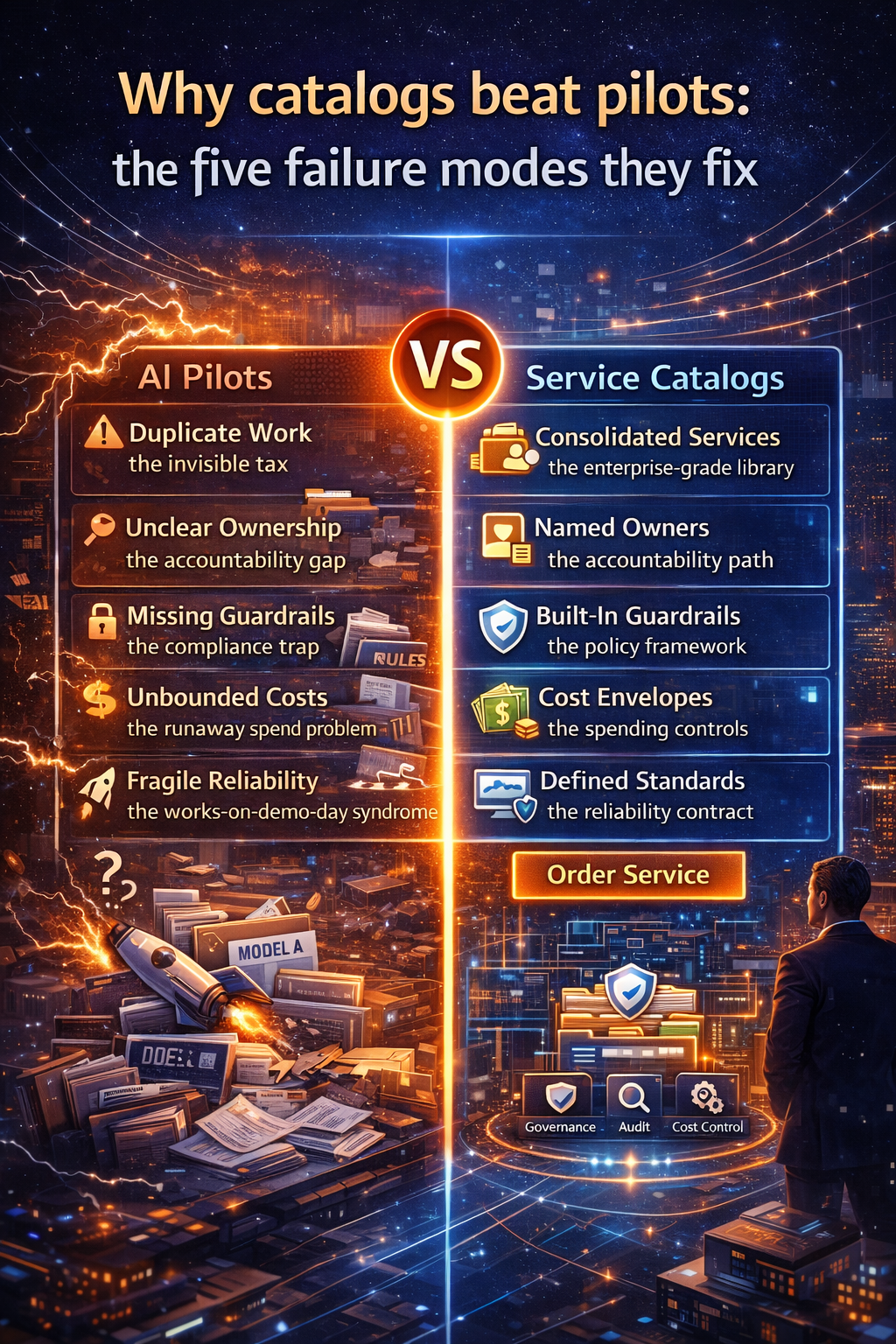
Why catalogs beat pilots: the five failure modes they fix
-
Duplicate work (the invisible tax)
Without a catalog:
- One team builds an AI summarizer
- Another builds a slightly different summarizer
- A third builds “version 3” with new prompts
A catalog consolidates effort: one enterprise-grade service, many consumers.
-
Unclear ownership (the accountability gap)
When an AI-driven workflow causes an incident, ownership becomes murky.
A catalog makes ownership explicit:
- Named service owner
- Defined escalation paths
- Measurable SLOs
- Controlled change management
-
Missing guardrails (the compliance trap)
Pilots often skip:
- Approval logic
- Data boundaries
- Audit evidence
- Retention policies
Catalog services ship with guardrails by default—so scaling doesn’t multiply risk.
-
Unbounded costs (the runaway spend problem)
Agentic systems can be expensive because they:
- Chain model calls
- Fetch large contexts
- Retry and branch
- Invoke tools repeatedly
A catalog enforces cost envelopes: rate limits, model-routing rules, and low-cost fallback modes—an approach increasingly emphasized in emerging AI control-plane platforms.
-
Fragile reliability (“works on demo day” syndrome)
Pilots are optimistic. Production is not.
Catalog services define:
- What “good enough” means
- What happens at low confidence
- How humans intervene by exception
- How failures recover safely
This is how AI becomes operable.
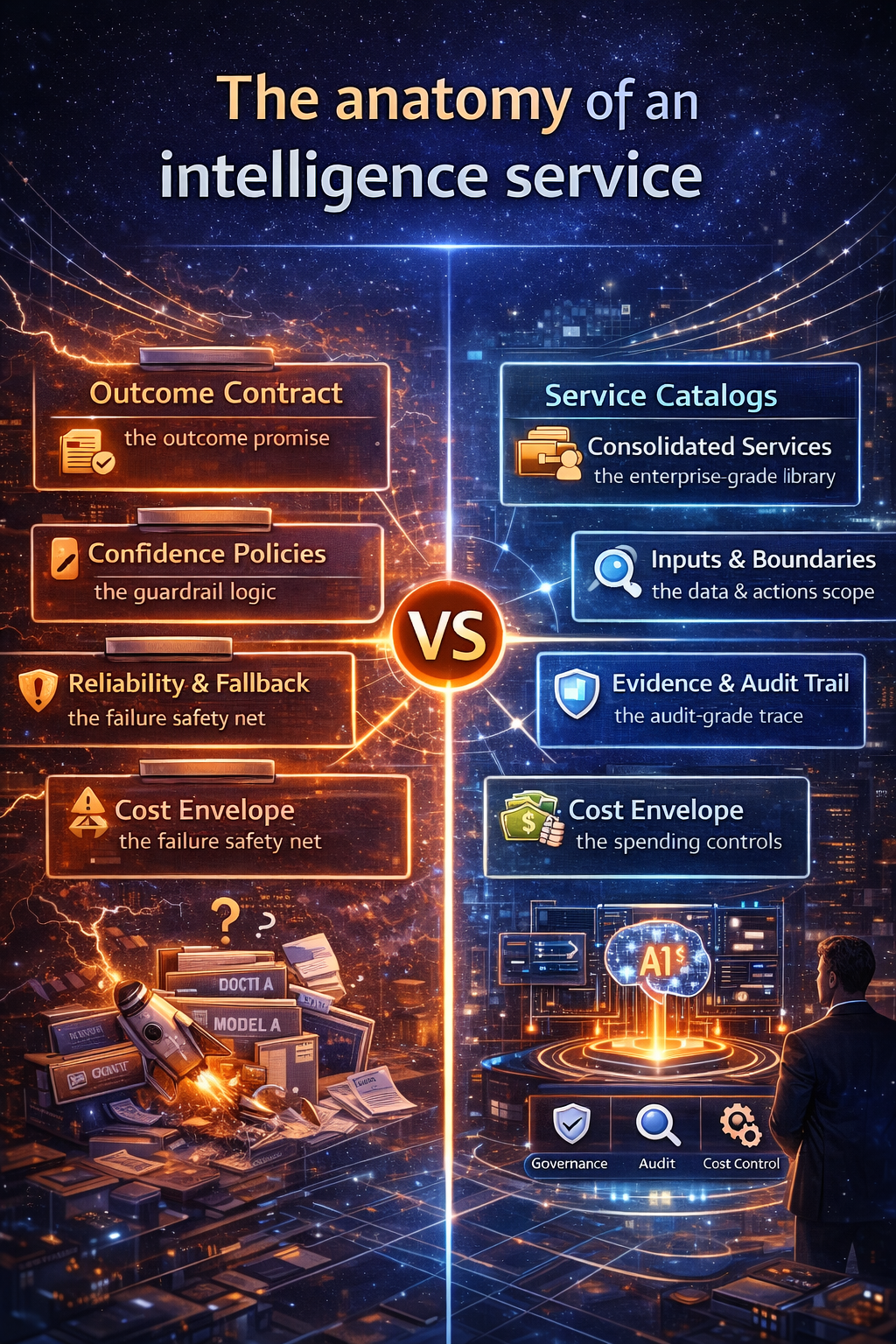
The anatomy of an intelligence service
A catalog entry is not a button.
It is a product specification.
Mature enterprises standardize the following:
-
A) Outcome contract
A single sentence a CXO understands:
“This service reduces turnaround time for request triage by routing cases with evidence.”
-
B) Inputs and boundaries
- Approved data sources
- Explicit exclusions
- Read vs write permissions
-
C) Confidence policies
- When the system can auto-act
- When approval is required
- When it must refuse
-
D) Evidence and audit trail
- Sources used
- Tools invoked
- Approvals requested
- Final decisions and rationale
As autonomous decision-making increases, this audit-grade trace becomes non-negotiable.
-
E) Reliability and fallback modes
When confidence drops:
- Switch to a safer mode
- Escalate to human review
- Route to a specialist queue
-
F) Cost envelope
- Token and context limits
- Tool-call caps
- Retry ceilings
- Model routing options
Simple examples that make it real
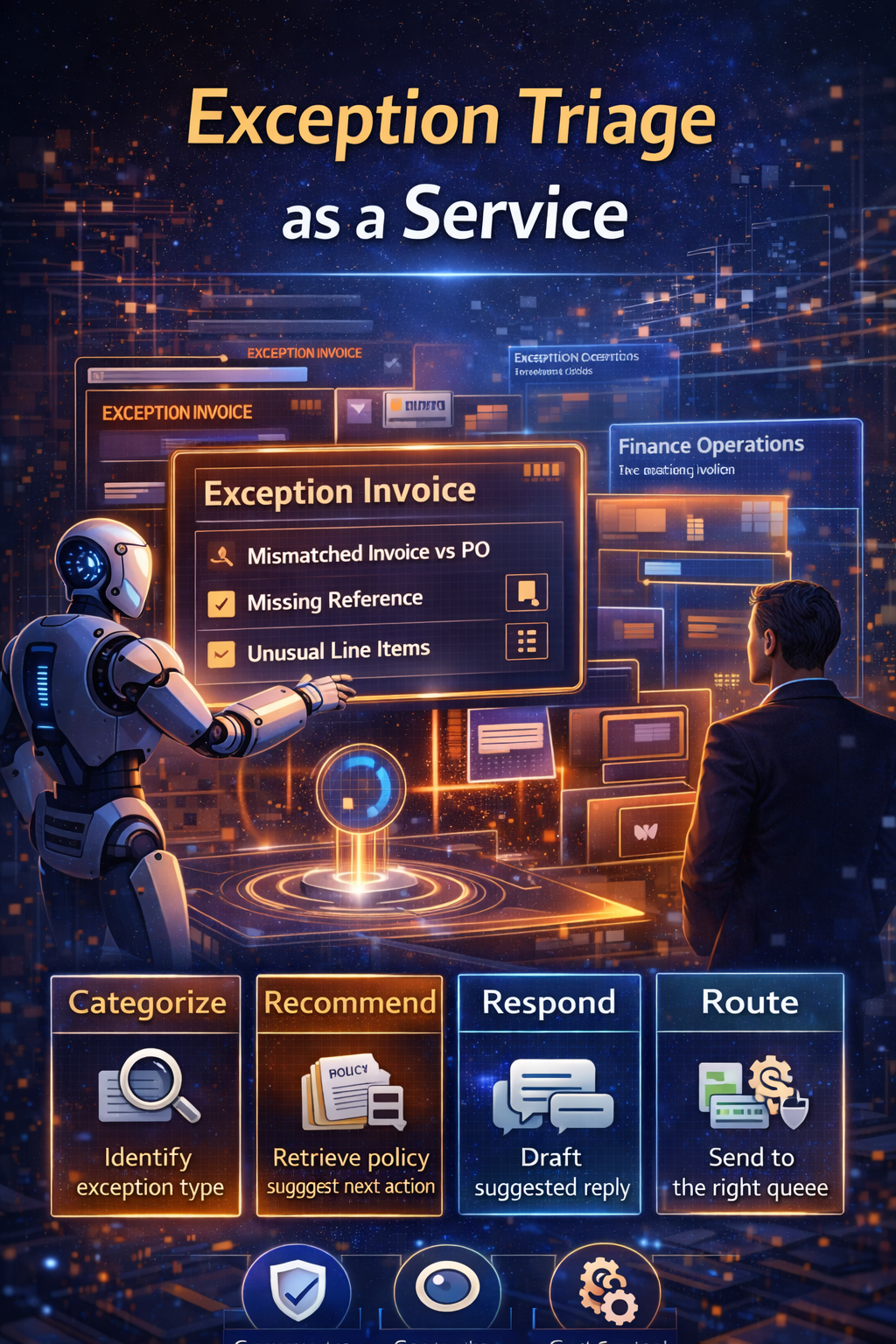
Example 1: Exception Triage as a Service
Instead of “classifying exceptions,” the service:
- Identifies exception type
- Retrieves relevant policies
- Recommends next action
- Routes to the right queue
- Escalates only when confidence is low
This becomes a reusable, governed service across teams.
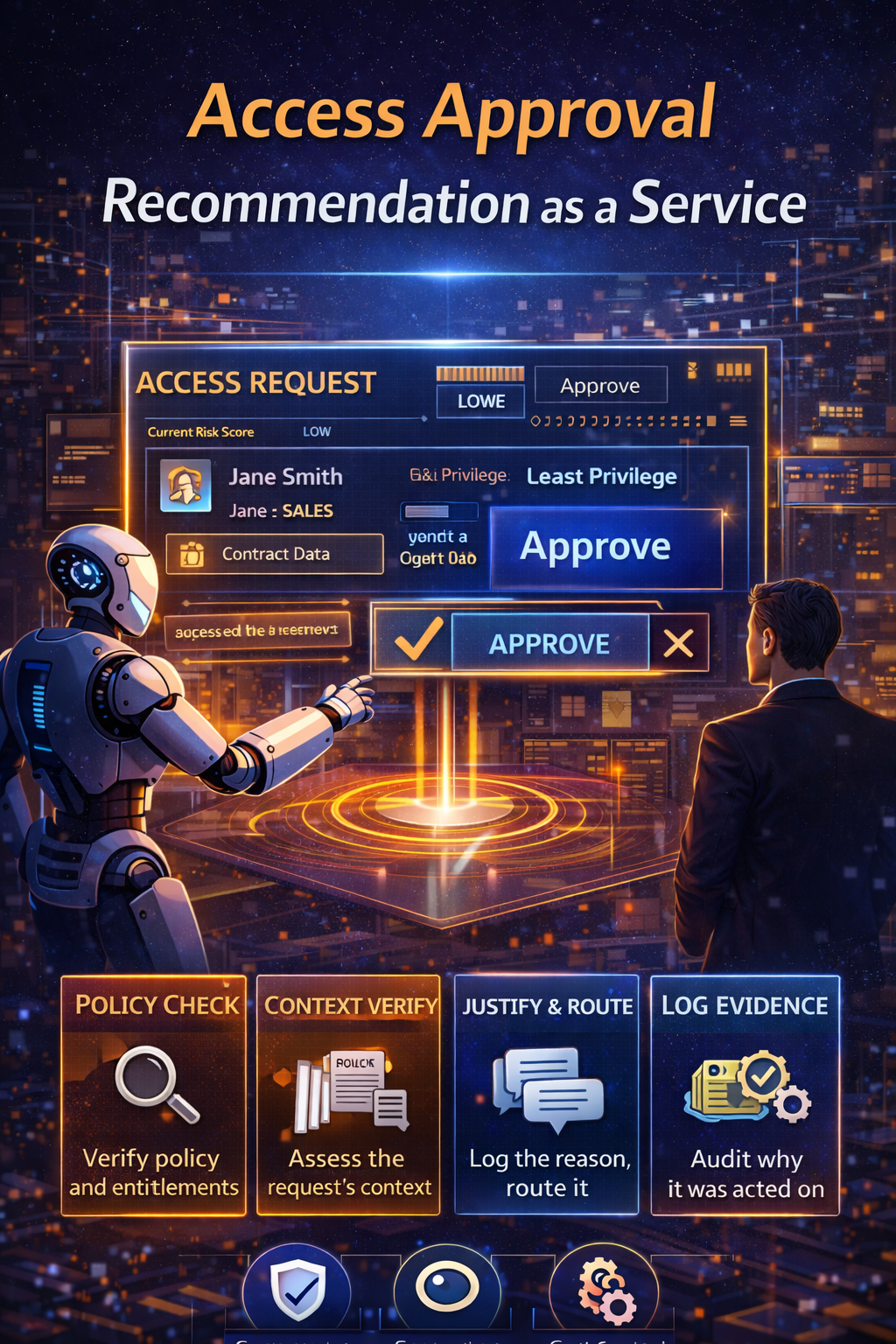
Example 2: Access Approval Recommendation as a Service
A catalog service:
- Checks policy and entitlement rules
- Verifies request context
- Records justification
- Routes to the correct approver
- Enforces least privilege
- Logs evidence for audit
This is managed autonomy, not blind automation.
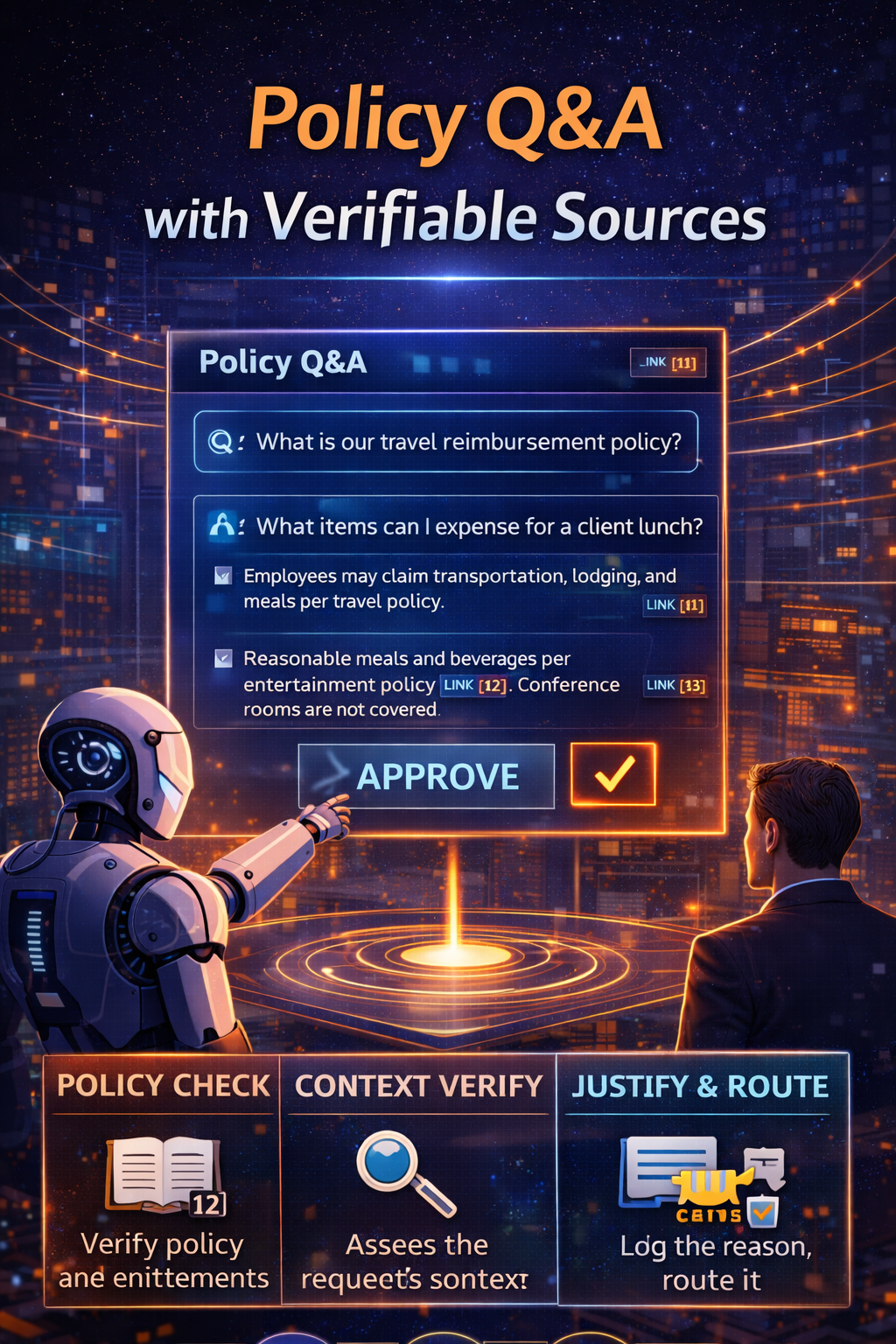
Example 3: Policy Q&A with Verifiable Sources
Unlike pilots that hallucinate, the service:
- Restricts retrieval to approved sources
- Returns citations
- Refuses when coverage is weak
- Logs evidence used
This prevents confident nonsense at scale.
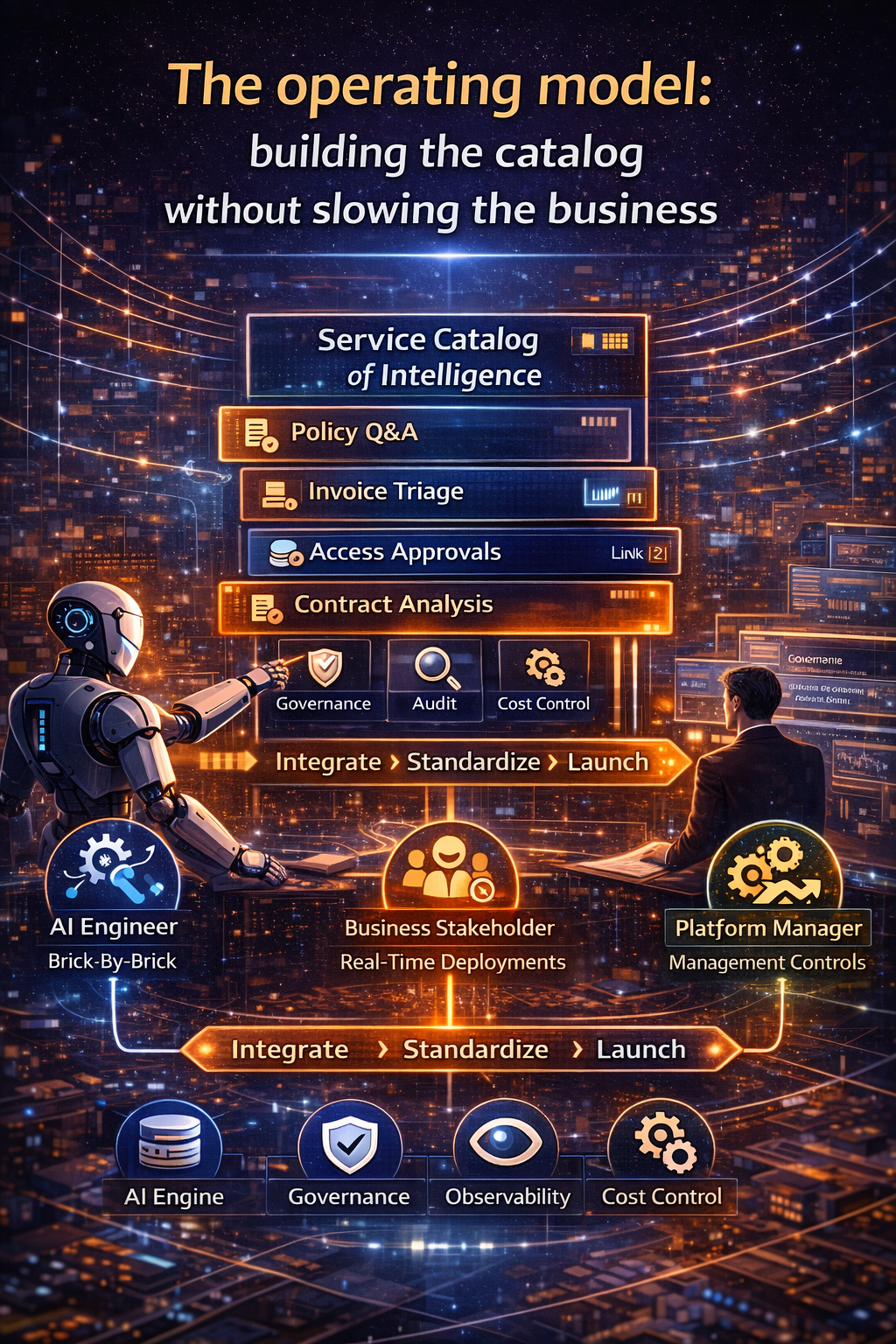
The operating model: building the catalog without slowing the business
A catalog succeeds when it is self-serve and governed.
Step 1: Start with high-volume, low-regret services
Clear outcomes, repetitive processes, recoverable errors.
Step 2: Standardize the service template
Outcome contract, boundaries, confidence rules, audit trail, fallback mode, cost envelope.
Step 3: Create lightweight approval paths
Risk classification, data boundary checks, security permissions, observability hooks.
Step 4: Make observability non-negotiable
If you can’t answer:
- What did it do?
- Why did it do it?
- What did it cost?
- Did it fail safely?
You don’t have an enterprise service—you have a demo.
Step 5: Run it like a product portfolio
Track adoption, deflection, escalation rates, incidents, and cost per request.
The winners don’t “launch AI.”
They run an AI product line.
Why this resonates globally
CXOs don’t want debates about models.
They want answers to five questions:
- What outcomes are we industrializing?
- What risks are we taking—and how are they contained?
- How do we prove what happened?
- How do we control costs?
- How do we scale without chaos?
A Service Catalog of Intelligence answers all five.
It also travels well across regulatory environments because it enforces:
- Policy consistency
- Auditability
- Data boundary control
- Region-aware deployment
This is why many enterprises are converging on what is increasingly described as an AI control plane—a unifying layer for governance, observability, and cost discipline.
Enterprise AI scales when intelligence becomes a catalog of reusable services—each with guardrails, audit trails, and cost envelopes—so teams can consume outcomes safely without rebuilding the plumbing.
Glossary
- Service Catalog of Intelligence: A curated portfolio of reusable AI services with standardized governance, observability, and cost controls
- Managed Autonomy: AI that can act within strict boundaries, escalating to humans only when needed
- Control Plane: The layer enforcing policy, identity, audit, and observability across AI services
- Cost Envelope: Predefined limits on spend-driving behaviors
- Human-by-Exception: Human intervention only when confidence is low or risk is high
FAQ
Does this replace MLOps?
No. MLOps ships models. A Service Catalog ships enterprise outcomes that may use many models and tools.
Is this only for agentic AI?
No. Start with assistive services and expand to action-taking services as governance matures.
Won’t this slow innovation?
It usually accelerates it—by eliminating reinvention and standardizing trust.
What’s the first metric to track?
Adoption and deflection, followed by escalation rate and cost per request.
Closing: why this wins the next phase
Agentic AI is not failing because models are weak.
It is failing because enterprises are trying to scale autonomy with a project mindset.
The next winners will build something more structural:
A Service Catalog of Intelligence—a governed marketplace of reusable AI services—so the enterprise can move fast and stay in control.
A few years from now, “AI pilots” will feel like the early days.
The real era will be when intelligence became orderable, operable, and auditable—just like every other enterprise-grade capability.
You can read more about this at
The Composable Enterprise AI Stack: From Agents and Flows to Services-as-Software – Raktim Singh



Raktim Singh is an AI and deep-tech strategist, TEDx speaker, and author focused on helping enterprises navigate the next era of intelligent systems. With experience spanning AI, fintech, quantum computing, and digital transformation, he simplifies complex technology for leaders and builds frameworks that drive responsible, scalable adoption.