
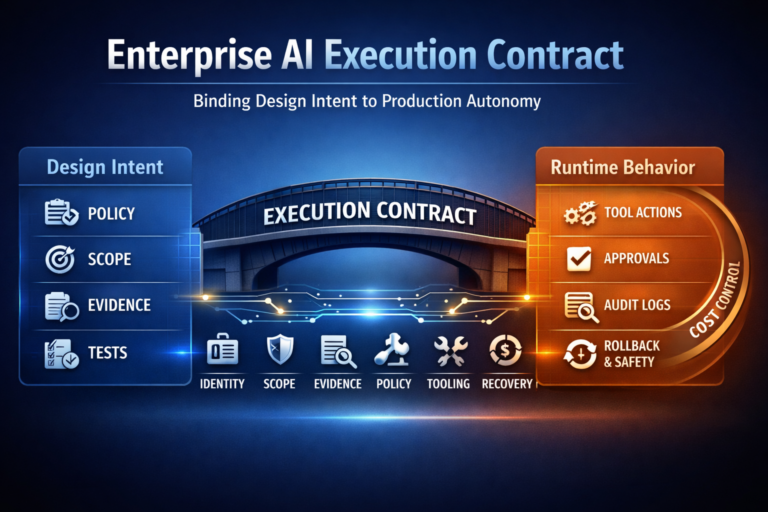
As enterprises move from AI that advises to AI that executes—approving requests, triggering workflows, updating records, granting access, and coordinating across systems—the central challenge is no longer model accuracy.
The challenge is ensuring that autonomous systems behave in production exactly as they were designed to behave—under policy change, drift, tool failures, and real-world ambiguity.
This is the purpose of the Enterprise AI Execution Contract: a practical, testable agreement that binds AI design intent to runtime behavior so autonomy can scale without losing control.
Key terms used in this article (quick reference)
- Execution Contract: A machine-enforced set of rules and guarantees that binds AI design intent to runtime behavior.
- Actioned workflow: A workflow where AI initiates or executes steps that change a system of record, trigger approvals, or commit an outcome.
- Reversible autonomy: The ability to undo, compensate, or safely contain AI-initiated actions when conditions change or errors occur.
Why enterprises need an execution contract now
When AI begins to take actions, the risk shifts:
The risk is no longer “wrong answers.”
It is “wrong outcomes” caused by actions.
Enterprise AI services are:
- Contextual (behavior depends on retrieved context)
- Probabilistic (non-deterministic under edge conditions)
- Tool-driven (APIs and connectors convert reasoning into real change)
- Policy-constrained (rules vary by region and evolve over time)
- Continuously changing (models, prompts, tools, and threats keep moving)
That is why AI can look “fine” in pilots and fail after it starts acting.
Enterprises need a translation layer between design intent and runtime execution—the same gap a Studio-to-Runtime architecture is designed to address.
The Execution Contract is that translation layer.
What is the Enterprise AI Execution Contract?
Definition:
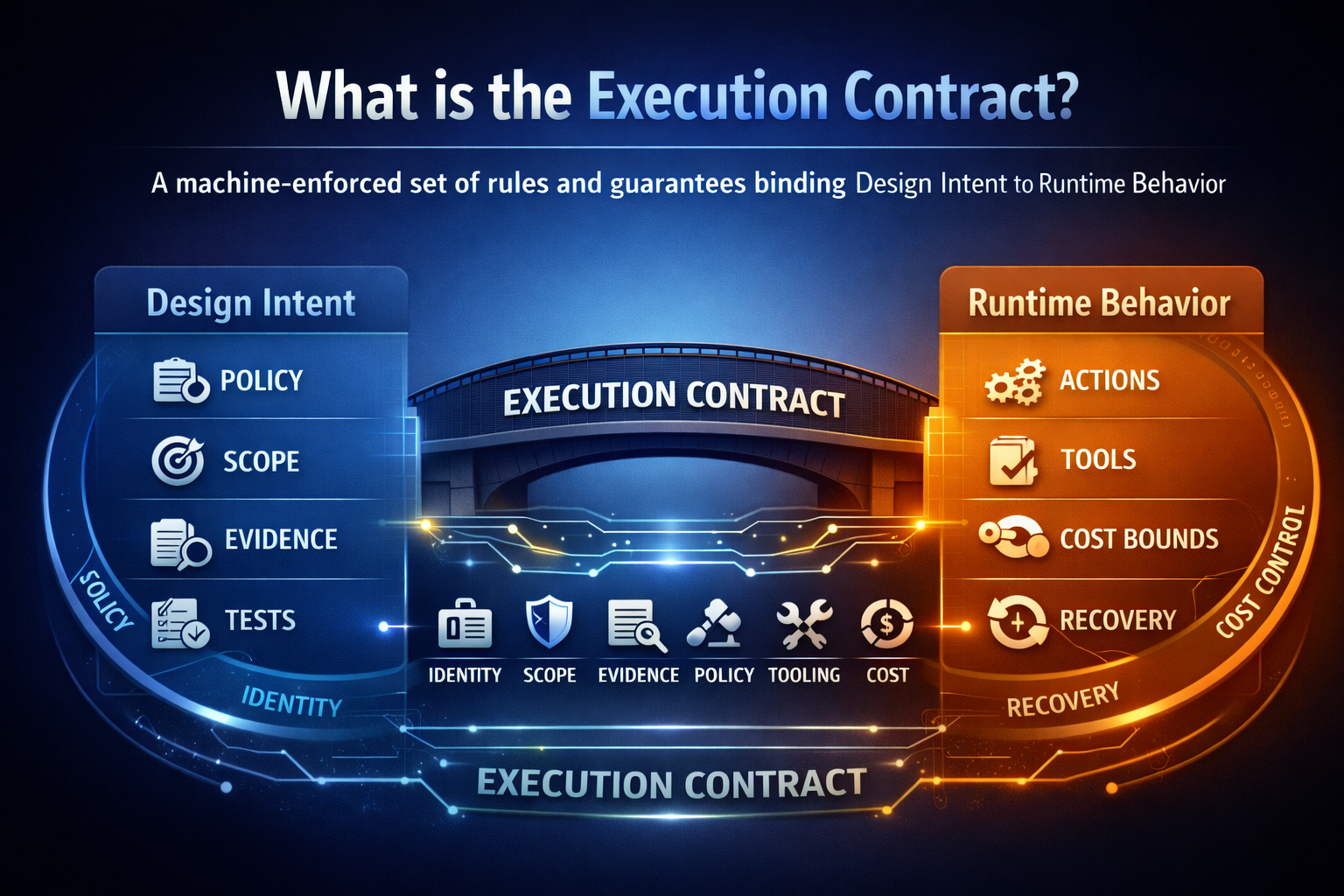
The Enterprise AI Execution Contract is a machine-enforced set of rules and guarantees that specifies what an AI-enabled service is allowed to do, under which conditions, with what evidence, at what cost, and how it must fail safely.
It ensures autonomy remains:
- Accountable (who did what, and why)
- Governed (policy enforced, not documented)
- Operable (observable, controllable, reversible)
- Economically bounded (cost limits, loop control, throttles)
- Change-ready (safe evolution under drift and upgrades)
It is not a document for approval.
It is a runtime truth.
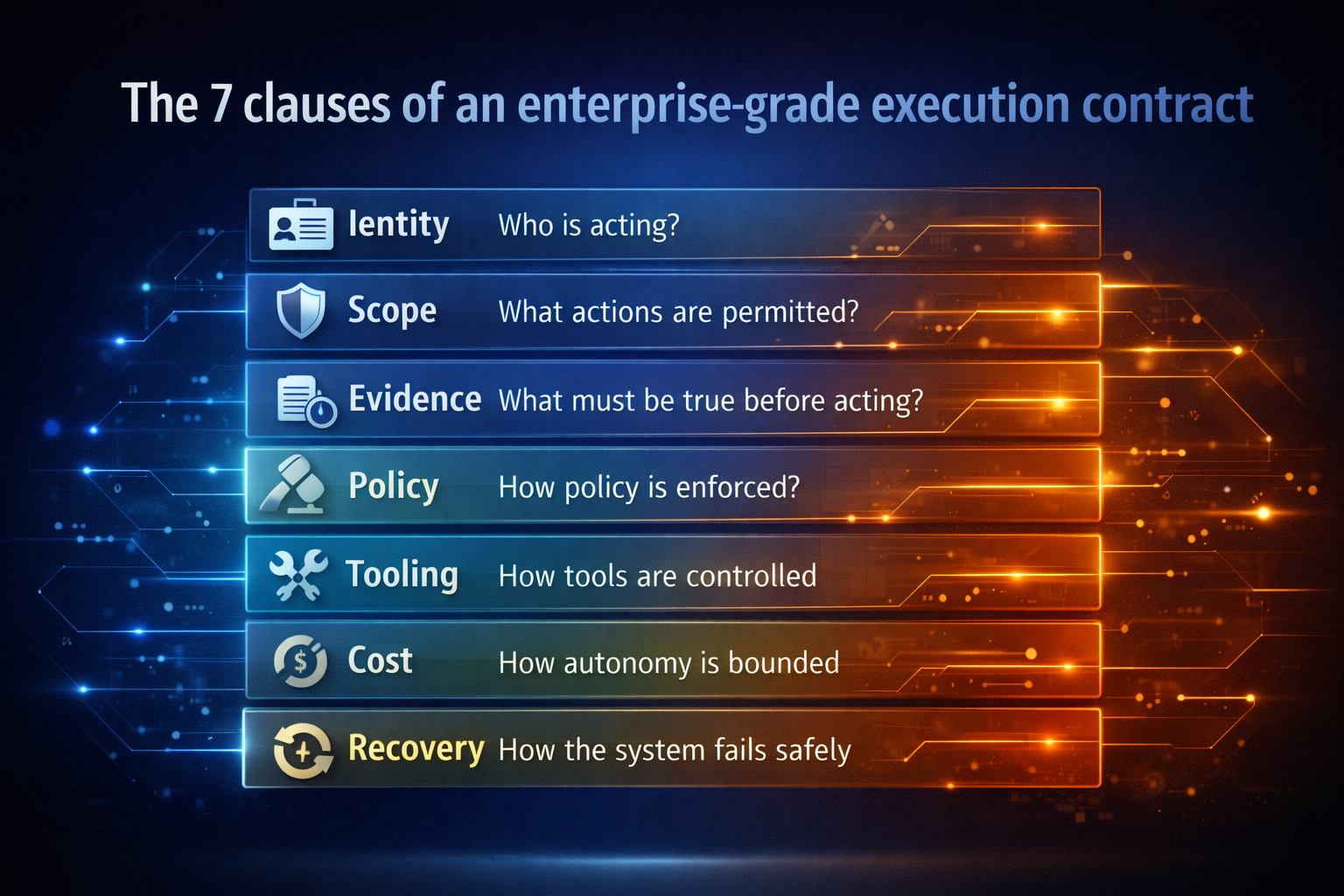
The 7 clauses of an enterprise-grade execution contract
1) Identity clause: Who is acting?
Every AI service must operate under a distinct non-human identity with:
- least-privilege permissions
- separation of duties (build vs approve vs run)
- a named human owner (accountability)
- traceable delegation (who enabled autonomy and when)
If the “who” is unclear, audit becomes storytelling.
2) Scope clause: What actions are permitted?
Define the action envelope:
- allowed action types (read, draft, recommend, execute)
- forbidden actions (never allowed)
- approval thresholds (when execution requires human sign-off)
- escalation triggers (risk, ambiguity, privilege)
Key rule: a system must not decide its own scope. Scope is designed.
3) Evidence clause: What must be true before acting?
Before any action, the service must present minimum evidence such as:
- policy version used
- source-of-truth references (with provenance)
- completeness checks (required fields, missing data)
- conflict checks (inconsistent records, stale context)
- evidence sufficiency signals (not “model confidence”)
Evidence is not explainability.
Evidence is the minimum proof required to act.
4) Policy clause: How policy is enforced at machine speed
Policies must be:
- versioned
- centrally governed
- consistently applied across channels
- testable through scenario suites
This clause prevents a common failure pattern:
chat is compliant, portal is not, email behaves differently, and nobody can prove which policy was applied.
5) Tooling clause: How tools are controlled
Tools are the highest-risk surface. The contract defines:
- tool allow-lists per service
- parameter validation and schema constraints
- rate limits and circuit breakers
- idempotency rules (avoid duplicate writes)
- safe fallbacks and timeouts
The model is rarely the dangerous part.
The tool call is.
6) Cost clause: How runaway autonomy is prevented
Define cost and loop bounds:
- budget per workflow instance
- max tool calls per run
- loop detection and stop conditions
- throttles per identity / per workflow / per domain
- cost-to-value thresholds (abort when marginal value collapses)
If cost is unbounded, autonomy becomes a financial incident.
7) Recovery clause: How the system fails safely
Every autonomous action must be designed for safe failure:
- kill switch / safe mode
- rollback hooks or compensating actions
- replayable traces for audit and incident review
- containment boundaries (blast radius control)
A simple maturity test:
If an action cannot be undone, it was not governed—it was tolerated.
A concrete example: “Refund decisioning” as a contracted enterprise AI service
Instead of “an agent that handles refunds,” define a contracted service:
- Identity: RefundDecisionService (non-human identity)
- Scope: may approve below a threshold; must escalate above it
- Evidence: policy version + transaction proof + eligibility checks
- Policy: versioned refund policy; region-specific thresholds
- Tools: read-only transaction API + controlled payout API (allow-listed)
- Cost: max retrieval passes; max payout attempts; loop stop rules
- Recovery: payout reversal workflow + full trace + kill switch
Now it is not an “agent.”
It is an operable enterprise service.
How to implement an execution contract without slowing teams
Step 1: Start from actioned workflows, not AI tools
Select 2–3 workflows where AI either:
- already executes actions, or
- is one toggle away from executing actions
Step 2: Write the contract in plain language, then encode it
Translate clauses into enforceable controls:
- tool allow-lists
- policy checks
- approval gates
- budgets and throttles
- trace + replay requirements
Step 3: Test behavior, not outputs
Build behavioral tests for:
- missing evidence
- policy mismatch
- tool failures mid-run
- ambiguous inputs
- cost overrun
- rollback/compensation success paths
Step 4: Productize as services-as-software
Once contracted, the service becomes reusable across:
- chat interfaces
- portals
- case systems
- partner channels
This is how reuse increases without multiplying risk.
Where the execution contract fits in the Enterprise AI Operating Model
The Enterprise AI Operating Model explains how organizations design, govern, and scale intelligence safely.
The Execution Contract is the mechanism that makes those goals enforceable:
- Design becomes explicit intent (scope + evidence + policy)
- Govern becomes runtime enforcement (identity + tool controls + auditability)
- Scale becomes safe reuse (contracted services across channels)
- Operate becomes reality (cost controls + reversibility + incident readiness)
Operating Model = the blueprint for running intelligence
Execution Contract = the enforceable runtime agreement that makes the blueprint true
Takeaway
Many organizations still build enterprise AI like this:
Model → prompts → tools → demo → production
A production-grade enterprise approach looks different:
Operating model → execution contract → controlled runtime → reusable services → continuous recomposition
The Execution Contract is the missing mechanism that converts “autonomy” into something enterprises can safely run.
Further reading in the Enterprise AI Operating Model (on this site)
- The Enterprise AI Operating Model: How organizations design, govern, and scale intelligence safely – Raktim Singh: How organizations design, govern, and scale intelligence safely
- Studio-to-Runtime: Why Enterprise AI Fails Without a Build Plane and a Production Kernel – Raktim Singh: Translating AI design intent into controlled execution
- The Synergetic Workforce: How Enterprises Scale AI Autonomy Without Slowing the Business – Raktim Singh: Designing work across humans, AI, and automation
- Continuous Recomposition: Why Change Velocity—Not Intelligence—Is the New Enterprise AI Advantage – Raktim Singh: Why change velocity is the new enterprise advantage
- AI Risk Management Framework | NIST
- ISO/IEC 42001:2023 – AI management systems
- OWASP Top 10 for Large Language Model Applications | OWASP Foundation



Raktim Singh is an AI and deep-tech strategist, TEDx speaker, and author focused on helping enterprises navigate the next era of intelligent systems. With experience spanning AI, fintech, quantum computing, and digital transformation, he simplifies complex technology for leaders and builds frameworks that drive responsible, scalable adoption.