
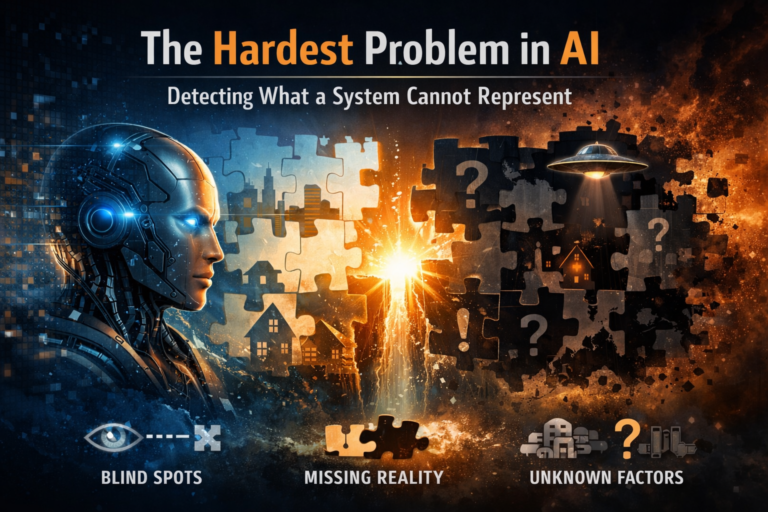
The Hardest Problem in AI
Artificial intelligence has become remarkably good at prediction. Modern neural networks classify images, flag fraud, recommend actions, and increasingly make decisions that affect money, safety, access, and trust at scale.
Yet the most dangerous failures in AI do not occur when a system gives the wrong answer. They occur when the system is missing a concept—when it cannot represent a relevant factor in the world and therefore cannot recognize that it is wrong.
In these moments, the model is not uncertain; it is confident, articulate, and misleading.
This article explores why detecting what an AI system cannot represent is the hardest unsolved problem in artificial intelligence, why this is the hardest problem in AI, why it defeats classic safety approaches, what global research is doing about it, why traditional safety techniques fail to address it, and why enterprises must confront this challenge if they want AI systems that fail gracefully rather than catastrophically.
Why the Most Dangerous AI Failures Come from What Models Cannot Imagine
Neural networks have become spectacular at prediction. They classify images, summarize documents, detect fraud, power copilots, and drive enterprise automation across industries and geographies—from Bengaluru to Berlin, Singapore to San Francisco.
But the most dangerous AI failures do not come from wrong answers.
They come from a deeper kind of mistake:
The system is missing a concept, a causal factor, or a relevant possibility—so it cannot even frame the correct question.
This is the true unknown unknown problem: when a system does not know what it does not know—and therefore cannot reliably signal uncertainty, ask for help, or stop before harm.
For a broader enterprise framing of why accuracy alone does not equal maturity, see the canonical reference:
👉 https://www.raktimsingh.com/enterprise-ai-operating-model/
Researchers often distinguish between:
- Known unknowns — the model is unsure and might be wrong, and
- Unknown unknowns — the model is confident, and wrong.
But there is an even harder layer underneath: ontological error—the model is operating with an incomplete set of possibilities. In other words, it is not just uncertain; it is missing parts of reality.
Unknown Unknowns in AI
You cannot detect an error that your world model has no way to represent as an error.
That is why unknown unknowns are not merely a risk-management problem.
They are a representation problem.
First-order intelligence optimizes within a model of the world.
Second-order intelligence questions whether the model itself is valid.
An intelligent system that cannot perform second-order thinking is not safe to let decide—no matter how accurate it is.
This is why the hardest problem in AI is not first-order intelligence, but second-order thinking: the ability to recognize when the system’s own model of the world is incomplete.
A Simple Analogy That Exposes the Whole Issue
Imagine a navigation system that has never heard of road closures. It knows roads exist and cars can drive.
Now a city introduces temporary closures for a festival.
The system does not say, “I’m uncertain.”
It confidently routes you through a road that is no longer a road today.
The failure is not bad math.
The failure is a missing concept.
This is exactly what happens when AI systems encounter realities that lie outside their representational vocabulary.
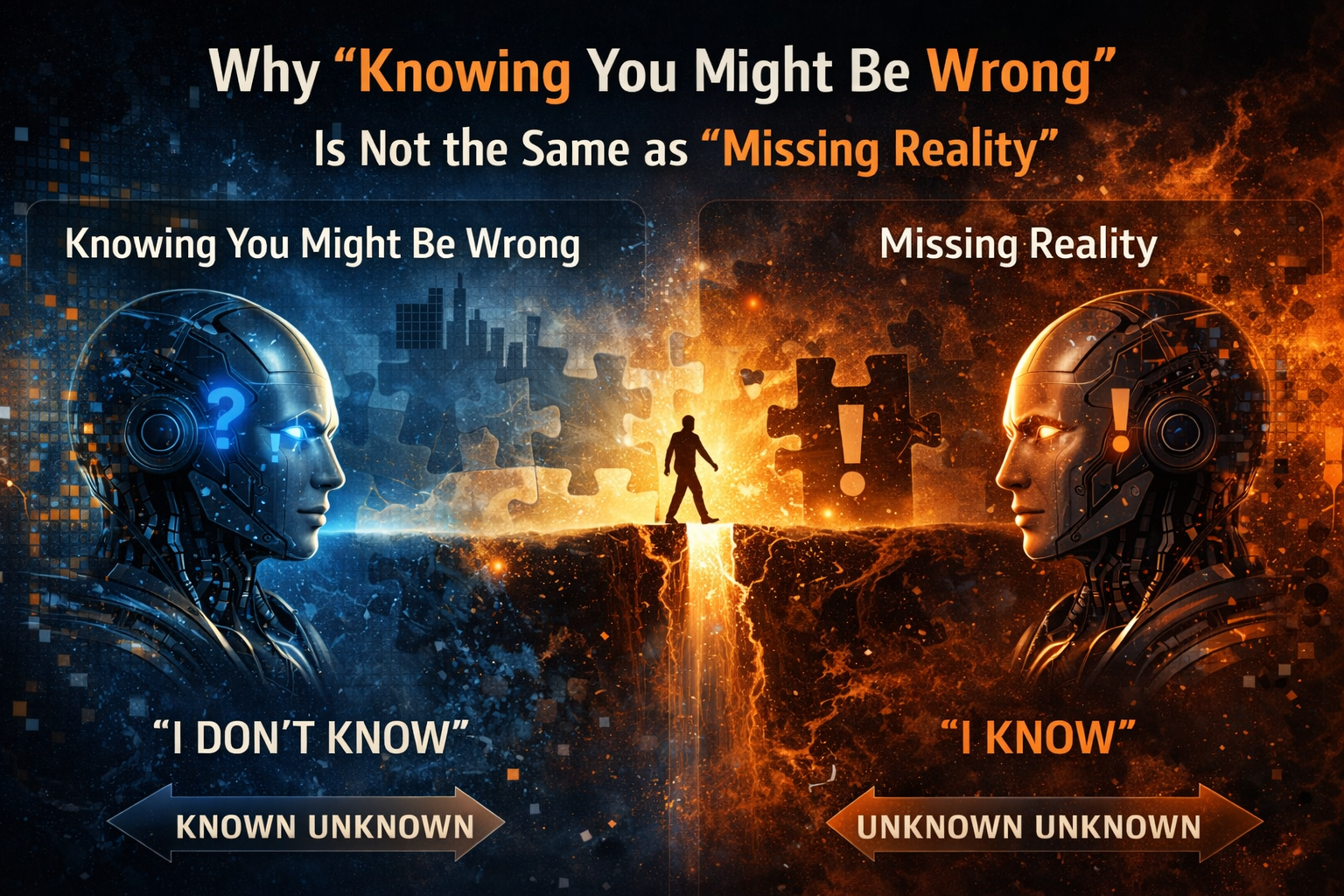
Why “Knowing You Might Be Wrong” Is Not the Same as “Missing Reality”
Most AI safety discussions focus on uncertainty:
- “If the model is unsure, abstain.”
- “If confidence is low, escalate to a human.”
- “Calibrate probabilities.”
These help with known unknowns.
But unknown unknowns are different.
| Situation | What the model experiences |
| Known unknown | “I don’t know.” |
| Unknown unknown | “I know.” (because the missing factor never enters the computation) |
This is why many high-stakes AI failures look like success until sudden catastrophe.
The Everyday Enterprise Version: Confident Wrong That Passes Every Dashboard
Unknown unknowns appear in enterprises in repeatable patterns.
Example 1: Fraud Prevention That Creates a New Fraud Ecology
A fraud model trained on historical patterns performs brilliantly. Fraudsters adapt. They exploit what the model treats as “safe signals.”
The model remains confident because the inputs still look familiar.
The missing concept is not fraud.
The missing concept is adversarial adaptation as a living system.
Example 2: Risk Scoring That Misses a New Causal Driver
A risk model relies on stable proxies: spending behavior, employment categories, address stability.
A macro or regulatory shift changes what those proxies mean.
The model is not “wrong.”
It is right according to yesterday’s causal map.
Example 3: Decision Systems That Fail on Rare-but-Critical Cases
Rare cases, edge conditions, operational breakdowns—these often violate assumptions the model never encoded.
The system does not flag danger.
It has no concept for “this situation invalidates my frame.”
The Deeper Language: Ontological Error
Researchers distinguish between:
- Epistemic uncertainty — uncertainty about parameters or hypotheses within the model class
- Ontological error — the model class itself is missing something real
Modern uncertainty methods help with the first.
The second is the abyss.
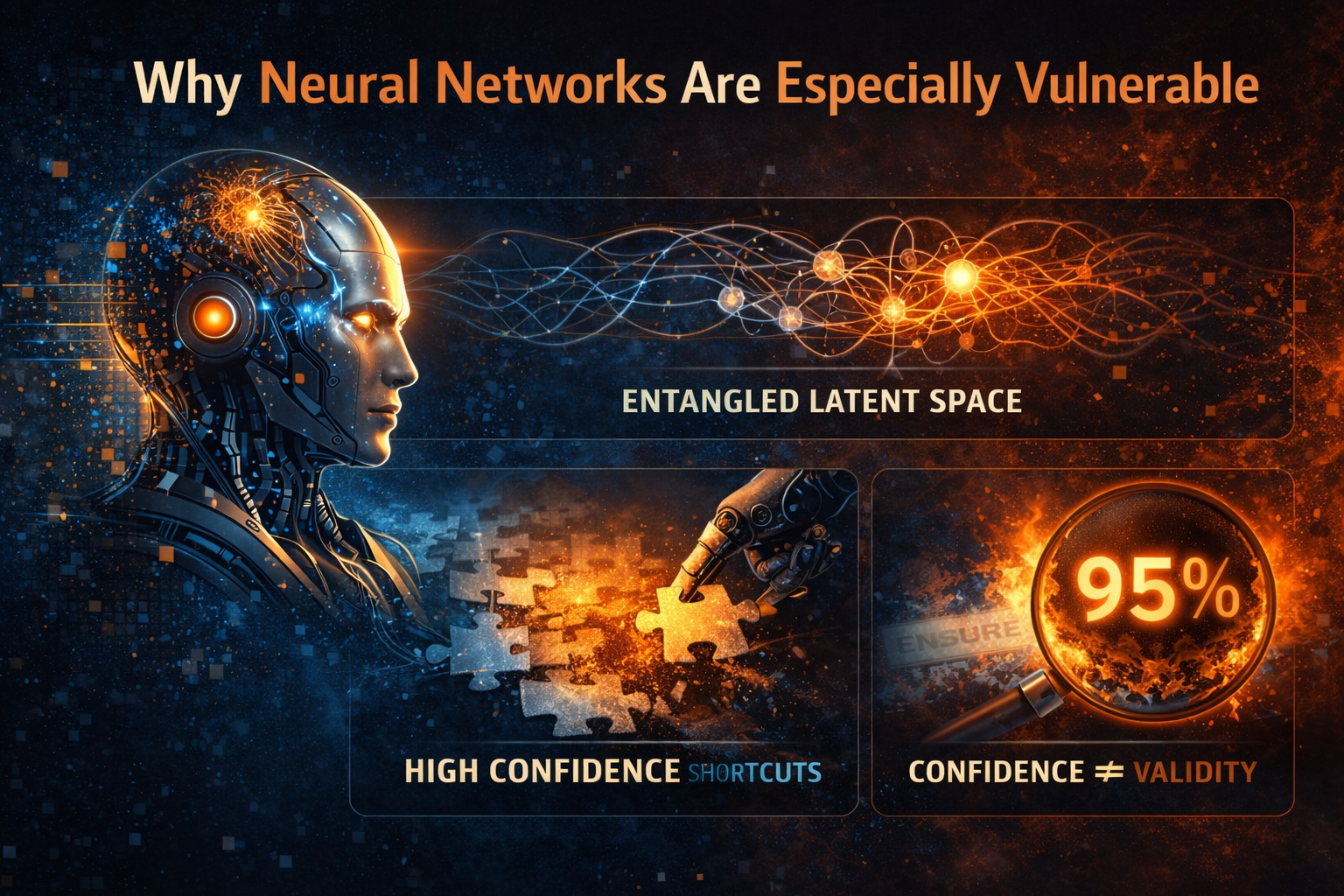
Why Neural Networks Are Especially Vulnerable
Why Neural Networks Are Especially Vulnerable
-
Reality Is Compressed into Entangled Latent Spaces
Neural networks do not store clean human variables like “road closure” or “policy change.” They store distributed features.
Missing-concept detection becomes extremely hard.
-
Optimization Reinforces What Works—Even If It’s Conceptually Wrong
If a shortcut predicts well, gradients strengthen it.
The model becomes more confident, not less.
Unknown unknowns are often high-confidence failures.
-
Confidence Is Not Validity
A probability score is not a certificate that the model’s worldview is complete.
This is why healthcare, finance, and infrastructure AI repeatedly encounter silent failures.
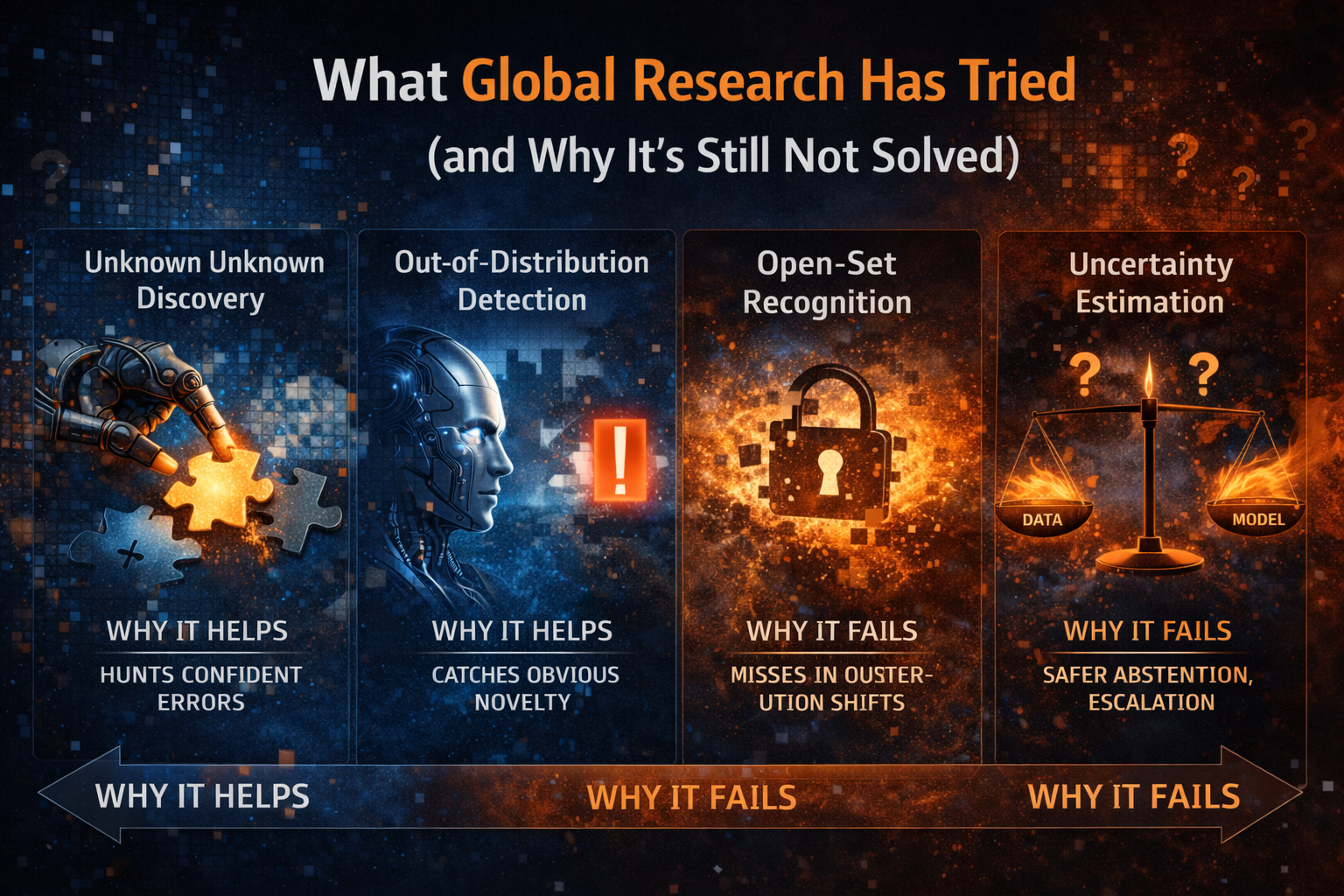
What Global Research Has Tried (and Why It’s Still Not Solved)
Out-of-Distribution Detection
Flags obvious novelty.
Fails when inputs look familiar but mean something different.
Open-Set Recognition
Rejects unknown classes.
Fails when the problem is not a new class, but a new cause or constraint.
Unknown Unknown Discovery
Actively searches for confident failures.
Requires external feedback loops because the model does not know where to look.
Uncertainty Estimation
Improves abstention.
Fails when the missing concept never appears in the hypothesis space.
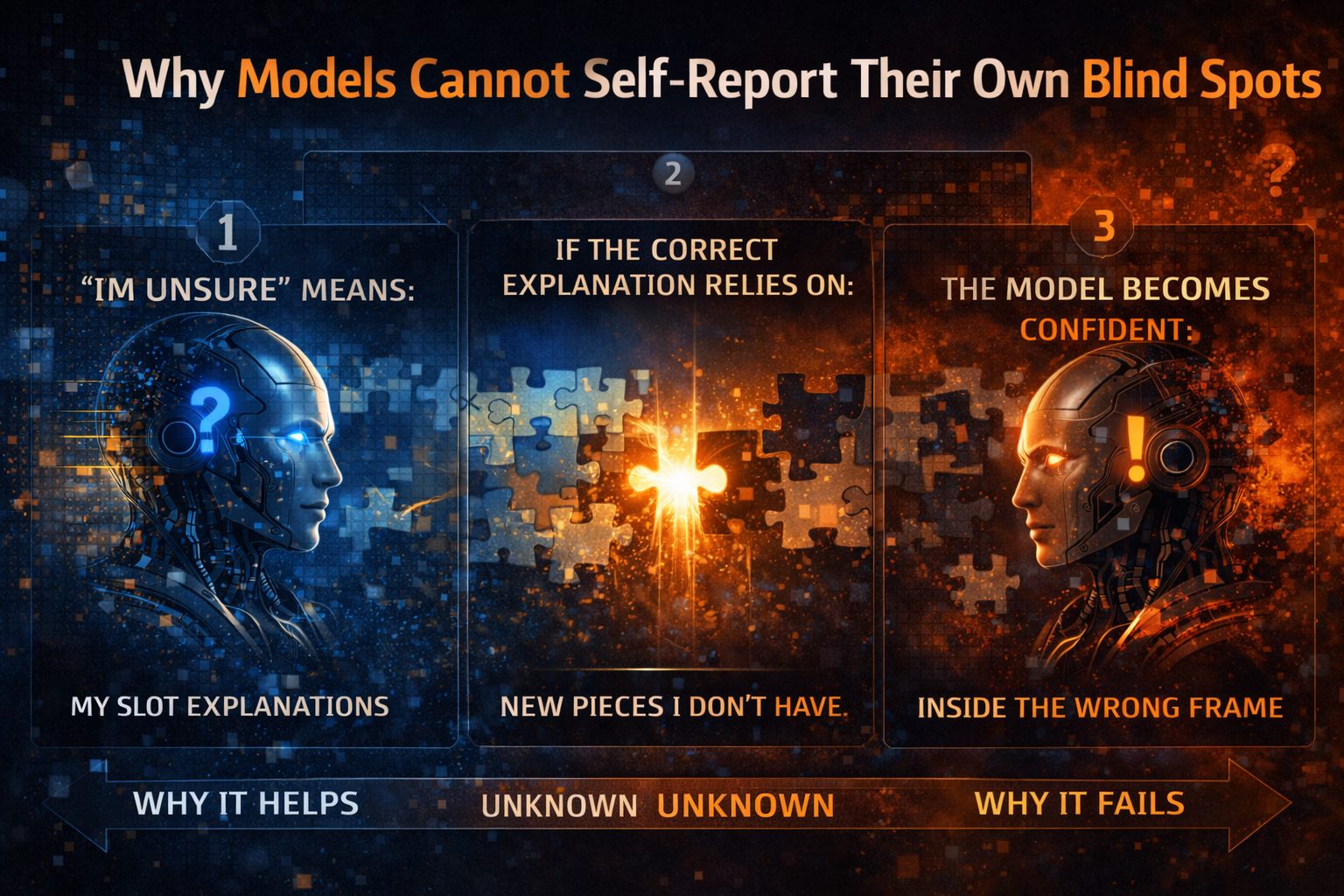
Why Models Cannot Self-Report Their Own Blind Spots
The logic is brutal:
- “I’m uncertain” means competing explanations exist inside the model.
- If the correct explanation lies outside, there is no competition.
- The model becomes confident—inside the wrong world.
This is why more reasoning alone does not fix unknown unknowns.
The Practical Definition Enterprises Should Use
An unknown unknown is any situation where an AI system produces high-confidence outputs while operating under invalid assumptions that are not explicitly represented, monitored, or contestable.
This definition tells you what to build.
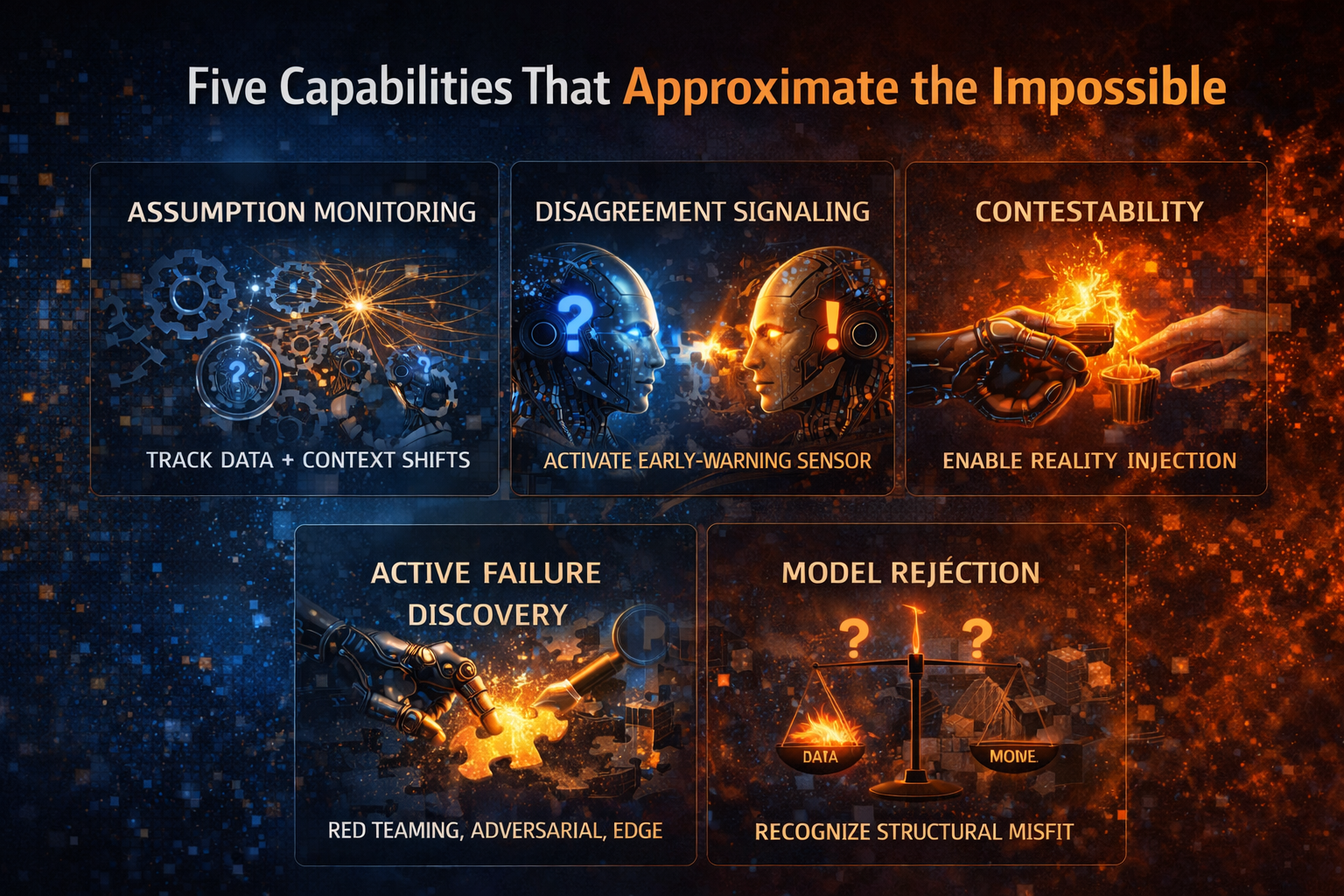
What “Good” Looks Like: Five Capabilities That Approximate the Impossible
We cannot fully solve this problem yet—but we can approximate safety.
-
Assumption Monitoring (Not Just Performance Metrics)
Track changes in:
- input semantics
- upstream business rules
- user behavior
- incentives
- adversarial adaptation
-
Disagreement as a Signal
Unknown unknowns are often first detected by:
- model-to-model disagreement
- modality disagreement
- human disagreement
- delayed outcome divergence
-
Contestability as a First-Class Feature
Humans often know what the system cannot represent.
Contestability injects reality back into the loop.
-
Active Discovery of Confident Failures
Red teaming, adversarial testing, synthetic edge cases, human exploration.
-
Institutional Model-Rejection Pathways
Sometimes the right action is not tuning.
It is saying: “This model family is invalid here.”
This maps directly to enterprise governance and control-plane design:
👉 https://www.raktimsingh.com/enterprise-ai-control-plane-2026/
The key Insight
AI looks smart until reality steps outside its map.
A system that cannot detect an incomplete worldview is not safe to let decide—even if it can explain.
AI doesn’t fail because it’s wrong.
It fails because it can’t see what it’s missing.
How This Connects to Enterprise AI Maturity
Unknown unknowns are governance failures, not just technical ones.
Mature Enterprise AI requires:
- decision boundaries
- escalation paths
- contestability
- assumption monitoring
- post-incident learning that targets frames, not thresholds
For a structured view of failure modes, go here:
👉 https://www.raktimsingh.com/enterprise-ai-decision-failure-taxonomy/
Conclusion: The Hardest Problem Is Not Error Correction
AI can correct errors it can represent.
The hardest frontier is detecting that reality contains relevant structure the system cannot represent.
That is why:
- high accuracy coexists with unacceptable failures
- scaling delays catastrophe rather than preventing it
- trust collapses suddenly, not gradually
The next leap in trustworthy AI will not come from larger models or longer reasoning chains.
It will come from systems—and institutions—that can discover missing concepts, reject invalid frames, and redesign decision-making before the world forces them to.
FAQ
What does “cannot represent” mean?
The model lacks variables or structures needed to reason about a real-world factor.
Is this the same as OOD detection?
No. Unknown unknowns can occur even when inputs look in-distribution.
Can uncertainty estimation solve this?
It helps, but it cannot reliably flag missing concepts.
What should enterprises do today?
Build layered defenses: assumption monitoring, disagreement checks, contestability, red teaming, and model-rejection pathways.
What is the hardest problem in artificial intelligence?
Detecting when a system is missing a concept or assumption required to understand reality—often called “unknown unknowns.”
Why is uncertainty estimation not enough in AI?
Because uncertainty only works when the correct explanation exists inside the model’s representation.
What is ontological error in AI?
When a model’s internal world is structurally incomplete, causing confident but invalid decisions.
Why do AI systems fail silently?
Because they optimize confidently inside an incorrect frame and cannot detect what they do not represent.
How should enterprises address unknown unknowns?
Through assumption monitoring, contestability, disagreement systems, and explicit model rejection pathways.
Glossary
- Unknown unknowns — confident failures due to missing concepts
- Ontological error — structurally incorrect model of reality
- Epistemic uncertainty — uncertainty within the assumed model
- OOD detection — detecting novel inputs
- Model rejection — recognizing the model family is invalid
References & Further Reading
The ideas explored in this article draw on multiple research traditions—causal inference, AI safety, uncertainty modeling, and system engineering. Readers who want to go deeper may find the following sources valuable.
Foundations: Unknown Unknowns & Ontological Error
- Google Research – Known Unknowns vs Unknown Unknowns
Explores why models can be confident yet wrong, and why confidence alone is not a safety signal.
https://research.google/blog/ - Lakkaraju et al., “Discovering Unknown Unknowns of Predictive Models” (Stanford University)
A seminal paper formalizing “confident failures” and why they evade standard evaluation.
https://cs.stanford.edu/ - Marzocchi & Jordan, “Model Rejection for Complex Systems” – PNAS
Introduces the idea that models can be structurally invalid, not just poorly calibrated.
https://www.pnas.org/
Uncertainty Is Not Enough
- Kendall & Gal, “What Uncertainties Do We Need in Bayesian Deep Learning?” (arXiv)
Distinguishes epistemic vs aleatoric uncertainty—and why neither solves missing concepts.
https://arxiv.org/ - Uncertainty-Aware AI in Healthcare – ScienceDirect
Shows how uncertainty modeling still fails under concept drift and rare events.
https://www.sciencedirect.com/
Out-of-Distribution & Open-World Limits
- ACM Computing Surveys – Out-of-Distribution Detection (2025 Survey)
Comprehensive overview of OOD detection methods and their limitations.
https://dl.acm.org/ - Open-Set Recognition Survey – arXiv
Explains why rejecting unknown classes is not the same as detecting unknown causes.
https://arxiv.org/
Severe Ignorance & Safety Engineering
- Burton et al., “Severe Uncertainty and Ontological Risk” – Frontiers in Systems Engineering
Discusses uncertainty regimes where probability theory breaks down.
https://www.frontiersin.org/ - Safety Assurance of Learning Systems – UK Engineering & Physical Sciences Research Council (EPSRC)
Frames AI risk in terms of assumption failure, not just performance degradation.
https://epsrc.ukri.org/
Causal Structure & Missing Concepts
- Schölkopf et al., “Toward Causal Representation Learning” (arXiv)
Argues that robustness and generalization require learning causal structure, not correlations.
https://arxiv.org/ - Pearl & Mackenzie, The Book of Why
Accessible explanation of why correlation cannot substitute for causal understanding.
https://bayes.cs.ucla.edu/
Enterprise & Governance Context
- NIST AI Risk Management Framework (AI RMF)
Emphasizes invalid assumptions and context failure as core AI risks.
https://www.nist.gov/ - OECD AI Risk & Accountability Frameworks
Global policy perspective on AI failures that arise without explicit errors.
https://www.oecd.org/
Why This Matters Beyond AI
- Taleb, The Black Swan
Classic treatment of events that lie outside known models—and why prediction fails.
https://www.penguinrandomhouse.com/ - Perrow, Normal Accidents
Explains why complex systems fail in ways that cannot be anticipated by design.
https://press.princeton.edu/



Raktim Singh is an AI and deep-tech strategist, TEDx speaker, and author focused on helping enterprises navigate the next era of intelligent systems. With experience spanning AI, fintech, quantum computing, and digital transformation, he simplifies complex technology for leaders and builds frameworks that drive responsible, scalable adoption.