
The Representation Strategy of the Firm:The real AI question most firms are still missing
Most firms still think their AI strategy is about models, copilots, automation, and data platforms. That is too narrow.
The deeper strategic question is this:
What reality enters the machine, and whose reality never makes it in?
That question matters more than most executives realize. Around the world, the center of gravity in AI governance has already begun shifting. The conversation is no longer only about whether a model is accurate, fast, or powerful.
It is increasingly about whether institutions can govern AI systems responsibly, account for harms, preserve trust, and ensure that the people and realities affected by AI are not silently excluded. That broader direction is visible across NIST’s AI Risk Management Framework, the OECD AI Principles, UNDP’s recent work on algorithmic exclusion, EEOC guidance on employment uses of AI, and EU AI Act risk-management requirements. (NIST)
This shift has a major strategic implication.
In the AI economy, firms will not compete only on intelligence.
They will compete on representation: on how well they can make reality machine-legible before AI begins to reason over it and act on it.
The firms that win will not simply be the ones with the biggest models or the fastest deployments. They will be the firms that represent more of the real world, represent it more faithfully, refresh it more intelligently, and govern action more legitimately. That is the strategic foundation of what I call Representation Economics: the emerging logic by which value, trust, power, and long-term advantage increasingly depend on how reality is made visible to machine systems. This article extends that broader body of work on the Representation Economy, the Representation Boundary, the Representation Utility Stack, Representation Due Diligence, Representation Collapse, and related themes already developed in your site’s canon.
Representation Strategy is the discipline of deciding what reality must be visible to AI systems before they act.
Firms that win in the AI economy will not be those with the most automation, but those that represent reality most completely.
Why this article matters now
Every AI system has silent stakeholders.
They may be customers who do not generate rich digital signals. They may be suppliers far from the center of the enterprise. They may be workers whose frontline knowledge never reaches the dashboard. They may be communities indirectly affected by automated decisions. They may be future risks that do not yet appear in historical data. They may even be physical realities that create weak, delayed, or messy digital traces.
They are “voiceless” not because they do not matter.
They are voiceless because the institution has not built the machinery to hear them clearly.
That matters because AI does not optimize reality. It optimizes what the institution has managed to represent.
And that creates one of the most dangerous distortions in the AI era:
What is easy to measure gets represented.
What is hard to capture gets ignored.
What is ignored eventually gets harmed.
This is not only an ethical issue. It is a business issue. It shapes hidden risk, strategic blindness, customer trust, regulatory exposure, operational resilience, and long-term growth.
The firm that learns to represent the voiceless is not being charitable.
It is building the next real source of durable advantage.

Section 1: The silent stakeholder problem
Sub-section 1.1: A simple lending example
Consider a small-business lending system.
A bank may build an AI model that can see repayment history, tax records, account flows, transaction volumes, and cash movement patterns. On paper, that looks like a rich decision system.
But what if the model cannot see supplier dependency?
What if it cannot see neighborhood disruption?
What if it cannot see seasonal fragility?
What if it cannot see whether a merchant is surviving because of community trust that never appears in formal digital signals?
Now imagine two businesses with similar formal financial patterns. One is fragile. The other is resilient. The model sees them as similar because the most important difference never entered the system.
The institution then calls the result intelligence.
But it is not intelligence. It is optimization over a partial map.
No amount of sophisticated modeling can recover what the institution never represented in the first place. NIST’s AI RMF is built around exactly this broader concern: organizations must manage risks across the AI lifecycle, including impacts on people, organizations, and society, not merely chase model performance in isolation. (NIST)
Sub-section 1.2: Hiring shows the same failure in a different form

The same pattern appears in hiring.
An AI screening system may rank candidates based on keywords, role similarity, education markers, continuity of employment, assessments, and prior resume patterns. But what if the strongest candidate took an unconventional path? What if the person built real-world judgment through unusual roles, nonlinear work, or skill transfer that the system cannot parse cleanly?
The institution may end up selecting what is digitally neat instead of what is organizationally valuable.
That is not just a fairness issue. It is a strategic failure in talent recognition.
The EEOC has repeatedly warned that AI and automated systems used in employment can create discriminatory outcomes and still remain subject to existing anti-discrimination law. The lesson is wider than compliance: when an institution confuses parseability with value, it starts systematically filtering out forms of capability it never learned to represent. (EEOC)
Sub-section 1.3: Healthcare made the proxy problem impossible to ignore
Healthcare offers one of the clearest illustrations.
A widely cited 2019 Science study showed that a healthcare algorithm used costs as a proxy for health needs. Because costs were an imperfect and unequal proxy, the system underestimated care needs for Black patients. The problem was not that the model could not calculate. The problem was that the institution used the wrong representation of reality. (Science)
This is one of the most important lessons in the AI era:
When firms use proxies for reality and then forget that they are proxies, AI can become highly confident and deeply wrong at the same time.
Sub-section 1.4: This is now everywhere
The same logic now applies across:
- insurance claims
- customer support
- fraud detection
- supply chain risk
- dynamic pricing
- workforce planning
- ESG reporting
- public service delivery
- healthcare triage
- education personalization
In each case, the strategic question is not only whether AI can process the available inputs.
The real question is whether the firm has built the capability to represent the full decision reality well enough for AI to act safely, profitably, and legitimately.
UNDP’s recent work on “data deserts” makes this point especially clearly: when local infrastructure, context, and social realities do not enter the system, exclusion is not an accident. It becomes a structural design outcome. (UNDP)
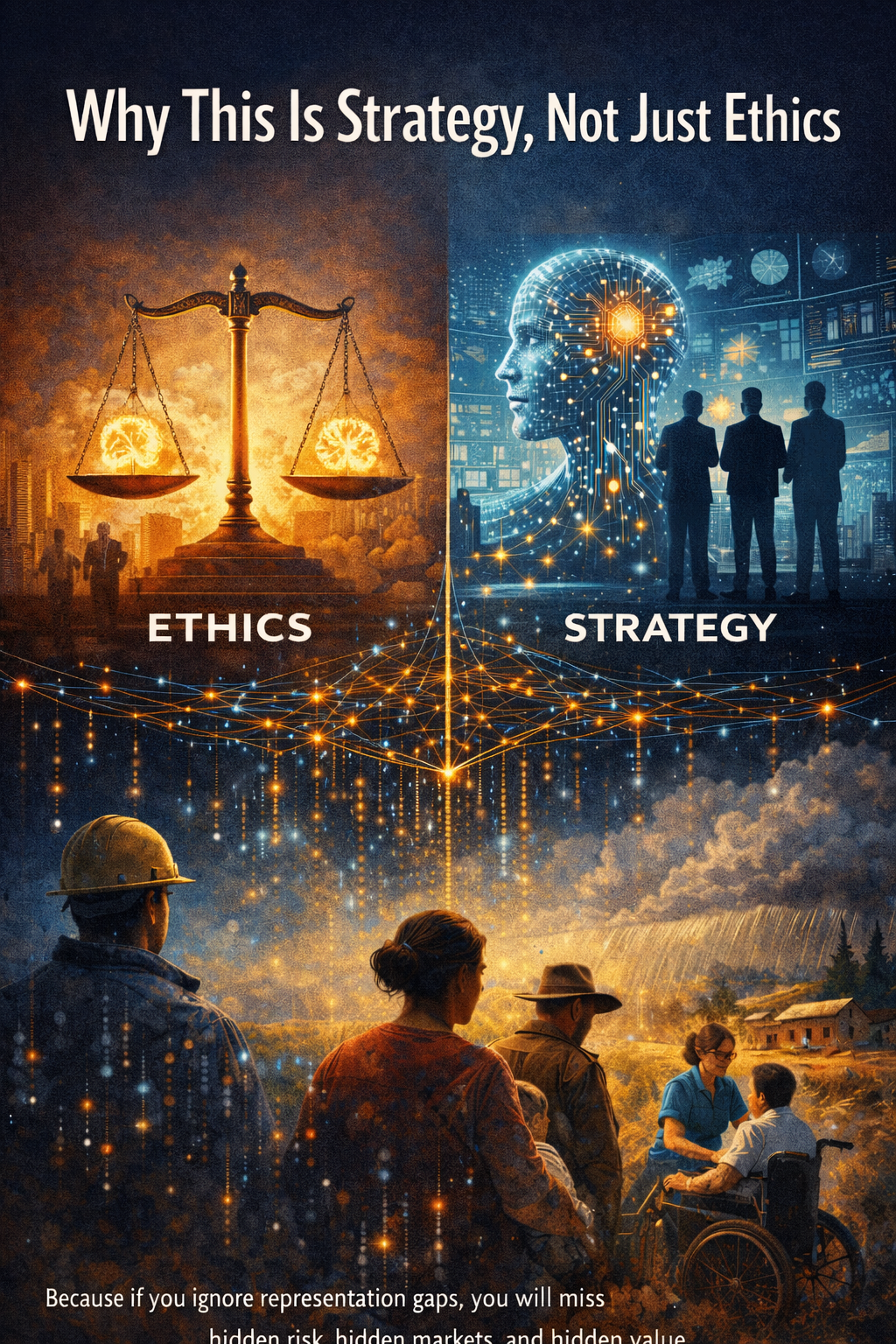
Section 2: Why this is strategy, not just ethics
Many leaders instinctively place this topic under ethics, fairness, or responsible AI.
That is too small a frame.
The representation strategy of the firm is a strategy question because it shapes four things that determine long-term advantage.
Sub-section 2.1: It shapes what the firm can optimize
AI cannot optimize for realities the institution has failed to encode.
If a system cannot represent supplier fragility, customer vulnerability, weak-signal demand, operational nuance, or invisible dependencies, then it is optimizing on a partial map.
And partial maps create expensive certainty.
Sub-section 2.2: It shapes what the firm can see early enough to matter
Risk is often treated as something the model “gets wrong.”
But many of the most damaging failures begin earlier than that.
They begin when the institution never captured the relevant reality well enough for the model to reason over it.
That is why the EU AI Act emphasizes ongoing lifecycle risk management for high-risk systems, not just one-time testing. It is also why recent WEF work frames effective AI governance as a business growth capability rather than a compliance burden. (Artificial Intelligence Act)
Sub-section 2.3: It shapes whether trust can scale
Trust is not built because a model is impressive.
Trust scales when institutions can explain:
- whose interests are represented,
- which risks are visible,
- where proxies are being used,
- how decisions are governed,
- and what recourse exists when the system is wrong.
The OECD AI Principles and recent WEF work both reinforce this direction: trustworthy AI is not an abstract ethical aspiration but an operational condition for scale. (OECD)
Sub-section 2.4: It shapes where future growth will come from
AI naturally over-serves what is already visible:
the customer with rich digital history,
the workflow with perfect instrumentation,
the market with easy feedback loops,
the operation with clean structured data.
But the next growth frontier often sits elsewhere:
in smaller suppliers, underserved users, fragile environments, under-modeled processes, and invisible edge conditions.
Some of the most valuable opportunities in the AI era will come not from optimizing what is already visible, but from making previously under-represented reality newly legible.
That is why this is not only an ethics story.
It is a market-creation story.
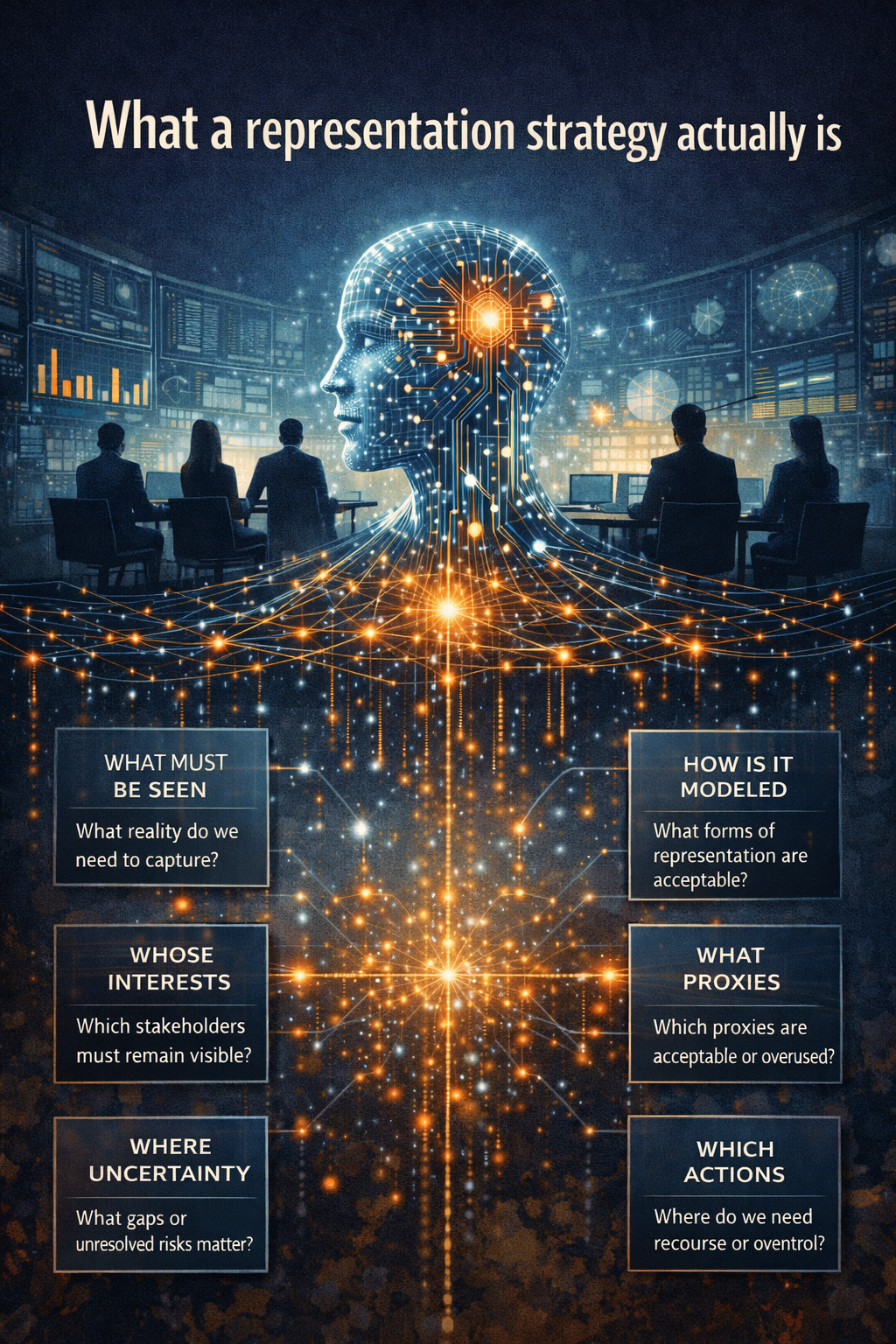
Section 3: What a representation strategy actually is
A representation strategy is the discipline by which a firm decides:
- what must be seen,
- how it will be modeled,
- whose interests must remain legible,
- what proxies are acceptable,
- where uncertainty is intolerable,
- and which actions require recourse before AI is allowed to scale.
This is bigger than data strategy.
Data strategy asks what data the firm owns, collects, or can access.
Representation strategy asks whether the firm has built a sufficiently faithful, current, contextualized, and governable picture of reality for machines to act on it responsibly.
That is a much harder question.
It is also the one that will increasingly determine who wins.
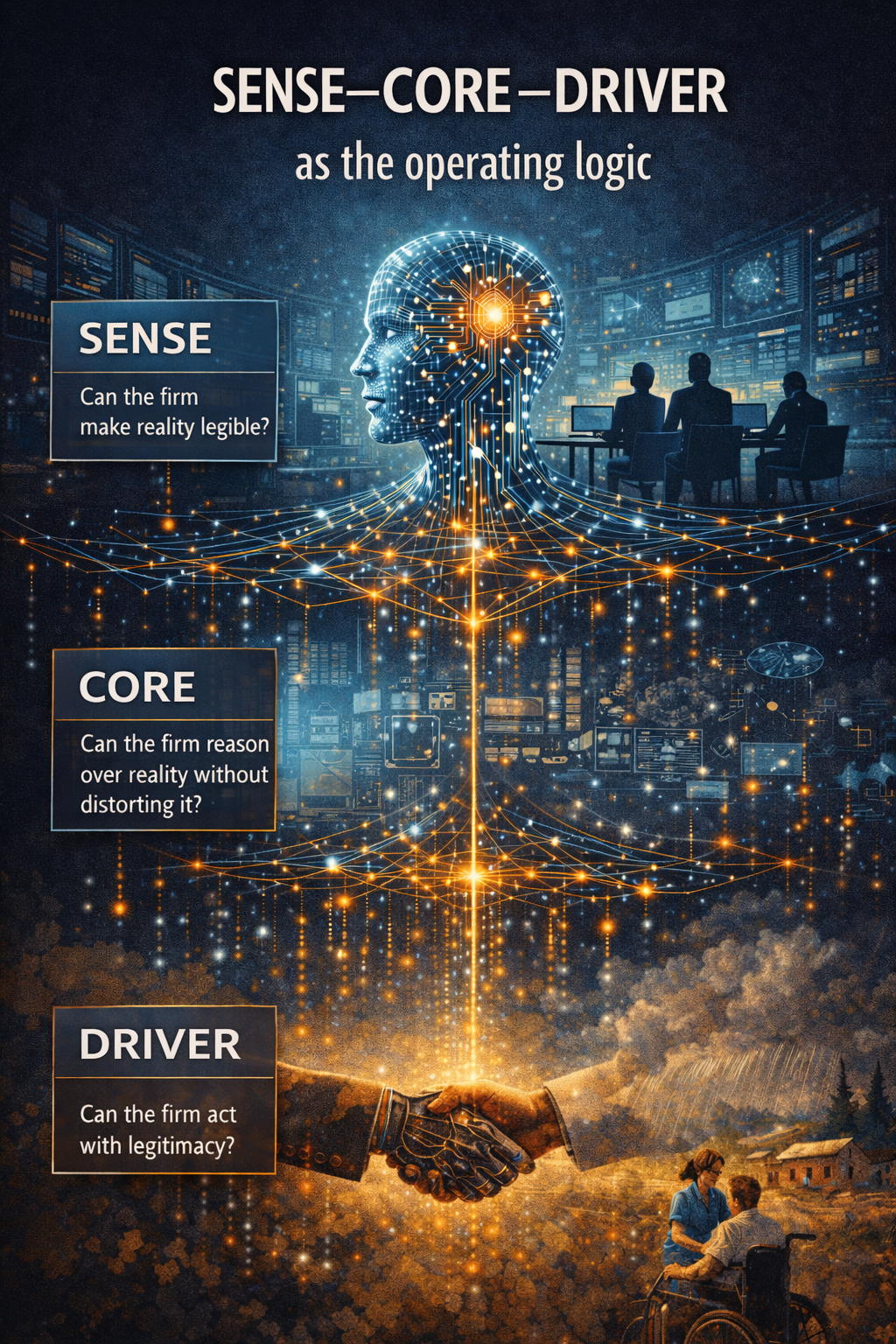
Section 4: SENSE–CORE–DRIVER as the operating logic
The easiest way to understand representation strategy is through the SENSE–CORE–DRIVER framework.
Sub-section 4.1: SENSE — can the firm make reality legible?
SENSE is the layer where reality becomes machine-readable.
It is about signals, entities, state representation, and evolution over time.
In simple terms, SENSE asks:
- What can the institution detect?
- What can it identify?
- What can it model?
- What can it update as the world changes?
A firm with weak SENSE may have vast amounts of data and still miss the thing that matters.
It may know transaction counts but not customer strain.
It may know delivery times but not route fragility.
It may know output metrics but not why the frontline process keeps failing.
UNDP’s current work on algorithmic exclusion is important here because it reminds us that what does not enter the system cannot benefit from the system. (UNDP)
Sub-section 4.2: CORE — can the firm reason without distorting reality?
CORE is the cognition layer.
It is where the system interprets context, optimizes decisions, evaluates options, and updates through feedback.
But CORE is only as good as the reality it receives.
If the institution feeds AI a thin, outdated, proxy-heavy, or badly structured picture of the world, then even a powerful model will reason over distortion.
This is one of the deepest misunderstandings in the current AI market:
better reasoning does not repair missing reality.
Sub-section 4.3: DRIVER — can the firm act with legitimacy?
DRIVER is where decisions become real-world action.
It is about delegation, representation, identity, verification, execution, and recourse.
Who authorized the action?
Who is affected?
How is the decision checked?
How is it reversed?
What happens if the institution was wrong?
This matters because when AI acts on incomplete representation, the result is not just a bad score. It can deny a service, reduce a limit, reroute a worker, escalate an investigation, prioritize the wrong supplier, or quietly distort who gets attention and who does not.
That is why governance is not a side issue. It is part of the action layer itself.
Sub-section 4.4: The simple summary
Put simply:
SENSE decides whether reality enters the machine.
CORE decides how the machine interprets that reality.
DRIVER decides whether action remains legitimate when reality was incomplete.
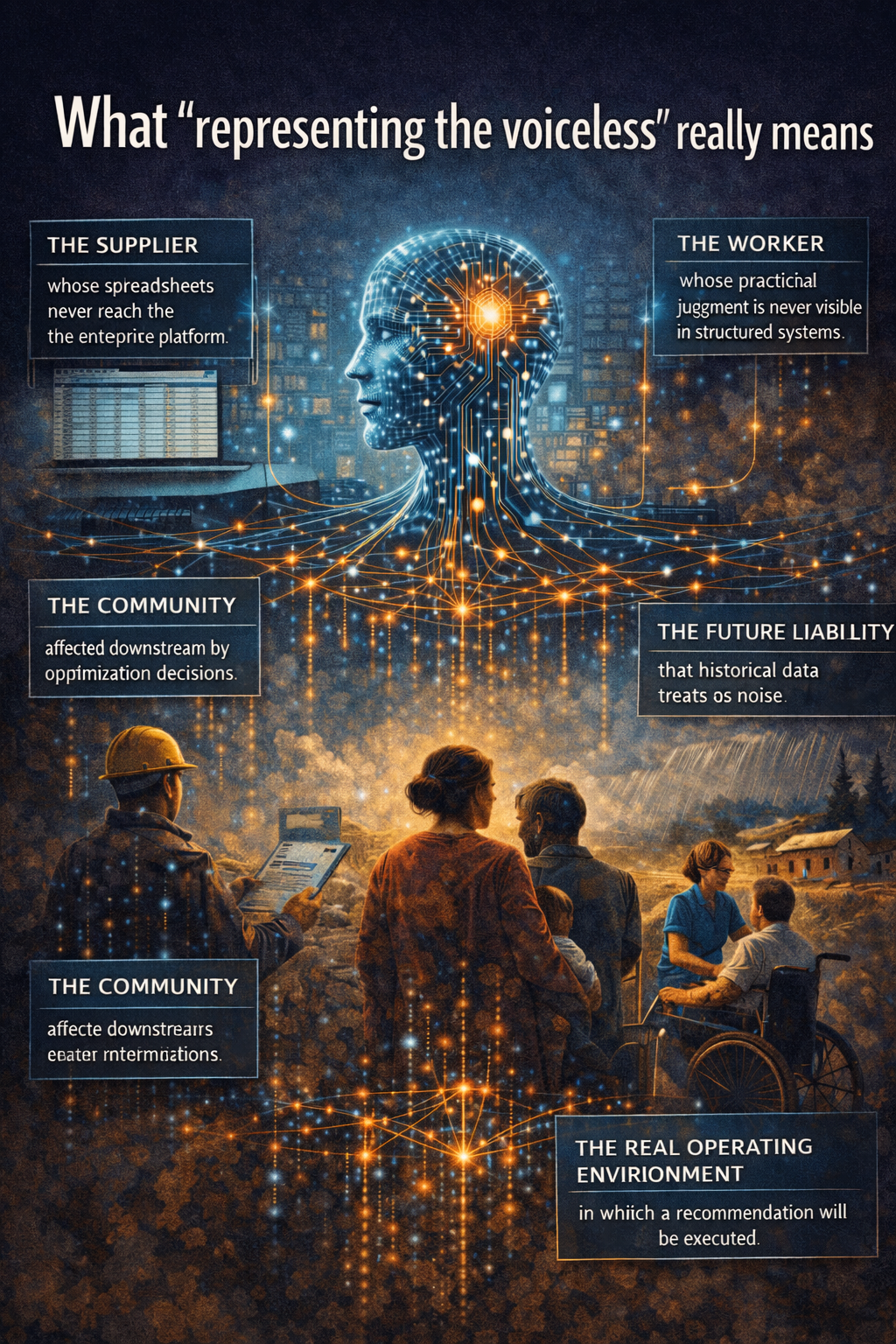
Section 5: What “representing the voiceless” really means
This phrase should not be misunderstood.
It does not mean turning firms into activists.
It means recognizing that every institution has stakeholders and realities that are under-captured by default.
These may include:
- the customer who interacts rarely but suffers deeply when the system is wrong,
- the supplier whose spreadsheets never reach the enterprise platform,
- the worker whose practical judgment never appears in structured systems,
- the community affected downstream by optimization decisions,
- the future liability that historical data treats as noise,
- the physical world that generates weak or delayed digital traces,
- and the real operating environment in which a recommendation will be executed.
A delivery company may optimize routes for speed while ignoring unsafe handoff zones or access complexity.
A software firm may optimize customer success around ticket volume while missing silent churn among customers who complain less but disengage faster.
A manufacturer may optimize procurement costs while missing supplier concentration risk until disruption exposes the weakness.
In each case, the “voiceless” party is not necessarily a person in a moral appeal.
It is any relevant reality the system has not learned to hear clearly.
AI acts on what a system can represent.
The future belongs to those who decide what must be seen.
Section 6: The new source of advantage — representation depth
For years, leaders assumed that AI advantage would come from more data, more compute, or better models.
Those things still matter.
But as models become more accessible, the deeper advantage shifts to representation depth.
Representation depth is a firm’s ability to model not just the obvious variables, but the latent structure around a decision:
- context,
- edge cases,
- dependencies,
- weak signals,
- invisible risks,
- and silent stakeholders.
That depth creates advantage because it produces:
- better judgment,
- earlier warnings,
- safer automation,
- stronger trust,
- and more resilient decision-making.
This is also where many existing firms still have a real chance to win.
They may not lead the world in foundation models. But they often sit on years of domain nuance, process memory, exception handling knowledge, and relationship context.
If they can convert that institutional memory into machine-legible form, they can build an advantage that generic AI providers cannot easily copy.
The AI-era firm will not just own workflows.
It will own a governed representation of reality rich enough to let intelligence operate responsibly.
Section 7: What boards and CEOs should do now
The representation strategy of the firm should become an explicit executive agenda.
Boards and C-suites should begin with five questions.
Sub-section 7.1: Where are our silent stakeholders?
In which decisions are we optimizing what is measurable while under-representing what is consequential?
Sub-section 7.2: Where are our proxies hiding?
Which variables stand in for reality because the real thing is harder to capture?
Cost for need.
Engagement for satisfaction.
Volume for value.
Speed for quality.
Activity for intent.
These are common traps. (Science)
Sub-section 7.3: Where is our SENSE weakest?
Which parts of the business, customer journey, workforce, supply chain, or risk environment remain poorly instrumented or weakly modeled?
Sub-section 7.4: Where does DRIVER need stronger recourse?
Which AI-supported decisions need clearer appeal, reversal, override, audit, or post-action review because the cost of being wrong is too high?
Sub-section 7.5: Who owns representation?
Today, this issue is usually fragmented across data, AI, risk, legal, product, operations, and customer experience.
That fragmentation is dangerous.
The firms that move first will create a real representation function, whether or not they use that exact title.
Section 8: The next kinds of companies that will emerge
This topic also points to new company categories in the Representation Economy.
One category will specialize in representation infrastructure: helping firms capture weak signals, model messy reality, and keep digital representations updated.
Another will build recourse and legitimacy systems for AI decisions: appeal, correction, verification, audit, and controlled reversal.
A third will build domain representation networks that translate sector-specific reality into machine-legible form for finance, healthcare, logistics, manufacturing, and public systems.
A fourth will help organizations detect where data deserts and algorithmic exclusion are silently degrading performance and trust.
These categories are logical because trustworthy AI increasingly depends on the institutional system around the model, not the model alone. (NIST)
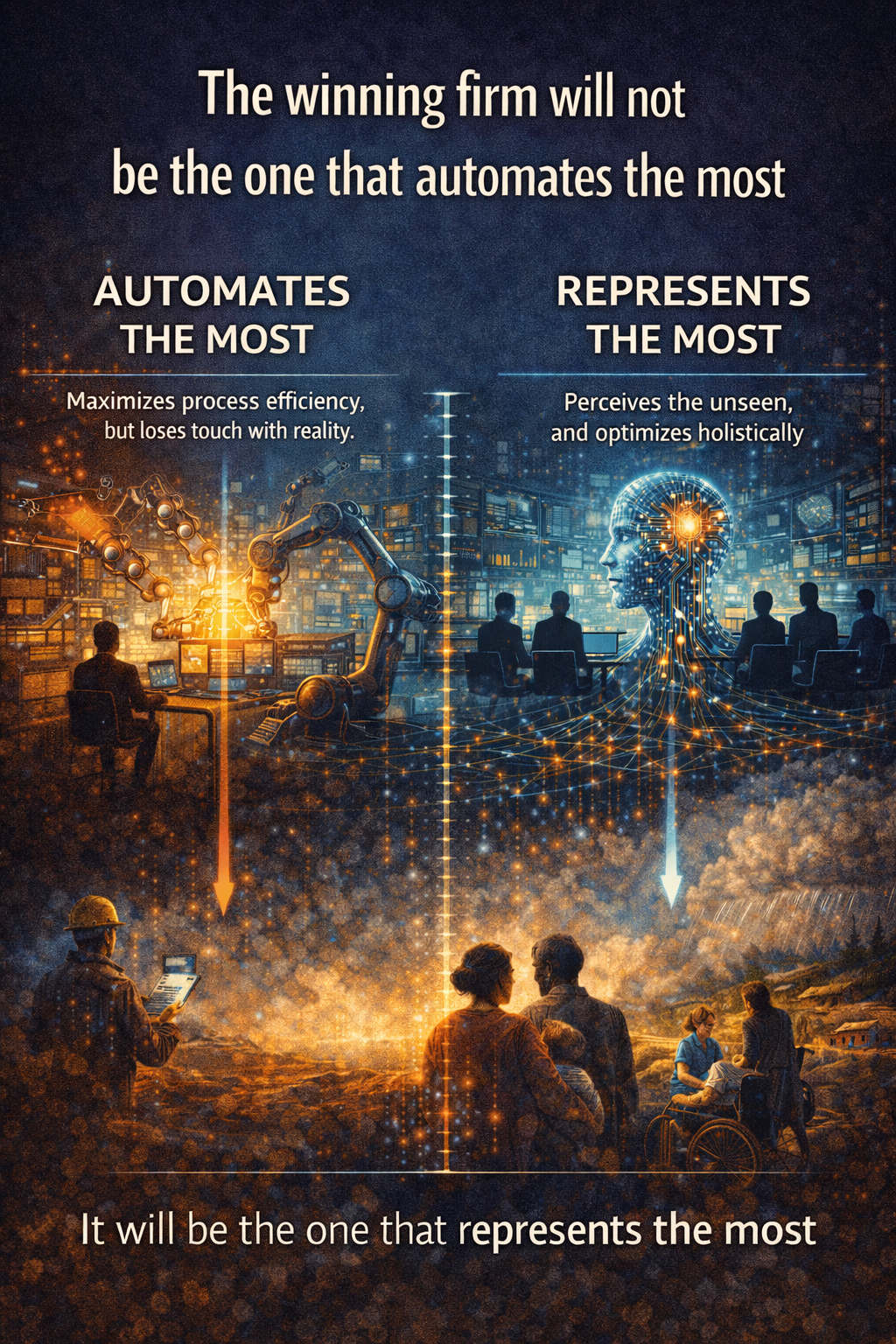
Conclusion: The winning firm will not be the one that automates the most
The winning firm will be the one that understands a more important truth:
AI does not fail first because it is unintelligent.
It fails first because the institution did not represent reality well enough for intelligence to matter.
That is why the representation strategy of the firm is becoming central.
In the next phase of the AI economy, the question will not be:
“Do we have AI?”
It will be:
What can our institution represent well enough for AI to act on safely, profitably, and legitimately?
The firms that answer that question well will build more than efficient systems.
They will build durable trust.
They will make better decisions.
They will see risk earlier.
They will capture value where others only see noise.
They will govern action with greater legitimacy.
And they will shape markets with fewer blind spots.
Competitive advantage in the AI era will not come only from teaching machines to think.
It will come from teaching institutions what must never become invisible.
Explore the Architecture of the AI Economy
This article is part of a broader research series exploring how institutions are being redesigned for the age of artificial intelligence. Together, these essays examine the structural foundations of the emerging AI economy — from signal infrastructure and representation systems to decision architectures and enterprise operating models. If you want to explore the deeper framework behind these ideas, the following essays provide additional perspectives:
-
- The Representation Economy: Why AI Institutions Must Run on SENSE, CORE, and DRIVER – Raktim Singh
- The Representation Economy: Why Intelligent Institutions Will Run on the SENSE–CORE–DRIVER Architecture – Raktim Singh
- Representation Failure: Why AI Systems Break When Institutions Misread Reality – Raktim Singh
- The Firm of the AI Era Will Be Built Around Representation: Why Institutions Must Redesign Themselves for the SENSE–CORE–DRIVER Economy – Raktim Singh
- The Representation Stack: The New Architecture of Intelligent Institutions in the AI Economy – Raktim Singh
- Representation Economics: The New Law of Value Creation in the AI Era – Raktim Singh
- What Is the Representation Economy? (raktimsingh.com)
- The Representation Economy: Why AI Institutions Must Run on SENSE, CORE, and DRIVER (raktimsingh.com)
- Decision Scale: Why Competitive Advantage Is Moving from Labor Scale to Decision Scale (raktimsingh.com)
- Firms Won’t Be Defined by Employees. They Will Be Defined by Delegation – Raktim Singh
- The New Company Stack: The 7 Business Categories That Will Emerge in the Representation Economy – Raktim Singh
- The Representation Attack Surface: Why AI’s Biggest Threat Is Reality Hacking, Not Model Hacking – Raktim Singh
- The Chief Representation Officer: Why Institutions Collapse When Machine-Readable Reality Falls Behind – Raktim Singh
- The Scarcity of Reality: Why the AI Economy Will Be Defined by the Lifecycle of High-Trust Representation – Raktim Singh
- Delegation Rating Agencies: Why the AI Economy Needs a New System to Rate Machine Authority – Raktim Singh
- The Machine-Readable Franchise: How Small Firms Will Win in the AI Trust Economy – Raktim Singh
- Representation Due Diligence: Why Every AI-Era Deal Must Start with a Reality Audit – Raktim Singh
- Recourse Platforms (raktimsingh.com)
- The New Company Stack (raktimsingh.com)
- Representation Economy and the SENSE–CORE–DRIVER Framework — foundational architecture for how institutions see, think, and act. (raktimsingh.com)
- The Representation Utility Stack — on interoperable reality as the next competitive layer. (raktimsingh.com)
- Representation Due Diligence — why AI-era deals must start with a reality audit. (raktimsingh.com)
- Recourse Platforms — why correction, appeal, and recovery become core AI infrastructure. (raktimsingh.com)
- The New Company Stack — business categories emerging in the Representation Economy. (raktimsingh.com)
- Representation Cold Start — why some industries cannot use AI until reality becomes machine-ready. (raktimsingh.com)
- The Representation Boundary: Why AI Systems Replace Reality—and Why It Will Define Who Wins the AI Economy – Raktim Singh
- Representation Collapse: Why AI Systems Fail Between Too Little Reality and Too Much – Raktim Singh
Together, these essays outline a central thesis:
The future will belong to institutions that can sense reality, represent it clearly, reason about it intelligently, and act through governed machine systems.
This is why the architecture of the AI era can be understood through three foundational layers:
SENSE → CORE → DRIVER
Where:
- SENSE makes reality legible
- CORE transforms signals into reasoning
- DRIVER ensures that machine action remains accountable, governed, and institutionally legitimate
Signal infrastructure forms the first and most foundational layer of that architecture.
AI Economy Research Series — by Raktim Singh
Written by Raktim Singh, AI thought leader and author of Driving Digital Transformation, this article is part of an ongoing body of work defining the emerging field of Representation Economics and the SENSE–CORE–DRIVER framework for intelligent institutions.
This article is part of a larger series on Representation Economics, including topics such as Representation Utility Stack, Representation Due Diligence, Recourse Platforms, and the New Company Stack.
Glossary
Representation Economics
A framework for understanding how value, trust, and competitive advantage in the AI era depend on how reality is made visible, structured, and governable for machine systems.
Representation Strategy
The discipline by which a firm decides what reality must be seen, how it will be modeled, what proxies are acceptable, and where AI action requires stronger governance and recourse.
Silent Stakeholders
People, entities, environments, or future conditions that materially matter to decisions but are weakly represented or absent in enterprise systems.
Machine-legible reality
A version of reality that is structured in a form machines can detect, model, reason over, and act upon.
Weak signals
Low-volume, messy, delayed, or indirect signals that may still carry high strategic importance.
Representation depth
The degree to which a firm can model not just visible variables, but also context, edge cases, dependencies, and under-represented realities.
SENSE
The layer where reality becomes machine-readable through signals, entities, state representation, and change over time.
CORE
The cognition layer where systems interpret context, optimize decisions, and update through feedback.
DRIVER
The action and legitimacy layer where machine-supported decisions are delegated, verified, executed, and corrected when necessary.
Recourse
The ability to challenge, correct, reverse, or appeal an AI-supported decision.
Data desert
A context in which relevant local, social, or operational reality is poorly captured, creating systematic exclusion or distorted decisions. (UNDP)
FAQ
What is the representation strategy of the firm?
The representation strategy of the firm is the discipline of deciding what reality must be visible to AI systems, how it will be modeled, what proxies are acceptable, and which decisions require stronger oversight, verification, and recourse.
Why is representation strategy important in the AI economy?
It matters because AI can only optimize what an institution has managed to represent. If important realities, stakeholders, or risks remain invisible to the system, even powerful AI can make confident but damaging decisions.
What does “representing the voiceless” mean in business?
It means ensuring that weak-signal customers, under-represented suppliers, frontline realities, future risks, and other poorly captured stakeholders or conditions still remain visible enough for machine-supported decisions to be fair, profitable, and legitimate.
How is representation strategy different from data strategy?
Data strategy focuses on collection, access, and management of data. Representation strategy goes further by asking whether the firm has built a faithful, contextual, and governable model of reality that AI can safely act upon.
What is the SENSE–CORE–DRIVER framework?
SENSE is the legibility layer, where reality becomes machine-readable. CORE is the cognition layer, where systems interpret and optimize. DRIVER is the action layer, where decisions are executed, verified, and corrected when necessary.
Why do AI systems often fail despite high accuracy?
Because accuracy on visible variables does not solve missing reality. Many AI failures occur when key context, weak signals, or stakeholder realities never entered the system in the first place.
What are examples of silent stakeholders in enterprise AI?
Examples include low-frequency customers, suppliers outside core systems, frontline workers, indirectly affected communities, under-measured risk conditions, and operational realities that create weak digital traces.
How can boards improve AI strategy using this idea?
Boards can ask where silent stakeholders exist, where proxies are hiding, where SENSE is weak, where DRIVER needs stronger recourse, and who owns representation across the enterprise.
References and further reading
- National Institute of Standards and Technology (NIST), AI Risk Management Framework (AI RMF 1.0). (NIST)
- OECD, OECD AI Principles. (OECD)
- U.S. Equal Employment Opportunity Commission (EEOC), Employment Discrimination and AI for Workers and related materials. (EEOC)
- Obermeyer et al., Dissecting racial bias in an algorithm used to manage the health of populations, Science (2019). (Science)
- United Nations Development Programme (UNDP), Seeing the Unseen: Avoiding Data Deserts and Algorithmic Exclusion. (UNDP)
- EU AI Act high-level materials on risk classification and lifecycle risk management. (Artificial Intelligence Act)
- World Economic Forum, materials on trustworthy AI, governance, and scaling responsible AI. (World Economic Forum)



Raktim Singh is an AI and deep-tech strategist, TEDx speaker, and author focused on helping enterprises navigate the next era of intelligent systems. With experience spanning AI, fintech, quantum computing, and digital transformation, he simplifies complex technology for leaders and builds frameworks that drive responsible, scalable adoption.