
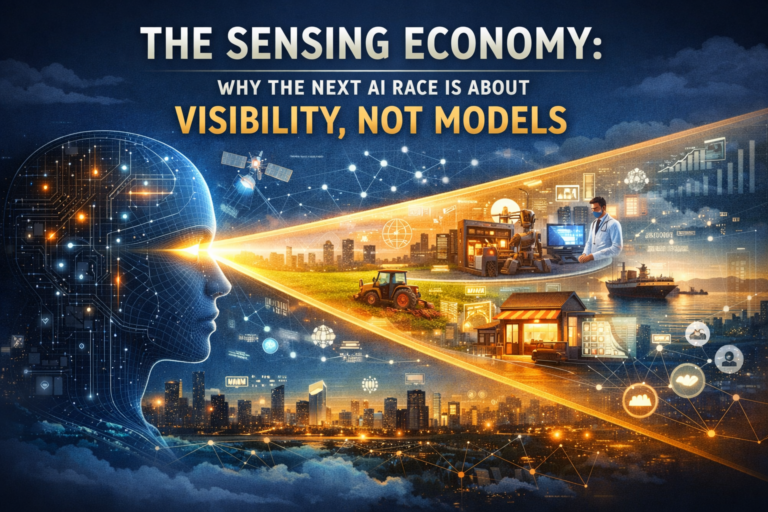
Introduction: The Next AI Race Is No Longer Just About Intelligence
Most conversations about artificial intelligence still begin with the same question:
Which model is better?
Which model reasons better, writes better, sees better, costs less, or runs faster?
Those questions still matter. But they no longer explain where durable advantage will come from.
A different race is now unfolding beneath the model layer. It is a race to make reality visible.
AI cannot reason well about what an institution cannot properly see. A bank cannot intelligently serve a merchant it cannot clearly identify. A factory cannot optimize a machine it cannot continuously observe. A city cannot respond well to flooding it cannot measure in real time. A hospital cannot coordinate care effectively if the patient’s records are fragmented across systems.
In each case, the real bottleneck is not raw intelligence. It is visibility.
That is why the next AI race is increasingly about sensing infrastructure: the systems that capture signals from the real world, connect them to the right entities, maintain an up-to-date state, and make that reality usable for both machine reasoning and human decision-making.
This is the foundation of what I call the Sensing Economy.
In the industrial era, economic power came from controlling production. In the digital era, it came from controlling information flows. In the next era, increasing advantage will come from controlling the quality, freshness, and coverage of institutional visibility.
The winners will not simply have smarter models. They will have richer windows into reality.
That matters because many AI projects still fail before intelligence even begins. Gartner said in July 2024 that at least 30% of generative AI projects would be abandoned after proof of concept by the end of 2025 because of poor data quality, inadequate risk controls, escalating costs, or unclear business value. In February 2025, Gartner sharpened the point further: through 2026, organizations will abandon 60% of AI projects unsupported by AI-ready data. (Gartner)
That is not mainly a model problem.
It is a sensing problem.
Why This Article Matters to Boards and C-Suites
Most AI strategy conversations are still organized around procurement decisions:
Which model should we use?
Which vendor should we trust?
Should we buy, fine-tune, or build?
Those are necessary questions. But they are not the decisive questions.
The real strategic question is this:
What parts of reality can our institution actually see well enough to compute, coordinate, and govern?
That is a board-level question, because visibility shapes revenue quality, service quality, risk quality, resilience, and ultimately competitive advantage.
In other words, the future of AI will not be determined only by who has more intelligence. It will be determined by who has more legible reality.
The Hidden Truth About AI: Intelligence Starts After Visibility
In my broader architecture, successful intelligent institutions require three layers:
SENSE — how institutions make reality observable
CORE — how machines reason over represented reality
DRIVER — how institutions govern automated decisions
Most organizations are investing aggressively in CORE. They are buying model access, testing copilots, experimenting with agents, and comparing benchmarks.
But many are underinvesting in SENSE, which is the layer that makes reality legible before cognition even begins.
Without SENSE, AI works like a very talented analyst locked in a dark room.
It may have exceptional reasoning ability. But if the window is narrow, delayed, fragmented, dirty, or pointed at the wrong object, the conclusions will still be weak.
This is one reason so many organizations remain stuck between pilots and scaled impact. McKinsey’s 2025 State of AI research says that organizations are beginning to take steps that drive bottom-line impact, including redesigning workflows as they deploy generative AI, and that high performers are much more likely to redesign how work actually gets done. (McKinsey & Company)
In plain language: AI value does not come from models floating above the business. It comes from models connected to the actual reality of the business. (McKinsey & Company)
What Is the Sensing Economy?
The Sensing Economy is an economy in which competitive advantage increasingly comes from the ability to:
- capture real-world signals,
- attach those signals to the correct entity,
- build a living state representation,
- update that state continuously,
- and use that visibility for better decisions, coordination, and automation.
This is not limited to physical sensors in the narrow hardware sense.
A signal can be many things:
- a satellite image,
- a card transaction,
- a device log,
- a patient update,
- a vehicle location ping,
- a machine vibration reading,
- a weather shift,
- a document event,
- a supply-chain milestone,
- a customer behavior change.
The key question is not whether data exists somewhere.
The key question is whether an institution can convert scattered traces into a useful and current picture of reality.
That is the difference between having data and having visibility.

Why Visibility Matters More Now Than Ever
As foundation models become more widely available, intelligence itself becomes more accessible.
That means the source of differentiation will move.
It will move toward the quality of the inputs, context, identity resolution, and institutional visibility that surround those models.
Put simply:
When models commoditize, sight becomes strategic.
If two organizations use similarly capable AI models, the one that can see its customers, assets, workflows, and environments more clearly will usually make better decisions. It will detect change earlier. It will personalize more accurately. It will automate with fewer errors. It will recover faster when something breaks.
This shift is already visible across sectors.
NASA’s Earthdata resources show that satellite and Earth observation data can track land use, soil moisture, vegetation health, precipitation, and related signals that support agricultural decision-making and crop productivity. These capabilities help turn previously opaque geographies into more observable decision environments. (NASA Earthdata)
That is not just a science story.
It is an economic story.
When more reality becomes visible, more reality becomes computable.
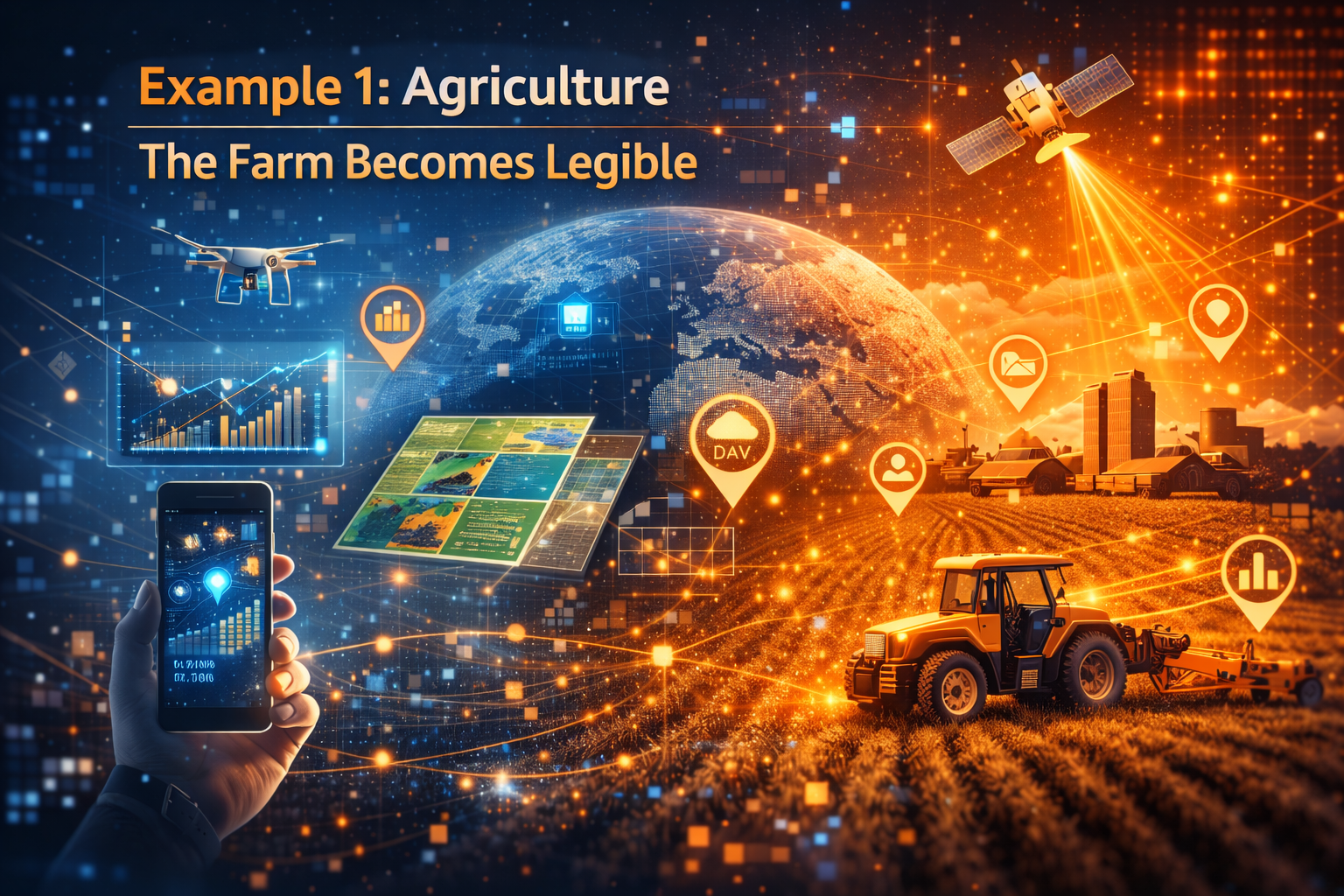
Example 1: Agriculture — The Farm Becomes Legible
Imagine two lenders trying to serve farmers.
The first lender uses a generic credit model with little local visibility. It knows almost nothing about the field, weather pattern, crop health, irrigation stress, or harvest history.
The second lender has stronger sensing infrastructure. It combines satellite signals, rainfall patterns, parcel-level identity, and historical production clues.
Which lender has the better AI?
Most people would instinctively say the one with the better model.
But in practice, the second lender may outperform even with a similar model, because it has a much better picture of reality.
FAO’s 2022 State of Food and Agriculture found that digital and automation technologies are spreading across agrifood systems, but adoption remains uneven and constrained by infrastructure, capabilities, and local conditions. That makes sensing capacity itself a source of advantage. (Open Knowledge FAO)
This is the Sensing Economy in action: value begins when a previously invisible farm becomes visible enough to serve.
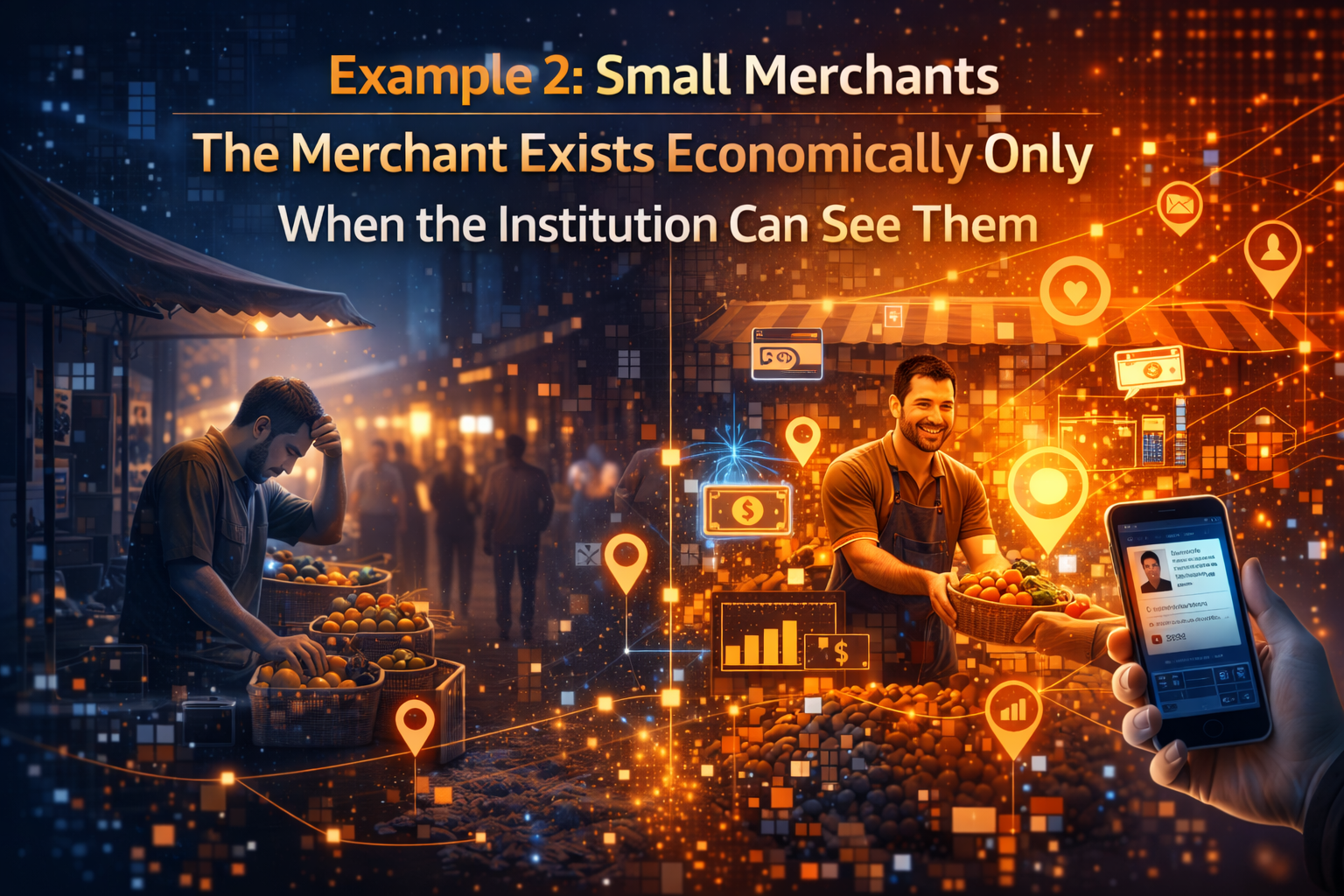
Example 2: Small Merchants — The Merchant Exists Economically Only When the Institution Can See Them
In many emerging markets, the hardest problem is not advanced modeling. It is institutional invisibility.
A merchant may have real customers, real cash flow, real local trust, and real economic value. But if those signals are fragmented across devices, addresses, rails, and informal records, the institution cannot truly see the merchant.
The result is exclusion.
This is why identity infrastructure matters so much. The World Bank’s ID4D initiative says that approximately 850 million people lack official ID, and 3.3 billion do not have access to a government-recognized digital identity to transact securely online. (id4d.worldbank.org)
So the Sensing Economy is not only about efficiency.
It is also about inclusion.
When an institution gains the ability to identify and represent a person, merchant, or asset more reliably, it can finally begin to serve them.
That is why, especially in the Global South, the first AI advantage may not come from frontier models. It may come from making invisible actors visible.
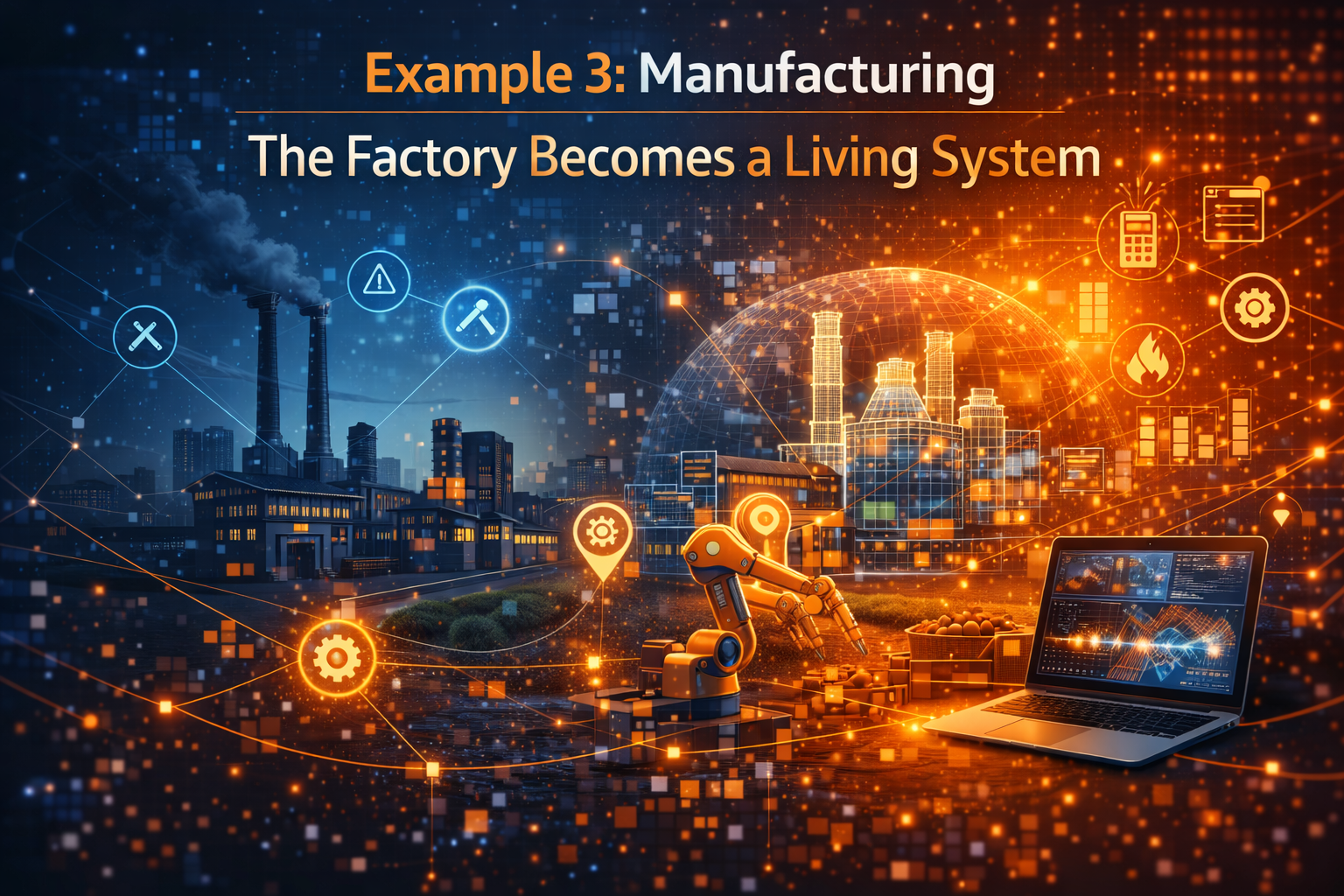
Example 3: Manufacturing — The Factory Becomes a Living System
Now consider manufacturing.
A factory may have ambitious AI plans. But if its machines are poorly instrumented, if maintenance logs are inconsistent, if production bottlenecks are not visible in real time, and if the plant lacks a reliable digital twin, then sophisticated AI will have little to work with.
Digital twins matter because they turn physical operations into continuously observable systems. The World Economic Forum describes digital twins as a technology that can improve productivity, predict maintenance needs, identify bottlenecks, and optimize industrial coordination. (World Economic Forum)
Again, the value is not that AI becomes magically smarter.
The value is that the institution gains a richer state representation of the factory.
That richer state is what allows intelligence to become operational.
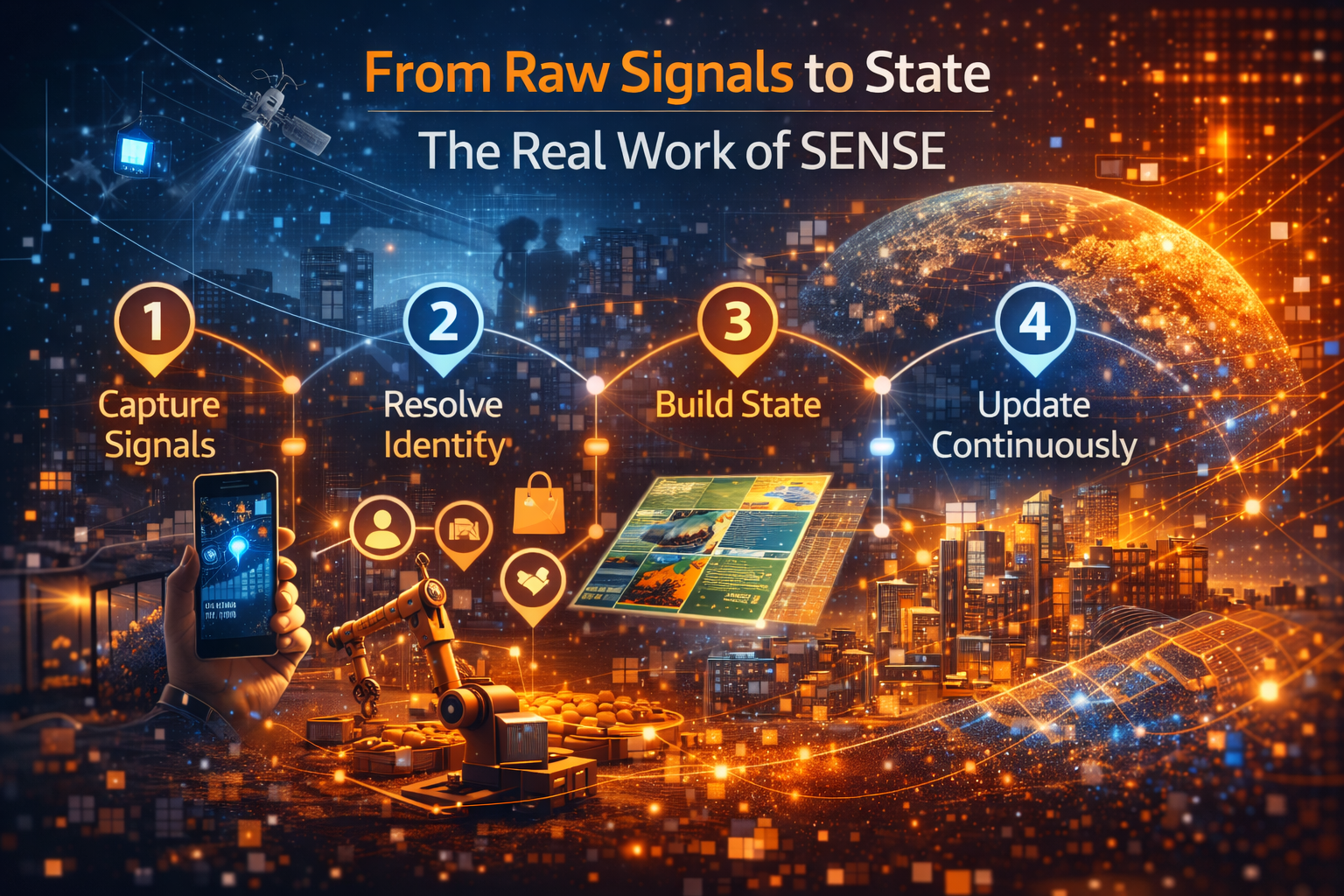
From Raw Signals to State: The Real Work of SENSE
This is the most misunderstood part of the AI stack.
People often assume that data is enough.
It is not.
For AI to become useful, institutions usually have to move through four steps.
-
Capture Signals
Something in the world must leave a trace: a payment, scan, image, event, movement, or measurement.
-
Resolve Identity
The institution must know what the signal belongs to: a customer, patient, parcel, machine, shipment, account, farm, or organization.
-
Build State
The institution must turn many signals into a current picture of the entity’s condition.
-
Update Continuously
The state must evolve as the world evolves.
This is what SENSE really does.
It does not merely store information. It builds a living map of reality.
This aligns directly with NIST’s AI Risk Management Framework, which emphasizes governance, context mapping, measurement, and ongoing management across the AI lifecycle, rather than judging AI only by isolated model performance. (NIST)
The Strategic Shift: From Data Economy to Sensing Economy
The data economy rewarded those who could collect, store, and process information.
The Sensing Economy rewards those who can create timely, trustworthy, decision-ready visibility.
That is a much more demanding challenge.
It means asking:
- What can we see now that we could not see before?
- What remains invisible?
- Which entities are poorly resolved?
- Where is our state stale, thin, or fragmented?
- Which decisions are being made with partial visibility?
- Where are we automating before we are truly observing?
These are not side questions for the IT team.
They are board-level strategy questions.
Because as AI becomes more embedded in operations, the quality of sensing will shape the quality of service, revenue, risk management, resilience, and trust.
Why This Matters for Nations, Not Just Firms
The Sensing Economy is not only a company issue. It is also a national competitiveness issue.
Digital public infrastructure increasingly matters because it improves visibility across society. UNDP describes digital public infrastructure as a set of foundational systems that enable secure and seamless interactions between people, businesses, and governments, including identity, payments, and data exchange. (UNDP)
That means the future AI race will be shaped partly by national choices around:
- digital identity,
- interoperable records,
- payments infrastructure,
- geospatial coverage,
- connectivity,
- trusted data exchange.
Countries and regions that build these foundations create better conditions for finance, healthcare, logistics, agriculture, and public services to become machine-legible.
So the Sensing Economy is not simply about better dashboards.
It is about building the visibility layer of modern economic life.
Why This Matters Especially in India and the Global South
In many advanced economies, AI debates are often dominated by privacy, model transparency, and frontier model competition.
Those are important.
But in much of the Global South, the earlier structural problem is different: invisibility.
Small merchants remain underrepresented. Workers remain weakly documented. Assets remain fragmented across records. Physical systems remain under-instrumented. Service continuity remains inconsistent.
That is why digital public infrastructure matters so much. India’s global push around digital public infrastructure, including digital identity, payments, and data exchange, reflects a broader recognition that visibility is not just a technical issue; it is a development issue and a competitiveness issue. India’s government said in March 2026 that it had signed cooperation arrangements with 24 countries around India Stack and digital public infrastructure. (pib.gov.in)
The deeper lesson is this:
AI adoption at scale depends on what societies make legible.
The Danger of Getting This Wrong
When institutions underbuild sensing, three things usually happen.
First, they overestimate the power of models.
Second, they automate on top of incomplete reality.
Third, they create systems that are fast but fragile.
This is especially dangerous in lending, healthcare, public services, industrial operations, logistics, and infrastructure.
The OECD’s AI Principles and its 2026 due diligence guidance both emphasize that trustworthy AI requires governance, monitoring, responsible processes, and proactive risk management around AI use, not just technical capability. (OECD)
In practical terms, poor sensing creates confident systems with weak grounding.
That is one of the most expensive failure patterns in enterprise AI.
What Leaders Should Do Now
If this is the Sensing Economy, then leaders should stop asking only, “What model should we use?”
They should also ask:
- What parts of our business are still invisible?
- Which critical entities do we identify poorly?
- Where is our state representation too thin or stale?
- Which decisions depend on data that arrives too late?
- Where do we need instrumentation before automation?
- What sensing advantage could become a long-term competitive moat?
These questions shift AI strategy from procurement to architecture.
They also align directly with intelligent institutions.
Before CORE can reason, SENSE must make reality visible.
Before DRIVER can govern, SENSE must make actions traceable and verifiable.
That is why sensing is not a peripheral data issue.
It is the opening move of institutional intelligence.
Conclusion Column: The Institutions That Win Will See Better
The most important idea in this article is simple:
AI does not begin with reasoning. It begins with visibility.
The next AI race will not be won only by the organizations with the largest models, the loudest demos, or the most aggressive experimentation budgets.
It will be won by institutions that can see reality more clearly, more continuously, and more usefully than others.
They will know more about the condition of the customer, machine, shipment, farm, patient, worker, asset, and environment. They will build stronger state representations. They will make better decisions. They will automate with greater confidence. And they will create more trustworthy systems because their intelligence is grounded in a richer picture of the world.
That is the real promise of the Sensing Economy.
Not smarter models floating above reality.
But smarter institutions built on top of it.
The Intelligence-Native Enterprise Doctrine
This article is part of a larger strategic body of work that defines how AI is transforming the structure of markets, institutions, and competitive advantage. To explore the full doctrine, read the following foundational essays:
- The AI Decade Will Reward Synchronization, Not Adoption
Why enterprise AI strategy must shift from tools to operating models.
https://www.raktimsingh.com/the-ai-decade-will-reward-synchronization-not-adoption-why-enterprise-ai-strategy-must-shift-from-tools-to-operating-models/ - The Third-Order AI Economy
The category map boards must use to see the next Uber moment.
https://www.raktimsingh.com/third-order-ai-economy/ - The Intelligence Company
A new theory of the firm in the AI era — where decision quality becomes the scalable asset.
https://www.raktimsingh.com/intelligence-company-new-theory-firm-ai/ - The Judgment Economy
How AI is redefining industry structure — not just productivity.
https://www.raktimsingh.com/judgment-economy-ai-industry-structure/ - Digital Transformation 3.0
The rise of the intelligence-native enterprise.
https://www.raktimsingh.com/digital-transformation-3-0-the-rise-of-the-intelligence-native-enterprise/ - Industry Structure in the AI Era
Why judgment economies will redefine competitive advantage.
https://www.raktimsingh.com/industry-structure-in-the-ai-era-why-judgment-economies-will-redefine-competitive-advantage/ - Why Most AI Projects Fail Before Intelligence Even Begins – Raktim Singh
- Identity Infrastructure: The Missing Layer Between Signals and Representation in the AI Economy – Raktim Singh
- The Representation Stack: How Reality Becomes Identifiable, Legible, and Actionable in the AI Economy – Raktim Singh
- The Hardest Problem in AI: Representing What Cannot Speak – Raktim Singh
Institutional Perspectives on Enterprise AI
Many of the structural ideas discussed here — intelligence-native operating models, control planes, decision integrity, and accountable autonomy — have also been explored in my institutional perspectives published via Infosys’ Emerging Technology Solutions platform.
For readers seeking deeper operational detail, I have written extensively on:
- What Makes an Enterprise Intelligence-Native? The Blueprint for Third-Order AI Advantage
https://blogs.infosys.com/emerging-technology-solutions/artificial-intelligence/what-is-enterprise-ai-the-operating-model-for-compounding-institutional-intelligence.html - Why “AI in the Enterprise” Is Not Enterprise AI: The Operating Model Difference Most Organizations Miss
https://blogs.infosys.com/emerging-technology-solutions/artificial-intelligence/why-ai-in-the-enterprise-is-not-enterprise-ai-the-operating-model-difference-that-most-organizations-miss.html - The Enterprise AI Control Plane: Governing Autonomy at Scale
https://blogs.infosys.com/emerging-technology-solutions/artificial-intelligence/the-enterprise-ai-control-plane-governing-autonomy-at-scale.html - Enterprise AI Ownership Framework: Who Is Accountable, Who Decides, and Who Stops AI in Production
https://blogs.infosys.com/emerging-technology-solutions/artificial-intelligence/enterprise-ai-ownership-framework-who-is-accountable-who-decides-and-who-stops-ai-in-production.html - Decision Integrity: Why Model Accuracy Is Not Enough in Enterprise AI
https://blogs.infosys.com/emerging-technology-solutions/artificial-intelligence/decision-integrity-why-model-accuracy-is-not-enough-in-enterprise-ai.html - Agent Incident Response Playbook: Operating Autonomous AI Systems Safely at Enterprise Scale
https://blogs.infosys.com/emerging-technology-solutions/artificial-intelligence/agent-incident-response-playbook-operating-autonomous-ai-systems-safely-at-enterprise-scale.html - The Economics of Enterprise AI: Designing Cost, Control, and Value as One System
https://blogs.infosys.com/emerging-technology-solutions/artificial-intelligence/the-economics-of-enterprise-ai-designing-cost-control-and-value-as-one-system.html
Together, these perspectives outline a unified view: Enterprise AI is not a collection of tools. It is a governed operating system for institutional intelligence — where economics, accountability, control, and decision integrity function as a coherent architecture.
FAQ
What is the Sensing Economy in simple terms?
The Sensing Economy is the emerging economic order in which advantage comes from the ability to see reality better: capturing signals, resolving identity, building state representations, and using that visibility to drive decisions and automation.
Why is the next AI race about visibility and not just models?
Because increasingly capable models are becoming accessible to many organizations. The differentiator shifts to who has better context, fresher signals, stronger identity systems, and richer operational visibility.
How is SENSE different from traditional data management?
Traditional data management often focuses on storage, reporting, and access. SENSE focuses on making real-world conditions legible in ways that support dynamic reasoning, traceability, and action.
Why does this matter for enterprise AI?
Enterprise AI fails when institutions cannot see the customer, asset, workflow, or environment clearly enough to support trustworthy reasoning and automation. Gartner and McKinsey findings both point to data readiness, workflow redesign, and strong foundations as central to scaling AI. (Gartner)
Why is the Sensing Economy especially relevant in the Global South?
Because the challenge in many developing contexts is not only computational capability. It is visibility: identity gaps, fragmented records, under-instrumented systems, and weak continuity of service.
What is the relationship between SENSE, CORE, and DRIVER?
SENSE makes reality observable. CORE reasons over represented reality. DRIVER governs automated decisions. Without SENSE, the other two layers become fragile.
What should boards ask about the Sensing Economy?
Boards should ask what their institution cannot yet see, where identity is fragmented, where state is stale, and where automation is happening before adequate observability exists.
Glossary
Sensing Economy
An economic environment in which competitive advantage increasingly comes from the ability to make reality visible and decision-ready.
SENSE
The layer of institutional architecture that captures signals, resolves identity, builds state representation, and updates it over time.
CORE
The cognition layer in which AI systems comprehend context, optimize decisions, realize action, and evolve through feedback.
DRIVER
The governance layer that defines delegation, representation, identity, verification, execution, and recourse for automated decisions.
Entity Resolution
The process of determining which person, asset, account, machine, shipment, or organization a signal belongs to.
State Representation
A structured and current picture of the condition of an entity, built from multiple signals over time.
Digital Public Infrastructure (DPI)
Foundational digital systems such as identity, payments, and data exchange that enable secure and seamless interaction across society. (UNDP)
Digital Twin
A virtual representation of a physical asset, system, or process that helps organizations simulate, monitor, and optimize real-world operations. (World Economic Forum)
AI-Ready Data
Data that is sufficiently available, reliable, contextualized, governed, and observable to support effective AI deployment. (Gartner)
Institutional Observability
The ability of an organization to see and continuously understand the changing state of customers, assets, operations, and environment
References and Further Reading
This article draws on current research and institutional guidance from Gartner on AI-ready data and project abandonment risk; McKinsey on workflow redesign and AI value capture; NASA Earthdata on agricultural observation; FAO on digital automation in agrifood systems; the World Bank’s ID4D initiative on identity gaps; the World Economic Forum on digital twins; NIST on AI risk management; UNDP on digital public infrastructure; and the OECD on trustworthy and responsible AI. (Gartner)
For further reading on your own site, this article should sit alongside your growing canon on the architecture of intelligent institutions, especially your articles on Enterprise AI Operating Model, Enterprise AI Runtime, Enterprise AI Control Plane, Decision Scale, The AI Dividend, and AI’s Agency Crisis.



Raktim Singh is an AI and deep-tech strategist, TEDx speaker, and author focused on helping enterprises navigate the next era of intelligent systems. With experience spanning AI, fintech, quantum computing, and digital transformation, he simplifies complex technology for leaders and builds frameworks that drive responsible, scalable adoption.